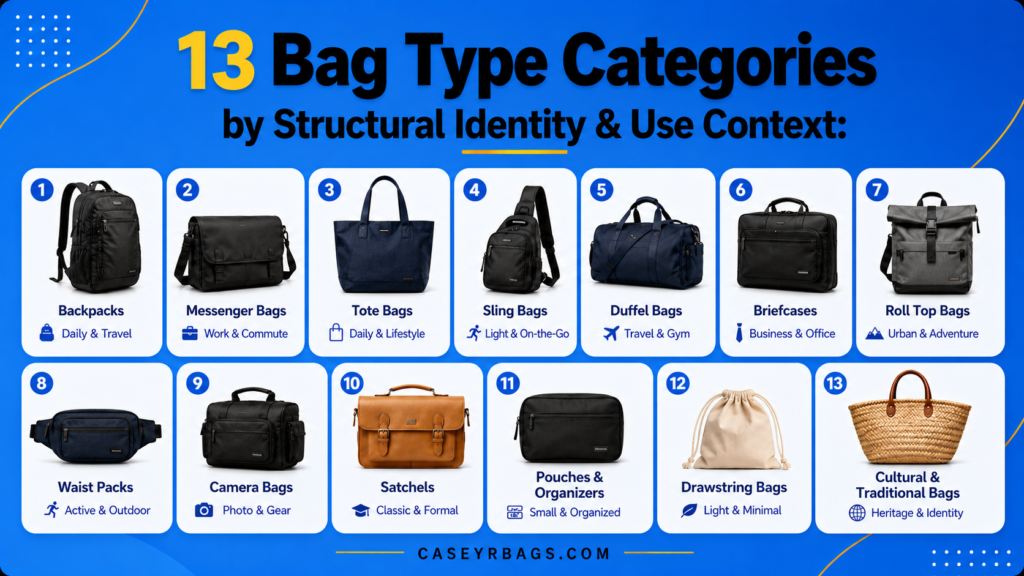
13 Bag Type Categories by Structural Identity & Use Context
The 13 Bag Type Categories can be distinguished by examining both what a bag physically is and the context it is designed to serve. Silhouette, construction, size, opening structure, carry configuration, capacity, and internal architecture create structural identity, while task, environment, professional role, specialized function, material significance, and cultural context explain why that form exists.
The two signals do not need equal weight. A Compact Bag may be recognized mainly through reduced scale, while a Medical Bag may be classified mainly through healthcare-specific purpose even when its outer form resembles a general Equipment Bag. The stronger explanatory relationship should control primary placement rather than a simple count of matching attributes.
This produces one governing rule for the taxonomy: dominant structural identity plus defining use context leads to the primary category. Secondary similarities still matter for comparison, but they should not create several competing parent categories for the same bag type.
Which 13 Bag Type Categories Are Defined by Structural Identity & Use Context?
The 13 Bag Type Categories do not rely on one identical classification rule because different groups are recognized through different dominant signals. Everyday Bags are routine-use-led, Fashion Bags are more style-led, Compact Bags are scale-led, Travel Bags are journey-led, and several specialist groups are defined mainly by professional, environmental, equipment, healthcare, tactical, material, or cultural context.
Structural identity comes from the physical form that remains recognizable: silhouette, construction, opening system, strap or handle architecture, body depth, rigidity, and capacity profile. Together, these characteristics explain what the bag physically presents as before its purpose is considered.
Use context explains the task, environment, user need, or specialized role that gives that form practical meaning. Classification becomes strongest when both lenses are considered together and the more explanatory relationship receives greater taxonomic weight: dominant structural identity plus defining use context leads to primary category placement.
What Defines Everyday Bags?
Everyday Bags are primarily defined through routine use context, supported by familiar structures that provide manageable capacity, practical access, and general-purpose organization. Repeated personal activities such as commuting, errands, school, and ordinary daily movement create a need for predictable storage without highly specialized architecture.
Frequent use alone is not enough to establish this category. A bag used every day for clinical supplies, outdoor equipment, professional tools, or travel may belong more strongly to Medical, Outdoor, Equipment, Work, or Travel Bags when that specialized context better explains its structure.
What Defines Fashion Bags?
Fashion Bags are distinguished primarily through style-led structural identity, where silhouette, proportion, carrying configuration, and presentation play a central role in recognition. Shape, handle or strap placement, compact personal-item storage, and presentation-oriented form work together to make the visual and carrying identity taxonomically meaningful.
Attractive appearance alone does not create Fashion Bag classification. Work, Everyday, Travel, and Heritage Bags can also be visually distinctive. Fashion becomes the stronger parent only when style-led form explains the recognized family more clearly than a specialized professional, travel, cultural, or task-based purpose.
What Defines Compact Bags?
Compact Bags are primarily distinguished through deliberately reduced structural scale, limited capacity, and minimal bulk. Smaller dimensions narrow the carrying envelope toward essentials-focused use, while close-control handling and reduced body depth strengthen the identity of the category.
A small version of another bag does not automatically become Compact. A small Medical, Equipment, Travel, or Fashion Bag may retain its stronger specialized identity if clinical organization, equipment protection, trip transport, or style-led form explains the bag more clearly than scale alone.
What Defines Travel Bags?
Travel Bags are defined mainly through journey-related use context, with structures adapted to packing, portability, transit handling, organization, and movement between locations. The category is strengthened when the bag’s capacity, access system, handles, mobility features, or internal layout clearly support the transport of belongings across a trip.
Large capacity alone does not establish Travel Bag identity. Outdoor, Equipment, Work, and Utility Bags can also provide substantial volume. Travel should remain primary when journey-based transport requirements explain the architecture more strongly than another task or environment.
What Defines Work Bags?
Work Bags are defined mainly through professional or occupational use context supported by organization for laptops, documents, electronics, tools, or business essentials. Repeated workplace and commuting needs shape compartment placement, protective sections, access patterns, and carrying formats around professional contents.
Being carried to work is not sufficient by itself. Everyday, Utility, Equipment, or Travel Bags may also appear in professional settings. Work Bags remain the stronger category when professional organization and repeat-use occupational carry explain the design more clearly than general or specialized alternatives.
What Defines Outdoor Bags?
Outdoor Bags are defined through recreational, sports, or expedition-oriented outdoor use context supported by movement, load stability, durability, and environmental exposure management. Hiking, trekking, camping, climbing, and field activity can shape strap systems, closures, storage placement, and overall carry behavior.
Rugged construction alone does not make a bag Outdoor. Tactical and Equipment Bags may use similarly durable materials, webbing, or reinforced structures. Outdoor placement becomes stronger when activity and environmental exposure provide the main reason the bag is built that way.
What Defines Utility Bags?
Utility Bags are primarily defined through practical task-support context and structures that prioritize access to tools, supplies, reusable contents, or frequently handled items. Accessible compartments, open or semi-structured capacity, and functional organization support repeated household, service, or general-purpose tasks.
A bag is not Utility simply because it is useful. Dedicated equipment requirements, professional role, healthcare workflow, or tactical operation can outweigh general task support. Utility remains primary when broad practical storage explains the design better than a more specialized context.
What Defines Family Bags?
Family Bags are mainly defined through caregiver and shared-use context, with structures that support multiple users, childcare items, separation, quick retrieval, and dependent-specific organization. The design becomes category-relevant when caregiver workflow materially shapes pocketing, accessibility, capacity, and content separation.
A normal Everyday or Travel Bag does not automatically become a Family Bag because family belongings are placed inside it. Family placement is stronger when caregiver needs and shared-use organization explain the bag’s structure more clearly than ordinary daily or journey-based use.
What Defines Equipment Bags?
Equipment Bags are defined through specialized gear context combined with construction shaped around the dimensions, protection, and organization needs of specific equipment. Padding, supports, shaped compartments, protective closures, and equipment-specific proportions strengthen the category by making the carried gear part of the architecture itself.
General tools or supplies may fit Utility Bags when dedicated equipment does not determine construction. Medical Bags also remain separate when healthcare workflow dominates. Equipment Bags are strongest when protection and task-specific access for a defined gear set explain the bag more clearly than general utility.
What Defines Medical Bags?
Medical Bags are primarily defined through healthcare context, with structures designed around clinical tools, emergency supplies, medications, or medical equipment. Controlled separation, rapid retrieval, portable organization, and protective storage support healthcare workflow rather than ordinary general-purpose carrying.
Medical contents alone do not turn a general bag into a Medical Bag. An Equipment or Utility Bag carrying healthcare items may retain its original category if clinical workflow did not shape the architecture. Medical placement is strongest when healthcare-specific organization explains why the bag exists in that form.
What Defines Tactical Bags?
Tactical Bags are defined through mission-oriented military, security, law-enforcement, survival, or field context supported by modular organization, equipment attachment, rapid access, load control, and operational durability. Mission-specific architecture becomes more important than rugged appearance alone.
Military-inspired styling, webbing, or dark colors do not automatically create Tactical Bag identity. Outdoor, Utility, and Equipment Bags can use similar structural elements. Tactical placement becomes defensible when operational requirements and field-ready organization provide the dominant explanation for the design.
What Defines Material Bags?
Material Bags are distinguished when the construction medium itself forms part of recognized category identity rather than functioning only as a product specification. Material can affect structure, surface behavior, rigidity, flexibility, durability, and naming strongly enough to become taxonomically meaningful.
A leather Work Bag, canvas Travel Bag, or nylon Tactical Bag normally remains within its stronger functional category when material is secondary. Material Bags require the build medium to explain the recognized identity more strongly than an incidental fabric choice or finish.
What Defines Heritage Bags?
Heritage Bags are primarily distinguished through substantive cultural, regional, historical, or traditional context. Cultural continuity, recognized inherited form, established construction, historical role, and carrying practice can make tradition itself the dominant classification signal.
Vintage appearance alone does not establish Heritage identity. A newly styled bag can look traditional without having a meaningful cultural or historical relationship. Heritage claims should therefore be treated cautiously, with specific historical assertions verified before they are used as evidence for primary category placement.
How Does Structural Identity Distinguish Bag Type Categories?
Structural identity distinguishes Bag Type Categories by showing which physical characteristics remain stable enough to make a bag family recognizable across different contexts. Form matters most when changing those characteristics would materially change how the bag is recognized.
Which Structural Traits Provide the Strongest Identity Signals?
Silhouette, width-to-height proportion, rigidity, body depth, base construction, opening system, closure, strap architecture, handle architecture, and capacity profile can all contribute to structural identity. No single attribute is automatically decisive. The strongest signal is the combination that creates a recognizable physical form and consistently distinguishes one family from nearby alternatives.
How Do Structured and Flexible Forms Affect Bag Identity?
Structured forms retain geometry even when lightly loaded, while flexible forms change more visibly with their contents. Either pattern can appear across several parent categories, so rigidity alone does not determine placement. Structure becomes meaningful when shape retention, body depth, base construction, and opening behavior work together as part of a stable recognizable identity.
When Does Structural Identity Become Strong Enough to Define the Category?
Structural identity becomes category-defining when the recognizable form explains the bag family better than an incidental feature. Changing one strap, pocket, closure, or decorative detail should not normally move the bag to another parent. A stronger test is whether substantially changing the form would alter how the bag type itself is recognized.
How Does Use Context Distinguish Bag Type Categories?
Use context distinguishes Bag Type Categories by showing which task, environment, user need, or specialized purpose gives otherwise similar physical forms different practical identities. It becomes decisive when purpose materially shapes organization, protection, access, capacity, or carrying behavior.
Which Use Contexts Create the Strongest Category Boundaries?
Daily routine, fashion presentation, travel, professional work, outdoor activity, task support, family care, equipment transport, healthcare, and tactical field use can all create meaningful category boundaries. The key is not merely where a bag appears, but whether the relevant environment or task explains why its structure was designed that way.
How Does General Use Differ From Specialized Use?
General-use categories support broad repeated needs without architecture dominated by one narrow task. Specialized categories are shaped more strongly by purpose-built requirements such as clinical retrieval, dedicated equipment protection, field organization, or caregiver access. Where a bag is used is therefore not necessarily the same as what the bag was designed to do.
When Should Use Context Override Similar Structural Form?
Use context should carry more weight when two bags share similar silhouettes, straps, capacities, or openings but serve materially different tasks, equipment, environments, or user roles. A general case and a medical case can resemble each other externally while internal organization and workflow requirements produce different primary categories.
| Use Context | Required Characteristics | Category Direction | Closest Overlap |
|---|---|---|---|
| Repeated personal routine | Manageable capacity, familiar access | Everyday Bags | Work / Fashion |
| Journey transport | Packing, handling, portability | Travel Bags | Outdoor / Equipment |
| Professional role | Documents, devices, task organization | Work Bags | Everyday / Equipment |
| Outdoor activity | Movement, exposure control, stability | Outdoor Bags | Tactical / Equipment |
| Caregiver workflow | Separation, shared access, dependent support | Family Bags | Everyday / Travel |
| Healthcare workflow | Controlled storage, rapid clinical retrieval | Medical Bags | Equipment / Utility |
| Operational field use | Mission organization, attachment, load control | Tactical Bags | Outdoor / Equipment |
How Should Structural Identity and Use Context Be Balanced?
Structural identity and use context should be balanced by determining which relationship more strongly explains the recognized bag family when the two signals point in different directions. Classification is not a 50/50 formula; the stronger explanatory relationship can carry greater weight.
When Should Structural Identity Carry More Classification Weight?
Structural identity deserves more weight when silhouette is strongly recognized, scale is type-defining, construction creates the family’s recognizable form, or the same form remains stable across several use contexts. This is especially relevant to Compact Bags, Fashion Bags, and Material Bags when scale, style-led form, or build medium genuinely drives recognition.
When Should Use Context Carry More Classification Weight?
Use context deserves more weight when specialized function determines construction, the environment imposes requirements, equipment dimensions shape architecture, user role controls organization, or similar forms serve materially different tasks. Travel, Work, Outdoor, Utility, Family, Equipment, Medical, and Tactical Bags often depend strongly on these contextual relationships.
What Happens When Structure and Context Provide Equally Strong Signals?
When both signals remain strong, compare the two closest categories directly instead of counting features. Start with recognized identity, then test dominant purpose and the nearest category boundary. The stronger question is which relationship better explains why the bag exists in that form, not which category collects the most matching attributes.
| Structural Signal | Context Signal | Stronger Relationship | Primary Category Direction |
|---|---|---|---|
| Reduced scale strongly defines recognition | General personal use | Structure | Compact Bags |
| Presentation-led silhouette | General personal use | Structure | Fashion Bags |
| Generic rectangular case | Healthcare-specific organization | Context | Medical Bags |
| Rugged pack form | Outdoor recreation | Context | Outdoor Bags |
| Protective shaped case | Dedicated equipment transport | Both reinforce | Equipment Bags |
| Traditional form | Verified cultural continuity | Context + identity | Heritage Bags |
How Should Overlapping Bag Type Categories Be Resolved?
Overlapping Bag Type Categories should be resolved by identifying the strongest defining relationship rather than assigning several competing primary parents. Similarity can remain visible as a secondary relationship without weakening the main taxonomy.
Which Signal Should Determine Primary Category Placement?
Primary placement should follow the strongest combination of recognized identity, structural form, carry configuration, main use context, specialized requirements, material significance, and cultural significance. The aim is not to reward the category with the most superficial matches. It is to identify the relationship that best explains why the bag belongs where it does.
How Should Secondary Category Relationships Be Handled?
Secondary characteristics should support comparison, contextual explanation, or related internal navigation while remaining subordinate to the parent category. A Work Bag may share Everyday traits, and an Equipment Bag may share Utility traits, but those similarities do not require duplicate primary parents when one category explains the design more strongly.
How Should Hybrid Bag Types Be Classified?
Hybrid bag types should still be tested for dominant form, primary use context, recognized identity, specialized requirements, and secondary characteristics. Multiple signals can coexist without creating a new parent category. If one relationship remains strongest after comparison with the closest alternative, that category should retain primary placement.
| Observed Identity | Use Context | Competing Categories | Dominant Signal | Primary Placement |
|---|---|---|---|---|
| Small structured case | Clinical supplies | Compact / Medical | Healthcare context | Medical Bags |
| Rugged modular pack | Hiking | Outdoor / Tactical | Outdoor activity | Outdoor Bags |
| Large open-capacity bag | General household tasks | Utility / Travel | Task support | Utility Bags |
| Styled compact personal bag | Presentation-led carry | Compact / Fashion | Style-led identity | Fashion Bags |
| Protective case | Camera or technical gear | Utility / Equipment | Dedicated equipment architecture | Equipment Bags |
| Traditional regional form | Documented cultural continuity | Fashion / Heritage | Cultural identity | Heritage Bags |
How Can Bag Type Category Classification Be Validated?
Bag Type Category classification is defensible when one parent category explains the recognizable identity and defining use context more clearly than its closest competing category. Validation should correct weak or duplicated placement rather than add more parent labels.
Which Classification Mistakes Should Be Avoided?
Common errors include structure-only classification, context-only classification, size-only placement, styling-only assumptions, material-only classification when material is secondary, incidental-use classification, marketing-label classification, and duplicate primary placement. Each can let a superficial signal overpower a stronger defining relationship and destabilize the wider knowledge graph.
What Should Be Checked Before Assigning a Bag Category?
Identify the exact bag type, inspect recognizable form and construction, identify its primary carry configuration, establish the main use context, check specialization, evaluate material or cultural significance where relevant, and compare the closest neighboring categories. The goal is not to count features; it is to identify the strongest explanatory relationship.
When Is Bag Category Classification Strong Enough?
A Strong Fit exists when one category clearly explains both recognizable identity and defining context. A Conditional Fit retains one strongest category while acknowledging a meaningful secondary relationship. A Weak Fit relies mainly on a secondary characteristic, while Misclassified means another parent provides the stronger explanation. Weak or incorrect placement should be rechecked and compared again.
Surface-level signal → wrong parent assumption → unstable taxonomy placement → duplicate relationships → inconsistent child mapping. Stable classification depends on the strongest defining relationship.
Final Bag Category Classification Checklist
- Exact bag type identified.
- Recognizable silhouette established.
- Structural characteristics understood.
- Primary carry configuration identified.
- Capacity profile understood.
- Defining use context established.
- Specialized requirements checked.
- Material identity evaluated where relevant.
- Cultural context evaluated where relevant.
- Closest competing category identified.
- Dominant structural/contextual relationship established.
- One primary category selected.
- Secondary relationships kept subordinate.
- Duplicate parent placement avoided.
- Correct category branch relationship preserved.
- Child-page wording does not rename the parent entity.
Conclusion
The 13 Bag Type Categories can be distinguished through the relationship between structural identity and defining use context. Some categories are more structure-led, such as Compact or Fashion Bags, while others depend more heavily on professional, travel, outdoor, healthcare, equipment, tactical, or caregiver context. One identical classification rule therefore cannot govern all 13 groups.
Dominant structural identity plus defining use context leads to primary category placement, but the stronger relationship may carry more taxonomic weight when the signals compete. CaseyrBags uses this dual-lens taxonomy to keep bag categories distinct by comparing recognizable structure with the defining context each bag family is designed to serve. A clear bag taxonomy allows whichever signal best explains the recognized bag family to control primary placement.
FAQs About Bag Type Categories
The 13 categories are Everyday Bags, Fashion Bags, Compact Bags, Travel Bags, Work Bags, Outdoor Bags, Utility Bags, Family Bags, Equipment Bags, Medical Bags, Tactical Bags, Material Bags, and Heritage Bags. Each parent is distinguished by the structural or contextual relationship that most clearly explains its identity.
Neither always dominates. A strongly recognized form may carry greater classification weight in one category, while specialized use context may control another. The deciding principle is stronger explanatory relationship → greater classification weight, not a fixed rule that always prioritizes structure or purpose.
A bag can share structural or contextual traits with several categories, but the taxonomy should retain one strongest primary placement. Secondary relationships can be acknowledged for comparison without creating duplicate parent categories. The primary category is the one that best explains the bag’s recognized identity and defining use context.