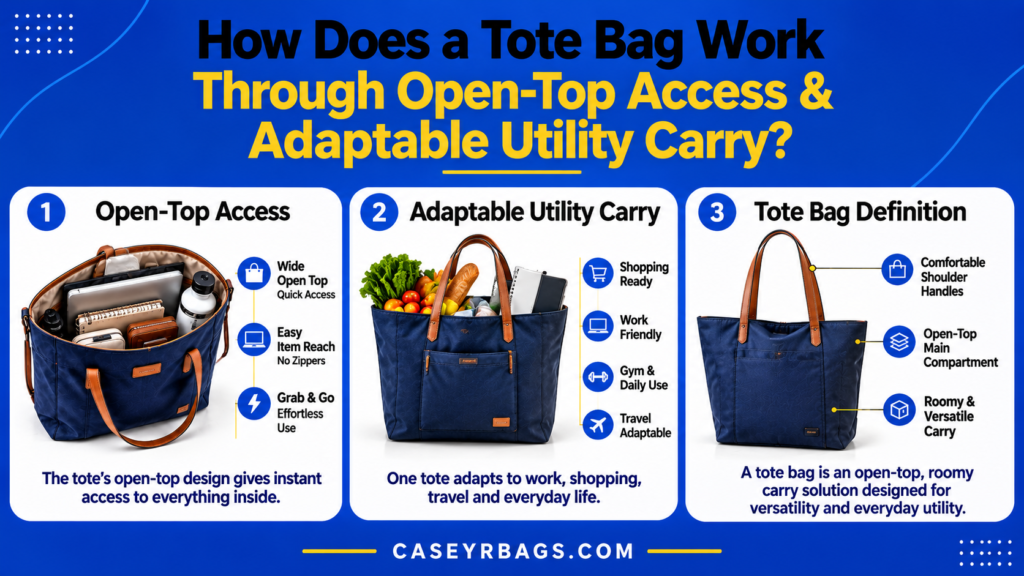
What Defines a Tote Bag Through Open-Top Access & Adaptable Utility Carry?
A Tote Bag is defined through the relationship between a broad accessible opening, paired handles, usable interior volume, and a body structure designed for straightforward loading and adaptable utility carry. The recognizable form can be flexible, semi-structured, or structured, but its opening, body, handles, and storage behavior still work together as one practical carry system.
Open-top access supports Tote identity because it reduces loading friction and makes changing daily contents easier to place or remove, but open access alone does not make a bag a Tote. Paired handles, body proportions, usable depth, base behavior, and the way the bag carries its normal load also matter. Flexible bodies adapt around irregular contents, while structured bodies preserve shape and item position; both can retain Tote identity when the same core carry architecture remains recognizable.
What Does Open-Top Access & Adaptable Utility Carry Mean for a Tote Bag?
Within Everyday Carry Bag Types, open-top access and adaptable utility carry describe how a Tote Bag combines broad loading access, practical interior volume, paired handles, and straightforward carrying architecture. The form remains identifiable when those features work together to support repeated loading, carrying, and retrieval without depending on a complex harness or highly specialized use case.
Which Structural Features Directly Define a Tote Bag?
A Tote Bag is most recognizable when a broad primary opening sits above a practical body supported by paired or parallel handles. The body may be tall, wide, shallow, deep, flexible, or structured, but it needs enough usable interior volume to support the general-purpose loading behavior associated with the form. A simple opening-and-handle relationship usually matters more than decorative styling because it controls how the bag is loaded, lifted, and repositioned.
The useful mechanism is structural feature → practical effect → Tote identity consequence. Paired handles create a direct lifting architecture, the broad opening reduces loading steps, and the body provides a flexible or controlled storage cavity. Two handles alone are not enough; the relationship between opening, body, usable volume, and carry behavior is what makes the architecture read as a Tote.
How Does Open-Top Access Support Tote-Bag Identity?
Broad top access supports Tote identity by allowing items to be placed and removed with little setup. A wide opening can accommodate changing daily loads, irregular shapes, work items, shopping contents, or mixed personal objects without requiring every item to pass through a narrow access point. That direct-loading behavior is one of the strongest functional signals associated with the Tote form.
Open-Top Tote Access still does not define the category alone. Other open bags can use the same access pattern, so Tote identification also depends on paired handles, body proportion, practical volume, and utility carry.
Why Does One Tote Structure Not Fit Every Carrying Use Equally?
One Tote structure cannot serve every load equally because flexible and controlled forms respond differently to contents. A soft open Tote can expand around irregular items and compress when lightly loaded, but the same flexibility can allow small objects to migrate or make the opening less predictable. A structured or closable Tote can keep a more stable shape and improve item control, but reinforcement and closures add structure, weight, and access steps.
The correct comparison is therefore not open versus secure or flexible versus structured. The useful question is which relationship best matches the repeated load. A Tote remains a Tote across these variations when its broad-access body, paired handles, usable volume, and straightforward utility carry remain structurally recognizable.
| Tote Feature | Practical Effect | Identity Consequence |
|---|---|---|
| Broad primary opening | Reduces loading and removal steps | Supports characteristic Tote access |
| Paired handles | Creates direct hand/elbow/shoulder handling | Reinforces recognizable Tote carry architecture |
| Usable body volume | Accommodates changing daily contents | Supports general-purpose utility |
| Flexible or structured panels | Controls how the body responds to load | Changes behavior without automatically changing type |
| Simple carry system | Limits conversion friction | Keeps Tote handling straightforward |
How Does Open-Top Access Shape Tote Bag Use?
Open-top access shapes Tote use by reducing loading steps while changing visibility, retrieval effort, retention, security, and organization. The practical value comes from how the opening works with body depth and storage layout, not from opening width by itself.
Why Does a Broad Opening Make Tote Loading Adaptable?
A broad opening makes Tote loading adaptable because the user can place items directly into the cavity without aligning them with a narrow zipper path or rigid compartment. Irregular objects, changing daily loads, folded garments, books, work materials, or shopping contents can occupy the available volume according to shape rather than a fixed internal grid. The opening therefore reduces loading friction and makes the body more responsive to variation.
The same openness can also expose the consequences of poor internal control. If the cavity becomes crowded or too deep, fast loading can create slower retrieval later. Broad opening → low loading friction → flexible Tote use is strongest when the body remains easy to scan and the load stays within the practical range of the structure.
How Does Open-Top Access Affect Everyday Retrieval?
Open-top access can shorten the path to an item because the user does not need to complete a closure sequence before reaching into the bag. That does not guarantee easy item location. Deep bodies, shifting small objects, limited pockets, and a crowded flexible cavity can create search friction even when the opening itself is immediately accessible.
Predictable retrieval therefore depends on opening access plus organization. Pockets, dividers, stable zones, or a sufficiently shallow body can keep frequently used items in known positions. Easy opening ≠ easy item location; Tote access is strongest when the user can reach the cavity quickly and also anticipate where routine items will be inside it.
When Does a Closure Improve Rather Than Weaken Tote Usability?
A closure improves Tote usability when retention, privacy, weather exposure, or crowded environments matter enough to justify an extra opening action. Zippers, magnetic closures, snaps, partial closures, or internal security pockets can reduce the chance of items shifting out or remaining exposed while the bag moves. These additions change the access sequence, but they do not automatically replace the core Tote architecture.
The useful mechanism is added closure → improved retention/security → additional opening steps. Tote Access Security matters when a closable Tote needs stronger retention while the broad top, paired handles, usable body volume, and utility carry relationship remains intact.
| Opening Factor | Loading Effect | Retrieval Effect | Trade-Off |
|---|---|---|---|
| Broad unobstructed top | Fast placement of varied items | Direct cavity reach | Lower retention if fully open |
| Deep cavity | More vertical capacity | Can increase search distance | More item migration |
| Pockets/dividers | Reduce flexible open space | Improve item predictability | Less unrestricted loading |
| Added closure | Adds one access action | Controls exposure | More secure, less immediate |
How Do Tote Body Structure & Capacity Support Utility Carry?
Tote body structure and capacity support utility carry by controlling usable volume, load shape, item stability, and how easily changing contents can be accommodated. Capacity is useful only when the opening, base, sidewalls, and handles can manage the normal load without turning extra space into repeated retrieval or carrying friction.
How Do Tote Proportions Affect Usable Storage?
Tote proportions determine how much of the apparent size becomes practical storage. Width controls lateral space, height affects vertical stacking, depth creates front-to-back volume, base width influences stability, and gussets allow the body to expand beyond a flat profile. Opening width also matters because the largest routine object must pass through the top before the interior volume becomes useful.
The mechanism is body geometry → usable volume → load behavior. A deep narrow Tote may hold substantial volume but place small items farther from the hand, while a broader shallower form can expose more of the cavity at once. Capacity therefore supports Tote utility only when the proportions match repeated contents rather than maximizing size by itself.
How Do Flexible & Structured Totes Handle Loads Differently?
Flexible Totes use load-responsive sidewalls that can expand, fold, and change shape around irregular contents. This supports variable loads and compressible storage, but the body may sag or allow items to shift when the load is uneven. Structured Totes use reinforced panels, a firmer base, or shape-retaining construction to hold a more predictable geometry even when contents are removed or rearranged.
Neither structure is universally superior. Flexible sidewalls → load-responsive body → irregular-load adaptability, while reinforced body/base → retained geometry → more predictable item positioning. The stronger Tote format is the one whose body behavior supports the normal contents and carrying pattern without adding unnecessary rigidity or instability.
Why Does Greater Tote Capacity Not Always Mean Greater Utility?
Greater capacity can reduce utility when extra depth or volume encourages overfilling, increases item migration, or makes frequently used objects harder to locate. A larger cavity can also shift more weight onto the handles and anchors, especially when the user treats available space as a signal to keep adding contents. More volume ≠ automatically better Tote utility.
Comfortable Shopping Tote Weight depends on construction, handle geometry, contents, and carrying duration rather than one universal number. Shopping Tote Load Capacity depends more directly on seams, handle anchors, base support, and body construction.
| Body Trait | Storage Effect | Load Adaptability | Access Consequence | Utility Fit |
|---|---|---|---|---|
| Wide/shallow body | Spreads contents laterally | Moderate | More cavity visible | Frequent mixed-item access |
| Tall/deep body | Increases vertical volume | High potential capacity | Longer reach to lower items | Bulkier repeated loads |
| Flexible sidewalls | Conform to irregular contents | High | More item movement | Changing loads |
| Reinforced base | Supports bottom geometry | Moderate-high | Improves item stability | Predictable heavier utility |
How Does Handle Design Create Adaptable Tote Carry?
Handle design creates adaptable Tote carry by determining whether the bag sits in the hand, at the elbow, or on the shoulder and how easily it transitions between those positions. Handle drop, clearance, anchor placement, and any secondary strap should solve a repeated carry need rather than add modes for their own sake.
How Does Handle Drop Change Tote Carrying Position?
Handle drop changes the distance between the top edge of the Tote and the hand or body position used to support it. Short handles favor hand carry and brief elbow positioning, while longer handles can create enough clearance for shoulder carry. The same body can therefore behave differently even when the opening and storage volume remain unchanged.
The mechanism is handle drop → body position → load handling → access behavior. A shoulder-capable drop can keep both hands freer during short transitions, while short handles can reduce bag movement and keep the body closer to the hand. The correct drop depends on repeated use, clothing clearance, normal load, and whether the user expects frequent position changes.
When Does Shoulder Carry Improve Tote Utility?
Shoulder carry improves Tote utility when longer handle clearance supports commuting, building-to-vehicle transitions, brief hands-free movement, or easier repositioning during repeated access. Moving the load to the shoulder can free the hands without requiring a separate harness, which preserves the straightforward carry architecture associated with the Tote form.
Shoulder carry is optional, not mandatory for Tote identity. A Tote with short handles can remain fully recognizable when its opening, body, paired-handle arrangement, and utility volume still fit the category. Shoulder capability adds value only when it matches a real routine and the handle length does not make the bag swing, sit too low, or become difficult to control.
When Do Secondary Straps Add Genuine Tote Adaptability?
A secondary strap adds genuine adaptability when it creates an additional carry position that solves a recurring change in the day. Tote-to-backpack conversion can matter when the user repeatedly alternates between straightforward Tote handling and supported hands-free movement. If the extra strap is rarely used or complicates the main opening, it adds configuration without much practical value.
Tote Pack Carry Switch becomes useful when Tote and backpack positions are both genuine parts of the repeated carry pattern. For office commuting, Tote Pack Office Straps should support that transition without compromising primary access or adding unnecessary conversion friction.
| Carry Configuration | Tote Position | Useful Load | Access Behavior | Main Trade-Off |
|---|---|---|---|---|
| Short paired handles | Hand / elbow | Compact to moderate | Opening stays close to hand | Limited hands-free carry |
| Long paired handles | Shoulder / hand | Moderate | Easy on-body repositioning | More movement under heavier load |
| Secondary shoulder strap | Diagonal / shoulder | Conditional | Can free hands | Added hardware and setup |
| Tote Pack conversion | Tote ↔ backpack | Moderate repeated carry | Access depends on conversion state | Higher system complexity |
How Do Structured & Flexible Tote Bags Differ?
Structured and flexible Tote Bags differ in shape retention, response to changing loads, organization, base support, and predictable access while retaining the same underlying Tote relationship. The distinction changes how the body behaves under load rather than deciding by itself whether the bag qualifies as a Tote.
What Defines a Flexible Tote Structure?
A flexible Tote uses soft panels and limited rigid reinforcement so the body can fold, compress, or expand around changing contents. This allows the cavity to accommodate irregular shapes and reduces the space the bag occupies when lightly loaded or stored. The opening may also change width as the sidewalls respond to the load.
Soft structure → changing geometry → flexible utility. The trade-off is reduced shape control: small items can move, the base can deform, and the top may collapse inward when the bag is not full. Flexible construction is strongest when changing-load adaptability matters more than fixed organization or a consistently upright body.
What Defines a Structured Tote?
A structured Tote uses reinforced panels, a stable base, firmer seams, or shape-retaining construction to preserve geometry as the load changes. That can make the opening more predictable, keep items in more consistent positions, and reduce the amount the body collapses when partially loaded. The structure supports control rather than simply adding visual formality.
Reinforcement → shape retention → stronger structural control. Utility Tote Durability should be tied to repeated load, seams, panels, handle attachment, and reinforcement rather than a single material label. The added control is most useful when repeated contents benefit from stable placement and a base that resists collapse during loading and retrieval.
Which Structural Trade-Offs Matter Most?
The most important trade-offs are flexibility versus shape retention, collapsibility versus base stability, irregular-load adaptability versus controlled organization, and lightweight construction versus reinforcement. A flexible Tote can adapt to contents that change shape, while a structured Tote can make the cavity and opening more predictable. Both can remain valid Tote forms when the core architecture stays recognizable.
Utility Tote Reinforced Base construction becomes useful only when repeated load, wet contact, abrasion, or environmental exposure justifies reinforcement or water-resistant base treatment. It is not a universal Tote requirement. The decision should follow the normal load, access pattern, and carrying duration rather than treating reinforcement or flexibility as automatic upgrades.
| Factor | Flexible Tote | Structured Tote |
|---|---|---|
| Shape | Load-responsive | Shape-retaining |
| Loading | Highly adaptable | More controlled |
| Organization | More content-dependent | More predictable |
| Storage | Often compressible | More space-dependent |
| Main benefit | Flexible utility | Structural control |
How Should Tote Bags Be Distinguished From Similar Bag Types?
Tote Bags should be distinguished from neighboring forms by comparing the dominant relationship between body shape, paired handles, opening structure, carry architecture, and use context. Shared features can overlap, so classification should follow the structure that controls how the bag is normally loaded and carried.
How Does a Tote Differ From a General Shoulder Bag?
A Tote typically centers on a broad body, paired handles, straightforward top access, and flexible utility volume. A general Shoulder Bag is more likely to be organized around a primary shoulder strap and side-body position, with body proportions or compartment structure that may be narrower or more specialized. The decisive difference is which carry architecture leads the form.
Paired-handle architecture versus shoulder-strap-led architecture is therefore more useful than asking whether both bags can sit on a shoulder. A Tote can have handles long enough for shoulder carry and still remain a Tote because the paired handles and broad-access body continue to define its main structural relationship.
How Does a Tote Differ From a Shopping Bag?
Shopping is a use context; Tote is a structural bag type. A Shopping Bag can resemble a Tote when it uses a broad body, paired handles, and direct top access, but shopping use alone does not prove Tote identity. Disposable, highly specialized, or differently constructed shopping carriers can serve the same activity without sharing the full Tote relationship.
The classification should therefore return to structure: opening, body, handles, usable capacity, and carry behavior. A bag does not become a Tote simply because groceries or purchases are placed inside it, and a genuine Tote does not stop being a Tote when it is used for work, study, personal items, or other daily loads.
How Does a Tote Differ From a Handbag?
A Tote is commonly organized around broad top access, paired handles, and general-purpose utility volume. The broader Handbag family can include compact, closure-led, highly structured, or silhouette-specific forms whose primary identity comes from a different relationship between body, access, and carry. Some handbags can resemble Totes, especially when larger structured forms use two handles.
The boundary is therefore not fashion styling or size. Tote identification becomes stronger when the paired handles, accessible upper opening, practical cavity, and straightforward utility behavior work together. When those signals weaken and another silhouette or closure system becomes dominant, the bag may fit another Handbag form more accurately.
| Compared Form | Shared Trait | Structural Difference | Use Difference | Classification Rule |
|---|---|---|---|---|
| Shoulder Bag | May sit on shoulder | Primary strap architecture | More side-body oriented | Identify the dominant carry system |
| Shopping Bag | May be open and two-handled | Can be use-specific or simplified | Shopping is the context | Use context alone is not type |
| Handbag | May use paired handles | Broader silhouette/closure family | Can prioritize compact personal carry | Compare opening + body + handle relationship |
Which Tote Format Best Fits a Carrying Need?
The appropriate Tote format is the one whose opening, body structure, capacity, handle configuration, organization, and closure match the normal repeated load. Selection should begin with what is carried most often and only then decide how much flexibility, structure, security, or secondary carry is useful.
How Should the Normal Load Influence Tote Format?
The normal load should set the baseline for Tote body size, structural support, handle requirement, and access pattern. Item volume, the largest repeated object, normal weight, carrying duration, and how much the contents vary determine whether the body should remain flexible or retain more shape. Rare edge-case loads should not define the everyday Tote if they distort normal use.
The mechanism is normal load → body requirement → handle requirement → Tote-format fit. Irregular changing loads may favor a broad flexible cavity, while repeated devices, documents, or organized personal items may benefit from more structure and stable storage zones. The Tote should handle its common load in the normal configuration before secondary features are considered.
How Should Access & Organization Needs Influence Tote Choice?
Changing loads can favor a broad opening, flexible cavity, and lower internal subdivision because the user needs adaptable space more than fixed categories. Predictable work or personal loads may favor pockets, dividers, a stable base, or structured panels because those features keep recurring items in known positions and reduce search friction.
Neither approach is inherently more useful. The choice depends on whether the repeated task is flexible loading or predictable retrieval. Open space preserves capacity freedom, while organization converts part of that freedom into location control. A strong Tote format balances the two according to the normal routine rather than maximizing compartments or openness in isolation.
Which Tote Characteristics Should Be Verified Before Use?
- Identify the normal load.
- Check opening width.
- Verify usable interior depth.
- Inspect the base.
- Inspect side structure.
- Check handle drop and clearance.
- Determine hand versus shoulder carry.
- Review closure requirements.
- Evaluate organization.
- Confirm that the combined structure still supports Tote utility.
This sequence prevents selection from being driven by one attractive feature. A broad opening is useful only if the body and handles support the contents, and added structure is useful only if it solves a repeated need. The final direction should be the Tote form that works predictably with the normal load before edge-case capacity or rarely used conversion features are considered.
| Load Requirement | Opening Fit | Body Fit | Handle Fit | Organization Fit | Security Fit | Tote-Format Direction |
|---|---|---|---|---|---|---|
| Changing irregular items | Broad/open | Flexible | Simple paired handles | Low-moderate | Conditional | Flexible utility Tote |
| Predictable daily items | Broad/controlled | Semi-structured | Hand/shoulder capable | Moderate-high | Moderate | Organized everyday Tote |
| Repeated supported carry | Broad but secure enough | Structured/reinforced | Long handles or secondary support | Moderate | Moderate-high | Structured / convertible Tote variant |
How Can Tote Bag Structure & Utility Mismatches Be Avoided?
Tote mismatches are avoided by evaluating opening, body form, paired handles, load behavior, and utility together rather than identifying the bag from one superficial characteristic. Most classification and use problems begin when one visible trait is treated as proof of the whole category.
Why Is Identifying a Tote From Open-Top Access Alone a Mistake?
Identifying a Tote from open-top access alone is a mistake because broad openings appear in other bag forms. An open shopping carrier, bucket-like bag, simple utility container, or another handled form can provide direct access without using the full Tote relationship. The opening is a major signal, but it has to be interpreted alongside the body and carry system.
The stronger classification rule is opening + body + handles + capacity behavior + utility → Tote classification. If paired handles are absent, the body behaves unlike a practical Tote cavity, or another strap architecture clearly controls the form, an open top should not override those structural differences.
How Can the Wrong Tote Structure Reduce Practical Utility?
The wrong Tote structure creates repeated friction when body depth, base support, handle clearance, panel flexibility, organization, closure, or total volume does not fit the normal load. Excessive depth can bury small items, insufficient base support can let the load sag, short handles can limit the intended carry position, and excessive flexibility can reduce item control.
The opposite mismatch also matters. Unnecessary reinforcement, excessive compartments, or a closure system that adds repeated steps can make a simple changing-load routine more cumbersome than necessary. Structural mismatch → repeated friction → weaker utility. The Tote should solve the common load and access pattern before adding structure for rare conditions.
What Should Be Verified Before Classifying or Using a Tote Bag?
- Broad primary opening identified.
- Paired handles identified.
- Handle placement supports Tote architecture.
- Body proportions create useful volume.
- Base construction understood.
- Side-panel behavior understood.
- Flexible or structured behavior identified.
- Opening and closure relationship understood.
- Normal load fits usable volume.
- Largest repeated item fits.
- Handle drop fits intended carry position.
- Secondary straps solve a recurring need if present.
- Utility is not inferred from one incidental use.
- Open top is not the only classification signal.
- Two handles are not the only classification signal.
- Neighboring Shoulder, Handbag, and Shopping forms are compared.
- Combined structure supports recognizable Tote identity.
If several checks fail together, re-evaluate the opening, handles, body, normal load, and nearest neighboring bag form before treating added accessories as the solution. The correction path is opening → handles → body → utility → closest neighboring form → revalidate. Tote identity should become clearer as those relationships align, not because one label or use case is repeated.
Conclusion
A Tote Bag is defined through the relationship between its broad accessible opening, paired-handle structure, usable interior volume, and adaptable utility carry. Opening width shapes loading, body and base construction control load behavior, handle drop influences carry position, and flexible or structured construction changes shape retention and organization without automatically changing bag type.
Open-top access alone does not establish Tote identity, and general usefulness alone does not establish Tote structure. A Tote can remain a Tote when closable, structured, organized, shoulder-capable, or selectively convertible, provided its opening, body, paired handles, usable volume, and utility relationship remain recognizable. CaseyrBags identifies Tote Bags through the combined behavior of these signals rather than any isolated feature. The strongest identification comes from broad top access, paired handles, practical volume, and straightforward adaptable utility carry.
FAQs
No. Broad or open access is strongly associated with Tote design, but a zipper, snap, magnet, or partial closure can modify access without automatically changing the underlying bag type. The classification still depends on the combined relationship between body, opening, paired handles, usable volume, and utility carry.
A Tote is typically organized around a broad body, paired handles, straightforward top access, and utility volume. A Shoulder Bag is more commonly organized around a primary shoulder-strap architecture and side-body position. Shoulder-capable Tote handles do not automatically turn the bag into a Shoulder Bag.
Yes. Tote Bags can be flexible, semi-structured, or structured. Reinforced panels, a stable base, or more controlled organization change shape retention and load behavior, but the bag can remain a Tote as long as its body, opening, paired handles, and practical utility volume remain recognizable.