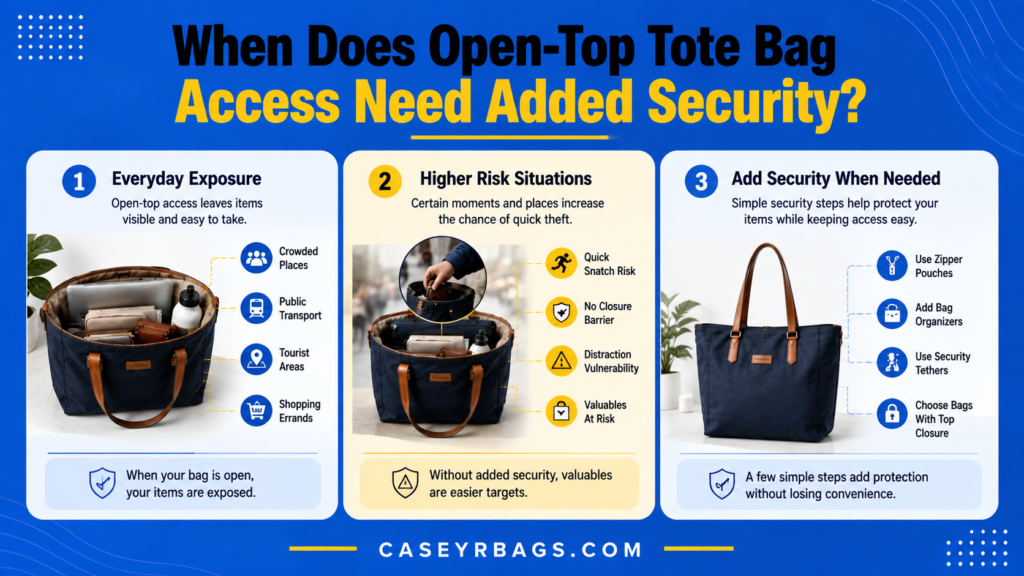
When Does Open-Top Tote Bag Access Need Added Security?
Open-Top Tote Bag Access needs added security when unrestricted entry creates enough retention, exposure, or access-control risk to outweigh the convenience of leaving the main opening fully unrestricted. Movement, orientation changes, tipping, crowding, weather, item sensitivity, and retrieval frequency can all change how much control the Tote needs during normal use.
The correct response may be no added closure, partial retention, protected internal storage, or a stronger top closure. Open access ≠ automatic insecurity, and greater security ≠ automatically better Tote usability. The goal is to match the security layer to the actual risk while keeping routine retrieval practical, rather than sealing the entire Tote simply because its main opening is broad and direct.
What Makes Added Security Necessary for Open-Top Tote Bag Access?
Added security becomes necessary when unrestricted Open-Top Tote access creates a meaningful retention, exposure, or access-control problem during normal carrying. Stable upright use in a controlled setting can leave the broad opening practical when contents are low-risk, predictable, and unlikely to move toward the rim.
The need changes when movement, tipping, crowding, weather, loose objects, or sensitive contents increase the consequence of leaving the opening unrestricted. A security feature should answer that specific condition rather than being added automatically because the Tote has an open top.
Access frequency also matters because repeatedly used essentials can become frustrating behind a high-friction closure, while lower-frequency sensitive contents may justify stronger control. Security level must match both risk and retrieval frequency. The broader Tote Bag structure provides the parent context for how security interacts with opening form, handles, storage behavior, and utility carry.
Which Conditions Create the Strongest Need for Added Security?
The strongest need for added security appears when multiple exposure conditions act together. Frequent movement can shift contents toward the opening, tipping can convert convenient access into spill exposure, and crowding can reduce control over who or what contacts the upper cavity. Loose small items and sensitive contents increase the consequence if the opening remains uncontrolled.
Weather and unpredictable orientation can add further pressure when the Tote is repeatedly set down, angled, or carried through changing environments. The useful chain is condition → retention or exposure risk → security consequence. A strong trigger is not the Open-Top label itself; it is a real use condition that makes unrestricted access meaningfully harder to control.
When Can an Open-Top Tote Remain Secure Enough Without Added Closure?
An Open-Top Tote can remain appropriately controlled without added top closure when it stays mostly upright, moves predictably, and carries contents with low spill or exposure consequences. A shallow or well-organized interior can keep items below the rim, while protected internal storage can isolate the few objects that need more control without changing the main opening.
Low tipping exposure and a controlled setting reduce the value of adding another fastening step. No added closure can therefore be appropriate when actual risk remains low. The correct description is appropriate retention, not guaranteed safety: the absence of a closure does not remove all risk, but neither does it automatically create a meaningful retention problem.
Why Does One Security Level Not Fit Every Open-Top Tote?
One security level does not fit every Open-Top Tote because contents, movement, environments, and retrieval patterns differ. Low-risk items accessed many times a day benefit from a short, low-friction path, while higher-consequence items retrieved less often can tolerate stronger retention or a protected internal zone. The same closure can therefore be useful for one load and excessive for another.
Different contents + different environments → different security requirements. A single sensitive item does not necessarily justify sealing the entire main compartment, and a low-friction opening should not remain unrestricted when repeated tipping makes loose contents difficult to retain. Security works best when it follows the actual risk pattern rather than a universal Tote rule.
How Does Movement Increase the Need for Tote Bag Security?
Movement increases the need for Tote security when changes in bag position or orientation allow contents to shift toward the opening, become less controlled, or leave their predictable storage zones.
How Can Normal Movement Affect Open-Top Contents?
Normal movement affects Open-Top contents by changing their position relative to the opening. Walking, swinging the Tote, setting it down, lifting it again, or moving between hand and shoulder carry can cause loose objects to migrate, stack differently, or press against flexible sidewalls. Handle tension can also deform the opening as the body moves.
The mechanism is movement → content displacement → retention need. Movement does not automatically require a zipper, but repeated displacement can make a light closure, stable pocket, or stronger containment more useful when important items repeatedly move toward the rim or become difficult to keep in a controlled zone.
When Does Tipping Make Added Closure More Important?
Tipping makes added closure more important when the Tote is frequently placed on floors, seats, uneven surfaces, or carried at angles that direct contents toward the opening. Rapid repositioning and uneven loading can increase the same effect because the bag may rotate before the user can stabilize the upper cavity. Small loose items are especially vulnerable to these orientation changes.
Open upright access can become spill exposure when orientation changes. Added closure becomes more valuable when the consequence of that exposure is meaningful and the Tote cannot reliably remain upright. The appropriate response may still be partial or selective if only certain items need extra retention rather than the entire main compartment.
How Does Commuting Change the Security Requirement?
Commuting can strengthen the need for retention because the Tote is repeatedly repositioned between walking, seating, standing transit, vehicle movement, and setting the bag down or picking it up. Each transition can change orientation, compress the opening against the body, or shift contents toward a different side of the cavity.
The security question remains about retention and access control, not theft-proofing. A commuter who retrieves essentials frequently may benefit from low-friction top control plus a protected zone for selected items, while a mostly stationary routine may need less intervention. The carry pattern determines whether repeated movement creates enough exposure to justify another security layer.
| Carry Condition | Bag Movement | Content Exposure | Retention Need | Security Direction |
|---|---|---|---|---|
| Stable upright desk carry | Low | Low | Low | Open access may remain sufficient |
| Walking / shoulder movement | Moderate | Variable | Partial | Light closure or controlled zones |
| Frequent set-down / pickup | Moderate-high | Tipping possible | Moderate | Retention becomes more useful |
| Repeated angled or transit carry | High | Higher displacement | Stronger | Greater top control may fit |
How Do Carried Items Change the Need for Added Security?
Carried items change security need because their size, exposure consequence, sensitivity, replacement difficulty, and retrieval frequency determine how much access control or retention they require.
Which Items Benefit Most From Protected Storage?
Protected storage is most useful for small, easily lost, sensitive, expensive, difficult-to-replace, or exposure-sensitive items because the consequence of uncontrolled movement is higher for those contents. A dedicated internal pocket can isolate them from the open cavity while leaving larger low-risk items available through the broad main opening.
The security benefit comes from selective control rather than from treating every object as equally sensitive. A protected zone is strongest when it keeps higher-consequence contents in a predictable location with enough closure to prevent migration or casual exposure. It should not be interpreted as theft-proofing or as proof that the entire top opening is otherwise fully retained.
When Should Frequently Used Items Remain Easier to Access?
Frequently used items should remain easier to access when repeated opening steps would create more routine friction than meaningful security benefit. Exterior pockets, accessible interior zones, low-friction closures, or predictable upper positions can keep essentials reachable without leaving them randomly exposed in the main cavity. The key is controlled convenience rather than unrestricted visibility.
Frequent access does not require unrestricted exposure. A phone or keys can remain in a predictable quick-access zone while a less frequently used sensitive item stays behind a stronger internal closure. The security design should shorten repeated retrieval where consequences are low and add stronger control only where the exposure consequence justifies it.
Why Should High-Risk & Low-Risk Items Use Different Access Zones?
High-risk and low-risk items should use different access zones because they create different consequences if exposed, displaced, or difficult to retain. Low-risk, high-frequency contents benefit from an accessible zone that keeps routine retrieval fast, while higher-risk, lower-frequency contents can use a protected zone with stronger closure or deeper placement.
The relationship is low-risk/high-frequency → accessible zone and higher-risk/lower-frequency → protected zone. Different item risks can therefore use different security layers within the same Tote. This preserves the main advantage of Open-Top access while avoiding the weak rule that one sensitive item requires the entire main compartment to remain fully sealed during every interaction.
| Item Characteristic | Access Frequency | Exposure Consequence | Security Priority | Storage Direction |
|---|---|---|---|---|
| Low-risk routine essential | High | Low | Low-moderate | Predictable quick-access zone |
| Small easily lost item | Moderate-high | Moderate | Moderate | Dedicated pocket / partial control |
| Sensitive or difficult-to-replace item | Low-moderate | High | High | Protected internal storage |
| Large low-risk item | Variable | Low | Low | Main cavity where practical |
How Do Tote Closures Change Open-Top Security?
Tote closures increase retention and opening control to different degrees, while each also introduces a different amount of retrieval friction and may affect how much of the broad entry remains immediately usable.
When Is a Magnetic or Snap Closure Enough?
A magnetic or snap closure can be enough when the security problem is limited to reducing opening spread, keeping the upper edges together, or providing light retention during moderate movement. These closures usually reopen quickly and preserve much of the Tote’s broad entry, making them useful when repeated access matters and full containment is unnecessary.
Partial closure ≠ sealed retention. A magnet or snap may not control the entire opening if the Tote tips, and it may not prevent small objects from leaving gaps around the fastening point. The fit is strongest when the risk is moderate, the bag stays mostly upright, and low reopening friction is more valuable than complete top-level containment.
When Does a Zipper Provide a Stronger Security Benefit?
A full zipper provides a stronger security benefit when the main concern is controlling most of the top opening rather than simply drawing the rim together at one point. Full zipper → stronger opening control → greater containment, which can help when movement, tipping, weather exposure, or sensitive contents create a larger consequence if the cavity remains broadly exposed.
The trade-off is stronger retention → additional opening step. A zipper can slow repeated retrieval, narrow usable access until fully opened, and require hand movement before loading. It is therefore justified when the added containment solves a real problem, not because a zipper should be treated as theft-proof or universally superior.
When Is an Internal Secure Pocket Better Than Closing the Entire Tote?
An internal secure pocket is often better than closing the entire Tote when most contents are low-risk, the main cavity is accessed frequently, and only selected items need stronger control. A protected pocket can isolate sensitive or easily lost objects without repeatedly interrupting broad loading and retrieval for larger routine contents.
The useful relationship is selective protection → preserved Open-Top utility. This approach works especially well when different items have different exposure consequences. The internal pocket should remain reachable enough for its intended items, and it should not be described as complete top-level retention because the rest of the main opening can still remain broadly accessible.
| Security Method | Access Friction | Relative Retention | Exposure Control | Best Role |
|---|---|---|---|---|
| Fully open | Lowest | Lower | Lower | Low-risk access |
| Magnetic closure | Low | Moderate | Moderate | Light retention |
| Snap closure | Low-moderate | Moderate | Moderate | Simple opening control |
| Full zipper | Higher | Higher | Higher | Greater containment |
| Internal zip pocket | Low main-access impact | High locally | High locally | Selected-item protection |
How Should Everyday Access & Added Security Be Balanced?
Everyday access and added security should be balanced by adding only enough retention or access control to solve the actual Tote risk without creating unnecessary repeated friction.
When Does Stronger Security Create Too Much Access Friction?
Stronger security creates too much access friction when frequent retrieval requires repeated opening, the closure is awkward to operate, the usable opening becomes unnecessarily restricted, or several fastening steps interrupt routine access. A security feature that is consistently bypassed, left open, or avoided during normal use may not fit the actual interaction pattern.
The trade-off depends on both consequence and frequency. Low-consequence items used repeatedly should not be hidden behind a high-friction system without a clear benefit, while sensitive low-frequency contents can justify slower access. Security that is repeatedly bypassed may not fit the routine because its theoretical retention advantage is not being used in practice.
When Should Secure Access Take Priority Over Speed?
Secure access should take priority over speed when the consequence of spill, exposure, or uncontrolled opening is higher than the inconvenience of another retrieval step. Frequent orientation changes, sensitive contents, weather exposure, crowded environments, or meaningful spill consequences can all increase the value of stronger containment, particularly when the affected items are not accessed constantly.
The decision should remain conditional rather than absolute. Greater security is useful when it solves the dominant risk and the user can tolerate the added opening effort. If retrieval remains highly frequent, a protected pocket or layered access system may preserve speed for routine items while giving stronger control to contents with higher exposure consequences.
How Can Layered Security Preserve Open-Top Convenience?
Layered security preserves Open-Top convenience by assigning different access controls to different item risks. The main cavity can remain broadly accessible for low-risk or bulky contents, a light top closure can reduce opening spread, and a secure internal pocket can protect selected sensitive items without forcing every retrieval through the strongest control layer.
Different item risks → different access layers. A quick-access zone can serve routine essentials while the protected zone handles lower-frequency sensitive contents. This arrangement keeps the Tote’s broad utility available while still increasing retention where it matters. Layering is useful only when the extra zones remain understandable and do not fragment the interior into unnecessary complexity.
| Access Priority | Security Need | Closure Level | Retrieval Effect | Best Balance |
|---|---|---|---|---|
| Very high | Low | Open / light control | Fastest | Routine low-risk items |
| High | Moderate | Magnet / snap / selective pocket | Low friction | Mixed daily use |
| Moderate | High for selected items | Secure internal pocket | Localized extra step | Layered protection |
| Low-moderate | High top-level retention | Full zipper | Higher friction | Greater containment need |
Which Security Level Best Fits an Open-Top Tote?
The appropriate security level is the lowest level of added retention or access control that adequately addresses the Tote’s actual movement, exposure, item sensitivity, and access requirements.
When Is No Added Top Closure Necessary?
No added top closure is necessary when contents are low-risk, orientation is stable, the setting is controlled, and spill exposure remains small. Protected pockets can handle the few items that need more control while the main cavity stays open for routine access. In this condition, adding a stronger top closure may create effort without solving a meaningful problem.
Low actual retention need → open access may remain appropriate. The decision should still consider how the Tote is carried rather than how it looks while empty. If the normal load stays below the rim, movement is limited, and sensitive contents already have protected positions, unrestricted top access can remain a practical fit.
When Is Partial Security the Better Fit?
Partial security is the better fit when movement or tipping is moderate, item sensitivity is mixed, and frequent access still makes full closure inconvenient. A magnet, snap, or protected pocket can add control without eliminating the broad opening behavior that makes the Tote easy to load and retrieve from during routine use.
Partial security works best when the risk is real but localized or intermittent. The security method should solve the identified problem—such as reducing opening spread or controlling selected small items—without being treated as full containment. If the Tote regularly tips or carries more sensitive contents, partial retention may no longer address enough of the exposure.
When Is Stronger Top-Level Security Justified?
Stronger top-level security is justified when frequent movement, meaningful spill consequences, sensitive contents, higher environmental exposure, or a stronger retention requirement make broad unrestricted access difficult to control. It is especially suitable when opening frequency is lower, because the additional fastening step creates less cumulative retrieval friction during the day.
The final test is simple: does the security benefit outweigh the additional access friction? A stronger closure should materially reduce the dominant exposure or retention problem. If it does not, the feature may add complexity without improving security fit. Greater containment is a response to stronger conditions, not the default destination for every Open-Top Tote.
| Carry Environment | Movement Risk | Item Sensitivity | Access Frequency | Retention Need | Security Level |
|---|---|---|---|---|---|
| Stable / controlled | Low | Low | High | Low | No added top closure |
| Mixed everyday use | Moderate | Mixed | High | Partial | Light closure / protected zone |
| Mixed with selected sensitive items | Moderate | High locally | Mixed | Selective | Protected internal storage |
| High movement / exposure | High | Moderate-high | Lower | Strong | Stronger top-level retention |
How Can Open-Top Tote Security Mismatches Be Avoided?
Open-Top Tote security mismatches are avoided by selecting retention and closure controls according to actual exposure rather than increasing security solely because the Tote has an open top.
Why Is Adding a Zipper to Every Open-Top Tote a Weak Rule?
Adding a zipper to every Open-Top Tote is a weak rule because it ignores contents, environment, retrieval frequency, tipping exposure, internal protected storage, and the way the bag is actually handled. A full closure can add useful containment, but it can also introduce unnecessary opening steps and reduce the convenience that the broad Tote entry is meant to provide.
Closure choice should follow risk, not the Open-Top label alone. A stable low-risk Tote may gain little from full closure, while a frequently moving Tote with sensitive contents may benefit substantially. The same structural feature therefore has different value under different carrying conditions.
Why Can Relying on One Small Closure Create False Confidence?
Relying on one small closure can create false confidence because a magnet or snap mainly controls the opening near its fastening point and does not necessarily contain the entire upper cavity. Gaps can remain around the closure, and small contents may still shift toward exposed areas if the Tote tips or becomes heavily angled.
The correct relationship is closure type → actual retention capability. Light closures can be useful, but they should be described according to what they physically control rather than treated as equivalent to a full zipper. Accurate security fit depends on matching the closure’s real containment behavior to the exposure problem.
What Should Be Verified Before Adding Security to Open-Top Tote Access?
- Normal carry environment is identified.
- Typical Tote orientation is understood.
- Movement exposure is evaluated.
- Tipping exposure is evaluated.
- Loose-item spill or loss risk is checked.
- Sensitive contents are identified.
- High-frequency and protected items are separated.
- Existing secure pockets are evaluated.
- Required retention level is identified.
- Partial closure is considered before unnecessary full closure.
- Full closure has practical control value.
- Security does not unnecessarily block loading.
- Retrieval friction remains acceptable.
- Closure capability is described accurately.
- Open-Top convenience and retention stay balanced.
The checklist should be applied to the normal load and real carrying routine, not an empty Tote. Verify the opening while the bag is upright, moving, repositioned, and accessed at normal frequency so the security feature is tested under the conditions that create the real retention problem. If the chosen control does not reduce the dominant exposure problem, or if it creates repeated friction that the user constantly bypasses, recheck movement, item sensitivity, access frequency, existing protected storage, and required retention before increasing closure strength.
These are qualitative security-fit outcomes, not a numerical scoring system or guarantee of loss prevention.
Conclusion
Open-Top Tote Bag Access needs added security when unrestricted entry creates meaningful retention, exposure, or access-control problems for the way the Tote is actually carried. Movement, tipping, changing environments, sensitive contents, retrieval frequency, and closure capability determine whether open access remains practical or whether partial, selective, or stronger retention adds useful control.
Open access ≠ automatic insecurity, added closure ≠ guaranteed security, and greater security ≠ automatically better Tote usability. CaseyrBags evaluates added Tote security by matching retention and access-control features to actual carrying conditions rather than assuming every Open-Top Tote needs the same closure system. Added security is justified when the consequence of unrestricted access becomes greater than the friction created by the security feature, with the protection level matched to contents, movement, and environment.
FAQs
No. Closure need depends on movement, orientation, carried contents, environment, tipping exposure, and the actual retention requirement. Open top alone does not determine closure need. Stable low-risk use may work without added top control, while changing orientation or sensitive contents can justify stronger retention.
Sometimes. A magnetic closure can reduce opening spread and provide light or moderate retention with low reopening friction, but it is not equivalent to a fully zipped opening. Whether it is enough depends on tipping exposure, movement, contents, and how much containment the normal carry routine requires.
Yes. Partial closure, a protected internal pocket, and layered access zones can add control to selected contents while preserving broad main-compartment access. Convenience remains strongest when frequent low-risk items use a low-friction path and stronger protection is reserved for contents that justify the extra opening step.