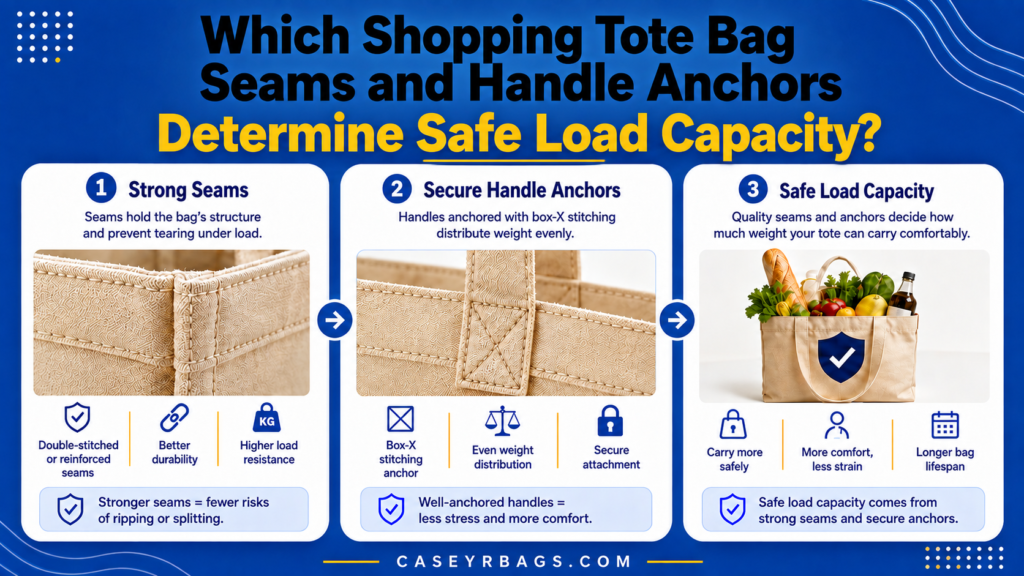
Which Shopping Tote Bag Seams and Handle Anchors Determine Safe Load Capacity?
Shopping Tote Bag load capacity depends on the complete structural path that transfers force from the handles through their anchors, surrounding panels, load-bearing seams, and base rather than on one visibly reinforced attachment. Handle tension enters the Tote through the anchor zone, then spreads into the top edge, body panels, side or gusset seams, and lower structure that supports the carried contents.
Visible reinforcement ≠ verified load capacity, and strong handle ≠ strong handle-to-body connection. A box-X pattern, heavy fabric, broad anchor, or reinforced base may contribute to structural support, but no single visible feature establishes a universal safe kg/lb value. The correct question is whether the complete handle-to-base load path remains intact and whether any capacity claim is supported by applicable whole-bag manufacturer guidance or testing.
What Do Seams & Handle Anchors Mean for Shopping Tote Bag Load Capacity?
Seams and handle anchors affect Shopping Tote load capacity by forming the structural path that transfers handle tension through the bag body and into the wider load-support system. A loaded Tote creates tension in the handles, and that force enters the body through the handle-anchor zones rather than remaining isolated in the straps.
Structural continuity depends on what surrounds those anchors. The reinforced top edge, body panels, seam allowances, reinforcement layers, side or gusset seams, and base must continue the force path without excessive separation or distortion. A locally strong attachment can still be limited by weaker material or seams elsewhere.
The complete Tote therefore matters more than one visible feature. A strong local anchor does not guarantee a strong complete Tote. The broader Tote Bag structure provides the parent context for how this structural-capacity question fits with opening form, handles, storage behavior, and adaptable utility carry.
Which Seams Directly Participate in the Tote Load Path?
Several seams can participate in the structural load path because handle tension must pass from the anchor zone into the rest of the Tote body. Handle-anchor seams connect the straps to local material, top-edge seams stabilize the upper structure, side and gusset seams connect body panels, and base seams help contain the load supported by the lower portion of the bag.
Panel-joining seams and reinforcement-layer seams can also matter when they carry tension between structural zones. Seam location → transferred force → structural consequence. No single seam necessarily carries the entire load, so capacity should be assessed across the connected network rather than from the appearance of one reinforced joint.
What Role Do Handle Anchors Play in Load Transfer?
Handle anchors are the points where handle tension enters the Tote body. As the bag is lifted, the handles pull against the anchor zones, which must transfer that demand into the surrounding material and wider panel structure. An effective anchor spreads force through enough supported material to avoid relying on one narrow attachment line.
The useful chain is handle tension → anchor zone → surrounding material → wider Tote body. Broader integration can improve potential force distribution, but anchor size alone does not establish capacity. The surrounding panel, reinforcement, seams, and downstream structure must remain able to carry the transferred load.
Why Can One Strong Seam Not Determine Total Tote Capacity?
One strong seam cannot determine total Tote capacity because the load path continues through several connected structural components. A reinforced anchor seam may remain intact while a weaker panel tears beside it, a side seam opens, a base seam separates, or a reinforcement layer pulls away from the surrounding body.
Local strength ≠ whole-bag strength. The limiting component can appear somewhere other than the visibly reinforced area, especially when material has already been damaged or when the load is uneven. Whole-bag capacity therefore requires evidence that applies to the complete connected structure, not just one seam or attachment detail.
How Do Seam Construction & Stitching Affect Tote Load Capacity?
Seam construction affects Shopping Tote load transfer by controlling how effectively joined material carries force across structural connections.
Which Seam Characteristics Matter Most Under Load?
Seam performance under load depends on seam type, seam allowance, stitch continuity, stitch spacing, thread integrity, reinforcement layers, and how much surrounding material is captured in the joint. These factors determine how force passes across the connection and whether the joined material remains supported as tension rises.
A continuous seam with intact thread and adequate captured material can provide a more reliable transfer path than a damaged or partially separated connection. However, visual quality alone is not a capacity rating. Structural behavior still depends on material, workmanship, load direction, and how the seam interacts with the rest of the Tote.
Why Does Stitch Density Alone Not Determine Seam Strength?
Stitch density alone does not determine seam strength because performance also depends on thread, body material, stitch geometry, needle perforation, seam allowance, loading direction, and workmanship. More stitches can create additional transfer points, but excessive perforation or weak surrounding material can still limit the connection.
More stitches ≠ automatically stronger seam. A dense pattern in weak, torn, or highly perforated material may perform worse than a simpler intact seam in a better-supported structural zone. Stitch count should therefore be read as one visible feature within a complete seam system rather than as a universal capacity indicator.
How Does Surrounding Material Affect Seam Performance?
Surrounding material affects seam performance because thread and stitches can remain intact while the material beside the seam stretches, frays, perforates, tears, or separates. The seam only transfers load effectively if the captured panel can continue supporting the forces entering through the stitch line.
Stitch integrity + material integrity → effective structural seam performance. A strong-looking stitch line cannot compensate for degraded surrounding material, and thick material does not guarantee whole-bag capacity if the joining seam is poor. Both parts of the connection must remain structurally sound.
| Seam Factor | Load Function | Potential Weakness | Structural Consequence |
|---|---|---|---|
| Seam allowance | Provides captured material | Insufficient supported area | Greater local separation risk |
| Stitch continuity | Maintains transfer path | Broken/skipped stitches | Interrupted load sharing |
| Thread integrity | Connects joined panels | Fraying/breakage | Progressive seam opening |
| Reinforcement layer | Supports local structure | Poor integration | Local layer may detach |
| Surrounding material | Receives stitch load | Tearing/perforation | Failure beside intact thread |
How Do Handle Anchors Determine Tote Bag Load Capacity?
Handle anchors affect Tote structural capacity by controlling how concentrated handle tension enters and spreads through the surrounding bag body.
How Does Anchor Area Affect Load Transfer?
Anchor area affects load transfer because a small isolated attachment concentrates handle demand into a narrower region, while a broader integrated attachment can distribute tension across more surrounding material. Wider distribution may reduce dependence on one local connection and create a longer path for force to enter the Tote structure.
Broader integrated anchor → wider force distribution → less isolated concentration. The boundary is important: anchor area alone cannot establish safe capacity. If the surrounding material, top edge, side seams, or reinforcement layers are weak, a broad anchor can still be limited by those downstream components.
How Do Reinforced Anchor Patterns Affect Structural Support?
Reinforced anchor patterns such as box stitches, box-X patterns, parallel stitching, extended handle attachments, or reinforcement patches can create additional potential paths for transferring handle tension into the surrounding structure. Their benefit depends on whether the pattern is continuous, properly integrated, and supported by the material underneath it.
Anchor pattern → potential load-spreading path. No one pattern should be treated as universally strongest because thread, material, stitch quality, attachment area, loading direction, and surrounding reinforcement all affect performance. A visually complex pattern can still be limited if the connected panel or nearby seam is weaker.
Why Does Anchor Placement Matter?
Anchor placement matters because the attachment should feed handle tension into a structural zone capable of carrying it. Anchors integrated into a reinforced top edge, main body panel, multiple material layers, or an established seam network can spread demand into more of the Tote body than a small isolated patch.
Strong anchor pattern + weak surrounding structure → limited whole-bag benefit. Placement should therefore be evaluated together with panel condition, top-edge construction, seam continuity, and reinforcement integration. The goal is not maximum visible stitching but a connected load path that avoids abrupt weak points.
| Anchor Feature | Structural Role | What to Verify |
|---|---|---|
| Attachment area | Spreads handle force | Supported surrounding area |
| Reinforcement layer | Supports local material | Secure integration |
| Stitch pattern | Transfers force | Intact continuous stitching |
| Anchor position | Connects handle to body | Strong surrounding structure |
| Handle continuation | Extends load path | Integrated attachment |
How Do Top, Side & Base Seams Work With Handle Anchors?
Top, side, gusset, and base seams complete the structural network that receives handle-anchor forces and keeps the Tote body connected around its load.
Why Does Top-Edge Construction Matter Near Handle Anchors?
Top-edge construction matters because handle anchors are often positioned near the upper rim where the body must resist local pulling and lateral tension. A reinforced top edge can connect multiple material layers, stabilize the anchor zone, and reduce local distortion as handle force enters the Tote.
Strong top edge ≠ compensation for weak downstream structure. Side panels, gussets, and base seams must still continue the load path. A well-supported rim can stabilize the anchor, but total capacity remains limited by the connected structural system and the condition of the material below it.
How Do Side & Gusset Seams Affect Load Stability?
Side and gusset seams affect load stability by connecting the panels that contain the carried contents and transfer force between upper anchor zones and the lower body. As the handles pull upward, panel tension travels through these joining seams, which help preserve shape and maintain structural continuity.
Anchor demand → panel tension → seam transfer → body stability. If a side or gusset seam opens, stretches, or separates, the load path becomes less continuous even when handle anchors remain intact. The seam network therefore supports both containment and structural load transfer.
Why Does Base Construction Matter Even When Handles Fail First?
Base construction matters because the base supports the contents while handles and anchors suspend the loaded body. A weak or poorly integrated base can sag, tear, separate at its seams, or allow dense contents to shift in ways that increase demand on the rest of the Tote structure.
Handle capacity and base capacity must belong to the same structural system. Strong handles cannot compensate for a failing base, and a reinforced base cannot compensate for weak anchors. Whole-bag capacity depends on the connected system remaining intact from the carried contents through the lower body and back into the suspension points.
Which Structural Failures Reveal Weak Tote Load Capacity?
Visible structural deterioration can reveal weaknesses in the Tote load path, but it cannot be used to calculate an exact remaining load capacity.
What Happens When Handle Anchors Begin to Fail?
Handle-anchor failure can appear as stitch separation, elongated stitch holes, local panel distortion, anchor lifting, tearing beside the attachment, or separation of a reinforcement layer. These are warning signals that the local load-transfer zone is no longer behaving as intended and should not be treated as normal cosmetic change.
Visible damage does not reveal an exact remaining capacity, but it does reduce structural confidence. Continued heavy use can transfer more demand into weakened material or neighboring seams. The correct response is to reassess the load and rely on verified guidance rather than assuming the anchor can safely continue at the same loading level.
How Can Seam Failure Develop Under Load?
Seam failure can develop through thread breakage, progressive stitch loss, seam opening, tearing of adjacent material, or deformation that spreads along the joint. A small damaged area can reduce continuity and shift more demand into the remaining stitches or nearby panel material as the Tote continues to carry load.
The visible failure location may not always be the original weakest component. A seam can open because of local thread damage, surrounding material weakness, uneven loading, or force transferred from another structural zone. Inspection should therefore follow the connected load path rather than treating one damaged stitch line as an isolated problem.
Why Should Repeated Deformation Be Treated as a Load Warning?
Repeated stretching, seam opening, anchor distortion, or base sagging should be treated as a load warning because recurring deformation shows that the structure is not returning cleanly to its normal working shape under repeated use. Even when no complete tear is visible, the load path may be experiencing concentrated or uneven demand.
Persistent structural distortion → reassess load. Visual deformation does not provide an exact remaining capacity, but it is a reason to reduce assumptions about structural fit and check manufacturer guidance, current condition, and the full handle-to-base system before continuing the same heavy-load routine.
| Observed Signal | Structural Zone | Possible Load Consequence | Required Response |
|---|---|---|---|
| Stitch separation | Anchor / seam | Reduced continuity | Reduce load and reassess |
| Hole elongation | Anchor material | Increasing local demand | Do not infer remaining capacity |
| Panel tearing | Surrounding material | Anchor support compromised | Stop relying on appearance |
| Base sagging | Lower body | Less stable support | Reassess whole-bag fit |
| Repeated distortion | Any load zone | Persistent structural demand | Reduce load and verify guidance |
How Does Load Distribution Affect Seams & Handle Anchors?
Load distribution affects Tote seams and anchors because off-center or shifting contents can create unequal handle tension and concentrated demand on one side.
Why Does an Uneven Load Increase Stress on One Side?
An uneven load increases structural demand on one side because off-center contents shift the bag’s load center away from the natural suspension line. One handle and anchor can then receive more of the lifting demand while the opposite side carries less, creating asymmetric tension through the top edge and body panels.
Off-center contents → uneven handle tension → uneven anchor loading. Exact stress cannot be inferred visually without engineering evidence, but the directional effect is clear: unequal distribution reduces the assumption that both sides are sharing demand evenly and can accelerate distortion at the more heavily loaded structural zone.
Why Can Carrying From One Handle Change Anchor Loading?
Carrying a loaded Tote from one handle changes anchor loading because two-handle suspension normally shares demand across both attachment systems, while single-handle carry transfers much more of the suspension requirement into one side. The body can rotate or twist as the unused side drops away from the primary carry line.
Two-handle suspension → shared demand, while single-handle heavy carry → asymmetric structural demand. No universal failure threshold should be inferred, but repeated one-handle loading can make the structural system behave differently from the intended balanced configuration and should be considered when evaluating capacity.
How Does Load Movement Affect Structural Demand?
Load movement affects structural demand because swinging contents, dense-item shifts, sudden lifting, and repeated set-down/pick-up cycles change the direction and timing of forces entering the handles and anchor zones. A static bag sitting on the floor does not reproduce these repeated changes in suspension and panel tension.
Static weight + movement → changing structural demand. The Tote may remain intact at rest yet show greater distortion when contents shift during lifting or walking. Whole-bag verification should therefore account for the intended use pattern rather than assuming a static load automatically represents repeated carrying behavior.
How Should Shopping Tote Bag Load Capacity Be Verified?
Shopping Tote load capacity should be verified through applicable whole-bag manufacturer guidance or appropriate testing rather than inferred from visual reinforcement alone.
What Can Visual Inspection Reliably Tell the User?
Visual inspection can reliably identify obvious condition problems such as damaged stitching, torn material, distorted anchors, separated seams, worn handles, or reinforcement layers pulling away from the body. These observations can reduce confidence in the current structural state and help identify where the load path requires closer attention.
Visual inspection cannot establish an exact safe kg/lb capacity. A Tote that looks reinforced may still lack verified whole-bag evidence, while an undamaged bag may have limits that are not visible from construction alone. Inspection is therefore a condition check, not a substitute for a documented capacity basis.
What Evidence Provides a Stronger Load-Capacity Basis?
A stronger basis comes from manufacturer-rated capacity, documented Tote specifications, appropriate whole-bag load testing, or relevant quality-control evidence that applies to the exact bag or construction being evaluated. The evidence should address the complete structural system rather than only one fabric, handle, seam, or anchor component.
Evidence should apply to the complete Tote, not only to one component. A material strength figure or isolated handle test does not automatically establish whole-bag load capacity because anchors, seams, panels, and the base can become limiting elsewhere in the load path.
Why Should Failure Strength Not Be Used Directly as Safe Capacity?
Failure strength describes the point at which structural breakdown occurs under test conditions, while safe working capacity refers to a verified operating range below failure conditions. The two concepts are not interchangeable because normal use should not be based on repeatedly approaching the point where the bag begins to break down.
Failure load ≠ safe working load. A generic safety factor should not be invented without applicable engineering or manufacturer evidence. Use whole-bag guidance or suitable test evidence that already defines an appropriate working capacity for the exact Tote and use case.
How Can Shopping Tote Load-Capacity Mismatches Be Avoided?
Shopping Tote load-capacity mismatches are avoided by evaluating the entire handle-to-base structural system rather than relying on one reinforced-looking feature.
Why Is Judging Capacity From Handle Anchors Alone a Mistake?
Judging capacity from handle anchors alone is a mistake because anchor appearance does not reveal panel strength, thread condition, seam integrity, base condition, material fatigue, or whether the whole Tote has been verified for a specific load. A large reinforcement patch can still depend on weaker material immediately beyond its edges.
Anchor reinforcement ≠ whole-Tote rating. The correct evaluation follows the load path away from the handle into the top edge, panels, side or gusset seams, and base. If any meaningful connected component is damaged or unverified, the visible anchor cannot establish safe working capacity by itself.
Why Is Judging Capacity From Fabric Thickness Alone a Mistake?
Fabric thickness alone is a weak capacity rule because the structural limit may occur at a seam, narrow attachment, poorly integrated anchor, damaged stitch line, weak base, or another connected zone rather than in the main body fabric. Heavy material can contribute to local strength without proving the reliability of every connection.
The complete load path is only as reliable as its meaningful connected structural components. Thick fabric ≠ whole-bag strength. Capacity should therefore be based on the exact Tote’s condition and whole-bag evidence, not on a visual judgment that heavier-looking material must support a particular load.
What Should Be Verified Before Carrying a Heavily Loaded Shopping Tote Bag?
- Exact Tote is identified.
- Manufacturer load guidance is checked where available.
- Handles show no obvious damage.
- Handle-anchor stitching remains intact.
- Anchor material shows no tearing or distortion.
- Reinforcement layers remain securely integrated.
- Top-edge seams remain intact.
- Side/gusset seams show no separation.
- Base seams and panels remain structurally sound.
- Load is reasonably balanced.
- Both handles are used as intended where applicable.
- Dense items do not create extreme local distortion.
- Visible reinforcement is not treated as proof of capacity.
- Failure load is not treated as safe working capacity.
- Any claimed safe capacity is supported by appropriate whole-bag evidence.
If one or more structural zones show damage, repeated deformation, weak integration, or missing verification, do not infer a specific safe load from the remaining reinforced features. Recheck the complete path—handles → anchors → surrounding panels → seams → base—and confirm that each connected zone remains intact under the intended loading pattern. Compare visible condition with any applicable manufacturer guidance or whole-bag evidence, verify that load distribution is reasonable, and reduce the load when structural confidence is incomplete rather than testing the Tote to failure.
These are qualitative structural-fit outcomes, not universal kg/lb ratings or engineering safety factors.
Conclusion
Shopping Tote Bag load capacity depends on the complete structural path connecting the handles, anchors, surrounding panels, top-edge structure, side or gusset seams, and base. Handle tension must pass through these zones without excessive separation, tearing, distortion, or loss of structural continuity, while load distribution can change how evenly that demand is shared.
Visible reinforcement ≠ verified load capacity, strong handle ≠ strong handle-to-body connection, and failure load ≠ safe working load. CaseyrBags evaluates Shopping Tote structural capacity through the complete handle-to-base load path and verified whole-bag evidence rather than one visible reinforcement feature. The seams and handle anchors that matter most are those forming the complete transfer path, but safe load capacity should be based on verified whole-bag performance rather than appearance alone.
FAQs
No single seam necessarily defines capacity. Handle-anchor seams, surrounding panels, top-edge seams, side or gusset seams, and the base operate as one connected structural system. The limiting point can occur in any meaningful part of that load path, so whole-bag evidence is more informative than one seam’s appearance.
Box-X stitching can provide one potential load-spreading anchor pattern, but it does not guarantee a universal capacity. Performance still depends on thread, body material, stitch quality, attachment area, surrounding reinforcement, anchor integration, and the rest of the Tote structure. It should be treated as a structural feature, not a rating.
No. Appearance can reveal obvious damage, distortion, separation, or weak construction, but visual inspection alone cannot establish a precise safe-load rating. A specific capacity should come from applicable whole-bag manufacturer guidance or suitable testing rather than from stitching style, material thickness, or reinforcement appearance.