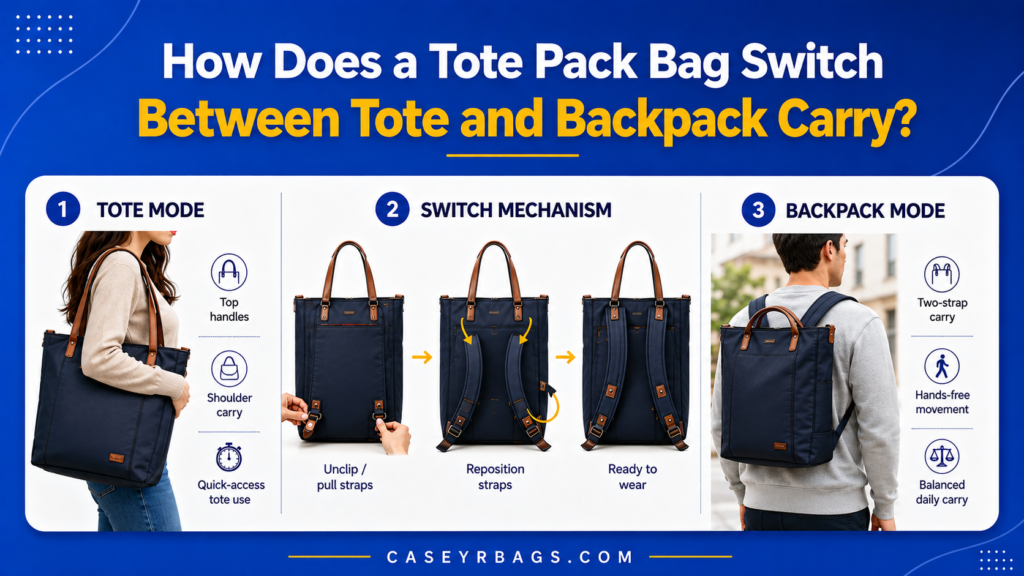
How Does a Tote Pack Bag Switch Between Tote and Backpack Carry?
A Tote Pack Bag switches between Tote and Backpack carry by transferring the active carry role from its Tote handles to a two-strap Backpack system while keeping inactive components, bag orientation, opening access, and load position under control. Tote mode suspends the bag through its handles, while Backpack mode activates shoulder straps through upper and lower anchors to create a different load path.
Effective conversion requires more than simply adding extra straps. Routing, adjustment hardware, stowage, body orientation, and the position of the primary opening must continue to work after the switch. Multiple straps ≠ effective carry conversion, and carry-mode change ≠ bag-type change. The same Tote Pack body remains the central structure; only the active support system and its interaction with the body change.
What Does Tote-to-Backpack Carry Conversion Mean in a Tote Pack Bag?
Tote-to-Backpack carry conversion means one Tote Pack body supports two carrying configurations by shifting active load support between Tote handles and Backpack shoulder straps. In Tote mode, the handles suspend the body from their attachment points; in Backpack mode, two shoulder straps use upper and lower anchors to support the same body against the back.
The switch depends on how the second carry system is integrated and controlled. Fixed straps may remain attached while being folded or stowed, detachable straps may connect only when needed, and adjustment hardware determines whether the active strap path reaches the intended length and routing without twisting.
The same Tote Bag body must remain usable after conversion. Contents, pockets, and the primary opening should keep a functional orientation, while inactive components stay clear of the active mode. Two carry systems ≠ successful conversion unless the transition preserves access, orientation, and practical control.
Which Components Directly Control Tote Pack Carry Conversion?
The components that directly control conversion are the Tote handles, Backpack straps, upper anchors, lower anchors, adjustment hardware, buckles or clips, stowage zones, and the attachment panels that connect those parts to the bag body. Each component determines whether the active carry system can be engaged cleanly and whether the inactive system can remain controlled.
The useful relationship is component → conversion role → practical consequence. Upper and lower anchors establish the Backpack strap path, clips can permit attachment or removal, adjusters set usable strap length, and stowage areas reduce interference. Multiple components are only useful when they operate as one clear transition system rather than as unrelated extra straps.
How Does Tote Carry Differ Mechanically From Backpack Carry?
Tote carry suspends the bag body from its Tote handles, placing the active load path through the handle attachments and allowing hand, forearm, or shoulder carry where handle drop permits. The bag often remains farther from the torso and can move more freely as the user walks or repositions it.
Backpack carry activates two straps connected through upper and lower anchors, placing the same body closer to the back and distributing the active support path across both sides. The body orientation may remain the same or change depending on the design. Tote carry and Backpack carry therefore use different support geometry even though the bag itself remains the same type.
Why Does One Conversion System Not Work the Same Way on Every Tote Pack?
One conversion system does not work the same way on every Tote Pack because designs vary in fixed versus detachable straps, exposed versus stowable components, handle length, anchor geometry, body orientation, and opening location. A design with permanently attached Backpack straps may switch quickly but leave more inactive strap material exposed in Tote mode.
A detachable system can create a cleaner inactive configuration but may require more connection steps. Some bodies preserve orientation while others rotate or reposition during the switch. Same two carry modes ≠ same conversion mechanism, so conversion quality should be evaluated from the actual component layout rather than from the simple presence of Tote handles and Backpack straps.
How Do Handles & Backpack Straps Enable the Carry Switch?
Handles and Backpack straps enable the switch by alternating which attachment system carries the Tote Pack’s load while the other system becomes inactive and controlled.
How Do Tote Handles Function During Tote Carry?
During Tote carry, the handle attachments support the suspended bag body and establish the primary active load path. Depending on handle drop, the Tote Pack may be carried by hand, over the forearm, or on the shoulder, but the defining mechanism remains the same: the handles rather than the Backpack straps are supporting the body.
Handle attachment → suspended body → Tote carry position. The Backpack system may still be physically present, but it should not interfere with hand placement, the opening, or the bag’s normal movement. Tote handles do not need to disappear during Backpack mode, but they should remain controlled when they are no longer the active support system.
How Do Backpack Straps Become the Active Carry System?
Backpack straps become active when they are released from storage or inactive positioning, routed correctly, connected where necessary, and adjusted through their intended upper and lower anchor path. The upper anchor supports the top of the strap path while the lower anchor controls the lower connection and helps position the body against the back.
Upper anchor + lower anchor + strap adjustment → active Backpack configuration. Both straps need predictable routing without twisting or crossing into the wrong attachment point. Backpack mode does not automatically increase load capacity; it only changes which structural system is supporting the same Tote Pack body and contents.
What Happens to the Inactive Carry System?
The inactive carry system should remain controlled so it does not dangle, twist, drag, block access, or interfere with the active mode. Depending on the design, inactive straps or handles can remain exposed but secured, be folded, tucked into dedicated sleeves, stored inside a panel, or selectively detached from their anchors.
No one method is universally best. Fixed straps reduce attachment steps but can leave more material exposed; detachable parts create a cleaner inactive mode but add transition actions. Inactive strap control → lower interference → cleaner active mode. The correct solution is the one that keeps unused components predictable during both directions of the carry switch.
| Component | Tote Mode Role | Backpack Mode Role | Conversion Check |
|---|---|---|---|
| Tote handles | Active support | Inactive / controlled | Do they avoid strap and opening interference? |
| Backpack straps | Inactive / controlled | Active support | Can they deploy without twisting? |
| Upper anchors | Inactive or secondary | Top strap support | Is routing clear and stable? |
| Lower anchors | Inactive or secondary | Lower strap support | Do they position the body correctly? |
| Adjusters / clips | Stored or neutral | Length / connection control | Are they accessible during conversion? |
How Does Strap Routing Change During Tote Pack Conversion?
Strap routing changes by moving Backpack straps between controlled inactive positions and their intended upper/lower active anchor path.
How Do Stowable Backpack Straps Work?
Stowable Backpack straps move through a predictable sequence: stored → release → route → attach where required → adjust → active. In Tote mode, the straps remain inside sleeves, panels, channels, or other controlled positions so they do not hang below the bag or obstruct the Tote handles and primary opening.
During conversion, the straps are released and aligned with their intended upper and lower anchor path before adjustment. Dedicated stowage can create cleaner inactive control but adds another conversion action. The benefit is strongest when the storage path is easy to reverse and does not require excessive folding, twisting, or manipulation around the bag opening.
How Do Detachable Strap Systems Change the Conversion?
Detachable strap systems change conversion by allowing Backpack straps to disconnect fully or partially from the bag when they are not needed. The switch can involve releasing clips, reconnecting the strap to designated anchors, checking orientation, and adjusting length before Backpack mode becomes active.
Detachable ≠ automatically easier conversion. Removing the straps can produce a cleaner Tote mode with less inactive material, but reconnecting them creates more transition steps and requires the correct attachment points to remain obvious. A detachable design is effective when disconnection and reconnection are predictable rather than when removability simply adds hardware without improving control.
Why Does Correct Strap Routing Matter?
Correct strap routing matters because twisted, crossed, loosely routed, or incorrectly attached straps can create an unpredictable Backpack load path and interfere with the bag opening or body position. A strap that reaches the wrong anchor may still look connected while pulling the body from an unintended angle or creating excess loose material.
Correct routing → predictable load path → usable carry mode. Before the straps become active, check that each one leaves its storage position cleanly, reaches the intended upper and lower anchors, lies flat, and remains clear of the primary opening. More hardware does not improve conversion when routing remains ambiguous.
How Does Bag Orientation Change Between Tote & Backpack Carry?
Bag orientation matters because contents, openings, and internal organization must remain functional when the Tote Pack changes carry position.
Does the Tote Pack Body Stay in the Same Orientation?
Some Tote Pack designs preserve the same body orientation in both modes, so the top, base, and primary opening remain in the same relative positions while only the active carry system changes. This can keep content organization more predictable and reduce the chance that pockets or openings become rotated during conversion.
Other designs reposition or rotate the body to create Backpack mode. That can improve mode-specific carry positioning but may change which edge becomes uppermost and how contents settle. Orientation-preserving and body-repositioning systems can both work; the important requirement is that the transition remains understandable and does not unexpectedly compromise access or load control.
How Does Load Position Change in Backpack Mode?
In Tote mode, the bag body may sit farther from the torso and move more freely from the hand, forearm, or shoulder. In Backpack mode, the same body usually sits closer to the back because the two shoulder straps and their upper/lower anchors pull it into a more rear-positioned configuration.
Tote mode → farther from body, while Backpack mode → closer to back. This can reduce some free swing but can also change how contents settle against the back-facing panel. The effect depends on body orientation, strap adjustment, and internal organization. Backpack positioning should not be treated as proof of greater load capacity.
Why Must Internal Contents Remain Stable During Conversion?
Internal contents should remain reasonably stable because changing carry mode should not unintentionally reorganize the entire load. Loose objects can shift when the body rotates, flexible items can settle toward a new lower edge, and pockets that were upright in Tote mode may face a different direction after conversion.
Carry conversion should preserve a usable content orientation even when some movement is unavoidable. The main opening should still contain the load appropriately, internal pockets should not become functionally inverted, and the second mode should not require routine repacking merely to restore basic access. Stable conversion concerns orientation control, not packing advice.
| Orientation Pattern | Tote Mode | Backpack Mode | Conversion Consequence |
|---|---|---|---|
| Orientation-preserving body | Opening/base stay familiar | Same body direction | More predictable content orientation |
| Body-repositioning design | Primary Tote position | Body rotates or repositions | Greater content-shift potential |
| Loose internal load | May settle toward base | May migrate after switch | Check pocket and opening orientation |
| Controlled internal zones | Predictable positions | More stable after conversion | Lower orientation friction |
How Does Tote Pack Access Change Between Carry Modes?
Access changes because each carry position creates a different physical retrieval path to the main opening and secondary pockets.
How Does Tote Mode Affect Access?
Tote mode can make the bag easier to reposition because the user can lift or rotate it through the active handles before opening the main compartment. A broad upper opening may remain visible during hand or forearm carry, and set-down access can be straightforward when the body rests in its normal Tote orientation.
These are potential access advantages rather than universal rules. Long handles, exposed Backpack straps, or a compressed opening can still create friction in Tote mode. Tote mode ≠ automatically easier access. The correct question is whether the active handles and inactive Backpack components leave the intended opening clear and easy to reach in the actual design.
How Does Backpack Mode Affect Access?
Backpack mode places the main body behind the user, so accessing the primary opening may require removing the bag, rotating it, or repositioning it before retrieval. Some secondary pockets can remain reachable without full removal, but that depends on their placement and whether the active shoulder straps cover or compress those access zones.
Rear positioning changes the retrieval path even when the opening itself is unchanged. Backpack mode should therefore be evaluated for how easily the bag can move from carrying position to access position and back again. A convertible design is not equally effective in both modes simply because both configurations can physically support the body.
Why Should the Primary Opening Remain Usable After Conversion?
The primary opening should remain usable because conversion is incomplete if straps, handles, buckles, or body repositioning block the compartment that contains the main load. Active components should not cover a zipper path, collapse the opening, obstruct a flap, or force the user to undo unrelated hardware before reaching the interior.
Carry conversion → functional opening → usable second mode. Inactive components also need to remain clear of the access path. A strong conversion system changes the support configuration without creating unnecessary retrieval barriers that make the newly activated mode impractical for normal use.
| Access Factor | Tote Mode | Backpack Mode | Verification Question |
|---|---|---|---|
| Primary opening | Often directly repositionable | May require removal/rotation | Does the opening remain unobstructed? |
| Secondary pockets | Depends on handle position | Depends on rear/side placement | Are important pockets still reachable? |
| Inactive straps | Backpack straps controlled | Tote handles controlled | Do unused parts stay clear? |
| Body orientation | Tote access direction | Preserved or repositioned | Does conversion change the retrieval path? |
How Does Load Stability Differ Between Tote & Backpack Carry?
Load stability differs because Tote mode suspends the bag through handles while Backpack mode controls it through two back-positioned straps.
How Does Tote Carry Control the Load?
Tote carry controls the load through the active handles, which suspend the bag body and allow the user to reposition it directly by hand or arm. Because the body can sit farther from the torso, it may swing more freely during walking, especially when contents shift or the Tote is carried from one side.
Hand control can make immediate repositioning easy, but it does not eliminate movement. One-sided shoulder use can also change how the body hangs relative to its opening and internal load. Tote-mode stability should therefore be judged from actual handle control and bag movement rather than from the assumption that suspended carry is inherently more or less stable.
How Does Backpack Carry Change Load Stability?
Backpack carry activates two straps and brings the Tote Pack closer to the back, which can reduce some free swing compared with a loosely suspended Tote configuration. Upper and lower anchors create a more defined two-strap path, and strap adjustment determines how tightly the body is held in its intended rear position.
This change does not establish greater load capacity. Backpack mode ≠ automatic heavier-load capacity. Stability can still be weakened by loose adjustment, twisted routing, body rotation, shifting contents, or an opening that does not remain appropriate for the new orientation. The mode only changes how the same bag is controlled.
When Can One Carry Mode Become Less Suitable for the Same Load?
One carry mode can become less suitable when the same contents interact differently with weight, bulk, duration, movement, strap control, or access frequency. A bulky load may swing excessively in Tote mode, while the same load may press awkwardly against the back or interfere with strap routing in Backpack mode.
Same Tote Pack + same contents ≠ identical behavior in both modes. Frequent retrieval can favor the mode with the simpler access path, while repeated movement can favor the mode that better controls the body. The useful comparison is mode-specific behavior, not a universal claim that one configuration is always superior.
Which Tote Pack Conversion System Best Fits Repeated Carry Switching?
The better conversion system is the one whose transition steps, inactive-component control, orientation, access, and stability remain practical during repeated switching.
How Many Conversion Steps Are Practically Necessary?
The practical number of conversion steps depends on what must be released, connected, adjusted, stored, rotated, or reopened before the second mode is fully usable. A fixed-strap design may require fewer attachment actions but more inactive-strap control, while a detachable system may require additional clipping and reconnection steps.
Fewest steps ≠ automatically best. A slightly longer sequence can still be stronger if each action is obvious and creates a cleaner final mode. Repeated switching should be judged by whether the sequence remains predictable, reversible, and free from unnecessary rework rather than by step count alone.
When Is Strap Storage Worth Prioritizing?
Strap storage is worth prioritizing when inactive straps would otherwise dangle, twist, drag, obstruct the opening, catch on surrounding objects, or interfere with the active carry position. Dedicated sleeves, pockets, or channels can keep Backpack straps contained in Tote mode and reduce the need to manually wrap or secure them elsewhere.
The trade-off is an extra storage and release action during conversion. Storage is most valuable when it materially improves the inactive mode and remains easy to reverse. If the straps already stay controlled without dedicated stowage, another storage layer may add complexity without solving a meaningful interference problem.
Which Criteria Should Be Verified Before Choosing a Tote Pack Carry System?
- Tote carry position is practical.
- Backpack carry position is practical.
- Active anchors are clear and correctly paired.
- Inactive straps and handles remain controlled.
- The conversion sequence is understandable.
- Body orientation remains appropriate.
- The main opening remains usable.
- Load stability remains acceptable in both modes.
- Reverse conversion works without unnecessary complexity.
The strongest repeated-conversion fit comes from a system that can move between both modes without unclear routing, uncontrolled components, unexpected body rotation, or access loss. The criteria should be tested in both directions because a conversion that works smoothly into Backpack mode but becomes awkward when returning to Tote mode is only partially successful. Repeated-use fit also improves when the active anchors remain obvious, the inactive carry system stays controlled, and the main opening can be restored cleanly without unnecessary extra steps after each switch.
For a narrower work-use case, see Office Commuting Strap Arrangement.
| Conversion Trait | Potential Advantage | Possible Trade-Off | Repeated-Switch Check |
|---|---|---|---|
| Fixed Backpack straps | Fewer attachment steps | More inactive strap exposure | Do they stay controlled in Tote mode? |
| Detachable straps | Cleaner inactive mode | More connection steps | Are anchors obvious and reversible? |
| Dedicated stowage | Strong inactive control | Extra release/store action | Is storage fast and predictable? |
| Orientation-preserving body | More predictable contents | May constrain mode-specific positioning | Does each carry position still work? |
How Can Tote-to-Backpack Carry Conversion Problems Be Avoided?
Tote Pack conversion problems are avoided by evaluating the complete transition rather than judging convertibility from visible strap count alone.
Why Is Judging a Tote Pack From Strap Count Alone a Mistake?
Visible strap count does not reveal whether the carry systems are actually integrated, correctly routed, stowable, compatible with the bag’s orientation, or clear of the primary opening. A bag can display Tote handles and two shoulder straps yet still convert poorly if the inactive components dangle or the active straps reach awkward anchor positions.
Two carry systems ≠ successful carry conversion. The meaningful test is whether one system becomes active while the other becomes controlled, and whether orientation, access, and stability remain usable after the switch. Convertibility is a transition quality, not a simple count of available straps.
How Can Inactive Straps Interfere With Tote Pack Use?
Inactive straps can interfere by dangling below the bag, tangling with active handles, dragging against surfaces, covering the main opening, bunching behind the body, or shifting into a position that complicates the next conversion. Loose components can also make the active carry mode look and feel unfinished even when the main support system works.
Inactive strap control → lower interference → cleaner active mode. The correct response can be folding, tucking, stowing, securing, or detaching depending on the design. No method should be ranked universally; the goal is to keep the unused carry system predictable and out of the active mode’s functional path.
What Should Be Verified Before Switching Between Tote & Backpack Carry?
- Tote handles are identified.
- Backpack straps are identified.
- Upper anchors are identified.
- Lower anchors are identified.
- Correct strap routing is understood.
- Backpack straps activate without twisting.
- Inactive straps remain controlled.
- Inactive Tote handles remain controlled.
- Tote handles do not obstruct Backpack mode.
- Backpack straps do not obstruct Tote mode.
- Bag orientation remains appropriate.
- Contents remain stable enough for the switch.
- Main opening works in both modes.
- Important pockets remain usable.
- Tote-mode stability remains acceptable.
- Backpack-mode stability remains acceptable.
- Conversion reverses without unnecessary complexity.
Run the checklist in both directions using the normal conversion sequence and the bag’s usual contents. Confirm that each active strap follows the intended anchors, inactive components remain controlled, the body keeps a usable orientation, and the primary opening stays functional after every switch. If twisting, obstruction, unexpected rotation, content movement, or unstable positioning appears, correct the routing or component control before treating the design as a successful two-mode system. Revalidate Tote mode and Backpack mode separately after the change.
These are qualitative conversion-fit outcomes, not universal comfort, posture, or load-capacity ratings.
Conclusion
A Tote Pack Bag switches between Tote and Backpack carry by transferring the active load path from Tote handles to a two-strap Backpack system while controlling inactive components, orientation, access, and load position. The conversion depends on handles, upper and lower anchors, strap routing, adjustment hardware, stowage, and body design working as one transition system.
Multiple straps ≠ effective carry conversion, carry-mode change ≠ bag-type change, and convertible design ≠ equal performance in both modes. CaseyrBags evaluates Tote Pack conversion by how effectively the active support system changes while inactive components, opening access, and load orientation remain controlled. An effective Tote Pack conversion allows Tote handles and Backpack straps to alternate as the active carry system while keeping the bag usable in both modes.
FAQs
No. Backpack straps can be fixed, foldable, stowable, partly detachable, or fully removable. The important requirement is that they become active through the correct routing and remain controlled when inactive. Removability can create a cleaner Tote mode, but it also adds connection steps and is not automatically easier.
Not necessarily. Strong conversion should preserve a usable content orientation, although loose items may shift when the bag changes position. Designs that rotate the body may create more movement than orientation-preserving systems. The main opening and important pockets should still remain functional without requiring routine full repacking.
Yes. Tote handles can remain exposed when they stay controlled and do not materially obstruct the Backpack straps, primary opening, body position, or normal movement. They do not need to disappear for conversion to work. The key requirement is that inactive handles remain predictable while the shoulder straps become the active system.