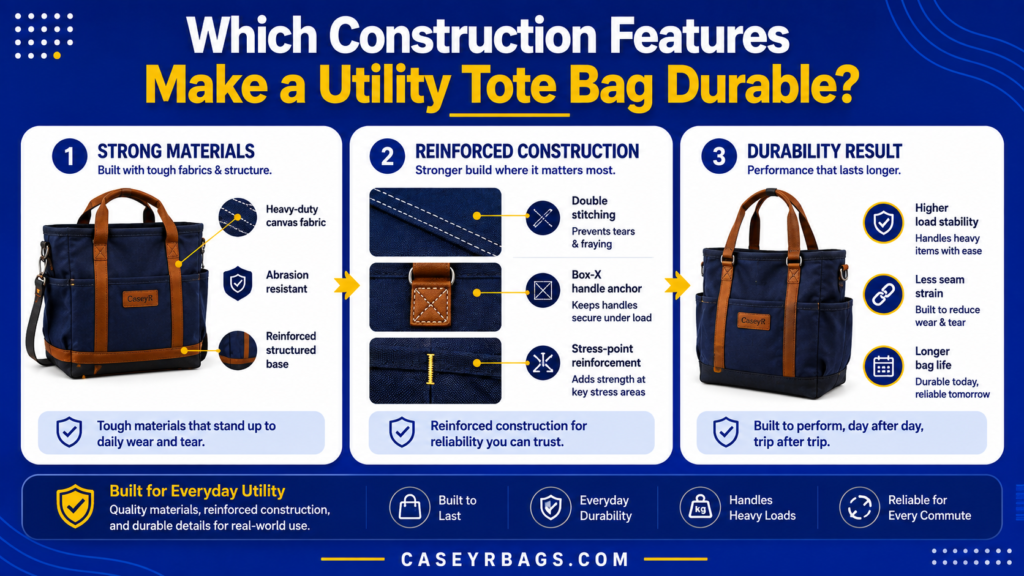
Which Construction Features Make a Utility Tote Bag Durable?
A durable Utility Tote Bag depends on a connected construction system in which body material, load-bearing seams, handle anchors, base structure, gussets, edge finishing, and closures work together to resist repeated loading and structural wear. Durability is not created by one rugged-looking feature; it develops from how well all major load and wear zones remain integrated through repeated carrying, movement, flexing, abrasion, and set-down cycles.
Material strength ≠ whole-bag durability, and visible reinforcement ≠ verified durability. Strong fabric can still be limited by weak seams, a reinforced handle can still depend on fragile surrounding material, and a rigid-looking base may still wear at corners or junctions. The correct evaluation follows the entire construction path and asks whether structural and high-contact zones remain suitable for repeated utility use.
What Construction Features Directly Determine Utility Tote Bag Durability?
Utility Tote durability depends on how effectively its load-bearing and wear-resistant construction zones work together during repeated carrying, loading, movement, and set-down use. The body contains the load, structural seams join the panels, handle anchors transfer carrying force, and the base supports contents while the bag is lifted, moved, and placed on surfaces.
Connected weaknesses matter because one strong feature cannot compensate for a weak neighboring zone. Strong material + weak seam → weak durability system, while strong anchor + weak surrounding panel → the same result. The broader Tote Bag structure provides the parent context for this narrower Utility Tote durability question.
Durability also depends on wear zones outside the main load path. Bottom corners, opening edges, closure attachments, and contact surfaces experience repeated rubbing, folding, impact, and handling. A durable construction system therefore combines structural integrity with wear resistance instead of treating load-bearing strength and surface durability as the same property.
Which Parts of a Utility Tote Receive the Most Structural Stress?
The highest structural stress zones usually include handle anchors, top-edge seams, side seams, gusset seams, base seams, bottom corners, opening edges, and closure attachment zones. These areas repeatedly receive tension, panel movement, load transfer, contact, or flexing as the Tote is lifted, filled, carried, set down, and reopened.
Stress zone → repeated demand → durability consequence. Handle anchors receive concentrated carrying force, seams maintain panel continuity, the base and corners support contents and contact surfaces, and closure attachments experience repeated opening force. The exact limiting zone varies by construction, so durability should be assessed across all connected high-demand areas rather than from one reinforced location.
How Do Load-Bearing & Wear-Resistant Features Differ?
Load-bearing construction resists the tension and structural demand created by carried contents, while wear-resistant construction resists abrasion, rubbing, flexing, fraying, and surface deterioration during repeated contact. A seam or handle anchor can remain structurally strong while an exposed edge gradually abrades, and a wear-resistant panel can still depend on a weak joining seam.
Durability requires both structural integrity and wear resistance. Load strength does not automatically predict long-term wear behavior, and abrasion resistance does not establish load capacity. The two systems overlap at corners, seams, and attachment zones, but they should still be evaluated as distinct durability functions within the same Utility Tote.
Why Can One Strong Feature Not Make the Entire Utility Tote Durable?
One strong feature cannot make the entire Utility Tote durable because repeated use transfers demand through connected materials, seams, anchors, base zones, edges, and closures. A strong body panel can still be limited by weak stitching, a strong seam can still connect to a weak anchor, and a reinforced anchor can still depend on fragile surrounding material.
Strong material + weak seam = weak system; strong seam + weak anchor = weak system; strong anchor + weak panel = weak system. Whole-bag durability depends on connected construction, not isolated strength. The practical question is whether each major structural and wear zone supports the next part of the system without becoming the obvious weak point.
How Does Body Material Affect Utility Tote Durability?
Body material affects Utility Tote durability through resistance to tearing, abrasion, repeated flexing, deformation, fraying, and its ability to support structural seams and reinforcement.
Which Material Properties Matter Most for Utility Tote Durability?
The material properties that matter most are tear resistance, abrasion resistance, dimensional stability, flexibility, resistance to repeated folding, stitch-holding ability, and fray resistance. These properties influence whether the body can contain irregular loads, support seams and anchors, and resist repeated contact at surfaces and edges.
Tear resistance supports local rupture resistance, abrasion resistance helps high-contact areas survive rubbing, and dimensional stability limits progressive distortion. Flexibility can accommodate irregular contents but also creates more fold cycles. No single material property determines durability, so the body should be evaluated by how its combined behavior matches the expected utility environment.
Why Does Thicker Material Not Automatically Mean Better Durability?
Thicker material does not automatically mean better durability because material structure, weave or construction, fiber behavior, seam interaction, repeated flexing, abrasion exposure, and workmanship all influence real performance. A thick panel can still fray, tear beside stitching, crack at repeated fold zones, or depend on poorly integrated seams.
Material thickness ≠ complete durability. A thinner material with strong tear resistance, good stitch retention, and suitable abrasion behavior can outperform a thicker material in some repeated-use conditions. Thickness is therefore one observable property rather than a durability rating, and it should never replace whole-bag evaluation.
How Does Material Flexibility Affect Repeated Utility Use?
Flexible material can adapt around changing or irregular contents, which may reduce rigid shape constraints but creates more repeated folding, creasing, and panel movement. Structured material holds shape more consistently and can stabilize the opening or base, yet repeated flexing may become concentrated at specific edges, seams, or transition zones.
Flexible material → changing shape + more fold cycles, while structured material → stronger shape control + more localized flexing. Neither construction is universally more durable. The useful question is whether the material’s movement pattern matches the expected load and whether seams, reinforcement, and high-wear zones are designed to tolerate that repeated behavior.
| Material Trait | Structural Role | Wear Benefit | Possible Limitation | Durability Relevance |
|---|---|---|---|---|
| Tear resistance | Resists local rupture | Protects stressed zones | Does not prove seam strength | Important near anchors and seams |
| Abrasion resistance | Protects surface integrity | Slows rubbing wear | Does not establish load capacity | Important at base and corners |
| Dimensional stability | Controls deformation | Maintains shape | May shift flexing elsewhere | Important for repeated loading |
| Flexibility | Adapts to irregular contents | Reduces rigid constraints | Creates repeated fold cycles | Important in changing utility loads |
| Stitch-holding ability | Supports seams | Maintains attachment zones | Depends on workmanship | Critical around structural connections |
How Do Seams & Stitching Affect Utility Tote Durability?
Seams and stitching affect Utility Tote durability by maintaining panel connections under repeated tension, flexing, load movement, and wear.
Which Seams Are Most Important for Structural Durability?
The most important structural seams are usually handle-anchor seams, side-panel seams, gusset seams, base seams, top-edge seams, and reinforcement-panel seams. Each one sits in a different part of the load or wear path and must keep connected materials engaged during repeated use.
Seam location → load or wear exposure → durability role. Anchor seams receive carrying tension, side and gusset seams keep the body connected, base seams support lower structure, and top-edge seams stabilize the opening and nearby handle zones. No single seam can represent the whole system, so inspection should follow every meaningful connection from the handles through the body and base.
Which Stitching Characteristics Affect Seam Integrity?
Stitch continuity, stitch spacing, thread integrity, seam allowance, reinforcement, captured material, and workmanship consistency all affect seam integrity. Continuous stitching keeps the connection active, adequate seam allowance keeps enough material engaged in load transfer, and intact thread maintains the intended join between panels or reinforcement layers.
More stitching is not automatically stronger. Spacing that is too dense can perforate weak material, while wide spacing may provide fewer transfer points depending on construction. The useful evaluation combines stitching with surrounding material condition, seam geometry, and repeated load direction rather than ranking one stitch style universally.
Why Can Dense Stitching Sometimes Weaken Surrounding Material?
Dense stitching can weaken surrounding material when closely spaced needle holes create a line of local perforations, reduce the amount of intact material between stitches, or concentrate repeated stress along a narrow path. The thread may remain intact while the body material begins tearing beside the seam.
More stitching ≠ automatically more durable construction. The final result depends on material structure, thread, stitch spacing, seam allowance, and load direction. Dense stitching can be useful when appropriately matched to the material, but it should not be treated as proof that the seam or whole Tote will resist repeated utility demand.
| Seam Factor | Durability Function | Possible Failure |
|---|---|---|
| Continuous stitching | Maintains panel connection | Broken stitch sequence |
| Adequate seam allowance | Supports load transfer | Edge pullout |
| Reinforcement | Distributes local stress | Reinforcement separation |
| Appropriate stitch spacing | Balances connection and material integrity | Excess perforation |
| Strong surrounding material | Supports seam | Tear beside seam |
How Do Handles & Anchor Construction Affect Utility Tote Durability?
Handle anchors affect Utility Tote durability by transferring repeated carrying force from the handles into reinforced attachment zones and the surrounding Tote body.
Why Are Handle Anchors Major Durability Zones?
Handle anchors are major durability zones because every lift transfers handle tension into a relatively small attachment area before that force spreads into the surrounding panel and wider Tote body. Repeated carrying therefore concentrates structural demand at the anchor stitching, reinforcement, and nearby material.
Loaded Tote → handle tension → anchor → body panel. Warning signals include stitch separation, elongated holes, panel stretching, reinforcement lifting, local tearing, and progressive distortion. An anchor can remain visually reinforced while the adjacent body begins failing, so durability should be judged from the entire attachment zone rather than from the stitch pattern alone.
Which Handle-Anchor Features Improve Structural Integration?
Handle-anchor integration can improve when the attachment area is broad enough to spread force, reinforcement layers remain securely joined, handles extend into supported body zones, multiple stitch paths share demand, and the surrounding panel stays intact. These features reduce dependence on one narrow local connection.
Larger attachment area or complex stitching does not guarantee durability by itself. The strongest anchor is the one that integrates with sound surrounding material and downstream seams. One pattern, including Box-X stitching, should not be treated as universally superior because material, thread, workmanship, and load direction still influence performance.
Why Does Surrounding Material Matter as Much as Anchor Stitching?
Surrounding material matters because strong anchor stitching can remain intact while weak or damaged panel material stretches, perforates, or tears around it. In that situation, the stitching itself may not be the first visible failure even though the attachment zone is losing structural integrity.
Anchor durability = stitching + reinforcement + surrounding panel integrity. A strong local anchor only contributes to whole-bag durability when the panel can carry the transferred force into the wider Tote structure. Reinforced handles ≠ durable whole Tote if the connected material, side seams, or base system remains weak.
How Do Base & Gusset Construction Affect Utility Tote Durability?
Base and gusset construction affect durability by supporting contents, controlling Tote shape, and resisting repeated pressure, abrasion, sagging, and set-down wear.
Why Is the Tote Base a High-Demand Durability Zone?
The Tote base is a high-demand zone because it supports the contents during carrying, receives concentrated pressure from dense items, flexes as the load shifts, and repeatedly contacts floors, shelves, counters, or other surfaces during set-down cycles. Bottom corners often receive both structural and abrasion demand at the same time.
Contents → base → seams and corners → structural demand. Warning signs include progressive sagging, abrasion thinning, corner wear, seam separation, and material distortion around dense load points. Base durability therefore depends on both load support and repeated surface exposure rather than on rigidity alone.
How Do Gussets Affect Structural Durability?
Gussets increase Tote depth and connect side panels to the base, allowing the body to expand around changing loads while creating additional structural junctions. They can help distribute irregular contents across a wider volume, but their seams also experience repeated folding, tension, and shape changes as the Tote fills and empties.
Gusset seams create additional structural junctions that must remain intact. Their durability depends on seam continuity, surrounding material, corner geometry, and how the base carries load into the side structure. More gusset depth does not automatically improve durability; it changes the load and flex pattern that the connected construction must manage.
When Does Base Reinforcement Add Useful Durability?
Base reinforcement adds useful durability when repeated abrasion, concentrated loading, excessive sag, or bottom-corner wear would otherwise create a persistent weak zone. Reinforcement can spread local pressure, protect high-contact surfaces, or stabilize the lower body where the normal utility task repeatedly stresses the same area.
More rigid base ≠ automatically more durable Tote. A reinforced panel can still separate from surrounding seams, transfer stress into corners, or become another failure zone if poorly integrated. Reinforcement is most useful when it responds to a real wear or structural demand and remains connected to sound base and gusset construction.
| Construction Feature | Load Role | Wear Exposure | Durability Benefit | Possible Failure Zone |
|---|---|---|---|---|
| Base panel | Supports contents | High surface contact | Controls lower structure | Sagging / abrasion |
| Bottom corners | Connect base and sides | High rubbing / impact | Maintains lower junction | Corner thinning / tearing |
| Gusset seams | Join expandable structure | Repeated flexing | Maintains depth and shape | Seam separation |
| Base reinforcement | Spreads pressure | Depends on surface exposure | Supports high-demand zones | Reinforcement separation |
How Do Edges, Bindings & Closures Affect Long-Term Tote Durability?
Edges, bindings, and closure attachments affect long-term durability because they experience frequent contact, abrasion, flexing, and repeated interaction outside the main load path.
Why Do Opening Edges Need Reinforcement?
Opening edges experience repeated hand contact, pulling, folding, loading abrasion, handle interaction, and closure movement each time the Tote is accessed. Raw or lightly finished edges can fray or distort over time, while folded, bound, or reinforced rims can protect the material and stabilize the opening structure.
The reinforcement must remain well integrated rather than simply covering the edge. A stiff rim can still separate at stitching, and binding can wear through where contact is concentrated. Opening-edge durability therefore depends on both protection and attachment quality across the complete access zone.
How Does Edge Binding Protect High-Wear Areas?
Edge binding can protect raw material, limit fraying, reinforce corners, and absorb repeated rubbing at exposed boundaries. It is especially relevant where cut edges, panel junctions, or bottom corners would otherwise receive direct contact during utility use and set-down cycles.
Binding quality matters more than binding presence alone. Poorly attached binding can loosen, peel, separate at corners, or create another stitch line that becomes a failure point. Effective binding should remain secure while the underlying material flexes and should protect the edge without concentrating wear at the end of the binding path.
How Do Closures Become Durability Weak Points?
Closures become durability weak points because every zipper pull, snap action, hook-and-loop separation, buckle cycle, or magnetic closure movement transfers repeated force into the attachment zone and surrounding material. The closure hardware may remain functional while the fabric, stitching, tape, or reinforcement around it begins separating.
Repeated closure force → attachment zone → surrounding-material demand. A durable closure system therefore depends on secure integration into the opening structure, not just on the hardware itself. Visual inspection should check movement, looseness, tearing, and separation around the attachment rather than only whether the closure still opens and closes.
Which Construction Features Matter Most for Repeated Utility Use?
The most important Utility Tote durability features are those matched to the repeated loading, abrasion, movement, and handling patterns of the Tote’s actual utility context.
How Does Repeated Loading Differ From Occasional Heavy Loading?
Occasional heavy loading creates short-term structural demand, while repeated moderate loading creates cumulative demand across seams, anchors, material, edges, and high-contact surfaces. A Tote can survive one heavy event yet still deteriorate over time when moderate loads repeatedly flex the same seams, pull on the same anchors, or abrade the same corners.
One pattern is not universally more damaging than the other because the result depends on load size, frequency, movement, construction, and wear exposure. The important distinction is that durability concerns repeated performance over time, not simply whether the bag survives one isolated load event.
How Does Load Movement Affect Durability?
Load movement affects durability because shifting contents, swinging, repeated lifting, uneven loading, and set-down or pick-up cycles continually change where tension and contact occur. The same contents can create different stress patterns when they move against side panels, press into corners, or repeatedly pull the body away from one anchor zone.
Repeated movement → changing stress → cumulative construction demand. Static inspection alone does not reproduce that behavior. A durability evaluation should therefore consider how the Tote is normally lifted, moved, set down, and exposed to irregular contents rather than judging only the material at rest.
Which Durability Features Should Be Matched to Utility Context?
Durability features should match the actual utility context, including repeated transport of tools, shopping supplies, work materials, household items, irregular bulky contents, or other recurring loads. Different contexts change which zones receive the most seam demand, anchor tension, base abrasion, edge wear, moisture exposure, and repeated set-down contact.
The correct match links actual exposure to the construction that receives it. A high-abrasion routine may place greater value on protected base surfaces and corners, while irregular bulky contents may increase repeated panel flexing and seam demand. The goal is not to prescribe packing methods but to identify whether the connected durability system matches the expected repeated-use environment.
For the narrower condition question, see Utility Tote Reinforced Seams & Base.
How Can Utility Tote Bag Durability Be Evaluated?
Utility Tote durability should be evaluated by inspecting the whole construction system from body material and structural seams to anchors, base, edges, closures, and progressive wear.
What Can Visual Inspection Reveal About Durability?
Visual inspection can reveal current condition signals such as intact seams, secure anchors, controlled edge fraying, stable base shape, secure closure attachment, and the absence of progressive tearing or elongated stitch holes. It can also identify material distortion, corner abrasion, loose reinforcement, and other changes that suggest repeated structural or wear demand.
Visual inspection reveals current condition, not guaranteed lifespan. An undamaged-looking Tote can still lack verified durability evidence, while visible wear does not automatically reveal the exact remaining service life. Inspection is most useful for locating active deterioration and comparing connected construction zones under the expected use pattern.
Which Early Wear Signals Suggest Reduced Durability?
Early wear signals include seam separation, anchor stretching, fraying, base thinning, corner abrasion, loose reinforcement, closure separation, elongated stitch holes, cracking where relevant, and repeated deformation that no longer returns cleanly to the normal shape. These changes can indicate that the connected construction is losing integrity.
Progressive structural wear → reassess continued utility. One cosmetic mark does not establish failure, but repeated or expanding deterioration in a load-bearing or high-wear zone should reduce confidence in continued durability. The pattern and location of the wear matter more than the simple presence of surface scuffs.
Which Criteria Should Determine Overall Construction Durability?
- Identify the expected utility use.
- Inspect body material condition.
- Locate load-bearing seams.
- Inspect handle anchors.
- Check surrounding reinforcement.
- Inspect base and gussets.
- Check edges and corners.
- Inspect closure attachment.
- Look for progressive wear.
- Judge construction as one connected system.
Overall construction durability should be decided only after these zones are considered together. The strongest fit keeps structural connections intact, high-wear areas controlled, and reinforcement integrated where repeated use creates real demand. If one critical zone shows progressive deterioration, the remaining strong features should not be used to overrule that weakness. The evaluation should reflect the actual utility environment, current whole-bag condition, repeated-use pattern over time, and whether wear is isolated or progressing across connected structural zones rather than relying on a generic durability score.
How Can Utility Tote Construction Mismatches Be Avoided?
Utility Tote construction mismatches are avoided by evaluating the complete structural and wear system rather than treating fabric thickness, reinforced handles, or any single visible feature as proof of durability.
Why Is Judging Durability From Fabric Alone a Mistake?
Judging durability from fabric alone is a mistake because body material does not reveal seam quality, anchor integration, base construction, edge finishing, closure attachment, or workmanship across the complete Tote. A strong panel can still be joined by weak stitching, connect to poorly supported handles, or expose vulnerable corners and edges.
Strong fabric ≠ durable whole bag. Material properties matter, but durability emerges from how the body works with the structural connections and high-wear zones around it. Fabric should therefore be treated as one part of the system rather than as a shortcut for predicting long-term performance.
Why Is Judging Durability From Reinforced Handles Alone a Mistake?
Reinforced handles alone do not prove durability because the handles still depend on anchor stitching, reinforcement layers, surrounding body panels, side seams, gussets, and base structure to transfer repeated carrying force through the Tote. A locally strong attachment can simply move the limiting point into the neighboring material.
Reinforced handle ≠ reinforced Tote system. The useful question is whether the anchor integrates into a connected structural path and whether the downstream seams and panels remain sound. Local reinforcement should therefore support whole-bag durability rather than be treated as evidence that every other construction zone can tolerate the same repeated demand.
What Should Be Verified Before Relying on a Utility Tote for Repeated Use?
- Body material suits expected wear conditions.
- Material has appropriate tear and abrasion resistance.
- Load-bearing seams remain intact.
- Stitching remains continuous and consistent.
- Seam allowances remain secure.
- Handle anchors integrate into supported body zones.
- Anchor reinforcement remains intact.
- Surrounding material shows no progressive tearing.
- Base structure supports normal contents.
- Gusset seams remain intact where present.
- Bottom corners show acceptable wear.
- Opening edges remain adequately finished.
- Bindings or edge reinforcement remain secure.
- Closures remain firmly attached.
- No single feature is treated as proof of whole-bag durability.
- Repeated-use wear is evaluated rather than only one-time load performance.
Apply the checklist to the Tote’s expected repeated-use conditions rather than to a one-time display inspection. Recheck body material, seams, anchors, base and gusset zones, edges, closures, and progressive wear together. If one meaningful zone shows repeated separation, tearing, distortion, thinning, reinforcement loss, or spreading abrasion, reduce confidence in the construction system. Reassess whether the Tote still matches the intended utility environment, whether the weakness affects connected zones, and whether continued repeated use is still consistent with the observed whole-bag condition.
These are qualitative durability-fit outcomes, not guaranteed lifespan estimates, engineering durability scores, or safe-load ratings.
Conclusion
The construction features that make a Utility Tote Bag durable are those that maintain a continuous structural and wear-resistant system from the handles and anchors through the body seams, gussets, base, edges, and closures. Body material must resist the relevant tearing, abrasion, flexing, and deformation while structural connections keep the load path intact under repeated use.
Material strength ≠ whole-bag durability, visible reinforcement ≠ verified durability, and load capacity ≠ long-term wear resistance. CaseyrBags evaluates Utility Tote durability by how effectively materials, structural connections, reinforcement, and high-wear zones work together under repeated real-use demands. A durable Utility Tote combines wear-resistant body material with intact seams, integrated handle anchors, supported base construction, protected high-wear edges, and reinforcement placed where repeated use actually creates stress.
FAQs
No single feature determines whole-bag durability. Body material, seams, handle anchors, base construction, edges, closures, and high-wear zones operate as one connected system. A strong feature only adds value when the neighboring construction can carry or resist the same repeated structural and wear demands.
Not automatically. Thickness may influence performance, but durability also depends on tear resistance, abrasion behavior, seam integration, stitching, anchor support, reinforcement, repeated flexing, and expected use. A thicker material can still fail at weak seams or high-wear zones, so thickness should not be treated as a complete durability rating.
Reinforced anchors can improve how repeated handle force enters the body, but they do not determine whole-bag durability alone. Surrounding material, structural seams, the base, gussets, edges, and closures must also remain sound. A locally strong anchor cannot compensate for deterioration elsewhere in the connected construction system.