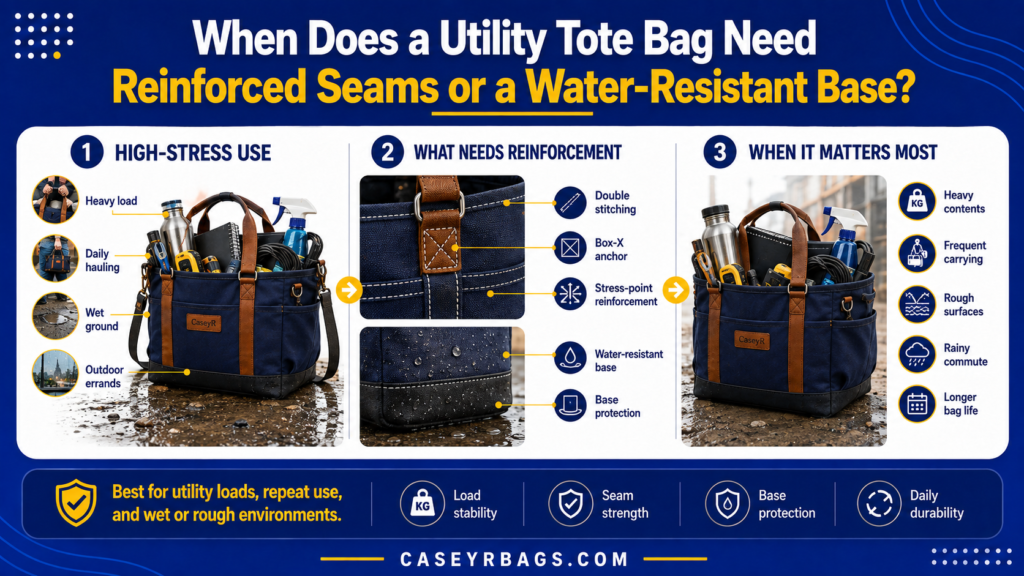
When Does a Utility Tote Bag Need Reinforced Seams or a Water-Resistant Base?
A Utility Tote Bag needs reinforced seams when repeated carrying creates meaningful structural stress along load-bearing connections, while a water-resistant base becomes more useful when repeated floor contact exposes the lower bag to moisture or similar environmental wear. Seam stress usually develops around handle anchors, side seams, gussets, and base seams, whereas base-protection demand comes from damp floors, wet ground, spills, rough surfaces, and repeated set-down contact.
Structural reinforcement ≠ moisture protection, and a water-resistant base ≠ a waterproof bag. Some Utility Totes need reinforced seams only, some need localized base protection only, some need both, and lower-demand routines may need neither. The correct decision depends on the actual failure mechanism: recurring load tension should lead to structural reinforcement decisions, while repeated moisture or abrasion exposure should lead to lower-bag protection decisions.
What Determines Whether a Utility Tote Needs Reinforced Seams or Base Protection?
A Utility Tote needs reinforced seams, base protection, or both according to whether normal use creates structural load stress, repeated lower-bag environmental exposure, or both conditions together. Handle anchors, side seams, gussets, and base seams receive recurring tension when dense contents, repeated lifting, or shifting loads create sustained structural demand.
Base protection solves a different problem. Damp floors, wet ground, spills, rough surfaces, repeated set-down cycles, and bottom-corner contact expose the lower Tote to moisture, abrasion, or both. The broader Tote Bag structure provides the parent context for this narrower reinforcement and base-protection question.
Different failure mechanisms require different protection features. Reinforced seams improve structural connection and load transfer, while a water-resistant base reduces localized lower-bag moisture exposure. Neither feature should be added simply because it looks durable; the useful choice follows actual recurring stress, exposure, and wear in the Tote’s intended utility environment.
Which Use Conditions Create a Need for Reinforced Seams?
Reinforced seams become more relevant when repeated moderate-to-heavy loads, dense contents, frequent lifting, shifting loads, concentrated handle-anchor stress, loaded gussets, or repeated carrying cycles create recurring structural demand. These conditions repeatedly pull on the same load-bearing connections rather than producing only an isolated short-term event.
Use condition → seam stress → reinforcement need. Warning signals include seam distortion, local stretching, repeated anchor pull, progressive opening at panel joins, or visible concentration of force around a narrow connection. Reinforcement should answer those actual load paths and does not establish a universal safe load rating or guarantee that every connected zone can tolerate the same demand.
Which Conditions Create a Need for a Water-Resistant Base?
A water-resistant base becomes more useful when the Tote is repeatedly set on damp floors, wet ground, spill-prone surfaces, outdoor areas, cleaning environments, dirty floors, or other locations where the lower panel contacts moisture. Repeated contact matters more than a single incidental exposure because it creates a recurring lower-bag protection need.
Base exposure → moisture risk → protection need. The purpose is localized protection at the bottom panel and nearby corners, not whole-bag waterproofing. A water-resistant base may add little value in a consistently dry, controlled environment, while frequent damp or spill-prone contact can make lower-bag moisture resistance a meaningful durability feature.
Why Does One Protection Feature Not Solve Both Problems?
One protection feature does not solve both problems because reinforced seams and water-resistant base materials address different failure mechanisms. Reinforced seams improve structural connection where load transfer creates repeated tension, while a water-resistant base reduces localized moisture transfer through the lower panel during contact with damp or wet surfaces.
Different failure mechanism → different protection feature. Structural reinforcement does not make the base moisture-resistant, and a coated or water-resistant base does not strengthen weak handle anchors or load-bearing seams. A Utility Tote should therefore receive the feature that matches the observed structural or environmental demand rather than using one visible durability feature as a substitute for another.
When Do Utility Tote Seams Need Reinforcement?
Utility Tote seams need added reinforcement when repeated load transfer creates enough recurring tension, distortion, or anchor demand that ordinary panel connections become a meaningful durability concern.
How Does Repeated Loading Increase Seam Demand?
Repeated loading increases seam demand because each lifting cycle transfers tension through handle anchors, top-edge connections, side seams, gussets, and base seams. Even when one load event does not cause visible damage, recurring tension can gradually change stitch holes, seam alignment, surrounding material, or the way force moves through the connection.
Repeated lift → tension cycle → seam demand. Watch for stitch fatigue, material distortion, progressive seam opening, repeated anchor pull, and changes that appear only after many carrying cycles. No universal cycle-count threshold applies because construction, material, load distribution, and carrying frequency vary from Tote to Tote.
Which Seams Usually Face the Greatest Structural Demand?
The seams with the greatest structural demand are usually those nearest the load path: handle-anchor seams, top-edge seams near the handles, side-panel seams, gusset seams, and base seams. Their relative importance depends on how the Tote body transfers force from the active handles into the lower and side structure.
Actual stress depends on the Tote’s load path and construction. A broad anchor can reduce local concentration while a loaded gusset can move more demand into side or base junctions. The correct inspection follows the actual force path instead of assuming the same seam is always the limiting zone.
When Is Ordinary Seam Construction Likely to Be Sufficient?
Ordinary seam construction is more likely to be sufficient when routine loads remain light, carrying frequency is lower, contents stay relatively stable, the Tote shows little structural distortion, and standard seams are adequately supported by sound surrounding material. In these conditions, added reinforcement may solve no meaningful recurring stress problem.
Ordinary seams are not inherently weak. Their suitability depends on the expected load path, material, seam allowance, stitch integrity, and repeated-use demand. If standard construction remains stable under the intended utility pattern, reinforcement can add bulk or stiffness without addressing a real durability need.
| Use Condition | Structural Demand | Reinforcement Priority |
|---|---|---|
| Light stable load | Lower | Added reinforcement may not be needed |
| Repeated moderate load | Moderate | Inspect key load seams |
| Dense shifting load | Higher | Reinforcement becomes more relevant |
| Frequent lifting | Repeated tension | Anchor/seam reinforcement gains importance |
| Visible distortion | Elevated warning | Reassess construction and load |
How Do Reinforced Seams Improve Utility Tote Durability?
Reinforced seams improve Utility Tote durability by spreading recurring load stress across a broader or better-supported construction zone rather than leaving force concentrated at one ordinary connection.
How Does Reinforcement Spread Seam Stress?
Reinforcement spreads seam stress by increasing the supported area available to receive recurring tension. Extra material layers, wider attachment zones, additional stitch paths, or reinforced seam allowances can help move force away from one narrow line and into a broader section of sound material.
Localized tension → broader reinforced area → distributed load transfer. The benefit depends on integration: reinforcement must remain connected to material that can continue carrying the load. Added layers or stitching alone do not prove stronger durability when the surrounding panel or downstream seam remains the weaker part of the path.
Why Do Handle-Anchor Seams Need Special Attention?
Handle-anchor seams need special attention because handle tension enters the Tote at a relatively concentrated location before spreading into the surrounding panel. Repeated lifting can therefore create recurring pull at the anchor stitching, reinforcement edge, and nearby material even when the handles themselves remain intact.
Handle tension → anchor → surrounding panel. Reinforcement should spread that force rather than create a hard transition where stress simply moves to the edge of the reinforced area. Strong anchor stitching cannot compensate for weak surrounding material or a poorly supported downstream seam.
Why Can Reinforced Seams Still Fail?
Reinforced seams can still fail when surrounding material is weak, stitch quality is inconsistent, seam allowance is inadequate, thread is damaged, repeated distortion continues, abrasion affects the same zone, or actual loading exceeds what the complete construction can tolerate. Reinforcement changes the load path but does not remove structural limits.
Reinforced seam ≠ unlimited seam capacity. A locally strong seam can transfer failure into adjacent material, another junction, or a weakened anchor panel. Reinforcement should therefore be evaluated as one part of the whole structural system rather than as a guarantee of load capacity or service life.
When Does a Utility Tote Need a Water-Resistant Base?
A water-resistant base becomes useful when repeated lower-bag contact with damp, wet, spill-prone, or similar surfaces creates meaningful localized moisture exposure.
Which Environments Create Meaningful Base Moisture Exposure?
Meaningful base moisture exposure can occur on damp floors, wet pavement, vehicle floors, workshop surfaces, utility rooms, markets, outdoor ground, spill-prone work areas, and similar environments where the Tote is repeatedly placed on surfaces that are not consistently dry. Frequency and contact pattern matter more than the location label alone.
Repeated moisture contact increases the value of localized lower-bag protection because the bottom panel and corners are the first zones to meet the surface. This does not mean the entire Tote needs waterproof construction. The requirement remains limited to the actual exposure path created by normal set-down use.
How Does Repeated Set-Down Contact Change Base Requirements?
Repeated set-down contact changes base requirements because the lower panel experiences both environmental exposure and mechanical wear that upper body panels may avoid. Every set-down can add contact with moisture, dirt, rough texture, hard surfaces, or localized pressure at bottom corners and base seams.
Repeated set-down → surface contact → moisture + abrasion exposure. Even a modest exposure becomes more important when it happens repeatedly. The base should therefore be judged by the surfaces it normally contacts, not by the appearance of the upper Tote body or by a single occasional placement.
When Is a Standard Fabric Base Sufficient?
A standard fabric base is more likely to be sufficient when the Tote is used mainly in dry indoor settings, floor contact is limited, surfaces are clean and controlled, moisture exposure is infrequent, and the base shows no repeated abrasion or deformation pattern that requires specialized protection.
Water resistance should answer an actual exposure pattern. Adding a coated or otherwise water-resistant base to a low-exposure Tote may provide little practical value while increasing material complexity or stiffness. Standard construction remains appropriate when the normal environment does not create a recurring lower-bag moisture problem.
| Environment | Moisture Exposure | Surface Abrasion | Base Protection Need | Main Concern |
|---|---|---|---|---|
| Dry controlled interior | Low | Low | Standard base may be sufficient | Routine wear |
| Damp smooth floor | Moderate–high | Low | Water-resistant base gains value | Moisture transfer |
| Dry rough surface | Low | Higher | Abrasion-focused protection | Surface wear |
| Wet rough surface | Higher | Higher | Combined lower-bag protection | Moisture + abrasion |
How Does a Water-Resistant Base Protect Utility Tote Contents?
A water-resistant base provides localized lower-bag protection by reducing moisture transfer from wet or damp contact surfaces into the bottom of the Utility Tote.
How Does Base Material Reduce Moisture Transfer?
Base material reduces moisture transfer when its construction resists or slows penetration from a damp contact surface into the lower Tote panel. A coating, laminated layer, denser surface, or other water-resistant construction can create a more protective barrier at the exact zone that contacts the floor or ground.
Wet surface → protected base layer → reduced moisture penetration. The effect remains localized and depends on seams, corners, wear condition, and material integrity. A water-resistant base should therefore be described as lower-bag protection rather than as evidence that the entire Tote can prevent water entry from every direction.
Why Do Bottom Corners Need Attention as Well as the Flat Base?
Bottom corners need attention because they combine rubbing, folding, impact, seam exposure, and direct surface contact in a smaller area than the flat base. They can wear faster than the center panel and may create entry or failure points even when the broad bottom surface remains in good condition.
Base panel + corner construction → effective lower-bag protection. Moisture-resistant material across the center panel adds limited value if the corners abrade through, seams separate, or repeated flexing weakens the same junction. Corner condition should therefore be inspected as part of the base system rather than as a separate cosmetic issue.
Why Does a Water-Resistant Base Not Make the Entire Tote Waterproof?
A water-resistant base does not make the entire Tote waterproof because water can still enter through untreated seams, side panels, the opening, closure areas, stitching, or other materials that do not share the same resistance. Localized bottom protection addresses one exposure path, not every possible route into the bag.
Water-resistant base = localized protection. It can reduce moisture transfer from contact surfaces without changing the rest of the Tote into a waterproof enclosure. Whole-bag waterproof claims require evidence beyond the presence of a protected base and should not be inferred from appearance alone.
How Should Abrasion Resistance & Water Resistance Be Balanced?
Utility Tote base protection should balance moisture resistance with abrasion durability because lower-bag wear can come from rough contact even in dry environments.
When Does Abrasion Matter More Than Water Resistance?
Abrasion matters more than water resistance when the Tote repeatedly contacts dry rough floors, hard surfaces, textured shelves, concrete, or other abrasive areas without meaningful moisture exposure. Repeated dragging, set-down cycles, and bottom-corner rubbing can thin or damage material even though the environment stays completely dry.
Dry environment can still create high base wear. In that situation, surface toughness and corner protection may solve the actual failure mechanism more directly than moisture resistance. A coated base that resists water but abrades quickly can still be a poor match for the environment.
When Do Moisture & Abrasion Occur Together?
Moisture and abrasion occur together on wet pavement, rough workshop floors, outdoor surfaces, transport areas, utility spaces, and other environments where the Tote meets both liquid exposure and textured contact. The base and bottom corners can then experience wetting and surface wear during the same repeated set-down cycle.
Moisture exposure + rough contact → combined base demand. In these conditions, a moisture-resistant surface that lacks abrasion durability may wear through, while a tough abrasive-resistant surface without useful moisture resistance may still allow dampness to transfer into the lower panel. The two properties should therefore be considered separately and together.
Why Should Base Material Be Evaluated as Part of the Whole Construction?
Base material should be evaluated as part of the whole construction because the protected panel still depends on base seams, side-panel connections, bottom corners, gusset integration, and surrounding material. A durable-looking bottom surface can still fail if its attachment to the rest of the Tote is weak.
Strong base panel + weak attachment = weak protection system. The lower-bag construction must keep the protective material connected while carrying normal loads and tolerating repeated set-down cycles. Base protection therefore works best when structural integration and environmental resistance support the same use pattern.
| Base Condition | Moisture Demand | Abrasion Demand | Primary Construction Need |
|---|---|---|---|
| Dry smooth floor | Low | Low | Standard base may be sufficient |
| Dry rough surface | Low | Higher | Abrasion resistance |
| Damp smooth floor | Higher | Low–moderate | Water-resistant base |
| Wet rough surface | Higher | Higher | Combined base protection |
When Does a Utility Tote Need Both Reinforced Seams & a Water-Resistant Base?
A Utility Tote needs both features when repeated use creates meaningful structural load stress and meaningful lower-bag moisture or abrasion exposure at the same time.
Which Utility Contexts Create Both Load & Base-Protection Demands?
Contexts that can create both demands include repeated supply transport, tool or equipment support, heavier market or shopping use, workplace utility carry, and mixed indoor/outdoor handling where the Tote is repeatedly loaded and also set on wet, dirty, or rough surfaces. The exact environment matters more than the category label.
Combined demand appears when the same routine stresses both structural load paths and lower-bag exposure zones. Reinforced seams can address recurring tension while base protection addresses moisture or abrasion. Neither feature should be added merely because the other one is justified.
How Should Reinforcement Priorities Be Ordered?
Reinforcement priorities should begin by identifying the load path and highest-stress seams, then identifying the base-contact pattern, moisture exposure, abrasion exposure, and whether those environmental demands recur often enough to justify lower-bag protection. The goal is to match each feature to a defined mechanism.
- Identify the load path.
- Identify the highest-stress seams.
- Identify the base-contact pattern.
- Identify moisture exposure.
- Identify abrasion exposure.
- Reinforce only zones matching actual demand.
Add every possible durability feature is the wrong strategy. More features can add bulk, stiffness, complexity, or unused material without improving the limiting zone. Prioritize the weakest recurring mechanism first, then add a second protection feature only when a separate exposure pattern clearly justifies it.
When Would Adding Both Features Be Unnecessary?
Adding both features is unnecessary when routine loads are light, carrying frequency is limited, the Tote remains structurally stable, floor contact is infrequent, the environment is dry and controlled, and no meaningful seam distortion, bottom wear, or recurring moisture exposure appears during normal use.
Durability features should match exposure, not simply increase feature count. A Utility Tote that faces only structural stress may need seam reinforcement without special base treatment, while a low-load Tote in a damp environment may need base protection without added seam reinforcement. Lower-demand conditions can justify standard construction alone.
How Can Reinforced Seam & Base-Protection Needs Be Evaluated?
Reinforcement and base-protection needs should be evaluated through a repeatable sequence that separates structural seam demand from environmental lower-bag exposure before deciding whether one or both features are justified.
What Should Be Inspected at the Seams?
Inspect handle-anchor stitching, load-bearing seam continuity, seam separation, elongated stitch holes, reinforcement integrity, gusset seams, base seams, and surrounding-material distortion. These observations show whether recurring load transfer is concentrating demand at a structural connection or whether the standard seam system remains stable.
The location matters as much as the symptom. A small change at a major anchor zone can be more structurally relevant than surface wear far from the load path. Visual inspection reveals current seam condition but does not establish a specific safe load rating or future service life.
What Should Be Inspected at the Base?
Inspect moisture marks, coating or surface wear, abrasion, thinning, bottom-corner damage, exposed seams, surface cracking where relevant, and repeated deformation. These signals help separate moisture-related base exposure from rough-surface wear and identify whether the lower panel is losing protective or structural integrity.
Base inspection should include the flat panel, seams, corners, and surrounding gusset or side connection. A broad water-resistant surface can still be limited by an abraded corner or exposed junction, while a dry base can still show significant mechanical wear from repeated contact.
Which Criteria Should Determine the Final Construction Need?
- Identify the normal utility load.
- Identify carrying frequency.
- Inspect load-bearing seams.
- Check handle-anchor stress.
- Identify floor-contact frequency.
- Identify moisture exposure.
- Identify abrasion exposure.
- Determine whether seam reinforcement is needed.
- Determine whether base protection is needed.
- Determine whether both are justified.
The final construction need should follow the dominant recurring mechanism rather than a feature checklist alone. Low structural demand and low exposure support standard construction; repeated load stress supports seam reinforcement; lower-bag moisture or abrasion supports base protection; and repeated structural plus environmental demand supports combined protection. Reassess when the use pattern changes, because the same Tote can move from one fit category to another as carrying frequency, contents, floor contact, environmental exposure, visible wear patterns, or repeated deformation changes across connected major construction zones.
How Can Utility Tote Reinforcement Mismatches Be Avoided?
Utility Tote reinforcement mismatches are avoided by targeting the actual structural or environmental failure mechanism rather than adding reinforcement where it does not solve the problem.
Why Is Reinforcing Every Seam Unnecessary?
Reinforcing every seam is unnecessary because only some connections sit on meaningful repeated load paths. Adding material or stitching to low-demand seams can increase bulk, stiffness, complexity, and material use without improving the zones that actually receive handle tension, gusset demand, or repeated structural distortion.
More reinforcement ≠ automatically better durability. Reinforcement should target the seams where recurring load stress is observed or expected from the real utility pattern. The strongest approach protects meaningful stress zones while leaving adequately supported lower-demand connections unchanged and avoiding extra construction where no recurring structural demand exists.
Why Is Choosing a Water-Resistant Base From Appearance Alone a Mistake?
Choosing a water-resistant base from appearance alone is a mistake because a glossy, coated, laminated, or dark lower panel does not establish actual water resistance, abrasion resistance, seam protection, or long-term performance. Visual finish can suggest a construction difference without proving how that material behaves under repeated use.
Water-resistant appearance ≠ verified base performance. The useful evaluation considers actual moisture exposure, floor-contact frequency, abrasion, corner condition, base seams, and how the protective layer remains integrated after repeated set-down cycles. Appearance should not replace evidence of the feature’s intended function.
What Should Be Verified Before Relying on Reinforced Seams or Base Protection?
- Normal utility load is identified.
- Load-bearing seams are identified.
- Handle-anchor zones are inspected.
- Side and gusset seams remain intact.
- Base seams remain structurally sound.
- Repeated seam distortion is checked.
- Floor-contact frequency is understood.
- Moisture exposure is identified.
- Abrasion exposure is identified.
- Bottom-corner wear is checked.
- Seam reinforcement sits where load stress actually occurs.
- Base protection matches actual moisture exposure.
- Water-resistant base is not treated as whole-bag waterproofing.
- Structural reinforcement is not treated as moisture protection.
- Neither feature is added solely for appearance.
- Combined protection is used only when both stress and exposure justify it.
Apply the checklist to the actual repeated-use environment rather than to an empty Tote or a single inspection moment. Recheck the load path, high-demand seams, floor-contact pattern, moisture and abrasion exposure, bottom corners, and base condition together. If a protection feature does not match the recurring failure mechanism, treat that as a construction mismatch and re-evaluate whether standard construction, seam reinforcement, base protection, or combined protection better fits the use pattern.
These are qualitative protection-fit outcomes, not universal safe-load ratings, lifespan guarantees, or whole-bag waterproof classifications.
Conclusion
A Utility Tote Bag needs reinforced seams when repeated loading creates meaningful stress along handle anchors, panel seams, gussets, or base connections, while a water-resistant base becomes useful when repeated floor contact exposes the lower bag to moisture-prone conditions. Abrasion can create a separate base-protection need even when the environment stays dry.
Structural reinforcement ≠ moisture protection, a water-resistant base ≠ a waterproof bag, and visible reinforcement ≠ verified load capacity. CaseyrBags evaluates Utility Tote reinforcement by separating structural load demand from lower-bag environmental exposure so each feature matches the problem it is meant to solve. Reinforced seams are justified by structural load demand, while a water-resistant base is justified by repeated lower-bag moisture exposure; both are appropriate only when actual use creates both forms of stress.
FAQs
No. Reinforcement becomes more useful when repeated loading, dense contents, frequent lifting, handle tension, or visible structural distortion create greater seam demand. A Tote used with light stable loads and adequately supported standard seams may not benefit from added reinforcement simply for appearance.
No. A water-resistant base provides localized protection against moisture from contact surfaces. Untreated seams, side panels, openings, closures, and other materials remain separate exposure paths. The presence of a protected base should therefore not be interpreted as evidence that the whole Tote is waterproof.
It can be useful indoors when the Tote is repeatedly placed on damp, spill-prone, workshop, utility, or frequently cleaned surfaces. Dry controlled indoor use with little floor contact may not justify specialized base protection. The decision should follow actual recurring exposure rather than the indoor label alone.