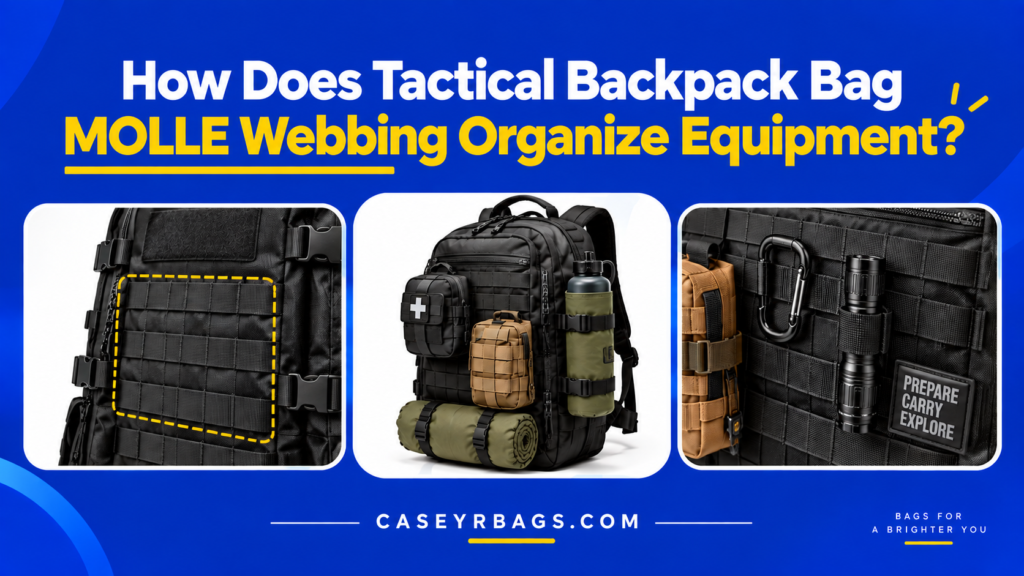
How Does Tactical Backpack Bag MOLLE Webbing Organize Equipment?
Tactical Backpack Bag MOLLE webbing organizes equipment by providing a structured external attachment grid where compatible pouches, holders, and removable modules can be positioned according to function and access priority. The webbing does not organize equipment by itself; it creates repeatable mounting positions that allow the external storage layout to be configured.
This system can separate equipment into dedicated external zones, make selected items easier to identify, and allow modules to be removed or repositioned as the carried set changes. Effective MOLLE organization still depends on secure attachment, sensible module placement, opening clearance, internal storage roles, and reasonable load balance. More attachment space or more pouches does not automatically create a better organization system.
What Does MOLLE Webbing Do on a Tactical Backpack Bag?
MOLLE-style organization begins with horizontal attachment rows arranged across selected areas of the Backpack. These rows create repeatable positions where compatible pouches, holders, or removable modules can connect, rather than functioning as storage compartments themselves.
The organizational value comes from configuration. Instead of relying only on permanent pockets, external modules can be assigned to different zones and changed when the carried equipment changes. The broader Backpack Bag page places this external modular organization within balanced loading, load stability, compartment structure, and modular organization.
The system works best when every attached module has one clear role. Filling unused webbing without a functional reason adds bulk and search complexity without necessarily improving organization. Available mounting space is optional architecture rather than storage that must always be occupied.
What Is the Difference Between MOLLE Webbing and the Attached Pouch?
MOLLE webbing provides attachment architecture, while the pouch, holder, or removable module provides the actual storage component. The webbing defines where compatible equipment can connect to the Backpack surface, but it does not hold contents directly in the way a pocket or compartment does.
Attachment system + compatible storage module = configurable organization. This distinction prevents the grid itself from being mistaken for storage capacity. Organization begins only when a module with a clear role is attached in a position that supports access, retention, opening clearance, and the complete load layout.
How Does the Webbing Grid Create Attachment Positions?
The webbing grid creates attachment positions through horizontal rows with repeated intervals that allow compatible attachment interfaces to connect across a defined Backpack surface. The repeated structure gives modules more than one possible position instead of fixing every external storage role permanently.
Grid → repeatable attachment position → compatible module. The concept is functional rather than instructional. The grid creates connection opportunities; module size, role, attachment security, and available surface determine which positions are actually useful for the intended organization.
Why Does Webbing Coverage Not Equal Organization Quality?
Webbing coverage does not equal organization quality because organization still depends on module choice, placement, retention, access priority, load balance, and actual use. A Backpack can have a large attachment field while using it poorly through duplicated pouches, blocked openings, or random storage roles.
Available mounting space ≠ useful organization. More rows increase configuration options, but they also increase the number of possible poor placements. The practical measure is whether selected modules create clearer equipment zones and easier retrieval without adding unnecessary depth, imbalance, or search friction.
How Does MOLLE Webbing Create Equipment Zones?
Attachment areas can divide external storage into purposeful front, side, or upper zones when each module has a distinct role and does not interfere with the rest of the Backpack.
How Can Front, Side & Upper Attachment Zones Serve Different Roles?
A front zone can support expandable external organization, side zones can support narrower accessory modules, and an upper area can support smaller accessible modules where the Backpack design permits. These positions are organizational zones rather than mandatory locations for specific equipment.
Different surfaces change access, depth, balance, and opening clearance. A front module may increase total Backpack depth, while a side module can affect left-right balance. Zone choice should therefore follow the module’s role and load effect rather than filling whatever attachment area is available.
Why Should Each Module Have One Clear Organizational Role?
Each module should have one primary role because purposeful zoning reduces duplicated storage, random placement, unnecessary pouch opening, and repeated searching. When a pouch has a stable function, its contents become easier to identify and the external layout becomes more predictable.
Module role → predictable location → faster identification. A module can hold several small items, but its organizational purpose should remain clear enough that the user knows why the pouch is attached and when it should be accessed. Ambiguous modules create extra search locations.
When Does Adding More Zones Create Unnecessary Complexity?
Adding more zones becomes excessive when roles overlap, too many small pouches divide similar contents, the same category appears in multiple places, or retrieval requires deciding among several nearly identical modules. Extra zones can increase visual clutter and organizational friction even when attachment space remains available.
More zones ≠ clearer organization. Expansion is useful only when each new zone reduces a real storage or access problem. If a pouch duplicates another role or is usually empty, removing it can create a simpler and more effective layout.
| Attachment Zone | Organization Role | Main Consideration |
|---|---|---|
| Front zone | Configurable external storage | Added depth |
| Side zone | Separate accessory storage | Left-right balance |
| Upper zone | Smaller accessible modules | Opening interference |
| Internal storage | Protected central storage | Less direct external access |
How Does MOLLE Module Placement Affect Equipment Access?
Module placement affects access because retrieval priority should influence how direct, predictable, and unobstructed the selected attachment zone is.
Where Should Higher-Frequency Equipment Modules Be Positioned?
Higher-frequency modules should occupy a direct and predictable location that can be identified without searching across several external zones. The principle is organizational rather than anatomical: frequently retrieved contents should not be hidden behind lower-priority storage or blocked by overlapping modules.
Higher retrieval frequency → more direct, predictable location. The best zone depends on the Backpack design, module size, openings, and other storage already present. No single body-relative position works universally, so access should be evaluated through retrieval steps and opening clearance.
Where Should Lower-Frequency Modules Be Positioned?
Lower-frequency modules can occupy zones where immediate retrieval matters less, provided they remain secure and do not interfere with more important storage. These modules can sit in less direct areas or remain internal when external access does not provide a meaningful advantage.
Access priority → module position. Lower priority should not consume prime access space when higher-frequency storage needs that location. The objective is a hierarchy in which module position reflects actual retrieval demand rather than visual prominence.
Why Can Too Many External Quick-Access Modules Reduce Efficiency?
Too many quick-access modules can create visual clutter, duplicated priorities, more search locations, blocked openings, and unnecessary external bulk. When every pouch is treated as high priority, the user loses the hierarchy that makes quick access useful in the first place.
Quick access works only when priority remains selective. A smaller number of clearly defined high-frequency zones usually creates stronger retrieval predictability than spreading urgent items across many similar modules. More external pouches can therefore reduce access quality instead of improving it.
How Does MOLLE Attachment Keep Modules Secure?
Effective MOLLE organization depends on attached modules remaining in the intended position instead of moving independently enough to reduce access predictability or interfere with nearby storage.
How Does Interwoven Attachment Improve Module Retention?
Interwoven attachment increases retention by distributing the connection between module attachment straps and Backpack webbing rows across more than one contact point. This relationship helps reduce excessive independent movement between the module and the Backpack surface during normal carrying.
Module attachment straps + Backpack webbing rows → distributed connection. The important organizational effect is a more stable module position, not a step-by-step attachment procedure. Secure integration keeps the pouch where the user expects it to remain and supports predictable access.
Why Does a Loosely Attached Pouch Weaken Organization?
A loosely attached pouch can swing, shift, change item position, interfere with nearby modules, and become harder to access consistently. Even when the module stays connected, excessive independent movement reduces the value of assigning it a precise organizational location.
Organized location must remain a stable location. Attachment security is therefore part of organization architecture, not only physical retention. A module that repeatedly moves away from its expected position creates friction and can also alter the Backpack’s balance during movement.
Why Does Module Size Need to Match the Available Attachment Area?
Module size should match the supported attachment area because oversized or poorly supported modules can extend beyond the intended zone, move excessively, block nearby storage, or create weak structural integration. Compatibility involves both connection and practical placement.
A compatible module is not equally effective in every location. The same pouch may work well on one area and poorly on another if it blocks an opening, lacks enough supported surface, or adds unnecessary depth. Placement should therefore consider both size and available attachment architecture.
How Does MOLLE Organization Affect Backpack Load Balance?
External module placement changes Backpack load distribution because every attached pouch adds weight, depth, and position outside the fixed internal storage system.
How Can Side-Mounted Modules Create Left-Right Imbalance?
A dense side-mounted module can shift the external load away from the Backpack centerline and create different demand on the left and right sides. The effect depends on item density, module size, internal loading, and what is attached elsewhere on the bag.
Dense module on one side → off-center external load → asymmetric Backpack behavior. External equipment remains part of total Backpack load distribution. A side module should therefore be judged as part of the complete load rather than as separate storage that does not influence balance.
How Can Front-Mounted Modules Change Backpack Depth?
Front-mounted modules can increase overall Backpack depth by positioning some storage farther from the main internal load zone. Greater depth can change bag geometry, create more external bulk, and increase the distance between external contents and the Backpack centerline.
This is a mechanical load-layout issue rather than a medical claim. Front storage can be useful for access or temporary expansion, but the added depth should remain proportionate to the organizational benefit and should not block openings or destabilize normal movement.
How Should Paired or Multiple Modules Be Evaluated for Balance?
Multiple modules should be evaluated by item density, module size, left-right placement, total external weight, and the resulting Backpack shape. Identical pouch count does not guarantee equivalent loading because the contents inside those modules can differ substantially.
The goal is reasonable balance, not forced symmetry. Two sides do not need identical modules, but concentrated dense storage on one side should trigger a check of the complete load layout. Module roles and access value should be preserved without allowing external storage to dominate balance.
| Module Placement | Possible Load Effect | Main Check |
|---|---|---|
| Centered front | Adds rearward depth | Total external weight |
| Left side only | Can shift load left | Left-right balance |
| Right side only | Can shift load right | Left-right balance |
| Distributed modules | Can spread external storage | Combined density |
| Oversized front module | Adds bulk and depth | Stability & access |
How Do MOLLE Webbing & Internal Compartments Work Together?
MOLLE-based external storage should complement the Backpack’s internal organization instead of replacing central protected storage or duplicating every fixed compartment role.
Which Equipment Is Better Suited to Internal Organization?
Internal organization is better suited to items needing protection, dense items that benefit from central positioning, flat items, enclosed contents, and equipment that does not require frequent external access. Internal storage also reduces external depth and protects the main load relationship from unnecessary expansion.
The choice should remain functional rather than based on a fixed equipment list. If internal sleeves, compartments, or organizers already provide secure and predictable storage, moving the same role outside through MOLLE may only duplicate capacity and add bulk.
When Does a MOLLE-Mounted Module Add Real Value?
A MOLLE-mounted module adds real value when it provides useful separation, a removable equipment group, direct external access, temporary expansion, or a reconfiguration option that the internal layout cannot provide efficiently. The benefit should be specific and repeatable.
External modularity is strongest when the module can be added for one use pattern and removed when that need disappears. If the pouch remains permanently attached without adding a distinct storage or access role, fixed internal storage may be simpler.
Why Should External Modules Not Duplicate Every Internal Compartment?
Duplicating internal compartments externally can create redundant storage, extra bag weight, increased bulk, and more search locations. The user may then have several possible places for the same category of item, weakening retrieval predictability instead of improving it.
Internal and external organization should divide roles, not duplicate them. The internal system should handle protected central storage effectively, while MOLLE modules should solve storage needs that benefit specifically from removability, separation, expansion, or external access.
| Storage Method | Main Strength | Main Limitation |
|---|---|---|
| Main compartment | Central protected capacity | Less immediate access |
| Internal organizer | Controlled small-item storage | Fixed internal space |
| MOLLE pouch | Removable external zone | Added bulk |
| Side module | Separate accessory storage | Balance considerations |
| Front module | Expansion + access | Increased bag depth |
How Does MOLLE Webbing Support Modular Reconfiguration?
MOLLE webbing supports reconfiguration by allowing external storage roles to change while the base Backpack remains the same.
How Can Modules Be Changed When the Equipment Set Changes?
When the carried equipment set changes, a module can be removed, repositioned, or replaced so the external storage map matches the new organizational need. This allows selected storage roles to change without rebuilding the fixed Backpack interior or changing the base bag.
Different equipment set → remove module → reposition or replace module → revised organization. The important benefit is not constant reconfiguration for its own sake, but the ability to change only the storage zones that need to change when the item set changes.
When Is Removable Modular Storage More Useful Than Fixed Pockets?
Removable modular storage is more useful when work equipment changes, separate equipment groups need to stay together, temporary extra storage is required, or daily requirements shift enough that permanent pockets would be inefficient. A module can then appear only when its role is needed.
The benefit comes from changing storage roles while keeping the base Backpack stable. When the contents rarely change, the same flexibility may offer little practical advantage and can simply add attachment hardware or extra decision points.
When Is Fixed Organization More Efficient Than MOLLE Reconfiguration?
Fixed organization is often more efficient when daily contents remain stable, item positions are predictable, external expansion is rarely needed, and the user prefers a simpler storage map. Permanent zones can reduce setup and retrieval decisions when reconfiguration provides no repeated benefit.
Modularity provides value only when organization actually needs to change. If attached modules remain permanently in the same positions and serve roles already covered internally, a simpler fixed layout may provide equal or better organization with less bulk and complexity.
When Does MOLLE Expansion Become Excessive?
MOLLE expansion becomes excessive when additional external storage starts increasing bulk, imbalance, opening interference, or search friction faster than it improves organization.
Why Is Filling Every Webbing Row a Weak Organization Strategy?
Unused attachment space does not represent a problem that must be solved. Filling every row can add unnecessary bulk, external weight, visual clutter, and blocked access even when some attached modules have no clear or frequently used role.
Available mounting space ≠ useful organization. The grid is valuable because it provides options, not because every option must be occupied. Selective use preserves adaptability while keeping the external layout easier to understand and manage.
How Can Stacked or Oversized Modules Reduce Usability?
Stacked or oversized modules can increase Backpack depth, overlap openings, make the main compartment harder to reach, and create unstable module placement when the attachment area does not adequately support the module. Extra storage can therefore reduce the usability of existing storage.
Maximum expansion ≠ maximum organization. A module should fit both the attachment area and the surrounding opening geometry. If expansion blocks other zones or creates more movement than storage value, the layout has passed the point of useful modularity.
Which Signal Suggests a Module Should Be Removed?
A module should be reconsidered when its contents are rarely used, its role duplicates another zone, it creates persistent imbalance, blocks an opening, adds unnecessary bulk, or is usually carried empty. These signals show that the pouch is consuming organization space without solving a repeated need.
Removal can improve organization by reducing search locations and restoring clearer storage roles. A modular system is strongest when modules can disappear as easily as they can be added; unused hardware should not become permanent complexity simply because attachment space exists.
How Can MOLLE Organization Be Evaluated as a Complete System?
A complete MOLLE evaluation should combine module role, attachment security, access priority, load balance, Backpack depth, and the internal storage already available.
What Should Be Checked Before Attaching Modules?
Before attaching modules, identify the normal equipment set, group contents by function, note retrieval frequency, identify dense items, and review the internal storage already available. This establishes whether an external module is actually needed or whether the existing Backpack can already organize the item effectively.
The goal is to solve a defined organization problem rather than begin from empty webbing. A module should be justified by separation, access, removability, temporary expansion, or another clear function before its attachment zone is selected.
What Should Be Checked After Modules Are Attached?
After modules are attached, verify secure connection, opening clearance, module accessibility, left-right balance, overall Backpack depth, and continued access to internal storage. The module should remain stable during normal movement and stay in the location the organization system expects.
Also check whether the external storage has duplicated an internal role or created unnecessary search locations. A technically attached pouch can still be organizationally poor if it blocks access, shifts the load, or adds more decisions than value.
Which Sequence Should Determine the Final MOLLE Layout?
Use the sequence in the checklist below so MOLLE organization begins with actual contents rather than available webbing. Internal storage should be used first where appropriate, then modular separation should be added only for equipment that benefits from an external role.
After attachment, test security, opening clearance, balance, movement, and retrieval together. Any module that fails to provide repeated organizational value should be removed. The final layout should remain functional and selective rather than becoming a numerical score or a maximum-expansion target.
- Identify normal equipment.
- Use internal storage first where appropriate.
- Identify equipment needing modular separation.
- Assign each module one primary role.
- Select an appropriate attachment zone.
- Secure the module.
- Check opening clearance.
- Check left-right balance.
- Test normal movement and retrieval.
- Remove modules that do not solve a repeated organization need.
How Can MOLLE Organization Mismatches Be Avoided?
MOLLE mismatches are avoided by assigning modules from actual storage needs instead of treating empty webbing as a requirement to add more external storage.
Why Is Choosing Module Placement From Available Space Alone a Mistake?
Available webbing does not account for access priority, item density, left-right balance, opening clearance, or module size. A physically open attachment point can still be a poor organizational position if the pouch blocks a zipper, moves the load off-center, or creates unnecessary depth.
Available attachment point ≠ correct attachment point. The correct position is the one that supports the module’s role while preserving access and the whole Backpack layout. Attachment opportunity should therefore be treated as a choice rather than a recommendation.
Why Is Adding More Pouches a Weak Solution to Poor Organization?
Adding more pouches is a weak solution when the real problem is unclear item grouping, duplicate equipment locations, poor internal zoning, or unused existing storage. More external volume can multiply search locations without correcting the logic that made the layout confusing.
Fix organization logic before adding storage volume. Clear storage roles, access priority, and internal organization should be resolved first. New modules should then be added only when they solve a specific remaining problem that the existing layout cannot handle efficiently.
What Should Be Verified Before Relying on MOLLE Webbing for Equipment Organization?
Verify that the normal equipment set is understood, internal storage roles remain clear, every external module has a primary purpose, high-frequency contents have predictable locations, and lower-priority items do not consume prime access space. Modules should remain securely attached without blocking openings or fixed pockets.
Also confirm that dense modules do not create major one-sided loading, front storage does not add unnecessary depth, external roles do not duplicate internal storage, and empty or rarely used pouches are removed. Effective MOLLE organization should improve access or adaptability rather than add permanent complexity.
- Normal equipment set is identified.
- Internal storage roles are understood.
- Every external module has a clear purpose.
- High-frequency equipment has a predictable location.
- Lower-frequency equipment does not occupy prime access zones unnecessarily.
- Modules are securely attached.
- Attachment straps remain controlled.
- Modules do not block the main opening.
- Modules do not block important fixed pockets.
- Dense modules are positioned with load balance in mind.
- Side-mounted storage does not create major one-sided loading.
- Front modules do not create unnecessary depth.
- Module size matches the available attachment area.
- External storage complements rather than duplicates internal storage.
- Empty or rarely used modules are removed.
- Webbing rows are not filled simply because they are available.
- MOLLE organization improves access or adaptability rather than adding complexity.
Conclusion
Tactical Backpack Bag MOLLE webbing organizes equipment by creating a structured attachment architecture where compatible external modules can be positioned according to role, access priority, and changing storage needs. The webbing provides the mounting system, while attached pouches, holders, and removable organizers create the actual equipment zones.
Effective MOLLE organization comes from selective use of that grid: modules should have clear purposes, remain securely attached, preserve opening clearance, complement internal storage, and maintain reasonable load balance. More webbing, more pouches, or maximum expansion does not automatically improve organization. The best layout solves repeated storage needs without adding unnecessary bulk, duplicated roles, or unstable external loading.
FAQs
No. MOLLE webbing is primarily attachment architecture rather than a storage compartment. It provides repeatable mounting positions where compatible storage components can connect.
The actual storage comes from pouches, holders, or removable modules attached to the grid. Attachment grid ≠ storage compartment.
No. Unused webbing does not reduce organization quality. Empty attachment space simply preserves the option to add or reposition storage later.
Modules should be added only when they provide useful separation, access, or reconfiguration. Available mounting space ≠ useful organization overall.
Yes. Dense or large modules placed heavily on one side or far from the Backpack’s central load zone can change left-right balance, depth, and movement behavior.
External modules remain part of the complete Backpack load and should be evaluated with the internal contents. Modularity ≠ automatic load balance.