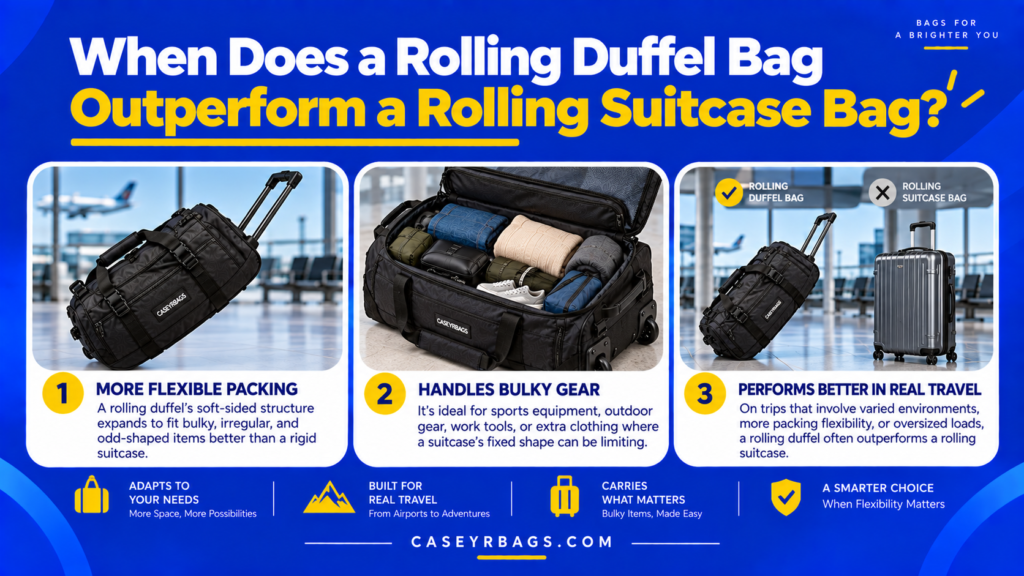
When Does a Rolling Duffel Bag Outperform a Rolling Suitcase Bag?
A Rolling Duffel Bag can outperform a Rolling Suitcase Bag when flexible packing, adaptable cavity shape, and a softer upper structure solve the intended load and storage demands better than a more fixed wheeled shell. This advantage is strongest with bulky, soft, irregular, or changing contents that benefit from a less rigid packing boundary.
The advantage is conditional rather than universal. A Rolling Suitcase may be the stronger fit when shape retention, fixed organization, or persistent exterior geometry matters more, while travel surfaces, lifting transitions, and storage constraints can change the result for either format. Outperform ≠ universally superior, flexible structure ≠ unlimited packing, and rigid shell ≠ unlimited protection.
What Does “Outperform” Mean When Comparing a Rolling Duffel & Rolling Suitcase?
A Rolling Duffel outperforms a Rolling Suitcase only when its structural characteristics better solve the specific packing, movement, and storage demands of the trip. The comparison should therefore begin with the intended contents and travel conditions rather than with a general winner.
The central structural difference is flexibility. A Rolling Duffel typically combines a more flexible upper packing body with a reinforced rolling base, while a Rolling Suitcase generally retains more fixed exterior geometry across a larger portion of the bag.
Neither structural approach is automatically superior. Within the broader Duffel Bag system, flexible geometry supports adaptability around contents, while more rigid geometry supports shape retention and a more predictable packing boundary.
Which Variables Should Determine the Comparison?
The comparison should examine contents, structural flexibility, shape-retention needs, packing organization, travel surfaces, lifting frequency, and storage constraints. These variables reveal whether the Rolling Duffel’s adaptability solves a real trip problem or whether the Suitcase’s fixed geometry provides more useful control.
Feature → mechanism → consequence → best-fit condition. No single variable should determine the result because a format can perform strongly in one dimension and create a meaningful trade-off in another. The stronger fit is the one that solves more important needs with fewer costly mismatches.
Why Is Wheel Presence Alone a Weak Comparison?
Both formats may use wheels, but the body structure surrounding those wheels remains different. A Rolling Duffel combines rolling hardware with a more flexible packing body, while a Rolling Suitcase usually combines wheels with more persistent external geometry and structured interior boundaries.
Same mobility feature ≠ same luggage format. Wheels solve only the surface-supported movement task; they do not erase differences in cavity conformity, storage footprint, lifting behavior, packed-shape control, or organization.
Why Should the Comparison Remain Context-Dependent?
One format may solve flexible packing, partial collapse, or direct repositioning better, while the other may solve fixed geometry, shape retention, or structured organization better. The advantage changes when the contents or trip pattern changes.
Context determines value because the same structural feature can be helpful in one scenario and restrictive in another. Outperform should therefore mean better functional fit for the actual trip, not a universal quality ranking.
How Does Structural Flexibility Differ Between the Two Formats?
Structural flexibility changes how each format responds to irregular contents, external pressure, packed shape, and storage space.
How Does a Rolling Duffel Retain Flexible Packing Behavior?
A Rolling Duffel typically retains flexible sidewalls, a softer upper structure, a conformable main cavity, and a packed profile that changes more strongly with the contents. Its rolling hardware introduces fixed zones without eliminating upper-body adaptability.
Rolling hardware reduces some Duffel flexibility without eliminating it. The bag can therefore combine a structured lower mobility base with a more content-responsive upper packing area, creating a hybrid between soft-sided packing and wheeled movement.
How Does a Rolling Suitcase Retain More Fixed Geometry?
A Rolling Suitcase generally uses more persistent shell boundaries, defined corners, and exterior surfaces that retain their shape regardless of how lightly the interior is packed. Not every suitcase is fully rigid, but the overall geometry is usually less content-responsive than a Duffel.
Fixed exterior boundaries create a more predictable profile and can support consistent internal organization. The trade-off is lower cavity conformity when an irregular item does not align naturally with the shell geometry.
When Does Flexible Structure Become the Stronger Advantage?
Flexible structure becomes stronger when the load includes changing item mixes, bulky soft contents, irregular shapes, or contents that do not need fixed shell geometry. The cavity can adapt around the load rather than forcing the load to match one persistent outline.
That advantage remains conditional on control. If flexibility produces excessive bulging, weak shape retention, or unstable packing, the structural benefit decreases and the Suitcase’s more fixed geometry may become the stronger fit.
| Structural Trait | Rolling Duffel | Rolling Suitcase |
|---|---|---|
| Upper body | More flexible | More fixed |
| Rolling base | Structured | Structured |
| Exterior geometry | Content-responsive | More shape-retaining |
| Collapsibility | Potentially greater | Usually lower |
| Irregular-item conformity | Usually greater | More constrained |
When Does Rolling Duffel Packing Flexibility Become More Useful?
Rolling Duffel flexibility becomes more useful when the intended contents benefit from adaptable cavity geometry more than they need fixed external boundaries.
Which Contents Benefit From a More Adaptable Cavity?
Bulky soft goods, irregular shapes, changing item combinations, and contents that tolerate conformity can benefit from a Rolling Duffel’s less rigid chamber. The sidewalls can respond to the load instead of requiring every item to fit one fixed geometry.
Flexible upper body → conformity around contents → adaptable cavity. This can improve functional use of the available space, but it does not create unlimited capacity or remove the need to control final bulging and load movement.
How Can Fixed Suitcase Geometry Restrict Irregular Contents?
A fixed boundary requires the item to fit within the available shell geometry rather than allowing the exterior to conform around it. Irregular objects may therefore require more deliberate orientation or may leave unusable gaps around their shape.
Fixed boundary → item must fit available geometry → lower cavity conformity. This does not mean fixed geometry automatically wastes space; it means the load must fit the structure rather than strongly reshaping it.
When Does Flexible Packing Stop Being an Advantage?
Flexible packing becomes less useful when the load creates excessive bulging, unstable external shape, poor organization, or weak control around shape-sensitive contents. At that point, adaptability can create more uncertainty than practical benefit.
Packing flexibility becomes less valuable when load control becomes the stronger requirement. The better format then shifts toward whichever structure keeps the contents more predictable under the actual trip conditions.
| Load Type | Rolling Duffel | Rolling Suitcase |
|---|---|---|
| Soft bulky contents | High conformity potential | Fixed cavity |
| Irregular contents | Greater geometry adaptation | More constrained |
| Structured contents | Context-dependent | Predictable fit |
| Shape-sensitive contents | Requires control | Fixed geometry may help |
| Mixed load | Flexible but organization-dependent | More structured boundary |
When Does Rolling Suitcase Shape Retention Become More Useful?
More fixed geometry becomes valuable when the contents benefit from a persistent outer shape, stronger compartment boundaries, or lower exterior deformation.
How Does Fixed Exterior Geometry Support Shape Retention?
A more fixed shell resists exterior deformation and keeps the packed profile closer to the original bag geometry. This can make the overall shape more predictable when internal contents should not strongly reshape the exterior.
Fixed shell geometry → lower exterior deformation → predictable packed profile. Shape retention is a structural property, not a universal guarantee of protection, and internal contents still require appropriate organization and retention.
Which Contents Benefit More From Stable Geometry?
Shape-sensitive, highly structured, organization-dependent, or fixed-orientation contents can benefit from a more persistent boundary. The shell can help keep the exterior form stable when the load itself should not determine the bag’s overall geometry.
The value is strongest when stable boundaries matter more than cavity conformity. A fixed shell can be a better fit for contents that would be poorly served by strong panel movement or an irregular external shape.
Why Does Stronger Geometry Not Automatically Make the Suitcase Better?
Stronger geometry reduces conformity, preserves a persistent storage footprint, and can restrict irregular-item accommodation. The same fixed shape that provides control can become a limitation when the load or storage space is irregular.
More structure ≠ better format fit. The Suitcase becomes stronger only when its shape retention solves a more important trip requirement than the Rolling Duffel’s packing adaptability.
| Content Need | Flexible Duffel Response | Fixed Suitcase Response | Stronger Fit Condition |
|---|---|---|---|
| Irregular soft load | Conforms more readily | Retains fixed cavity | Duffel when conformity matters |
| Shape-sensitive load | Needs added control | Retains outer geometry | Suitcase when stable shape matters |
| Mixed contents | Adaptable but variable | Structured boundary | Context-dependent |
| Fixed organization need | More packing-dependent | More persistent layout | Suitcase when organization dominates |
How Does Wheel-Supported Mobility Compare?
Both formats can reduce continuous carrying on suitable surfaces, but their rolling mobility remains embedded within different body structures and packed geometries.
When Are Their Rolling Benefits Broadly Similar?
On smooth surfaces, long rollable corridors, and routes with limited obstacles, both formats can use wheels to replace continuous carrying for meaningful segments. The basic mobility benefit can therefore look similar when ground conditions dominate the movement task.
Both formats can reduce continuous carrying where wheels can be used. The comparison becomes more meaningful once packing structure, lifting transitions, storage geometry, and the final packed shape are considered alongside the wheel system.
How Can Packed Shape Affect Rolling Duffel Behavior Differently?
A Rolling Duffel’s flexible exterior can develop asymmetric bulging or respond more strongly to internal load migration. Even with a structured rolling base, the upper body can change geometry in ways that influence tilt and tracking.
The Rolling Suitcase generally retains a more persistent external outline. This does not automatically make its wheel system better, but it can create a more predictable body shape while rolling if the internal load is also controlled.
Why Does Wheel Comparison Alone Fail to Identify the Better Format?
Wheel presence does not answer questions about packing structure, storage, lifting, protection, organization, or cavity adaptability. These differences remain even when both bags roll effectively across the same surface.
Wheel presence solves only one part of the travel problem. The better format emerges from how the entire structure behaves before, during, and after the rolling segments.
How Do Lifting & Travel Transitions Change the Comparison?
When wheels cannot perform the movement task, handle access, exterior geometry, direct control, and transition frequency become more important than rolling similarity.
Which Stages Still Require Manual Handling?
Stairs, vehicle loading, storage placement, retrieval, obstacles, and short vertical transfers still require direct control for both formats. Wheels do not remove these stages from the trip.
Frequent manual handling reduces the importance of wheel similarity and increases the importance of how each body structure behaves when lifted, repositioned, or placed into storage.
When Can Duffel-Style Grab/Carry Handling Be Advantageous?
Duffel-style handling can be useful when accessible grab points, a flexible body, manageable load size, and repeated direct repositioning fit the trip pattern. The body may conform slightly during lifts or placement where persistent shell geometry is less helpful.
The advantage is situational rather than ergonomic certainty. If the Duffel is overpacked, unstable, or poorly controlled, flexibility can make direct handling less predictable instead of more useful.
When Does Fixed Suitcase Geometry Make Transitions More Predictable?
A persistent exterior shape can support repeatable orientation, stable set-down geometry, and more predictable hand position during repeated placement. The bag presents the same overall outline each time it is moved.
Fixed geometry does not make a Suitcase universally easier to lift. It simply provides a more consistent object shape, which may matter when repeated transitions favor predictability over conformity.
| Transition | Rolling Duffel Consideration | Rolling Suitcase Consideration |
|---|---|---|
| Stairs | Handle control + flexible body | Fixed shell + handle control |
| Vehicle loading | Lift/reposition | Lift/reposition |
| Storage placement | Potential conformity | Persistent geometry |
| Retrieval | Flexible exterior may shift | Fixed exterior profile |
| Long smooth path | Roll | Roll |
When Does Storage Geometry Favor a Rolling Duffel?
Storage geometry favors a Rolling Duffel when partial upper-body conformity or collapse solves a real space constraint that a persistent shell would not.
How Can a Rolling Duffel Remain More Compressible?
Wheels, base structure, and pull-handle channels remain fixed, but some upper-body zones can still compress or conform when the bag is lightly packed or empty. This gives the Rolling Duffel a partially collapsible storage profile rather than a fully fixed one.
The degree varies by design and packing state. Rolling hardware prevents complete collapse, yet upper-body flexibility can still matter in tight or irregular storage spaces.
Why Does a Rolling Suitcase Retain a More Persistent Storage Footprint?
A more fixed shell keeps its external boundaries even when the interior is empty. This creates a predictable footprint but offers less potential to collapse around a restricted storage geometry.
Fixed shell → fixed external boundaries → lower collapse potential. Not every suitcase has identical rigidity, but the overall structure usually remains more persistent than a soft upper Duffel body.
When Does Storage Flexibility Materially Affect Format Choice?
Storage flexibility matters when available space is restricted, partial collapse is useful, or packing volume changes significantly between uses. In those situations, the Rolling Duffel’s conformable upper zones may create a practical advantage.
If storage space already accommodates a fixed shell comfortably, collapsibility may provide little additional value. The advantage must solve an actual storage constraint rather than remain a theoretical feature.
| Storage Need | Rolling Duffel | Rolling Suitcase |
|---|---|---|
| Partial collapse | More possible in flexible zones | More limited |
| Fixed stacking profile | Less predictable | More predictable |
| Tight irregular space | Greater conformity potential | Fixed geometry |
| Empty storage | Hardware still persists | Shell persists |
Which Contents Most Strongly Favor a Rolling Duffel?
Contents favor the Rolling Duffel when flexible cavity behavior solves their shape and packing needs better than stronger fixed geometry.
When Do Bulky Soft Items Favor Duffel Flexibility?
Bulky soft contents can use a conformable cavity efficiently because the bag can adapt around them instead of requiring every item to align with rigid corners. The upper body can respond to the load while the rolling base preserves ground mobility.
Soft bulky load → conformable cavity → adaptable packed profile. The advantage disappears if the load is pushed until bulging, closure strain, or poor control becomes the dominant result.
When Do Irregular Items Favor a Flexible Rolling Format?
Irregular items favor a Rolling Duffel when they can safely tolerate bag conformity, variable cavity geometry, and softer sidewalls. The exterior can adapt around shapes that would interact awkwardly with a fixed shell boundary.
The benefit depends on the item’s tolerance for deformation and movement. If an irregular item is also shape-sensitive, fixed geometry may become more useful than conformity.
When Should Protection or Fixed Organization Outweigh Flexibility?
Protection or fixed organization should outweigh flexibility when contents are shape-sensitive, require stronger geometric separation, or depend on stable compartment boundaries. These needs increase the value of a more persistent outer structure.
The goal is not to label the Suitcase universally more protective. It is to recognize when shape retention and structured organization solve more important content requirements than flexible packing does.
| Content Characteristic | Rolling Duffel Advantage | Rolling Suitcase Advantage |
|---|---|---|
| Bulky + soft | Stronger | Lower |
| Irregular + compressible | Stronger | Lower |
| Shape-sensitive | Lower | Stronger |
| Fixed organization needed | Context-dependent | Stronger |
| Mixed adaptable load | Stronger | Context-dependent |
Which Travel Patterns Most Strongly Favor a Rolling Duffel?
Travel patterns favor the Rolling Duffel when flexible storage, mixed rolling and direct handling, and changing load geometry matter more than a persistent shell outline.
When Does Mixed Rolling & Carrying Favor a Rolling Duffel?
Trips with rollable segments, repeated lifting, direct repositioning, and flexible storage demands can favor a Rolling Duffel because its structure combines wheels with a softer upper body and multiple direct-control points.
The advantage is strongest when the Duffel’s flexibility remains controlled through those transitions. If the load shifts or bulges excessively, the same flexibility can reduce handling predictability.
When Does Predictable Fixed Geometry Favor a Rolling Suitcase?
A Rolling Suitcase can become the stronger fit when consistent shape, fixed organization, and persistent exterior geometry matter more than cavity adaptation. The shell keeps the bag’s outline more stable across packing and handling stages.
This is useful when the trip values repeatable geometry more than collapsibility or irregular-item conformity. The stronger fit comes from matching structure to the travel task, not from a universal superiority claim.
Why Can the Same Traveler Need Different Formats on Different Trips?
Different trips can involve different contents, surfaces, lifting demands, and storage constraints, so the same traveler may reasonably need a different format depending on the context. A flexible-load trip and a shape-sensitive trip can produce opposite conclusions.
Format fit follows trip requirements, not traveler identity. The decision should be rebuilt around the current load and route each time the structural trade-offs change.
Which Criteria Should Determine the Final Format Choice?
The final choice should compare contents, structure, mobility, lifting, and storage together rather than letting one attractive feature decide the result.
What Should Be Evaluated About the Contents?
Evaluate softness, rigidity, irregular shapes, shape sensitivity, organization needs, and protection priorities. These attributes determine whether adaptable cavity geometry or fixed boundaries create the more useful packing environment.
The same nominal volume can behave differently in the two formats because the load may conform to the Duffel or be constrained by the Suitcase. Functional packing fit therefore matters more than capacity alone.
What Should Be Evaluated About the Trip?
Evaluate rolling distance, surface quality, stairs, lifting frequency, storage space, and repeated travel transitions. These conditions reveal whether wheel-supported mobility or direct handling dominates the trip and whether collapsibility creates real value.
The trip can reverse the structural preference created by the contents. A load that fits both formats may still favor one because of repeated lifts, restricted storage, or a need for persistent external geometry.
Which Sequence Should Determine the Stronger Fit?
Identify normal contents, separate soft or irregular items from rigid or shape-sensitive items, determine fixed-organization and shape-retention needs, then identify expected rolling surfaces plus stairs and lifting transitions. After that, check storage constraints and whether collapsibility matters.
Finally compare the trade-offs of both formats and choose the one that solves more important trip requirements with fewer meaningful mismatches. This keeps the decision context-based instead of converting the comparison into a universal ranking.
How Can Rolling Duffel vs Rolling Suitcase Comparison Mistakes Be Avoided?
Comparison mistakes are avoided by refusing to let capacity, wheel presence, or one successful trip determine a universal winner.
Why Is Capacity Alone a Weak Comparison Rule?
Nominal capacity does not reveal usable geometry, content compatibility, organization, structure, or the final packed shape. Two bags with similar stated volume can interact very differently with irregular or shape-sensitive contents.
Capacity number ≠ functional packing fit. The comparison should focus on whether the usable geometry and structural behavior match the actual contents instead of assuming more stated volume means a better format.
Why Is “Both Have Wheels” a Weak Comparison Rule?
Both formats may use wheel-supported movement, but wheel presence solves only one part of the travel problem. The bodies still differ in cavity conformity, storage geometry, packed-shape behavior, and direct handling.
Same mobility feature ≠ same luggage format. A meaningful comparison must continue beyond the wheels to the structural trade-offs that remain active during packing, lifting, storage, and transitions.
What Should Be Verified Before Deciding That the Rolling Duffel Outperforms the Rolling Suitcase?
Verify that flexible packing provides a real advantage, the contents tolerate softer structure, fixed shell geometry is not the dominant need, rolling surfaces are suitable, lifting transitions remain manageable, and storage flexibility matters enough to influence the trip.
Also confirm that Rolling Duffel base hardware is acceptable, final packed shape remains controlled, and the choice solves more important requirements than it creates. If neither format clearly produces fewer meaningful trade-offs, the result should remain context-dependent rather than forcing a winner.
- Normal contents are identified.
- Soft and bulky items are identified.
- Irregular items are identified.
- Shape-sensitive items are identified.
- Fixed organization needs are identified.
- Exterior shape-retention needs are identified.
- Flexible packing provides a real functional advantage.
- Rolling surfaces are considered.
- Stair and lifting transitions are considered.
- Storage-space constraints are considered.
- Collapsibility needs are identified.
- Rolling Duffel base hardware is accounted for.
- Rolling Suitcase fixed geometry is accounted for.
- Packing flexibility is not treated as unlimited capacity.
- Fixed geometry is not treated as unlimited protection.
- Wheel presence is not used as the only comparison criterion.
- The selected format solves the more important trip requirements.
- Neither format is treated as universally superior.
Conclusion
A Rolling Duffel Bag can outperform a Rolling Suitcase Bag when flexible packing, adaptable cavity geometry, and a partly compressible body solve the intended load and storage requirements better than a more fixed wheeled shell. This advantage is strongest when contents are bulky, soft, irregular, or variable and do not require strong fixed geometry.
The result remains conditional. A Rolling Suitcase can be the stronger fit when shape retention, structured organization, or persistent exterior geometry matters more. The better format is therefore the one whose packing behavior, rolling context, lifting transitions, and storage geometry match the trip with fewer important trade-offs. Neither wheel presence nor capacity alone should determine the winner.
FAQs
No. Flexible cavity geometry can accommodate some bulky or irregular contents more easily because the upper body can conform around the load.
Overpacking, poor load control, shape-sensitive contents, or unstable bulging can remove that advantage. Greater conformity ≠ unlimited capacity, and the final packed shape still needs to remain controlled.
No. More fixed exterior geometry can provide stronger shape retention and a more persistent structural boundary around the packed load.
That does not prove universal impact or damage protection. Shape retention ≠ guaranteed protection, and internal organization, item movement, and actual content sensitivity still matter.
Both can provide wheel-supported movement on suitable surfaces, especially during long smooth travel segments where continuous carrying can be reduced.
Body structure, packed geometry, wheel layout, lifting transitions, and handling still affect their practical behavior. Same wheel feature ≠ same overall travel performance.