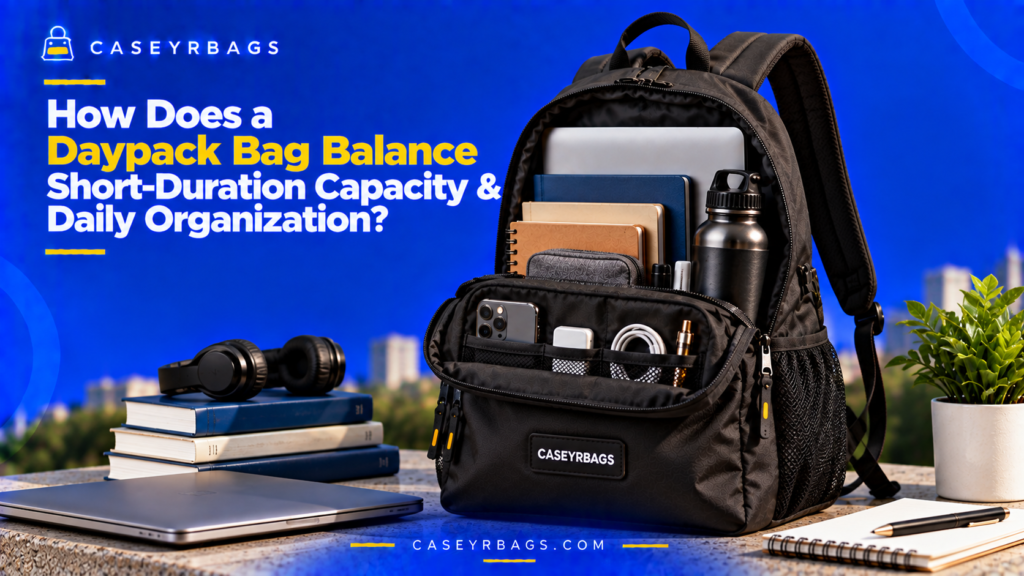
How Does a Daypack Bag Balance Short-Duration Capacity & Daily Organization?
A Daypack Bag balances short-duration capacity and daily organization by providing enough usable space for the essentials needed during a limited period while dividing that space into a small number of purposeful storage zones. A functional main compartment handles larger items, while quick-access pockets, sleeves, and small-item sections keep frequently used contents from becoming buried or mixed together.
The balance depends on more than nominal capacity. Loaded depth, opening geometry, compartment placement, device storage, exterior pockets, compression, and load distribution determine whether the bag remains compact and easy to use once filled. Effective Daypack design therefore aims for sufficient accessible space without turning every available surface into another compartment or forcing the routine load into unnecessary layers.
What Does Capacity-and-Organization Balance Mean in a Daypack Bag?
A Daypack is generally intended to carry a daily or short-duration load rather than the expanded equipment associated with multi-day use. Its capacity therefore needs to support routine essentials without forcing the bag into the size and complexity of a larger travel or expedition pack.
Organization determines how efficiently that usable space functions. A bag with adequate volume can still perform poorly if small items disappear into one chamber, while a highly divided bag can waste useful space when too many fixed pockets compete with larger contents.
A balanced Daypack combines sufficient usable volume, controlled loaded shape, purposeful compartment zoning, and predictable access priority during normal loading and retrieval. Within the broader Everyday Carry category, the Daypack is the short-duration branch focused on adaptable daily storage.
Which features most directly create the balance?
The balance comes from the main compartment, main opening, loaded depth, internal sleeves, quick-access pockets, small-item zones, exterior storage, and compression working as one storage system. Main-chamber geometry provides the physical space, while opening and depth determine how much of that space remains accessible.
Test the condition with the normal intended load and confirm that capacity and organization continue to support each other under the normal loaded condition. Do not treat maximum volume, minimum size, or raw pocket count as the goal. The governing distinction is: Feature → capacity role → organization consequence. Judge the complete loaded system rather than the empty bag alone.
Why is more storage space not automatically better?
More storage space can increase flexibility, but it can also create larger unused zones, deeper loading layers, greater item migration, and more opportunity to add contents that the short-duration task does not require. Extra volume is useful only when the daily load actually benefits from it.
Test the condition with the normal intended load and confirm that the intended short-duration contents fit without forcing crowding, inaccessible layers, or unnecessary bulk. Do not treat maximum volume, minimum size, or raw pocket count as the goal. Judge the complete loaded system rather than the empty bag alone.
Why is more organization not automatically better?
More organization can stabilize item locations, but additional fixed pockets and dividers can fragment the main chamber, duplicate storage roles, create extra search choices, and reduce flexible space for larger contents. Daypack balance comes from enough organization for predictable retrieval, not from maximizing feature count.
Test the condition with the normal intended load and confirm that storage zones reduce item mixing without fragmenting the bag into unnecessary fixed compartments. Do not treat maximum volume, minimum size, or raw pocket count as the goal. The governing distinction is: Daypack balance comes from enough capacity and enough organization—not the maximum of either.. Judge the complete loaded system rather than the empty bag alone.
What Makes Daypack Capacity Suitable for Short-Duration Use?
Explain capacity according to the intended load rather than a universal volume figure.
What does short-duration capacity need to accommodate?
Short-duration capacity needs to support the categories required by the intended daily task: primary essentials, one or more larger routine items, small frequent-use contents, optional flat or device-like items, and limited situational extras. The useful requirement comes from the load, not from one universal liter or item-count target.
Test the condition with the normal intended load and confirm that the intended short-duration contents fit without forcing crowding, inaccessible layers, or unnecessary bulk. Do not treat maximum volume, minimum size, or raw pocket count as the goal. Judge the complete loaded system rather than the empty bag alone.
When is capacity insufficient?
Capacity is insufficient when the normal load creates closure strain, forces constant stacking, requires one item to be removed to reach another, or lets rigid contents distort the bag. Physical fit alone is not enough if access and zoning already deteriorate under that load.
Test the condition with the normal intended load and confirm that the intended short-duration contents fit without forcing crowding, inaccessible layers, or unnecessary bulk. Do not treat maximum volume, minimum size, or raw pocket count as the goal. Judge the complete loaded system rather than the empty bag alone.
When is capacity unnecessarily large?
Capacity can be unnecessarily large when substantial internal space remains unused, contents migrate through that free volume, or the loaded profile stays larger than the routine task requires. Some reserve space can still support realistic daily variation, so spare capacity is not automatically a problem.
Test the condition with the normal intended load and confirm that the intended short-duration contents fit without forcing crowding, inaccessible layers, or unnecessary bulk. Do not treat maximum volume, minimum size, or raw pocket count as the goal. The governing distinction is: Short-duration capacity should match the intended daily load rather than maximize available volume.. Judge the complete loaded system rather than the empty bag alone.
How Does the Main Compartment Balance Capacity & Flexibility?
Explain why the primary chamber needs enough uninterrupted space for larger daily contents.
How does open main-compartment volume support capacity?
How does open main-compartment volume support capacity because 2 focused paragraphs. In practice, the mechanism should be traced through usable capacity, free space, and daily load fit so its consequence for short-duration Daypack function remains explicit.
Test the condition with the normal intended load and confirm that the intended short-duration contents fit without forcing crowding, inaccessible layers, or unnecessary bulk. Do not treat maximum volume, minimum size, or raw pocket count as the goal. Judge the complete loaded system rather than the empty bag alone. A reasonable reserve of space can remain useful when it serves real day-to-day variation.
Why can one completely open chamber reduce organization?
A completely open chamber can reduce organization when small items mix with bulky contents, denser objects move into new positions, and frequent-use items become buried under later-loaded gear. The issue is unrestricted migration, not the existence of one large chamber by itself.
Test the condition with the normal intended load and confirm that larger routine contents retain usable space while predictable items remain controlled. Do not treat maximum volume, minimum size, or raw pocket count as the goal. Judge the complete loaded system rather than the empty bag alone.
How much subdivision should the main chamber contain?
The main chamber should contain only enough subdivision to control predictable content categories while preserving continuous space for larger or irregular items. A sleeve or divider is useful when it gives a stable role to a repeated content type without breaking the chamber into inflexible fragments.
Test the condition with the normal intended load and confirm that larger routine contents retain usable space while predictable items remain controlled. Do not treat maximum volume, minimum size, or raw pocket count as the goal. The governing distinction is: The main compartment should preserve enough flexible volume for larger items while adding only the internal structure needed to control predictable daily contents.. Judge the complete loaded system rather than the empty bag alone.
| Main Chamber | Flexible Volume | Organization | Main Tradeoff |
|---|---|---|---|
| Fully open | High | Low | Item mixing |
| Lightly zoned | High | Moderate–high | Balanced |
| Heavily divided | Lower | High potential | Reduced flexibility |
| Overbuilt | Low | Fragmented | Poor space efficiency |
How Does Loaded Depth Affect Daypack Capacity?
Explain how front-to-back expansion changes usable space and daily compactness.
How can moderate depth support usable capacity?
How can moderate depth support usable capacity because 2 focused paragraphs. In practice, the mechanism should be traced through usable capacity, free space, and daily load fit so its consequence for short-duration Daypack function remains explicit.
Test the condition with the normal intended load and confirm that the intended short-duration contents fit without forcing crowding, inaccessible layers, or unnecessary bulk. Do not treat maximum volume, minimum size, or raw pocket count as the goal. Judge the complete loaded system rather than the empty bag alone. A reasonable reserve of space can remain useful when it serves real day-to-day variation.
When does greater depth become inefficient?
Greater depth becomes inefficient when items stack behind one another, retrieval requires moving through several layers, and the load expands farther outward than the short-duration task needs. The bag may hold more, yet the access path becomes less direct and the loaded profile becomes bulkier.
Test the condition with the normal intended load and confirm that the loaded bag stays compact enough for the intended use without creating unnecessarily deep search paths. Do not treat maximum volume, minimum size, or raw pocket count as the goal. Judge the complete loaded system rather than the empty bag alone.
Why should loaded rather than empty depth be evaluated?
Loaded depth should be evaluated because an empty Daypack shell can collapse and appear much slimmer than it becomes after routine contents fill the chamber and external pockets. Normal intended loading reveals the real front-to-back profile and the actual number of retrieval layers.
Test the condition with the normal intended load and confirm that the loaded bag stays compact enough for the intended use without creating unnecessarily deep search paths. Do not treat maximum volume, minimum size, or raw pocket count as the goal. The governing distinction is: Empty-bag compactness ≠ loaded Daypack compactness. Judge the complete loaded system rather than the empty bag alone.
How Does Opening Geometry Affect Capacity Use?
Explain how the main opening determines how much available interior space can actually be packed and accessed efficiently.
How can a broad opening improve usable capacity?
How can a broad opening improve usable capacity because 2 focused paragraphs. In practice, the mechanism should be traced through usable capacity, free space, and daily load fit so its consequence for short-duration Daypack function remains explicit.
Test the condition with the normal intended load and confirm that the intended short-duration contents fit without forcing crowding, inaccessible layers, or unnecessary bulk. Do not treat maximum volume, minimum size, or raw pocket count as the goal. Judge the complete loaded system rather than the empty bag alone. A reasonable reserve of space can remain useful when it serves real day-to-day variation.
How can a narrow opening reduce practical capacity?
A narrow opening can reduce practical capacity even when the interior is physically large enough, because bulky contents may be difficult to insert and lower zones may remain hard to see or reach. Space that cannot be loaded or retrieved from efficiently is not fully usable capacity.
Test the condition with the normal intended load and confirm that the intended short-duration contents fit without forcing crowding, inaccessible layers, or unnecessary bulk. Do not treat maximum volume, minimum size, or raw pocket count as the goal. Judge the complete loaded system rather than the empty bag alone.
Why is total volume different from accessible volume?
Total interior volume describes theoretical space, while accessible volume is the portion that can be reached, loaded, and retrieved through the actual opening and storage geometry. A bag can therefore measure as roomy yet still make part of that volume difficult to use repeatedly.
Test the condition with the normal intended load and confirm that the intended short-duration contents fit without forcing crowding, inaccessible layers, or unnecessary bulk. Do not treat maximum volume, minimum size, or raw pocket count as the goal. The governing distinction is: Internal volume ≠ easily usable volume. Judge the complete loaded system rather than the empty bag alone.
How Do Internal Compartments Support Daily Organization?
Explain how a limited number of defined zones can reduce item mixing without consuming excessive main-compartment space.
How do compartment roles reduce search?
Compartment roles reduce search when each meaningful zone has a predictable purpose, so the user already knows where a content category belongs. Known storage role leads to predictable item location, which reduces uncertainty and avoids checking several similar pockets.
Test the condition with the normal intended load and confirm that storage zones reduce item mixing without fragmenting the bag into unnecessary fixed compartments. Do not treat maximum volume, minimum size, or raw pocket count as the goal. Judge the complete loaded system rather than the empty bag alone.
Which contents benefit most from dedicated zones?
Dedicated zones are most useful for contents that are easy to lose, likely to move, repeatedly accessed, or geometrically distinct, such as small loose contents, thin flat items, device-like items, and high-frequency essentials. The benefit comes from stable location rather than from assigning every object its own pocket.
Test the condition with the normal intended load and confirm that capacity and organization continue to support each other under the normal loaded condition. Do not treat maximum volume, minimum size, or raw pocket count as the goal. Judge the complete loaded system rather than the empty bag alone.
When does compartment count become excessive?
Compartment count becomes excessive when several pockets perform the same role, larger contents lose usable shared space, or the user must inspect multiple similar sections to find one item. At that point, fixed organization creates both physical fragmentation and additional search complexity.
Test the condition with the normal intended load and confirm that storage zones reduce item mixing without fragmenting the bag into unnecessary fixed compartments. Do not treat maximum volume, minimum size, or raw pocket count as the goal. The governing distinction is: Compartment role matters more than compartment count.. Judge the complete loaded system rather than the empty bag alone.
| Organization Style | Search Predictability | Space Flexibility |
|---|---|---|
| One chamber | Lower | High |
| Few assigned zones | High | High |
| Many specialized zones | High only if used | Lower |
| Repetitive pockets | Low–moderate | Fragmented |
How Should Access Priority Shape Daypack Organization?
Explain why item position should follow retrieval frequency.
Where should frequent-use items generally sit?
Frequent-use items generally benefit from short, predictable access paths such as quick-access zones, upper compartments, or other easily reached internal or external pockets provided by the design. Their exact position is less important than keeping the retrieval path direct and repeatable.
Test the condition with the normal intended load and confirm that frequent-use items remain in predictable accessible zones while lower-priority contents stay out of the way. Do not treat maximum volume, minimum size, or raw pocket count as the goal. Judge the complete loaded system rather than the empty bag alone.
Where should lower-frequency contents sit?
Lower-frequency contents can tolerate deeper main-compartment positions, secondary internal zones, or lower-priority pockets because they are retrieved less often. Their placement should still avoid blocking high-frequency contents or forcing repeated rearrangement of the bag.
Test the condition with the normal intended load and confirm that capacity and organization continue to support each other under the normal loaded condition. Do not treat maximum volume, minimum size, or raw pocket count as the goal. Judge the complete loaded system rather than the empty bag alone. A reasonable reserve of space can remain useful when it serves real day-to-day variation.
Why does access priority improve organization efficiency?
Access priority improves organization efficiency by matching item position to retrieval frequency. When frequently used contents occupy accessible zones, fewer main-compartment searches are needed and lower-priority storage can remain deeper without disrupting normal use.
Test the condition with the normal intended load and confirm that storage zones reduce item mixing without fragmenting the bag into unnecessary fixed compartments. Do not treat maximum volume, minimum size, or raw pocket count as the goal. The governing distinction is: Storage priority should follow retrieval frequency rather than pocket availability alone.. Judge the complete loaded system rather than the empty bag alone.
How Do Quick-Access Pockets Support Daily Organization?
Explain when an easily reached pocket reduces unnecessary opening of the main compartment.
What makes a quick-access pocket useful?
A quick-access pocket is useful when it is easy to locate, offers a direct hand path, has a defined storage role, and keeps search depth limited. Physical accessibility matters only when the user also knows what belongs there.
Test the condition with the normal intended load and confirm that the pocket reduces main-compartment searches without becoming a second clutter chamber. Do not treat maximum volume, minimum size, or raw pocket count as the goal. Judge the complete loaded system rather than the empty bag alone. A reasonable reserve of space can remain useful when it serves real day-to-day variation.
When can quick-access pockets become cluttered?
Quick-access pockets become cluttered when too many unrelated items are added, contents form multiple layers, or the pocket is deep enough to behave like another main chamber. The zone may remain easy to reach while becoming slow to search.
Test the condition with the normal intended load and confirm that the pocket reduces main-compartment searches without becoming a second clutter chamber. Do not treat maximum volume, minimum size, or raw pocket count as the goal. Judge the complete loaded system rather than the empty bag alone. A reasonable reserve of space can remain useful when it serves real day-to-day variation.
Why should a quick-access pocket remain selective?
A quick-access pocket should remain selective so its contents can be retrieved without sorting through a mixed group of low-priority objects. A clear retrieval role preserves the reason the pocket is quicker than opening the main compartment.
Test the condition with the normal intended load and confirm that the pocket reduces main-compartment searches without becoming a second clutter chamber. Do not treat maximum volume, minimum size, or raw pocket count as the goal. The governing distinction is: Quick access works best when the pocket has a clear retrieval role rather than becoming a second main compartment.. Judge the complete loaded system rather than the empty bag alone.
How Should Small Items Be Organized in a Daypack?
Explain why small loose contents require more positional control than larger items.
Why do small items become difficult to retrieve in the main chamber?
Small items become difficult to retrieve in the main chamber because they can settle to the bottom, slide into corners, or disappear behind larger contents. Their size allows them to migrate into spaces that remain visually and physically obstructed by bulkier items.
Test the condition with the normal intended load and confirm that larger routine contents retain usable space while predictable items remain controlled. Do not treat maximum volume, minimum size, or raw pocket count as the goal. Judge the complete loaded system rather than the empty bag alone.
How can small-item pockets improve retrieval?
Small-item pockets improve retrieval by holding loose contents in a predictable location, separating them from larger objects, and reducing clutter at the base of the main chamber. Positional retention shortens the search path because the item does not need to be rediscovered after movement.
Test the condition with the normal intended load and confirm that loose contents remain predictably located instead of settling beneath larger items. Do not treat maximum volume, minimum size, or raw pocket count as the goal. Judge the complete loaded system rather than the empty bag alone.
When can too many small pockets reduce efficiency?
Too many small pockets can reduce efficiency when several zones have duplicated roles, locations are forgotten, or the user repeatedly checks multiple micro-compartments. Excessive micro-zoning fragments storage memory even though every item may technically have a place.
Test the condition with the normal intended load and confirm that capacity and organization continue to support each other under the normal loaded condition. Do not treat maximum volume, minimum size, or raw pocket count as the goal. The governing distinction is: Small-item retention should reduce searching without creating storage fragmentation.. Judge the complete loaded system rather than the empty bag alone.
How Does Device Storage Affect Daypack Capacity & Organization?
Explain how a dedicated flat or padded zone interacts with remaining main-compartment volume.
How can a device sleeve improve organization?
A device sleeve can improve organization by separating one flat, shape-distinct item from the flexible main chamber, preserving a predictable location, and limiting movement within the bag. This is an organization benefit and does not by itself establish any level of device protection.
Test the condition with the normal intended load and confirm that storage zones reduce item mixing without fragmenting the bag into unnecessary fixed compartments. Do not treat maximum volume, minimum size, or raw pocket count as the goal. Judge the complete loaded system rather than the empty bag alone.
How can device storage consume usable capacity?
Device storage can consume usable capacity when thick padding, rigid walls, dedicated depth, or fixed divider geometry occupies space that would otherwise belong to the shared main chamber. That structural cost can remain even when the device zone is only partly used.
Test the condition with the normal intended load and confirm that the intended short-duration contents fit without forcing crowding, inaccessible layers, or unnecessary bulk. Do not treat maximum volume, minimum size, or raw pocket count as the goal. Judge the complete loaded system rather than the empty bag alone.
Why is device fit different from useful Daypack organization?
Device fit answers only whether a particular flat item can occupy the intended zone. Useful Daypack organization must still support the rest of the short-duration load, maintain accessible volume, and preserve predictable storage roles; fit alone also does not prove protective performance.
Test the condition with the normal intended load and confirm that storage zones reduce item mixing without fragmenting the bag into unnecessary fixed compartments. Do not treat maximum volume, minimum size, or raw pocket count as the goal. The governing distinction is: Device fit ≠ complete Daypack organization. Judge the complete loaded system rather than the empty bag alone.
How Do Exterior Pockets Affect Daily Capacity?
Explain how external storage can preserve main-compartment space while changing the loaded profile.
How can exterior pockets increase functional capacity?
Exterior pockets can increase functional capacity by moving selected small or frequently accessed contents outside the main chamber, preserving shared interior space and potentially reducing internal searching. Their value depends on giving them defined roles rather than using them as overflow for unrelated items.
Test the condition with the normal intended load and confirm that the intended short-duration contents fit without forcing crowding, inaccessible layers, or unnecessary bulk. Do not treat maximum volume, minimum size, or raw pocket count as the goal. Judge the complete loaded system rather than the empty bag alone.
How can exterior loading increase bulk?
Exterior loading increases the real loaded dimensions because filled outer pockets add depth, width, or local protrusion beyond the main chamber. External storage is therefore part of the complete capacity system even when the interior itself remains relatively open.
Test the condition with the normal intended load and confirm that outside pockets extend useful storage without scattering items across too many locations or adding unnecessary depth. Do not treat maximum volume, minimum size, or raw pocket count as the goal. Judge the complete loaded system rather than the empty bag alone.
When do exterior pockets create organizational fragmentation?
Exterior pockets create fragmentation when items are scattered across too many locations, identical storage roles exist both inside and outside, or contents are forgotten because the user no longer has a stable location model. More locations can reduce rather than improve predictability.
Test the condition with the normal intended load and confirm that storage zones reduce item mixing without fragmenting the bag into unnecessary fixed compartments. Do not treat maximum volume, minimum size, or raw pocket count as the goal. The governing distinction is: Exterior storage should extend useful organization—not create a second scattered storage system.. Judge the complete loaded system rather than the empty bag alone.
How Do Side Pockets Support Short-Duration Organization?
Explain how side storage can isolate shape-distinct or frequently accessed contents from the main chamber.
What organizational role can a side pocket provide?
A side pocket can isolate a tall or shape-distinct item from the main chamber, preserve flexible interior space, and provide a direct retrieval route. The role should remain based on the bag’s actual design and load rather than one mandatory item category.
Test the condition with the normal intended load and confirm that storage zones reduce item mixing without fragmenting the bag into unnecessary fixed compartments. Do not treat maximum volume, minimum size, or raw pocket count as the goal. Judge the complete loaded system rather than the empty bag alone.
How can side loading affect bag balance?
Side loading can create a visibly asymmetric profile when one pocket carries substantially more mass or bulk than the other side. The result is a one-sided exterior shape and a storage system whose organization now affects the geometry of the whole loaded Daypack.
Test the condition with the normal intended load and confirm that side-pocket use supports organization without dominating one side of the bag or widening the profile unnecessarily. Do not treat maximum volume, minimum size, or raw pocket count as the goal. Judge the complete loaded system rather than the empty bag alone.
Why should side-pocket capacity remain subordinate to the Daypack system?
Side-pocket capacity should remain subordinate to the Daypack system because side storage is a supporting zone, not an independent capacity target. It helps organization only while the full loaded profile remains controlled and one side does not dominate the bag.
Test the condition with the normal intended load and confirm that the intended short-duration contents fit without forcing crowding, inaccessible layers, or unnecessary bulk. Do not treat maximum volume, minimum size, or raw pocket count as the goal. The governing distinction is: Side storage supports organization only when it does not create an unbalanced or excessively wide loaded profile.. Judge the complete loaded system rather than the empty bag alone.
How Does Load Placement Affect Daily Organization?
Explain why organization includes where mass and bulk sit, not only which pocket contains each item.
Where should denser items generally remain?
Denser items generally benefit from predictable, controlled zones rather than loose outer positions, unstable top-heavy placement, or highly asymmetric side loading. Stable location keeps the storage geometry repeatable and reduces the chance that dense contents displace smaller items or change pocket roles.
Test the condition with the normal intended load and confirm that mass and bulk stay predictably positioned without blocking openings, small-item zones, or high-priority contents. Do not treat maximum volume, minimum size, or raw pocket count as the goal. Judge the complete loaded system rather than the empty bag alone.
How should bulky items interact with smaller contents?
Bulky items establish much of the dominant interior geometry, so they should not cover frequent-access zones, crush small-item pockets, or obstruct the main opening. Smaller-item zones need to remain reachable around the larger shapes that define the chamber’s current layout.
Test the condition with the normal intended load and confirm that mass and bulk stay predictably positioned without blocking openings, small-item zones, or high-priority contents. Do not treat maximum volume, minimum size, or raw pocket count as the goal. Judge the complete loaded system rather than the empty bag alone.
Why is item location part of capacity efficiency?
Item location is part of capacity efficiency because poor arrangement can block otherwise available space or force one content category to occupy the access path to another. Capacity depends on how the volume is arranged, not only on how much physical room exists.
Test the condition with the normal intended load and confirm that the intended short-duration contents fit without forcing crowding, inaccessible layers, or unnecessary bulk. Do not treat maximum volume, minimum size, or raw pocket count as the goal. The governing distinction is: Poor placement can make usable space inaccessible even when total volume remains available.. Judge the complete loaded system rather than the empty bag alone.
How Does Base Geometry Affect Daypack Organization?
Explain how the lower chamber influences item settling and usable storage.
How can a defined base support capacity?
A defined base can support capacity by preserving a predictable lower resting area, maintaining lower-chamber geometry, and reducing severe inward collapse. Stable bottom space helps contents settle into repeatable positions rather than constantly changing the shape of the lowest storage zone.
Test the condition with the normal intended load and confirm that the intended short-duration contents fit without forcing crowding, inaccessible layers, or unnecessary bulk. Do not treat maximum volume, minimum size, or raw pocket count as the goal. Judge the complete loaded system rather than the empty bag alone.
How can a very soft base affect organization?
A very soft base can let small items collect at the lowest point, allow the load shape to become uneven, and make the bag less predictable when set down. These behaviors reflect flexible construction rather than automatically proving a defect.
Test the condition with the normal intended load and confirm that storage zones reduce item mixing without fragmenting the bag into unnecessary fixed compartments. Do not treat maximum volume, minimum size, or raw pocket count as the goal. Judge the complete loaded system rather than the empty bag alone.
Does a rigid base automatically improve organization?
No. A rigid base can preserve lower geometry, but it may also create inaccessible corners, add structural bulk, or reduce flexibility for irregular contents. Base stability supports organization only when it works with the storage zoning above it.
Test the condition with the normal intended load and confirm that storage zones reduce item mixing without fragmenting the bag into unnecessary fixed compartments. Do not treat maximum volume, minimum size, or raw pocket count as the goal. The governing distinction is: Base stability supports organization but does not replace storage zoning.. Judge the complete loaded system rather than the empty bag alone.
How Does Compression Help a Daypack Adapt to Smaller Daily Loads?
Explain how adjustable volume control can reduce unused space without replacing organization.
How can compression control partially filled volume?
Compression can control a partially filled Daypack by reducing unused free space, limiting internal migration, and pulling the bag toward a more compact loaded profile. It changes volume geometry but does not create storage roles or access priorities by itself.
Test the condition with the normal intended load and confirm that the intended short-duration contents fit without forcing crowding, inaccessible layers, or unnecessary bulk. Do not treat maximum volume, minimum size, or raw pocket count as the goal. Judge the complete loaded system rather than the empty bag alone.
How can compression preserve loaded depth?
Compression can preserve loaded depth by pulling unused fabric or structure inward, limiting unnecessary outward expansion, and keeping a partial load closer to the intended profile. The benefit applies to spare volume, not to forcing an already excessive load into a smaller shape.
Test the condition with the normal intended load and confirm that the loaded bag stays compact enough for the intended use without creating unnecessarily deep search paths. Do not treat maximum volume, minimum size, or raw pocket count as the goal. Judge the complete loaded system rather than the empty bag alone.
When can compression become counterproductive?
Compression becomes counterproductive when contents distort, access narrows, pockets are flattened, or rigid and device-like items are pressed unnecessarily. At that point, volume control begins to interfere with the load rather than simply managing unused space.
Test the condition with the normal intended load and confirm that compression manages free volume without forcing an excessive load into minimum space or replacing organization. Do not treat maximum volume, minimum size, or raw pocket count as the goal. The governing distinction is: Compression should manage unused space—not force every load into minimum volume.. Judge the complete loaded system rather than the empty bag alone.
How Does a Daypack Adapt to Changing Daily Loads?
Explain why capacity needs may vary within short-duration use.
What changes between lighter and fuller daily loads?
Between lighter and fuller daily loads, occupied volume, compartment use, loaded depth, and reliance on exterior storage can change. The bag may use only its core zones on a light day and activate secondary space as the short-duration load expands.
Test the condition with the normal intended load and confirm that core item locations remain understandable as the occupied volume changes. Do not treat maximum volume, minimum size, or raw pocket count as the goal. Judge the complete loaded system rather than the empty bag alone. A reasonable reserve of space can remain useful when it serves real day-to-day variation.
How should organization remain consistent as volume changes?
Organization should remain consistent by preserving stable item roles, predictable quick-access zones, an adaptable main chamber, and optional compression as volume changes. The user should not need to relearn where routine contents belong whenever the bag becomes lighter or fuller.
Test the condition with the normal intended load and confirm that the intended short-duration contents fit without forcing crowding, inaccessible layers, or unnecessary bulk. Do not treat maximum volume, minimum size, or raw pocket count as the goal. Judge the complete loaded system rather than the empty bag alone.
Why should the bag not require complete reorganization for every load size?
A Daypack should not require complete reorganization for every load size because constant relocation increases setup work and makes retrieval less predictable. Good daily organization stays recognizable even when total carried volume changes, while flexible space expands or contracts around the same core zones.
Test the condition with the normal intended load and confirm that storage zones reduce item mixing without fragmenting the bag into unnecessary fixed compartments. Do not treat maximum volume, minimum size, or raw pocket count as the goal. The governing distinction is: Good daily organization remains recognizable even when total carried volume changes.. Judge the complete loaded system rather than the empty bag alone.
How Does Overfilling Affect Daypack Organization?
Explain how exceeding practical capacity reduces the value of otherwise useful organizational features.
How does overfilling affect the main opening?
Overfilling can obstruct the zipper path or closure edge, reduce hand clearance, and let upper contents block access to lower zones. The bag may still physically contain the load while its main opening becomes less usable.
Test the condition with the normal intended load and confirm that the intended short-duration contents fit without forcing crowding, inaccessible layers, or unnecessary bulk. Do not treat maximum volume, minimum size, or raw pocket count as the goal. Judge the complete loaded system rather than the empty bag alone. A reasonable reserve of space can remain useful when it serves real day-to-day variation.
How does overfilling affect compartments?
Overfilling can compress pockets, push contents into neighboring zones, and distort dividers that normally separate storage roles. Physical crowding therefore weakens the organization architecture even before the bag reaches a point where it can no longer close.
Test the condition with the normal intended load and confirm that the intended short-duration contents fit without forcing crowding, inaccessible layers, or unnecessary bulk. Do not treat maximum volume, minimum size, or raw pocket count as the goal. Judge the complete loaded system rather than the empty bag alone. A reasonable reserve of space can remain useful when it serves real day-to-day variation.
Why is maximum physical capacity different from useful daily capacity?
Maximum physical capacity is different from useful daily capacity because a Daypack may still close after opening clearance, pocket function, zoning, and retrieval have already deteriorated. Organized capacity ends where normal use stops being predictable, not simply where the shell stops accepting more contents.
Test the condition with the normal intended load and confirm that the intended short-duration contents fit without forcing crowding, inaccessible layers, or unnecessary bulk. Do not treat maximum volume, minimum size, or raw pocket count as the goal. The governing distinction is: Maximum physical fill ≠ usable organized capacity. Judge the complete loaded system rather than the empty bag alone.
When Does Too Much Organization Reduce Daypack Capacity?
Explain the tradeoff between fixed storage architecture and flexible space.
How do thick dividers consume shared volume?
Thick dividers consume shared volume by occupying chamber width, adding structural layers, and creating fixed geometry that larger or irregular contents cannot use. The organizational feature therefore has a direct space cost even when its dedicated zone is not fully occupied.
Test the condition with the normal intended load and confirm that the intended short-duration contents fit without forcing crowding, inaccessible layers, or unnecessary bulk. Do not treat maximum volume, minimum size, or raw pocket count as the goal. Judge the complete loaded system rather than the empty bag alone.
How can specialized pockets become unused volume?
A specialized pocket can become unused volume when the user does not carry the content type it was built to hold, yet the fixed fabric, padding, or divider geometry still remains inside the Daypack. Unused architecture can therefore reduce flexible-volume efficiency.
Test the condition with the normal intended load and confirm that the intended short-duration contents fit without forcing crowding, inaccessible layers, or unnecessary bulk. Do not treat maximum volume, minimum size, or raw pocket count as the goal. Judge the complete loaded system rather than the empty bag alone.
What defines appropriate organization density?
Appropriate organization density means having enough defined zones to control predictable contents while preserving sufficient flexible shared space for changing daily loads. Organization density should follow actual storage roles rather than the number of features a design can physically include.
Test the condition with the normal intended load and confirm that storage zones reduce item mixing without fragmenting the bag into unnecessary fixed compartments. Do not treat maximum volume, minimum size, or raw pocket count as the goal. The governing distinction is: Enough defined zones to control predictable contents while preserving sufficient flexible volume for changing daily loads.. Judge the complete loaded system rather than the empty bag alone.
When Does Too Much Capacity Reduce Daily Efficiency?
Explain why a larger Daypack can become less efficient even when extra space remains available.
How can excess volume increase item migration?
Excess volume increases item migration because contents have more unused space in which to move, smaller items can settle away from their original positions, and storage zones may become less predictable even without overpacking. Free volume changes behavior as well as capacity.
Test the condition with the normal intended load and confirm that the intended short-duration contents fit without forcing crowding, inaccessible layers, or unnecessary bulk. Do not treat maximum volume, minimum size, or raw pocket count as the goal. Judge the complete loaded system rather than the empty bag alone.
How can excess capacity encourage unnecessary packing?
Excess capacity can encourage additional packing because empty space may invite nonessential items, deeper layering, or use of zones that were not needed for the original short-duration task. This is a potential behavior rather than a universal outcome.
Test the condition with the normal intended load and confirm that the intended short-duration contents fit without forcing crowding, inaccessible layers, or unnecessary bulk. Do not treat maximum volume, minimum size, or raw pocket count as the goal. Judge the complete loaded system rather than the empty bag alone. A reasonable reserve of space can remain useful when it serves real day-to-day variation.
Why is unused volume not automatically harmful?
Unused volume is not automatically harmful because some spare capacity can support realistic day-to-day variation, temporary extras, or changing load states. Reserve space becomes inefficient only when it consistently increases bulk, migration, or organizational uncertainty without serving the intended load.
Test the condition with the normal intended load and confirm that the intended short-duration contents fit without forcing crowding, inaccessible layers, or unnecessary bulk. Do not treat maximum volume, minimum size, or raw pocket count as the goal. The governing distinction is: Extra capacity becomes inefficient when it consistently increases bulk or reduces organizational control without serving the intended load.. Judge the complete loaded system rather than the empty bag alone.
How Can Capacity-Organization Problems Be Diagnosed?
Identify whether the Daypack problem comes from insufficient space, excess volume, poor zoning, or item placement.
What does repeated overpacking suggest?
Repeated overpacking suggests either that the main chamber is genuinely too small for the intended load or that fixed organization and poor allocation are creating an artificial capacity shortage. Main volume, compartment intrusion, and external-storage dependence should be checked separately.
Test the condition with the normal intended load and confirm that the intended short-duration contents fit without forcing crowding, inaccessible layers, or unnecessary bulk. Do not treat maximum volume, minimum size, or raw pocket count as the goal. Judge the complete loaded system rather than the empty bag alone.
What does repeated searching suggest?
Repeated searching is primarily an organization symptom. It can point to unclear pocket roles, weak small-item retention, poor access priority, or too many similar compartments rather than a simple lack of physical capacity.
Test the condition with the normal intended load and confirm that capacity and organization problems are identified separately before the storage system is changed. Do not treat maximum volume, minimum size, or raw pocket count as the goal. Judge the complete loaded system rather than the empty bag alone. A reasonable reserve of space can remain useful when it serves real day-to-day variation.
What does excessive bulk with spare interior space suggest?
Excessive bulk with spare interior space can indicate inefficient loaded depth, rigid compartment structure, poor placement, or unused fixed-volume zones. The exterior profile can therefore remain larger than necessary even while the main chamber is not full.
Test the condition with the normal intended load and confirm that the intended short-duration contents fit without forcing crowding, inaccessible layers, or unnecessary bulk. Do not treat maximum volume, minimum size, or raw pocket count as the goal. The governing distinction is: Capacity and organization problems should be diagnosed separately before changing the storage system.. Judge the complete loaded system rather than the empty bag alone.
How Should Daypack Capacity & Organization Be Evaluated?
Provide a repeatable real-use test using the normal short-duration load.
What should be inspected before loading?
Before loading, inspect the main chamber, main opening, device sleeve, internal dividers, quick-access pockets, small-item pockets, side pockets, exterior storage, and compression points. This establishes the empty storage architecture and the intended role of each zone.
Test the condition with the normal intended load and confirm that capacity and organization continue to support each other under the normal loaded condition. Do not treat maximum volume, minimum size, or raw pocket count as the goal. Judge the complete loaded system rather than the empty bag alone. A reasonable reserve of space can remain useful when it serves real day-to-day variation.
What should be observed after loading?
After loading, observe usable capacity, loaded depth, item position, compartment crowding, opening clearance, retrieval path, and unused space. Compare the real loaded system with the intended empty architecture to see whether the storage plan still works under the normal daily load.
Test the condition with the normal intended load and confirm that capacity and organization continue to support each other under the normal loaded condition. Do not treat maximum volume, minimum size, or raw pocket count as the goal. Judge the complete loaded system rather than the empty bag alone.
Which sequence should determine Daypack balance?
The Daypack balance sequence should first establish the normal short-duration load, categorize contents, assign larger, flat, small, and frequent-use items to their intended zones, then close the bag and inspect depth, crowding, and spare space. These steps establish whether the capacity and zoning architecture fit the load.
Test the condition with the normal intended load and confirm that capacity and organization continue to support each other under the normal loaded condition. Do not treat maximum volume, minimum size, or raw pocket count as the goal. Judge the complete loaded system rather than the empty bag alone.
- Identify the normal short-duration load.
- Separate bulky, small, dense, and frequent-use contents.
- Open the main compartment fully.
- Place larger routine items in the primary chamber.
- Place flat/device-like items in their intended zone where relevant.
- Assign small loose items to defined pockets.
- Assign frequent-use contents to accessible zones.
- Use side or exterior storage only where it has a clear role.
- Close the bag normally.
- Observe loaded depth.
- Check whether pockets are overcrowded.
- Check whether significant unused volume remains.
- Retrieve a frequent-use item.
- Retrieve an item from the main chamber.
- Return both to their intended zones.
- Reclose the bag.
- Walk or carry the Daypack normally.
- Reopen it.
- Confirm items remain predictably positioned.
- Repeat with a lighter realistic load where appropriate.
- Use compression if needed.
- Confirm organization remains understandable across both load states.
- Correct capacity, zoning, or placement problems separately.
How Can Daypack Capacity-Organization Mismatches Be Avoided?
Prevent maximum volume or maximum pocket count from replacing functional short-duration design.
Why is “choose more capacity just in case” an incomplete strategy?
Choosing more capacity just in case is incomplete because extra volume can add unnecessary bag bulk, deepen retrieval paths, increase migration, and encourage loading beyond the actual short-duration need. Realistic spare capacity can be useful, but maximum volume should not replace load matching.
Test the condition with the normal intended load and confirm that the intended short-duration contents fit without forcing crowding, inaccessible layers, or unnecessary bulk. Do not treat maximum volume, minimum size, or raw pocket count as the goal. The governing distinction is: More capacity ≠ better short-duration function. Judge the complete loaded system rather than the empty bag alone.
Why is “choose more compartments for better organization” also incomplete?
Choosing more compartments for better organization is incomplete because additional zones can consume usable volume, duplicate storage roles, increase search complexity, and reduce packing flexibility. Defined compartments help only when each one has a repeated purpose.
Test the condition with the normal intended load and confirm that storage zones reduce item mixing without fragmenting the bag into unnecessary fixed compartments. Do not treat maximum volume, minimum size, or raw pocket count as the goal. The governing distinction is: More compartments ≠ better daily organization. Judge the complete loaded system rather than the empty bag alone.
What should be verified before treating a Daypack as well balanced?
Before treating a Daypack as well balanced, verify that the normal short-duration contents fit, the main chamber retains flexible space, the opening exposes the usable interior, loaded depth remains controlled, and larger items do not block routine access. These checks establish whether the physical capacity is practically usable.
Test the condition with the normal intended load and confirm that capacity and organization continue to support each other under the normal loaded condition. Do not treat maximum volume, minimum size, or raw pocket count as the goal. Judge the complete loaded system rather than the empty bag alone.
- Short-duration use is not confused with minimal contents.
- Capacity is matched to the intended daily load.
- Available volume is not confused with useful Daypack capacity.
- Maximum physical fill is not confused with organized capacity.
- Main chamber preserves flexible storage space.
- Main opening supports loading and retrieval.
- Internal volume is not confused with accessible volume.
- Loaded depth remains controlled.
- Empty-bag compactness is not used as the only size test.
- Compartments have defined storage roles.
- More compartments are not automatically treated as better organization.
- Fixed dividers do not unnecessarily consume flexible space.
- Frequent-use items occupy accessible zones.
- Lower-frequency items do not displace high-priority contents.
- Quick-access pockets remain selective.
- Quick-access pockets do not become secondary clutter chambers.
- Small loose items have predictable storage.
- Small-item organization does not become fragmented.
- Device storage remains proportionate to total Daypack volume.
- Device fit is not confused with total organization quality.
- Device fit is not confused with device protection.
- Exterior pockets extend rather than fragment organization.
- Exterior loading does not unnecessarily increase depth.
- Side pockets have defined roles.
- One-sided external loading does not dominate the bag.
- Dense items remain predictably positioned.
- Bulky items do not block frequent-use zones.
- Base geometry supports rather than replaces organization.
- Compression manages unused space where appropriate.
- Compression is not used to force an excessive load.
- Organization remains recognizable across lighter and fuller daily loads.
- Overfilling does not distort compartments.
- Maximum capacity is not treated as the ideal daily load.
- Spare capacity is retained only where it serves realistic variation.
- Capacity and organization problems are diagnosed separately.
- Final evaluation uses the normal loaded Daypack rather than the empty bag alone.
- The complete system balances usable volume, storage roles, access priority, loaded depth, and retrieval.
Conclusion
A Daypack Bag balances short-duration capacity and daily organization when its main compartment provides enough flexible room for the intended daily load while a limited number of purposeful storage zones keep frequent, small, flat, and shape-distinct contents predictably positioned. Opening geometry and controlled loaded depth help ensure that available capacity remains practically accessible rather than merely measurable. The balance weakens when storage volume becomes unnecessarily large or when fixed compartments consume flexible space and create extra search steps. Effective Daypack design therefore uses capacity for the contents that genuinely need to be carried and organization only where it improves item location, access priority, loaded-shape control, or retrieval across realistic lighter and fuller daily loads.
FAQs
No universal volume requirement exists. Useful capacity depends on the actual short-duration load and the amount of accessible space needed to carry it without forced stacking or excessive bulk.
The contents should fit while preserving opening clearance, purposeful organization, and controlled loaded depth. Physical fit alone does not prove that the capacity is usable.
Not necessarily. A few clearly assigned storage zones can make item location predictable while preserving flexible shared space for larger or changing daily contents.
Too many similar or specialized compartments can consume usable volume, duplicate roles, and increase search complexity. Compartment role matters more than raw pocket count.
A large open chamber, unclear pocket roles, loose small contents, or buried frequent-use items can make item location unpredictable even when every item physically fits.
Excess loaded depth or poorly placed dividers can also create long retrieval paths. Capacity and organization should therefore be diagnosed as related but separate parts of the system.