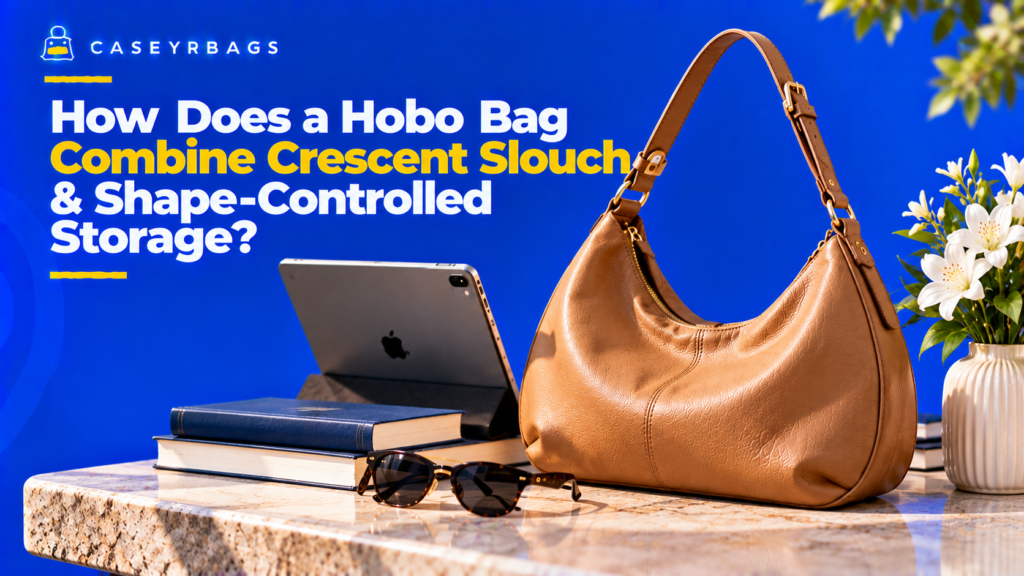
How Does a Hobo Bag Combine Crescent Slouch & Shape-Controlled Storage?
A Hobo Bag combines crescent slouch with shape-controlled storage through a soft curved body that can drape under gravity while remaining bounded by panel geometry, seams, strap anchors, opening structure, and base construction. Its characteristic silhouette develops when the central chamber drops below elevated side regions, producing a relaxed scooped form rather than a rigid box-like body.
The storage chamber remains practical when flexibility is guided rather than unrestricted. Limited internal organization, controlled seam placement, suitable lining, balanced load placement, and a base that supports without becoming rigid help the bag preserve access and containment while still allowing visible drape. The result is a controlled soft-structure system whose loaded form stays recognizable instead of collapsing randomly around every item.
What Defines Crescent Slouch & Shape-Controlled Storage in a Hobo Bag?
A Hobo Bag typically uses a soft or semi-soft body with curved upper geometry and shoulder-oriented suspension. When the bag hangs from its strap, gravity pulls the central body downward while the supported upper regions remain elevated, creating the raised-side and lowered-center relationship associated with a crescent or scooped silhouette.
That visible slouch does not mean the storage chamber lacks control. Panel seams, lining, base geometry, opening structure, and selected internal pockets can limit where the body folds and how freely contents migrate while still allowing the exterior panels to remain flexible and responsive to the load.
The defining relationship is controlled flexibility: enough softness for the body to drape and form a crescent, combined with enough structural boundaries to keep the load accessible, contained, and visually coherent. This mechanism places the Hobo within the broader Fashion Bag Types family without reducing it to a decorative silhouette alone. See Fashion Bags.
Which features create the crescent slouch?
The crescent slouch comes from several interacting features rather than one decorative curve. A curved upper edge establishes the initial direction, soft side panels permit drape, elevated strap anchors support the sides, and a flexible base allows the center to settle. Together these elements create a body that can visibly drop under suspension without becoming a rigid container.
Each feature changes how gravity acts on the bag. Supported side regions remain higher while the softer center and lower chamber respond more strongly to load, producing the characteristic scoop. The mechanism should be read as feature → gravitational response → silhouette effect, because the Hobo identity depends on the combined suspended geometry rather than on one isolated seam or opening line.
Which features create shape-controlled storage?
Shape-controlled storage comes from the boundaries that guide a soft chamber. Seams define the usable perimeter, lining moderates panel response, pockets stabilize selected contents, the base spreads load, and the opening and closure limit upper-body distortion. None of these elements needs to make the bag rigid; their role is to prevent unrestricted movement.
The practical objective is predictable containment and retrieval inside a flexible exterior. Structural boundaries should keep dense or loose items from dictating every fold while still allowing the body to drape around the normal load. Shape control therefore means guiding movement within a repeatable chamber, not freezing the Hobo Bag into one fixed outline.
Why do slouch and shape control work together?
Slouch and shape control are complementary because the Hobo depends on softness operating inside structural limits. A flexible body can create the central drop and relaxed curvature, while seams, anchors, base geometry, and organization keep that softness from becoming arbitrary collapse. Removing either side of this balance weakens the intended mechanism.
The useful relationship is flexible body + structural boundaries → soft crescent form without uncontrolled collapse. If flexibility disappears, the bag becomes too fixed and box-like; if guidance disappears, access and storage become unpredictable. The Hobo remains recognizable because its softness is directed through recurring zones rather than allowed to deform without constraint.
How Does Crescent Geometry Create Hobo Bag Identity?
Explain how the curved body outline differs from rectangular or box-like shoulder-bag geometry.
What creates the crescent visual profile?
A Hobo Bag’s crescent profile comes from elevated side or anchor regions, a lower central body, a curved upper edge, and softened corners working together. This combination creates a scooped external outline that reads differently from a rectangular shoulder bag because the center is visually lower than the supported sides.
The crescent is therefore a whole-body relationship, not a single curved line. Side elevation, center drop, base response, and suspended tension all contribute to the visible contour. Recognition becomes stronger when these cues persist under normal carry instead of appearing only while the empty bag is arranged for display. See Crescent Hobo.
Why is the crescent not produced by one line alone?
The upper edge influences the silhouette, but side panels, base depth, strap tension, material stiffness, and load distribution decide how that curve behaves in three dimensions. A bag with the same top-edge cut can appear broader, deeper, flatter, or more gathered depending on how those other components respond.
For that reason, the visible crescent must be evaluated as suspended body geometry rather than as a drawn outline. The most reliable identity appears when upper curvature, side elevation, center drop, and lower-body shape reinforce one another. If those relationships change substantially under load, the empty curve alone does not establish the real-use form. See Hobo Organization.
Why can loaded contents alter the crescent?
Loaded contents can deepen, flatten, widen, or shift the crescent because soft panels respond directly to item geometry and mass placement. A dense central load may deepen the center drop, while a rigid wide object can flatten curvature or force the exterior outward. One-sided contents can pull the whole silhouette laterally.
This is why crescent silhouette ≠ guaranteed loaded shape. A Hobo Bag should be assessed with the recurring daily load suspended from the strap, not only while empty. The strongest identity persists when normal contents still produce a recognizable scoop without creating severe bulges, excessive depth, or one-sided deformation that overwhelms the intended body geometry. See Mini Capacity.
How Does Slouch Form in a Hobo Bag?
Explain the mechanical relationship between gravity, soft panels, suspension, and load.
What happens when the bag hangs from its strap?
When a Hobo Bag hangs from its strap, the anchor zones become the primary support points while central panels move downward under gravity. The upper edges may draw inward, the lower chamber can deepen, and flexible side walls begin to curve around the suspended load. These changes create the relaxed hanging form associated with Hobo construction.
The crescent appears because the supported regions and unsupported center respond differently. Anchor zones stay elevated while the softer middle drops, so suspension actively shapes the body rather than merely carrying it. This distinction matters because a bag that looks crescent-shaped on a table may behave differently once strap tension and gravity begin acting on the structure. See Mini Essentials.
How does the load affect the slouch?
Contents modify slouch by changing where downward force enters the soft chamber. A centered dense item can pull the middle lower, soft contents can spread across the base, and a rigid object can create local flattening or protrusion. The same total quantity can therefore create different silhouettes when the item shapes and positions change.
Load distribution matters as much as load amount because the Hobo body has limited resistance to localized force. Predictable slouch comes from contents settling into zones that reinforce rather than fight the intended geometry. If one object dominates a side, corner, or upper opening, the resulting deformation can weaken the crescent even though the bag remains within its physical capacity. See Structured Shape.
What makes slouch controlled rather than random?
Controlled slouch follows recurring panel geometry, seam boundaries, strap anchors, base shape, and expected load zones. Those components create preferred directions for folding and expansion, so the bag tends to drop and curve in repeatable places instead of collapsing differently every time it is handled.
The practical boundary is simple: controlled slouch follows the construction system rather than arbitrary item pressure. If the opening disappears, the base twists, or contents repeatedly reshape the bag into unrelated forms, softness is no longer being guided effectively. Shape control does not remove drape; it makes the drape predictable enough for access, containment, and recognizable Hobo identity. See Hobo Silhouette.
How Does Material Softness Affect Hobo Shape?
Explain how material flexibility determines how readily the body drapes.
How does softer construction affect the crescent?
Softer construction permits greater central drop, stronger folding, more body conformity, and gentler edge transitions. Flexible panels respond quickly to gravity and the normal load, so the crescent can become visibly deeper and more relaxed than it would with firmer walls. This softness is a primary contributor to Hobo drape.
The advantage remains useful only while surrounding boundaries still control the chamber. The Large Crescent Hobo Slouch branch shows the same material-response principle at subtype level: greater flexibility can strengthen the crescent, but useful slouch still depends on seams, anchors, opening geometry, and load placement preventing uncontrolled collapse. Compare Slouchy Bag.
How does firmer construction affect the same pattern?
Firmer construction produces a shallower slouch, more persistent side walls, and a clearer upper opening because the panels resist gravity and load deformation more strongly. Moderate firmness can therefore make the crescent easier to repeat and can keep the chamber accessible when soft contents would otherwise pool toward the center.
The trade-off is that increasing firmness also reduces visible drape. A successful Hobo does not require maximum softness, but the central body should still respond enough to suspension for the curved identity to remain evident. Moderate structure is compatible when it stabilizes specific zones without turning the entire body into a fixed, box-like shell.
Why is maximum softness not always better?
Maximum softness can cause the upper opening to disappear into folds, allow contents to migrate toward the lowest point, and make the exterior shape depend too heavily on individual objects. The body may slouch strongly, but the resulting form becomes less predictable and retrieval may require repeated manual reshaping.
More softness ≠ better Hobo structure. The target is a flexible chamber whose drape remains bounded by seams, anchors, base behavior, and selective organization. If the bag cannot recover a usable opening, maintain a coherent crescent, or keep contents from pooling unpredictably, the softness has exceeded the level that supports practical Hobo function.
| Body Structure | Slouch | Shape Control |
|---|---|---|
| Very soft | High | Low unless supported |
| Soft | Strong | Moderate |
| Semi-structured | Controlled | Strong |
| Rigid | Limited | High but less Hobo-like |
How Does Shoulder Suspension Shape the Crescent?
Explain how hanging from one shoulder-oriented strap changes the bag body.
How does suspension pull the body upward at the sides?
Shoulder suspension raises the strap-anchor regions and turns them into elevated support points while the chamber between them remains free to respond to gravity. This tension pattern keeps the sides higher and allows the middle of the bag to settle lower, strengthening the raised-side and lowered-center relationship associated with a crescent.
The effect is mechanical rather than decorative. Strap tension enters the body through specific anchor points, so the location and spacing of those points determine where the upper body stays supported. A Hobo Bag with weak or poorly placed suspension may still be soft, but it will not necessarily create the controlled curve expected from the type.
How does the suspended load deepen the center?
Load mass adds downward pull to the chamber once the bag is hanging. When a substantial portion of the normal contents settles near the center, the flexible body drops farther below the side supports and the crescent becomes more pronounced. This response is one reason the loaded silhouette matters more than the empty display shape.
The relationship can be summarized as load mass → downward pull → center body drop → stronger crescent. However, the effect depends on placement as well as total mass. A side-heavy load can pull the curve off-center, while an evenly distributed soft load may create a broad, smoother drop even at a similar overall weight.
Why is strap geometry part of silhouette identity?
Strap length, attachment position, and anchor spacing change how the body is suspended and where tension enters the panels. Wider support can preserve upper width and produce a broader crescent, while inward attachment can gather the top and deepen the central drop. These are direct shape effects, not simply carry preferences.
The strap is therefore both a suspension component and a silhouette-forming component. Its geometry helps determine the Hobo’s hanging orientation, side elevation, and center response under load. A strap that changes these relationships substantially can alter the visible identity even when the panels and materials remain unchanged, which is why shoulder suspension must be included in structural evaluation.
How Do Strap Anchors Affect Shape Control?
Explain how anchor placement determines where the soft body is supported.
How can wide anchor spacing affect the silhouette?
Wider strap-anchor spacing distributes suspension force across a larger upper span and can preserve more of the bag’s upper width. This often creates a broader crescent with less concentrated inward gathering because the side regions remain separated while the center drops between them.
The important mechanism is tension distribution rather than spacing alone. Anchors determine where the soft body is held against gravity, so their relationship to seams and panel geometry controls how the upper body gathers. A wide layout can still behave poorly if reinforcement, material response, or load placement causes one side to stretch or collapse unevenly.
How can narrow or inward anchor placement affect slouch?
Narrow or inward anchor placement can pull the upper body toward the center, creating stronger gathering and a narrower top profile. This geometry may deepen the central drop because the supported points move closer together while the flexible chamber hangs below them.
The same arrangement can also concentrate tension and make the upper curve more pronounced. Whether that improves the Hobo form depends on panel strength, opening behavior, and the normal load. If inward gathering closes the opening or distorts one side more than the other, the deeper slouch may come at the expense of access or balanced shape control.
Why do anchors also matter structurally?
Strap anchors transfer the suspended load from the strap into reinforced panel or seam regions, so they are part of the bag’s load path as well as its silhouette. The chain is strap → anchor → reinforced panel or seam → loaded chamber. Weak integration can create stretching or localized distortion.
Anchor geometry therefore influences both visual form and structural behavior. The best arrangement supports the intended crescent without allowing attachment zones to pull unpredictably, rotate the bag, or deform seams under normal load. Evaluating anchors only as attachment hardware misses their role in shaping the soft body and distributing the forces that keep storage controlled.
How Do Curved Panels Control Hobo Bag Form?
Explain how pattern geometry creates predictable softness before the bag is even loaded.
How do curved panel edges influence the body?
Curved panel edges encourage rounded side walls, soften hard corners, and guide fabric folding toward recurring zones. Even before the bag is loaded, this geometry establishes a tendency toward a scooped body because the seams and cut lines do not force the panels into a rectangular envelope.
Suspension and normal contents then exaggerate the built-in tendency. Curved geometry gives the soft material a predictable direction for drape, helping the loaded bag repeat a similar silhouette instead of developing unrelated folds each time. The panel shape does not guarantee the final crescent, but it creates the structural starting point from which controlled slouch can develop.
How do gussets or side panels affect depth?
Gussets and side panels define how far the chamber can expand and where additional depth appears. They can provide dimensional storage without allowing the entire body to widen unpredictably, and their seam lines create boundaries that redirect fabric movement into known directions.
This geometry affects both usable storage and visible slouch. A modest gusset can give the lower chamber room to hold soft contents while preserving the curved upper body, whereas excessive or rigid depth can make the bag read as box-like. Side-panel architecture should therefore support storage without becoming the dominant silhouette feature.
Why does panel geometry matter more than surface styling?
Panel geometry determines where the Hobo folds, expands, curves, and resists deformation. Color, print, branding, or decorative trim can change the visual finish, but those treatments do not create the underlying suspended body mechanics unless they also alter construction.
The governing distinction is that panel geometry creates the structural basis for slouch; decoration does not. If surface styling is removed, the bag should still display the same recurring curve, seam boundaries, and load response. Classification and shape evaluation should therefore prioritize the cut and connection of the panels before aesthetic details that leave mechanics unchanged.
How Do Seams Limit Uncontrolled Collapse?
Explain how soft panels remain bounded by their connections.
How do seams define storage boundaries?
Seams join flexible panels into a bounded three-dimensional chamber. Even when the material itself bends easily, the joined edges establish a usable perimeter and limit how far individual surfaces can separate or expand. This makes it possible for a soft bag to retain a coherent storage volume without rigid walls.
The relationship is panels + seams → usable chamber perimeter. Softness remains high inside those boundaries, but the maximum expansion directions become more predictable. When seam geometry is well integrated with the crescent body, contents can shift and the panels can drape while the chamber still behaves like one connected volume rather than a collection of independent fabric surfaces.
How can seam placement guide folding?
Seam placement can create natural hinge lines, preserve side shape, and limit expansion in selected directions. A curved seam may encourage a recurring fold, while a side seam can help prevent the front and back panels from spreading without control when the bag is heavily loaded.
These boundaries guide where softness expresses itself. Strategic seam placement makes the Hobo more likely to slouch repeatedly in similar zones, which supports a stable visual identity and predictable access. If folds consistently develop outside the intended paths, the issue may come from load placement, panel geometry, or insufficient structural guidance rather than from softness alone.
Why does soft construction still depend heavily on seams?
As panel stiffness decreases, seams become more important because the fabric itself contributes less resistance to deformation. The seam network carries the job of connecting the panels, maintaining the chamber perimeter, and transferring tension from the strap anchors toward the rest of the body.
Slouch ≠ structureless collapse. A soft Hobo can drape dramatically while still depending on precise structural connections to keep the load contained. If seam paths stretch, twist, or fail to hold the intended relationships, the bag may lose both storage control and silhouette even though the material remains intact and visually soft.
How Does the Main Opening Affect Hobo Shape?
Explain how the top opening influences both access and upper-body control.
How can a broad opening support the Hobo form?
A broad opening allows the upper body to relax and can preserve flexible access while following the curved top geometry. Because the edges are not tightly constrained, the opening can participate in the soft upper line rather than forcing the body into a rigid horizontal or framed shape.
This flexibility remains useful only when the opening stays visible and practically reachable after the bag settles. If the broad top collapses completely into folds, access suffers even though the silhouette may appear softer. Successful Hobo geometry balances a relaxed opening with enough edge definition to let the user locate and operate it without reshaping the entire chamber.
How can a narrow or reinforced opening change slouch?
A narrow or reinforced opening stabilizes the top edge and can limit inward collapse, helping the bag retain a clearer access zone. That added control may also reduce the amount of central drop or change how the side panels gather because the upper body resists deformation more strongly.
The trade-off is between upper-edge control and flexible drape. Reinforcement can improve predictability, but excessive stiffness may flatten the crescent or make the top visually dominate the softer lower body. The opening should support access and shape control without becoming so rigid that it overrides the Hobo’s defining suspended softness.
Why should opening shape not be treated separately from storage?
The opening determines both how the upper body behaves and how users reach into the chamber after the bag slouches. When the body settles, the access path can narrow, tilt, fold, or shift relative to the contents, so opening geometry directly affects practical retrieval.
Opening geometry therefore influences silhouette and storage at the same time. A visually successful crescent that hides the opening or requires repeated manual spreading is not fully controlled. The bag should preserve enough upper-body definition that soft drape does not turn access into a separate problem every time contents settle toward the center.
How Does Closure Design Affect the Crescent Slouch?
Explain how closure tension can alter the upper silhouette.
How can a zipper influence the top line?
A zipper can draw opposing edges together and create continuous tension along the upper body. This tends to reduce opening spread, align the top panels more closely, and produce a more controlled upper curve than a fully open or loosely fastened construction.
The same tension can reduce free drape. If the zipper path is too rigid relative to the soft body, it may flatten the center or create a visibly fixed line across the top. Zippered Hobo construction therefore works best when closure control supports access and containment without overriding the curved geometry produced by suspension and soft panels.
How can a magnetic, snap, or loose closure differ?
Magnetic, snap, or loose closure systems can allow more flexible drape because they do not necessarily apply continuous tension across the entire opening. The upper body may retain more freedom to curve, gather, and settle around the normal load while still gaining a defined point of closure.
This difference should be treated structurally rather than categorically. A looser closure may preserve softness, but it does not automatically improve Hobo identity or security. The mechanism should be judged by whether it keeps the opening usable and the load contained while allowing the suspended crescent to form naturally.
Why does closure type not determine Hobo identity alone?
Closure mechanism ≠ complete Hobo Bag identity. Zippers, snaps, magnets, or other closures can appear across many bag families, and the same mechanism can produce different results depending on body geometry, strap suspension, panel softness, and proportions.
The closure should therefore reinforce rather than define the Hobo system. A compatible design controls the opening without becoming the dominant shaping force. If the body remains rigid or box-like despite a soft closure, or collapses unpredictably despite a structured closure, the broader geometry and load response still determine whether the bag behaves like a Hobo.
How Does the Base Help Control Soft Storage?
Explain how the lower bag geometry affects sag, item concentration, and loaded form.
How does a fully soft base behave?
A fully soft base can sag beneath dense contents and allow the lower body to respond directly to item placement. This creates load-dependent curvature and can reinforce the relaxed Hobo character, especially when the normal contents are soft or distributed across the chamber.
The same flexibility reduces predictability when weight becomes concentrated. Dense objects can create point sag, lower-corner distortion, or an uneven base that pulls the whole crescent off balance. A soft base therefore supports Hobo drape only when the load and surrounding seam structure prevent one item from dominating the lower silhouette.
How can modest base reinforcement help?
Light base reinforcement can spread dense loads across a broader area, reduce severe point sag, and give the lower body a more predictable resting geometry. Because the reinforcement remains limited, the chamber can still curve and respond to suspension instead of sitting on a rigid platform.
This is shape-controlled storage rather than rigid shape retention. Reinforcement works best when it solves a specific instability while leaving the central body free to drop. If the base becomes the strongest structural plane, the Hobo may retain storage control but lose the lower-body softness that supports its recognizable crescent.
Why can too much base rigidity weaken Hobo slouch?
A rigid base resists lower-body curvature and can force the chamber into a flatter or more box-like volume. Instead of allowing dense contents to settle into a controlled soft shape, the platform preserves a fixed footprint that may visually dominate the suspended upper body.
More base structure ≠ automatically better Hobo form. The base should distribute load without eliminating the bag’s ability to drape. When the lower body remains completely flat and fixed while the upper panels try to form a crescent, the resulting silhouette can look disconnected and less characteristic of a controlled soft-structure Hobo.
| Base Type | Slouch | Lower Shape Control |
|---|---|---|
| Very soft | High | Low |
| Lightly reinforced | Strong | Moderate–high |
| Firm | Reduced | High |
| Rigid | Limited | Very high |
How Does Internal Organization Control Storage Without Killing Slouch?
Explain how limited pockets can stabilize contents while preserving the flexible chamber.
Which items benefit from dedicated zones?
Small loose contents, flat items, and high-frequency essentials benefit most from dedicated zones because they are the objects most likely to disappear into the deepest part of a slouched chamber. A limited pocket can keep these items predictable without dividing the entire bag into rigid compartments.
The purpose is retrieval control rather than maximum segmentation. Dedicated zones should solve recurring migration problems while leaving the main chamber flexible enough to accept changing item shapes. When every object receives a separate compartment, the internal architecture can become more rigid than the exterior mechanism needs.
How do organizer pockets reduce migration?
Selected organizer pockets reduce migration by giving specific contents stable positions away from the chamber’s lowest points. This keeps loose items from pooling together and can reduce random local bulges because the weight of small objects is distributed more deliberately around the soft interior.
Organization also supports the exterior shape indirectly. The Large Crescent Hobo Organization branch applies the same principle to a softer subtype: pockets help only when they control recurring contents without replacing the flexible chamber with heavy compartmentation. Useful organization improves retrieval and shape predictability at the same time.
When does organization become excessive?
Organization becomes excessive when rigid dividers, thick pocket layers, or duplicated compartments resist natural folding and fragment the usable chamber. The bag may remain orderly, but its interior begins to dictate a fixed structure that suppresses the panel movement required for Hobo slouch.
Shape-controlled storage requires selective organization, not rigid compartmentation. The strongest system stabilizes only the contents that need control and leaves the main volume responsive to normal load variation. If the body can no longer drop, gather, or conform because the organizer structure dominates the interior, storage control has begun to undermine Hobo identity.
How Does Lining Affect Hobo Bag Shape?
Explain how an internal layer can influence drape, friction, and item movement.
How can lining add subtle structure?
Lining can add subtle structure by supporting panel boundaries, moderating stretch, and changing how the interior follows the outer shell. A lining with some body may reduce extreme collapse without creating a rigid wall, helping the chamber maintain a more predictable relationship to the exterior panels.
Its role is secondary structural guidance. The lining works with seams, base geometry, and the shell rather than replacing them. If the outer body lacks coherent panel boundaries, lining alone cannot create a controlled crescent; it can only influence how strongly the existing construction drapes and how consistently the interior responds under load.
How can smooth lining affect item movement?
A smooth lining can reduce friction between contents and the chamber, allowing objects to slide more easily toward the lowest points once the bag is suspended. This can make retrieval less predictable and can change load distribution even when the outer shell and pocket layout remain unchanged.
Because item movement affects where weight settles, lining can influence exterior slouch indirectly. A very smooth interior may encourage dense items to migrate toward one side or the center, while a grippier surface may slow that movement. The effect should be evaluated as part of the loaded system rather than treated as a cosmetic interior choice.
Why is lining only one part of shape control?
Lining supports the system but does not replace seams, base geometry, opening structure, or internal organization. It may moderate drape and movement, yet the overall chamber still depends on the shell construction and the way load is transferred through anchors and panel boundaries.
Loaded form emerges from the complete soft-structure system. If the bag collapses excessively or contents migrate unpredictably, changing the lining may help only when friction or stretch is the real cause. Diagnosis should identify whether the problem begins with the shell, load placement, base, organization, or lining before altering one component in isolation.
How Does Item Shape Affect the Hobo Slouch?
Explain how soft and rigid contents interact differently with a flexible crescent body.
How do soft contents interact with the bag?
Soft contents can conform to the curved chamber, spread across the base, and fill irregular zones without forcing the canvas or leather into sharp external angles. This often preserves smoother transitions and allows the crescent to remain visually coherent as the body settles around the load.
Compatibility still depends on distribution. A large soft object concentrated in one region can deepen that area excessively and alter the suspended balance even without creating a hard protrusion. Softness reduces local pressure but does not remove mass, so placement and volume still matter when judging whether the loaded silhouette remains controlled.
How do rigid or angular items affect the silhouette?
Rigid or angular items can flatten local curves, create protrusions, and establish fixed pressure points that the flexible body must wrap around. A broad hard object may straighten the rear panel, while a sharp corner can push the front or side outward in a way that becomes visible from outside.
These objects can dominate the silhouette even when they fit comfortably inside. Their geometry does not adapt to the Hobo; the Hobo adapts around them. The practical test is therefore not only whether the item fits, but whether the bag can still preserve its crescent, opening access, and balanced suspension after the rigid shape is included.
Why does physical fit not guarantee compatible shape?
Item fit ≠ silhouette compatibility. A rigid or bulky object can sit fully inside the chamber while flattening the crescent, increasing loaded depth, or creating an exterior protrusion that becomes more visually dominant than the bag’s intended curve.
The loaded test should examine how the item changes the whole body, not only whether the closure works. If normal carry repeatedly turns the Hobo into a deep rectangular package or forces one panel outward, the item may be capacity-compatible but shape-incompatible. Practical storage should preserve both containment and the structural identity of the bag.
How Does Load Placement Control the Crescent?
Explain why where contents sit can matter as much as how much is carried.
What happens when dense items sit near the center?
Dense items near the center increase downward pull where the Hobo is already designed to drop. This can deepen the central curve, reinforce the crescent, and increase base sag while keeping the side regions relatively elevated under strap tension.
Centered loading supports the silhouette only while the base and opening remain functional. If the dense object sinks too far, the bottom may form a point and the opening may fold inward. The goal is not maximum center drop but a predictable curve that preserves access, containment, and enough lower-body control for the bag to recover after handling.
What happens when dense items sit strongly to one side?
A dense one-sided load pulls that region farther downward, shifts the chamber laterally, and creates uneven tension between the strap anchors. The crescent can become asymmetric, the body may tilt, and one seam or side panel may carry more of the visible deformation.
This affects both appearance and mechanics. Uneven suspension can make the bag feel less stable and can cause contents to continue migrating toward the lower side. Correcting the issue should begin with load placement before changing the construction, because the same bag may regain a balanced curve when dense contents are redistributed.
Why is perfectly symmetrical loading unnecessary?
Controlled load placement ≠ perfect symmetry. A Hobo Bag does not require identical weight on both sides, and normal daily items rarely create mathematically balanced distribution. The practical objective is a predictable loaded shape with no single object or side dominating the silhouette.
A slightly uneven load can remain compatible when the crescent stays recognizable, the strap hangs naturally, the opening remains usable, and contents do not migrate uncontrollably. Evaluation should focus on repeatable behavior rather than theoretical balance, because the construction is meant to accommodate realistic variation while preserving controlled slouch.
How Does Loaded Depth Affect Hobo Bag Storage?
Explain how expansion influences both slouch and retrieval.
How can moderate depth support Hobo storage?
Moderate depth gives the crescent chamber usable volume and allows soft contents to settle without forcing the bag into a flat envelope. A little dimensional expansion can strengthen the sense of softness while leaving the curved upper body and central drop visually dominant.
Depth should support storage rather than become the primary silhouette. When the chamber expands only enough for recurring items, access stays manageable and the exterior retains a soft crescent reading. The bag can therefore carry more than a flat pouch while still behaving like a Hobo rather than a deep box-shaped shoulder bag.
What happens when depth becomes excessive?
Excessive loaded depth increases outward projection, creates more layers of stacked contents, and makes the bag bulkier against the body. As the chamber expands, the crescent can become less visually dominant because the side profile begins to define the bag more strongly than the suspended curve.
Retrieval also becomes more layered because target items may sit behind or beneath other contents. The Mini Hobo Capacity question is therefore not only how much the bag can physically hold, but whether normal loading still preserves a readable Hobo silhouette, workable opening, and predictable item access without turning the chamber into a deep general-purpose container.
When does depth begin to overwhelm the silhouette?
Depth begins to overwhelm the silhouette when the normal recurring load makes the body appear primarily deep or box-like rather than crescent and slouched. At that point, outward projection and stacked volume become stronger visual cues than the upper curve and center drop.
More depth ≠ stronger Hobo identity. The functional limit is reached before maximum physical fill if added volume consistently flattens the crescent, crowds the opening, or changes suspended behavior. The best loaded depth is the amount that supports recurring storage while allowing the defining soft curve to remain the dominant structural pattern.
How Does Overfilling Affect Crescent Slouch?
Explain why excessive load can replace controlled drape with expansion pressure.
How does overfilling change the upper curve?
Overfilling pushes the upper panels outward, increases tension around the opening, and can flatten the central drop that normally forms under suspension. Instead of gravity and soft drape shaping the top, internal expansion pressure begins to force the body into a wider and more fixed profile.
This can make the opening harder to operate and reduce the contrast between raised sides and the lower center. Once expansion pressure becomes the dominant shaping force, the Hobo may still look soft but the crescent mechanism is no longer functioning normally. Shape-compatible capacity should preserve drape rather than simply maximize the enclosed volume.
How does overfilling change the lower body?
The lower body can bulge, lose its natural folds, and develop stronger corner protrusions as contents force the base and side panels outward. Loaded depth increases, seam tension rises, and the body may stop recovering its normal curve after access because the chamber remains under continuous pressure.
These changes are why the Mini Hobo Essentials question matters at the compact end of the family: recurring contents should preserve practical capacity without overwhelming the form. The same rule applies at larger sizes—storage is useful only while the normal load leaves the crescent and access system functioning.
Why is maximum physical capacity not the correct target?
Maximum physical fill ≠ shape-compatible Hobo capacity. A soft bag may physically accept more contents than it can carry while preserving the intended silhouette, opening behavior, item control, and suspension. Compression and bulging can hide the point at which useful Hobo storage has already been exceeded.
The correct target is the load that maintains functional slouch, access, and predictable storage rather than the most material the chamber can contain. If the bag must be packed tightly enough to flatten the crescent or distort seams, the extra volume is working against the structural mechanism that defines the type.
When Does a Hobo Bag Become Too Structured?
Identify when added shape control suppresses the defining soft silhouette.
What does excessive rigidity do to the crescent?
Excessive rigidity prevents the central body from dropping naturally, keeps the side walls fixed, and reduces the visible drape that separates Hobo form from box-like construction. Curved styling cues may remain, but the suspended body no longer responds enough to gravity for a true crescent to develop.
The Structured Hobo Shape branch is useful here because selective reinforcement can preserve shape without eliminating slouch. The mismatch begins when structure becomes the dominant body behavior rather than a targeted control mechanism. A successful Hobo should still show load-responsive curvature even when certain zones are reinforced.
What kinds of structure can cause this?
Rigid bases, thick internal frames, stiff dividers, heavily reinforced top edges, and broad inflexible panels can all suppress the Hobo’s central drop. Each element may improve local control, but combining several strong reinforcements can turn a flexible chamber into a fixed container.
The Structured Hobo Silhouette question focuses on where reinforcement can remain compatible with a more controlled presentation. Structure is not the problem by itself; the problem appears when reinforced zones prevent the center, upper edge, or side panels from participating in the suspended curve that defines the Hobo.
When can structure still remain compatible?
Structure remains compatible when reinforcement stabilizes specific zones while leaving the central body free to drape. Supported anchors, a lightly reinforced base, or a controlled opening can improve access and load distribution without fixing the entire silhouette in place.
Shape control should guide softness, not eliminate it. The practical test is whether the bag still forms a recognizable crescent when normally loaded and suspended. If reinforcement improves storage predictability while the central drop, curved side response, and soft body movement remain visible, the Hobo mechanism is still functioning as intended.
When Does a Hobo Bag Become Too Soft?
Identify when flexibility no longer produces predictable storage.
What indicates excessive collapse?
Excessive collapse appears when the opening disappears into folds, side walls wrap around individual contents, and the chamber pools toward the lowest point instead of maintaining a readable shape. The bag may look very relaxed, but access and storage boundaries become difficult to predict.
These signs show that softness is no longer being guided effectively by seams, base geometry, anchors, or organization. A useful Hobo should drape without requiring the user to rebuild the chamber by hand before every retrieval. When the body cannot maintain a usable opening or coherent loaded form, flexibility has exceeded the practical shape-control range.
What happens to retrieval?
Retrieval becomes slower when items migrate into the deepest slouch, pockets collapse into surrounding folds, and the body must be lifted or reshaped to expose the opening. Loose contents can collect together, making the chamber feel less organized even if nominal capacity remains adequate.
This should be diagnosed as a softness and shape-control problem rather than as an unrelated organization issue. The neighboring Slouchy Bag architecture can also use dramatic drape, but comparison is most useful after identifying whether the Hobo still retains its own bounded crescent and access behavior.
What does this reveal?
More slouch ≠ better Hobo function. Strong drape is valuable only while the bag remains accessible, the load stays reasonably controlled, and the exterior shape continues to reflect a recognizable crescent instead of random deformation around contents.
Useful Hobo construction therefore requires both visible softness and predictable storage control. A bag that collapses deeply but cannot preserve the opening, recover after access, or keep contents from migrating has lost the balance that makes slouch functional. The best result is a repeatable suspended curve that remains soft without becoming shapeless.
How Can Hobo Bag Shape-Control Problems Be Diagnosed?
Identify whether poor form comes from material softness, load placement, seams, base, opening, or overfilling.
What does asymmetric slouch suggest?
Asymmetric slouch suggests checking one-sided dense loading, uneven strap-anchor tension, distorted side-panel geometry, and seam behavior. The first question is whether the lower side follows a particular content placement or remains low even after the chamber is emptied and reloaded more evenly.
That distinction separates packing problems from construction problems. If the asymmetry moves with the load, redistribution may correct it; if the same side consistently drops, anchors, seams, or panel geometry deserve closer inspection. Diagnosis should trace the visible symptom back to the mechanism before adding reinforcement or changing the whole bag structure.
What does uncontrolled collapse suggest?
Uncontrolled collapse suggests excessive panel softness, weak lining support, insufficient base definition, overloaded low points, or organization that does not stabilize recurring contents. The symptom is not simply a soft bag; it is a bag whose folds and item movement become difficult to predict in normal use.
Correction should target the specific mechanism producing deformation. Adding global rigidity may hide one problem while suppressing the crescent everywhere else. If the opening is the weak point, stabilize the opening; if the base pools, address load distribution or base support; if contents migrate, examine pockets and lining before changing the outer panels.
What does lost crescent identity suggest?
Lost crescent identity suggests checking overfilling, excessive rigidity, deep box-like loading, opening distortion, and load placement that pulls the body away from its intended center. The key symptom is that the normal loaded form no longer reads as raised sides with a softer central drop.
Diagnose the shape mechanism before adding or removing structure. A flattened crescent caused by overfilling requires a different correction from one caused by a rigid base or stiff top edge. The evaluation should isolate whether volume, material response, suspension, or construction is dominating the bag before the design is judged incompatible.
How Should Crescent Slouch & Shape-Controlled Storage Be Evaluated?
Provide one repeatable loaded test covering empty shape, suspended slouch, item placement, access, and post-use recovery.
What should be inspected before loading?
Before loading, inspect panel softness, the curved upper edge, shoulder strap, strap anchors, seams, opening, lining, internal pockets, and base. These components establish the structural baseline that will determine where the body can fold, where tension enters, and how the chamber is likely to respond once weight is added.
Empty inspection should record potential rather than final performance. The Hobo still needs to be suspended and loaded because gravity, item geometry, and mass distribution can change the silhouette substantially. The goal is to understand the starting architecture so later shape changes can be traced to the load instead of being mistaken for construction defects.
What should be observed after loading?
After loading, observe central drop, side elevation, loaded depth, item migration, opening visibility, base behavior, and any asymmetry. These indicators show whether the bag preserves a coherent crescent while the storage chamber remains usable under the actual recurring load.
Normal loaded and suspended behavior should control the final judgment. An empty Hobo can look ideal but fail once dense items flatten the curve or the opening disappears. Conversely, a modest empty outline can develop a strong controlled crescent under suspension. Evaluation should therefore prioritize repeatable real-use shape rather than display presentation alone.
Which sequence should determine Hobo shape quality?
Steps 1–10 establish the empty and early loaded baseline: observe the natural body, identify the intended crescent, suspend the empty bag, locate the center drop, inspect anchors, open the chamber, add normal contents, place dense items deliberately, use defined zones for loose items, and settle the opening normally.
Steps 11–20 validate the loaded mechanism through suspension, crescent recognition, asymmetry and depth checks, live access, item return, shape recovery, base and seam inspection, and mechanism-specific correction. The sequence should be treated as one controlled test because storage quality depends on how the bag changes before, during, and after retrieval rather than on a single static shape.
- Observe the empty bag standing or lying naturally.
- Identify the intended crescent geometry.
- Suspend the empty bag from its strap.
- Observe where the center drops.
- Inspect the strap anchors.
- Open the main chamber.
- Load the normal intended contents.
- Place dense items deliberately rather than randomly.
- Add small loose contents to defined zones where available.
- Close or settle the opening normally.
- Suspend the loaded bag.
- Observe whether the crescent remains recognizable.
- Check whether one side drops excessively.
- Observe loaded depth.
- Open the bag while loaded.
- Retrieve a frequent-use item.
- Return the item.
- Observe whether the body regains its usable shape.
- Check base sag and seam tension.
- Correct the specific load, organization, or structural problem if the slouch repeatedly becomes uncontrolled or excessively rigid.
How Can Hobo Bag Slouch & Storage Mismatches Be Avoided?
Prevent maximum softness or maximum structure from replacing balanced Hobo construction.
Why is “more slouch means more authentic Hobo form” incomplete?
More slouch can obscure the opening, bury contents, destabilize the body, and make retrieval dependent on repeated manual reshaping. A dramatic drop may look visually soft, but that does not prove the storage system is functioning well or that the loaded crescent remains coherent.
More slouch ≠ better Hobo function. The desired result is controlled drape, not unrestricted collapse. Softness should be strong enough to create the suspended curve while seams, base geometry, opening structure, and organization keep the load predictable. If access and containment fail, additional slouch is reducing rather than strengthening the Hobo mechanism.
Why is “add more structure to control the bag” also incomplete?
Adding structure can solve local instability, but excessive reinforcement can flatten the central drop, reduce side-panel movement, and make the body read as rectangular or box-like. The bag may become easier to organize while losing the soft suspended response that defines its type.
More structure ≠ better shape control. Reinforcement should target the mechanism causing instability without fixing the entire body. A successful correction might stabilize the base, anchor, or opening while leaving the center flexible. The best Hobo balance uses selective structure to guide softness rather than replacing softness with rigid shape retention.
What should be verified before treating the balance as successful?
Verify that the crescent remains recognizable, the body drapes naturally, anchors guide suspension, seams preserve storage boundaries, the opening stays usable, and the base supports the load without becoming a rigid platform. These checks confirm that the bag still behaves as a controlled soft structure.
Also verify that organization remains selective, lining does not create uncontrolled migration, dense contents do not dominate one side, loaded depth stays compatible, normal contents preserve central slouch, and storage remains accessible after settling. A successful Hobo balances drape, silhouette, containment, retrieval, and repeatability rather than optimizing one variable in isolation.
- Hobo identity is evaluated through crescent form and controlled slouch.
- Crescent silhouette is not assumed from empty shape alone.
- Empty silhouette is distinguished from loaded silhouette.
- Slouch is not confused with structureless collapse.
- Softness is not automatically treated as better.
- More structure is not automatically treated as better.
- Curved panel geometry is evaluated.
- Central body drop is observed.
- Shoulder suspension is considered part of the silhouette.
- Strap anchors are evaluated structurally and visually.
- Anchor spacing is considered.
- Seams define flexible storage boundaries.
- Soft construction is not confused with weak construction.
- Opening geometry remains usable.
- Closure tension does not erase the intended slouch.
- Base construction supports the lower body.
- Rigid base structure does not dominate the silhouette unnecessarily.
- Internal organization remains selective.
- Shape-controlled storage is not confused with rigid compartmentation.
- Lining behavior is considered.
- Item shape is considered.
- Rigid contents do not create excessive protrusion.
- Load placement is considered.
- Controlled placement is not confused with perfect symmetry.
- Loaded depth remains compatible with the Hobo silhouette.
- Overfilling does not flatten the crescent.
- Maximum physical fill is not treated as the goal.
- Excessive rigidity is recognized as mismatch.
- Excessive softness is recognized as mismatch.
- Item migration is distinguished from intentional slouch.
- Shape problems are diagnosed by mechanism.
- Final evaluation uses the bag suspended and loaded.
- Storage access remains practical after the body settles.
- Final form balances drape, silhouette, containment, and retrieval.
Conclusion
A Hobo Bag combines crescent slouch and shape-controlled storage by allowing its soft body to drape between elevated strap-anchor points while seams, panel geometry, base construction, opening structure, and selective internal organization keep the chamber within predictable boundaries. The visible central drop creates the relaxed Hobo silhouette without requiring the bag to collapse randomly around every item.
The balance depends on avoiding both extremes. Too much rigidity suppresses the crescent and makes the body box-like, while too much softness can bury contents, distort the opening, and create uncontrolled item migration. Effective Hobo construction therefore uses enough flexibility to create slouch and enough structural guidance to preserve access, containment, and a recognizable loaded form.
FAQs
The soft body hangs between shoulder-strap anchor points, so gravity and the loaded chamber pull the center downward while the supported side regions remain higher. This raised-side and lowered-center relationship creates the familiar suspended crescent.
Curved panel geometry and material softness reinforce that response. The shape therefore comes from the whole suspended body, not from one decorative top-edge curve alone.
No. Seams, lining, light base reinforcement, closures, and limited internal pockets can guide the storage chamber while the exterior remains soft enough to drape and form a crescent.
Excessive rigid structure can suppress the central drop and push the body toward a fixed box-like form. The useful goal is controlled softness rather than complete absence of structure.
Excessive contents push panels outward, flatten the natural center drop, increase loaded depth, and place the opening and side seams under greater expansion pressure.
The bag may still physically contain the load while losing the crescent slouch that defines its Hobo form. Practical capacity therefore ends before maximum physical fill when expansion pressure replaces controlled drape.