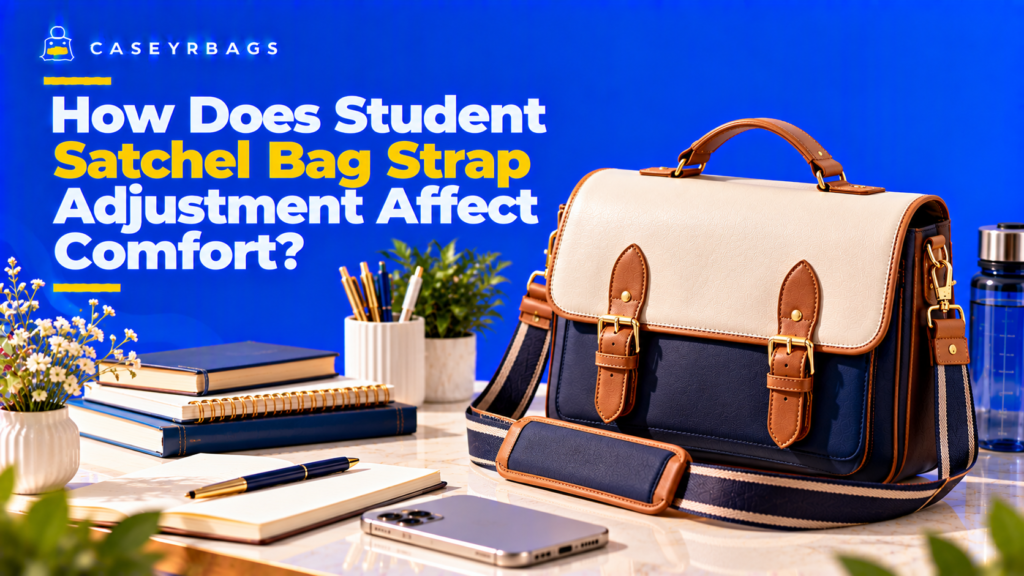
How Does Student Satchel Bag Strap Adjustment Affect Comfort?
Student Satchel Bag strap adjustment affects comfort by changing where the loaded bag rests, how closely it contacts the body, how far it moves while walking, and how easily the student can reach the opening and frequent-use pockets. Shortening the strap generally raises the Satchel and can reduce its movement arc, while lengthening it lowers the bag and can increase reach distance, swing, or rotation; neither direction is automatically more comfortable.
The practical setting is the one that keeps the normal student load controlled, reachable, and predictably positioned in the intended carry mode without creating avoidable contact or restricting access. Bag width, loaded depth, anchors, organization, load placement, clothing, and user proportions can strengthen or limit what strap adjustment accomplishes, so the final setting must be validated with the real recurring load rather than accepted from empty appearance or strap length alone.
What Does Strap Adjustment Change in Student Satchel Comfort?
Strap adjustment changes the usable suspension length between the Student Satchel’s anchors and the student’s shoulder or supported crossbody path. The setting therefore changes loaded resting height and the relationship between the bag body and the user.
Practical comfort here means a controlled, reachable, reasonably stable loaded condition without obvious avoidable contact caused by the setting. It is observed through position, movement, access, hardware stability, and user response—not assigned by one number.
Shortening or lengthening changes position, but anchors, bag dimensions, clothing, body proportions, load amount, and item placement modify the outcome. Adjustment must therefore be tested with the recurring load rather than with the empty bag.
For the wider carry-and-capacity system, see Satchel Bag.
How does strap length change loaded resting position?
Strap length changes loaded resting position by changing the suspension distance between the Student Satchel anchors and the user’s shoulder or supported crossbody path. The direct directional mechanism. Shortening reduces suspension length and generally raises the loaded Satchel; lengthening increases suspension length and generally lowers it. Keep “generally” because anchor geometry, carry mode, and strap path modify the exact result.
Connect resting position to practical consequences: opening reach, pocket reach, body contact, arm clearance, movement arc, and the ability to keep the rectangular bag controlled. Close with resting height is an input to comfort, not a complete verdict. The setting should therefore be accepted only when the same loaded comparison shows a practical observable improvement without creating a new access or movement problem.
Why must the Satchel be tested while loaded?
The Student Satchel must be tested while loaded because the normal contents change downward force, loaded depth, center of mass, tilt, and movement. Contents add downward force, change loaded depth, alter the center of mass, and can cause a semi-structured body to project or tilt differently. An empty Satchel can therefore rest higher, move less, and appear more stable than the real school load.
The normal recurring load rather than a rare maximum. Explain that the test should include the usual books or notebooks, compatible device when normally carried, and recurring essentials in their intended zones while keeping the page focused on strap fit. The setting should therefore be accepted only when the same loaded comparison shows a practical observable improvement without creating a new access or movement problem.
What creates a workable comfort balance?
A workable comfort balance keeps the loaded Satchel reachable, controlled, repeatable, and free from obvious avoidable contact created by the strap setting. The target as a setting that keeps the loaded bag reachable, controlled, and repeatable without obvious avoidable contact or excessive movement. Include access to the main opening and one high-frequency pocket. The direction of change matters more than a universal number because anchor geometry, bag dimensions, clothing, and the actual loaded path modify the result.
The relationship: compatible strap setting + stable hardware + effective anchors + controlled loaded profile + normal load → practical fit. Clarify that failure in any one component can limit the result. The setting should therefore be accepted only when the same loaded comparison shows a practical observable improvement without creating a new access or movement problem.
Which Inputs Should Be Checked Before Adjusting the Strap?
A useful Student Satchel adjustment begins with a repeatable baseline. Inspect the usable strap range, hardware, anchors, bag geometry, recurring load, clothing layer, and intended carry mode before comparing one setting with another.
What defines the usable adjustment range?
The usable adjustment range is the set of positions the actual buckle, slider, holes, stitching, and strap construction can hold securely and repeatably. The usable range is the set of positions the actual hardware can hold securely—not the full loose length of the strap. Mention holes, slider travel, buckle position, tail management, stitching, and whether the strap remains flat.
Failure boundaries: a setting outside the hardware’s reliable range may slip, twist, leave excessive loose tail, or place hardware at an irritating contact point. Do not recommend modifying hardware or punching holes unless product guidance and safe construction support it. The setting should therefore be accepted only when the same loaded comparison shows a practical observable improvement without creating a new access or movement problem.
Which bag and load variables should remain fixed?
The same bag, recurring load, item arrangement, clothing layer, and intended carry mode should remain fixed while strap settings are compared. The same Satchel, normal recurring load, content arrangement, clothing layer, and intended carry mode. Explain that changing the load while changing the strap makes cause attribution unreliable. The direction of change matters more than a universal number because anchor geometry, bag dimensions, clothing, and the actual loaded path modify the result.
Record loaded bag width and depth qualitatively or by measurement when practical, dense-item location, and whether the bag closes normally. State that an overfilled Satchel is not a valid baseline for proving strap comfort. The setting should therefore be accepted only when the same loaded comparison shows a practical observable improvement without creating a new access or movement problem.
How can the starting position be recorded?
A starting position should be recorded with a repeatable hardware reference and a consistent user-chosen body reference rather than a universal body landmark. A repeatable hardware marker such as a buckle hole, stitched reference, or measured exposed strap segment, plus a consistent body reference chosen by the user. Avoid prescribing one universal hip, waist, or torso position.
One short route and two access tasks to be repeated at each setting. This turns “feels better” into a comparison involving position, movement, reach, and hardware stability. The setting should therefore be accepted only when the same loaded comparison shows a practical observable improvement without creating a new access or movement problem.
| Input | What to Record | Why It Matters |
|---|---|---|
| Carry mode | Shoulder or supported crossbody | Changes strap path |
| Normal load | Same recurring items | Controls test conditions |
| Clothing | Normal test layer | Changes usable range |
| Strap setting | Hole, marker, or repeatable point | Allows comparison |
| Loaded position | Repeatable user reference | Tracks direction |
| Movement | Swing, bounce, rotation | Shows dynamic fit |
| Access task | Opening + frequent pocket | Tests practical reach |
What Happens When a Student Satchel Strap Is Too Short?
A strap is too short because of its loaded behavior, not because it falls below a universal measurement. The problem begins when the higher resulting position repeatedly creates contact, access, movement, or carry-path interference.
How can a high position improve control?
A higher loaded position can improve control when the shorter suspension path reduces the movement arc and keeps the Satchel closer to the upper body. A shorter suspension path can keep the Satchel closer to the upper body and reduce the potential movement arc. This may make lifting, turning, or moving through a crowded space feel more controlled for some users and designs.
Greater body adjacency can increase contact with the torso or arm, move the opening under the arm, or limit the space needed to open a stiff zipper or flap. Do not label high carry universally superior. The setting should therefore be accepted only when the same loaded comparison shows a practical observable improvement without creating a new access or movement problem.
Which signs suggest the setting is too short?
A setting is functionally too short when the loaded position repeatedly creates avoidable contact, traps the opening, restricts settling, or interferes with the intended carry path. Observable signals: the bag presses upward, the strap or hardware sits at an awkward contact point, the opening is trapped close to the arm, the student lifts the shoulder to create space, or the bag cannot settle naturally.
Separate setting symptoms from design symptoms. If a slightly longer setting improves reach and contact while preserving control, the original setting was likely too short; if not, inspect bag height, anchor location, strap width, and load. The setting should therefore be accepted only when the same loaded comparison shows a practical observable improvement without creating a new access or movement problem.
How should a too-short setting be corrected?
A too-short setting should be corrected by lengthening the strap one small repeatable increment and retesting the same route and access tasks. Lengthen by one small repeatable increment, secure the hardware, and retest the same route and access tasks with the same load. Avoid jumping directly to the longest setting. The direction of change matters more than a universal number because anchor geometry, bag dimensions, clothing, and the actual loaded path modify the result.
Accept the change only if reach or contact improves without introducing excessive swing, low collision, or unstable rotation. If improvement requires an unavailable length, classify the adjustment range as incompatible rather than forcing the setting. The setting should therefore be accepted only when the same loaded comparison shows a practical observable improvement without creating a new access or movement problem.
What Happens When a Student Satchel Strap Is Too Long?
A longer strap can create more room around the upper torso and may improve visibility into the bag, but the longer suspension path can also increase swing, rotation, low contact, and retrieval distance.
When can a lower position improve access?
A lower position can improve access when it moves the opening away from the upper arm and makes the bag easier to see or rotate without forcing the carry path. A lower resting position can move the opening away from the upper arm and make the bag body easier to see or rotate for some users. Keep the outcome conditional on opening type, strap path, and bag design.
The student may need a longer hand path, the bag may travel farther during walking, and a wide or deep body may contact the hip or leg more strongly. The setting should therefore be accepted only when the same loaded comparison shows a practical observable improvement without creating a new access or movement problem.
Which signs suggest the setting is too long?
A setting is functionally too long when the bag repeatedly swings, rotates, collides low, requires a long retrieval reach, or cannot hold one predictable position. Excessive swing, repeated rotation, low collision with the leg or nearby surfaces, longer retrieval reach, the need to lift the bag before opening it, and difficulty maintaining one repeatable position.
Note that some movement can come from a broad bag, high loaded depth, loose contents, or separated anchors rather than length alone. Require a controlled shortening test before assigning the cause. The setting should therefore be accepted only when the same loaded comparison shows a practical observable improvement without creating a new access or movement problem.
How should a too-long setting be corrected?
A too-long setting should be corrected by shortening one small repeatable increment and checking whether movement decreases without creating new contact or access problems. Shorten one small repeatable increment, secure the hardware, and repeat the same loaded route and access tasks. Observe whether the movement arc decreases and whether the bag remains reachable. The direction of change matters more than a universal number because anchor geometry, bag dimensions, clothing, and the actual loaded path modify the result.
Stop shortening when contact or access begins to worsen, even if movement continues to decrease. The target is not the shortest possible setting; it is the shortest setting that preserves practical reach and avoids a new failure mode. The setting should therefore be accepted only when the same loaded comparison shows a practical observable improvement without creating a new access or movement problem.
| Condition | Likely Position | Possible Benefit | Possible Failure |
|---|---|---|---|
| Too Short | Higher / tighter | Less swing | Contact, restricted access |
| Workable | Controlled / reachable | Balanced access and movement | Still load- and design-dependent |
| Too Long | Lower / looser | More visual access in some cases | Swing, rotation, longer reach |
How Do Strap Anchors and Bag Geometry Modify the Adjustment?
Strap adjustment changes suspension length, while anchors and bag-body geometry determine where force enters the Student Satchel and how the loaded body reacts. The same nominal setting can therefore behave differently across designs.
How does anchor placement affect tilt and orientation?
Anchor height, spacing, and front-to-rear placement change the direction through which the loaded Satchel is suspended, so the same strap length can produce different tilt or rotation. Anchor height, front-to-rear position, spacing, and symmetry influence whether the bag remains upright, leans inward, rotates, or pulls one edge higher. Do not assume visually symmetrical anchors behave identically when the load is uneven.
Maintain anchor strength ≠ effective anchor geometry. Reinforcement may resist failure, but it does not guarantee the best suspension angle, level orientation, or movement pattern for every load. The setting should therefore be accepted only when the same loaded comparison shows a practical observable improvement without creating a new access or movement problem.
How do bag width and loaded depth affect movement?
Bag width and loaded depth increase projection away from the suspension line, which can enlarge contact area, rotational leverage, and movement through space. A wider or deeper loaded body places more volume away from the suspension line and can increase projection, contact area, rotational leverage, or movement through space. Use directional logic rather than universal limits.
Shortening can sometimes reduce movement but cannot erase excess loaded depth or a capacity mismatch. If the bag remains bulky at every usable setting, the next correction belongs to load or bag selection. The setting should therefore be accepted only when the same loaded comparison shows a practical observable improvement without creating a new access or movement problem.
Why can identical settings produce different results?
Identical strap settings can produce different results because user proportions, clothing, carry mode, anchor geometry, strap stiffness, bag height, and loaded contents change the final position. User proportions, clothing, carry mode, anchor geometry, strap stiffness, bag height, and loaded contents change the final resting position. A measured strap length is therefore not a universal fit prescription.
Instruct the writer to use comparison language: the same user may need different settings on two Satchels, and two users may need different settings on the same Satchel. The correct evidence is loaded behavior, not copied measurement. The setting should therefore be accepted only when the same loaded comparison shows a practical observable improvement without creating a new access or movement problem.
How Does Loaded Weight Interact With Strap Adjustment?
Strap adjustment changes where and how the loaded Student Satchel hangs, but it does not reduce the actual mass of the contents. A better position can improve control while a load or hardware problem remains unresolved.
What can strap adjustment change about a loaded bag?
Strap adjustment can change resting height, body proximity, movement arc, reach, and the angle through which the strap transfers force to the anchors. A setting can change resting height, body proximity, movement arc, reach, and the angle through which the strap transfers load to the anchors. These changes may improve practical handling. The direction of change matters more than a universal number because anchor geometry, bag dimensions, clothing, and the actual loaded path modify the result.
The boundary: the setting does not reduce the amount of weight, strengthen weak hardware, enlarge the strap-contact area, or make an overloaded chamber appropriate. Avoid promising health outcomes. The setting should therefore be accepted only when the same loaded comparison shows a practical observable improvement without creating a new access or movement problem.
How does dense-item placement change the result?
Dense-item placement changes the result because a heavy book, bottle, charger, or device can pull one side lower and create tilt or rotation without any strap-length error. A dense book, bottle, charger, or device positioned to one side can pull that side lower, increase rotation, or make the strap feel uneven even when the nominal setting is suitable.
A separate placement test: keep the strap fixed, move the dense item into a stable intended zone, and repeat the route. If orientation improves, the primary cause was placement rather than length. The setting should therefore be accepted only when the same loaded comparison shows a practical observable improvement without creating a new access or movement problem.
When is strap adjustment no longer the main solution?
Strap adjustment is no longer the main solution when persistent movement, tilt, hardware slip, anchor twist, excessive loaded depth, or incompatible range remains after sensible setting changes. Boundaries: the normal load still causes persistent excessive movement; the bag remains strongly tilted after sensible placement; hardware slips; anchors twist; loaded depth remains excessive; or every usable setting creates a different serious misfit.
Use this exact contextual transition once: For the separate load-level and body-response question, continue to When does Student Satchel Bag weight affect posture. Do not summarize that page, diagnose posture, or add another link. The setting should therefore be accepted only when the same loaded comparison shows a practical observable improvement without creating a new access or movement problem. For the separate load-level question, see Weight & Posture.
| Symptom | Test First | Hold Constant | Possible Next Variable |
|---|---|---|---|
| Bag hangs too low | Shorten slightly | Load, clothing, mode | Usable range |
| Bag presses too high | Lengthen slightly | Load, clothing, mode | Bag height / anchors |
| Bag tilts | Load placement | Strap setting | Anchor geometry |
| Setting slips | Adjustment hardware | Load and route | Hardware condition |
| Swing persists | Strap setting | Same route and load | Loaded depth / width |
| Access remains poor | Resting position | Same load | Opening geometry |
How Should a Student Satchel Strap Be Adjusted?
Adjustment should begin from a repeatable baseline, use the normal recurring load, change one small increment at a time, and preserve the same clothing, route, carry mode, and retrieval tasks.
How should the baseline setting be established?
A baseline setting should use the normal recurring load, normal clothing layer, intended carry mode, secure hardware, and one repeatable starting point. Load the recurring items in their intended zones, close the bag normally, put on the normal clothing layer, select the intended carry mode, and set the strap at a repeatable middle or currently used position that the hardware can hold.
Record the setting and observe resting position, contact, movement, tilt, opening reach, and high-frequency pocket reach. Clarify that a middle setting is only a starting point, not a recommendation. The setting should therefore be accepted only when the same loaded comparison shows a practical observable improvement without creating a new access or movement problem.
How should small adjustments be compared?
Small adjustments should be compared one increment at a time while every other variable remains unchanged. Change the strap by one hole or one small measured slider increment, secure loose webbing, and repeat the same route. If testing a second setting, restore every other variable. The direction of change matters more than a universal number because anchor geometry, bag dimensions, clothing, and the actual loaded path modify the result.
Compare directional evidence: higher or lower position, less or more swing, easier or harder reach, improved or worsened contact, stable or slipping hardware. Avoid relying on appearance alone. The setting should therefore be accepted only when the same loaded comparison shows a practical observable improvement without creating a new access or movement problem.
When should the adjustment stop?
Adjustment should stop when the loaded position remains controlled and repeatable, access stays practical, movement is manageable, and no new contact problem appears. Stop when the loaded position remains controlled and repeatable, the opening and frequent pocket are reachable, movement is manageable, and no new contact problem appears during the same test. The direction of change matters more than a universal number because anchor geometry, bag dimensions, clothing, and the actual loaded path modify the result.
Also stop when the hardware limit is reached, the strap twists, the anchors distort, or every available setting fails. Classify that outcome as a design or system mismatch rather than continuing to force adjustment. The setting should therefore be accepted only when the same loaded comparison shows a practical observable improvement without creating a new access or movement problem.
How Should Shoulder and Crossbody Strap Positions Be Compared?
Shoulder and supported crossbody carry use different strap paths. Each mode changes contact, resting height, access rotation, and movement, so only modes supported by the actual strap length, anchors, and design should be tested.
What does single-shoulder carry emphasize?
Single-shoulder carry emphasizes quick placement and removal, but its stability depends on the strap surface, shoulder path, load, bag geometry, and chosen setting. The strap travels from the bag anchors to one shoulder and can support quick placement and removal. The Satchel may remain at the side, but movement and slip depend on strap material, shoulder slope, load, and setting.
The test: observe whether the strap remains in place, whether the bag stays reachable, and whether normal walking produces manageable movement. Do not make medical symmetry claims. The setting should therefore be accepted only when the same loaded comparison shows a practical observable improvement without creating a new access or movement problem.
What changes in supported crossbody carry?
Supported crossbody carry changes the strap path across the torso, usually creating a more restrained position while also changing contact, bag height, and the rotation needed for access. The strap crosses the torso, creating a different path and often a more body-restrained position. This may reduce loss of shoulder placement while changing contact, bag height, and access rotation.
Use crossbody only when the strap is long enough, the anchors and hardware support it, and the bag can lie without forced twisting. Physical reach alone does not prove design suitability. The setting should therefore be accepted only when the same loaded comparison shows a practical observable improvement without creating a new access or movement problem.
Why must each intended mode be fitted separately?
Each supported carry mode must be fitted separately because the shoulder and crossbody paths create different effective geometry even when the same strap is used. One setting may work on the shoulder but sit too high crossbody, while another may work crossbody but hang too low from one shoulder. Strap path changes the effective geometry.
Separate observations and a separate repeatable setting for each supported mode. Do not average the two settings or declare one setting universally correct. The setting should therefore be accepted only when the same loaded comparison shows a practical observable improvement without creating a new access or movement problem.
How Do Clothing, Body Proportions, and Movement Change Strap Fit?
The practical strap setting is conditional on real use. Clothing thickness, body proportions, movement pattern, and the Satchel’s loaded profile change the space and friction along the strap path.
How can clothing layers change the usable setting?
Clothing layers can change strap friction, clearance, and the suspension distance required to reproduce the same loaded resting position. A jacket, sweater, uniform layer, or other normal clothing can change strap friction, clearance, and the distance required for the same resting position. Avoid suggesting exact seasonal increments. The direction of change matters more than a universal number because anchor geometry, bag dimensions, clothing, and the actual loaded path modify the result.
Recording separate repeatable settings only when the actual clothing change consistently alters fit. Retest with the same load rather than assuming the warm-weather setting transfers unchanged. The setting should therefore be accepted only when the same loaded comparison shows a practical observable improvement without creating a new access or movement problem.
Why do body proportions change the result?
Body proportions change the result because torso length, shoulder shape, and the strap path around the body alter where a given suspension length places the Satchel. Torso length, shoulder shape, and the path around the body affect where a given strap length places the bag. State this descriptively without ranking bodies or prescribing a universal landmark.
The correct reference is the user’s repeatable loaded behavior: reach, contact, movement, and access. Nominal strap measurements support comparison but do not replace individual testing. The setting should therefore be accepted only when the same loaded comparison shows a practical observable improvement without creating a new access or movement problem.
Which movements should be included in the fit check?
The fit check should include ordinary walking, turning, sitting, standing, and retrieving one frequent item so the setting is tested dynamically rather than only while stationary. Include normal walking, turning, sitting down, standing up, and retrieving one frequent item. Add stairs or a comparable ordinary movement only if relevant and safe in the test setting.
Observe changes rather than forcing endurance: swing, rotation, low collision, hardware slip, opening obstruction, and the need to repeatedly reposition the bag. A short functional check validates mechanics; it does not guarantee prolonged medical comfort. The setting should therefore be accepted only when the same loaded comparison shows a practical observable improvement without creating a new access or movement problem.
Which Signs Show Practical Fit, Conditional Fit, or Misfit?
Practical Fit, Conditional Fit, and Misfit should be classified from observable loaded behavior rather than points or a universal body position. The same setting can change category when load, clothing, or carry mode changes.
What indicates Practical Fit?
Practical Fit is a repeatable loaded position with secure hardware, manageable movement, usable opening and pocket reach, stable enough orientation, and no obvious avoidable contact created by the setting. Practical Fit as a repeatable loaded position with secure hardware, manageable movement, practical opening and pocket reach, stable enough orientation, and no obvious avoidable contact caused by the setting during the test.
Practical Fit is conditional on the tested bag, load, clothing, carry mode, and route. A changed load or mode requires retesting. The setting should therefore be accepted only when the same loaded comparison shows a practical observable improvement without creating a new access or movement problem.
What indicates Conditional Fit?
Conditional Fit exists when a setting works only under a named condition such as a lighter recurring load, one clothing layer, one carry mode, or a specific item arrangement. Conditional Fit as a setting that works only with a stated condition: lighter recurring load, one clothing layer, one supported carry mode, a specific item arrangement, or reduced temporary capacity.
The condition to be named. Do not present a setting as generally comfortable if its success depends on hiding the normal load or avoiding the intended task. The setting should therefore be accepted only when the same loaded comparison shows a practical observable improvement without creating a new access or movement problem.
What indicates Misfit?
Misfit appears when repeated failure remains across usable settings, including hardware slip, incompatible range, excessive swing, strong tilt, forced twisting, awkward access, or a load that overwhelms the bag. Misfit through repeated observable failure: hardware slip, incompatible adjustment range, excessive swing, strong tilt, forced twisting, awkward access at every usable setting, persistent problem contact, or a load that overwhelms the bag.
Misfit does not automatically identify one cause. It triggers the diagnostic sequence: setting, hardware, anchors, bag geometry, load placement, and load level. The setting should therefore be accepted only when the same loaded comparison shows a practical observable improvement without creating a new access or movement problem.
How Can Student Satchel Strap-Fit Problems Be Diagnosed and Corrected?
Strap-fit symptoms can overlap, so diagnosis should change one primary variable while the bag, load, clothing, route, and intended carry mode remain constant. A correction is accepted only when the same test improves.
What does a low, swinging, but level Satchel suggest?
A low but level Student Satchel with a long movement arc often suggests that the strap setting is too long for the intended shoulder position when hardware and load balance are otherwise stable. A low, level bag with a long movement arc suggests the strap may be too long for the intended shoulder position, especially if the hardware remains secure and the load is balanced.
Test one small shortening increment. If movement decreases and access remains practical, retain the new setting; if the bag still swings strongly, inspect loaded depth, width, and loose contents. The setting should therefore be accepted only when the same loaded comparison shows a practical observable improvement without creating a new access or movement problem.
What does a high, restricted, or compressed position suggest?
A high position with opening obstruction, upper contact, or limited settling often suggests that the strap is too short, although bag height and anchor placement can create similar behavior. A high position with opening obstruction, upper contact, or limited settling suggests the strap may be too short, though bag height and anchor placement can create similar behavior.
Test one small lengthening increment. If access and contact improve without excessive movement, retain it; if not, classify the geometry or adjustment range as the likely limiter. The setting should therefore be accepted only when the same loaded comparison shows a practical observable improvement without creating a new access or movement problem.
What do tilt, slipping, or inconsistent results suggest?
Tilt, slipping, and inconsistent position point to different causes: load or anchors, adjustment hardware, or uncontrolled test conditions. Separate the signals: tilt suggests load placement or anchor interaction; slipping suggests adjustment hardware or strap material; inconsistent height with the same marked setting suggests hardware movement or uncontrolled test conditions. The direction of change matters more than a universal number because anchor geometry, bag dimensions, clothing, and the actual loaded path modify the result.
Inspect and test each variable independently. Do not keep changing length when the adjuster cannot hold, an anchor twists, or dense contents repeatedly pull one side lower. The setting should therefore be accepted only when the same loaded comparison shows a practical observable improvement without creating a new access or movement problem.
| Observation | Controlled Change | Improvement Evidence | Stop Condition |
|---|---|---|---|
| Low swing point | Shorten one increment | Less movement, access retained | Contact or access worsens |
| High restricted position | Lengthen one increment | Easier reach, controlled movement | Swing becomes excessive |
| Uneven tilt | Reposition dense item | More level orientation | Anchor still twists |
| Repeated slip | Reset and secure adjuster | Setting remains repeatable | Hardware cannot hold |
| Crowded carry | Remove non-recurring item | Depth and movement decrease | Normal load still exceeds bag |
How Should the Final Loaded Strap Fit Be Validated?
The final strap setting must work as a complete loaded system. Keep the same bag, normal load, item arrangement, clothing, carry mode, route, and retrieval tasks so the final result is repeatable.
What should be checked before the movement test?
Before movement, the strap surface, stitching, adjuster, anchors, closure, normal load, item placement, and loaded depth should be checked while the setting is held fixed. Inspect the strap surface, stitching, adjuster, anchors, bag closure, normal load, item placement, and loaded depth. Confirm that the strap lies flat and the hardware holds the recorded setting. The direction of change matters more than a universal number because anchor geometry, bag dimensions, clothing, and the actual loaded path modify the result.
Put the Satchel on in the intended mode and observe initial resting position, contact, orientation, opening reach, and pocket reach. Do not correct multiple variables during this observation. The setting should therefore be accepted only when the same loaded comparison shows a practical observable improvement without creating a new access or movement problem.
What should be observed during and after movement?
During and after movement, the key observations are swing, rotation, low collision, shoulder slip, contact changes, repeated repositioning, hardware stability, access, and item position. During the fixed route, observe swing, bounce, rotation, low collision, shoulder slip, contact changes, and whether the bag requires repeated repositioning. Perform the same safe turn, sit/stand action, and retrieval tasks.
After the route, confirm that the marked setting did not move, the anchors did not twist, the opening remains usable, and the load remains in its intended zones. A result that degrades during the route is not Practical Fit. The setting should therefore be accepted only when the same loaded comparison shows a practical observable improvement without creating a new access or movement problem.
Which sequence should determine the final outcome?
The final outcome should come from one fixed loaded sequence that tests the supported carry mode, access, movement, hardware stability, and remaining system limitations. Introduce the fixed 18-step sequence below. State that it is a validation aid, not a score or medical test. The direction of change matters more than a universal number because anchor geometry, bag dimensions, clothing, and the actual loaded path modify the result.
One final category: Practical Fit, Conditional Fit, or Misfit. Record the tested setting and condition, plus the next limiting variable if the result is not Practical Fit. The setting should therefore be accepted only when the same loaded comparison shows a practical observable improvement without creating a new access or movement problem.
- Confirm that the Satchel is designed for the intended shoulder or crossbody mode.
- Inspect the strap, adjustment hardware, stitching, and anchors.
- Identify the normal recurring student load.
- Place the same items in their intended zones.
- Close the Satchel without forcing the opening.
- Confirm that loaded depth is not created by avoidable overfilling.
- Put on the normal clothing layer for the test.
- Set the strap at the recorded candidate position.
- Secure the adjuster and keep the strap flat.
- Put on the Satchel in the intended carry mode.
- Observe resting height, orientation, and contact.
- Open the main closure or simulate the normal opening task safely.
- Reach one high-frequency pocket or item.
- Walk the same short route at a normal pace.
- Turn, sit, and stand in the same safe sequence.
- Observe swing, rotation, collision, slip, and repeated repositioning.
- Recheck the setting, anchors, access, and item placement.
- Classify the result as Practical Fit, Conditional Fit, or Misfit and name any remaining limiting variable.
Final Student Satchel Strap-Fit Checklist
- The page answers how strap adjustment affects comfort.
- Comfort is defined as practical loaded usability, not medical safety.
- The Student Satchel has an actual adjustable strap.
- The intended carry mode is supported by the design.
- Shoulder and crossbody modes are not treated as interchangeable.
- The usable adjustment range is inspected.
- Adjustment hardware is inspected.
- Strap condition is inspected.
- Strap twist is checked.
- Anchor location is considered.
- Anchor reinforcement is distinguished from anchor geometry.
- The normal recurring load is used.
- Rare maximum loading does not determine the setting.
- Item placement remains fixed during setting comparison.
- Dense-item placement is checked separately.
- Loaded bag width is considered.
- Loaded depth is considered.
- Overfilling is not hidden through adjustment.
- Clothing condition is recorded.
- Body proportions are acknowledged without universal prescriptions.
- The starting setting is repeatable.
- Adjustments are made in small increments.
- One primary variable changes at a time.
- Resting position is observed.
- Opening reach is tested.
- One high-frequency pocket or item is tested.
- Movement is tested on the same route.
- Swing and rotation are distinguished from tilt.
- Hardware slip is checked after movement.
- A higher position is not automatically treated as better.
- A lower position is not automatically treated as better.
- Strap adjustment is not described as reducing actual weight.
- Persistent pain, numbness, or discomfort is not diagnosed in the article.
- The result is classified as Practical Fit, Conditional Fit, or Misfit.
- Any remaining load, anchor, hardware, capacity, or design limiter is named.
- Only the two approved internal links appear in the article copy.
Conclusion
Student Satchel Bag strap adjustment affects comfort by changing loaded resting height, body contact, movement, reach, and opening access. Shortening usually raises the bag and can reduce movement while increasing contact or restriction; lengthening lowers it and can improve space or visibility while increasing reach distance, swing, or rotation.
The practical setting is the one validated with the normal load, secure hardware, workable anchors, the intended carry mode, and repeatable movement and retrieval tasks. Strap adjustment cannot reduce actual load mass or correct incompatible anchors, excessive loaded depth, failed hardware, or a bag whose usable range does not fit the student. The strongest setting is therefore the repeatable loaded position that keeps the intended carry mode controlled and reachable without hiding a separate system mismatch.
FAQs
Should a Student Satchel sit high or low?
Neither position is universally correct. A higher setting may reduce movement but increase upper contact or restrict access, while a lower setting may improve visibility or space but increase swing, rotation, and reach distance.
Choose the repeatable loaded position that works with the actual bag, normal load, clothing, intended carry mode, movement route, and access tasks rather than prescribing one body landmark.
Can strap adjustment make a heavy Student Satchel comfortable?
Adjustment can change position, movement, and handling, but it does not reduce actual load mass. A better setting may improve control while the load remains excessive or poorly distributed.
Persistent problems after a controlled setting and placement check require review of load level, capacity, hardware, anchors, or bag design rather than more strap adjustment.
How often should a Student Satchel strap setting be checked?
Recheck the setting when the recurring load, clothing layer, intended carry mode, strap hardware, or bag condition changes, and whenever the adjuster begins to slip.
Recording repeatable settings for common conditions can help, but each changed condition should be validated with the same short loaded fit test.