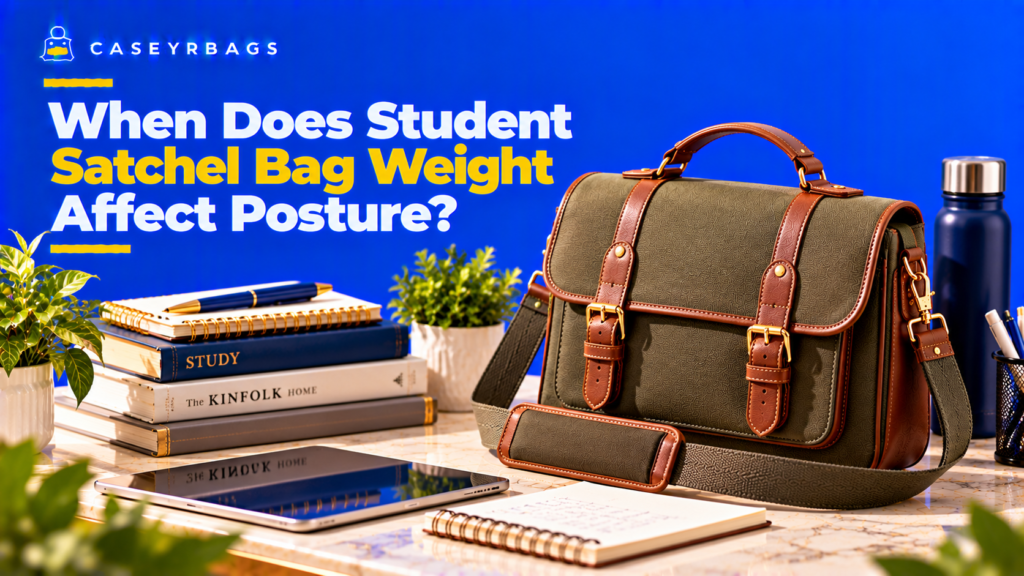
When Does Student Satchel Bag Weight Affect Posture?
Student Satchel Bag weight begins to affect posture functionally when the loaded one-strap bag repeatedly changes how the student positions or moves the carrying shoulder, trunk, or arms to keep the Satchel controlled. The pattern may become more visible when dense contents sit off-center, the loaded bag projects farther from the body, the strap allows a large swing arc, or ordinary walking repeatedly moves the load.
The useful threshold is not one universal percentage or one momentary lean. Weight is a stronger contributor when the same pattern persists during comparable carry and becomes smaller after nonessential load is removed or repositioned despite a reasonable strap check. This is a functional load-management signal only: strap position, loaded depth, anchors, distribution, movement, and duration can change the result, and the observation does not diagnose injury or permanent postural change.
When Does Satchel Weight Become a Functional Postural Demand?
Carrying any Student Satchel adds external mass that the student manages through the strap, shoulder, trunk, arms, and walking pattern. Minor changes in position are normal during lifting, turning, opening, and changing direction.
A functionally meaningful pattern is a repeated loaded-carry change that appears during ordinary use and relates to controlling the Satchel. Shoulder level, trunk position, arm movement, swing response, gripping, and repositioning are observations—not diagnoses.
Observe comparable conditions, test one nearby reasonable strap setting, then reduce or reposition nonessential load. Weight becomes a stronger practical contributor when load reduction produces the clearer repeatable improvement.
For the wider carry-and-capacity system, see Satchel Bag.
Which first signs deserve observation?
The first useful signs are repeated changes in shoulder level, trunk position, arm movement, bag control, gripping, or repositioning during the same loaded route. Repeated shoulder elevation or lowering, trunk shift, reduced arm movement on one side, gripping the bag, repeated strap repositioning, and a recurring lean that appears during the loaded walk. Avoid the phrase “bad posture.”.
Repetition. One brief movement while putting on, turning, or opening the bag is insufficient; the sign becomes more useful when it recurs during the same ordinary task or route. The result remains a practical load-management observation, not proof of injury, permanent postural change, or medical causation.
What counts as normal momentary adjustment?
Normal momentary adjustment includes brief shoulder, trunk, or arm changes used for lifting, turning, stepping, avoiding obstacles, or opening the Satchel. People constantly adjust posture while standing and moving. Brief shoulder, trunk, or arm changes can support lifting, stepping, turning, avoiding obstacles, or accessing the bag. The observation should be repeated under comparable conditions before the pattern is treated as meaningful.
Normal movement ≠ weight-related compensation. The article should focus on loaded patterns that are repeated, control-related, and responsive to a controlled change. The result remains a practical load-management observation, not proof of injury, permanent postural change, or medical causation.
What defines the functional “when” threshold?
The functional threshold appears when the same loaded-carry compensation repeats during ordinary use and becomes smaller after relevant carried demand is reduced or repositioned. Define the threshold through behavior rather than a percentage: repeated compensation during normal carry, difficulty maintaining the preferred carrying pattern, or frequent repositioning that is not explained by one momentary task.
Add the evidence boundary: the pattern should decrease after the relevant carried demand is reduced or repositioned. Call this a functional threshold only; do not translate it into injury, structural change, or medical risk. The result remains a practical load-management observation, not proof of injury, permanent postural change, or medical causation.
Why Does One-Sided Student Satchel Carry Create Asymmetric Demand?
A shoulder Student Satchel applies its primary strap force on one side while the loaded bag occupies space beside the body. The student may make ordinary adjustments to maintain overall control and balance without that asymmetry automatically indicating harm.
What does the carrying side manage?
The carrying side manages strap contact, downward pull, bag position, movement, and the local control needed to keep the one-strap Student Satchel stable. The carrying shoulder and nearby trunk and arm structures manage strap contact, downward pull, bag position, and movement. Anchor geometry and strap setting determine how the force reaches the bag body. The observation should be repeated under comparable conditions before the pattern is treated as meaningful.
The response can include holding the arm differently, stabilizing the bag, or changing shoulder position. These are observations of load management, not proof that the carry method is harmful. The result remains a practical load-management observation, not proof of injury, permanent postural change, or medical causation.
Why can the opposite side also respond?
The opposite side can respond because adding a one-sided external load changes the balance of the combined student-plus-bag system during movement. Adding mass to one side changes the combined student-plus-bag distribution. The trunk, opposite arm, or stepping pattern may adjust to maintain overall control during movement. The observation should be repeated under comparable conditions before the pattern is treated as meaningful.
Avoid one universal direction. A student may shift away to counterbalance or toward the bag to restrain swing; bag position, depth, movement, and individual strategy modify the result. The result remains a practical load-management observation, not proof of injury, permanent postural change, or medical causation.
Does asymmetry automatically mean excessive demand?
No. One-sided suspension creates asymmetry, but functional significance depends on mass, position, depth, duration, movement, repetition, and the individual response. No. One-sided suspension creates an asymmetric condition, but functional significance depends on mass, position, duration, movement, repetition, and the individual response. The observation should be repeated under comparable conditions before the pattern is treated as meaningful.
Asymmetric load ≠ automatically unsafe load. The useful question is whether a repeated, difficult-to-control pattern appears and changes under a controlled strap or load comparison. The result remains a practical load-management observation, not proof of injury, permanent postural change, or medical causation.
How Can Student Satchel Weight Change Shoulder and Trunk Behavior?
Shoulder and trunk behavior can change as the student tries to maintain strap contact, control the bag, counter outward pull, or limit swing. The direction can vary across users, bag geometries, strap settings, and load distributions.
Why might the carrying shoulder rise or lower?
The carrying shoulder may rise to prevent strap slip or control a low-hanging bag, while it may lower under downward pull or a different stabilization strategy. Shoulder elevation when the student tries to prevent strap slip, lift a low bag, or reduce perceived hanging distance. Explain possible lowering through downward pull, settling, or a different control strategy.
Context: check strap slip, strap length, bag height, load amount, and swing. One isolated shoulder position should not be labeled as a weight problem. The result remains a practical load-management observation, not proof of injury, permanent postural change, or medical causation.
Why might the trunk shift away from or toward the bag?
The trunk may shift away to counterbalance or toward the bag to restrain movement and reduce the bag-body gap. An away shift can act as counterbalance, while a toward shift can reduce the bag-body gap or restrain movement. Keep both as conditional mechanics. The observation should be repeated under comparable conditions before the pattern is treated as meaningful.
Loaded depth, strap setting, bag height, and walking movement can change the direction. Do not claim that one visible lean proves injury or permanent postural change. The result remains a practical load-management observation, not proof of injury, permanent postural change, or medical causation.
What makes a shoulder or trunk pattern meaningful?
A shoulder or trunk pattern becomes more meaningful when it recurs during normal loaded walking and changes after a controlled load or position adjustment. The same response to recur during normal loaded walking or carrying, not only while putting the bag on. Note whether the student repeatedly grips, hikes, shifts, or repositions to maintain control.
A comparison. If the response decreases after a relevant load or position change under the same route, the changed variable is a plausible contributor; the observation remains non-diagnostic. The result remains a practical load-management observation, not proof of injury, permanent postural change, or medical causation.
How Do Strap Length and Bag Height Modify Weight-Related Demand?
Strap length and bag height change where the loaded Student Satchel rests and how far it can move. Position can improve or worsen control, but adjustment cannot reduce actual mass.
What can happen when the Satchel hangs lower?
A lower Student Satchel can develop a longer movement arc, a longer reach path, and more contact with the hip or leg, depending on width and loaded depth. A longer suspension path may place the bag lower, increase its movement arc, lengthen the reach path, and increase contact with the hip or leg depending on the bag’s width and depth.
Connect to observation: look for larger swing, repeated low impact, gripping, or trunk and arm changes during walking. Do not conclude that every low position is unsuitable. The result remains a practical load-management observation, not proof of injury, permanent postural change, or medical causation.
What can happen when the Satchel sits very high?
A very high Student Satchel may reduce movement but can crowd the torso, interfere with the arm or opening, or encourage repeated shoulder elevation. A shorter setting may reduce movement and hold the bag closer, while a very high or tight position can crowd the torso, interfere with the arm or opening, or encourage shoulder elevation.
Pair benefit and trade-off. The objective is not the highest position; it is a repeatable position that supports control and access without creating a different compensation pattern. The result remains a practical load-management observation, not proof of injury, permanent postural change, or medical causation.
When has strap adjustment reached its limit?
Strap adjustment reaches its limit when several reasonable settings still produce repeated control-related changes or when load reduction produces clearer improvement. The boundary: several reasonable settings still produce repeated control-related changes; hardware slips; anchors twist; loaded depth remains high; or reducing contents produces more improvement than repositioning. The observation should be repeated under comparable conditions before the pattern is treated as meaningful.
Strap adjustment ≠ load reduction. Move to load amount, distribution, depth, and bag suitability rather than tightening indefinitely. The result remains a practical load-management observation, not proof of injury, permanent postural change, or medical causation.
How Do Loaded Depth and Distance From the Body Change Demand?
Loaded depth and body distance matter because external carrying demand depends on both how much mass the Student Satchel carries and where that mass sits relative to the body and suspension line.
What happens as loaded depth increases?
Increasing loaded depth projects contents farther outward and can increase side profile, rotation, movement, and arm interference during walking. Added depth projects contents farther outward, can increase the bag’s side profile, and may enlarge rotation or movement during walking. Use directional logic rather than a universal depth limit. The observation should be repeated under comparable conditions before the pattern is treated as meaningful.
Overfilled pockets or layered dense items can create local bulges and move the load’s effective position. A bag can close yet still have an inefficient loaded profile. The result remains a practical load-management observation, not proof of injury, permanent postural change, or medical causation.
Why can a lighter but bulky load still feel difficult to control?
A lighter but bulky load can still be difficult to control because distance, width, outward projection, and movement remain important parts of carrying demand. Lower mass does not eliminate the effect of distance, width, and movement. A bulky load can contact the body, interfere with arm swing, or rotate even when its measured mass is lower.
Bag weight ≠ complete postural demand. Compare mass, loaded depth, body distance, and movement together. The result remains a practical load-management observation, not proof of injury, permanent postural change, or medical causation.
What loaded profile should be preferred?
The preferred loaded profile is closed, controlled, and contained within the intended chamber without unnecessary outward bulging or forced overfilling. A closed, controlled profile that keeps recurring contents within the intended chamber and avoids unnecessary outward bulging. Do not prescribe one centimeter threshold. The observation should be repeated under comparable conditions before the pattern is treated as meaningful.
Verify through the same walking task. If reducing depth or relocating items decreases swing or repeated control behavior, loaded geometry was a meaningful contributor. The result remains a practical load-management observation, not proof of injury, permanent postural change, or medical causation.
How Do Load Distribution and Dense Items Affect the Response?
Two Student Satchels with the same total mass can behave differently because dense contents may sit at different ends, depths, or distances from the body-facing side.
What happens when dense items sit at one end?
Dense items at one end can pull that side lower, alter anchor demand, increase rotation, and require more hand, shoulder, or trunk control. One end may pull lower, one anchor may carry a different share of the suspended behavior, and the bag may rotate or require more hand or trunk control. The observation should be repeated under comparable conditions before the pattern is treated as meaningful.
A controlled placement comparison: keep total contents and strap setting the same, relocate the dense item to a more stable intended zone, and repeat the route. The result remains a practical load-management observation, not proof of injury, permanent postural change, or medical causation.
What happens when dense items sit far from the body-facing side?
Dense items placed far from the body-facing side can increase outward projection and rotational leverage, especially in deep chambers or external pockets. The item can increase outward projection and rotational leverage, especially in a deep chamber or external pocket. Use “can” rather than claiming one universal response. The observation should be repeated under comparable conditions before the pattern is treated as meaningful.
A dedicated sleeve or compartment is useful only if it holds the item securely and does not create excessive outer depth. Do not turn the section into device-shopping advice. The result remains a practical load-management observation, not proof of injury, permanent postural change, or medical causation.
What distribution principle should be used?
Use predictable load placement rather than perfect symmetry: dense recurring items should stay stable without unnecessary end loading while closure and access remain normal. Predictable load placement rather than perfect mathematical symmetry. Keep dense recurring items stable, avoid unnecessary end loading, and preserve normal closure and access. The observation should be repeated under comparable conditions before the pattern is treated as meaningful.
Test distribution independently from total load. If tilt improves after relocation but shoulder or trunk changes persist, continue to load-amount and position comparison. The result remains a practical load-management observation, not proof of injury, permanent postural change, or medical causation.
Why Does Walking Reveal More Than Standing Alone?
Standing and walking answer different questions. A stationary student shows the baseline position, while walking reveals repeated direction changes, swing, contact, and repositioning that can increase control demand.
What should be observed while standing?
Standing provides the baseline for bag height, strap position, loaded depth, shoulder level, trunk position, and visible tilt before movement begins. The initial bag height, strap position, loaded depth, shoulder level, trunk position, and whether the bag is already tilting. Do not force the student into a staged “correct” pose. The observation should be repeated under comparable conditions before the pattern is treated as meaningful.
Standing as a baseline only. A normal-looking stationary position cannot rule out movement-related control demand. The result remains a practical load-management observation, not proof of injury, permanent postural change, or medical causation.
What should be observed while walking?
Walking reveals repeated shoulder or trunk changes, arm-movement differences, bag-side contact, swing, rotation, gripping, and repositioning that standing can hide. Observe repeated shoulder elevation or lowering, trunk shift, arm movement difference, bag-side contact, swing, rotation, gripping, and repositioning over the same short ordinary route. The observation should be repeated under comparable conditions before the pattern is treated as meaningful.
Note frequency and recurrence rather than one step. Avoid filming, testing, or observing in a way that compromises privacy or safety. The result remains a practical load-management observation, not proof of injury, permanent postural change, or medical causation.
How does swing increase carrying demand?
Swing increases carrying demand because the direction and timing of strap force keep changing, requiring the student to control the bag repeatedly with the shoulder, trunk, arm, or hand. A moving Satchel changes the direction and timing of strap force, and the student may respond with the shoulder, trunk, arm, or hand to restrain the bag.
Controlled movement ≠ zero movement. The relevant problem is repeated larger movement that requires visible control or repositioning and changes under a relevant correction. The result remains a practical load-management observation, not proof of injury, permanent postural change, or medical causation.
| Observation | Standing | Walking |
|---|---|---|
| Shoulder level | Baseline view | Repeated dynamic change |
| Trunk position | Baseline view | Counter-shift may become clearer |
| Arm movement | Limited evidence | Side-to-side difference visible |
| Bag swing | Minimal | Movement arc visible |
| Repositioning | May not occur | Frequency becomes observable |
| Body contact | Static | Repeated contact visible |
How Do Carry Duration and Fatigue Change the Pattern?
Carry duration can change the observed pattern as the strap settles, movement repeats, contents shift, or the student’s carrying behavior changes. No universal time threshold should be inferred.
What may change later in the carrying period?
Later in the carrying period, repositioning, shoulder switching, gripping, shoulder position, trunk shift, arm movement, or bag height may change as the system settles. More frequent repositioning, shoulder switching, gripping, altered shoulder position, larger trunk shift, reduced arm movement, or a lower settled bag position. The observation should be repeated under comparable conditions before the pattern is treated as meaningful.
These changes can reflect several variables, including hardware slip, strap settling, duration, load movement, or fatigue. Do not assign one cause without comparison. The result remains a practical load-management observation, not proof of injury, permanent postural change, or medical causation.
When does repeated repositioning become informative?
Repeated repositioning becomes informative when it repeatedly interrupts normal carry because the bag no longer stays controllable in the intended position. Occasional adjustment is normal. Repositioning becomes more informative when it repeatedly interrupts normal carry because the bag no longer stays controllable or tolerable in the intended position. The observation should be repeated under comparable conditions before the pattern is treated as meaningful.
When the pattern appears relative to the same short route or routine, but do not convert it into a universal minute limit or a claim about injury. The result remains a practical load-management observation, not proof of injury, permanent postural change, or medical causation.
How should fatigue be described?
Fatigue should be described only as a possible functional change in the ability or willingness to maintain the earlier carrying pattern, not as a diagnosis. Describe fatigue only as a possible functional change in the ability or willingness to maintain the earlier carry pattern. Use observed behavior rather than medical interpretation. The observation should be repeated under comparable conditions before the pattern is treated as meaningful.
Fatigue-related repositioning ≠ proof of injury. If persistent symptoms or concerning functional changes occur, end the bag test and seek appropriate qualified guidance. The result remains a practical load-management observation, not proof of injury, permanent postural change, or medical causation.
| Checkpoint | What to Observe | What Not to Infer |
|---|---|---|
| Start | Initial position and contact | Long-term tolerance |
| Mid-route | Swing, shoulder/trunk change | Injury |
| End of short route | Repositioning and control | Universal time limit |
| After strap change | Position-driven improvement | Weight reduction |
| After load reduction | Demand-driven improvement | Medical diagnosis |
Do Strap Width and Padding Prevent Weight-Related Compensation?
Strap width and padding can change local contact at the shoulder, but neither feature removes loaded mass, outward projection, uneven distribution, or swing.
What can a wider strap change?
A wider strap can spread local contact over a broader surface when it lies flat, which may reduce the concentrated feel of a narrow edge. A wider strap can spread contact over a larger surface when it lies flat and fits the shoulder path. This may reduce the concentrated feel of a narrow edge. The observation should be repeated under comparable conditions before the pattern is treated as meaningful.
The limits: width does not guarantee secure placement, stop strap slip, correct anchor geometry, or reduce total load. A twisted wide strap can lose its intended contact advantage. The result remains a practical load-management observation, not proof of injury, permanent postural change, or medical causation.
What can padding change?
Padding can cushion local contact and reduce the feel of hard edges or hardware, but it does not remove the mass or outward demand of the load. Padding can cushion local contact and reduce the feel of hard edges or hardware when appropriately positioned. Avoid “pressure-free” or “ergonomic” guarantees. The observation should be repeated under comparable conditions before the pattern is treated as meaningful.
Padding ≠ weight reduction. Padding cannot remove dense unnecessary contents, reduce loaded depth, balance one-sided placement, or eliminate a long swing arc. The result remains a practical load-management observation, not proof of injury, permanent postural change, or medical causation.
When are width or padding not the main solution?
Width or padding are not the main solution when compensation persists across reasonable settings and load reduction or geometry correction produces clearer improvement. Conditions: compensation persists across reasonable strap settings; the load remains deep or uneven; the bag swings strongly; or reducing contents creates the clearer improvement. The observation should be repeated under comparable conditions before the pattern is treated as meaningful.
Width and padding as contact variables within the system, not permission to carry a larger or less controlled load. The result remains a practical load-management observation, not proof of injury, permanent postural change, or medical causation.
When Is the Problem Strap Fit, Load Geometry, or Load Amount?
The same visible response can come from strap position, unstable distribution, excessive loaded depth, hardware behavior, or total load. The correct approach is to compare one variable at a time rather than guess.
What suggests a strap-position problem?
A strap-position problem is more plausible when the bag is obviously too high or low and the repeated behavior improves clearly after one nearby reasonable setting. A bag that hangs obviously low or high, swings because of a long suspension path, crowds the torso after over-shortening, or improves clearly after one nearby reasonable setting. The observation should be repeated under comparable conditions before the pattern is treated as meaningful.
Keep load and route constant during the setting comparison. If the behavior changes substantially without changing contents, strap position is a plausible contributor. The result remains a practical load-management observation, not proof of injury, permanent postural change, or medical causation.
What suggests a distribution or geometry problem?
A distribution or geometry problem is more plausible when tilt, bulging, or rotation improves after dense items are relocated while total mass remains unchanged. Persistent end tilt, one anchor pulling differently, outward bulging, excessive loaded depth, or rotation that improves when dense items are relocated while total mass remains the same. The observation should be repeated under comparable conditions before the pattern is treated as meaningful.
Separation: geometry can make a modest load behave poorly, while lowering total mass may still be useful. Do not collapse distribution and mass into one explanation. The result remains a practical load-management observation, not proof of injury, permanent postural change, or medical causation.
What suggests a stronger load-amount contribution?
A stronger load-amount contribution is more plausible when repeated compensation persists across reasonable position checks and improves most consistently after nonessential mass is removed. Repeated compensation across several reasonable strap or placement conditions, frequent switching or gripping during ordinary carry, and a clear improvement after nonessential dense contents are removed. The observation should be repeated under comparable conditions before the pattern is treated as meaningful.
Define the functional threshold: load amount is a stronger contributor when reducing carried demand produces the most consistent improvement under comparable conditions. This remains a practical finding, not a medical diagnosis. The result remains a practical load-management observation, not proof of injury, permanent postural change, or medical causation.
| Observation | Test First | Hold Constant | Next Variable |
|---|---|---|---|
| Bag hangs low and swings | Nearby strap setting | Same load and route | Loaded depth |
| Bag tilts to one end | Dense-item placement | Same strap setting | Anchor geometry |
| Shoulder repeatedly lifts | Strap slip and position | Same load | Load amount / swing |
| Trunk shift persists | Load reduction | Same route and setting | Depth / distribution |
| Repositioning increases later | Duration and settling | Same load | Fatigue / hardware slip |
| Local strap discomfort only | Width and padding | Same load | Contact surface |
How Can Student Satchel Weight/Posture Mismatches Be Diagnosed?
Weight/posture diagnosis here means identifying a likely bag-system contributor, not diagnosing a student’s health. Record the observation, list plausible variables, change one factor, and repeat the same safe task.
What does repeated trunk shift suggest checking?
Repeated trunk shift suggests checking total load, body distance, loaded depth, swing, and side-to-side distribution before assigning one cause. Total load, distance from the body, loaded depth, swing, and side-to-side distribution. Do not assume the direction of the shift identifies the cause by itself. The observation should be repeated under comparable conditions before the pattern is treated as meaningful.
One relevant correction: stabilize or reposition dense items, reduce depth, or remove nonessential mass while holding the route and strap setting comparable. The result remains a practical load-management observation, not proof of injury, permanent postural change, or medical causation.
What does repeated shoulder elevation or lowering suggest checking?
Repeated shoulder elevation or lowering suggests checking strap slip, strap length, bag height, local contact, total load, and swing under the same route. Strap slip, strap length, bag height, local contact, total load, and swing. Note whether the response appears from the first step or develops later. The observation should be repeated under comparable conditions before the pattern is treated as meaningful.
Test one nearby reasonable strap setting first. If the pattern persists and reduces more after load reduction, load demand becomes the stronger practical hypothesis. The result remains a practical load-management observation, not proof of injury, permanent postural change, or medical causation.
What do persistent or inconsistent results mean?
Persistent results across controlled settings justify reviewing load amount, depth, distribution, anchors, and bag-format compatibility; inconsistent results suggest uncertainty or uncontrolled conditions. Persistent results across controlled settings suggest reviewing load amount, depth, distribution, anchors, and whether the Satchel format matches the recurring load. Inconsistent results suggest uncontrolled conditions or an uncertain conclusion. The observation should be repeated under comparable conditions before the pattern is treated as meaningful.
Possible Load Contribution when evidence is mixed. End the article-level test and seek appropriate qualified evaluation when pain, numbness, weakness, balance difficulty, or other concerning symptoms are present. The result remains a practical load-management observation, not proof of injury, permanent postural change, or medical causation.
How Should Student Satchel Weight and Posture Be Evaluated?
Evaluation should compare the actual normal Satchel under comparable conditions, one nearby strap setting, one distribution change, and a reduced nonessential load. The result is a functional classification, not a medical verdict.
What should be recorded before carrying?
Before carrying, record normal contents, dense items, loaded mass when practical, loaded depth, item placement, strap setting, bag height, anchors, clothing, route, and intended duration. The normal contents, dense items, loaded mass when practical, loaded depth, item placement, strap setting, bag height, anchors, clothing, route, and intended carry duration. The observation should be repeated under comparable conditions before the pattern is treated as meaningful.
Remove temporary items that are not part of the true recurring load before the baseline, unless the specific purpose is to test their effect. Close the Satchel normally and avoid forced overfilling. The result remains a practical load-management observation, not proof of injury, permanent postural change, or medical causation.
What should be observed during each comparison?
Each comparison should use the same standing baseline and short walking route while observing repeated shoulder, trunk, arm, swing, gripping, switching, and repositioning behavior. Observe standing baseline and the same ordinary walking route. Record repeated shoulder, trunk, arm, swing, gripping, switching, and repositioning behavior without forcing or coaching a posture. The observation should be repeated under comparable conditions before the pattern is treated as meaningful.
Keep the observer position and tasks comparable. Stop if the student reports pain, numbness, weakness, balance difficulty, or another concerning symptom; do not use the article to interpret the symptom. The result remains a practical load-management observation, not proof of injury, permanent postural change, or medical causation.
Which sequence should determine the final classification?
The final classification should come from one controlled normal-load, strap-position, distribution, and reduced-load comparison rather than from a single appearance or percentage. Introduce the fixed 20-step sequence below as a practical comparison, not a validated medical assessment or score. The observation should be repeated under comparable conditions before the pattern is treated as meaningful.
One final category: No Clear Load Effect, Possible Load Contribution, or Stronger Functional Load Contribution. Name the tested conditions and the unresolved variable; do not label the student’s posture as healthy, damaged, or unsafe. The result remains a practical load-management observation, not proof of injury, permanent postural change, or medical causation.
- Confirm that the page is evaluating a one-strap Student Satchel, not a backpack.
- Identify the normal recurring contents.
- Separate dense recurring items from temporary or nonessential items.
- Inspect the strap, adjuster, stitching, and anchors.
- Arrange the normal contents in their intended zones.
- Close the Satchel without forcing the opening.
- Record loaded mass when a safe, practical scale is available.
- Record loaded depth, obvious bulging, tilt, and bag height.
- Record the starting strap setting and clothing condition.
- Observe the student standing naturally without coaching a “correct” posture.
- Observe the same short ordinary walking route.
- Record repeated shoulder, trunk, arm, swing, gripping, switching, and repositioning behavior.
- Test one nearby reasonable strap setting while keeping the load and route unchanged.
- Repeat the standing and walking observations.
- Restore or record the selected comparable strap setting.
- Reposition an off-center dense item when distribution is a plausible problem.
- Remove one or more nonessential dense items while preserving the recurring load’s purpose.
- Repeat the same standing and walking observations.
- Compare which controlled change—strap position, distribution, or load reduction—produced the clearest repeatable improvement.
- Classify the result as No Clear Load Effect, Possible Load Contribution, or Stronger Functional Load Contribution, and apply the medical/referral boundary.
| Test | Controlled Change | Evidence to Record | Boundary |
|---|---|---|---|
| Normal load | None | Baseline repeated behavior | Observation only |
| Nearby strap setting | Position only | Change in swing and behavior | Strap contribution possible |
| Better item placement | Distribution only | Change in tilt or rotation | Placement contribution possible |
| Reduced nonessential load | Demand only | Change in repeated compensation | Load contribution possible |
| Bag removed | External load removed | Whether loaded pattern stops | Not proof of injury or causation |
Final Student Satchel Weight/Posture Checklist
- The page answers when Student Satchel weight functionally affects posture.
- Posture is treated as static and dynamic body position, not a visual perfection standard.
- Postural compensation is distinguished from injury.
- Momentary movement is distinguished from a repeatable loaded pattern.
- The article evaluates a Student Satchel rather than a backpack.
- One-sided suspension is explained without labeling it automatically unsafe.
- Normal recurring contents define the baseline.
- Temporary and nonessential dense items are identified.
- Loaded mass is recorded only when practical and safe.
- No universal body-weight percentage is imposed.
- Strap setting is recorded.
- Bag height is recorded.
- Anchors and adjustment hardware are inspected.
- Loaded depth is evaluated.
- Distance from the body is considered.
- Side-to-side distribution is evaluated.
- Dense-item position is evaluated.
- Shoulder behavior is observed without diagnosis.
- Trunk behavior is observed without assuming one direction.
- Arm movement is observed.
- Standing is used only as a baseline.
- Walking is observed on the same short route.
- Bag swing and rotation are recorded.
- Controlled movement is not confused with zero movement.
- Repositioning and shoulder switching are interpreted in context.
- Carry duration is considered without a universal minute threshold.
- Fatigue is described functionally, not diagnosed.
- Strap width is treated as a contact variable.
- Padding is not confused with weight reduction.
- One nearby reasonable strap setting is compared.
- Load distribution is tested separately from total mass.
- A reduced nonessential load is compared under similar conditions.
- Improvement is treated as contribution evidence, not medical causation.
- The result uses one of the three non-medical classifications.
- Persistent pain, numbness, weakness, balance difficulty, or other concerning symptoms trigger appropriate referral.
- The single approved upward link appears once, and no unapproved internal or external links appear in the production copy.
Conclusion
Student Satchel weight affects posture functionally when the loaded bag’s one-sided and outward demand repeatedly changes shoulder, trunk, arm, or walking behavior as the student manages the bag. Strap position, bag height, loaded depth, distribution, swing, and duration can strengthen or reduce that pattern, so a single lean or one standing image is not enough.
There is no one article-level number that defines the threshold for every student. Stronger practical evidence is a repeatable pattern that remains after a reasonable strap check and becomes smaller when nonessential load is removed or positioned more predictably. That finding can guide bag-use correction, but it does not diagnose harm, predict long-term injury, or replace appropriate qualified evaluation when pain, numbness, weakness, balance difficulty, or other concerning symptoms persist.
FAQs
How can I tell if a Student Satchel is influencing posture?
Useful observations include repeated shoulder elevation or lowering, trunk shifting, altered arm movement, larger bag swing, gripping, or frequent repositioning during comparable normal walking—not one brief pose.
A load contribution becomes more plausible when the repeated pattern decreases after nonessential contents are removed or dense items are repositioned. This remains a functional observation, not an injury diagnosis.
Is there one safe weight limit for every Student Satchel?
No single universal percentage should be imposed here because students, Satchels, load positions, strap settings, movement, duration, and responses differ, and much schoolbag evidence is not specific to one-strap Satchels.
Focus instead on necessary recurring contents, controlled depth and distribution, repeatable carrying behavior, and appropriate professional guidance when symptoms are concerning.
Can adjusting the strap fix posture changes caused by a heavy Student Satchel?
Adjustment can improve bag height, body proximity, reach, and swing, but it cannot reduce actual mass or remove unnecessary dense items.
If repeated changes continue across reasonable settings and improve more after contents are removed, load amount or geometry is the stronger practical contributor under the tested conditions.