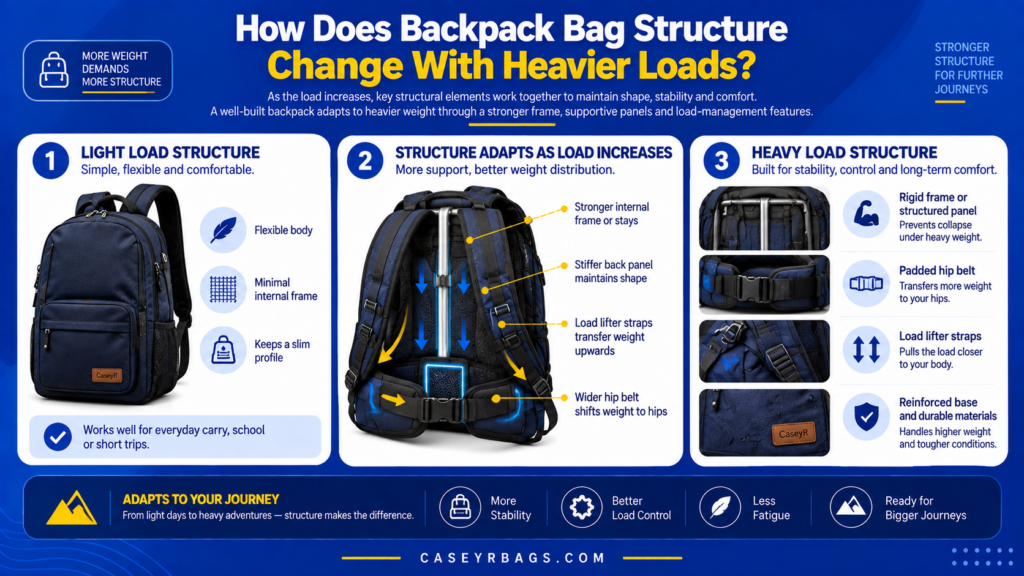
How Does Backpack Bag Structure Change With Heavier Loads?
As a Backpack Bag carries a heavier load, its body panels, seams, strap anchors, base, compartments, and any framing system experience greater structural demand. The bag may sag more, stretch at attachment points, change shape, or rely more heavily on reinforcement and frame structure to keep the load controlled.
Some of those changes can remain controlled, while others become progressive warning signs. Heavier load ≠ automatic overload, structural deformation ≠ structural failure, and load response ≠ verified safe load capacity. The important question is whether the whole Backpack continues to manage the added demand without worsening distortion, concentrated stress, loss of compartment shape, unstable movement, or damage at structural connections.
What Changes in a Backpack Bag as the Load Becomes Heavier?
A heavier Backpack Bag places greater tension and pressure on the structural path connecting the contents, base, body panels, seams, strap anchors, and shoulder straps. The structure must resist this demand while maintaining a usable bag shape and keeping the load sufficiently controlled during normal movement.
Some structural change can be normal. Flexible fabrics may stretch slightly, soft bases may sag, and compartments may become more defined around the contents without indicating failure. The broader Backpack Bag page places this heavier-load response within balanced loading, load stability, compartment structure, and modular organization.
The key issue is whether those changes remain controlled and stable or become progressively excessive. Repeated distortion, seam opening, anchor pulling, uncontrolled base sagging, frame displacement, or loss of bag shape can indicate that the load and construction are no longer working together predictably.
Which Backpack Components Respond First to Increasing Load?
The first structural responses usually appear in the zones that directly receive or transfer load: the base panel, shoulder-strap anchors, lower anchors, load-bearing seams, body panels, back panel, frame structure, and compartment walls. As load increases, each zone experiences more pressure, tension, bending, or shape demand according to its role.
Higher load → greater structural demand → visible or functional response. The base may sag more, panels may tighten or bulge, seams may carry greater tension, anchors may pull harder against surrounding material, and compartments may become more compressed. No single component proves whole-bag capacity because the entire structural path must continue functioning together.
Which Structural Changes Can Occur Without Immediate Failure?
Modest fabric tension, controlled base sag, predictable bag expansion, compartment shaping, and increased strap tension can occur as load rises without proving immediate structural failure. Flexible Backpack bodies are expected to respond to pressure, and some visible shape change may simply reflect the material and construction adapting to the contents.
Structural change does not automatically mean structural failure. The more useful distinction is whether the response remains limited, stable, and repeatable. A soft base that sags slightly but stays controlled is different from sag that grows progressively, shifts the load, pulls seams apart, or changes the bag’s ability to remain structurally stable.
When Does Deformation Become a Warning Sign?
Deformation becomes more concerning when it grows progressively or changes the Backpack’s function. Increasing left-right asymmetry, permanent panel distortion, seam separation, elongated stitch holes, anchor lifting, severe base sag, frame bending, or repeated one-sided collapse indicate that structural demand is no longer producing a simple controlled response.
Progressive deformation → reassess load and construction fit. One isolated cosmetic change is less meaningful than a worsening pattern that appears again under repeated loading. The goal is not to predict an exact failure point but to recognize when the Backpack’s structure is losing shape control, connection integrity, or load stability.
How Does the Backpack Body Change Under Heavier Loads?
Body panels and overall bag geometry respond to increased internal pressure through stretching, bulging, sagging, side expansion, or changes in bag depth.
How Does Heavier Loading Change Bag-Body Shape?
Heavier loading can increase panel tension, outward bulging, vertical sagging, sidewall expansion, and overall bag depth. Flexible materials often conform more closely around dense contents, while structured panels resist that shape change more strongly until the surrounding construction reaches greater demand.
Load pressure → panel deformation → changed bag geometry. The response becomes more important when it moves the load center, changes the bag centerline, collapses nearby compartments, or increases tension at seams and anchors. Shape change should therefore be judged by its effect on structural control rather than appearance alone.
Why Do Flexible and Structured Backpacks Respond Differently?
A flexible body conforms more around the contents, while a structured body resists shape change more strongly. Flexible construction may show visible bulging or sag earlier, whereas stiffer panels can retain geometry longer but still transfer structural demand into seams, anchors, frames, and other connections.
Neither response is universally superior. A flexible Backpack can remain functionally controlled even with visible deformation, and a rigid-looking Backpack can still experience significant hidden stress at connection points. The complete bag response matters more than whether the material appears soft or stiff.
When Does Body Deformation Reduce Load Control?
Body deformation reduces load control when the shape change begins to shift contents, destabilize bag position, collapse compartments, increase left-right distortion, or create uneven strap behavior. At that point, flexibility is no longer only a material characteristic; it is affecting how the Backpack manages the heavier load.
Useful flexibility becomes a problem when load control is lost. Repeated bulging, sag, or side expansion that changes movement or concentrates stress deserves more attention than predictable shape change that remains stable. The distinction should be based on function, not a universal amount of acceptable deformation.
| Structural Response | Lower Load | Heavier Load | Main Concern |
|---|---|---|---|
| Panel tension | Limited | Increased | Stretching |
| Base sag | Limited | More visible | Load concentration |
| Side expansion | Controlled | Greater | Shape loss |
| Bag tilt | Minimal | May increase | Uneven loading |
How Do Seams & Strap Anchors Respond to Heavier Loads?
Increasing load raises tension at the structural connections that transfer force through body panels, seams, anchors, and shoulder straps.
How Does Heavier Load Increase Seam Demand?
Heavier load increases seam demand because greater internal pressure pulls harder on the panels joined by side seams, base seams, top seams, and reinforcement seams. As panel tension rises, the stitches and surrounding material must transfer more force without separating, elongating, or distorting.
More carried load → greater panel tension → greater seam demand. Strong stitching alone does not prove whole-bag capacity because seam performance also depends on material strength, reinforcement design, stitch-hole condition, and how evenly the load is distributed through adjacent panels.
Why Do Shoulder-Strap Anchors Become Critical Under Heavier Loads?
Shoulder-strap anchors become critical because they transfer increasing Backpack load from the bag body into the shoulder straps. The upper and lower anchor zones must carry tension through reinforcement layers, surrounding panels, and seams while maintaining their intended geometry as load demand rises.
Bag load → anchor → shoulder strap. A visually strong strap cannot compensate for an anchor zone that lifts, stretches, tears, or separates from the body. Anchor integrity therefore has to be evaluated together with the surrounding construction rather than judging the strap material by itself.
Which Anchor or Seam Changes Indicate Excessive Stress?
Stitches pulling apart, elongated stitch holes, material puckering, local tearing, anchor distortion, reinforcement separation, or progressive lifting around an attachment zone all deserve attention under heavier loading. These changes suggest that structural demand is concentrating at a connection instead of remaining controlled across the intended load path.
Local stress concentration can become the weak point of the whole load path. One cosmetic wrinkle is not equivalent to failure, but repeated or worsening separation around seams and anchors is a stronger signal that the load and construction should be reassessed before carrying continues.
How Does the Backpack Base Respond to Heavier Loads?
Increasing internal weight raises downward pressure at the Backpack base and can make sagging, localized pressure, and base-seam demand more visible.
Why Does Base Pressure Increase With Heavier Contents?
Base pressure increases because the contents transmit downward load into the bottom panel, while dense objects can concentrate more of that pressure over smaller areas. As the load rises, the base must resist greater bending, stretching, and seam demand while keeping the contents supported inside the intended bag shape.
Contents → downward load → base panel. A heavier load does not automatically mean the base is failing, but increasing local pressure can expose weak areas, create more visible sag, or transfer extra demand into base seams and adjacent side panels.
How Does Base Sag Affect Backpack Structure?
Base sag can lower the position of the internal load, change the bag shape, pull harder on side seams, increase movement, and create uneven pressure across the lower structure. Limited sag can be a normal response in flexible construction, especially when the deformation remains stable and predictable.
Controlled base sag ≠ automatic failure. The concern grows when sag becomes progressively deeper, one-sided, difficult to control, or associated with seam separation, unstable movement, or concentrated pressure from dense items. Function matters more than whether the base appears perfectly flat.
When Does Base Reinforcement Become More Useful?
Base reinforcement becomes more useful when dense items, repeated heavier loading, noticeable sagging, concentrated pressure, or frequent floor contact create a repeatable structural demand at the bottom of the Backpack. Reinforcement can help spread or resist that demand more effectively when the base is otherwise deforming excessively.
Base reinforcement should answer an actual structural demand. A stronger base cannot compensate for weak shoulder-strap anchors, damaged side seams, unstable framing, or poor internal distribution. Whole-bag structure still determines whether the heavier load remains controlled.
| Load Condition | Base Behavior | Seam Effect | Load-Control Consequence |
|---|---|---|---|
| Moderate distributed load | Limited sag | Controlled tension | Stable lower structure |
| Heavier distributed load | More visible sag | Greater base-seam demand | May remain controlled |
| Dense localized item | Concentrated pressure | Localized seam/panel demand | Higher distortion risk |
| One-sided dense load | Asymmetric sag | Uneven seam demand | Can increase tilt |
How Does Framing Change Backpack Response to Heavier Loads?
Frame sheets, stays, reinforced panels, or other structural supports can change how strongly the Backpack resists deformation as load demand rises.
How Does Framing Resist Bag-Body Deformation?
Framing resists bag-body deformation by providing structural resistance against collapse, twisting, sagging, or rear-panel shape change. As load pressure increases, the frame can help the Backpack retain a more consistent geometry instead of allowing soft panels to conform freely around the contents.
Load pressure → frame resistance → retained bag shape. Potential benefits include reduced collapse, reduced twisting, more consistent back-panel shape, and more stable compartment geometry. These benefits remain construction-dependent and do not establish a universal safe carrying capacity.
When Does Framing Become More Useful as Load Increases?
Framing becomes more useful when heavier loads repeatedly produce sagging, bag-body collapse, unstable dense items, loss of shape, or inconsistent strap geometry that the existing structure cannot control. The advantage should be visible under the intended load rather than assumed from the presence of a frame.
No universal weight threshold determines when framing is required. A lighter load can create structural problems in a very soft design, while a heavier load can remain controlled in a different construction. The useful test is whether framing improves shape retention and load control without hiding poor internal distribution.
Why Does Framing Not Solve Every Heavy-Load Problem?
Framing cannot correct excessive total load, weak seams, weak anchors, damaged structure, poor internal distribution, or unstable external storage. A frame can help preserve the bag shape while other structural connections continue receiving more demand than they can manage predictably.
Frame support ≠ unlimited structural capacity. Strong framing must still work with the base, panels, seams, anchors, compartments, and strap system. If another component begins to distort or separate progressively, a rigid frame does not make the complete Backpack structurally suitable.
| Load Response | Frameless Backpack | Framed Backpack |
|---|---|---|
| Shape retention | More content-dependent | More structure-dependent |
| Sag control | Lower to moderate | Potentially greater |
| Dense-load stability | Organization-dependent | Frame can assist |
| Flexibility | Greater | Lower |
| Structural limit | Still construction-dependent | Still construction-dependent |
How Do Backpack Compartments Change Under Heavier Loads?
Increased load pressure can change compartment geometry, compress dividers, stretch pockets, distort organizers, and alter how well internal zones retain their intended shape.
How Can Heavier Contents Distort Compartments?
Heavier contents can compress dividers, stretch pockets, collapse sleeves, reduce usable space, and shift compartment boundaries. These changes occur when the internal load pushes against organization features more strongly than under lighter conditions, especially when dense items concentrate pressure in one zone.
Compartment distortion matters when it stops being a cosmetic shape change and begins moving items, reducing access, transferring pressure into seams, or destabilizing the bag body. A divider that flexes slightly is different from one that collapses enough to let the load shift unpredictably.
How Do Dense Items Affect Modular Organization?
Dense items can push modules aside, distort removable organizers, create one-sided pressure, and change access to neighboring contents. As the total load rises, the same dense object can have a larger structural influence because surrounding dividers and compartment walls are already under greater pressure.
Organization must remain stable under the intended load. Modular components should continue controlling items rather than becoming another source of movement or asymmetry. Dense-item placement should therefore be evaluated through its effect on both organization and structural demand.
When Does Compartment Distortion Become a Structural Problem?
Compartment distortion becomes structural when it allows load shifting, worsens balance, reduces access enough to force the bag out of shape, presses hard against seams, or contributes to unstable overall geometry. At that point, the organization system is affecting the Backpack’s load-control behavior rather than only internal appearance.
The concern is strongest when the distortion repeats or worsens under heavier loading. A compartment that loses shape temporarily but returns to function can still be usable, while progressive collapse suggests that the internal structure and intended load need reassessment.
| Load Increase | Compartment Response | Organization Effect | Structural Consequence |
|---|---|---|---|
| Limited increase | Minor shaping | Zones remain usable | Controlled response |
| Greater pressure | Divider compression | Reduced separation | More load movement possible |
| Dense localized item | Organizer distortion | One-sided pressure | Asymmetric structural demand |
| Progressive overload pattern | Compartment collapse | Loss of organization | Reduced load control |
How Does Heavier Loading Affect Backpack Load Distribution?
Increasing total load amplifies the structural consequences of poor internal placement because the same left-right or localized imbalance now creates greater demand through the bag structure.
Why Does Off-Center Weight Matter More as the Load Increases?
Off-center weight matters more as the load increases because greater asymmetric load produces a larger left-right difference in structural demand. The Backpack may tilt more strongly, one strap path may experience greater tension, and one side panel or seam may receive more pressure than the other.
Greater asymmetric load → greater left-right structural difference. A small imbalance that remains manageable at a lighter load can become more visible when total demand rises. The internal load should therefore be checked before structural asymmetry is corrected only through strap adjustment.
How Do Dense Items Create Localized Structural Demand?
Dense items create localized structural demand by concentrating pressure over smaller areas of the base, back panel, compartment wall, side seam, or other nearby construction. As total load rises, these concentrated pressure points can create more visible bulging, sagging, or tension around local structural zones.
Dense item → concentrated pressure → localized structural stress. The item does not automatically damage the bag, but the surrounding construction must manage the concentrated demand without progressive deformation. Stable positioning and pressure distribution therefore remain part of heavy-load structural evaluation.
Why Should Load Placement Be Checked Before Changing Strap Adjustment?
Load placement should be checked first because an internal imbalance can create bag tilt and unequal structural demand before the shoulder straps are adjusted. Tightening one strap may reposition the Backpack while leaving the original off-center load and structural pressure unchanged.
Structural imbalance → inspect internal load first → refine strap adjustment second. Straps can reposition the bag; they cannot remove an internal load imbalance. This sequence prevents adjustment from hiding a structural response that begins inside the Backpack.
Which Structural Changes Signal That the Load Is Too Demanding?
The most useful warning signs are progressive structural changes that worsen with repeated or increased loading rather than one isolated cosmetic observation.
Which Visible Changes Deserve Attention?
Permanent panel distortion, anchor pulling, seam opening, tearing, excessive base sag, frame bending or displacement, and repeated one-sided collapse deserve attention when carrying a heavier load. These changes suggest that structural demand is no longer staying fully within the bag’s normal controlled response.
One observation should be interpreted in context, but worsening separation, distortion, or displacement is more meaningful than a stable cosmetic change. The correct response is reassessment rather than predicting an exact failure point from appearance alone.
Which Functional Changes Matter Even Before Visible Damage Appears?
Functional changes can matter before obvious damage appears. Repeated load shifting, unstable bag position, compartments no longer holding shape, extreme strap compensation, closures becoming difficult to align, or a frame repeatedly moving inside its intended position can all signal deteriorating load control.
No visible deformation ≠ no structural stress. A bag can look intact while its function becomes less predictable. Changes in stability, alignment, or internal control should therefore be evaluated alongside visible construction changes rather than waiting for tearing or separation to appear.
Why Should Progressive Change Matter More Than One Isolated Observation?
Progressive change matters because repeated load creates repeated structural demand, and worsening distortion provides stronger evidence that the Backpack is not returning to a stable controlled state. A single wrinkle, temporary bulge, or one-time sag event can occur without establishing an ongoing mismatch.
Repeated load → repeated distortion → cumulative structural concern. A worsening structural response is stronger evidence of mismatch than a single cosmetic change. The purpose is to identify a trend that justifies reducing or redistributing the load without claiming a universal failure threshold.
How Can Backpack Structure Be Evaluated Under a Heavier Load?
A repeatable whole-bag evaluation should compare the unloaded Backpack with its intended heavier load and then inspect whether structure, connections, and movement remain controlled.
What Should Be Inspected Before Adding More Load?
Before adding more load, inspect body panels, load-bearing seams, shoulder-strap anchors, lower anchors, base condition, frame or back-panel structure, compartments, and adjustment hardware. This establishes whether the Backpack begins from a sound and reasonably symmetrical condition before additional structural demand is introduced.
Manufacturer guidance should also be checked where available because structural appearance alone cannot establish safe capacity. Existing damage, stretched stitch holes, distorted anchors, bent frame elements, or weakened seams should be treated as pre-existing conditions rather than changes caused by the new load.
What Should Be Checked After the Load Increases?
After the load increases, observe bag shape, base sag, left-right symmetry, anchor movement, seam tension, compartment stability, frame behavior, and load movement. Compare these responses with the unloaded state and with the Backpack’s normal load rather than evaluating the heavier condition in isolation.
The key question is whether the structural changes remain controlled and predictable. Progressive distortion, worsening tilt, new seam separation, increasing anchor movement, or loss of compartment control are reasons to redistribute or reduce the load and reassess the construction fit.
Which Sequence Should Determine Whether the Structure Remains Suitable?
- Identify the normal load.
- Confirm manufacturer guidance where available.
- Inspect the unloaded bag.
- Add the intended load.
- Check bag-body deformation.
- Check seams and anchors.
- Check the base.
- Check frame behavior.
- Check compartment stability.
- Walk normally and observe movement.
- Reduce or redistribute the load if structural control deteriorates.
Use the sequence in that order so the Backpack is evaluated as a complete structural system rather than by one strong-looking component. Start with known guidance and unloaded condition, then add the intended heavier load and inspect how each major structural zone responds before movement introduces another variable.
After walking, compare the loaded structure again. If deformation, connection stress, base behavior, framing, compartments, or load movement become progressively less controlled, reduce or redistribute the load instead of using strap adjustment to hide the mismatch. The sequence is descriptive and does not create a universal safe-load class.
How Can Heavy-Load Structural Mismatches Be Avoided?
Heavy-load mismatches are avoided by judging the complete Backpack structure rather than assuming that size, one strong component, or one successful heavy carry proves suitable structural capacity.
Why Is Backpack Size a Weak Guide to Heavy-Load Capability?
Backpack size is a weak guide because large volume describes internal space, not the strength of seams, anchors, panels, base construction, framing, or reinforcement. A large bag can still use flexible materials, light-duty connections, or minimal structural support that were not designed around repeated heavier loading.
Large volume ≠ high structural capacity. Capacity should be interpreted through actual construction and manufacturer guidance where available, not through liters or physical size alone. More space only makes it possible to fit more contents; it does not prove that the complete load path is designed for greater structural demand.
Why Can Strong Shoulder Straps Still Coexist With Weak Bag Structure?
Strong shoulder straps can coexist with weak bag structure because the complete load path also includes upper and lower anchors, surrounding panels, seams, the base, framing, and body material. A durable strap transfers force into these connections, so weakness elsewhere can still limit the structural response.
Strong strap ≠ strong whole Backpack. The anchor may pull through a weak panel, a base seam may separate, or the bag body may deform even when the strap webbing itself remains intact. Whole-bag performance must therefore be evaluated through every major structural zone that carries or transfers the heavier load.
What Should Be Verified Before Repeatedly Carrying Heavier Loads?
Before repeatedly carrying a heavier load, verify manufacturer guidance where available, inspect body panels, seams, upper and lower anchors, the base, framing, compartment shape, load distribution, and adjustment behavior. The Backpack should remain reasonably controlled without progressive damage, extreme one-sided compensation, or worsening movement after repeated use.
One successful heavy carry ≠ proven long-term structural capacity. Repeat the same structural checks over time because gradual stitch-hole elongation, frame displacement, base sag, anchor distortion, or compartment collapse can develop progressively even when the first carry appeared stable.
- Manufacturer load guidance is checked where available.
- Body panels show no progressive damage.
- Bag shape remains reasonably controlled.
- Shoulder-strap anchors remain intact.
- Lower strap anchors remain intact.
- Load-bearing seams show no separation.
- Stitch holes are not progressively elongating.
- Base sag remains controlled.
- Dense items are not creating extreme localized pressure.
- Framing remains stable where present.
- Frame structure is not bent or displaced.
- Compartments retain functional shape.
- Load remains reasonably centered.
- Side pockets do not create major imbalance.
- Both straps can be adjusted without extreme compensation.
- Load movement remains controlled.
- Heavier loading is not justified solely by Backpack size.
- A successful single heavy carry is not treated as proof of long-term structural capacity.
Conclusion
Backpack Bag structure changes under heavier loads because greater weight increases pressure on the base, tension through body panels and seams, demand at strap anchors, and reliance on framing or reinforcement to maintain shape. Controlled deformation can become more visible, while poorly supported structures may sag, distort, shift, or concentrate stress at weak connections.
A Backpack remains structurally suitable for a heavier load when its body, seams, anchors, base, framing, compartments, and strap system continue to control the load without progressive deformation, instability, or structural damage. No single strap, seam, material, frame, or successful carry proves capacity; the whole structure and manufacturer guidance where available remain the relevant reference.
FAQs
Not always. Flexible Backpacks may show more sag or shape change as load increases, while structured or framed designs may resist deformation more strongly. The amount of change depends on construction, load placement, base support, and whether the deformation remains controlled rather than progressively worsening.
Framing can improve shape retention and load control, but it does not by itself establish safe carrying capacity. Seams, anchors, materials, base construction, compartments, the complete structural path, and manufacturer guidance where available still determine whether a particular load is appropriate.
Increasing seam separation, anchor distortion, excessive base sag, persistent bag tilt, frame displacement, tearing, progressive stitch-hole elongation, or loss of compartment shape are reasons to reassess or reduce the load. No single universal numerical threshold can identify structural failure across every Backpack design.