Why Does a Backpack Bag Use Two Shoulder Straps?
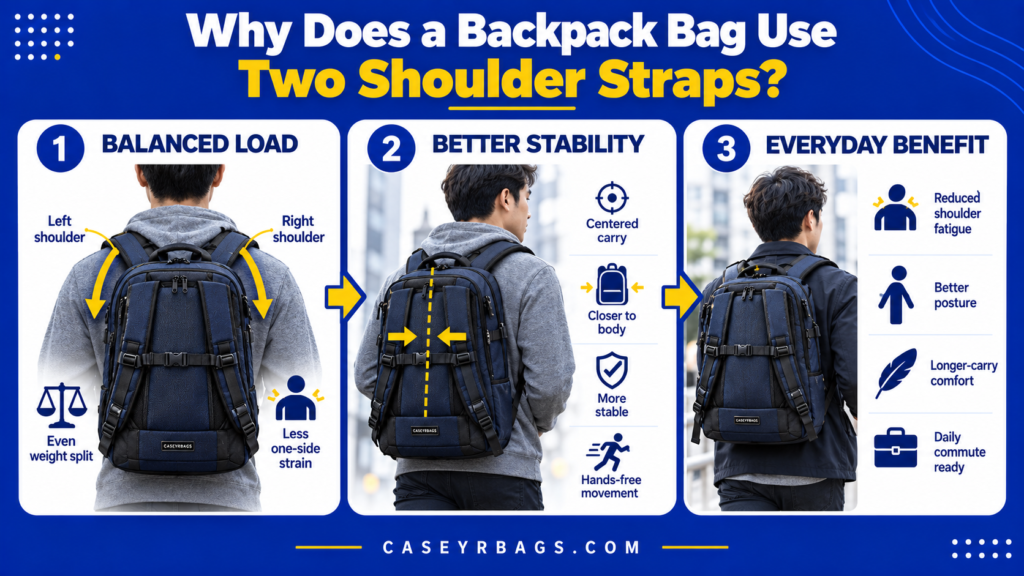
A Backpack Bag uses two shoulder straps to create two primary support paths between the loaded bag and the carrying surface. The left and right straps connect through upper and lower anchors, helping the Backpack remain more centrally positioned while both sides participate in supporting and controlling the normal load during walking, commuting, and other routine movement.
Two support paths ≠ guaranteed equal loading, weight distribution ≠ weight reduction, and two straps ≠ unlimited load capacity. Actual left-right support still depends on strap adjustment, anchor geometry, bag position, side-pocket loading, internal load placement, and whether contents remain stable. The two straps work as one connected carrying system, not as two independent full-load systems, and their effectiveness depends on the loaded Backpack behaving predictably as a whole.
What Do Two Shoulder Straps Do in a Backpack Bag?
Two shoulder straps create a left support path and a right support path from the Backpack. Each path begins at an upper anchor, continues through a shoulder strap, and returns through a lower anchor, while the bag body links both sides into one connected structure.
Shared support depends on more than having two visible straps. Internal load position, strap adjustment, anchor position, bag tilt, and external pocket loading can change how much demand reaches each side. The broader Backpack Bag page places this paired strap system within balanced loading, load stability, compartment structure, and modular organization.
The two-strap system also helps control bag position and side-to-side movement. When both straps are active and the internal load remains stable, the Backpack has greater potential to stay near its intended centerline during normal movement. That stability improves carrying predictability without implying perfectly equal forces, lighter total weight, or unlimited load capacity.
How Do Two Shoulder Straps Create Two Load Paths?
Two shoulder straps create separate left and right routes through which the loaded Backpack can transfer carrying demand. Each route combines an upper anchor, shoulder strap, adjustment hardware, lower anchor, and the bag body that connects the two sides. The paths operate simultaneously when both straps are used as intended.
Loaded Backpack → Left Strap Path + Right Strap Path → Shared Support. The two straps form connected support paths within one Backpack system; they are not two independent systems each carrying the entire load. Actual demand still depends on internal load position, bag movement, and adjustment, so two paths create balanced potential rather than guaranteed equality.
Why Does a Backpack Benefit From Left-Right Support?
A Backpack benefits from left-right support because two active paths can restrain the bag from both sides instead of letting the normal load depend mainly on one shoulder. This two-sided relationship helps control lateral movement, bag tilt, shifting position, and repeated rotation during routine carrying.
Left-right support is mechanical rather than medical. It improves the Backpack’s potential to remain centered when the contents and adjustment are also reasonably balanced. If one side pocket becomes heavy or a dense item shifts laterally, the bag can still pull off-center despite both straps being active, so two-sided support works best when the load itself remains controlled.
Why Do Two Straps Not Automatically Divide Weight Equally?
Two straps do not automatically divide weight equally because each support path responds to the actual loaded bag. Off-center contents, uneven strap adjustment, side-pocket loading, bag-body asymmetry, shifting objects, or changing bag angle can alter the demand reaching the left and right sides even when the straps look symmetrical.
Two straps create two support paths, not guaranteed 50/50 loading. Symmetrical-looking straps do not guarantee symmetrical forces. A more level bag position can improve the opportunity for comparable demand, but actual sharing remains dependent on internal load position and movement, so equal strap count should never be treated as proof that the load is already balanced.
How Do Two Shoulder Straps Share Backpack Load?
Two shoulder straps can share Backpack carrying demand across left and right support paths, but the actual share depends on the loaded bag rather than strap count alone.
What Determines How Much Load Each Strap Supports?
The amount of demand reaching each strap depends on internal load position, strap adjustment, anchor symmetry, bag tilt, external pocket loading, and the geometry formed by the bag body and both support paths. These factors determine how the loaded Backpack presents force to the left and right sides.
Load position + strap geometry → left/right strap demand. Neither strap should be described as independently carrying the entire Backpack load because both paths remain connected through the same bag body. A strongly offset internal load can increase demand on one side even when the anchor layout and strap lengths appear symmetrical.
How Does Centered Loading Support More Even Strap Demand?
Centered stable contents help keep the Backpack’s load center closer to the bag centerline, creating a greater opportunity for the left and right strap paths to experience comparable demand. This does not require perfect numerical symmetry, but it does require avoiding strong lateral concentration of dense items.
Centered stable contents → more symmetrical bag position → greater opportunity for comparable strap loading. The two sides may still differ because of adjustment, movement, external pockets, or bag shape, so centered loading should be treated as one condition within the complete support system rather than proof of exact equality.
How Does an Off-Center Load Change the Two-Strap System?
An off-center load shifts the Backpack’s internal balance before the force reaches the two shoulder straps. A dense item placed strongly to the left or right can move the bag toward that side, change bag tilt, and increase the demand reaching the corresponding support path.
Dense item shifted to one side → bag tends toward that side → strap demand can become uneven. Internal balance affects external strap balance. The correct response is to inspect the load itself before using one-sided adjustment as compensation, because tightening one strap can reduce visible tilt without removing the underlying load offset.
| Load Condition | Bag Position | Strap Effect |
|---|---|---|
| Centered stable load | More level | More comparable strap demand |
| Left-heavy load | Tends left | Higher left-side demand may occur |
| Right-heavy load | Tends right | Higher right-side demand may occur |
| Shifting load | Variable | Strap demand changes during movement |
How Do Two Straps Improve Backpack Stability?
Two shoulder straps improve Backpack stability by restraining both sides of the bag and reducing its dependence on a one-sided support path during normal carrying.
How Do Two Straps Reduce Side-to-Side Bag Movement?
Two straps reduce side-to-side movement by creating restraint on both the left and right sides of the Backpack. When both paths remain active, the bag has less freedom to rotate or swing around a single shoulder connection during ordinary walking and directional changes.
Left restraint + right restraint → greater lateral control. Two straps do not eliminate all movement because loose adjustment, shifting contents, bag depth, or irregular motion can still change the bag’s position. The practical benefit is stronger two-sided control, not complete immobilization, and that control depends on the internal load remaining reasonably stable.
How Do Two Straps Help Keep the Backpack Centered?
Two straps help keep the Backpack centered because comparable left and right carry paths can hold the bag closer to its intended centerline instead of allowing one side to become the dominant suspension point. Back-panel position and stable internal contents further support that centered relationship.
Symmetrical carry paths + stable contents → greater potential for centered bag position. Centered bag position still depends on internal load placement, so both straps cannot fully correct dense items that are strongly offset. A bag can appear centered momentarily while continuing to generate unequal strap demand if its contents remain asymmetrical.
Why Can a Two-Strap Backpack Still Move Excessively?
A two-strap Backpack can still move excessively when both straps are too loose, the contents shift, the normal load is bulky, the bag body is deep, tension differs significantly between sides, or irregular movement repeatedly changes the bag angle. Two active straps improve control but do not eliminate poor load behavior.
The system should be judged by how the loaded Backpack behaves during normal motion rather than by strap count alone. Excessive swing or repeated tilt should trigger checks of adjustment, internal movement, bag depth, and left-right loading. The two straps provide control potential, but stable carrying still requires a coherent relationship among the straps, contents, and bag body.
Why Are Two Shoulder Straps Useful for Hands-Free Carry?
Two shoulder straps support hands-free Backpack carry by keeping the bag supported through the strap system rather than requiring the hands to remain the primary means of carrying or stabilizing it.
How Does the Strap System Free Both Hands?
The strap system frees both hands by transferring the Backpack’s normal carrying demand through the two shoulder paths instead of requiring the hands to act as the primary supports. When both straps remain active, the bag can stay attached to the carrying system while the hands perform ordinary tasks.
Bag supported through shoulder straps → hands not required as primary load supports. The mechanical benefit applies during walking, commuting, opening doors, or carrying other light items without turning the discussion into lifestyle advice. Hands-free carry remains dependent on stable bag position because a Backpack that repeatedly shifts may still require frequent manual repositioning.
Why Does Stable Bag Positioning Matter for Hands-Free Movement?
Stable bag positioning matters because hands-free movement is less practical when the Backpack repeatedly swings, tilts, or requires gripping to keep it centered. Two active strap paths can reduce the need for manual stabilization when their adjustment and the internal load keep the bag reasonably controlled.
Stable two-strap support → less manual bag control. This does not mean the bag will never need repositioning, because loose straps, irregular movement, or changing contents can still alter its position. The advantage is a stronger carrying system that relies less on the hands to correct ordinary movement during routine use.
How Does Two-Strap Carry Differ From Carrying a Backpack by One Strap?
Two-strap carry uses left and right support paths together, creating a more centered relationship between the bag and the carrying system. One-strap carry removes one active path and makes the remaining shoulder connection the dominant suspension route, which changes the intended geometry.
Two straps → two-sided support → more centered bag position. One strap → one-sided suspension → greater dependence on one carry path. The comparison is mechanical rather than medical: one-strap use may be convenient for brief handling, but it does not reproduce the same left-right control or bag-position relationship as the full paired system.
How Does Strap Adjustment Affect the Two-Strap System?
Strap adjustment affects the two-strap system by changing Backpack position, left-right support relationships, and the effective paths through which both straps control the bag.
Why Should Both Straps Be Adjusted Together?
Both straps should be adjusted together because coordinated changes help maintain comparable bag height, a stable centerline, and similar left-right support paths. Adjusting each side gradually allows the Backpack to move within its intended geometry without immediately creating a large difference between the two strap lengths.
Coordinated adjustment → controlled bag position. Equal lengths are not required as a universal rule, because bag design and user dimensions can differ, but extreme one-sided compensation should trigger a check of the internal load and anchors. Adjustment should refine a reasonable load relationship rather than become a substitute for correcting asymmetry elsewhere.
What Happens When One Shoulder Strap Is Much Looser?
When one shoulder strap is much looser, the Backpack can tilt toward that side, shift away from the centerline, increase lateral movement, and create different tension between the two support paths. The tighter side may become the dominant controlling path even though both straps remain physically present.
Uneven adjustment can create or increase asymmetric support. A large adjustment difference does not automatically identify the original cause, because off-center contents may already be pushing the bag toward one side. Recheck internal loading, side pockets, anchor condition, and movement before assuming that tightening the loose strap alone solves the problem.
Why Does Tighter Not Always Mean Better?
Tighter does not always mean better because shortening both straps changes bag height, strap angle, back-panel position, and the amount of movement available within the system. Excessive tightening can pull the Backpack away from its intended working geometry just as excessive looseness can allow too much movement.
Tighter adjustment is not automatically better adjustment. The correct setting is the one that keeps the normal loaded bag controlled without extreme compensation, persistent tilt, or distorted strap paths. No universal correct tension applies to every Backpack, so adjustment should be evaluated through bag behavior rather than a single fixed length or tightness rule.
| Adjustment Condition | Bag Position | Strap Relationship | Stability Effect |
|---|---|---|---|
| Coordinated adjustment | More controlled centerline | Comparable paths | Supports predictable carry |
| One strap much looser | Can tilt or shift | Unequal effective lengths | May reduce left-right control |
| Both excessively loose | Farther / more movement | Reduced control | Can increase swing |
| Both excessively tight | Changed height/angle | Compressed geometry | May distort intended position |
How Do Strap Anchors Support Two-Shoulder Carry?
Upper and lower strap anchors make the two shoulder straps part of the Backpack structure by connecting each strap path to the bag body and defining how those paths begin, angle, and adjust.
What Do Upper Shoulder-Strap Anchors Do?
Upper shoulder-strap anchors establish where each primary strap path begins at the Backpack body. Their spacing, left-right symmetry, and structural integration influence the initial direction through which load enters the shoulder straps and how the two paths relate to the bag centerline.
Bag body → upper anchor → strap. Upper anchors should be evaluated as part of the connected support system rather than as isolated attachment points. A visually symmetrical pair creates balanced potential, but internal load offset, lower-anchor differences, or bag deformation can still change the effective demand reaching each side.
What Do Lower Strap Anchors Do?
Lower strap anchors complete each strap path by connecting the lower part of the shoulder strap back to the Backpack body. Their position influences strap angle, lower-bag control, adjustment range, and the relationship between the strap and the lower portion of the loaded bag.
Lower anchors are therefore more than adjustment attachment points. Moving or weakening one endpoint changes the effective path through which the strap controls the Backpack. The two lower anchors should remain intact and reasonably consistent so both sides can participate in the intended two-strap geometry without creating unnecessary asymmetry.
Why Must Both Anchor Systems Work Together?
Both anchor systems must work together because the upper and lower endpoints define the complete geometry of each shoulder strap. A well-positioned upper anchor cannot create a coherent path if the corresponding lower anchor pulls the strap in a conflicting direction or fails to hold its intended position.
Upper anchor + lower anchor → complete strap geometry. The two sides should then operate as connected paths through the same bag body. Poor function or placement at either end can alter bag angle, adjustment behavior, or left-right control, so anchor inspection should consider the complete path rather than one attachment point at a time.
How Does Internal Backpack Loading Affect Two-Strap Carry?
Internal Backpack loading affects two-strap carry because the two shoulder straps respond to the position and movement of the load they are supporting.
Why Should Dense Items Remain Reasonably Centered?
Dense items should remain reasonably centered because a strong left-right offset can shift the Backpack’s load center before force reaches the two shoulder straps. That shift can create bag tilt, different strap tension, repeated repositioning, and more demand on one support path.
Centered dense load → more predictable two-strap support. Perfect numerical symmetry is not necessary for every small item, but major dense components should not create strong one-sided pull. The practical objective is a stable internal load that lets the two strap paths respond to the bag’s geometry rather than constantly correcting moving or offset contents.
How Do Side Pockets Affect Two-Strap Loading?
Side pockets affect two-strap loading because external storage still contributes to the total position of the Backpack load. A heavily loaded pocket on one side can shift the bag’s balance even when the main compartment is relatively centered and both straps are adjusted similarly.
External storage still contributes to total load distribution. One dense side pocket can create lateral offset, change bag tilt, and increase demand on the corresponding support path. Side-pocket loading should therefore be checked whenever the Backpack feels uneven instead of assuming that the problem begins with strap length or anchor geometry.
How Do Shifting Contents Change Strap Demand?
Shifting contents change strap demand because moving objects alter the load center while the Backpack is already being carried. Lateral movement, vertical collapse, or loose items sliding into open space can change the bag’s position and make the two shoulder straps experience different demand from moment to moment.
Moving contents → changing load center → changing strap tension. Stable organization should help keep both support paths more predictable. A Backpack that starts level can become asymmetric after repeated movement if dense or loose items are not controlled, so strap evaluation should include a movement test rather than relying on the initial packed position alone.
| Load Placement | Bag Behavior | Left/Right Strap Effect | Main Correction |
|---|---|---|---|
| Centered stable load | More level | More comparable demand | Maintain control |
| Left-offset dense load | Tends left | Greater left-side demand possible | Reposition load |
| Right-offset dense load | Tends right | Greater right-side demand possible | Reposition load |
| Shifting contents | Variable position | Changing strap demand | Secure contents |
Why Is One-Strap Carry Different From the Backpack’s Intended Two-Strap System?
One-strap carry changes the Backpack’s intended support geometry by removing one of the two active support paths and shifting the bag toward one-sided suspension.
What Changes When Only One Shoulder Strap Supports the Backpack?
When only one shoulder strap supports the Backpack, one dominant load path replaces the intended left-right support relationship. The bag tends to move off-center, rotate more around the active shoulder connection, and depend on one side for a greater share of control during ordinary movement.
One active strap changes the intended support geometry. The second strap may still be physically present, but it is no longer participating in load support when it is not engaged. The result is a one-sided suspension pattern that does not reproduce the centered control, shared restraint, or two-path behavior of normal two-strap carry.
Does Carrying by One Strap Damage a Backpack?
Carrying by one strap does not support a universal prediction of damage. The outcome depends on load, strap construction, anchor strength, duration, usage pattern, bag condition, and how the Backpack was designed to handle temporary one-sided use or repeated carrying habits.
The relevant mechanical point is that one-strap carry changes support geometry and can concentrate demand differently. It should not automatically be described as safe or damaging in every case. Evaluation should remain focused on whether the bag is being handled within its intended structure rather than making unsupported failure claims.
When Does Using Both Straps Become Especially Important?
Using both straps becomes especially important when sustained walking, a larger normal load, frequent movement, or the need for stable hands-free carrying increases the value of two-sided support. These conditions make bag position and repeated movement more important than during brief handling or short repositioning.
No universal weight threshold is required to identify the principle. The relevant question is whether one-sided carrying repeatedly creates off-center behavior, extra manual correction, or unstable movement. When the Backpack is intended to remain supported for longer periods, activating both paths preserves the designed two-strap relationship more consistently.
How Can the Backpack Two-Strap System Be Evaluated?
The Backpack two-strap system should be evaluated by checking whether both straps, both anchor paths, Backpack position, and internal load work together without persistent one-sided compensation.
What Should Be Checked Before the Backpack Is Loaded?
Before loading, inspect the left strap, right strap, upper anchors, lower anchors, adjustment hardware, visible twisting, and any obvious damage that could change the intended path. This unloaded check establishes whether both sides begin from a coherent structural condition before internal load placement adds another variable.
Look for secure anchors, straps that are not twisted, and adjustment hardware that functions on both sides. An unloaded inspection cannot prove final load sharing, but it can reveal problems that would make a loaded comparison unreliable. The system should then be tested with the normal contents rather than judged only from empty appearance.
What Should Be Checked After Loading?
After loading, check whether the Backpack sits reasonably level, contents remain stable, both straps follow comparable paths, neither side requires extreme adjustment, and the bag does not repeatedly pull toward one side during ordinary movement. These observations connect the unloaded structure with the actual two-strap behavior.
If persistent asymmetry appears, inspect internal load position, side pockets, strap adjustment, bag tilt, and anchor condition before changing one strap aggressively. The objective is to identify where the imbalance originates instead of assuming that the visible strap difference is always the primary cause.
Which Criteria Should Determine Final Two-Strap Fit?
- Identify the normal load.
- Center dense items where practical.
- Control loose contents.
- Put on both shoulder straps.
- Adjust both sides gradually.
- Check bag position.
- Check left-right tilt.
- Walk normally.
- Reassess internal loading if one side continues to carry noticeably differently.
Final two-strap fit should be based on the complete loaded system rather than equal strap length alone. Both paths should remain active, the bag should stay reasonably centered, dense items should remain controlled, and normal movement should not create persistent one-sided compensation. If one strap repeatedly feels or looks more demanding, return to internal loading and anchor condition before tightening that side further. The result should remain stable without repeated one-sided correction.
How Can Two-Strap Backpack Mismatches Be Avoided?
Two-strap Backpack mismatches are avoided by using the paired support system as intended and correcting internal load problems before using strap adjustment as compensation.
Why Is Using Only One Strap a Poor Substitute for the Full System?
Using only one strap is a poor substitute for the full system because it removes one of the two intended support paths and shifts the Backpack toward one-sided suspension. The bag may still be carried, but its centered geometry and left-right restraint are no longer operating as designed.
One strap can carry the bag, but it does not reproduce two-strap load behavior. The active side becomes the dominant path, while the unused side contributes little or no direct support. This difference matters when the goal is stable, sustained, hands-free carrying rather than brief handling or repositioning.
Why Can Equal Strap Length Still Produce Uneven Loading?
Equal strap length can still produce uneven loading because equal adjustment does not account for off-center contents, asymmetrical external storage, shifting loads, bag tilt, or differences in effective anchor geometry. Two straps can be adjusted to matching visible lengths while the loaded Backpack still sends more demand to one side.
Equal strap length ≠ equal strap demand. Length is only one variable in the complete support system. When the bag feels uneven, inspect the internal load and external pockets before using length equality as proof of balance. The goal is predictable loaded behavior, not visual sameness alone.
What Should Be Verified Before Relying on Two Shoulder Straps for Normal Carry?
- Both shoulder straps are intact.
- Upper anchors are secure.
- Lower anchors are secure.
- Left and right straps are not twisted.
- Adjustment hardware functions properly.
- Both straps are used as intended.
- Strap adjustment is reasonably coordinated.
- Dense contents are not strongly offset to one side.
- Side pockets are not creating major imbalance.
- Loose contents remain controlled.
- Backpack sits reasonably centered.
- One strap does not require extreme compensation.
- Bag movement remains controlled during normal walking.
- Persistent imbalance triggers an internal-load check.
- Two-strap support is not treated as permission for excessive total load.
Apply the checklist with the normal Backpack load and repeat the check after ordinary walking. Confirm that both straps and anchors remain functional, the contents stay controlled, the bag remains reasonably centered, and neither side needs extreme compensation. If asymmetry persists, return to internal load placement, side pockets, anchor condition, and coordinated adjustment before relying on further strap changes to correct the system. Retest after movement so the same relationship remains predictable.
Conclusion
A Backpack Bag uses two shoulder straps because two parallel support paths help carry the normal load from both sides of the bag, keep the Backpack more centrally positioned, control side-to-side movement, and support hands-free carrying during ordinary movement. Upper and lower anchors, coordinated adjustment, internal loading, and bag position determine how effectively those two paths work together.
Two support paths ≠ guaranteed equal loading, weight distribution ≠ weight reduction, two straps ≠ unlimited load capacity, and symmetrical straps ≠ guaranteed symmetrical forces. Both straps are parts of one connected support system, not independent full-load systems. Effective two-strap carry depends on stable contents, coherent strap geometry, functioning anchors, reasonable adjustment, and a loaded Backpack that remains predictable without persistent one-sided compensation.
FAQs
No. Two straps allow the load to be shared across two support paths, but actual distribution still depends on internal load position, strap adjustment, anchor geometry, side-pocket loading, bag position, and movement. Activating both straps improves balanced potential without guaranteeing a perfect 50/50 split.
Yes, a Backpack can sometimes be handled by one strap, but doing so changes the intended two-sided support geometry. One strap becomes the dominant load path, the bag tends to sit less centrally, and left-right control is reduced compared with normal paired-strap carry.
A Backpack can still feel uneven when both straps are active if contents are off-center, one side pocket is heavily loaded, items shift during movement, adjustment differs, or the bag tilts. Two active straps cannot automatically correct an internal load that remains asymmetric.