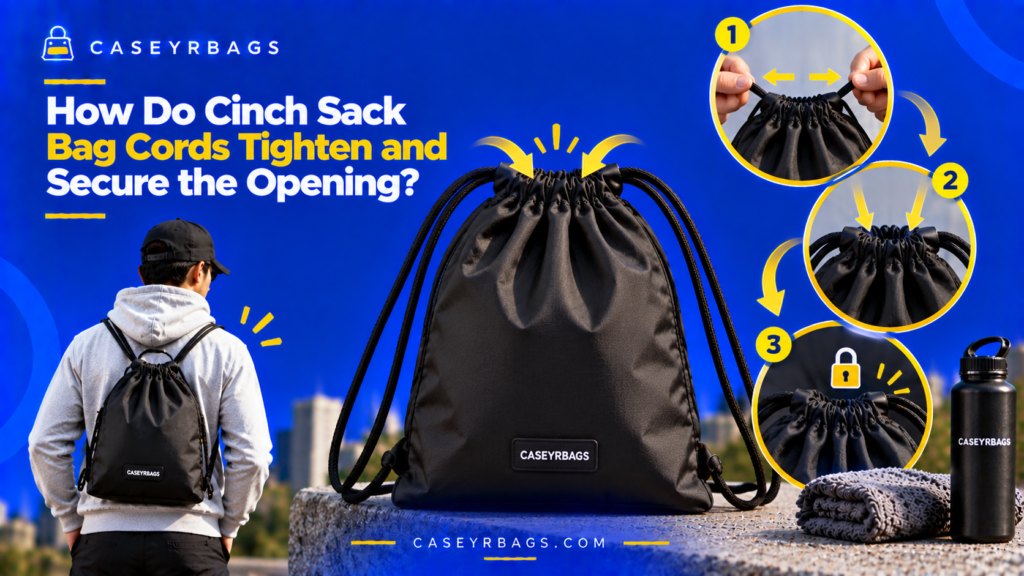
How Do Cinch Sack Bag Cords Tighten and Secure the Opening?
Cinch Sack Bag cords tighten the opening by removing slack and transferring the user’s pull into tension around a flexible upper perimeter. As tension reaches the routed upper edge, sections of fabric gather into folds and the effective opening becomes smaller. The tightening stage therefore depends on cord movement, routing geometry, flexible fabric, and enough free space for the perimeter to gather.
Keeping that smaller opening controlled is a separate retention stage. Depending on the design, resistance can come from routing friction, cord interaction, a cord lock, a knot, dual-cord behavior, or integrated carry tension. These mechanisms help resist immediate reverse movement during normal use, but they do not automatically create a lock, seal, tamper-resistant closure, or theft-proof system.
What Does It Mean for Cinch Sack Cords to Tighten and Secure the Opening?
Tightening begins when the user pulls the drawcord and removes available slack from the closure path. As that loose length disappears, the cord starts carrying meaningful tension through the channel, eyelets, loops, or other guide points around the flexible upper perimeter.
That transferred tension causes the upper fabric to slide, fold, or bunch along the routed cord. The resulting gathering brings sections of the opening closer together and reduces the effective access gap without turning the flexible perimeter into a rigid seal.
Retention follows after the opening has been reduced. The cord position must resist immediate reverse movement if the gathered geometry is to remain controlled. This mechanism sits within the broader Drawstring Bag structure, where cord-controlled access depends on flexible opening geometry and supported load paths.
Which components create the tightening action?
Which components create the tightening action should be evaluated through the actual cord route, flexible upper edge, load position, and retention behavior. A useful observation connects the visible result to the mechanism that changes slack, tension, gathering, opening size, or reverse movement.
Test the condition with the normal intended load and observe tightening, retention, release, and reopening as separate stages. The governing distinction is: Component → tension role → opening effect. Keep the cord setting or retention method only when it preserves a controllable reduced opening without excessive force, blocked gathering, binding, unexplained loosening, or difficult deliberate release.
Which components can help retain the tightened state?
Which components can help retain the tightened state should be evaluated through the actual cord route, flexible upper edge, load position, and retention behavior. A useful observation connects the visible result to the mechanism that changes slack, tension, gathering, opening size, or reverse movement.
Test the condition with the normal intended load and observe tightening, retention, release, and reopening as separate stages. Keep the cord setting or retention method only when it preserves a controllable reduced opening without excessive force, blocked gathering, binding, unexplained loosening, or difficult deliberate release.
Why must tightening and retention be evaluated separately?
Why must tightening and retention be evaluated separately because the cord can tighten the opening successfully but still fail to retain that tightened state.. The mechanical question is whether that condition changes slack, tension transfer, gathering, opening contraction, retention, release, or reopening in a predictable way without overstating the system as a lock or seal.
Test the condition with the normal intended load and observe tightening, retention, release, and reopening as separate stages. The governing distinction is: The cord can tighten the opening successfully but still fail to retain that tightened state.. Keep the cord setting or retention method only when it preserves a controllable reduced opening without excessive force, blocked gathering, binding, unexplained loosening, or difficult deliberate release.
How Does Pulling the Cord Remove Slack?
Explain the first stage of tightening before significant gathering occurs.
What is cord slack?
Cord slack is the portion of cord length not yet carrying meaningful tension through the closure path. At this stage the free cord can move without immediately drawing the upper perimeter inward, because the routing system still contains available length before the cord begins transferring a stronger closing force.
Test the condition with the normal intended load and observe tightening, retention, release, and reopening as separate stages. The governing distinction is: Slack is the portion of cord length not currently carrying meaningful tension through the closure path.. Keep the cord setting or retention method only when it preserves a controllable reduced opening without excessive force, blocked gathering, binding, unexplained loosening, or difficult deliberate release.
What happens as the free cord end is pulled?
Pulling the free cord end first removes available slack. As that loose length is taken up, the routed cord begins carrying increasing tension through the channel, eyelets, loops, or guide points. The useful closing force therefore develops only after enough slack has been removed for the pull to reach the flexible upper perimeter.
Test the condition with the normal intended load and observe tightening, retention, release, and reopening as separate stages. The governing distinction is: Free cord moves → slack decreases → routed cord begins carrying tension. Keep the cord setting or retention method only when it preserves a controllable reduced opening without excessive force, blocked gathering, binding, unexplained loosening, or difficult deliberate release.
Why does gathering begin only after enough slack is removed?
Fabric gathering begins only after the moving cord has taken up enough slack for meaningful tension to develop. Before that point, the free end can travel while the upper edge changes little. Once tension reaches the perimeter, the flexible fabric can begin sliding, bunching, or folding inward along the routed path.
Test the condition with the normal intended load and observe tightening, retention, release, and reopening as separate stages. The governing distinction is: Cord movement ≠ immediate fabric gathering. Keep the cord setting or retention method only when it preserves a controllable reduced opening without excessive force, blocked gathering, binding, unexplained loosening, or difficult deliberate release.
How Does Cord Tension Travel Around the Opening?
Explain how pulling force is transferred through the routing system.
How does a continuous channel distribute tension?
A continuous channel distribute tension affects Cinch Sack tightening and retention because cord follows upper perimeter → pulling force transmitted along the routed path. The useful result is predictable opening reduction or controlled retention without binding, asymmetric gathering, unnecessary stress, unplanned loosening, or difficult release.
Test the condition with the normal intended load and observe tightening, retention, release, and reopening as separate stages. The governing distinction is: Cord follows upper perimeter → pulling force transmitted along the routed path. Keep the cord setting or retention method only when it preserves a controllable reduced opening without excessive force, blocked gathering, binding, unexplained loosening, or difficult deliberate release.
How do eyelets or loops redirect tension?
Eyelets or loops redirect tension affects Cinch Sack tightening and retention because 2 focused paragraphs. The useful result is predictable opening reduction or controlled retention without binding, asymmetric gathering, unnecessary stress, unplanned loosening, or difficult release.
Test the condition with the normal intended load and observe tightening, retention, release, and reopening as separate stages. Keep the cord setting or retention method only when it preserves a controllable reduced opening without excessive force, blocked gathering, binding, unexplained loosening, or difficult deliberate release. Do not interpret retained tension as theft-proof security or a sealed opening.
What happens when tension does not travel evenly?
What happens when tension does not travel evenly should be evaluated through the actual cord route, flexible upper edge, load position, and retention behavior. A useful observation connects the visible result to the mechanism that changes slack, tension, gathering, opening size, or reverse movement.
Test the condition with the normal intended load and observe tightening, retention, release, and reopening as separate stages. The governing distinction is: Predictable tightening depends on predictable tension distribution.. Keep the cord setting or retention method only when it preserves a controllable reduced opening without excessive force, blocked gathering, binding, unexplained loosening, or difficult deliberate release.
How Does Fabric Gathering Reduce the Opening?
Explain how the flexible perimeter changes geometry under tension.
How does the upper edge respond to tension?
The upper edge respond to tension affects Cinch Sack tightening and retention because 2 focused paragraphs. The useful result is predictable opening reduction or controlled retention without binding, asymmetric gathering, unnecessary stress, unplanned loosening, or difficult release.
Test the condition with the normal intended load and observe tightening, retention, release, and reopening as separate stages. Keep the cord setting or retention method only when it preserves a controllable reduced opening without excessive force, blocked gathering, binding, unexplained loosening, or difficult deliberate release. Do not interpret retained tension as theft-proof security or a sealed opening.
Why does gathering make the opening smaller?
Why does gathering make the opening smaller because spread fabric perimeter → gathered fabric perimeter → smaller effective access gap. The mechanical question is whether that condition changes slack, tension transfer, gathering, opening contraction, retention, release, or reopening in a predictable way without overstating the system as a lock or seal.
Test the condition with the normal intended load and observe tightening, retention, release, and reopening as separate stages. The governing distinction is: Spread fabric perimeter → gathered fabric perimeter → smaller effective access gap. Keep the cord setting or retention method only when it preserves a controllable reduced opening without excessive force, blocked gathering, binding, unexplained loosening, or difficult deliberate release.
Why does the opening usually not become a complete seal?
Why does the opening usually not become a complete seal because smaller opening ≠ sealed opening. The mechanical question is whether that condition changes slack, tension transfer, gathering, opening contraction, retention, release, or reopening in a predictable way without overstating the system as a lock or seal.
Test the condition with the normal intended load and observe tightening, retention, release, and reopening as separate stages. The governing distinction is: Smaller opening ≠ sealed opening. Keep the cord setting or retention method only when it preserves a controllable reduced opening without excessive force, blocked gathering, binding, unexplained loosening, or difficult deliberate release.
How Does Cord Routing Affect Tightening Quality?
Explain why smooth, balanced routing matters more than simply pulling harder.
How can good routing support even gathering?
Good routing support even gathering affects Cinch Sack tightening and retention because 2 focused paragraphs. The useful result is predictable opening reduction or controlled retention without binding, asymmetric gathering, unnecessary stress, unplanned loosening, or difficult release.
Test the condition with the normal intended load and observe tightening, retention, release, and reopening as separate stages. Keep the cord setting or retention method only when it preserves a controllable reduced opening without excessive force, blocked gathering, binding, unexplained loosening, or difficult deliberate release. Do not interpret retained tension as theft-proof security or a sealed opening.
What can disrupt routing?
What can disrupt routing should be evaluated through the actual cord route, flexible upper edge, load position, and retention behavior. A useful observation connects the visible result to the mechanism that changes slack, tension, gathering, opening size, or reverse movement.
Test the condition with the normal intended load and observe tightening, retention, release, and reopening as separate stages. Keep the cord setting or retention method only when it preserves a controllable reduced opening without excessive force, blocked gathering, binding, unexplained loosening, or difficult deliberate release. Do not interpret retained tension as theft-proof security or a sealed opening.
Why does poor routing reduce closure efficiency?
Why does poor routing reduce closure efficiency because more user force may be spent overcoming friction instead of gathering the opening. The mechanical question is whether that condition changes slack, tension transfer, gathering, opening contraction, retention, release, or reopening in a predictable way without overstating the system as a lock or seal.
Test the condition with the normal intended load and observe tightening, retention, release, and reopening as separate stages. The governing distinction is: Pulling force ≠ useful closing force when routing is obstructed.. Keep the cord setting or retention method only when it preserves a controllable reduced opening without excessive force, blocked gathering, binding, unexplained loosening, or difficult deliberate release.
How Does Friction Help Retain Cord Tension?
Explain how resistance to reverse cord movement can help retain the reduced opening.
Where can friction occur?
Where can friction occur should be evaluated through the actual cord route, flexible upper edge, load position, and retention behavior. A useful observation connects the visible result to the mechanism that changes slack, tension, gathering, opening size, or reverse movement.
Test the condition with the normal intended load and observe tightening, retention, release, and reopening as separate stages. Keep the cord setting or retention method only when it preserves a controllable reduced opening without excessive force, blocked gathering, binding, unexplained loosening, or difficult deliberate release. Do not interpret retained tension as theft-proof security or a sealed opening.
How can moderate friction support retention?
Moderate friction support retention affects Cinch Sack tightening and retention because moderate resistance → less spontaneous reverse movement → cord position remains more controlled. The useful result is predictable opening reduction or controlled retention without binding, asymmetric gathering, unnecessary stress, unplanned loosening, or difficult release.
Test the condition with the normal intended load and observe tightening, retention, release, and reopening as separate stages. The governing distinction is: Moderate resistance → less spontaneous reverse movement → cord position remains more controlled. Keep the cord setting or retention method only when it preserves a controllable reduced opening without excessive force, blocked gathering, binding, unexplained loosening, or difficult deliberate release.
Why can too much friction become a problem?
Why can too much friction become a problem because useful friction supports control; excessive friction creates binding.. The mechanical question is whether that condition changes slack, tension transfer, gathering, opening contraction, retention, release, or reopening in a predictable way without overstating the system as a lock or seal.
Test the condition with the normal intended load and observe tightening, retention, release, and reopening as separate stages. The governing distinction is: Useful friction supports control; excessive friction creates binding.. Keep the cord setting or retention method only when it preserves a controllable reduced opening without excessive force, blocked gathering, binding, unexplained loosening, or difficult deliberate release.
| Friction State | Tightening | Retention | Reopening |
|---|---|---|---|
| Very low | Easy | Lower passive resistance | Easy |
| Moderate | Controlled | Functional | Controlled |
| High | Difficult | High resistance | Difficult |
| Uneven | Jerky | Unpredictable | Unpredictable |
How Does a Cord Lock Retain the Tightened Opening?
Explain the role of a cord lock where the Cinch Sack design includes one.
What does a cord lock do?
A cord lock grips or resists the drawcord after the opening has been tightened. By restricting reverse cord movement, it can help preserve the chosen cord position and keep the gathered upper edge in a reduced state during normal use. Its mechanical role is retention of cord position rather than security against deliberate access.
Test the condition with the normal intended load and observe tightening, retention, release, and reopening as separate stages. Keep the cord setting or retention method only when it preserves a controllable reduced opening without excessive force, blocked gathering, binding, unexplained loosening, or difficult deliberate release.
How does releasing the lock allow reopening?
Releasing the cord lock reduces the pressure or resistance that holds the cord in place. The drawcord can then slide back through the retention point and routing system, restoring slack to the closure path. As tension falls, the gathered fabric gains room to move outward and the upper opening can expand again.
Test the condition with the normal intended load and observe tightening, retention, release, and reopening as separate stages. The governing distinction is: Retention pressure released → cord can slide → upper edge can expand. Keep the cord setting or retention method only when it preserves a controllable reduced opening without excessive force, blocked gathering, binding, unexplained loosening, or difficult deliberate release.
Why does a cord lock not make the bag theft-proof?
Why does a cord lock not make the bag theft-proof because cord lock ≠ security lock. The mechanical question is whether that condition changes slack, tension transfer, gathering, opening contraction, retention, release, or reopening in a predictable way without overstating the system as a lock or seal.
Test the condition with the normal intended load and observe tightening, retention, release, and reopening as separate stages. The governing distinction is: Cord lock ≠ security lock. Keep the cord setting or retention method only when it preserves a controllable reduced opening without excessive force, blocked gathering, binding, unexplained loosening, or difficult deliberate release.
How Can a Knot Retain Cinch Cord Tension?
Explain knot-based retention without treating it as universal.
How can a knot stop reverse cord movement?
A knot can retain Cinch Sack tension by creating a physical stop, increasing friction between cord sections, or restricting reverse movement after the opening has been reduced. That added resistance can preserve the cinched geometry, but it also adds a deliberate tying and untying step that changes the normal opening cycle.
Test the condition with the normal intended load and observe tightening, retention, release, and reopening as separate stages. Keep the cord setting or retention method only when it preserves a controllable reduced opening without excessive force, blocked gathering, binding, unexplained loosening, or difficult deliberate release.
What tradeoff does knot retention create?
What tradeoff does knot retention create should be evaluated through the actual cord route, flexible upper edge, load position, and retention behavior. A useful observation connects the visible result to the mechanism that changes slack, tension, gathering, opening size, or reverse movement.
Test the condition with the normal intended load and observe tightening, retention, release, and reopening as separate stages. Keep the cord setting or retention method only when it preserves a controllable reduced opening without excessive force, blocked gathering, binding, unexplained loosening, or difficult deliberate release. Do not interpret retained tension as theft-proof security or a sealed opening.
Why should knotting not be assumed in every Cinch Sack?
Why should knotting not be assumed in every Cinch Sack because retention method depends on the specific cord architecture.. The mechanical question is whether that condition changes slack, tension transfer, gathering, opening contraction, retention, release, or reopening in a predictable way without overstating the system as a lock or seal.
Test the condition with the normal intended load and observe tightening, retention, release, and reopening as separate stages. The governing distinction is: Retention mechanism ≠ security lock. Keep the cord setting or retention method only when it preserves a controllable reduced opening without excessive force, blocked gathering, binding, unexplained loosening, or difficult deliberate release.
How Do Dual Cords Tighten the Opening?
Explain how opposing cord paths can gather the upper edge from more than one direction.
How do opposing pulls affect the opening?
Opposing pulls affect the opening affects Cinch Sack tightening and retention because pull left cord + pull right cord → upper perimeter gathers toward multiple control directions. The useful result is predictable opening reduction or controlled retention without binding, asymmetric gathering, unnecessary stress, unplanned loosening, or difficult release.
Test the condition with the normal intended load and observe tightening, retention, release, and reopening as separate stages. The governing distinction is: Pull left cord + pull right cord → upper perimeter gathers toward multiple control directions. Keep the cord setting or retention method only when it preserves a controllable reduced opening without excessive force, blocked gathering, binding, unexplained loosening, or difficult deliberate release.
Why can dual cords support more balanced tightening?
Why can dual cords support more balanced tightening because 2 focused paragraphs. The mechanical question is whether that condition changes slack, tension transfer, gathering, opening contraction, retention, release, or reopening in a predictable way without overstating the system as a lock or seal.
Test the condition with the normal intended load and observe tightening, retention, release, and reopening as separate stages. Keep the cord setting or retention method only when it preserves a controllable reduced opening without excessive force, blocked gathering, binding, unexplained loosening, or difficult deliberate release.
Why can dual cords still tighten unevenly?
Why can dual cords still tighten unevenly because dual cords support balanced tension but do not guarantee equal tension.. The mechanical question is whether that condition changes slack, tension transfer, gathering, opening contraction, retention, release, or reopening in a predictable way without overstating the system as a lock or seal.
Test the condition with the normal intended load and observe tightening, retention, release, and reopening as separate stages. The governing distinction is: Dual cords support balanced tension but do not guarantee equal tension.. Keep the cord setting or retention method only when it preserves a controllable reduced opening without excessive force, blocked gathering, binding, unexplained loosening, or difficult deliberate release.
How Do Integrated Carry Cords Help Retain the Opening?
Explain designs where shoulder-carry cords also participate in closure tension.
How can shoulder loading influence upper-edge tension?
Shoulder loading influence upper-edge tension affects Cinch Sack tightening and retention because carry tension → cord remains tensioned → gathered opening may remain reduced. The useful result is predictable opening reduction or controlled retention without binding, asymmetric gathering, unnecessary stress, unplanned loosening, or difficult release.
Test the condition with the normal intended load and observe tightening, retention, release, and reopening as separate stages. The governing distinction is: Carry tension → cord remains tensioned → gathered opening may remain reduced. Keep the cord setting or retention method only when it preserves a controllable reduced opening without excessive force, blocked gathering, binding, unexplained loosening, or difficult deliberate release.
What happens when the bag is removed?
What happens when the bag is removed should be evaluated through the actual cord route, flexible upper edge, load position, and retention behavior. A useful observation connects the visible result to the mechanism that changes slack, tension, gathering, opening size, or reverse movement.
Test the condition with the normal intended load and observe tightening, retention, release, and reopening as separate stages. Keep the cord setting or retention method only when it preserves a controllable reduced opening without excessive force, blocked gathering, binding, unexplained loosening, or difficult deliberate release.
Why does this dual-function system need strong routing?
Why does this dual-function system need strong routing because carry tension can support closure retention but does not create a secure lock.. The mechanical question is whether that condition changes slack, tension transfer, gathering, opening contraction, retention, release, or reopening in a predictable way without overstating the system as a lock or seal.
Test the condition with the normal intended load and observe tightening, retention, release, and reopening as separate stages. The governing distinction is: Carry tension can support closure retention but does not create a secure lock.. Keep the cord setting or retention method only when it preserves a controllable reduced opening without excessive force, blocked gathering, binding, unexplained loosening, or difficult deliberate release.
How Do Cord Ends Affect Tightening Control?
Explain how free or joined cord ends determine where tension is applied and managed.
Why must the cord ends remain accessible?
Why must the cord ends remain accessible because 2 focused paragraphs. The mechanical question is whether that condition changes slack, tension transfer, gathering, opening contraction, retention, release, or reopening in a predictable way without overstating the system as a lock or seal.
Test the condition with the normal intended load and observe tightening, retention, release, and reopening as separate stages. Keep the cord setting or retention method only when it preserves a controllable reduced opening without excessive force, blocked gathering, binding, unexplained loosening, or difficult deliberate release. Do not interpret retained tension as theft-proof security or a sealed opening.
How can uneven free-end length affect dual-cord systems?
Uneven free-end length affect dual-cord systems affects Cinch Sack tightening and retention because 2 focused paragraphs. The useful result is predictable opening reduction or controlled retention without binding, asymmetric gathering, unnecessary stress, unplanned loosening, or difficult release.
Test the condition with the normal intended load and observe tightening, retention, release, and reopening as separate stages. Keep the cord setting or retention method only when it preserves a controllable reduced opening without excessive force, blocked gathering, binding, unexplained loosening, or difficult deliberate release. Do not interpret retained tension as theft-proof security or a sealed opening.
Why is longer cord not automatically better?
Why is longer cord not automatically better because useful cord length supports operation without unnecessary free movement.. The mechanical question is whether that condition changes slack, tension transfer, gathering, opening contraction, retention, release, or reopening in a predictable way without overstating the system as a lock or seal.
Test the condition with the normal intended load and observe tightening, retention, release, and reopening as separate stages. The governing distinction is: Useful cord length supports operation without unnecessary free movement.. Keep the cord setting or retention method only when it preserves a controllable reduced opening without excessive force, blocked gathering, binding, unexplained loosening, or difficult deliberate release.
How Does the Closure Zone Affect Tightening?
Explain why the upper area must retain enough free fabric to gather.
What is the closure zone?
The closure zone is the flexible upper area that must remain free enough to fold, slide, or gather inward when the cord is tightened. It includes the fabric immediately around the opening perimeter, where load position directly affects whether the upper edge can form the folds needed for functional opening reduction.
Test the condition with the normal intended load and observe tightening, retention, release, and reopening as separate stages. The governing distinction is: The upper flexible area that must fold or gather inward when the cord is tightened.. Keep the cord setting or retention method only when it preserves a controllable reduced opening without excessive force, blocked gathering, binding, unexplained loosening, or difficult deliberate release.
What happens when contents occupy that zone?
What happens when contents occupy that zone should be evaluated through the actual cord route, flexible upper edge, load position, and retention behavior. A useful observation connects the visible result to the mechanism that changes slack, tension, gathering, opening size, or reverse movement.
Test the condition with the normal intended load and observe tightening, retention, release, and reopening as separate stages. Keep the cord setting or retention method only when it preserves a controllable reduced opening without excessive force, blocked gathering, binding, unexplained loosening, or difficult deliberate release.
Why should contents remain below the gathering path where practical?
Why should contents remain below the gathering path where practical because the cinch mechanism needs movable upper fabric—not just available cord tension.. The mechanical question is whether that condition changes slack, tension transfer, gathering, opening contraction, retention, release, or reopening in a predictable way without overstating the system as a lock or seal.
Test the condition with the normal intended load and observe tightening, retention, release, and reopening as separate stages. The governing distinction is: The cinch mechanism needs movable upper fabric—not just available cord tension.. Keep the cord setting or retention method only when it preserves a controllable reduced opening without excessive force, blocked gathering, binding, unexplained loosening, or difficult deliberate release.
How Does Overfilling Affect Opening Retention?
Explain why physical storage capacity can exceed functional cinch capacity.
How can overfilling prevent complete tightening?
Overfilling prevent complete tightening affects Cinch Sack tightening and retention because 2 focused paragraphs. The useful result is predictable opening reduction or controlled retention without binding, asymmetric gathering, unnecessary stress, unplanned loosening, or difficult release.
Test the condition with the normal intended load and observe tightening, retention, release, and reopening as separate stages. Keep the cord setting or retention method only when it preserves a controllable reduced opening without excessive force, blocked gathering, binding, unexplained loosening, or difficult deliberate release. Do not interpret retained tension as theft-proof security or a sealed opening.
How can overfilling cause the opening to re-expand?
Overfilling cause the opening to re-expand affects Cinch Sack tightening and retention because 2 focused paragraphs. The useful result is predictable opening reduction or controlled retention without binding, asymmetric gathering, unnecessary stress, unplanned loosening, or difficult release.
Test the condition with the normal intended load and observe tightening, retention, release, and reopening as separate stages. Keep the cord setting or retention method only when it preserves a controllable reduced opening without excessive force, blocked gathering, binding, unexplained loosening, or difficult deliberate release. Do not interpret retained tension as theft-proof security or a sealed opening.
Why is bag volume different from secure closure-compatible volume?
Why is bag volume different from secure closure-compatible volume because available volume ≠ usable cinch-closure volume. The mechanical question is whether that condition changes slack, tension transfer, gathering, opening contraction, retention, release, or reopening in a predictable way without overstating the system as a lock or seal.
Test the condition with the normal intended load and observe tightening, retention, release, and reopening as separate stages. The governing distinction is: Available volume ≠ usable cinch-closure volume. Keep the cord setting or retention method only when it preserves a controllable reduced opening without excessive force, blocked gathering, binding, unexplained loosening, or difficult deliberate release.
| Upper Load Condition | Gathering Ability | Retention |
|---|---|---|
| Clear closure zone | High | Predictable |
| Moderate upper fill | Moderate | Design-dependent |
| Crowded upper zone | Reduced | Less stable |
| Overfilled | Low | Opening may remain exposed |
How Does Cord Material Affect Tension Retention?
Explain how cord surface and flexibility interact with routing friction.
How can surface texture influence retention?
Surface texture influence retention affects Cinch Sack tightening and retention because 2 focused paragraphs. The useful result is predictable opening reduction or controlled retention without binding, asymmetric gathering, unnecessary stress, unplanned loosening, or difficult release.
Test the condition with the normal intended load and observe tightening, retention, release, and reopening as separate stages. Keep the cord setting or retention method only when it preserves a controllable reduced opening without excessive force, blocked gathering, binding, unexplained loosening, or difficult deliberate release. Do not interpret retained tension as theft-proof security or a sealed opening.
How can cord flexibility affect tightening?
Cord flexibility affect tightening affects Cinch Sack tightening and retention because 2 focused paragraphs. The useful result is predictable opening reduction or controlled retention without binding, asymmetric gathering, unnecessary stress, unplanned loosening, or difficult release.
Test the condition with the normal intended load and observe tightening, retention, release, and reopening as separate stages. Keep the cord setting or retention method only when it preserves a controllable reduced opening without excessive force, blocked gathering, binding, unexplained loosening, or difficult deliberate release. Do not interpret retained tension as theft-proof security or a sealed opening.
Why can cord material not be evaluated alone?
Why can cord material not be evaluated alone because cord-material performance is system-dependent.. The mechanical question is whether that condition changes slack, tension transfer, gathering, opening contraction, retention, release, or reopening in a predictable way without overstating the system as a lock or seal.
Test the condition with the normal intended load and observe tightening, retention, release, and reopening as separate stages. The governing distinction is: Cord-material performance is system-dependent.. Keep the cord setting or retention method only when it preserves a controllable reduced opening without excessive force, blocked gathering, binding, unexplained loosening, or difficult deliberate release.
How Does Cord Diameter Affect Tightening & Retention?
Explain cord size as one system variable rather than an automatic quality ranking.
How can a thicker cord change the mechanism?
A thicker cord change the mechanism affects Cinch Sack tightening and retention because 2 focused paragraphs. The useful result is predictable opening reduction or controlled retention without binding, asymmetric gathering, unnecessary stress, unplanned loosening, or difficult release.
Test the condition with the normal intended load and observe tightening, retention, release, and reopening as separate stages. Keep the cord setting or retention method only when it preserves a controllable reduced opening without excessive force, blocked gathering, binding, unexplained loosening, or difficult deliberate release. Do not interpret retained tension as theft-proof security or a sealed opening.
How can a thinner cord change the mechanism?
A thinner cord change the mechanism affects Cinch Sack tightening and retention because 2 focused paragraphs. The useful result is predictable opening reduction or controlled retention without binding, asymmetric gathering, unnecessary stress, unplanned loosening, or difficult release.
Test the condition with the normal intended load and observe tightening, retention, release, and reopening as separate stages. Keep the cord setting or retention method only when it preserves a controllable reduced opening without excessive force, blocked gathering, binding, unexplained loosening, or difficult deliberate release. Do not interpret retained tension as theft-proof security or a sealed opening.
Why is neither universally better?
Why is neither universally better because cord diameter alone does not determine tightening or retention quality.. The mechanical question is whether that condition changes slack, tension transfer, gathering, opening contraction, retention, release, or reopening in a predictable way without overstating the system as a lock or seal.
Test the condition with the normal intended load and observe tightening, retention, release, and reopening as separate stages. The governing distinction is: Cord diameter alone does not determine tightening or retention quality.. Keep the cord setting or retention method only when it preserves a controllable reduced opening without excessive force, blocked gathering, binding, unexplained loosening, or difficult deliberate release.
What Causes the Cinched Opening to Loosen?
Identify why an opening that was successfully tightened may later expand.
What if the cord slides backward through the routing system?
What if the cord slides backward through the routing system should be evaluated through the actual cord route, flexible upper edge, load position, and retention behavior. A useful observation connects the visible result to the mechanism that changes slack, tension, gathering, opening size, or reverse movement.
Test the condition with the normal intended load and observe tightening, retention, release, and reopening as separate stages. Keep the cord setting or retention method only when it preserves a controllable reduced opening without excessive force, blocked gathering, binding, unexplained loosening, or difficult deliberate release.
What if the cord stays in place but the opening changes shape?
If the cord remains in the same position while the opening becomes larger, the problem may come from load settling, fabric redistribution, uneven folds, or outward pressure from the contents. In that case the gathered geometry has changed even though obvious reverse cord movement has not occurred.
Test the condition with the normal intended load and observe tightening, retention, release, and reopening as separate stages. Keep the cord setting or retention method only when it preserves a controllable reduced opening without excessive force, blocked gathering, binding, unexplained loosening, or difficult deliberate release.
What if one side loosens more than the other?
What if one side loosens more than the other should be evaluated through the actual cord route, flexible upper edge, load position, and retention behavior. A useful observation connects the visible result to the mechanism that changes slack, tension, gathering, opening size, or reverse movement.
Test the condition with the normal intended load and observe tightening, retention, release, and reopening as separate stages. The governing distinction is: Cord loosening and fabric re-expansion are related but not identical problems.. Keep the cord setting or retention method only when it preserves a controllable reduced opening without excessive force, blocked gathering, binding, unexplained loosening, or difficult deliberate release.
How Does Releasing Cord Tension Reopen the Bag?
Explain the reverse mechanism so tightening is understood as reversible opening control.
What must happen before the opening can expand?
What must happen before the opening can expand should be evaluated through the actual cord route, flexible upper edge, load position, and retention behavior. A useful observation connects the visible result to the mechanism that changes slack, tension, gathering, opening size, or reverse movement.
Test the condition with the normal intended load and observe tightening, retention, release, and reopening as separate stages. Keep the cord setting or retention method only when it preserves a controllable reduced opening without excessive force, blocked gathering, binding, unexplained loosening, or difficult deliberate release.
How does the fabric spread again?
The fabric spread again affects Cinch Sack tightening and retention because cord slack increases → gathered sections gain movement → upper edge can spread outward. The useful result is predictable opening reduction or controlled retention without binding, asymmetric gathering, unnecessary stress, unplanned loosening, or difficult release.
Test the condition with the normal intended load and observe tightening, retention, release, and reopening as separate stages. The governing distinction is: Cord slack increases → gathered sections gain movement → upper edge can spread outward. Keep the cord setting or retention method only when it preserves a controllable reduced opening without excessive force, blocked gathering, binding, unexplained loosening, or difficult deliberate release.
What indicates poor release behavior?
What indicates poor release behavior should be evaluated through the actual cord route, flexible upper edge, load position, and retention behavior. A useful observation connects the visible result to the mechanism that changes slack, tension, gathering, opening size, or reverse movement.
Test the condition with the normal intended load and observe tightening, retention, release, and reopening as separate stages. The governing distinction is: Functional retention should preserve closure without making normal reopening unnecessarily difficult.. Keep the cord setting or retention method only when it preserves a controllable reduced opening without excessive force, blocked gathering, binding, unexplained loosening, or difficult deliberate release.
When Does Cinch Sack Tightening Become Inefficient?
Identify conditions where more pulling produces little additional opening reduction.
What does high pulling force with little gathering suggest?
What does high pulling force with little gathering suggest is best understood through 2 focused paragraphs. That feature matters only if it contributes to predictable tension transfer, fabric gathering, controlled opening reduction, tension retention, or deliberate reopening under the normal loaded condition.
Test the condition with the normal intended load and observe tightening, retention, release, and reopening as separate stages. Keep the cord setting or retention method only when it preserves a controllable reduced opening without excessive force, blocked gathering, binding, unexplained loosening, or difficult deliberate release. Do not interpret retained tension as theft-proof security or a sealed opening.
What does increasing tension after the opening has already stabilized indicate?
What does increasing tension after the opening has already stabilized indicate is best understood through 2 focused paragraphs. That feature matters only if it contributes to predictable tension transfer, fabric gathering, controlled opening reduction, tension retention, or deliberate reopening under the normal loaded condition.
Test the condition with the normal intended load and observe tightening, retention, release, and reopening as separate stages. Keep the cord setting or retention method only when it preserves a controllable reduced opening without excessive force, blocked gathering, binding, unexplained loosening, or difficult deliberate release.
Why should closure performance not be judged by pulling force?
Why should closure performance not be judged by pulling force because effective tightening is measured by controlled opening reduction—not by how hard the cord is pulled.. The mechanical question is whether that condition changes slack, tension transfer, gathering, opening contraction, retention, release, or reopening in a predictable way without overstating the system as a lock or seal.
Test the condition with the normal intended load and observe tightening, retention, release, and reopening as separate stages. The governing distinction is: Effective tightening is measured by controlled opening reduction—not by how hard the cord is pulled.. Keep the cord setting or retention method only when it preserves a controllable reduced opening without excessive force, blocked gathering, binding, unexplained loosening.
How Can Cinch Sack Cord-Tension Problems Be Diagnosed?
Separate tightening, gathering, and retention failures.
What should be checked if the opening will not tighten?
What should be checked if the opening will not tighten should be evaluated through the actual cord route, flexible upper edge, load position, and retention behavior. A useful observation connects the visible result to the mechanism that changes slack, tension, gathering, opening size, or reverse movement.
Test the condition with the normal intended load and observe tightening, retention, release, and reopening as separate stages. Keep the cord setting or retention method only when it preserves a controllable reduced opening without excessive force, blocked gathering, binding, unexplained loosening, or difficult deliberate release.
What should be checked if the opening tightens unevenly?
What should be checked if the opening tightens unevenly should be evaluated through the actual cord route, flexible upper edge, load position, and retention behavior. A useful observation connects the visible result to the mechanism that changes slack, tension, gathering, opening size, or reverse movement.
Test the condition with the normal intended load and observe tightening, retention, release, and reopening as separate stages. Keep the cord setting or retention method only when it preserves a controllable reduced opening without excessive force, blocked gathering, binding, unexplained loosening, or difficult deliberate release.
What should be checked if the opening tightens but will not stay cinched?
What should be checked if the opening tightens but will not stay cinched should be evaluated through the actual cord route, flexible upper edge, load position, and retention behavior. A useful observation connects the visible result to the mechanism that changes slack, tension, gathering, opening size, or reverse movement.
Test the condition with the normal intended load and observe tightening, retention, release, and reopening as separate stages. The governing distinction is: Tightening failure and retention failure require different corrections.. Keep the cord setting or retention method only when it preserves a controllable reduced opening without excessive force, blocked gathering, binding, unexplained loosening, or difficult deliberate release.
How Should Cinch Sack Cord Tightening & Opening Retention Be Evaluated?
Provide a repeatable loaded test for tightening, retention, release, and reopening.
What should be checked before loading?
Before loading, inspect the cord condition, full route, channels, eyelets or loops, upper fabric, cord exits, retention mechanism, and lower anchors where the design integrates carrying and closure. These checks establish the intended path and resistance before contents introduce pressure near the gathering zone or change the way tension reaches the opening.
Test the condition with the normal intended load and observe tightening, retention, release, and reopening as separate stages. Keep the cord setting or retention method only when it preserves a controllable reduced opening without excessive force, blocked gathering, binding, unexplained loosening, or difficult deliberate release.
What should be checked after loading?
After loading, observe closure-zone clearance, available slack, gathering symmetry, final opening size, and whether the selected retention method keeps the opening controlled. The loaded state should reveal whether contents interfere with folds, alter tension balance, push the gathered perimeter outward, or make the release process unusually difficult.
Test the condition with the normal intended load and observe tightening, retention, release, and reopening as separate stages. Keep the cord setting or retention method only when it preserves a controllable reduced opening without excessive force, blocked gathering, binding, unexplained loosening, or difficult deliberate release.
Which sequence should determine closure function?
The evaluation sequence should test the loaded Cinch Sack from open state through slack removal, tension development, fabric gathering, opening reduction, retention, normal movement, deliberate release, and reopening. This separates the tightening stage from the retention stage and reveals whether either one fails only after the load begins moving.
Test the condition with the normal intended load and observe tightening, retention, release, and reopening as separate stages. Keep the cord setting or retention method only when it preserves a controllable reduced opening without excessive force, blocked gathering, binding, unexplained loosening, or difficult deliberate release.
- Open the Cinch Sack fully.
- Confirm the cord moves normally.
- Trace the complete cord path.
- Load normal intended contents.
- Keep the upper gathering zone reasonably clear.
- Identify the available cord slack.
- Pull the cord normally.
- Observe slack reduction.
- Observe tension reaching the upper perimeter.
- Confirm fabric begins gathering.
- Continue until the opening reaches a functional reduced state.
- Stop before applying unnecessary excess tension.
- Engage the retention feature where the design uses one.
- Observe whether the opening remains reduced.
- Move or carry the bag normally.
- Recheck cord position and opening geometry.
- Release the retention system.
- Feed slack back into the cord path.
- Expand the upper opening.
- Repeat the cycle.
- Diagnose tightening and retention separately if either stage repeatedly fails.
How Can Cinch Sack Tightening & Retention Mismatches Be Avoided?
Prevent maximum cord tension or minimum opening size from being mistaken for effective closure control.
Why is “pull as hard as possible” a weak strategy?
Why is “pull as hard as possible” a weak strategy because 2 focused paragraphs. The mechanical question is whether that condition changes slack, tension transfer, gathering, opening contraction, retention, release, or reopening in a predictable way without overstating the system as a lock or seal.
Test the condition with the normal intended load and observe tightening, retention, release, and reopening as separate stages. Keep the cord setting or retention method only when it preserves a controllable reduced opening without excessive force, blocked gathering, binding, unexplained loosening, or difficult deliberate release.
Why is “make the opening as small as possible” also incomplete?
Why is “make the opening as small as possible” also incomplete because the smallest possible opening is not automatically the best functional closure state.. The mechanical question is whether that condition changes slack, tension transfer, gathering, opening contraction, retention, release, or reopening in a predictable way without overstating the system as a lock or seal.
Test the condition with the normal intended load and observe tightening, retention, release, and reopening as separate stages. The governing distinction is: The smallest possible opening is not automatically the best functional closure state.. Keep the cord setting or retention method only when it preserves a controllable reduced opening without excessive force, blocked gathering, binding, unexplained loosening, or difficult deliberate release.
What should be verified before treating the opening as effectively retained?
What should be verified before treating the opening as effectively retained should be evaluated through the actual cord route, flexible upper edge, load position, and retention behavior. A useful observation connects the visible result to the mechanism that changes slack, tension, gathering, opening size, or reverse movement.
Test the condition with the normal intended load and observe tightening, retention, release, and reopening as separate stages. Keep the cord setting or retention method only when it preserves a controllable reduced opening without excessive force, blocked gathering, binding, unexplained loosening, or difficult deliberate release.
- Cord moves through its intended route.
- Available slack can be removed normally.
- Cord pull develops useful tension.
- Tension reaches the upper perimeter.
- Upper edge remains flexible enough to gather.
- Gathering reduces the effective opening.
- Opening reduction is reasonably even.
- Tightening is not confused with locking.
- Retention is not confused with theft-proof security.
- Smaller opening is not confused with sealing.
- More cord tension is not automatically treated as better.
- Cord routing is checked before greater pulling force is applied.
- Channels do not create excessive binding.
- Eyelets or loops maintain predictable routing.
- Guide-point reinforcement remains stable.
- Friction supports control without preventing normal movement.
- Cord lock functions correctly where present.
- Cord lock is not treated as a security lock.
- Knot retention is evaluated only where used.
- Dual cords remain appropriately balanced.
- Dual cords are not assumed to create perfectly equal tension.
- Integrated carry tension is understood where present.
- Carry tension is not confused with locking.
- Cord ends remain manageable.
- Excess free cord does not create unnecessary slack.
- Closure zone remains sufficiently clear.
- Overfilling does not prevent fabric gathering.
- Available volume is not confused with closure-compatible volume.
- Cord material is evaluated as part of the routing system.
- Cord diameter is matched to guides and retention hardware.
- Opening remains reduced during normal movement.
- Cord sliding is separated from fabric re-expansion during diagnosis.
- Release mechanism remains practical.
- Bag can reopen without excessive force.
- Tightening and retention are evaluated with the bag loaded.
- Complete performance is judged through pull, tension, gathering, retention, release, and reopening.
Conclusion
Cinch Sack Bag cords tighten the opening by removing slack and creating tension through a routed upper-edge system. As that tension reaches the flexible perimeter, the fabric gathers into folds and the effective access gap becomes smaller. Keeping the opening reduced is a separate retention task: friction, a cord lock, a knot, dual-cord interaction, or integrated carry tension may resist reverse movement depending on the design. Reliable closure also depends on clear gathering space, balanced routing, compatible load geometry, and a release path that remains practical. The goal is therefore not maximum pulling force or the smallest possible gap, but a predictable loaded cycle of tightening, controlled retention, deliberate release, and reopening.
FAQs
Retention depends on the specific design. Friction, cord interaction, a cord lock, a knot, or integrated carry tension may resist reverse cord movement after tightening.
These mechanisms help preserve the reduced opening during normal use, but none should automatically be interpreted as a security lock, theft-proof system, or sealed closure.
Additional tension helps only while it meaningfully reduces the opening through controlled fabric gathering. Once routing, load interference, or available folding space limits contraction, more pulling may add stress without improving retention.
Here, secure means controlled opening retention during normal use. It does not mean locked, tamper-resistant, sealed, or theft-proof.
The load may settle, gathered fabric may redistribute, or the upper-perimeter geometry may change after tightening even when the cord stays in roughly the same position.
That is fabric re-expansion rather than obvious cord slippage. The two behaviors should be diagnosed separately because one points toward load or fold geometry while the other points toward retention.