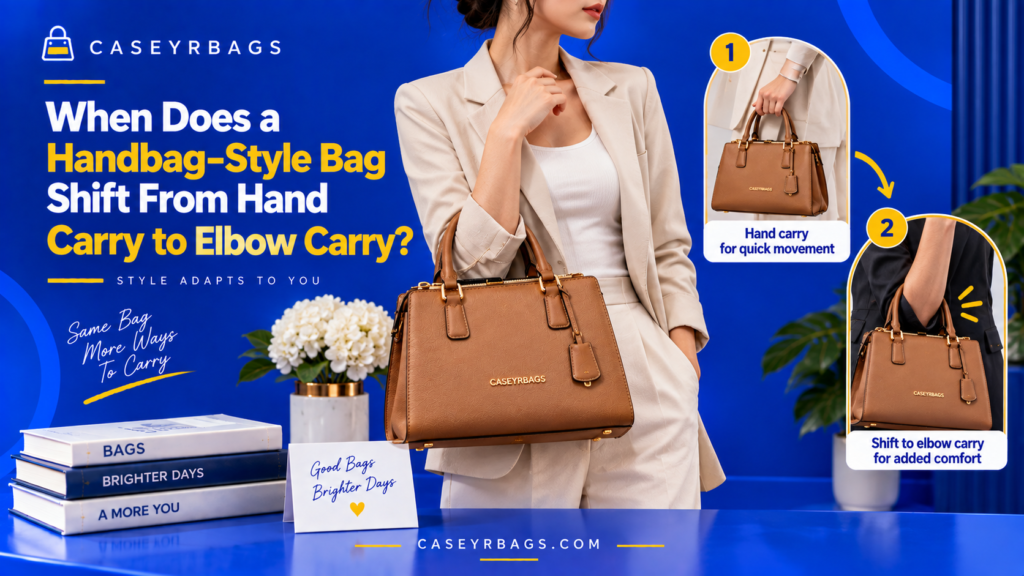
When Does a Handbag-Style Bag Shift From Hand Carry to Elbow Carry?
A Handbag-Style Bag shifts from hand carry to elbow or forearm-crook carry when its short handles provide enough usable opening for the forearm to pass through and the bag to rest higher along the arm without distorting the handles or bag body. This depends on handle drop, handle spacing, bag width, handle flexibility, and load.
The transition does not require the bag to become shoulder-oriented. Hand carry can remain the primary mode while elbow carry provides a secondary way to free the hand briefly or reposition the bag, provided the handles and load remain controlled.
What Does the Shift From Hand Carry to Elbow Carry Mean?
Hand carry suspends the Handbag directly below the hand, with the handles held primarily by the fingers or palm. This creates the shortest and most direct relationship between the hand and the bag.
Elbow or forearm-crook carry moves the same handles farther up the arm so they rest around the forearm or inner-elbow region rather than remaining in the hand. The exact resting point varies with handle opening, bag geometry, and the individual carrier.
This transition does not necessarily alter the bag’s structural identity. Within the broader Handbag-Style Bag system, elbow carry remains an alternate short-handle position when structured access and direct short-handle carry still dominate.
What Changes Mechanically Between Hand and Elbow Carry?
In hand carry, the handles remain concentrated at the hand and the bag hangs from a lower, direct support point. Moving the same handles farther up the forearm raises the support point and changes the bag’s position relative to the side.
Support point changes → bag height and angle change → hand availability changes. The bag can sit higher while the carrying hand becomes available for a short task.
Which Features Determine Whether the Shift Is Possible?
Handle drop, usable handle opening, handle spacing, bag width, handle flexibility, and normal load all determine whether the forearm can enter naturally and whether the bag remains controlled afterward.
The shift depends on complete geometry rather than one dimension. Hand clearance ≠ forearm clearance, and empty fit ≠ loaded fit.
Why Does Elbow Carry Not Turn the Bag Into a Shoulder Bag?
Elbow or forearm-crook carry still supports the short handles lower along the arm, while shoulder carry requires enough clearance for the handle or strap to move onto the shoulder.
Short-handle forearm/elbow support remains different from long shoulder suspension. Carry-position variation does not automatically change bag type.
How Does Handle Drop Determine the Carry Transition?
Vertical handle drop is one of the main variables controlling whether the hand and forearm can move through the opening, but it never works independently from width, spacing, and handle shape.
What Does a Very Short Handle Drop Favor?
A very short drop usually favors direct hand carry, compact suspension, and limited forearm clearance because the opening beneath the handles remains relatively small.
This geometry can strongly support primary hand carry while providing little or no useful elbow-carry transition. Limited clearance is not automatically a design flaw when elbow carry is not intended.
When Does Additional Drop Begin to Support Elbow Carry?
More usable vertical clearance increases the possibility that the hand and forearm can pass through the handle opening naturally without forcing the handles or bag body.
More usable vertical clearance → greater forearm-entry potential. No universal numeric drop threshold applies because the complete aperture still depends on other geometry.
Why Can Too Much Handle Drop Begin to Change the Bag’s Carry Identity?
Greater clearance can progressively support deeper forearm positioning and, in some designs, enough room for shoulder compatibility.
The relevant question is whether the handle remains short-handle oriented after clearance increases. More drop ≠ automatically better elbow carry.
| Handle-Drop Character | Hand Carry | Forearm/Elbow Carry | Shoulder Carry Potential |
|---|---|---|---|
| Very short | Strong | Limited | Very low |
| Short | Strong | Possible | Low |
| Short–moderate | Strong | Stronger | Design-dependent |
| Long | Possible | Strong | Greater potential |
Why Does Usable Handle Opening Matter More Than Drop Alone?
The forearm must pass through a two-dimensional opening shaped by drop, spacing, curve, stiffness, and bag-top width rather than one vertical number.
What Creates the Usable Handle Opening?
Vertical drop, horizontal handle spacing, handle curve, handle stiffness, and bag-top width combine to define the actual space available for hand or forearm entry.
Drop + spacing + curve + bag-top width → functional clearance. The same nominal drop can create very different openings on different bags.
Why Can Two Bags With the Same Handle Drop Fit Differently?
Two bags can share the same listed drop while differing in width, anchor spacing, handle curvature, or stiffness, which changes the usable opening area.
Same drop + different width/spacing/curve → different usable opening. Handle drop ≠ complete usable handle opening.
What Indicates That the Opening Is Too Small for Elbow Carry?
The opening is too small when the forearm must be forced through, handles twist excessively, the bag body lifts awkwardly, or the anchor areas visibly distort.
Forearm entry should come from usable clearance, not forced deformation. A possible transition is not a functional one if it requires distortion.
How Does Bag Width Affect Elbow-Carry Clearance?
Bag width changes how much of the handle geometry must span horizontally before it rises, altering the usable aperture even when handle drop stays constant.
How Does Wider Anchor Spacing Change the Handle Arc?
Greater bag-top span makes the handle bridge a wider horizontal distance, which can flatten or reshape the arc beneath the same vertical drop.
Greater bag-top span → more horizontal handle demand → altered forearm clearance. Width consumes part of the geometry that otherwise appears as open space.
Why Can a Narrow Bag Transition to Elbow Carry More Easily With the Same Drop?
On some narrower bags, less handle length is consumed by horizontal span, so more of the geometry can remain available as open clearance.
This is a design tendency rather than a universal rule. Anchor spacing, curve, stiffness, and load can still change the result.
When Does Width Make Elbow Carry Awkward?
Width becomes problematic when handles spread excessively, the bag presses awkwardly against the arm, the opening narrows under load, or the bag rotates during carry.
Bag width should be judged through usable aperture and loaded behavior, not as a stand-alone pass/fail dimension.
How Does Handle Flexibility Affect the Shift to Elbow Carry?
Handle flexibility controls how much the opening can adapt around the hand and forearm during entry and how predictably it returns to a stable carry shape afterward.
How Can Flexible Handles Improve Entry?
Flexible handles can conform around the hand or forearm, adapt the opening shape, and reduce rigid obstruction during the transition.
Greater flexibility can increase entry adaptability, especially when the opening is close to the required size. The benefit depends on the handle remaining controlled after entry.
How Can Overly Flexible Handles Reduce Carry Control?
Very flexible handles can twist, collapse inward, load the anchors unevenly, or fall across the opening after the arm passes through.
Adaptive entry ↔ twisting/collapse potential. Flexibility should support entry without destroying orientation.
How Do Rigid Handles Change the Transition?
Rigid handles preserve a predictable opening shape and reduce twisting, but they offer less ability to adapt around the forearm during entry.
Fixed opening geometry → predictable clearance but less adaptive entry. Whether this helps depends on whether the fixed aperture already suits the intended transition.
| Handle Type | Entry Adaptability | Bag Control | Main Tradeoff |
|---|---|---|---|
| Flexible | High | Variable | Can twist |
| Semi-structured | Moderate–high | High | Balanced |
| Rigid | Low–moderate | Predictable | Fixed clearance |
How Do Handle Anchors Affect Elbow-Carry Geometry?
Anchor spacing helps define the handle aperture while anchor stability determines whether that geometry remains predictable under the higher support position.
How Does Anchor Spacing Affect the Forearm Opening?
Anchor spacing combines with vertical drop to create the overall handle aperture and determines how much horizontal distance the handle must bridge.
Anchor spacing + drop → overall handle aperture. The same drop can therefore behave differently when the attachment points move farther apart or closer together.
How Do Stable Anchors Help the Bag Remain Oriented?
Stable attachment points preserve handle geometry under load and reduce unplanned inward pulling or distortion at the upper edge.
Stable attachment points → predictable handle geometry → predictable bag position. Anchor control becomes especially important once the support point moves higher along the arm.
Why Can Poorly Supported Anchors Make Elbow Carry Unstable?
Weak surrounding panels or poorly controlled anchors can pull inward, twist the handles, distort the upper edge, or let one side of the bag tilt.
Elbow carry depends on both clearance and structural anchor control. Aperture alone cannot create a stable secondary carry mode.
How Does Bag Load Affect the Hand-to-Elbow Transition?
Normal contents can change handle tension, bag shape, and the usable opening, so empty-bag clearance cannot prove loaded elbow-carry fit.
How Does Added Weight Change Handle Shape?
Depending on construction, added weight can straighten the handles, tighten their curve, deform upper panels, or change the opening beneath the handles.
Normal load → handle tension and shape change → realistic transition fit. The amount depends on the handle and body construction.
How Does a Heavier Load Affect Elbow Carry?
A heavier load increases downward pull, handle demand, and the effort required to reposition the bag after it moves higher along the arm.
Greater load does not automatically make elbow carry unusable, but it increases the importance of stable orientation and controlled transition. No universal comfort threshold applies.
Why Should the Transition Be Tested With the Normal Load?
An empty bag may show maximum handle flexibility and clearance that changes after realistic contents add tension and alter the bag body.
Empty-bag clearance ≠ loaded-bag carry fit. Elbow carry must remain controlled under normal loaded use, not merely possible when empty.
| Load State | Handle Geometry | Carry Behavior |
|---|---|---|
| Empty | Maximum natural flexibility | May appear easy |
| Light load | Mild tension | Predictable |
| Moderate load | More defined handle tension | Realistic fit |
| Heavy/uneven load | Distortion possible | Reduced stability |
How Does Bag Depth Affect Elbow Carry?
Moving the bag higher along the arm changes how its depth projects outward from the body, making front-to-back geometry more important in the secondary carry position.
How Does a Shallow Handbag Behave in Elbow Carry?
A shallow body usually remains relatively close to the forearm or side and creates less outward projection when the support point moves higher.
Smaller depth → lower outward projection potential → easier orientation. Shallow geometry still does not guarantee a stable loaded fit.
How Does a Deeper Bag Behave?
Greater depth can project farther outward, increase rotation potential, and create more contact with the side of the body in the higher position.
Deep geometry makes internal balance and anchor control more important because the same handle opening can lead to different loaded behavior.
Why Can Appropriate Handle Clearance Still Produce Poor Elbow Carry?
The forearm may fit through the handles while the bag body remains too deep, rotates strongly, or presses awkwardly against the side.
Handle fit and bag-body fit must both work. Forearm clearance alone does not prove the higher carry position is functional.
Where Should the Bag Rest During Elbow Carry?
A functional resting region lies somewhere along the forearm or forearm-crook area where the loaded bag remains controlled; one exact anatomical point should not be prescribed.
Should the Handles Sit Directly on the Elbow Joint?
No single exact elbow position applies to every bag or user. The handles may settle along the forearm or forearm-crook region depending on drop, bag geometry, and user dimensions.
The correct region is functional rather than anatomical. The bag should settle naturally without forcing the arm into one fixed point.
What Indicates a Controlled Elbow-Carry Position?
The bag hangs predictably, the handles remain untwisted, the load does not repeatedly slide, and the bag stays reasonably stable without constant correction.
Functional stability matters more than one exact resting point. Controlled orientation is the useful signal.
What Indicates That the Resting Position Is Poor?
Repeated slipping, heavy tilt, twisting handles, or constant hand support indicate that the higher position is not maintaining control.
A secondary mode loses value when it requires continuous correction. Elbow carry should reduce hand use temporarily rather than demand the hand to keep stabilizing it.
How Does Elbow Carry Change Bag Orientation?
Raising the support point changes the bag’s height and angle, so orientation must be reassessed rather than assumed from how the bag behaves in hand carry.
How Does the Bag Angle Differ From Hand Carry?
In hand carry, the bag hangs from a lower direct support point. In elbow carry, the support point moves higher and the bag may sit closer to the side.
Higher support point → changed bag angle → design-dependent orientation. The same body can behave differently after the transition.
How Can One-Sided Contents Change This Position?
Dense contents concentrated at one end can create end tilt, outward rotation, and uneven handle loading in the higher position.
Uneven internal load → end tilt/rotation → less stable elbow carry. The transition does not correct a poorly balanced bag.
Why Does Internal Load Control Still Matter?
Moving the bag higher changes support geometry but does not redistribute contents inside the bag.
Changing carry position does not correct poor internal balance. Stable elbow carry still depends on controlled internal loading.
How Does Elbow Carry Affect Access?
Elbow carry can free the hand for brief tasks, but the higher bag position can also change opening angle, visibility, and the ease of routine retrieval.
How Can Elbow Carry Free the Carrying Hand?
Moving the handles from the hand to the forearm or elbow-crook region releases the hand for brief routine tasks or short periods of repositioning.
Handle moves up arm → hand becomes temporarily available. This is one of the main practical reasons for using the secondary position.
When Can Elbow Carry Make the Main Opening Harder to Reach?
Access can become harder when the bag rests too high, the opening points inward, a handle overlaps the entry, or the body blocks the preferred reach path.
Higher support point can improve or worsen access depending on design. Hand availability alone does not guarantee easier retrieval.
When Should the Bag Return to Hand Carry for Retrieval?
Return to hand carry when direct support makes repositioning easier, improves opening visibility, or gives more stable control during retrieval.
A secondary carry position does not need to be the best retrieval position. Easy return to hand carry is part of functional carry-mode flexibility.
When Is Elbow Carry More Useful Than Hand Carry?
Elbow carry is most useful when temporary hand freedom solves a real short task without causing enough instability or access loss to outweigh that benefit.
When Does Temporary Hand Freedom Matter?
Brief routine tasks, handling another light object, or short repositioning periods can benefit from moving the bag higher while keeping the same short handles.
The usefulness comes from freeing the hand briefly rather than replacing hand carry permanently. The examples should remain task-specific and temporary.
When Does Elbow Carry Help With Repeated Short Transitions?
A hand → elbow/forearm → hand sequence can provide quick mode changes without attaching or relying on a longer secondary strap.
This reversible transition is valuable only when the loaded bag moves cleanly in both directions and does not require repeated correction.
When Should Hand Carry Remain Preferable?
Hand carry should remain primary when the bag is heavily loaded, precise control matters, the elbow position slips or rotates, or access is frequent.
Elbow carry is an option, not an automatic upgrade. The stronger mode is the one that fits the immediate task and loaded bag behavior.
When Does Elbow Carry Begin to Resemble Shoulder Carry?
The upper boundary of short-handle carry appears when increasing clearance begins to support shoulder entry and long suspension rather than primarily hand or forearm use.
What Separates Elbow/Forearm Carry From Shoulder Carry?
Elbow or forearm carry supports the short handles lower along the arm, while shoulder carry requires enough opening clearance for the handle or strap to pass onto the shoulder.
Elbow carry ≠ shoulder carry. The support point and suspension geometry remain different even when both use the same bag.
How Does Increasing Handle Drop Blur the Boundary?
More clearance creates more possible carry positions, moving the design from hand-only toward forearm, hybrid, and potentially shoulder-compatible use.
At some point the design may become hybrid. More handle drop increases options but does not automatically improve the short-handle role.
Does Hybrid Carry Automatically Change Handbag Identity?
No. Primary handles, dominant carry use, body structure, and opening architecture should all be considered before interpreting a category shift.
Primary structural intent matters more than occasional secondary use. Carry-position shift ≠ bag-type change.
When Does the Hand-to-Elbow Transition Become a Poor Fit?
The transition is a poor fit when insufficient clearance or loaded instability creates more distortion, slipping, rotation, or correction than functional benefit.
What Indicates Insufficient Handle Clearance?
Forced forearm entry, handle distortion, anchor pulling, or awkward bag lifting show that the available aperture is too small for a natural transition.
Insufficient usable opening → forced entry → handle/anchor distortion → failed transition. The arm should not need to force the bag geometry apart.
What Indicates Excessive Bag Instability in Elbow Carry?
Repeated slipping, strong rotation, end-heavy tilt, or constant manual correction show that the loaded bag is not settling predictably in the higher position.
A mode that requires constant correction does not provide useful secondary hand freedom. Stability matters more than simply achieving the position.
What if Elbow Carry Works Only When the Bag Is Empty?
If the bag fits the forearm when empty but normal loading removes usable clearance or causes tilt and rotation, the secondary mode is not validated for real use.
If normal loading removes the usable clearance or stability, elbow carry is not a functional loaded carry mode for that bag.
How Can Hand-to-Elbow Carry Be Evaluated?
Evaluation should use the normal load and observe both the transition into elbow carry and the return to direct hand carry.
What Should Be Checked Before Testing?
Inspect handle drop, usable handle opening, handle flexibility, anchor spacing, bag width, bag depth, and the normal load before attempting the transition.
These variables define the aperture and the loaded geometry. Testing only the empty bag can produce a false result.
What Should Be Observed in Both Positions?
Observe bag orientation, handle twist, slipping, movement, access, and ease of transition in hand carry and elbow/forearm carry.
Both positions must remain practical because the secondary mode is useful only when the bag can move between them without instability or obstruction.
Which Sequence Should Determine Elbow-Carry Fit?
- Load the Handbag normally.
- Lift it by the handles in hand carry.
- Observe bag orientation.
- Pass the hand and forearm through the opening naturally.
- Stop if the handles require forced stretching.
- Allow the bag to settle in a functional forearm/elbow-crook position.
- Observe tilt and rotation.
- Walk a short normal distance.
- Reposition the bag for access.
- Return to direct hand carry.
- Treat elbow carry as functional only if both transitions remain controlled.
Use the sequence in order so the bag is loaded normally, evaluated first in hand carry, then moved through the handle opening naturally without forced stretching before the elbow position is judged.
Observe tilt and rotation, walk briefly, test access, and return to direct hand carry. Treat elbow carry as functional only when both directions remain controlled and the normal load does not remove the fit.
How Can Hand-to-Elbow Carry Mismatches Be Avoided?
Mismatches are avoided by evaluating the complete aperture, normal loaded behavior, and reversible transition instead of using handle drop or empty-bag fit as proof.
Why Is Handle Drop Alone an Incomplete Fit Measure?
Clearance also depends on bag width, anchor spacing, handle curve, and handle flexibility, all of which change the effective aperture.
Handle drop ≠ complete usable opening. The same vertical measurement can produce different forearm fit on different bags.
Why Should Elbow Carry Not Justify Heavier Loading?
Changing the support point from hand to forearm does not reduce the actual mass of the bag or eliminate the demands created by depth, imbalance, or movement.
Different support position ≠ reduced bag weight. Secondary carry should not be used as permission to add more load.
What Should Be Verified Before Treating Elbow Carry as a Useful Secondary Mode?
Verify that short handles remain primary, hand carry still works, the forearm enters naturally, width and anchor spacing are considered, handles remain controlled, anchors stay stable, and the loaded bag does not repeatedly slip, twist, or rotate.
Also confirm that bag depth stays manageable, internal contents remain balanced, access works or the bag returns easily to hand carry, shoulder carry remains distinct, extra drop is not treated as automatically better, and the secondary position solves a real functional need.
- Short handles remain the primary carry system.
- Handle drop supports normal hand carry.
- Usable handle opening is large enough for intended forearm entry.
- Forearm does not need to be forced through the handles.
- Bag width is considered.
- Handle-anchor spacing is considered.
- Handle flexibility remains controlled.
- Handles do not twist excessively.
- Anchors remain stable under the normal load.
- Bag is tested while loaded, not only empty.
- Bag depth remains manageable in the higher carry position.
- Internal contents remain reasonably balanced.
- Bag does not repeatedly slip or rotate in elbow carry.
- Elbow/forearm position does not require constant hand support.
- Main opening remains usable or the bag can easily return to hand carry for access.
- Elbow carry is distinguished from shoulder carry.
- Additional handle drop is not automatically treated as better.
- Carry-mode shift is not treated as a bag-category change.
- Secondary elbow carry solves a real functional need.
- Hand carry remains practical as the primary short-handle mode.
Conclusion
A Handbag-Style Bag shifts from hand carry to elbow or forearm-crook carry when its short handles provide enough usable opening for the arm to pass through naturally while the loaded bag remains stable in the higher support position. Handle drop is important, but bag width, handle spacing, flexibility, depth, load, and anchor geometry also determine whether the transition works.
The secondary position should preserve easy return to direct hand carry rather than replace it. A functional transition exists when the forearm enters without forced deformation, the loaded bag settles with predictable orientation, access remains usable or easy to regain, and the bag can move back to hand carry without excessive slipping, twisting, or correction while retaining its primary Handbag-Style short-handle identity.
FAQs
Elbow or forearm-crook carry requires more usable handle clearance than direct hand carry because the forearm must pass through the opening.
Actual fit depends on handle drop, spacing, curvature, bag width, and handle flexibility rather than length alone. More drop can help without guaranteeing a functional loaded fit.
No. Elbow or forearm carry supports the short handles lower along the arm, around the forearm or forearm-crook region.
Shoulder carry requires enough clearance for the handle or strap to pass onto the shoulder. The support point and suspension geometry are therefore different.
Direct hand carry requires less opening space because only the hand needs to grip or enter the handle area.
Forearm entry depends on the complete aperture created by vertical drop, horizontal spacing, bag width, handle curvature, and flexibility. Hand clearance therefore does not guarantee forearm clearance.