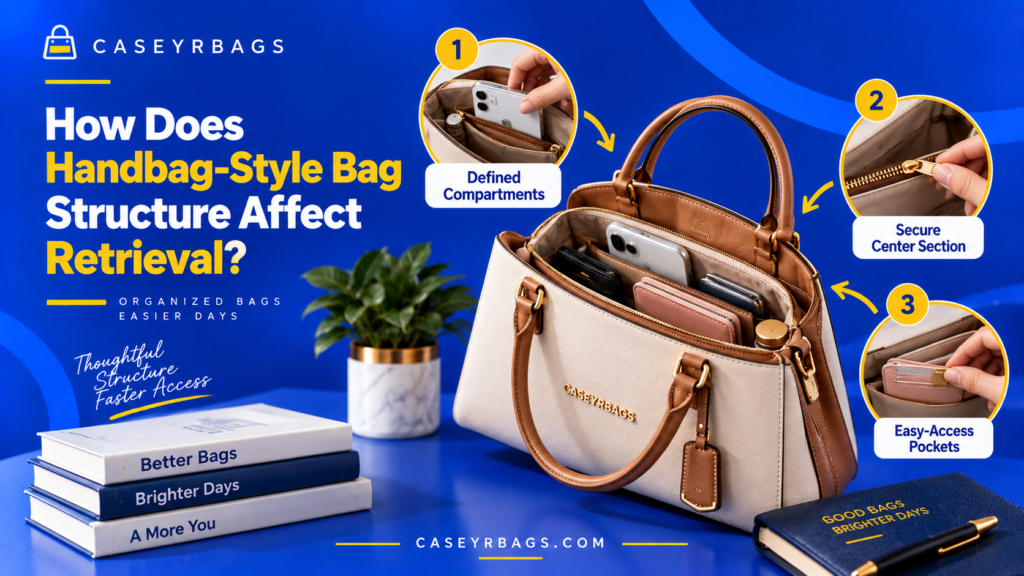
How Does Handbag-Style Bag Structure Affect Retrieval?
Handbag-Style Bag structure affects retrieval by determining how consistently the bag holds its shape, how widely the opening exposes the interior, and how predictably items remain positioned inside. A stable body can make the opening and compartment layout easier to use, while poor geometry can still create hidden or difficult-to-reach zones.
Retrieval also depends on bag depth, closure design, internal pockets, base stability, handle placement, and where frequently used items are stored. The strongest structure is therefore not necessarily the best; the most useful structure is the one that creates a clear path from opening the bag to locating and removing the intended item.
What Does Handbag Structure Mean for Item Retrieval?
A Handbag-Style Bag usually has a more shape-controlled body than a highly collapsible open bag. This can keep the opening, side panels, base, and internal pockets in more predictable positions during use.
Predictable structure can improve retrieval because the user learns where specific zones remain even when the bag is moved or set down. However, rigid or structured geometry can also create narrow corners, deep compartments, or fixed barriers that make some contents harder to reach.
Retrieval quality therefore depends on whether the structure supports visibility, predictable item placement, and a clear hand path rather than simply how rigid the bag feels. Within the broader Handbag-Style Bag system, structural access only helps when the retrieval path remains usable.
Which Structural Features Most Directly Affect Retrieval?
Body panels, the upper edge, main opening, closure, bag depth, base, compartments, pockets, and short handles all shape the retrieval path. Each feature changes either opening behavior, interior visibility, item position, or physical reach.
Structure → access effect → retrieval consequence. The strongest retrieval system is the one in which these features reinforce a predictable path rather than create competing barriers.
Why Can Shape Retention Improve Retrieval Predictability?
Stable bag geometry keeps the opening, pockets, and internal zones in more consistent locations, making repeated retrieval easier to learn and repeat.
Stable bag geometry → stable pocket/opening positions → easier repeated retrieval. Predictability reduces search, but only when items are also assigned to sensible zones.
Why Does More Structure Not Automatically Mean Easier Retrieval?
Highly rigid geometry can create narrow openings, fixed internal barriers, deep corners, or limited hand movement even while the bag itself remains perfectly shape-stable.
Retrieval depends on usable structure, not maximum rigidity. A well-structured bag can still create friction if reach and visibility are constrained.
How Does Body Shape Retention Affect Retrieval?
Shape retention changes how consistently the opening, side panels, pockets, and base remain positioned from one retrieval cycle to the next.
How Does a Stable Body Keep the Opening Predictable?
A shape-retaining body keeps the opening in a known location and reduces the amount of collapse that must be corrected before hand entry.
Shape retention → opening remains in a known location → more repeatable access. The benefit is consistency rather than guaranteed speed.
How Does a Collapsing Body Make Retrieval Less Predictable?
A collapsing body can fold the opening inward, let side panels cover contents, shift pocket positions, and allow items to stack unpredictably.
Changing geometry forces the user to re-establish the access path during each search. That reduces repeatability even when the chamber is not especially deep.
When Can Excessive Rigidity Reduce Retrieval Flexibility?
Excessive rigidity can make corners difficult to reach, preserve fixed narrow geometry, or prevent the bag from reshaping around the hand during access.
Useful shape retention should stabilize access without unnecessarily restricting reach. More rigidity is not automatically better.
| Body Structure | Shape Retention | Retrieval Effect | Main Tradeoff |
|---|---|---|---|
| Highly structured | High | Predictable geometry | Less flexible reach |
| Semi-structured | Moderate–high | Stable + adaptable | Balanced |
| Soft-structured | Moderate | Flexible access | More item movement |
| Highly collapsible | Low | Variable geometry | Less predictable retrieval |
How Does Main Opening Geometry Affect Retrieval?
Opening width, length, and orientation determine how much of the interior becomes visible and how directly the hand can move toward the intended item.
How Does a Wider Opening Improve Retrieval Visibility?
A broader controlled opening exposes more of the interior and can make visual scanning faster by reducing the amount of blind searching.
More exposed interior → easier visual scanning → faster location potential. Visibility improves location, but it does not guarantee physical reach.
Why Can a Large Opening Still Produce Difficult Retrieval?
A large opening can still lead into a deep, poorly organized, overfilled, or compartmentalized chamber where items remain hidden beneath or behind other contents.
Large opening ≠ easy item location. Opening size solves only one part of the retrieval path.
How Does Opening Orientation Change the Retrieval Path?
Top openings, framed openings, zipper tracks, and flap-covered openings each create different hand paths and visibility patterns around the main chamber.
Opening orientation → hand path → item visibility. The best geometry is the one that remains compatible with depth, organization, and intended retrieval behavior.
How Does Closure Design Affect Retrieval?
Closure design adds steps before the hand reaches the opening, so retrieval quality depends on whether those steps provide useful control without creating redundant friction.
How Does a Zipper Affect the Retrieval Path?
A zipper creates a sequence of locating the pull, opening to the needed width, reaching into the chamber, and then closing again after retrieval.
Locate zipper → open to needed width → reach → close. The zipper can provide variable opening control without automatically improving item location inside the bag.
How Do Flaps, Snaps, or Frame Closures Change Retrieval?
A flap adds another access layer, snaps or magnets can release quickly, and frame closures can preserve a defined opening shape after release.
Each closure changes the retrieval sequence differently. No closure type is universally best because chamber depth, visibility, and organization still matter.
When Does Closure Complexity Become Retrieval Friction?
Multiple redundant steps, difficult one-handed operation, closure hardware that blocks the opening, or repeated need to reposition the bag can turn access control into friction.
Controlled access should not require unnecessary retrieval steps. Closure value ends when the mechanism complicates routine item access without solving a real control need.
How Does Handbag Depth Affect Item Retrieval?
Bag depth determines how far the hand may need to travel and how easily small items can disappear below larger contents or into lower hidden zones.
How Does a Shallow Chamber Affect Retrieval?
A shallow chamber can keep more items visible, shorten the reach path, and reduce vertical stacking, though it also provides less overall internal volume.
Shallower depth can simplify retrieval when the available space suits the contents. Shallow does not automatically mean superior because capacity and organization still matter.
How Does Greater Depth Create Hidden Retrieval Zones?
A deep chamber can let small items collect at the bottom, disappear beneath larger contents, and require more vertical reaching or blind searching.
Deep chamber → longer reach + more stacking → hidden-zone risk. The effect increases when organization does not control the lower area.
When Is a Deep Bag Still Retrieval-Efficient?
A deep bag can remain efficient when it uses useful internal pockets, divided zones, predictable item placement, and enough opening visibility to reveal where contents sit.
Depth becomes a problem mainly when organization does not control it. Deep + organized can work better than shallow + disorganized.
| Chamber Depth | Visibility | Reach Distance | Organization Need |
|---|---|---|---|
| Shallow | Higher | Shorter | Lower |
| Moderate | Good | Moderate | Moderate |
| Deep | Lower potential | Longer | Higher |
| Deep + organized | Improved | Controlled | High but effective |
How Do Compartments Affect Handbag Retrieval?
Compartments reduce search when each zone has a clear role, but excessive subdivision can create memory and access friction.
How Do Defined Compartments Improve Retrieval?
A defined compartment role gives an item a predictable location, reducing the need to scan the entire bag each time it is needed.
Known compartment role → predictable item location → reduced search. Clear roles matter more than raw compartment count.
When Do Too Many Compartments Slow Retrieval?
Too many similar pockets or sections can force the user to remember numerous zones, open several compartments, or search fragmented spaces repeatedly.
More sections can improve separation while increasing search fragmentation. The trade-off becomes poor when the storage roles are unclear.
Why Is Compartment Role More Important Than Compartment Count?
A few clearly assigned zones can create more predictable retrieval than many nearly identical pockets with overlapping purposes.
Clear storage role > maximum number of sections, and more compartments ≠ better retrieval. Organization should reduce uncertainty rather than multiply it.
| Layout | Search Predictability | Main Benefit | Main Risk |
|---|---|---|---|
| One open chamber | Low–moderate | Maximum flexible space | Item mixing |
| Few defined zones | High | Predictable retrieval | Less free volume |
| Many small pockets | Variable | Detailed separation | Search fragmentation |
| Mixed layout | High when intentional | Flexible + organized | Requires clear roles |
How Does Pocket Position Affect Retrieval Priority?
Pocket position should follow access priority so frequently used contents occupy the shortest and most predictable retrieval path.
Which Pockets Support Fast Routine Retrieval?
Pockets near the main opening, easy to identify visually, directly reachable by hand, and assigned one clear purpose usually support faster routine access.
Fast-access zones should minimize both searching and reach distance. Their value comes from placement and role rather than exterior or interior location alone.
Which Pockets Are Better for Lower-Frequency Items?
Deeper internal zones, secondary compartments, or less immediately accessible sections can preserve prime access space for items used more often.
Lower-frequency storage can accept a longer retrieval path when that placement prevents high-priority zones from becoming crowded.
Why Can Exterior Pockets Distort Retrieval Organization?
Too many exterior pockets can duplicate item locations, encourage one-sided loading, or cause contents to be forgotten because similar roles appear in several places.
Access priority should determine pocket role. Pocket placement should reduce location uncertainty rather than scatter routine items across multiple zones.
How Does the Base Affect Retrieval Stability?
Base stability influences whether the lower interior keeps a consistent shape or collapses into a shifting collection zone when the bag is set down or opened.
How Does a Stable Base Help Contents Remain Predictable?
A stable base preserves lower interior geometry and reduces the amount of collapse that can change where contents settle between retrievals.
Stable base → more consistent interior geometry → less collapse. This helps item positions remain more repeatable.
How Does a Soft Collapsing Base Affect Small-Item Retrieval?
A collapsing base can make contents migrate toward the lowest point, deform internal pockets, and force the user to hold the bag open while searching.
Small items can therefore accumulate in a mixed lower zone where location becomes less predictable. The problem is geometry plus organization, not softness alone.
Does a Rigid Base Automatically Improve Retrieval?
No. A rigid base can stabilize the lower structure while still creating deep corners or hidden zones that remain difficult to access.
Base stability supports retrieval but does not replace organization. The lower geometry must still work with item placement and reach.
How Do Short Handles Affect Main-Opening Retrieval?
Short handles can stabilize the bag during access, but their placement can also compete with the same opening path used for hand entry.
How Can Short Handles Help Stabilize Retrieval?
A handle can be used to steady the bag, control its orientation, or lift and reposition the opening during retrieval.
Short-handle control can therefore make the opening easier to present to the retrieving hand. The benefit depends on the handle staying clear of the access path.
When Do Handles Interfere With the Main Opening?
Handles can cross the zipper path, fall inward, narrow entry near the anchors, or bring hardware into the hand path.
Handle interference → obstructed opening → longer retrieval path. The same feature that stabilizes the bag can become a barrier if its geometry overlaps the entry zone.
Why Should Handle Geometry Be Evaluated With Opening Geometry?
The handles and main opening occupy the same upper bag region, so their spacing and movement determine whether carry support and access cooperate or compete.
Short-handle carry and structured access should support the same retrieval path rather than compete for space. Both systems must be evaluated together.
How Does Interior Visibility Affect Retrieval?
Visibility reduces search by making items easier to identify, but a visible item still needs a clear physical path for the hand to reach it.
How Does a Structured Opening Improve Interior Visibility?
A controlled opening that stays open can create a wider visual field and make item identification easier during a quick scan.
Opening remains open → wider visual field → easier item identification. Visibility helps the user locate the item before reaching.
Why Can Visible Items Still Be Difficult to Retrieve?
A narrow hand path, deep layering, rigid dividers, bulky contents, or overpacking can obstruct physical reach even when the item can be seen.
Visibility ≠ physical reach. Seeing an item solves location, while retrieval still requires enough space and distance for grasp and removal.
What Structural Features Improve Both Visibility and Reach?
A controlled opening, moderate workable depth, clear pocket zones, and a stable bag body can keep both the visual field and the hand path predictable.
Visibility supports retrieval; reach completes it. Effective structure should preserve both without maximizing any one feature in isolation.
How Does Item Placement Affect Retrieval Within a Structured Handbag?
Even well-designed structure can fail when item placement ignores access priority and repeatedly blocks the most useful retrieval zones.
Where Should Frequently Retrieved Items Sit?
Frequently retrieved items generally work best near accessible upper zones or in known pockets where the search and reach path stays short.
The exact item type is less important than the access pattern. High-frequency contents should occupy predictable prime retrieval zones rather than deep clutter.
Where Should Bulky or Rarely Accessed Contents Sit?
Bulky or low-frequency contents should use lower-priority zones that do not obstruct the main opening, quick-access pockets, or routine hand path.
Their placement should preserve high-priority access space while keeping the bag’s internal geometry stable.
How Does Loose Small-Item Accumulation Reduce Retrieval Efficiency?
Loose small items can collect at the base or mix beneath larger contents, creating a shared zone that requires repeated searching.
Loose small items → mixed base zone → repeated searching. Retrieval efficiency depends on structure plus intentional item placement.
| Item Priority | Best Structural Role | Retrieval Goal |
|---|---|---|
| Frequent | Quick-access zone | Minimal search |
| Routine | Main organized compartment | Predictable reach |
| Low-frequency | Deep/secondary zone | Preserve prime access space |
| Small loose items | Dedicated pocket | Prevent base accumulation |
How Does Overfilling Affect Handbag Retrieval?
Overfilling can undermine a well-designed bag by distorting the opening, crowding compartments, and reducing the space available for hand entry and item removal.
How Does Overfilling Reduce Opening Width?
Packed pressure can push against the upper edge and closure, distort the intended opening shape, and reduce the clearance available for the hand.
Packed pressure → distorted opening → reduced hand clearance. Structural design cannot compensate indefinitely for excessive fill.
How Does Overfilling Hide Items?
Vertical stacking, compressed compartments, blocked pockets, and buried contents can make items harder to see and reach even when the bag remains physically closed.
Overfilling changes both visibility and organization. The chamber may hold the contents while retrieval quality falls sharply.
Why Is Maximum Capacity Not the Same as Useful Retrieval Capacity?
A bag may physically hold more contents than can be accessed efficiently through its opening and compartment layout.
Available volume ≠ usable retrieval volume. Practical capacity ends where searching, obstruction, or rearrangement becomes routine.
How Can Poor Handbag Retrieval Be Diagnosed?
Retrieval friction should be diagnosed from the repeated search behavior it creates, then traced back to structure, organization, handle interference, item placement, or fill level.
What Does Repeated Blind Searching Suggest?
Repeated blind searching can indicate excessive bag depth, low interior visibility, loose contents, or compartment roles that do not keep item locations predictable.
Blind searching is a symptom of weak location cues. The first checks should be depth, visibility, and whether the item has a stable assigned zone.
What Does Repeated Item Obstruction Suggest?
Repeated obstruction can point to overfilling, bulky items near the opening, handle interference, or rigid dividers that narrow the hand path.
The problem is not necessarily the opening itself. A clear entry can still lead into an obstructed retrieval path.
What Does Repeated Opening of Multiple Pockets Suggest?
Repeatedly opening several pockets usually indicates too many similar compartments, unclear storage roles, or inconsistent item placement.
Search behavior reveals whether the structure is actually supporting retrieval. Repeated location uncertainty means the organization system needs clearer roles.
How Should Handbag-Style Retrieval Be Evaluated?
Real-use evaluation should test the normally loaded bag repeatedly without reorganizing between every retrieval so the structure’s actual repeatability becomes visible.
What Should Be Checked Before Loading?
Inspect the opening geometry, closure, chamber depth, compartments, pockets, base, and handles before normal contents are added.
These pre-load checks establish the structural path that should support retrieval. They show where potential barriers or hidden zones may appear after loading.
What Should Be Checked After Loading?
Observe interior visibility, item position, opening clearance, compartment crowding, and handle interference once the normal contents are in place.
Post-load behavior matters because structure that looks clear when empty can behave differently after real contents occupy the chamber.
Which Sequence Should Determine Retrieval Fit?
- Load the bag with normal contents.
- Assign frequent-use items to predictable accessible zones.
- Close the bag.
- Open it normally.
- Observe interior visibility.
- Retrieve a frequent-use item.
- Retrieve an item from the main chamber.
- Return both to their intended zones.
- Close and reopen the bag.
- Repeat retrieval without reorganizing.
- Adjust storage if searching or obstruction repeatedly occurs.
Use the sequence in order so the bag is tested with normal contents and frequent-use items already assigned to predictable zones. The close-open-retrieve cycle then reveals whether the structure supports repeated access without hidden correction.
Repeat retrieval without reorganizing between attempts. If searching or obstruction repeatedly occurs, adjust storage rather than judging the bag only from opening size or pocket count.
How Can Handbag Retrieval Mismatches Be Avoided?
Retrieval mismatches are avoided by treating opening, depth, compartments, handles, visibility, reach, and item placement as one system rather than assuming structural sophistication guarantees good access.
Why Is Maximum Compartment Count a Weak Retrieval Strategy?
Too many compartments can fragment search, duplicate storage roles, reduce flexible space, and make location memory less reliable.
More compartments ≠ better retrieval. A smaller number of clearly assigned zones can create a stronger retrieval system.
Why Is Maximum Rigidity Also a Weak Retrieval Strategy?
Excessive rigidity can restrict hand movement, create fixed inaccessible corners, and prevent useful opening expansion around the hand.
Maximum rigidity ≠ maximum retrieval quality. Structure should stabilize the retrieval path without blocking it.
What Should Be Verified Before Treating Handbag Structure as Retrieval-Efficient?
Verify that the body retains enough shape, the opening is easy to locate and exposes enough interior, closure steps remain practical, depth matches organization, frequent items stay accessible, small items have defined pockets, and compartment roles remain clear.
Also confirm that the base preserves geometry, handles do not obstruct the opening, visible items remain reachable, bulky items do not block the hand path, the bag is not overfilled, and repeated retrieval does not require whole-bag reorganization. After that validation, Structured Access becomes the next close question.
- Bag body retains enough shape for predictable access.
- Structured does not automatically mean rigid.
- Main opening is easy to locate.
- Opening exposes enough of the interior for normal use.
- Closure does not create unnecessary steps.
- Bag depth matches the organization provided.
- Frequently used items remain in accessible zones.
- Small items have defined pockets.
- Deep zones are reserved for lower-frequency contents where appropriate.
- Compartments have clear roles.
- Pocket count is not treated as retrieval quality.
- Base remains stable enough to preserve interior geometry.
- Handles do not obstruct the main opening.
- Interior visibility is adequate.
- Visible items are also physically reachable.
- Bulky items do not block the access path.
- Bag is not overfilled.
- Available volume is not confused with usable retrieval capacity.
- Items can be returned to predictable locations.
- Repeated retrieval does not require reorganizing the entire bag.
- Retrieval quality is evaluated through opening, visibility, reach, and location together.
Conclusion
Handbag-Style Bag structure affects retrieval by controlling the shape of the opening, the visibility of the interior, the depth of the reach path, and the stability of compartments and pockets. A well-structured bag can make item locations more predictable, but structure only improves retrieval when the opening, depth, and organization remain usable.
Effective retrieval therefore depends on more than rigidity or pocket count. The bag should preserve a clear route from opening to visibility, item location, hand reach, grasp, and removal. Handbag-Style structure supports retrieval most effectively when body shape, opening geometry, compartment roles, handle placement, base stability, and intentional item positioning work together without repeated searching, obstruction, or reorganization.
FAQs
Structure can keep the opening, pockets, and storage zones in predictable positions, which can make repeated retrieval easier.
Actual retrieval still depends on opening width, bag depth, compartment layout, visibility, reach, and item placement. Structure helps only when those features remain usable together.
A few clearly assigned compartments can reduce searching by giving routine items predictable locations.
Too many similar pockets may fragment storage, create unclear roles, and make item location less predictable. More compartments ≠ better retrieval when the user must repeatedly open several zones.
A large opening can improve entry and interior visibility by exposing more of the main chamber.
A deep, overfilled, or poorly organized chamber can still hide items, create stacking, or block physical reach. Large opening ≠ easy retrieval when the lower structure remains difficult to use.