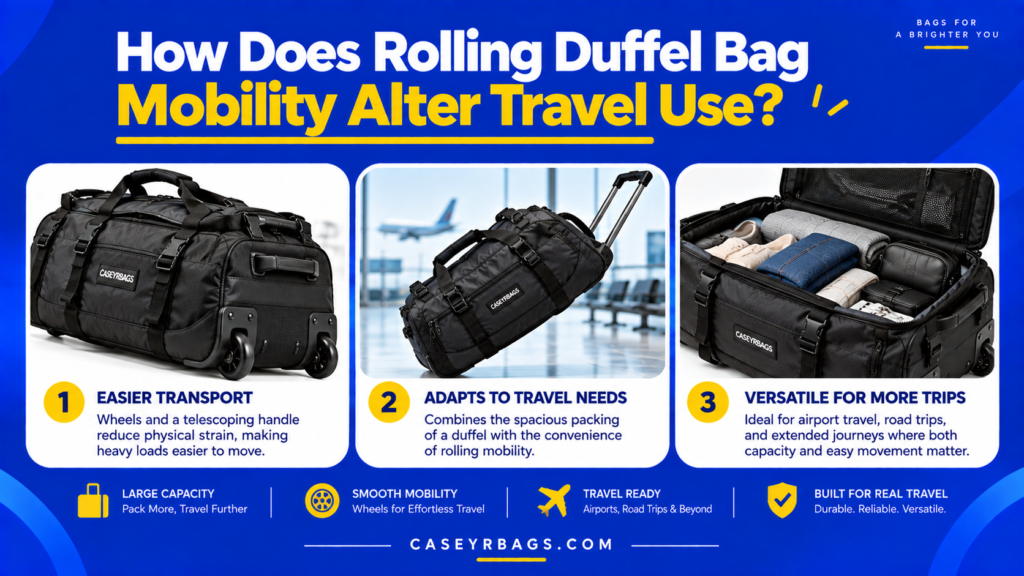
How Does Rolling Duffel Bag Mobility Alter Travel Use?
Rolling Duffel Bag mobility changes travel use by adding a wheel-supported base and pull system that can move part of the trip from continuous hand or shoulder carrying to surface-supported rolling. On suitable floors, the packed Duffel can travel between points with less need for continuous lifting while still retaining direct carry options for transitions.
The benefit remains dependent on surface type, packed-load control, wheel structure, storage conditions, and how often the bag must still be lifted. Stairs, rough ground, tight storage, unstable packing, and frequent transfer points can reduce the practical advantage of rolling. Rolling ≠ no lifting, wheels ≠ useful on every surface, and added hardware ≠ automatic travel advantage.
What Does Rolling Mobility Change in a Duffel Bag?
A Rolling Duffel Bag adds a wheel-supported base and pulling system to a flexible or semi-structured Duffel body. This allows part of the travel task to shift from carrying the packed bag entirely by handles or straps to moving it across suitable surfaces.
The change is functional rather than absolute. Rolling can reduce continuous carrying on smooth travel surfaces, but the bag still requires direct handling during stairs, vehicle transfers, storage placement, rough ground, and other transitions where wheels provide little help.
Rolling mobility should therefore be judged by how often it replaces carrying during the intended trip. The broader Duffel Bag relationship places rolling within flexible packing, carry options, packed-shape control, and adaptable travel mobility.
Which Components Create Rolling Duffel Mobility?
Wheels, wheel housings, a reinforced lower area, pull handle, grab handles, and the rolling base work together to create Rolling Duffel mobility. Wheels support ground travel, the reinforced base stabilizes the rolling interface, and handles control pulling or lifting transitions.
Component → mobility role → travel consequence. The system is useful only when these parts work with the packed bag rather than in isolation. Strong wheel hardware does not automatically produce good mobility if the load is unstable, the surface is unsuitable, or lifting remains frequent.
How Does a Rolling Duffel Differ From a Classic Carry Duffel?
A classic carry Duffel moves mainly through hand handles or shoulder carry, while a Rolling Duffel adds surface-supported movement. That extra method can replace continuous carrying across suitable travel segments.
Rolling hardware also adds structure, fixed geometry, and physical components that a simple carry Duffel may not need. More ground mobility is gained, but lower-body flexibility and storage compressibility can decrease.
Why Does Rolling Not Replace Every Other Carry Method?
Rolling cannot replace stairs, vehicle loading, rough ground, curbs, thresholds, storage placement, or lifting onto surfaces. These transitions still require direct handling even when wheels perform well between them.
Rolling supplements direct carry; it does not remove it. A useful Rolling Duffel therefore needs both effective ground mobility and accessible grab points for the portions of a trip where wheels cannot solve the movement task.
How Do Wheels Change Duffel Bag Ground Mobility?
Wheels transfer part of the movement task to surface contact, reducing continuous carrying during suitable travel segments.
How Does Rolling Reduce Continuous Carrying Demand?
A wheel-supported base lets the ground support much of the bag’s load while the user directs movement through the pull system. On suitable surfaces, this can replace repeated hand or shoulder carrying during longer travel segments.
Wheel-supported base → part of load supported through ground contact → reduced continuous carrying during suitable segments. The benefit ends whenever the route requires lifting, climbing, or surfaces that interrupt wheel travel.
How Does Wheel Placement Affect Bag Tracking?
Wheel placement, lower-body structure, bag orientation, and load alignment influence tracking. A wheel system positioned consistently relative to the reinforced base can help the Duffel follow a predictable line when packed geometry is balanced.
Wheel placement ≠ packed-load balance. Even well-positioned wheels can track poorly if the contents create strong left-right asymmetry or if dense mass sits away from the intended rolling centerline.
Why Can the Packed Load Still Affect Rolling Behavior?
Rolling behavior comes from the interaction between wheel hardware and packed geometry. One-sided bulging, a top-heavy load, or internal movement can alter the bag’s tilt and change how the rolling base meets the surface.
Wheel hardware + packed geometry → actual rolling behavior. Stable wheels cannot fully compensate for an unstable packed load, so load control must be established before wheel performance can be judged meaningfully.
| Travel Condition | Wheel Role | Mobility Effect |
|---|---|---|
| Smooth level surface | Continuous rolling | Strongest rolling benefit |
| Short threshold | Interrupted rolling | Direct control may increase |
| Stairs | Little/no rolling value | Lift required |
| Rough ground | Reduced wheel efficiency | Carrying may become practical |
| Tight turn | Directional control | Packed geometry matters |
How Does the Rolling Base Change Duffel Structure?
Wheel housing and base reinforcement create a more stable lower structure for rolling while reducing local softness.
Why Does a Rolling Duffel Need a Stronger Lower Structure?
Wheel-supported use normally requires lower-body support for wheel attachment, base stability, tilted orientation, and repeated ground interaction. A simple soft base would provide less predictable support for those functions.
Rolling support requires more fixed structure than a simple soft base. The lower area becomes more defined while the upper Duffel can remain comparatively flexible for packing and shape adaptation.
How Can Wheel Housings Affect Internal Packing Space?
Wheel housings and lower reinforcement can occupy or shape part of the internal floor geometry. This can create fixed zones or contours that influence how bulky or dense items sit near the base.
External mobility hardware can influence internal usable geometry. The effect varies by design and should be evaluated structurally rather than treated as a universal loss of capacity.
How Does Added Base Structure Change Duffel Flexibility?
A more rigid lower zone improves rolling support but reduces lower-body conformity. The base becomes less able to collapse or reshape around contents because it must maintain geometry for wheels and tracking.
More rigid lower zone → greater rolling support → less lower-body conformity. The upper Duffel may still remain flexible, creating a hybrid format with structured support below and adaptable packing space above.
How Does Rolling Orientation Affect Packed Contents?
Tilting the Duffel into rolling orientation changes the direction of loading, which can cause contents to settle toward the lower rolling zone.
How Do Contents Settle When the Duffel Is Tilted for Rolling?
When the bag changes from resting horizontally to a tilted or upright rolling orientation, gravity changes the direction in which contents settle. Loose items can migrate toward the lower rolling end, especially when free space remains.
Orientation change → gravity changes load direction → contents may settle toward the lower rolling zone. This shift can change internal pressure and packed shape even when the bag appeared stable while resting flat.
Why Do Dense Items Need Controlled Positioning?
Dense items can create stronger local pull during tilt, increasing one-sided distortion, unstable orientation, or sudden movement inside the Duffel. Their position therefore affects rolling geometry as well as packing geometry.
Dense-item position affects rolling geometry as well as packing geometry. A concentrated dense load high or far to one side can increase imbalance potential without requiring any universal weight threshold.
How Can Compartments or Retention Reduce Load Shift?
Internal straps, dividers, pockets, packing modules, or compartment boundaries can limit migration when the bag tilts. These features help keep items near their intended positions instead of letting the load reorganize around gravity.
Retention → reduced migration → more predictable rolling orientation. The goal is enough position control to prevent changing orientation from producing new bulges, imbalance, or unpredictable tracking.
| Load Pattern | Tilted Response | Rolling Consequence |
|---|---|---|
| Controlled centered load | Limited shift | More predictable |
| Dense top-heavy load | Greater downward shift | Reduced control |
| Loose mixed contents | Migration | Changing geometry |
| Retained contents | More stable position | More consistent rolling |
How Does Surface Type Change Rolling Duffel Mobility?
Rolling value depends heavily on the surfaces the bag actually encounters because wheel-supported movement works best when ground is smooth, firm, and continuous.
When Does Rolling Provide the Greatest Mobility Benefit?
Rolling provides its strongest value on smooth, firm, reasonably level, continuous surfaces where the bag can move for meaningful distances without repeated interruption. Long corridors and terminal-like environments illustrate the surface pattern rather than a universal travel assumption.
Rolling value rises when surface-supported movement replaces repeated carrying. The greater the uninterrupted rolling segment, the more the wheel system can justify its added structure.
Why Do Rough or Uneven Surfaces Reduce the Advantage?
Rough or uneven ground can increase wheel obstruction, interrupt tracking, require more directional correction, and reduce continuous rolling. The wheels may still function, but more direct control or intermittent lifting can become necessary.
Rough surface → greater rolling resistance or obstruction → more direct carrying. This does not make every imperfect surface unusable; it means the practical rolling advantage shrinks as interruptions increase.
When Does Carrying Become the Practical Alternative?
Carrying becomes practical during stairs, broken surfaces, tight obstacles, short lift-intensive transitions, or situations where rolling requires more correction than it saves. These segments can be brief yet frequent enough to change total mobility value.
Wheel-supported movement ≠ unrestricted movement. A Rolling Duffel remains most useful when the route contains enough surface-supported travel to outweigh the direct handling still required at interruptions.
| Surface / Transition | Rolling Value | Likely Movement Mode |
|---|---|---|
| Smooth terminal floor | High | Roll |
| Level pavement | Context-dependent | Roll / carry |
| Rough ground | Reduced | Carry may increase |
| Stairs | Minimal | Lift |
| Vehicle loading | Minimal | Lift & position |
| Tight storage area | Limited | Direct handling |
How Do Pull & Grab Handles Change Travel Use?
Pull and grab handles solve different movement tasks, allowing the same Rolling Duffel to transition between rolling control and direct lifting.
How Does a Pull Handle Support Rolling Control?
The pull handle helps set pulling direction, maintain rolling orientation, and move the bag between stationary and rolling states. It is a control point designed around wheel-supported movement rather than vertical lifting.
Pull-handle usefulness depends on design, surface, and packed geometry. It improves directional control during rolling but does not replace other handles needed when the bag must be lifted or repositioned directly.
Why Do Grab Handles Remain Necessary on a Rolling Duffel?
Grab handles remain necessary for stairs, vehicle transfers, storage placement, retrieval, and other transitions where wheels cannot support the movement. These tasks require direct lift and position control rather than pulling.
Pulling and lifting are different mobility tasks. A Rolling Duffel that rolls well but has inaccessible direct-lift points can become awkward at exactly the transitions where wheel value disappears.
When Does Switching Between Pull and Grab Handles Matter Most?
Handle switching matters most on routes that repeatedly move through roll → stop → lift → position → roll. The more often these transitions occur, the more important it becomes that both pull and grab points remain easy to access.
A smooth handle transition reduces friction between travel stages. The goal is not to maximize one carry system but to ensure the bag moves cleanly between wheel-supported and directly controlled states.
How Does Rolling Mobility Affect Duffel Packing?
The structured lower section and tilted rolling orientation change packing priorities because the load must remain controlled when the bag moves between flat and rolling positions.
How Does the Structured Base Change Where Items Can Sit?
Wheel housing and reinforcement can create a more defined lower packing geometry than a classic soft Duffel base. This influences how bulky or dense contents interact with the bottom of the chamber without establishing one universal item location.
The key effect is structural: the lower zone offers more fixed support and less conformity. Packing should account for that shape while preserving balance between the reinforced base and flexible upper chamber.
Why Should Dense Items Not Create a Top-Heavy Rolling Load?
Dense upper concentration can increase imbalance potential when the bag tilts into rolling orientation. A high center of mass or one-sided dense zone can make direction changes and transitions less predictable.
Dense upper concentration → higher imbalance potential during tilt → less predictable rolling. The correction is load-position control rather than a universal weight limit.
How Does Soft Upper-Body Flexibility Remain Useful?
The upper Duffel can still conform around contents, adapt shape, and preserve flexible packing even when the rolling base is more structured. This retains some classic Duffel adaptability above the reinforced lower zone.
Soft upper body → adaptable packing / structured lower body → rolling support. The combination works best when upper-body flexibility does not create bulges or load shifts that undermine tracking or storage handling.
| Packed Condition | Structural Response | Rolling Effect |
|---|---|---|
| Centered load | Controlled geometry | More predictable |
| Dense one-sided load | Asymmetric shape | Tracking/control may worsen |
| Top-heavy load | Higher tilt sensitivity | Less stable transition |
| Controlled flexible upper load | Adaptive upper shape | Base still supports rolling |
| Excessive bulging | Larger profile | Harder handling/storage |
How Do Rolling Duffels Change Travel Transitions?
Rolling changes travel transitions by reducing carrying during long level segments while leaving lifting tasks intact at stairs, vehicles, racks, storage areas, and retrieval points.
Which Travel Stages Benefit Most From Rolling?
Longer level walking segments, terminals, smooth corridors, and repeated ground movement benefit most because the wheel-supported base can remain engaged for meaningful distances. These stages let rolling replace carrying rather than merely interrupt it.
The practical value comes from duration and continuity. A short smooth section between repeated lifts provides less benefit than a long uninterrupted rolling segment, even if both occur on suitable surfaces.
Which Transitions Still Require Lifting?
Stairs, vehicle loading, racks or platforms, storage placement, and retrieval still require direct control because the wheels cannot complete those vertical or constrained movements. Grab handles therefore remain part of the core mobility system.
Rolling mobility reduces some carrying segments; it does not eliminate transfer lifts. The whole trip should be judged by how often those lifting transitions appear, not only by the presence of long rollable areas.
Why Does Transition Frequency Matter?
A trip with repeated roll → lift → roll → lift can produce a very different mobility value from one with long uninterrupted rolling. Frequent transitions reduce the time during which the wheel system replaces direct carrying.
Transition frequency therefore determines whether added hardware solves a repeated mobility need or simply travels with the bag while direct handling remains dominant.
| Travel Stage | Main Demand | Rolling Duffel Behavior |
|---|---|---|
| Terminal floor | Ground movement | Roll |
| Vehicle transfer | Lift/position | Grab handle |
| Stairs | Lift | Direct carry |
| Long corridor | Ground movement | Roll |
| Storage placement | Lift/control | Direct handling |
| Retrieval | Lift/position | Direct handling |
How Does Rolling Structure Affect Storage & Handling?
Wheels, reinforced base areas, and pull-handle structure remain part of the bag even when it is not rolling, so they change storage geometry and direct handling.
How Can Added Rolling Hardware Change Storage Flexibility?
Fixed lower hardware can reduce how much the bag collapses or conforms near the base. A Rolling Duffel may preserve soft-sided adaptability in the upper body while remaining comparatively rigid in the wheel and pull-handle zones.
The storage consequence depends on surrounding space and orientation. Added hardware is useful for mobility but can make the bag less compressible than a non-wheeled Duffel of similar overall form.
Why Does External Wheel/Base Geometry Matter During Placement?
Wheel housings and reinforced base geometry affect how the Duffel sits beside other items, fits into storage spaces, and changes orientation during placement. These fixed elements can become the minimum shape the bag cannot compress below.
Storage fit should therefore consider the complete rolling structure, not only flexible body panels. No universal fit can be assumed because available space and hardware geometry vary.
When Does Added Structure Become a Trade-Off?
Added structure becomes a trade-off when stronger rolling support also reduces lower-body softness, storage conformity, or ease of direct handling. The same hardware that improves ground travel can make compact storage more difficult.
Greater rolling support ↔ lower structural softness / more fixed geometry. Value depends on whether the route gains enough rolling benefit to justify carrying that fixed structure through every other travel stage.
| Feature | Mobility Benefit | Storage Trade-Off |
|---|---|---|
| Reinforced base | Rolling support | Less lower flexibility |
| Wheels | Ground movement | Added fixed hardware |
| Pull-handle structure | Rolling control | More structural components |
| Soft upper body | Flexible packing | Shape depends on contents |
When Does Rolling Duffel Mobility Provide the Most Travel Value?
Rolling provides the most value when the trip contains enough smooth, continuous surface-supported movement to replace carrying repeatedly without making lifting and storage transitions disproportionately harder.
Which Travel Patterns Favor a Rolling Duffel?
Repeated long level movement, smooth travel environments, fewer stair-heavy transitions, and trips where rolling frequently replaces carrying favor a Rolling Duffel. These conditions allow the wheel system to solve a repeated mobility problem instead of remaining mostly unused hardware.
The strongest fit occurs when surface-supported movement is common enough to matter across the whole trip. A few short rolling moments do not provide the same value as repeated long segments where carrying would otherwise be continuous.
Which Travel Patterns Reduce Rolling Duffel Value?
Frequent stairs, rough surfaces, short movement intervals, repeated lifting, and storage situations where wheel hardware provides little benefit reduce Rolling Duffel value. These conditions shift the trip back toward direct handling.
When carrying remains dominant, the added base, wheels, and pull structure still travel with the bag but solve fewer movement tasks. Mobility value should therefore be judged against the actual route rather than the feature list.
Which Criteria Should Determine Mobility Fit?
Identify the normal trip, rollable surfaces, stairs and lifting transitions, then inspect the rolling-base structure before packing the intended load. After packing, check load orientation during tilt, pull and grab transitions, and storage handling.
The final question is how often rolling genuinely replaces carrying. This sequence keeps the decision tied to observable movement behavior and actual trip context rather than treating wheels as an automatic upgrade.
How Can Rolling Duffel Mobility Mismatches Be Avoided?
Mobility mismatches are avoided by judging rolling opportunity, packed-load control, lifting frequency, and storage demands together. The narrower Rolling vs Suitcase comparison belongs only after this Rolling Duffel mechanism is understood.
Why Is “It Has Wheels” a Weak Travel-Use Rule?
Wheel value depends on surface, travel distance, transitions, packed load, and lifting frequency. A bag can have a complete rolling system yet spend most of a trip being lifted or directly carried if the route provides few practical rolling opportunities.
Rolling capability ≠ useful rolling opportunity. The useful question is how often the wheels actually replace carrying under the intended conditions, not whether the feature exists.
Why Should Packed Shape Be Checked Before Judging Rolling Performance?
Asymmetric bulging, dense-item position, top-heavy loading, internal movement, and load shift can change the bag’s tilted geometry. These packing conditions may reduce tracking quality even when the wheel system itself appears stable.
Wheel performance and packing behavior must be evaluated together. A stable wheel base cannot fully correct a load that changes shape or moves unpredictably when the Duffel tilts.
What Should Be Verified Before Relying on Rolling Duffel Mobility?
Verify rollable surface availability, wheel and base condition, pull-handle function, grab-handle access, packed balance, tilt behavior, tracking, lifting transitions, storage fit, and actual rolling frequency. These checks should use the intended packed load rather than the empty bag alone.
The final judgment should confirm that rolling solves a repeated mobility demand while direct handling remains manageable where needed. If the route requires frequent correction, carrying, or awkward storage, the rolling system may be structurally capable yet poorly matched to the trip.
- Intended travel route is identified.
- Rollable surfaces are common enough to matter.
- Stair and lifting transitions are identified.
- Wheels and wheel housings support normal movement.
- Rolling base remains stable.
- Pull handle supports controlled movement.
- Grab handles remain accessible.
- Packed load remains reasonably centered.
- Dense contents do not create severe top-heavy behavior.
- Contents remain controlled when the bag is tilted.
- External bulging does not undermine handling.
- Rolling remains predictable on intended surfaces.
- Rough-surface segments are accounted for.
- Vehicle and storage lifts remain manageable.
- Added rolling hardware provides repeated practical value.
- Wheels are not treated as a replacement for every carry method.
- Rolling mobility is evaluated separately from Rolling Suitcase performance.
Conclusion
Rolling Duffel Bag mobility alters travel use by adding surface-supported movement to the Duffel’s existing lifting and carrying options. On suitable surfaces, wheels can reduce continuous carrying between travel points, while the reinforced base and pull system create a more structured lower section that supports tracking and rolling control.
The benefit remains conditional. Packed balance, tilted-load behavior, surface type, lifting frequency, handle access, and storage geometry all affect whether rolling provides meaningful value. A Rolling Duffel works best when stable packing and repeated rollable segments let the wheel system replace substantial carrying without creating greater problems during stairs, vehicle transfers, storage, or other direct-handling transitions.
FAQs
No. Wheels can reduce continuous carrying on suitable, rollable surfaces and make long ground segments easier to manage.
Stairs, vehicle transfers, storage placement, retrieval, and rough surfaces can still require lifting or direct control. Rolling mobility reduces some carrying; it does not eliminate it.
No. Rolling usefulness depends on surface continuity, firmness, obstacles, and how consistently the wheels can maintain contact and direction.
Smooth, firm surfaces usually provide more rolling opportunity than rough, stair-heavy, or obstacle-rich transitions. Performance still varies by design and packed geometry.
Not universally. The two formats solve different structural and travel problems through different combinations of flexibility, packing behavior, rolling hardware, and storage geometry.
The stronger fit depends on the intended trip and load. The dedicated comparison should evaluate those trade-offs directly instead of ranking one format for every traveler.