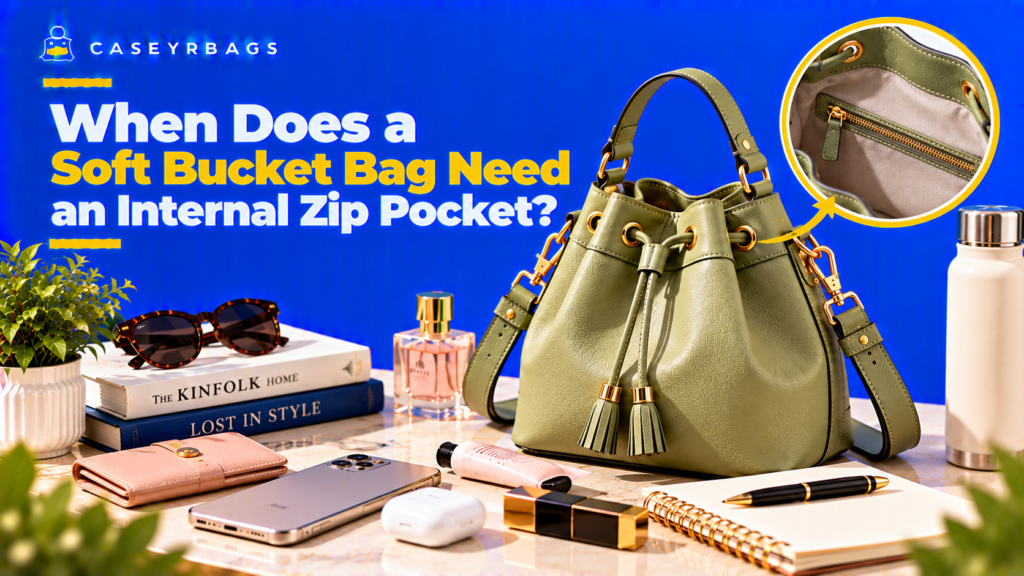
When Does a Soft Bucket Bag Need an Internal Zip Pocket?
A Soft Bucket Bag needs an internal zip pocket when small, important, or frequently accessed items repeatedly migrate through the flexible main chamber, become buried beneath larger contents, or require more reliable separation than the open compartment provides. The need becomes stronger in deeper bags where gravity, soft walls, and a variable drawstring opening increase search distance or reduce direct visibility.
The zip pocket is most useful when it has a clear role—such as containing cards, keys, earbuds, or similar compact essentials—without consuming excessive main-chamber space. If the main chamber or existing open pockets already keep those items predictable, retained, and directly accessible, an additional zipped compartment may add complexity without solving a real problem.
When Is an Internal Zip Pocket Functionally Necessary?
An internal zip pocket becomes functionally necessary only when the Soft Bucket Bag’s normal chamber or existing organization repeatedly fails a specific small-item task such as predictable location, separation, ordinary retention, or direct retrieval.
The strongest case appears when compact important items migrate through the flexible chamber, settle below larger contents, or become inconsistent to reach after normal movement. A controlled enclosed zone can shorten that retrieval path and keep an assigned item set separate from the main load.
The feature remains optional when a shallow chamber, stable routine, key tether, or well-positioned open pocket already performs those jobs reliably. Pocket presence alone is not proof of better organization. For the wider structure, see Bucket Bag.
Which Signs Indicate a Real Pocket Need?
A real pocket need appears when the same small item repeatedly becomes difficult to locate, separate, retain, or retrieve under the ordinary daily load. Repeated searching, small items settling beneath larger contents, important objects mixing with the general load, unpredictable post-movement location, or partial unloading for routine retrieval. Require a recurring normal-use pattern rather than one inconvenient packing event.
Each symptom to a named item, chamber condition, and retrieval consequence. The pocket becomes a candidate only when the existing main chamber or open organization fails a specific location, separation, retention, or access task. The result should be retested with the same daily load so location, retention, retrieval, intrusion, and access costs remain directly comparable.
Which Item Roles Most Strongly Justify Enclosure?
The strongest candidates are compact items with a clear recurring role, high retrieval importance, or a strong tendency to migrate within the chamber. Compact items that are important, frequently retrieved, easy to lose in the chamber, or better separated from larger contents. Explain that role and geometry matter more than item count alone.
A defined assigned set rather than “all small things.” A pocket with cards, keys, earbuds, or a few similar essentials can preserve predictable location; an undefined accumulation zone can recreate the same search problem. The result should be retested with the same daily load so location, retention, retrieval, intrusion, and access costs remain directly comparable.
When Is the Zip Pocket Unnecessary?
The zip pocket is unnecessary when the existing chamber or open organization already keeps assigned small items predictable and directly accessible. A simple load, shallow chamber, distinctive larger contents, effective open slip pocket, key tether, or established item placement may already provide predictable access and adequate ordinary retention. The judgment should be based on the actual loaded chamber and recurring use pattern rather than on pocket count or an empty interior photograph.
The decision rule: if no recurring problem exists or the feature does not materially improve the normal retrieval test, the pocket is optional. Do not treat internal zippers as a mandatory sign of quality or completeness. The result should be retested with the same daily load so location, retention, retrieval, intrusion, and access costs remain directly comparable.
Why Do Small Items Migrate in a Soft Bucket Bag?
Small-item migration begins with the Soft Bucket Bag’s flexible chamber rather than with the absence of a zipper. Wall movement, gravity, larger contents, lining folds, and ordinary carry can shift compact objects away from their original positions.
How Does Soft Construction Enable Movement?
Soft construction allows the walls and lining to conform to contents, so objects can shift as the bag changes orientation. Flexible walls and lining conform to the load rather than fixing every object in one rigid position. As the bag changes orientation, internal surfaces and contents can shift relative to one another.
The boundary: softness creates movement potential but does not automatically create disorganization. Item geometry, load density, pocketing, placement, chamber proportions, and routine determine whether migration becomes a real problem. The result should be retested with the same daily load so location, retention, retrieval, intrusion, and access costs remain directly comparable.
How Does Gravity Move Small Items Toward Low Points?
Gravity can move compact loose items toward the base, lining folds, and gaps beneath broader contents even when those items occupy little volume. Dense or compact loose objects can settle toward the base, slide into lining folds, or occupy gaps beneath and between broader contents. Their small volume does not prevent a long retrieval path.
The mechanism to evidence: observe where the same item sits after the bag is loaded and moved normally. Do not infer migration only from the empty silhouette or from chamber depth without contents. The result should be retested with the same daily load so location, retention, retrieval, intrusion, and access costs remain directly comparable.
How Do Larger Contents and Carrying Movement Redirect Small Items?
Larger contents create temporary barriers and channels that can redirect smaller objects as the bag moves during ordinary carry. A bottle, wallet, notebook, pouch, or other broad object can create channels, barriers, and low spaces that move small items away from their original location during ordinary carry. The judgment should be based on the actual loaded chamber and recurring use pattern rather than on pocket count or an empty interior photograph.
Name the failure boundary: migration becomes functionally relevant when the item repeatedly disappears from direct reach, contacts unsuitable objects, or requires movement of the main load before retrieval. This is the problem the proposed pocket must solve. The result should be retested with the same daily load so location, retention, retrieval, intrusion, and access costs remain directly comparable.
How Do Chamber Depth and Drawstring Access Affect Retrieval?
Chamber depth and drawstring access change the retrieval path without automatically creating disorganization. The question is whether the same important item repeatedly becomes harder to see, reach, or retrieve under the normal load.
How Does Chamber Depth Change the Search Path?
Greater chamber depth can increase the distance between the opening and a small item after it settles beneath or behind routine contents. A deeper vertical chamber lets small items settle below wallets, bottles, notebooks, and other daily contents. The user may need to reach farther, search by touch, move larger objects, or partially unload the bag.
The assumption that depth is automatically bad. A deep chamber remains practical when item zones are predictable; the pocket becomes more useful only when depth repeatedly separates high-frequency items from direct access. The result should be retested with the same daily load so location, retention, retrieval, intrusion, and access costs remain directly comparable.
How Does the Drawstring Opening Affect Visibility and Hand Entry?
The drawstring changes sight lines and hand angle by moving the opening between broad, partial, and strongly gathered states. Broad-open, partially open, and strongly gathered states. A reduced opening can limit sight lines and hand angle, especially when the target item sits low or behind upper contents. The judgment should be based on the actual loaded chamber and recurring use pattern rather than on pocket count or an empty interior photograph.
The distinction: the drawstring controls the main opening but does not organize the chamber. A known pocket location can reduce dependence on full visibility, but only when the zipper itself remains reachable under the normal load. Keep this supporting question connected to the complete Bucket Bag: Drawstring Access and Base-Stabilized Capacity structure. For the wider structural context, see Bucket Bag.
Which Retrieval Threshold Makes the Pocket More Useful?
The pocket becomes more useful when the same important item repeatedly needs blind searching, movement of larger contents, or partial unloading. The practical threshold through repeated behavior: the same important item requires blind searching, movement of larger contents, partial unloading, or an inconsistent retrieval path during normal use. The judgment should be based on the actual loaded chamber and recurring use pattern rather than on pocket count or an empty interior photograph.
Avoid a universal depth measurement. Compare retrieval of the same item from the existing system and from the proposed zip-pocket location; the pocket is justified only when the improvement is repeatable and its costs remain acceptable. The result should be retested with the same daily load so location, retention, retrieval, intrusion, and access costs remain directly comparable.
Which Items Benefit Most From Zipped Internal Storage?
Items benefit from zipped internal storage when their role makes predictable location, separation, or enclosure more valuable than immediate open access. Geometry and retrieval frequency matter more than assigning every small item to one pocket.
When Do Keys Justify a Zip Pocket?
Keys justify enclosure when their irregular geometry and migration repeatedly interfere with predictable location or separation from other contents. Keys are compact, irregular, hard-edged objects that can migrate, contact other contents, and become difficult to locate. Their strongest need is predictable location and separation rather than additional volume. The judgment should be based on the actual loaded chamber and recurring use pattern rather than on pocket count or an empty interior photograph.
The zip pocket with an existing key tether or well-retaining open pocket. If another dedicated feature provides direct, repeatable control without chamber loss, a zipped zone may duplicate the role. The result should be retested with the same daily load so location, retention, retrieval, intrusion, and access costs remain directly comparable.
When Do Cards or Small Documents Need Enclosure?
Cards and small documents benefit from a fixed enclosed plane when they repeatedly slide between contents or disappear against the lining. Flat items can slide between contents, enter lining folds, or become visually lost against the chamber wall. A proportionate zip pocket can create a fixed plane and reduce accidental displacement.
The security boundary: enclosure improves ordinary location and retention but is not theft-proof, waterproof, crush-proof, or universal document protection. Avoid overfilling the pocket with broad or thick items that strain the zipper or lining. The result should be retested with the same daily load so location, retention, retrieval, intrusion, and access costs remain directly comparable.
When Do Earbuds or Small Electronics Benefit?
Compact electronics benefit when their cases repeatedly settle beneath larger items and a known pocket position materially shortens retrieval. Compact electronic cases can settle under larger objects and become inconsistent to retrieve. A known enclosed zone can reduce loose movement and separate the item from the general chamber. The judgment should be based on the actual loaded chamber and recurring use pattern rather than on pocket count or an empty interior photograph.
Zipped enclosure does not prove impact or water protection. An appropriately sized open pocket may be sufficient when it retains the case predictably, while bulky electronics, bottles, or large wallets usually belong outside the small-item pocket. The result should be retested with the same daily load so location, retention, retrieval, intrusion, and access costs remain directly comparable.
How Do Open Slip Pockets Compare With an Internal Zip Pocket?
Open slip pockets should be tested before adding another enclosed zone because they can provide fast access, raised location, and separation with fewer steps. A zipper is justified only when the open alternative fails the assigned task under ordinary movement.
What Do Open Slip Pockets Do Well?
Open slip pockets work well when fast access, raised location, and a secure fit already keep the assigned item predictable during movement. Open pockets can provide fast access, visible separation, and a predictable raised location with fewer opening steps. They are often effective for items that fit securely and are retrieved frequently.
The condition boundary: an open pocket works when its height, opening, depth, and fit keep the assigned item from escaping or becoming buried. “Open” does not automatically mean inadequate. The result should be retested with the same daily load so location, retention, retrieval, intrusion, and access costs remain directly comparable.
What Does a Zip Pocket Add?
A zip pocket adds enclosure by creating a more complete boundary around the assigned small-item zone. The zipper creates a more complete boundary around the pocket opening, helping prevent assigned small items from migrating into the main chamber during normal movement. The judgment should be based on the actual loaded chamber and recurring use pattern rather than on pocket count or an empty interior photograph.
Pair the benefit with cost: enclosure adds a deliberate opening step, hardware dependence, pocket fabric, and loaded intrusion. The benefit must matter for the exact item rather than simply increasing feature count. The result should be retested with the same daily load so location, retention, retrieval, intrusion, and access costs remain directly comparable.
Which Pocket Type Should Be Preferred?
The least complex storage type that reliably solves the recurring problem should be preferred. The least complex storage type that reliably solves the problem. Prefer open access when speed and predictable fit are enough; prefer zipped enclosure when ordinary movement or item geometry defeats the open pocket. The judgment should be based on the actual loaded chamber and recurring use pattern rather than on pocket count or an empty interior photograph.
Test both with the same item, load, and movement sequence. Judge location, retention, access steps, obstruction, and chamber impact separately before choosing the better fit. The result should be retested with the same daily load so location, retention, retrieval, intrusion, and access costs remain directly comparable.
| Function | Main Chamber | Open Slip Pocket | Internal Zip Pocket |
|---|---|---|---|
| Fast access | Variable | Strong | Slower by one opening step |
| Separation | Low | Moderate | Strong |
| Enclosure | None | Open boundary | Closed boundary |
| Small-item retention | Depends on load | Depends on fit | Improved when zipper operates normally |
| Access steps | Few | Few | More |
| Chamber impact | Baseline | Low–moderate | Moderate when loaded |
How Do Pocket Position and Lining Support Affect Usefulness?
Pocket position and lining support determine whether the zipper remains genuinely accessible after the bag is loaded. A high or mid-wall pocket can shorten reach, while poor placement or loose lining can recreate the same obstruction the feature was meant to solve.
Why Is an Upper- or Mid-Wall Position Often Useful?
An upper- or mid-wall pocket can shorten the reach path and keep small items above the deepest settlement zone. A raised position can shorten the reach path, keep small items above the deepest settlement zone, and preserve visibility when the drawstring opening is only partly open. The judgment should be based on the actual loaded chamber and recurring use pattern rather than on pocket count or an empty interior photograph.
The benefit: the pocket must remain clear of the gather zone, opening folds, and tall main contents. A high pocket can still become blocked or distort the upper wall when overloaded. The result should be retested with the same daily load so location, retention, retrieval, intrusion, and access costs remain directly comparable.
What Happens When the Pocket Sits Too Low?
A low pocket can become buried behind routine contents and reproduce the same long reach and load disturbance as the main chamber. A low pocket can become buried behind bottles, notebooks, wallets, or pouches, forcing the same long reach and load movement that the pocket was intended to prevent. The judgment should be based on the actual loaded chamber and recurring use pattern rather than on pocket count or an empty interior photograph.
The comparison rule: a well-placed open pocket can outperform a poorly placed zip pocket. Evaluate access with the normal chamber loaded, not only when the bag is empty. The result should be retested with the same daily load so location, retention, retrieval, intrusion, and access costs remain directly comparable.
How Does Lining Support Affect Pocket and Zipper Behavior?
Lining support helps keep pocket height, zipper orientation, and access geometry predictable after the chamber is loaded. Stable lining attachment can keep the pocket height predictable and the zipper track easier to present to the hand. Very loose lining can collapse inward, twist the zipper, or sag under the stored items.
Coordinated behavior: pocket, lining, zipper, and supporting wall should move as one controlled internal structure. If the user must hold the lining with one hand to operate the zipper, accessibility has not fully passed. The result should be retested with the same daily load so location, retention, retrieval, intrusion, and access costs remain directly comparable.
How Should Pocket Opening, Depth, and Width Match the Item Set?
Pocket opening width, depth, and body width should match a defined item set rather than maximize theoretical capacity. Oversizing can turn a controlled zone into a second loose chamber and increase inward projection.
How Wide Should the Zipper Opening Be?
The zipper opening should admit the assigned item and the user’s fingers without awkward angling or major load disturbance. The practical opening must admit the assigned item and the user’s fingers without awkward angling, excessive force, or removal of major contents. The zipper length alone may overstate usable access when lining or load blocks its ends.
Maximum width is not automatically better: a very wide opening can consume construction space, load more of the flexible wall, and encourage the pocket to take on an undefined role. Match the usable opening to the intended small-item geometry. The result should be retested with the same daily load so location, retention, retrieval, intrusion, and access costs remain directly comparable.
How Deep Should the Pocket Be?
Pocket depth should be enough for the assigned compact items without creating a second blind search zone. Shallow-to-moderate depth can keep compact contents visible or reachable, limit stacking, and reduce the distance between the zipper and pocket base. The assigned item should settle without disappearing below other pocket contents. The judgment should be based on the actual loaded chamber and recurring use pattern rather than on pocket count or an empty interior photograph.
Excessive depth when small items collect at the bottom, layer over one another, or require the same blind search that occurs in the main chamber. A zip pocket should reduce search depth rather than recreate it. The result should be retested with the same daily load so location, retention, retrieval, intrusion, and access costs remain directly comparable.
How Wide Should the Pocket Body Be?
Pocket width should fit the assigned set without encouraging unrelated accumulation or excessive wall loading. Sufficient width can hold a defined set of flat or compact essentials without forcing them against the zipper or stacking them unnecessarily. Use item geometry, not a generic capacity target. The judgment should be based on the actual loaded chamber and recurring use pattern rather than on pocket count or an empty interior photograph.
An oversized pocket can behave like a second loose chamber, accumulate unrelated items, and project farther inward when filled. The useful width is enough for the assigned role without inviting uncontrolled accumulation. The result should be retested with the same daily load so location, retention, retrieval, intrusion, and access costs remain directly comparable.
| Pocket Geometry | Assigned Items | Visibility | Stacking | Zipper Access | Accumulation Risk | Intrusion |
|---|---|---|---|---|---|---|
| Narrow / shallow | Very small defined set | High | Low | Easy if opening fits | Low | Low |
| Proportionate | Defined compact set | Good | Controlled | Normal | Moderate | Controlled |
| Wide / deep | Broad undefined set | Lower | Higher | Can be obstructed | High | Higher |
How Does the Zipper Change Retention and Access Control?
The zipper changes ordinary retention by creating a more complete boundary around a smaller internal zone. Its role should remain separate from the drawstring and from unsupported claims about theft, impact, or water protection.
What Does Closing the Internal Zipper Do?
Closing the zipper creates a more complete storage boundary around the pocket opening and helps keep assigned small items in the selected zone. Closing the zipper creates a more complete boundary around the pocket opening, helping keep assigned small items inside the defined zone during normal chamber movement. The judgment should be based on the actual loaded chamber and recurring use pattern rather than on pocket count or an empty interior photograph.
The condition: the zipper must close normally without fabric catching, excessive tension, distorted track alignment, or contents entering the slider path. Closure presence alone does not prove effective operation. The result should be retested with the same daily load so location, retention, retrieval, intrusion, and access costs remain directly comparable.
How Do the Drawstring and Internal Zipper Divide Their Roles?
The drawstring controls the main chamber opening, while the internal zipper controls a smaller selected storage zone. The drawstring controls access to the main chamber, while the internal zipper encloses a smaller selected storage zone. The two layers can reduce casual exposure and migration through different mechanisms. The judgment should be based on the actual loaded chamber and recurring use pattern rather than on pocket count or an empty interior photograph.
The functions separate during evaluation. A well-retained drawstring does not make a small-item pocket unnecessary, and a closed internal zipper does not correct a broad or unstable main opening. The result should be retested with the same daily load so location, retention, retrieval, intrusion, and access costs remain directly comparable.
Does the Zip Pocket Make the Bag Secure?
The zip pocket can improve ordinary enclosure and retention, but it does not create theft-proof, tamper-proof, waterproof, or impact-protective storage. Answer narrowly: the pocket can improve ordinary item retention, separation, and deliberate access for its contents. It may add another opening step after the main chamber is reached. The judgment should be based on the actual loaded chamber and recurring use pattern rather than on pocket count or an empty interior photograph.
The evidence boundary: ordinary enclosure is not theft-proof, tamper-proof, waterproof, impact-protective, or equivalent to a security lock. Use “retained” and “enclosed” rather than unsupported protection claims. The result should be retested with the same daily load so location, retention, retrieval, intrusion, and access costs remain directly comparable.
How Do Pocket Loading and Pocket Count Affect the Main Chamber?
Pocket fabric and stored contents consume flexible chamber space. As the pocket fills, it can project inward, change item placement, load the wall, or create visible exterior bulging, so organization benefit must be weighed against capacity cost.
How Can a Loaded Pocket Change the Exterior Shape?
A filled wall pocket can push against a flexible outer panel and create localized bulging or distortion. A flexible outer wall can conform to keys, cases, wallets, or stacked pocket contents, creating a localized bulge or uneven panel shape. The effect scales with item thickness, pocket position, and wall softness.
The limit to normal appearance and function rather than aesthetics alone. A bulge becomes a mismatch when it distorts the wall, changes drawstring behavior, exposes item outlines, or indicates that the pocket role exceeds its supporting structure. The result should be retested with the same daily load so location, retention, retrieval, intrusion, and access costs remain directly comparable.
How Much Main-Chamber Space Can the Pocket Consume?
Pocket fabric and stored contents project inward from the wall and reduce flexible open volume available to the main chamber. Pocket fabric, zipper construction, and stored items project inward from the wall and reduce flexible open volume. Empty-pocket intrusion may be small, while a loaded pocket can narrow item placement or create a rigid internal obstacle.
A trade-off test: improved location and retrieval should justify the lost chamber flexibility. Compare the same daily load with the pocket empty and moderately filled before judging the cost. The result should be retested with the same daily load so location, retention, retrieval, intrusion, and access costs remain directly comparable.
When Do Overfilling or Too Many Pockets Reduce Function?
Overfilled or excessive pockets reduce function when they strain hardware, fragment the chamber, increase wall distortion, or make storage roles harder to remember. Overfilling through a strained zipper, tightly stacked contents, difficult hand entry, lining pull, wall bulging, or a pocket that cannot close normally. Several loaded wall pockets can compound inward projection and fragment the chamber.
Add the cognitive trade-off: too many overlapping zones can make storage locations harder to remember and duplicate functions. The target is a small number of purposeful zones, not maximum organization density. The result should be retested with the same daily load so location, retention, retrieval, intrusion, and access costs remain directly comparable.
| Pocket State | Inward Projection | Main-Chamber Effect | Exterior Effect | Interpretation |
|---|---|---|---|---|
| Empty pocket | Minimal | Little change | Usually none | Low cost |
| Moderately filled | Controlled | Some local narrowing | Possible light shaping | Acceptable if retrieval improves |
| Overfilled | High | Blocks or redirects contents | Bulge / distortion risk | Mismatch |
| Several filled wall pockets | Compounded | Fragmented flexible space | Multiple pressure points | Complexity / intrusion risk |
When Is No Built-In Zip Pocket—or a Removable Pouch—Better?
A built-in zip pocket is not always the best answer. Simple loads, effective open pockets, and removable pouches can solve the same problem with different access, flexibility, and transferability trade-offs.
When Is the Main Chamber Alone Sufficient?
The main chamber alone is sufficient when the ordinary load contains few distinctive items that remain predictable without a dedicated enclosed zone. A few relatively large, distinctive, directly accessible items may remain predictable without a dedicated small-item zone. Shallow chambers and stable packing routines can also shorten retrieval. The judgment should be based on the actual loaded chamber and recurring use pattern rather than on pocket count or an empty interior photograph.
Omission should follow observed performance, not minimalism as a style preference. If the normal load produces no recurring location, separation, retention, or retrieval failure, the pocket is optional. The result should be retested with the same daily load so location, retention, retrieval, intrusion, and access costs remain directly comparable.
When Are Existing Open Pockets Enough?
Existing open pockets are enough when their position and fit keep high-frequency items raised, separated, retained, and directly accessible. Well-positioned open pockets can keep high-frequency items visible, raised, separated, and quickly accessible when their fit prevents escape during ordinary movement. The judgment should be based on the actual loaded chamber and recurring use pattern rather than on pocket count or an empty interior photograph.
Duplicate storage roles. Adding a zipped zone is unnecessary when it stores the same item set with slower access and no meaningful improvement in retention, predictability, or chamber control. The result should be retested with the same daily load so location, retention, retrieval, intrusion, and access costs remain directly comparable.
When Is a Removable Pouch the Better Fit?
A removable pouch can be a better fit when several related items need transferable organization across different bags rather than a permanent fixed pocket role. A removable pouch can group several related items, move between bags, and create transferable organization without permanently loading one interior wall. It may suit kits rather than one or two fixed essentials.
The cost: the pouch becomes another object in the chamber, adds bulk and an extra retrieval step, and can migrate unless positioned deliberately. Choose built-in storage for a stable fixed role and a pouch for a transferable grouped role. The result should be retested with the same daily load so location, retention, retrieval, intrusion, and access costs remain directly comparable.
How Can Internal Zip-Pocket Need and Mismatch Be Diagnosed?
Pocket need should be diagnosed from the recurring storage problem rather than from feature preference. Migration, poor placement, wrong dimensions, lining collapse, overfill, duplicated roles, and general packing problems require different corrections.
What Does “Small Items Always Disappear” Suggest?
Repeated disappearance suggests a need to separate migration, chamber depth, load obstruction, and missing small-item zones before prescribing enclosure. Route the symptom through chamber depth, item geometry, low points, movement, upper-load obstruction, and the absence or failure of existing small-item zones. Confirm that the same item repeatedly becomes unpredictable. The judgment should be based on the actual loaded chamber and recurring use pattern rather than on pocket count or an empty interior photograph.
Test an existing open pocket or a temporary raised position before declaring a built-in zip pocket necessary. If location improves without enclosure, placement rather than retention may be the primary problem. The result should be retested with the same daily load so location, retention, retrieval, intrusion, and access costs remain directly comparable.
What Does “The Zip Pocket Exists but Is Rarely Used” Suggest?
Rare use can indicate poor placement, awkward dimensions, lining collapse, duplicated function, or an item set that does not actually require enclosure. Check whether the pocket sits too low, has a narrow or awkward zipper opening, is excessively deep, collapses with the lining, duplicates another pocket, or serves items that do not require enclosure.
Distinguish unnecessary function from defective implementation. A well-made pocket can still be irrelevant to the actual item set; a needed pocket can remain unused because its placement or dimensions fail. The result should be retested with the same daily load so location, retention, retrieval, intrusion, and access costs remain directly comparable.
What Does “Everything Ends Up in the Zip Pocket” Suggest?
When everything ends up in the zip pocket, the role may be too broad and the pocket may be functioning as a second unstructured chamber. Check for an overly broad pocket role, too many loose small items, insufficient organization elsewhere, or a large pocket that encourages accumulation. The zone may have become a second unstructured chamber.
Narrow the assigned item set, remove bulky or low-frequency objects, and retest retrieval. If the pocket still requires searching or strains the zipper, classify Pocket-Dimension or Pocket-Overfill Mismatch rather than calling the organization successful. The result should be retested with the same daily load so location, retention, retrieval, intrusion, and access costs remain directly comparable.
How Should Internal Zip-Pocket Need Be Evaluated?
The final decision should compare the same bag and daily load under fixed conditions. A useful pocket must improve predictable location, separation, ordinary retention, and retrieval enough to justify its access step, spatial cost, and complexity.
What Should Be Inspected Before Loading?
Before loading, inspect the chamber, lining, existing pockets, zip-pocket height, attachment, zipper track, opening, depth, width, and empty intrusion. Inspect chamber depth, lining behavior, existing open pockets, zip-pocket height, attachment, zipper track, usable opening, pocket depth, pocket width, empty intrusion, and visible wall support. Record binding or collapse before contents influence the result.
Fix the controls: same bag, same daily contents, same item placement, same high-frequency and retention-sensitive items, same movement sequence, and the same retrieval task. Do not compare unrelated loads or different items. The result should be retested with the same daily load so location, retention, retrieval, intrusion, and access costs remain directly comparable.
What Should Be Observed After Loading and Movement?
After loading and movement, observe item migration, pocket access, zipper operation, lining pull, inward projection, exterior shape, and retrieval disturbance. Observe item location, migration, open-pocket retention, zip-pocket accessibility, zipper movement, enclosure, lining pull, inward projection, exterior bulging, and whether major contents block the pocket. The judgment should be based on the actual loaded chamber and recurring use pattern rather than on pocket count or an empty interior photograph.
Retrieve the same assigned item after ordinary movement from each tested storage state. Compare search steps, load disturbance, access effort, predictable location, chamber impact, and successful reclosure. The result should be retested with the same daily load so location, retention, retrieval, intrusion, and access costs remain directly comparable.
Which 20-Step Sequence Determines the Final Decision?
The final decision should come from one fixed daily-load comparison that keeps the same bag, contents, movement sequence, assigned item, and retrieval task. The test exactly: 1) empty the bag; 2) list the normal daily contents; 3) separate large items from small loose items; 4) identify high-frequency items; 5) identify retention-sensitive items; 6) inspect chamber depth and existing pockets; 7) inspect zip-pocket position and dimensions where present; 8) load the large chamber contents; 9) place selected small items in the existing open pocket or normal main-chamber position; 10) move the bag in one ordinary repeatable sequence; 11) retrieve the assigned item and record search or obstruction; 12) move the retention-sensitive item into the zip pocket or equivalent test zone; 13) close the zipper normally; 14) repeat the same movement; 15) reopen the drawstring; 16) reach and open the zip pocket without removing major contents; 17) retrieve and replace the assigned item; 18) reclose the zipper and inspect lining, intrusion, and exterior shape; 19) compare retention, retrieval, access steps, and chamber cost; 20) assign the outcome from the complete repeatable result.
Select Zip Pocket Functionally Justified when enclosure repeatedly improves location, separation, retention, and retrieval enough to justify its access and space costs; select Optional or Existing Open Pocket Sufficient when comparable performance already exists; select Removable Pouch Better Fit for transferable grouped items; otherwise use the named placement, dimension, lining, overfill, complexity, or diagnosis mismatch. Reject false passes based on pocket presence, empty access, feature count, or theft-proof language.
- empty the bag
- list the normal daily contents
- separate large items from small loose items
- identify high-frequency items
- identify retention-sensitive items
- inspect chamber depth and existing pockets
- inspect zip-pocket position and dimensions where present
- load the large chamber contents
- place selected small items in the existing open pocket or normal main-chamber position
- move the bag in one ordinary repeatable sequence
- retrieve the assigned item and record search or obstruction
- move the retention-sensitive item into the zip pocket or equivalent test zone
- close the zipper normally
- repeat the same movement
- reopen the drawstring
- reach and open the zip pocket without removing major contents
- retrieve and replace the assigned item
- reclose the zipper and inspect lining, intrusion, and exterior shape
- compare retention, retrieval, access steps, and chamber cost
- assign the outcome from the complete repeatable result
- The H1 asks the exact Soft Bucket Bag internal zip-pocket-need question.
- The H1 introduction contains exactly two paragraphs and one disclaimer.
- Pocket need is tied to a recurring storage problem.
- The internal zip pocket remains optional rather than universally required.
- Soft-wall movement is connected to possible item migration.
- Softness is not equated with disorganization.
- Gravity and load geometry are connected to low-point settlement.
- Chamber depth is connected to retrieval distance conditionally.
- Drawstring opening control is separated from internal organization.
- High-frequency and retention-sensitive item roles are distinguished.
- Keys are evaluated through location and separation needs.
- Cards and small documents are evaluated without protection overclaims.
- Earbuds and small electronics are evaluated without impact or water claims.
- Bulky items are kept outside the defined small-item pocket role.
- Open slip pockets are considered before added enclosure.
- Fast access is separated from zipped retention.
- Pocket height and loaded reach path are evaluated.
- Low buried pockets are identified as possible access mismatches.
- Lining support and zipper presentation are evaluated.
- Zipper opening width matches the assigned item geometry.
- Excessive pocket depth is prevented from recreating search friction.
- Pocket width remains proportionate to its assigned role.
- Zipper closure is treated as ordinary enclosure.
- Zipped storage is not described as theft-proof or protective.
- Pocket loading is checked for inward chamber projection.
- Exterior wall bulging and distortion are evaluated.
- Pocket overfilling is identifiable.
- Multiple pockets are not automatically treated as better organization.
- No-need conditions are explicit.
- Removable pouch alternatives are compared on a limited functional basis.
- Diagnostic corrections change one variable at a time.
- The final protocol retains fixed controls and the normal daily load.
- Outcomes are explicit and mechanically justified.
- Exactly nine proof assets are specified and only four are SVGs.
- The approved upward link appears once with its exact anchor and destination; no unapproved reader-facing link is inserted.
- The conclusion answers when the pocket is justified and when it is unnecessary.
Conclusion
A Soft Bucket Bag needs an internal zip pocket when its flexible, often vertical chamber repeatedly lets important small items migrate, become buried, mix with larger contents, or require more controlled ordinary retention than the main chamber and existing open pockets provide. The need becomes stronger when the item is frequently retrieved and the pocket materially shortens the loaded retrieval path.
The pocket should occupy an accessible upper or middle location, match the geometry of a defined small-item set, operate normally with its lining and zipper, and avoid excessive inward projection or exterior distortion. If comparable predictability already exists—or if a removable pouch better serves transferable grouped items—the built-in zip pocket is optional rather than necessary.
FAQs
What Should Be Stored in a Soft Bucket Bag Internal Zip Pocket?
The strongest candidates are compact items that benefit from predictable location, separation, or enclosure, such as keys, cards, earbuds, or similarly small essentials. Assign the pocket a narrow, repeatable role.
Bulky bottles, large wallets, thick pouches, and unrelated accumulated objects can strain the zipper, distort the wall, and turn the pocket into a second disorganized chamber.
Does Every Soft Bucket Bag Need an Internal Zip Pocket?
A simple load, shallow chamber, effective open pocket, key tether, or consistent placement routine may already keep small essentials predictable, retained, and directly retrievable.
The feature is justified only when it solves a repeated normal-use problem and its loaded retrieval benefit outweighs its access, space, lining, and complexity costs.
Does an Internal Zip Pocket Make a Soft Bucket Bag More Secure?
It can improve ordinary item retention, separation, and access control by enclosing selected contents within a smaller internal zone and adding another opening step.
The pocket is not theft-proof, tamper-proof, waterproof, impact-protective, or equivalent to a security lock. Its primary role is controlled internal organization and ordinary retention.