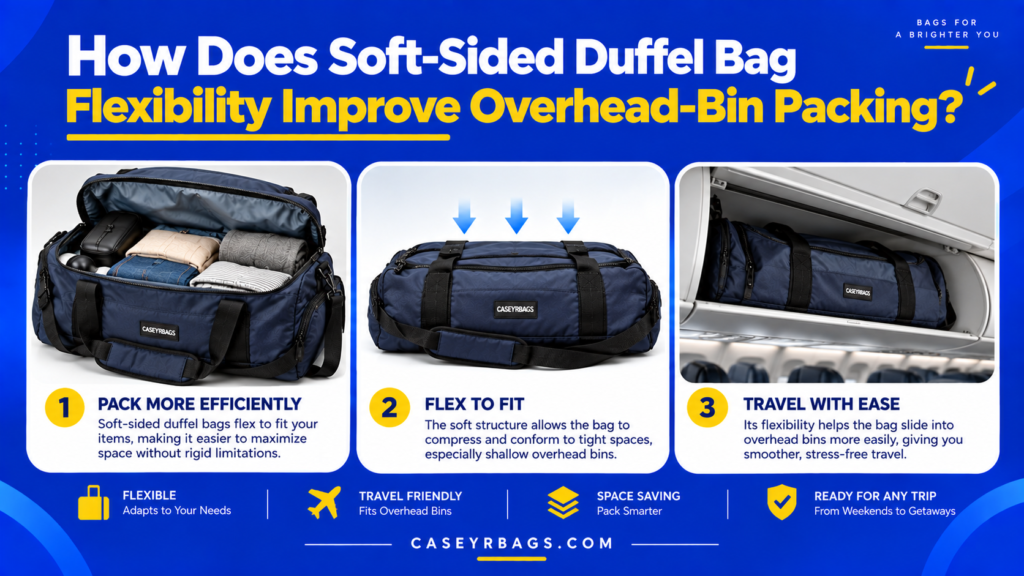
How Does Soft-Sided Duffel Bag Flexibility Improve Overhead-Bin Packing?
Soft-Sided Duffel Bag flexibility can improve overhead-bin packing because flexible body panels can conform around compressible contents and adapt the final packed profile more readily than a fully rigid shell. When the load leaves usable empty space, local side or top areas can collapse inward instead of preserving the full empty-bag shape.
This advantage depends on the packed system rather than softness alone. Rigid objects, maximum fill, closure strain, fixed structural zones, or dimensions beyond applicable baggage limits can remove much of the useful adaptability. Flexible exterior ≠ guaranteed overhead-bin fit, compressible bag ≠ compressible contents, and physical fit ≠ airline-compliance guarantee.
What Does Soft-Sided Flexibility Mean for Overhead-Bin Packing?
A Soft-Sided Duffel relies on flexible fabric panels rather than a completely rigid shell to define its exterior geometry. When the load leaves unused space, those panels can collapse inward or conform around the contents instead of maintaining the full empty-bag profile.
That adaptability can help during overhead-bin placement because small differences in height, width, or side profile may be absorbed through controlled panel movement. The benefit depends on whether the packed contents themselves can compress or reposition slightly without losing load control.
Flexibility therefore creates shape tolerance, not limitless fit. Within the broader Duffel Bag relationship, overhead-bin adaptability is one part of the larger connection between flexible packing, controlled shape, access, and travel mobility.
Which Structural Features Create Soft-Sided Duffel Flexibility?
Fabric side panels, a flexible top panel, soft end panels, limited internal framing, a flexible base where applicable, compression features, and pliable compartment walls all contribute to shape adaptability. Each feature determines how much of the packed exterior can respond to unused or compressible internal volume.
Structural feature → shape adaptability → overhead-bin consequence. Flexible panels can reduce a local profile, while reinforced zones preserve more fixed shape. Compression can refine unused volume, but it cannot shrink rigid contents or remove dimensions created by a tightly packed load.
How Does Soft-Sided Structure Differ From Rigid-Shell Geometry?
A soft-sided Duffel has final dimensions partly influenced by the contents, while a rigid shell keeps its exterior geometry comparatively fixed regardless of how lightly it is packed. The soft format therefore offers more local shape tolerance where the load still permits movement.
Neither format is universally better. Soft construction favors conformity but provides less fixed geometry, while rigid structure offers predictable shape with little local compression. Overhead-bin usefulness depends on the real packed profile rather than the material category alone.
Why Does Flexibility Not Guarantee Overhead-Bin Fit?
Flexibility cannot override packed dimensions, rigid contents, full volume, closure tension, structural base zones, bin geometry, or applicable baggage requirements. A flexible panel helps only where the load behind it retains enough freedom to change shape.
Flexible construction increases adaptability; it does not remove dimensional limits. A soft Duffel that is overfilled or built around hard contents can behave much more like a fixed-volume object than its empty appearance suggests.
How Do Flexible Panels Adapt to Overhead-Bin Space?
Flexible exterior panels can change local shape when genuine unused or compressible internal volume remains available.
How Can Side Panels Compress During Bin Placement?
Side panels can move inward where the chamber contains unused space or compressible material behind that area. This can reduce a local side profile and create a small amount of placement tolerance around compartment contours or neighboring soft luggage.
Unused internal space → side-panel compression → smaller local profile. The movement should come from available flexibility rather than force. Controlled conformity ≠ forced compression, and a taut panel should not be treated as meaningfully compressible simply because its material remains soft.
How Can Top-Panel Flexibility Reduce Excess Height?
Where the upper chamber is not completely filled, a flexible top can settle around the packed load and reduce unnecessary exterior height. The benefit is strongest when soft or compressible contents leave vertical room that the panel can occupy.
Unfilled upper volume → controlled top collapse → reduced packed profile. Rigid objects near the top can establish a minimum height the fabric cannot meaningfully reduce, even when the surrounding top panel remains flexible.
When Do Flexible Panels Stop Providing Useful Dimensional Adjustment?
Useful adjustment decreases when the Duffel is tightly packed, hard objects define local dimensions, reinforced panels resist movement, a rigid base fixes geometry, closures are stretched, or expansion sections are fully occupied.
Panel flexibility exists only where the packed load allows movement. Once the contents make the exterior taut, extra pressure produces distortion or concentrated force rather than useful dimensional reduction.
| Panel Condition | Packed Behavior | Overhead-Bin Effect |
|---|---|---|
| Flexible + underfilled | Can collapse inward | Greater shape adaptability |
| Flexible + fully packed | Limited compression | Less dimensional flexibility |
| Flexible + rigid contents | Exterior follows hard contents | Low local compression |
| Reinforced panel | Retains more shape | More predictable but less conformable |
How Do Compressible & Rigid Contents Change Duffel Flexibility?
The contents determine how much of the Duffel’s theoretical flexibility remains after packing because the fabric can move only where the load can also change shape or position.
Which Contents Allow the Duffel to Compress Most Readily?
Soft, foldable, compressible, and reshapeable contents allow the Duffel to adjust most readily because they can change local geometry as the exterior panel moves. The fabric and the contents then work together to produce a smaller or differently shaped local profile.
Compressible load → panels can move → greater final-shape adaptability. Content compressibility, not bag softness alone, creates usable adjustment. A very soft exterior surrounding rigid contents may provide little practical reduction in the dimensions that matter.
How Do Rigid Contents Limit Shape Conformity?
Hard or dimensionally fixed objects can establish minimum local height, width, length, or corner geometry. The exterior fabric can move around those objects, but it cannot pass through them or reduce their physical dimensions.
Soft bag around rigid contents behaves partly like a rigid load. One hard rectangular object can therefore determine the profile of an entire area even while nearby soft zones remain compressible.
Why Does Mixed Packing Require More Deliberate Placement?
Mixed packing creates a rigid core surrounded by areas that may remain compressible. Hard objects determine where the Duffel cannot shrink, while softer contents can be arranged around those fixed zones to preserve some useful panel movement.
Rigid item + compressible surroundings → flexible zones remain only around the rigid core. Placement matters because a hard object positioned near the largest bulge can eliminate the local compression that would otherwise improve fit adaptability.
| Content Type | Shape Adaptability | Effect on Duffel Compression |
|---|---|---|
| Soft clothing-like contents | High | Allows greater conformity |
| Semi-structured items | Moderate | Partial adaptability |
| Hard rectangular objects | Low | Establish fixed local dimensions |
| Mixed contents | Variable | Flexible only around rigid zones |
How Does Packing Volume Affect Overhead-Bin Flexibility?
Packing volume changes how much structural freedom remains: underfilled zones preserve panel movement, while maximum fill makes the exterior increasingly taut and dimensionally fixed.
Why Does Underfilling Preserve More Flexibility?
Unused chamber volume leaves room for side panels to move inward, top panels to settle, and the load to adjust locally. This preserves part of the soft-sided Duffel’s shape advantage without requiring an arbitrary fill percentage.
Unused chamber volume → available panel movement → greater shape adjustment. Underfilling is not automatically ideal because too much free space can increase internal movement, but meaningful compression requires some genuine empty or compressible volume.
What Happens When the Duffel Is Packed Completely Full?
A completely full Duffel can develop taut side panels, greater closure tension, fixed outward bulges, and very limited ability to reshape. The material remains soft, but the contents occupy the chamber so fully that panel movement becomes minimal.
A full soft bag can behave much less flexibly than an underfilled soft bag. Empty-bag softness is therefore a weak predictor of overhead-bin adaptability once the load itself controls the exterior geometry.
Why Can Overpacking Eliminate the Overhead-Bin Advantage?
Overpacking can make the Duffel larger, harder to compress, more irregular, and more difficult to reposition. Excessive bulges may consume extra compartment space while reducing the flexibility that soft construction was meant to provide.
Flexible capacity should not be used until flexibility disappears. The useful advantage comes from retaining controlled shape tolerance rather than stretching every panel until the packed system behaves like a fixed object.
How Does Packed Shape Affect Overhead-Bin Placement?
The final packed geometry matters more than the flexibility of the empty bag because the overhead compartment interacts with the actual profile presented during storage.
Why Is a Controlled Packed Profile Easier to Position?
A controlled profile has limited side bulging, predictable length, a stable top outline, and reasonably defined ends. This reduces unnecessary orientation changes because the bag behaves consistently as it passes through the bin opening and into the available space.
Controlled packed shape → more predictable compartment placement. Softness can still provide local adjustment, but the overall geometry remains clear enough to rotate, slide, or reposition without the load collapsing unpredictably.
How Does One-Sided Bulging Reduce Fit Efficiency?
An offset dense or bulky item can create a localized bulge that increases the effective width or height of one section. That protrusion may consume compartment space without adding proportional useful capacity across the rest of the Duffel.
Offset dense or bulky contents → localized bulge → larger effective profile. A single irregular zone can become the dimensional limit even when most of the bag remains relatively compact and compressible.
Why Should Dense Items Remain Structurally Controlled?
Dense contents can pull the bag downward, distort one side, create hard protrusions, and resist compression more strongly than soft contents. Their location can therefore determine both the final shape and the areas where panel flexibility becomes least useful.
Soft exterior flexibility works best around a stable internal load. Dense items should remain controlled so they do not migrate into positions that create new bulges or turn a previously compressible area into a fixed rigid zone.
How Do Compression Features Improve Soft Duffel Bin Fit?
Compression features can refine a partly filled Duffel by reducing genuine unused or compressible volume, but they cannot shrink hard contents or rescue an unsuitable load layout.
How Can Compression Reduce Unused Bag Volume?
Compression straps or similar features can draw flexible panels closer to a partially filled load, reduce loose exterior volume, limit bulging, and decrease movement opportunity. These effects can create a tighter and more predictable final packed profile.
Partially filled chamber → compression → reduced loose exterior volume. Useful compression acts on genuine empty or soft space and should refine a suitable load rather than force an overpacked bag into dimensions the contents do not permit.
Why Does Compression Not Reduce Rigid Item Dimensions?
Hard contents establish minimum physical dimensions that external straps cannot meaningfully reduce. Tightening the fabric around a rigid object may change surrounding soft areas, but the object’s width, height, length, and corners remain fixed.
Compression can reduce empty or soft volume, not the dimensions of hard contents. If rigid objects already define the Duffel’s largest profile, stronger strap tension may create little dimensional improvement.
When Can Excessive Compression Become Counterproductive?
Excessive compression can distort softer items, increase closure stress, push bulges into another area, make access harder, or concentrate pressure around one structural zone. The exterior can look tighter while the internal load becomes less controlled.
Controlled compression should refine the packed shape, not force an unsuitable load into it. If tightening only moves the bulge elsewhere, the underlying packing arrangement should be corrected first.
How Does Soft-Sided Flexibility Help Position a Duffel Inside the Bin?
Limited shape adaptability can make insertion, rotation, and final positioning easier because soft edges and underfilled zones can yield slightly around compartment contours.
How Can Localized Compression Help During Insertion?
Flexible edges or panels may yield slightly when moving past the bin opening, neighboring soft luggage, or internal compartment contours. This local conformity can make a Duffel easier to guide into available space than a fully rigid object with the same maximum profile.
The movement should come from available flexibility, not force. Controlled conformity is useful only where the contents and panel structure can change shape without excessive pressure, damage, or loss of load control.
How Can the Duffel Be Repositioned After Insertion?
A manageable soft load may allow small rotations, side-to-side adjustment, flattening of unused volume, or minor orientation changes after insertion. These movements help the Duffel use the actual compartment geometry instead of depending on one fixed placement angle.
Rigid contents can limit those adjustments by establishing noncompressible zones. Repositioning works best when the load retains a stable core with flexible outer areas rather than behaving as one fully rigid block.
Why Should Handles and Straps Remain Controlled?
Loose handles, shoulder straps, or accessory straps can catch, obstruct placement, occupy unnecessary space, or interfere with removal. Even when the main body fits well, uncontrolled exterior components can reduce the efficiency of the final position.
Controlled exterior → cleaner bin placement. Exterior straps should remain organized so they do not become the limiting factor after the packed profile has already been controlled.
| Duffel Condition | Placement Behavior | Bin-Space Consequence |
|---|---|---|
| Controlled flexible load | Can make minor shape adjustments | Better space adaptation |
| Overfilled load | Little conformity | Requires larger fixed space |
| Loose exterior straps | Can snag or interfere | Less efficient placement |
| Rigid internal load | Limited local compression | Fixed minimum profile |
When Does Soft-Sided Flexibility Provide Little Overhead-Bin Advantage?
Soft construction offers little additional fit advantage when the packed system itself becomes rigid, overfilled, or dependent on structure that prevents meaningful local compression.
When Do Rigid Contents Dominate the Bag Shape?
Hard cases, boxed objects, rigid electronics, and other fixed-shape items can make specific Duffel zones effectively rigid even though the surrounding fabric remains soft. The hard object establishes the minimum geometry of that area.
The exterior can move around the object but cannot reduce its physical dimensions. A soft Duffel may therefore remain flexible in one section and nearly rigid in another depending on the internal load.
When Does Overfilling Make a Soft Duffel Behave Like a Fixed-Volume Bag?
Maximum fill stretches the chamber until the panels become taut and the contents occupy nearly all available movement space. At that point, panel softness contributes little practical compression because the load itself supports the exterior shape.
Soft material remains soft, but the packed system may no longer be flexible. Packed-system behavior matters more than material softness when judging whether the Duffel retains a meaningful overhead-bin advantage.
When Can Additional Structure Actually Be Useful?
Additional structure can help when contents need shape protection, stable orientation, stronger base support, or reduced sag. Reinforcement may create a more predictable packed profile even though it also reduces local conformity.
Overhead-bin adaptability should be balanced with content protection and load control. Maximum flexibility is not universally superior if the load becomes unstable or difficult to protect without added support.
How Should Soft Duffel Overhead-Bin Fit Be Evaluated?
A complete evaluation begins with applicable baggage requirements and the unloaded Duffel, then examines how the real contents change final dimensions, bulging, compressibility, and physical placement behavior.
What Should Be Checked Before the Duffel Is Packed?
Before packing, identify the applicable baggage limits, empty-bag dimensions, rigid structural areas, compression features, handles, and straps. This establishes the starting geometry and reveals which zones could potentially change shape before contents add new constraints.
Current carrier requirements should be checked separately because baggage policies and overhead-bin geometry vary. Empty-bag flexibility describes potential adaptability; it does not establish the final packed dimensions or eligibility.
What Should Be Checked After Packing?
After packing, observe final external dimensions, rigid-content zones, side and top bulging, closure tension, remaining compressibility, and exterior strap control. The loaded Duffel, not the empty bag, is the relevant object for fit evaluation.
Also check whether the bag still contains genuine flexible zones or whether taut panels and hard contents have created a fixed profile. A soft-material label should never be used to assume meaningful adjustment after the load is packed.
Which Sequence Should Determine Overhead-Bin Packing Fit?
Start by checking the applicable carrier’s current baggage requirements, then identify the Duffel’s structural dimensions and rigid contents. Pack dense items stably, preserve compressible zones where practical, close the bag normally, and inspect bulging plus closure tension before using supported compression.
After compression, verify final packed dimensions when needed and treat overhead-bin availability as separate from dimensional eligibility. This sequence prevents empty-bag softness or successful physical insertion from being mistaken for a universal compliance guarantee.
How Can Soft Duffel Overhead-Bin Packing Mismatches Be Avoided?
Packing mismatches are avoided by treating flexibility as limited shape adaptability rather than permission to overpack, force hard contents into smaller geometry, or ignore final packed dimensions.
Why Is “It Will Compress” a Weak Packing Rule?
Compression depends on contents, fill level, structural panels, closure tension, and actual unused space. A soft exterior does not prove that the packed system has meaningful room to change shape after everything is loaded.
Potential flexibility ≠ guaranteed usable compression. The correct question is whether specific zones still contain genuine compressible volume, not whether the material feels soft when the bag is empty.
Why Are Empty-Bag Dimensions Alone Insufficient?
The loaded Duffel may bulge outward, increase in depth, lose a rectangular profile, or become effectively rigid where hard contents define the shape. Empty dimensions therefore show only the starting structure, not the final travel form.
Overhead-bin packing depends on final packed geometry. The relevant dimensions are those presented after the real contents are loaded, closures are secured, and any supported compression has been applied.
What Should Be Verified Before Relying on a Soft-Sided Duffel for Overhead Storage?
Verify current carrier requirements, final packed dimensions, rigid-content zones, usable compressibility, side and top bulging, closure condition, and the control of handles or exterior straps. The bag should retain a manageable profile without depending on forced deformation.
Also separate physical fit from policy eligibility and treat overhead-bin availability as a different issue. A bag can be dimensionally eligible yet encounter limited space, while successful physical insertion somewhere does not automatically prove compliance with current baggage rules.
- Current carrier baggage requirements are checked separately.
- Empty-bag dimensions are known.
- Final packed dimensions are considered.
- Rigid contents are identified.
- Compressible contents are identified.
- Dense items remain controlled.
- Soft panels retain some usable flexibility.
- The Duffel is not packed until all compression disappears.
- Side bulges remain controlled.
- Top-panel bulging remains controlled.
- Closure operates without excessive tension.
- Compression features reduce genuine unused volume.
- Compression is not being used to force rigid contents into smaller dimensions.
- Handles remain controlled.
- Loose shoulder straps or accessory straps are secured.
- The final bag shape remains manageable.
- Flexibility is not treated as permission to exceed baggage limits.
- Physical overhead-bin availability is treated separately from baggage eligibility.
Conclusion
Soft-Sided Duffel Bag flexibility can improve overhead-bin packing because flexible panels and compressible contents allow the final bag shape to adapt within limits instead of remaining completely fixed. Underfilled areas can collapse, controlled compression can reduce unused volume, and small shape adjustments can make the Duffel easier to position within available compartment geometry.
The advantage disappears when rigid contents, overpacking, taut panels, or excessive bulging define the final profile. Effective overhead-bin use therefore depends on a controlled, partly compressible load that preserves usable shape adaptability while remaining within applicable packed-size requirements. Physical insertion, baggage eligibility, and actual overhead-bin availability should always be treated as separate considerations.
FAQs
Not always. Soft construction can provide greater local shape adaptability where the contents remain compressible and unused space allows the panels to move.
Actual fit still depends on packed dimensions, rigid contents, aircraft bin geometry, and applicable baggage limits. Greater adaptability ≠ guaranteed better fit.
Often much less than expected. Overfilling can make panels taut and remove the unused volume that normally allows the Duffel to conform.
If rigid or tightly packed contents define the profile, meaningful compression may be minimal. Overfilled soft bag ≠ highly compressible bag.
They can reduce unused or compressible volume and help create a tighter external profile when the load leaves genuine room for adjustment.
They cannot meaningfully shrink hard contents, rigid internal zones, or dimensions established by fixed objects. Compression reduces flexible volume, not hard geometry.