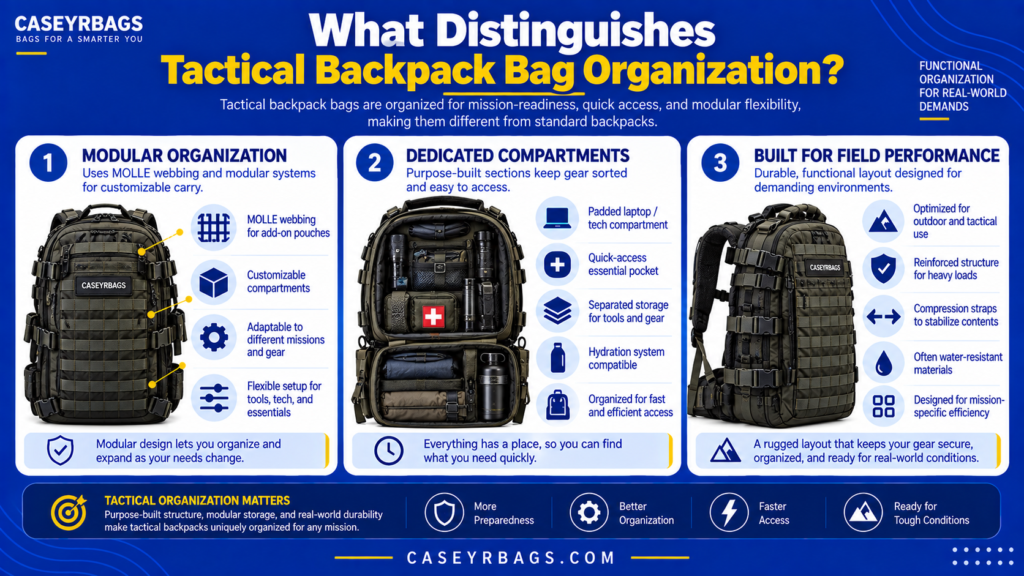
What Distinguishes Tactical Backpack Bag Organization?
Tactical Backpack Bag organization is distinguished by purposeful storage zones, internal retention, and configurable attachment areas that allow the layout to adapt to changing item sets. Instead of relying on pocket quantity alone, the organization system combines main storage, admin-style separation, quick-access areas, sleeves, retention features, and modular zones with clearly different roles.
Pocket count ≠ tactical organization, external attachment ≠ complete modular system, and modularity ≠ automatic access efficiency. Effective tactical-style organization depends on the relationship between zoning, retention, access priority, internal-versus-external storage, and load control. Added complexity is useful only when it solves a repeated storage or retrieval problem without creating unnecessary bulk, search friction, or left-right imbalance.
What Defines Tactical Backpack Bag Organization?
Tactical Backpack organization usually divides storage into functional zones rather than treating the interior as one undifferentiated space. Main compartments, admin-style organizer panels, internal sleeves, retention points, quick-access areas, and external attachment fields can each serve a different relationship between item size, access frequency, and load control.
A distinguishing feature is configurability. Some storage remains fixed, while other zones may support removable organizers, compatible pouches, attachment fields, or repositionable components that can change when the item set changes. The broader Backpack Bag page places tactical organization within balanced loading, load stability, compartment structure, and modular organization.
The system is therefore best understood as organization architecture rather than pocket count. Its effectiveness depends on whether fixed and modular features create predictable item positions, useful access priority, and stable load behavior without adding unnecessary duplication, bulk, or search decisions.
Which Features Most Strongly Distinguish Tactical-Style Organization?
Compartment zoning, admin-style organizer panels, internal retention straps, modular attachment fields, removable organizers, quick-access zones, and external expansion points are the strongest distinguishing features. Each feature should perform a clear storage function rather than exist only as a visual cue or extra pocket.
Feature → organization function → practical distinction. A sleeve creates a defined position, a retention strap restricts movement, a quick-access zone reduces retrieval steps, and a modular field allows compatible storage to be repositioned or removed. Tactical-style organization emerges from how these functions connect, not from maximum feature count.
How Is Organization Architecture Different From Having Many Pockets?
Many pockets describe the quantity of storage spaces, while organization architecture describes the relationship between zones, access priority, retention, and adaptability. Ten pockets with unclear roles can create more search decisions than a smaller number of zones designed around specific storage functions.
More pockets ≠ more organized system. Useful architecture tells the user where broad categories of items belong, how securely they should remain positioned, and how quickly they should be retrievable. Pocket count becomes meaningful only when those storage spaces support the overall layout rather than fragment it unnecessarily.
Why Is Configurability a Defining Tactical Characteristic?
Configurability matters because changing item sets may require different modules, different pocket assignments, added or removed external storage, or reconfigured internal zones. A tactical-style system can adjust those relationships without requiring the entire Backpack layout to remain permanently fixed.
Adaptable storage becomes meaningful when the carried load changes repeatedly. If the same everyday items remain consistent, fixed organization may be simpler and faster. Configurability is therefore a functional advantage only when changing storage roles or module positions solves a repeated organization need.
How Does Compartment Zoning Distinguish Tactical Backpack Organization?
Compartment zoning distinguishes tactical-style organization by dividing storage according to item role, access frequency, and load behavior rather than by pocket quantity alone.
How Do Primary and Secondary Storage Zones Differ?
A primary zone usually handles larger or central storage, while secondary zones handle smaller organized items that benefit from separation. A quick-access zone serves a different function again by prioritizing easier retrieval over deep storage or maximum capacity.
Primary zone → larger or central storage; secondary zone → smaller organized items; quick-access zone → frequently retrieved items. These categories are functional rather than prescriptive. The important distinction is that each zone has a clear role that reduces search effort and supports predictable item placement.
What Role Does an Admin-Style Organizer Panel Serve?
An admin-style organizer panel separates small accessories, electronics, writing tools, cables, documents, and other general-purpose items that would otherwise collect in one pocket or move freely through a larger compartment. The panel creates multiple defined positions within one broader access zone.
The defining value is predictable small-item placement. The organizer should reduce retrieval friction and prevent loose-item movement without creating so many subdivisions that the user has to search multiple nearly identical pockets. Its usefulness depends on role clarity, not visual complexity.
Why Should Compartment Count Remain Proportional to the Actual Load?
Too many compartments can waste volume, slow retrieval, force items into rigid positions, create forgotten storage zones, and reduce flexibility for bulky contents. Subdivision is useful only when the normal item set actually benefits from separate storage roles.
Useful zoning reduces search effort rather than multiplying compartments. A smaller number of clearly differentiated zones can outperform a highly divided interior when the contents remain predictable. Compartment count should therefore follow the load rather than becoming a goal by itself.
| Zone | Primary Role | Access Frequency | Organization Function |
|---|---|---|---|
| Main compartment | Bulk storage | Medium | Carries primary load |
| Admin zone | Small-item separation | Medium–high | Predictable retrieval |
| Quick-access zone | Immediate-use items | High | Reduces retrieval steps |
| Internal sleeve | Flat or separated items | Variable | Position control |
| Modular zone | Configurable storage | Variable | Adapts to changing load |
How Does Internal Retention Improve Tactical Backpack Organization?
Internal retention improves tactical-style organization by controlling item movement inside or against storage boundaries instead of relying only on compartment separation.
Which Retention Features Control Internal Movement?
Elastic loops, retention straps, internal webbing, sleeves, hook-and-loop retention, and secured organizer panels can limit item movement within a compartment. These features create repeatable positions for smaller or irregular objects that might otherwise slide, rotate, or migrate during normal carrying.
Retention feature → controlled item position → more predictable load. The feature should match the movement problem it is solving. A strap that prevents a frequently shifting item from moving can improve stability, while unused loops or redundant fasteners simply add organizational complexity.
Why Is Item Retention Different From Compartment Separation?
A compartment creates a storage boundary, while retention restricts movement within or against that boundary. An item can be separated from other contents and still move freely inside its own pocket if nothing controls its position.
Separated item ≠ secured item. Tactical-style organization often emphasizes both concepts because zoning determines where an item belongs, while retention determines how consistently it stays there. The two functions support different parts of organization architecture and should not be treated as interchangeable.
When Does Too Much Retention Become Inefficient?
Too much retention becomes inefficient when access requires excessive fastening steps, fixed positions no longer match the load, or redundant loops and straps create more decisions than control. Strong retention can also slow retrieval when the item does not actually need to be tightly secured.
Retention should control movement without creating unnecessary access friction. The correct level depends on the item, movement risk, and retrieval priority. More restraint is not automatically better if it makes routine storage slower or forces changing contents into unsuitable positions.
How Does Modular Attachment Distinguish Tactical Backpack Organization?
Modular attachment distinguishes tactical organization by allowing selected storage zones to be added, removed, or repositioned instead of forcing every function into the fixed Backpack layout.
How Do Modular Attachment Fields Work?
Structured attachment fields provide repeatable locations where compatible pouches or accessories can be mounted, removed, or repositioned. PALS-style webbing describes an attachment grid, while MOLLE refers more broadly to a modular load-carrying system commonly associated with compatible attachment methods.
The terms should not be treated as universally interchangeable in every context. The organizational point is that a defined attachment architecture creates configurable positions outside the permanent pocket layout. Modularity is useful when those positions solve real storage or access needs rather than simply filling available webbing.
What Does External Modularity Add Beyond Fixed Pockets?
External modularity can add removable storage, capacity that changes by function, dedicated accessory zones, and the ability to reposition selected modules. This allows the base Backpack to remain relatively stable while optional storage changes with the item set.
Base Backpack + optional module → adaptable organization. The benefit is greatest when the module can be added only when needed and removed when it is not. External modularity should support the overall layout rather than duplicate fixed pockets or create unnecessary bulk.
When Does External Modularity Become Excessive?
External modularity becomes excessive when redundant pouches, one-sided weight, increased depth, snag-prone layouts, blocked main openings, or too many organizational layers make the Backpack harder to use. Maximum attachment capacity does not prove that maximum use of that capacity is efficient.
Maximum attachment capacity ≠ optimal organization. Extra modules should be judged by whether they improve storage roles, access, or adaptability while preserving balance and opening clearance. If they mainly add search locations and bulk, the system has become more complex without becoming more organized.
| Organization Factor | Fixed Organization | Modular Organization |
|---|---|---|
| Storage structure | Permanent built-in zones | Removable or repositionable modules |
| Item locations | More predetermined | More configurable |
| Reconfiguration | Limited | Greater |
| Capacity change | Mainly built into the bag | Can change through compatible modules |
| Access pattern | More stable when contents remain consistent | Depends on module placement |
| Load effect | More predictable when fixed layout matches load | Can alter balance, depth, or bulk if poorly configured |
| Best fit | Stable, predictable item sets | Changing item sets or repeated reconfiguration needs |
How Does Access Hierarchy Distinguish Tactical Backpack Organization?
Access hierarchy distinguishes tactical organization by placing storage according to how often and how quickly an item needs to be retrieved instead of treating all pockets as equal.
How Are High-Frequency Items Separated From Low-Frequency Items?
High-frequency items belong in easier-access zones, while lower-frequency contents can remain deeper or more protected. The goal is not to prescribe specific items but to reduce retrieval steps by matching storage position to how often the user expects to reach that category.
High-frequency → easier-access zone; lower-frequency → deeper or more protected zone. Access hierarchy works when those levels stay clear. If frequently used contents are buried behind routine or reserve storage, the architecture creates unnecessary friction despite having many pockets.
What Makes a Quick-Access Pocket Different From Ordinary Storage?
A quick-access pocket is defined by position, opening path, predictable contents, and minimal retrieval steps rather than by size alone. The user should be able to identify the zone quickly and reach its intended category without reorganizing several other compartments first.
Quick access ≠ unrestricted access. The zone can still use closures or retention where needed. Its organizational value comes from priority and predictability, not from being permanently open or physically larger than other pockets.
When Can Too Many Quick-Access Zones Reduce Organization Quality?
Too many quick-access zones can create duplicated storage roles, forgotten item locations, dispersed small items, and more decisions about where a frequently used object might have been placed. When every pocket is treated as high priority, the hierarchy loses meaning.
Quick access works best when priority remains clear. A limited number of distinct high-frequency locations usually creates stronger retrieval predictability than spreading urgent items across many similar pockets. The goal is fewer search steps, not maximum numbers of fast-access openings.
| Access Priority | Storage Position | Typical Retrieval Effort |
|---|---|---|
| Immediate | Most direct access zone | Lowest |
| Frequent | Easy-access pocket or organizer | Low |
| Routine | Primary internal zone | Moderate |
| Low-Frequency | Deeper or protected storage | Higher |
| Reserve | Least-accessed storage | Highest |
How Do Internal & External Organization Work Together?
External modular storage should complement the internal organization system rather than duplicate its roles, block primary access, or destabilize the load.
Which Items Are Better Suited to Internal Organization?
Internal organization is better suited to items that need protection, stable positioning, enclosure, or a central relationship to the Backpack load. It also supports categories that benefit from sleeves, dividers, retention, or organizer panels without increasing external depth.
The distinction should remain functional rather than based on a fixed packing list. Items that influence central load balance or need protection usually benefit from internal control, while externally mounted storage should be reserved for cases where separation or removability creates a clear advantage.
When Does External Storage Provide Useful Organizational Value?
External storage provides useful value when it separates one category from the main compartment, allows a complete module to be removed, adds temporary configurable space, or provides access without reorganizing the interior. These benefits are strongest when the external role is clearly different from existing fixed storage.
The module should remain secure, balanced, and compatible with primary openings. External expansion is useful when it solves a specific organizational problem, not when it simply duplicates internal pockets or fills available attachment space.
Why Can External Expansion Disrupt the Main Organization System?
External expansion can disrupt the system through one-sided load, increased depth, blocked openings, overlapping modules, or altered bag shape. These effects can make internal zones harder to access and can change how the complete Backpack load behaves during movement.
External modularity must remain part of the whole load layout. A useful pouch can become counterproductive if its location creates imbalance, hides another opening, or adds a new search location for contents that already have a clear internal role.
| Organization Location | Primary Benefit | Main Risk |
|---|---|---|
| Internal main zone | Protected central storage | Overcrowding |
| Internal organizer | Predictable small-item placement | Excess subdivision |
| Internal retention | Controls movement | Slower access |
| External fixed pocket | Separate access | Load offset |
| External removable module | Adaptability | Added bulk / imbalance |
How Does Tactical Organization Support Load Control?
Organization architecture can support load control by keeping items in defined zones, limiting movement, and preventing configurable storage from creating unnecessary imbalance.
How Can Compartment Zoning Stabilize the Load?
Defined zones can limit lateral item movement, vertical shifting, and dense objects migrating through the Backpack during normal movement. A clear storage role keeps contents within a smaller structural area instead of allowing everything to settle unpredictably inside one large cavity.
Defined storage zone → controlled item position → more stable load. Zoning does not automatically balance the Backpack, but it creates better conditions for stable placement. The actual result still depends on how dense items are distributed across those zones.
How Can Modular Pouches Create Load Imbalance?
Modular pouches can create imbalance when several modules are added mainly to one side, the front, or an upper zone. That placement can move the effective load center, increase bag depth, or create asymmetric movement even when the internal organization remains well controlled.
Modular organization must still respect load distribution. A module should be evaluated not only for storage value but also for where its weight sits relative to the complete Backpack. Configurability does not remove the need for left-right and front-back load awareness.
Why Should Dense Items Not Be Organized by Access Alone?
Dense items should not be organized by access alone because retrieval priority has to be balanced with item density, location, stability, and bag geometry. The fastest-access position may not always be the most stable location for a heavy or compact object.
Fast access should not unnecessarily undermine load control. Tactical organization works best when access hierarchy and load stability are evaluated together rather than allowing one priority to override every other structural consideration.
How Does Tactical Organization Differ From Conventional Backpack Organization?
Tactical-style organization emphasizes configurability, retention, attachment architecture, and multiple access levels more strongly than a conventional fixed layout, but neither system is universally superior.
What Does a Conventional Fixed Layout Usually Prioritize?
A conventional fixed layout usually prioritizes permanent compartments, built-in pockets, predetermined item zones, and a simpler internal structure. The user learns one stable arrangement and relies on those positions without frequently changing modules or external storage.
This is not an inferior system. Fixed organization can be highly efficient when the item set stays predictable because the storage map remains stable and retrieval decisions stay limited. Lower adaptability can be an advantage when reconfiguration is rarely needed.
What Additional Capability Does Tactical-Style Organization Emphasize?
Tactical-style organization emphasizes configurable modules, stronger item retention, multiple access levels, attachment architecture, and changing storage roles. These capabilities make the layout more adaptable when the carried categories or access priorities vary repeatedly.
The distinction is adaptability and retention, not simply complexity. A layout with many pockets but no clear reconfiguration logic may be less tactical in organizational function than a simpler system with defined fixed zones plus a few purposeful modular areas.
When Is Conventional Organization Actually the Better Fit?
Conventional organization can be the better fit when daily contents remain stable, item categories change little, external expansion is unnecessary, and the user benefits from simpler retrieval with fewer organizational decisions. In that context, configurability may add complexity without solving a repeated need.
Tactical organization is useful when configurability solves a repeated need. More adaptable is not automatically more efficient. A fixed layout that consistently matches the load can outperform a highly modular arrangement that requires constant decisions but rarely changes in practice.
| Organization Factor | Conventional Layout | Tactical-Style Layout |
|---|---|---|
| Fixed compartments | Usually central | Still important |
| Modular attachment | Limited or absent | More prominent |
| Internal retention | Varies | Often emphasized |
| External expansion | Usually limited | More configurable |
| Layout adaptability | Lower to moderate | Typically greater |
| Complexity | Usually lower | Can be higher |
When Is Tactical Backpack Organization Actually Useful?
Tactical organization is useful when changing contents, retention needs, mixed access priorities, or repeated storage reconfiguration justify the added organizational architecture.
Which Load Patterns Benefit Most From Modular Organization?
Changing equipment sets, many small accessories, items that need separation, mixed access priorities, and repeated need to add or remove storage modules benefit most from modular organization. These conditions create genuine value from a layout that can change without rebuilding the complete Backpack interior.
The advantage depends on repeated change rather than one-time novelty. If modules remain permanently attached and never serve a different role, the user may be carrying modular complexity without receiving meaningful adaptability in return.
When Is a Simpler Layout More Efficient?
A simpler layout is often more efficient when daily contents are predictable, item categories are few, external expansion is minimal, and there is little need to reconfigure storage. In that situation, fewer zones can reduce search decisions and keep item locations more memorable.
More configurable does not automatically mean more efficient. Tactical architecture should earn its complexity by solving real storage changes, retention problems, or access conflicts. If it does not, a fixed or lightly zoned layout may provide cleaner organization.
Which Criteria Should Determine the Organization System?
- Identify normal contents.
- Group items by size and function.
- Identify access frequency.
- Identify items requiring retention.
- Identify changing item groups.
- Determine whether external modules are necessary.
- Check left-right load balance.
- Add modularity only where it solves a repeated organization problem.
Use the sequence in that order so organization begins with the actual load instead of the available pockets. Define the contents and their functional groups first, then identify access frequency and retention needs before deciding whether any part of the load changes often enough to justify modular storage.
Only after those steps should external modules be added and the complete load balance rechecked. Modularity is appropriate when it solves a repeated organization problem without adding disproportionate bulk, duplication, or search friction. The result should remain descriptive rather than becoming a universal performance score.
| Content Variety | Access Frequency | Retention Need | Load Change Frequency | Expansion Need | Organization Type |
|---|---|---|---|---|---|
| Low | Predictable | Low | Low | Low | Simple Fixed Layout |
| Moderate | Mixed | Moderate | Low | Low | Zoned Fixed Layout |
| High | Mixed | Moderate–high | Moderate | Moderate | Hybrid Tactical Layout |
| High / changing | Variable | High | High | High | Highly Modular Layout |
How Can Tactical Backpack Organization Mismatches Be Avoided?
Organizational mismatches are avoided by judging storage roles, retention, access, modular value, and load balance instead of choosing from tactical appearance or feature count alone.
Why Is Choosing From Pocket Count Alone a Mistake?
Pocket count does not reveal access hierarchy, useful dimensions, item retention, modularity, load balance, or overall layout logic. A Backpack can have many pockets while still forcing the user to search several similar locations for the same category of item.
Many pockets ≠ organized Backpack. The quality of the layout comes from clear roles and predictable placement. A smaller number of useful zones can outperform a large pocket count when every zone has a distinct purpose and supports the actual load.
Why Is Covering a Backpack With External Modules a Weak Organization Strategy?
Covering the Backpack with external modules can create duplicated storage, excessive bulk, one-sided loading, blocked openings, and more search locations. The system becomes harder to understand when every available attachment point is treated as an invitation to add another pouch.
Modular expansion should solve a storage need, not simply fill attachment space. A module earns its place when it adds a distinct role, remains secure, preserves access, and does not destabilize the overall layout. Otherwise it increases complexity without improving organization.
What Should Be Verified Before Relying on Tactical Organization?
Before relying on the system, verify that storage zones have clear roles, high-frequency items remain predictable, retention controls unnecessary movement, fixed compartments match the load, and modular areas solve real reconfiguration needs. External modules should remain secure, balanced, and clear of primary openings.
Also confirm that dense items remain controlled, attachment fields are not filled without purpose, rugged appearance is not being treated as proof of organization quality, and added modularity reduces rather than increases search friction. The complete layout should make storage decisions simpler even when it remains adaptable.
- Main storage zones have clear roles.
- Admin-style organization provides useful small-item separation.
- Frequently accessed items have predictable locations.
- Low-frequency items do not block high-frequency storage.
- Internal retention controls items that would otherwise move excessively.
- Fixed compartments match the normal load.
- Modular areas solve actual reconfiguration needs.
- Removable modules remain securely attached.
- External modules do not block primary openings.
- External modules do not create major one-sided loading.
- Dense items remain reasonably controlled.
- Organization supports load stability.
- Attachment fields are not being filled simply because space is available.
- Pocket quantity is not being used as the primary measure of organization quality.
- Rugged appearance is not being treated as proof of tactical organization.
- Added modularity reduces rather than increases organizational friction.
Conclusion
Tactical Backpack Bag organization is distinguished by purposeful compartment zoning, internal item retention, modular attachment, expandable storage, and access hierarchy. These features allow the storage layout to adapt as the carried item set changes while keeping important contents separated, retained, and predictably positioned instead of relying on pocket quantity alone.
What distinguishes tactical-style organization is not maximum feature count, but a structured relationship between fixed storage, configurable modules, access priority, item control, and load stability. A simpler layout can be the better fit when contents remain predictable, while modular architecture becomes valuable when repeated reconfiguration solves a real organizational need without adding unnecessary bulk, imbalance, or search friction.
FAQs
No. Pocket quantity alone does not define tactical-style organization. Tactical organization depends more on purposeful zoning, item retention, modular attachment, access hierarchy, and configurable storage relationships.
A Backpack with fewer but clearly defined zones can be better organized than one with many overlapping pockets. Pocket count ≠ tactical organization.
Structured attachment fields allow compatible external modules to be added, removed, or repositioned when the storage role changes. PALS-style webbing describes an attachment grid, while MOLLE refers to a modular load-carrying system.
Effective use still depends on balance, access, module stability, and whether the added storage solves a real need. The terms should not be treated as universally interchangeable.
Not universally. Tactical organization offers greater configurability when contents, storage roles, or access priorities change frequently, while a conventional fixed layout can be faster and simpler for predictable everyday loads.
More configurable does not automatically mean more efficient. The better system is the one that matches the actual load without adding unnecessary organizational friction.