The 7-Day Ergonomic Strain Diagnostic: Bag Weight or Carry Mechanics?
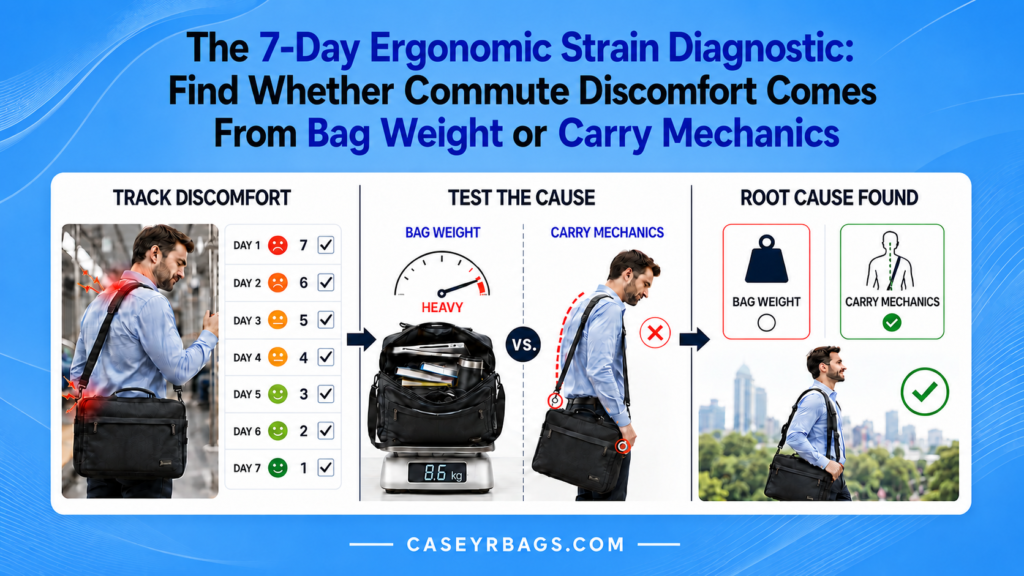
The 7-Day Ergonomic Strain Diagnostic The 7-Day Ergonomic Strain Diagnostic: Bag Weight or Carry Mechanics? The 7-day ergonomic strain diagnostic helps you test whether commute discomfort comes mainly from total payload, heavy-load placement, strap-support mechanics, or inconsistent daily conditions. This controlled carry test compares your daily discomfort under different carrying setups. By keeping your specific bag, daily route, and scoring scale as consistent as possible, you can isolate the true cause of your fatigue. Over the course of a week, this diagnostic turns subjective feelings into a practical packing rule. Remember, this test is intended for mild commute fatigue, not medical pain. Pay close attention to your daily scores, as understanding the difference between weight and mechanics can completely transform how you prepare for your commute. EDUCATIONAL DISCLAIMER This CaseyrBags diagnostic is for educational purposes only. It does not provide medical advice, a diagnosis, treatment guidance, injury assessment, pain-management instructions, professional healthcare advice, product guarantees, or universal bag-fit recommendations. What is the 7-day ergonomic strain diagnostic, and why does it matter? The 7-day ergonomic strain diagnostic is a controlled bag-carrying test that compares daily commute discomfort under different load-position and strap-support conditions. What does the 7-day ergonomic strain diagnostic measure? The 7-day ergonomic strain diagnostic measures how user-reported commute discomfort changes when total payload stays consistent but carry mechanics change. By isolating variables, the test separates weight-related discomfort from mechanics-related discomfort across a measured daily score, specific load position, and isolated strap engagement. Why can commute discomfort come from carry mechanics instead of bag weight? Commute discomfort can come from carry mechanics because the same total payload can feel different when the heaviest item sits farther from the body or the support system is not engaged. A laptop positioned away from the back alters leverage, while a loose sternum strap allows excess movement and friction. When should you use the 7-day ergonomic strain diagnostic? Use the 7-day ergonomic strain diagnostic when a commute bag repeatedly feels uncomfortable and you need to test whether total load, packing position, or strap support is the stronger trigger. It is ideal for repeated fatigue, uncertainty before replacing the bag, and uncertainty before removing gear. Bag Comfort Trigger Overview C Commute Discomfort Daily Carry Baseline Start by identifying the main comfort trigger. KG Load-Related Triggers Bag Weight Heavy-Item Placement Unbalanced Packing Stress created by payload and load distribution. Carry-Mechanic Triggers Strap Fit One-Shoulder Carry Poor Harness Support Stress created by fit, posture, and carry mechanics. CASEYRBAGS.COM C Figure 1.0: Trigger Pathways. Visualizing how commute discomfort usually comes from either load imbalance or carry mechanics, helping users identify the primary cause before changing bags, fit, or packing habits. Key Takeaway The 7-day ergonomic strain diagnostic matters because it turns commute bag discomfort from a guess into a controlled comparison. When should commute discomfort not be treated as only a bag issue? Commute discomfort should not be treated as only a bag issue if it is severe, persistent, unusual, worsening, or present when the bag is not being carried. When is discomfort too serious for a bag-only diagnosis? Discomfort becomes too serious for a bag-only diagnosis when it disrupts normal walking, sleep, daily activity, or continues outside bag-carrying situations. Stop the diagnostic immediately if discomfort becomes severe, unusual, or worsening. Why does the diagnostic still need a safety boundary? The diagnostic needs a safety boundary because a bag test can compare carry mechanics but cannot identify medical causes of pain. It assesses physical leverage and stabilization, not physiological conditions. How should the user continue safely? The user should continue safely by testing only mild to moderate commute-related discomfort and stopping if discomfort becomes intense, unusual, worsening, or unrelated to carrying the bag. Always seek qualified guidance for persistent issues [NIOSH Ergonomics Risk Factors, 2023]. Safety Boundary Box Use the diagnostic for: Mild commute-related bag discomfort. Do not rely on it for: Severe, persistent, unusual, worsening, or non-bag-related pain. Next step if unsure: Stop testing and seek qualified medical guidance. Key Takeaway The diagnostic can compare bag mechanics, but it cannot replace professional guidance for serious or persistent discomfort. Who is this diagnostic best suited for? This diagnostic works best for commute bags where load position and strap engagement can be changed and measured. Which bags work best with the diagnostic? The diagnostic works best with backpacks, laptop backpacks, travel backpacks, and adjustable messenger or crossbody bags. These profiles generally provide easily testable load placement and distinct strap variables. Which bags are harder to test with this diagnostic? The diagnostic is harder to run on clutches, simple totes, or bags without adjustable support features. Since strap engagement may be unavailable, users should mark strap-support tests as N/A and focus purely on load position and payload. What should the user do if the bag has no sternum strap or hip belt? If the bag has no sternum strap or hip belt, the user should test load position and total payload instead of forcing a strap-support comparison. Simply mark the strap engagement condition as unavailable. Bag Type Supported Variables Limitations Best Test Path Laptop Backpacks Load Proximity, Harness Engagement None Full 7-day protocol Messenger Bags Load Proximity, Crossbody Strap Lacks secondary harness support Focus on load placement and strap length Basic Totes Payload Weight No back panel, no harness Focus purely on payload reduction Key Takeaway The diagnostic is strongest when the bag has variables the user can actually change and repeat. How do you set a reliable baseline before the 7-day diagnostic? A reliable baseline keeps the same bag, payload, route, scoring scale, and logging time so the diagnostic measures carry mechanics instead of random daily changes. Baseline Stabilization 1 Same Bag 2 Payload KG 3 Route CASEYRBAGS.COM C Figure 2.0: Baseline Controls. These three fixed variables remain constant to isolate the tested comfort mechanic and ensure results reflect only the changes being evaluated. How do you keep the same bag during the diagnostic? Keep the same bag during the diagnostic because switching bag types changes structure, strap