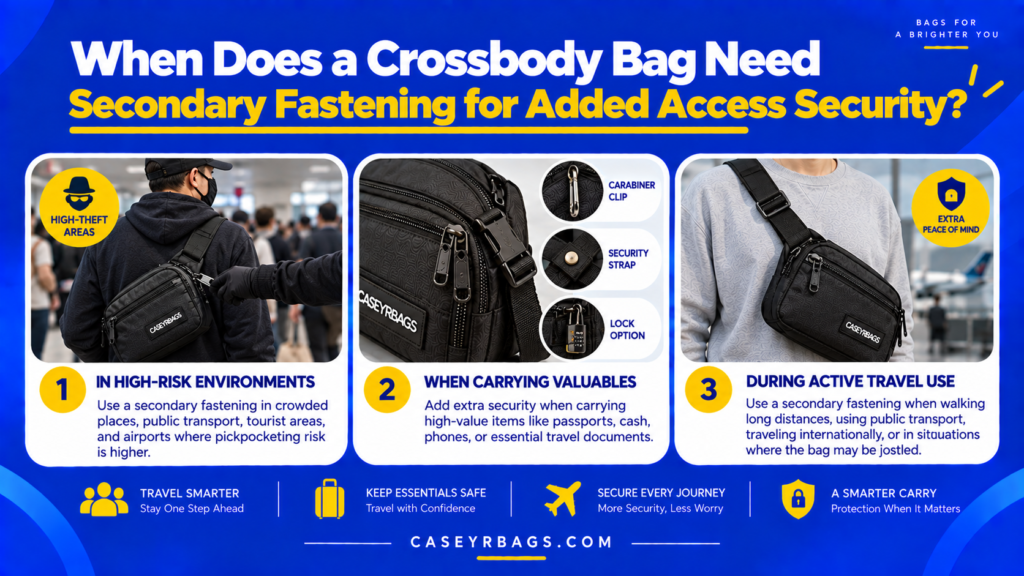
When Does a Crossbody Bag Need Secondary Fastening for Added Access Security?
A Crossbody Bag may need secondary fastening when its primary closure alone does not provide enough control over accidental opening, compartment exposure, or movement-related access. A flap, snap, buckle, clip, hook-and-loop tab, or similar retainer can add a second deliberate step before the compartment becomes fully accessible.
The extra fastening is most useful when the bag carries important contents, moves frequently, rests in an exposed orientation, or uses a primary closure that can be opened or displaced too easily for the intended context. It becomes less useful when it adds unnecessary friction to high-frequency access without solving a real retention problem.
What Does Secondary Fastening Mean in a Crossbody Bag?
The primary closure is the main mechanism that closes the compartment, such as a zipper, flap, snap, or draw-style opening. It controls the normal opening path used to enter the bag.
A secondary fastening adds another deliberate retention step over, beside, or in addition to that primary closure. Depending on the design, this could be a snap over a zipper, buckle over a flap, retaining clip, hook-and-loop tab, or another secondary mechanism.
Its purpose is not simply to make the bag harder to open. Within the broader Crossbody Bag system, secondary fastening should solve a specific problem such as accidental opening, movement-related separation, excessive exposure, or insufficient containment of an important compartment.
How Is Secondary Fastening Different From the Primary Closure?
The primary closure closes the compartment and defines its normal access path. A secondary fastener sits above or alongside that closure and adds another deliberate release or retention step before the opening can be fully accessed.
Primary closure → closes the compartment; secondary fastening → adds another access or retention step. The second layer adds control but should not replace a primary closure that is misaligned, damaged, unsuitable, or left partly open.
Which Secondary Fasteners Can Crossbody Bags Use?
Common secondary mechanisms include snaps, buckles, clips, hook-and-loop tabs, flap retainers, zipper-pull keepers, and secondary straps or tabs. Each adds a different kind of release step or opening restraint.
The fastener should be judged by its purpose rather than ranked universally. A simple snap may suit one access role, while a buckle, clip, or retaining flap may add more deliberate handling for another.
Why Does a Second Fastener Not Automatically Improve the Bag?
A second fastener can slow retrieval, add hardware, require extra opening steps, increase two-handed operation, or complicate reset after use. Those costs remain even when the fastener is mechanically functional.
Secondary fastening should solve a real access-control problem. If the primary closure already keeps the compartment controlled, another layer may create more friction than functional benefit.
When Is the Primary Closure Enough?
The primary closure is enough when it remains predictably closed, aligned, and contained through the bag’s normal load, movement, orientation, and access cycle.
When Does a Zipper Provide Sufficient Access Control on Its Own?
A zipper may be sufficient when it stays fully closed during movement, the opening remains controlled, zipper pulls do not migrate unintentionally, and the compartment is not overfilled. These conditions show that the primary closure is already managing the normal opening path.
Stable primary zipper → controlled opening → low secondary-fastening need. This does not imply theft-proofing or complete security; it only means another layer may add little functional access-control value.
When Can a Flap, Snap, or Other Primary Closure Be Sufficient?
A flap, snap, magnetic closure, or other primary system can be sufficient when it provides appropriate retention, predictable reclosure, suitable access speed, and enough containment for the actual contents and movement pattern.
The useful question is whether the closure performs its intended job under real use. If it stays aligned and predictable without uncontrolled exposure, another fastener may be unnecessary.
Why Should Unnecessary Secondary Fastening Be Avoided?
Redundant fastening can create access friction, add hardware, slow routine use, and make the closing sequence more complicated. High-frequency pockets are especially sensitive to repeated extra release steps.
If the primary closure already solves the access-control need, a second layer may add little functional value. More closure layers ≠ better usability.
| Condition | Primary Closure Behavior | Secondary Fastening Need |
|---|---|---|
| Stable closed zipper | Remains controlled | Low |
| Closure shifts during movement | Less predictable | Moderate–high |
| Wide exposed opening | More contents exposed | Higher |
| High-frequency routine pocket | Frequent intentional access | Keep added fastening minimal |
| Important low-frequency compartment | Rarely opened | Added layer may provide value |
Which Conditions Create a Need for Secondary Fastening?
A second layer becomes more defensible when a specific opening, exposure, or retention weakness remains after the primary closure and load are functioning as intended.
When Does Accidental-Opening Risk Justify Added Fastening?
Repeated closure separation, zipper-pull migration, flap lifting, snap release under load, or opening pressure can indicate that the primary system is not staying fully controlled during normal use. The repeated behavior matters more than the mere possibility of movement.
Repeated unintended opening behavior → stronger case for secondary retention. The cause should still be checked first because overfilling or damaged primary hardware should not be hidden by adding another fastener.
When Does Compartment Exposure Justify Another Layer?
A wide-opening main compartment, outward-facing opening, frequently rotated bag, or externally located important compartment can create more exposure after limited opening. A secondary layer may help keep the opening more deliberately controlled.
Wide exposed opening → greater content exposure → increased added-fastening value. The added layer remains appropriate only if it directly reduces that exposure without making normal access disproportionately difficult.
When Does Repeated Movement Increase Fastening Need?
Walking, transit movement, lifting, sitting-to-standing transitions, and rotating the bag from side to front can all change closure position. Movement matters when it repeatedly alters the opening, pulls hardware, or creates separation.
More movement matters only when it actually changes closure behavior or exposure. Movement alone is not a reason to add hardware if the primary closure remains fully controlled.
How Does Crossbody Movement Affect Secondary-Fastening Need?
Swing, rotation, compression, and repositioning can change the direction and force acting on a closure, but only movement that creates a real access-control problem increases the need for secondary retention.
How Can Bag Rotation Affect the Main Opening?
A stable bag orientation keeps the opening direction predictable, while repeated rotation can turn the compartment toward a more exposed angle or change how contents press against the closure. The same primary closure can therefore behave differently as the bag moves.
Stable opening orientation → predictable containment; repeated rotation → changing direction of opening and contents. The effect should be observed with the normal load before a second fastener is considered.
How Can Walking or Transit Movement Affect Closure Retention?
Walking or transit movement can produce flap lifting, zipper-pull movement, bag compression, or internal shifting. These effects may influence closure behavior if the bag structure allows them to reach the opening system.
Not every movement creates failure. A closure that remains fully aligned and closed through normal movement provides little evidence that another retention layer is needed.
When Does Movement Not Justify Extra Fastening?
Extra fastening is not justified when the primary closure remains stable, contents stay contained, the opening orientation remains controlled, and no unintended access occurs through walking or repositioning.
Movement alone is not enough; movement must create an actual access-control problem. Secondary fastening should respond to an observed weakness rather than to motion as an abstract condition.
How Does Opening Orientation Affect the Need for a Second Fastener?
Opening direction can increase or reduce exposure potential, so secondary-fastening need should be judged with the bag in the positions where the compartment is actually used.
When Can an Outward-Facing Opening Benefit From Added Fastening?
An outward-facing opening can become more exposed during side carry, forward rotation, seated positioning, or movement. If the primary closure repeatedly shifts or a wide opening becomes easier to expose, selective secondary retention can add control.
Outward exposure strengthens the case only when it creates an actual opening or retention weakness. Added fastening improves deliberate access control; it does not guarantee theft prevention.
How Does an Upward-Facing Opening Change the Need?
An upward-facing opening can use compartment geometry to support contents and may reduce exposure if the primary closure remains aligned and controlled. In that situation, another layer may provide little added value.
Upward orientation can reduce secondary-fastening need, but it does not determine the answer alone. Movement, primary-closure behavior, load pressure, and compartment role still matter.
Does a Body-Facing Opening Eliminate the Need for Secondary Fastening?
No. A body-facing orientation can reduce outward exposure, but the closure can still open unintentionally, contents can shift, and the bag can rotate away from that protected orientation.
Opening orientation influences fastening need; it does not determine it alone. Body-facing carry supports access control but does not replace closure behavior or selective fastening when a real weakness remains.
Which Compartments Benefit Most From Secondary Fastening?
Added fastening should be selective, with greater justification where low-frequency access and higher containment needs make another release step practical.
When Does the Main Compartment Benefit From Secondary Fastening?
A large main opening can benefit from another layer when it carries important mixed contents, rotates frequently, or uses a primary closure that still needs added retention after normal loading and alignment have been checked.
Main-compartment secondary fastening is most useful when it reduces a defined opening or exposure problem. It should not be added simply because the compartment is large.
When Do Small Exterior Pockets Benefit From It?
An exterior pocket can benefit when its contents should remain contained, are easy to lose, and are not constantly retrieved. In that role, another release step may create useful deliberate access without disrupting routine use.
Low-frequency exterior storage → higher containment priority → stronger selective fastening case. The same layer may be excessive on a pocket opened repeatedly throughout the day.
Which Pockets Usually Need Less Fastening Complexity?
High-frequency pockets, low-consequence contents, shallow controlled storage, and pockets already positioned in a protected body-facing zone usually have less need for multiple release steps.
Fastening level should follow item importance and access frequency. A lighter closure can be more functional where rapid retrieval is part of the pocket’s intended role.
| Compartment Role | Access Frequency | Containment Need | Secondary Fastening Priority |
|---|---|---|---|
| Quick-access zone | High | Low–moderate | Low |
| Routine main compartment | Moderate | Moderate–high | Context-dependent |
| Important internal pocket | Low | High | Higher |
| Low-priority open pocket | Variable | Low | Usually low |
How Do Different Secondary Fasteners Change Access?
Secondary fasteners should be compared by the extra retention they provide and the additional opening effort they create, not by a universal ranking of hardware strength.
How Does a Snap Add Secondary Control?
A snap adds one extra deliberate release step and can provide quick secondary retention with relatively low opening effort. It can be useful when a small increase in deliberate access is enough.
Snap closed → one extra deliberate release step. The trade-off is partial retention whose performance depends on alignment, design, and the forces acting on the compartment.
How Do Buckles or Clips Change Access?
Buckles and clips can create more deliberate mechanical retention and a clear open/closed state. They usually require more handling than a snap and can slow access when used on frequently opened compartments.
Buckle/clip → stronger deliberate mechanical retention → more handling. Their value comes from the specific control problem they solve, not from assumed universal superiority.
How Do Flap Retainers or Hook-and-Loop Tabs Change Access?
Retaining flaps and hook-and-loop tabs can provide broad opening coverage or fast secondary retention. They can be simple to operate and can hold a flexible opening in a more deliberate state.
The trade-offs can include noise, wear, added opening resistance, or another layer to manage. Their suitability depends on the compartment role and access frequency.
| Secondary Fastener | Added Opening Step | Retention Style | Access Trade-Off |
|---|---|---|---|
| Snap | Low | Point retention | Quick but limited |
| Buckle/clip | Moderate | Mechanical retention | More deliberate |
| Hook-and-loop | Low–moderate | Surface retention | Fast but design-dependent |
| Retaining flap | Moderate | Opening coverage | Adds another layer |
| Zipper-pull keeper | Low | Controls zipper-pull movement | Narrower use case |
How Should Secondary Fastening Balance Security & Access Speed?
The useful balance comes from adding only enough deliberate access control to solve the identified weakness without making normal retrieval impractical.
When Is Additional Access Control More Important Than Speed?
Additional control becomes more important for low-frequency access, important contents, movement-heavy situations, or large main openings where uncontrolled exposure creates a meaningful problem. Slower access is less costly when retrieval is infrequent.
The goal is stronger containment where it solves a real need, not maximum delay. Added access security means deliberate opening and retention rather than theft-proofing.
When Does Fast Retrieval Matter More?
Fast retrieval matters more for routine items, repeated short access, controlled environments, and pockets already protected by position or another primary closure. Extra release steps can become disproportionate in these roles.
Frequent retrieval → repeated secondary-release step → higher access friction. If the user repeatedly bypasses the second fastener, the layer has lost much of its functional value.
When Has Secondary Fastening Become Excessive?
Repeated frustration, needing to remove the bag, two-handed operation for every simple retrieval, redundant closure layers, or a fastener rarely used as intended all indicate excessive complexity.
Added security should increase deliberate control without making routine access impractical. More closure layers ≠ better usability.
How Does Body-Facing Carry Affect Secondary-Fastening Need?
Body position can reduce outward exposure, but it should be evaluated separately from the mechanical behavior of the primary and secondary closures.
When Can Front-Side Carry Reduce the Need for a Second Fastener?
Front-side carry can reduce added-fastening need when the opening remains visible, the bag stays close to the body, the primary closure remains controlled, and access is already deliberate.
Body-facing position → lower outward exposure potential → may reduce but not eliminate fastening need. Actual closure behavior remains the deciding evidence.
When Can Side or Rearward Positioning Increase the Value of Added Fastening?
Added fastening can become more useful when the main opening is less visible, the bag rotates, the compartment faces outward, or movement repeatedly causes closure shifts. These conditions can make controlled access harder to maintain.
The value comes from reducing accidental opening or exposure, not from crime-prevention claims. Side or rearward carry alone is not enough to justify another layer.
Why Should Body Position and Closure Be Evaluated Separately?
Bag position controls where the bag sits, while primary and secondary fastening control how the compartment opens. A favorable body position cannot repair a closure that separates unintentionally.
Body-facing carry supports access control but does not replace fastening. Likewise, stronger fastening cannot correct a bag position that continually rotates the opening into an exposed orientation.
When Does Overfilling Increase the Need for Secondary Fastening?
Overfilling can make closures behave differently, but added fastening should not be used to compensate for load pressure that prevents the compartment from closing normally.
How Can Overfilling Stress the Primary Closure?
Excess contents can create zipper tension, flap lifting, snap misalignment, or opening distortion. These effects change primary-closure behavior by forcing the compartment geometry away from its normal closed state.
Overfilled compartment → closure pressure or misalignment → greater unintended opening potential. The first diagnosis should be load pressure, not an assumption that stronger secondary retention is required.
Should Secondary Fastening Be Used to Hold an Overfilled Bag Closed?
Generally, no. A second fastener can add pressure without solving the geometry that is forcing the primary closure out of alignment. The extra layer may simply become another stressed component.
Secondary fastening should not compensate for a load that exceeds the compartment’s practical geometry. Reduce or redistribute contents before judging whether another fastening layer is necessary.
How Does Controlled Loading Reduce Fastening Demand?
Appropriate fill allows zippers, flaps, snaps, and other closures to align normally without constant outward pressure. This makes it easier to distinguish a true retention weakness from a loading problem.
Appropriate fill → closure aligns normally → less unintended opening pressure. Proper packing first; additional fastening second.
How Can the Need for Secondary Fastening Be Evaluated?
The need should be tested first with the primary closure alone, then with a secondary layer only after a real exposure or accidental-opening problem has been observed or reasonably identified.
What Should Be Checked With the Primary Closure Alone?
Test normal walking, seated movement, bag repositioning, opening orientation, closure alignment, and any accidental-opening behavior using the normal load. This establishes the baseline before added hardware changes the system.
The primary-closure-only test prevents a second fastener from hiding overfilling, poor orientation, or a closure that already performs adequately. If the opening remains controlled, added fastening may be unnecessary.
What Should Be Tested After Adding Secondary Fastening?
After adding the second layer, evaluate added retention, number of opening steps, one- or two-handed operation, reclosure speed, and interference with normal access. The fastener should solve the identified weakness without creating a larger usability problem.
Added retention should be observable, and the reset sequence should remain predictable. A fastener that is consistently bypassed, left open, or forces bag removal is poorly matched to the access role.
Which Sequence Should Determine Whether the Second Fastener Is Justified?
- Load the bag normally.
- Close the primary closure fully.
- Wear the bag in its normal carry position.
- Walk and reposition it.
- Observe whether the opening remains controlled.
- Access the compartment normally.
- Identify any real exposure or accidental-opening problem.
- Add secondary fastening only if it solves that problem.
- Retest access speed.
- Keep the second layer only if its added control outweighs its access friction.
Use the sequence in order so the normal bag and primary closure are tested before a second layer is introduced. Walking, repositioning, opening orientation, and routine access reveal whether a real problem remains.
Add secondary fastening only after identifying that problem, then retest access speed and keep the layer only if the added control outweighs its retrieval friction. The decision should remain qualitative rather than becoming a numerical score.
How Can Secondary-Fastening Mismatches Be Avoided?
Fastening mismatches are avoided by fixing load, orientation, pocket zoning, and primary-closure problems before multiplying closure layers.
Why Is Adding a Second Fastener to Every Pocket a Weak Strategy?
Adding another layer to every pocket creates redundant hardware, slower access, unnecessary complexity, and a weak pocket hierarchy. High-frequency zones can become especially frustrating when every retrieval requires multiple releases.
Secondary fastening should be selective. The second layer belongs only where its added control solves a real compartment-specific problem.
Why Can Extra Fastening Fail to Solve the Actual Problem?
The real issue may be an overfilled compartment, poor opening orientation, unsuitable primary closure, unstable bag position, or poor pocket assignment. A second fastener can hide the symptom while leaving the cause unchanged.
Secondary fastening should solve the actual failure mechanism rather than hide it. If better loading, orientation, or organization removes the problem, added hardware was not the primary solution.
What Should Be Verified Before Relying on Secondary Fastening?
Verify that the primary closure operates normally, the compartment is not overfilled, opening orientation and bag position remain controlled, accidental-opening risk is real, compartment importance and access frequency are known, and the second fastener has one clear purpose.
Also confirm that added retention is observable, reset remains predictable, quick-access pockets are not over-secured, body-facing carry is not treated as guaranteed security, and the added layer provides more useful control than retrieval friction.
- Primary closure is identified.
- Primary closure operates normally.
- Compartment is not overfilled.
- Opening orientation remains reasonably controlled.
- Bag position is stable during normal movement.
- Primary closure remains closed during walking.
- Bag rotation does not repeatedly expose the opening.
- Actual accidental-opening risk has been observed or reasonably identified.
- Compartment importance justifies added control.
- Access frequency is considered.
- Secondary fastening has one clear purpose.
- Secondary fastener does not unnecessarily block routine access.
- Fastener can be reset predictably after retrieval.
- Secondary fastening does not compensate for excessive load pressure.
- Quick-access pockets are not over-secured.
- Important low-frequency compartments receive more control where useful.
- Body-facing carry is not treated as guaranteed security.
- Two closure layers are not treated as theft-proofing.
- Added fastening provides more benefit than friction.
Conclusion
A Crossbody Bag needs secondary fastening when the primary closure, opening orientation, movement pattern, or compartment importance leaves a meaningful risk of accidental opening or unnecessary exposure. A second snap, buckle, clip, flap retainer, hook-and-loop tab, or similar mechanism can add another deliberate access step where that extra control serves a clear purpose.
The second layer should remain selective. Primary-closure behavior, load pressure, bag position, movement, access frequency, and compartment role should be checked first, because added hardware cannot repair overfilling or poor geometry. Secondary fastening is most useful when it solves a specific access-control weakness that the primary closure cannot adequately manage while preserving practical retrieval for the compartment’s actual access frequency.
FAQs
A well-functioning zipper may be sufficient when it remains closed, aligned, and controlled through normal movement and access.
A secondary retainer becomes more useful only when movement, opening orientation, or compartment importance creates a real need for another deliberate opening step.
Buckles and snaps provide different forms of retention and different levels of opening effort rather than one universal hierarchy.
The better choice depends on the compartment, access frequency, and specific control problem. A buckle may add more handling, while a snap can provide simpler deliberate retention.
No. Secondary fastening can add opening control, a deliberate access step, and additional item retention when the primary closure leaves a specific weakness.
It cannot guarantee theft prevention or complete security. Secondary fastening ≠ theft-proofing, and the bag still depends on its primary closure, orientation, loading, and use.