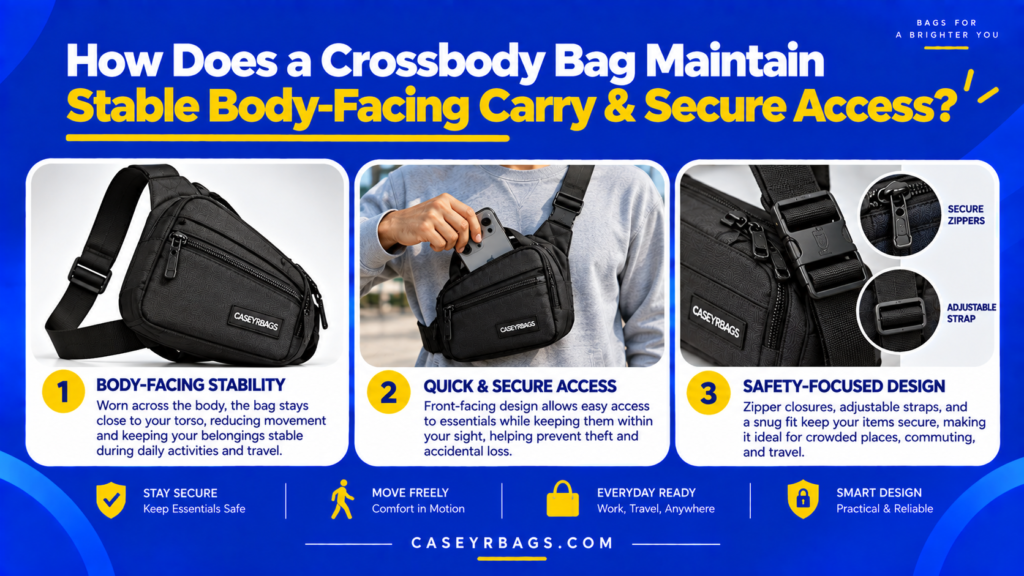
How Does a Crossbody Bag Maintain Stable Body-Facing Carry & Secure Access?
A Crossbody Bag maintains body-facing carry through a diagonal strap path that links the bag to the opposite shoulder while strap length, anchor placement, bag depth, and internal load determine how much the bag swings, rotates, tilts, or pulls away from the body during movement.
Secure access comes from controlling how the bag opens and which contents become exposed during repositioning or retrieval. Opening orientation, closures, internal pockets, and quick-access zones can keep routine access deliberate while reducing unnecessary exposure. Stable positioning ≠ zero movement, body-facing carry ≠ theft prevention, and closure control ≠ guaranteed security.
What Do Stable Body-Facing Carry & Secure Access Mean in a Crossbody Bag?
Stable body-facing carry means the Crossbody Bag remains in a reasonably predictable position against the torso, side, or hip instead of repeatedly swinging, rotating, or pulling strongly away from the body during normal movement.
Secure access means the user can reach intended contents while the opening, closure, and pocket layout keep other items reasonably contained and avoid unnecessary exposure. It describes retention and access control rather than theft prevention or guaranteed security.
The two functions are connected. Within Everyday Carry, a bag that moves excessively is harder to access predictably, while an opening that requires awkward repositioning can destabilize otherwise controlled crossbody carry.
Which Features Directly Support Stable Body-Facing Carry?
A diagonal shoulder strap, strap adjustment, anchor placement, bag width, bag depth, the body-facing panel, and internal load position all influence where the bag sits and how strongly it moves. Each feature changes the relationship between the bag body, the strap path, and the intended carry zone.
Feature → position effect → stability consequence. Strap adjustment sets overall location, anchors influence orientation, bag geometry affects body contact, and internal load placement determines whether the packed bag stays centered or pulls toward one side.
Which Features Directly Control Access?
Zippers, flaps, snaps or magnetic closures where present, opening orientation, internal pockets, exterior quick-access pockets, and compartment zoning control how contents become reachable. These features determine how much of the bag must open and how much else becomes exposed during retrieval.
Access feature → exposure control → retrieval consequence. Faster access can help routine items, while more complete containment can help items that should remain controlled. Neither maximum speed nor maximum closure complexity is automatically superior.
Why Must Stability and Access Be Evaluated Together?
A stable bag with awkward access can force repeated rotation or removal, while an easy-opening bag that moves excessively can expose contents unpredictably during retrieval. The two systems therefore affect each other during every routine access cycle.
Effective Crossbody carry combines controlled position with controlled retrieval. The bag should move enough to support access when needed, then return predictably to its normal body-facing carry zone without repeated correction.
How Does Crossbody Strap Geometry Stabilize the Bag?
Diagonal strap geometry creates a body-linked carrying system by supporting the bag from the opposite shoulder and limiting some of the free movement associated with single-shoulder carry.
How Does Diagonal Carry Differ From Single-Shoulder Carry?
A crossbody path runs from one shoulder across the torso to the bag on the opposite side. Within Everyday Carry, that diagonal linkage can provide more positional control than a bag hanging from one shoulder because the strap connects the bag to a broader body position rather than one local suspension point.
The advantage remains mechanical rather than medical. Diagonal carry can reduce some movement potential, but final stability still depends on strap length, anchor placement, bag depth, packed shape, and load behavior during movement.
How Does Strap Angle Affect Bag Position?
The path from the shoulder to the bag defines the direction in which strap tension supports the load. Strap Anchoring and strap length can move the bag toward the front, side, or hip and change how closely the body-facing panel contacts the user.
Shoulder point → diagonal strap path → bag location. The useful angle is the one that supports the intended carry zone while preserving controlled movement and workable access rather than forcing one universal position.
Why Can a Crossbody Bag Still Swing Despite Diagonal Carry?
A long strap setting, deep bag body, dense contents, normal walking movement, or loose internal load can still create swing and rotation. This remains distinct from Sling Bag rotational carry because the diagonal strap reduces some freedom but does not eliminate inertia or load movement.
Diagonal carry reduces some movement potential but does not eliminate motion. Stable carry therefore means predictable, manageable movement rather than a bag that never shifts at all.
How Does Strap Length Affect Body-Facing Stability?
Strap length changes the bag’s height, distance from the torso, movement freedom, and ease of repositioning, so adjustment should refine the intended carry zone rather than chase maximum tightness.
How Does a Shorter Strap Change Movement?
A shorter setting can place the bag closer to the torso and reduce some free swing by shortening the movement path available to the bag. It can also support more predictable Body Access when the bag geometry supports that position.
Closer does not automatically mean better for every user or bag. Excessive shortening can make the bag sit too high, reduce practical repositioning, or make the main opening harder to reach without awkward manipulation.
How Does a Longer Strap Change Movement?
A longer setting can place the bag lower, increase the swing arc, and make it easier to rotate the bag toward the front for Travel Access. The extra movement freedom can help retrieval while creating more opportunity for movement during walking.
Longer strap → greater movement freedom → increased swing potential. The useful length depends on whether that movement remains predictable and whether the bag can return easily to its normal body-facing position.
When Is Strap Adjustment No Longer Enough to Fix Instability?
Adjustment stops being sufficient when the bag is overloaded, excessively deep, unevenly packed, poorly anchored, or filled with contents that move independently. Secondary Fastening addresses opening control, not the structural cause of swing or load imbalance.
Adjustment can refine position; it cannot fix every structural mismatch. If instability persists, load distribution, anchor behavior, bag depth, and internal retention should be evaluated before extra tightening is used as the only correction.
How Does Anchor Placement Affect Crossbody Bag Stability?
Anchor placement determines how strap tension enters the bag body, affecting orientation, pivoting, and rotation.
How Do Widely Separated Anchors Affect Bag Orientation?
Separated attachment points can distribute strap influence across more of the bag body and help preserve a predictable orientation. Depending on bag shape, this can reduce the tendency for the entire body to pivot around one central point.
Anchor spacing → bag orientation → rotation control. Wider separation is not automatically superior because the result still depends on the bag’s dimensions, construction, strap path, and packed load.
How Can Narrow or Central Attachment Geometry Affect Movement?
Narrow or central attachment geometry can allow more pivoting, rotation, or bag-body movement in some designs because strap force enters through a smaller directional zone. That movement may help repositioning but can reduce orientation control if the load is uneven.
The actual behavior depends on the structure around the anchor and the contents inside the bag. Anchor location should therefore be observed as part of the whole system rather than ranked from spacing alone.
Why Must Anchors Work With the Bag Body?
A strong strap attached to poorly integrated anchor geometry does not guarantee stable carry. The bag body can still twist, tilt, or pull away if its shape, depth, or internal load creates forces that the anchors do not control well.
Strong strap + poorly integrated anchor geometry ≠ guaranteed stable carry. Effective stability comes from the interaction between strap tension, attachment geometry, bag structure, and packed-load behavior.
| Anchor Pattern | Bag Orientation Effect | Rotation Potential | Main Check |
|---|---|---|---|
| Separated side anchors | Broader orientation control | Often lower | Observe loaded alignment |
| Narrow anchor spacing | More localized pull | Can increase | Check pivoting |
| Centralized attachment | Easy rotation in some designs | Variable | Check body control |
| Asymmetric load + any anchor | Orientation can shift | Higher | Correct load first |
How Do Bag Size & Depth Affect Body-Facing Carry?
Bag size changes body contact and movement because width, depth, and packed shape determine how far the load sits from the body-facing panel and how easily the bag can rotate.
How Does Bag Depth Affect Body Contact?
Greater depth moves part of the load farther from the body-facing panel and can increase the space through which the bag can tilt or rotate. A deeper body can provide more storage while making controlled body contact more dependent on load placement and strap adjustment.
Greater depth → load farther from body-facing panel → greater movement potential. This is a structural relationship rather than a medical claim, and the practical limit appears through observable movement rather than one universal depth measurement.
How Does Bag Width Affect Stability?
A wider bag can create a larger contact area against the body and distribute contents across more horizontal space. It can also become more sensitive to one-sided loading because dense items placed far to one side create a stronger tilt or rotational tendency.
Width therefore creates both control and imbalance possibilities depending on shape and load. The bag should be evaluated while packed rather than assuming a wider or narrower body is automatically more stable.
When Does Bag Size Become Too Large for Stable Crossbody Behavior?
A functional size mismatch appears when the bag repeatedly swings, rotates, loses body contact, requires awkward repositioning, or develops an unstable packed shape during normal use. Those behaviors matter more than one fixed dimension.
Functional size limit appears when the load can no longer remain predictably controlled. The correction may involve reducing or redistributing contents, changing the carry position, or using a bag geometry better matched to the intended load.
| Bag Trait | Possible Stability Effect | Main Risk |
|---|---|---|
| Slim profile | Closer body position | Limited capacity |
| Greater depth | More volume | Increased movement potential |
| Wider body | Larger contact area | Uneven-load sensitivity |
| Compact body | Easier repositioning | Reduced storage volume |
How Does Internal Load Placement Affect Crossbody Stability?
Internal load placement changes how the bag hangs because dense, loose, and one-sided contents can shift the load center away from the position supported by the strap and anchors.
Why Should Dense Items Remain Close to the Body-Facing Side?
Dense items positioned closer to the body-facing panel can keep the packed geometry more compact and reduce the tendency for the load to pull outward. The goal is structural control rather than a medical rule about how weight must always be carried.
Dense item closer to body-facing panel → more controlled bag geometry. The benefit is strongest when the item also remains centered enough to avoid creating left-right tilt or interfering with the main opening.
How Does One-Sided Loading Change Bag Behavior?
A dense item shifted strongly left or right can pull the bag into tilt or rotation because the center of the packed load no longer aligns with the body and strap system. The bag may then present its opening or pockets at a less predictable angle.
Dense item shifted left/right → bag tilt or rotation → less predictable access. Correcting the load distribution is usually more effective than simply tightening the strap around the same imbalance.
How Do Loose Contents Increase Movement?
Loose contents can move independently inside the chamber, changing the load center as the user walks or repositions the bag. This can make the Crossbody appear stable at rest and then shift unexpectedly during movement or access.
Moving contents → changing load center → changing bag orientation. Stable contents support stable Crossbody carry, so internal pockets, dividers, or other retention methods can help when migration becomes a repeated problem.
| Load Position | Bag Behavior | Stability Effect | Access Effect |
|---|---|---|---|
| Dense item body-side | Closer geometry | More controlled | More predictable |
| Dense item outer-side | Pulls outward | Lower body contact | Opening angle may shift |
| Dense item one-sided | Tilt / rotation | Lower stability | Less predictable |
| Loose mixed contents | Changing load center | Variable | Changing pocket/opening position |
How Does Body-Facing Position Improve Access Control?
Keeping the bag within the immediate body zone can make repositioning and opening more deliberate.
How Does Front or Front-Side Positioning Affect Access?
Front or front-side positioning can improve visual control, direct hand reach, and observation of the opening during access. It can also reduce the need to remove the bag completely for routine retrieval when the strap and opening geometry support that position.
Greater visibility can improve access management, but it does not guarantee theft prevention or complete security. The bag still depends on closure operation, pocket roles, load control, and actual handling behavior.
How Does Side or Hip Positioning Change Access?
Side or hip positioning can feel natural for normal carrying and may keep the bag out of the immediate front body zone. Some designs then require controlled forward rotation before the main opening becomes easy to see and reach.
This repositioning is useful when it remains predictable and reversible. If the bag rotates too freely or the load shifts during the motion, routine access can become a repeated source of instability.
Why Is Easy Repositioning Important?
A well-controlled Crossbody can move from the side toward the front, allow access, and then return to the intended carry position without full removal. That sequence preserves the connection between the bag and strap while supporting routine retrieval.
Side position → controlled rotation forward → access → return to carry position. Good Crossbody access should not require fully detaching the bag for routine retrieval where the design intends on-body access.
How Do Opening Orientation & Closures Affect Secure Access?
Opening direction and closure type determine how much of the main compartment becomes exposed during access.
How Does Opening Orientation Change Exposure?
An opening that faces upward, outward, or toward the body presents contents differently during repositioning. The useful orientation depends on the bag design, carry position, and whether the opening remains predictable when the bag is moved for access.
Opening direction → visibility/exposure → access control. An orientation that works well at the side may behave differently after the bag rotates forward, so the opening should be evaluated through the full access movement rather than at rest alone.
How Do Zippers, Flaps & Other Closures Change Access?
A zipper can provide more complete opening control, a flap can cover the opening with a different access sequence, and a snap or magnetic closure can provide faster routine access with different retention behavior. Each mechanism changes both containment and retrieval steps.
Closure control ≠ guaranteed security. The useful closure provides enough retention for the intended contents without creating unnecessary opening difficulty or repeated manipulation that destabilizes the bag.
Why Can Excessive Closure Complexity Reduce Useful Access?
Extra opening layers can increase retrieval steps, make one-handed access more awkward, require more bag repositioning, and slow routine use. More closure mechanisms can therefore increase containment while also increasing manipulation.
More closure layers ≠ automatically better secure access. Controlled access requires appropriate retention and predictable opening behavior rather than maximum obstruction.
| Access Feature | Retention Role | Access Effect | Main Limitation |
|---|---|---|---|
| Zipper | Controls opening | Deliberate access | Extra opening step |
| Flap | Covers opening | Variable access speed | Can obstruct visibility |
| Snap/Magnet | Partial retention | Faster routine access | Less complete closure |
| Open pocket | Minimal closure | Fastest access | Greater exposure |
How Should Crossbody Bag Pockets Be Zoned for Secure Access?
Pocket zoning should assign frequent-use items to faster access zones and higher-containment items to more controlled internal zones so retrieval remains predictable rather than fragmented.
Which Items Belong in Quick-Access Zones?
Quick-access zones are best suited to frequently retrieved, low-bulk items whose brief exposure does not create a major containment problem. The category of item matters less than the frequency, bulk, and consequence of repeated retrieval.
Quick-access pocket → faster retrieval / greater exposure. The pocket should have a clear role instead of becoming a general overflow area that changes load balance or interferes with the main opening.
Which Items Are Better Kept in More Controlled Internal Zones?
Important, less frequently retrieved, easier-to-lose, or higher-containment items often fit better in internal zones where the main closure or compartment structure provides additional control. This reduces the number of exterior openings that must remain active.
Controlled internal zone → stronger containment / slower retrieval. The trade-off is acceptable when the item does not need constant access and when keeping its location predictable matters more than retrieval speed.
Why Can Too Many Exterior Pockets Reduce Access Control?
Too many exterior pockets can disperse item locations, create more exposed openings, duplicate storage roles, and increase the number of decisions required during retrieval. The result can be slower access despite having more nominally accessible compartments.
Secure access improves when pocket roles remain clear. A smaller number of purposeful zones can make retrieval more predictable than a larger number of overlapping pockets with uncertain roles.
How Should Carry Stability & Access Speed Be Balanced?
The most stable position is not always the fastest position for opening, so the final setup should balance controlled movement with the amount of repositioning needed for routine retrieval.
When Does a Tighter Body Position Improve Stability but Slow Access?
A closer body position can reduce free swing and improve positional control, but it may require more deliberate rotation before the opening becomes easy to see or reach. This creates a trade-off between carrying control and retrieval speed.
Closer position → greater control potential → more deliberate access. The best result is not maximum closeness but a position that stays controlled while still allowing routine access without excessive manipulation.
When Does a Looser Position Improve Access but Increase Movement?
More movement freedom can make the bag easier to rotate or slide toward the front, which can speed access in some designs. The same freedom increases the potential for swing, tilt, or rotation during normal movement.
More movement freedom → easier repositioning → potentially more swing. A useful setup preserves enough freedom for access without allowing the bag to move unpredictably when retrieval is not occurring.
How Should the Final Carry Position Be Chosen?
Identify the normal load and preferred carry zone, adjust the strap for controlled movement, then test front and side repositioning. Open the main compartment, retrieve common items, and return the bag to its carry position in that sequence.
If routine access repeatedly destabilizes the bag, adjust the setup and test again. The final position should support both predictable movement and workable retrieval rather than maximizing either stability or access speed in isolation.
When Does Crossbody Carry Become Unstable or Poorly Controlled?
Poor control appears when movement, load behavior, or routine access repeatedly forces the bag away from its intended body-facing position.
Which Movement Signals Indicate Poor Stability?
Repeated swinging, bag rotation, persistent tilt, repeated repositioning, and the bag pulling away from the body are practical signals that strap, load, or bag geometry may not be working together effectively.
One movement event does not establish a structural problem. The stronger signal is repeated, predictable instability during normal use that interferes with carry position or access.
Which Access Signals Indicate Poor Control?
Poor access control appears when the opening must remain unnecessarily exposed, contents move toward the opening, the closure is difficult to operate, the bag must be removed for simple retrieval, or exterior pockets interfere with the main opening.
These signals show that the access system is creating more manipulation than the carry position can absorb predictably. The correction should address the opening, pocket role, load, or bag position rather than merely adding closure complexity.
What Should Be Corrected First?
Check load distribution first, then control loose contents, adjust strap length, inspect anchor behavior, evaluate bag depth, review pocket assignment, and finally check closure and opening orientation. This order targets structural causes before access details are changed.
Fix the source of instability rather than only tightening the strap. A tighter strap cannot correct every one-sided load, deep bag, unstable anchor layout, or poorly organized interior.
How Can Crossbody Carry & Access Mismatches Be Avoided?
Mismatches are avoided by judging strap geometry, load control, opening behavior, and access needs together rather than treating one feature as the universal solution.
Why Is a Shorter Strap Not Always the Best Stability Solution?
Excessive shortening can create an awkward bag height, difficult opening access, poor repositioning, or an anchor angle that does not work well with the bag body. The bag may feel tighter while becoming less usable.
Shorter ≠ universally more stable. Strap length should refine the relationship among bag position, body contact, and access instead of compensating for poor load distribution or incompatible bag geometry.
Why Is the Strongest Closure Not Always the Best Access Solution?
Additional closure complexity can reduce retrieval speed, one-handed access, and practical everyday use. A highly obstructive opening can force more bag rotation or repeated manipulation even while improving containment.
Secure access requires appropriate control, not maximum obstruction. The closure should match the actual retention need while preserving predictable routine retrieval.
What Should Be Verified Before Relying on Crossbody Bag Carry and Access?
Verify strap integrity, strap length, anchor security, bag position, body contact, swing, rotation, dense-item position, loose-item control, opening orientation, closure usability, pocket roles, routine repositioning, and routine access with the normal packed load.
The bag should return predictably to its carry position after retrieval, and body-facing placement should not be treated as theft prevention. The completed system should be judged by controlled movement and controlled retrieval working together.
- Strap is intact.
- Strap length supports the intended body position.
- Strap anchors remain secure.
- Bag sits reasonably close to the body.
- Bag does not swing excessively during normal walking.
- Bag does not repeatedly rotate or tilt.
- Dense contents are positioned predictably.
- Loose items remain controlled.
- Bag depth does not create excessive movement.
- Main opening remains correctly oriented.
- Closure operates without unnecessary difficulty.
- Quick-access pockets have clear roles.
- Important contents are not unnecessarily exposed.
- Exterior pockets do not create major one-sided loading.
- Bag can be repositioned for access without full removal where intended.
- Routine access does not repeatedly destabilize the bag.
- Body-facing positioning is not treated as theft prevention.
- Closure strength is not treated as guaranteed security.
- Stability and access are evaluated as one connected system.
Conclusion
A Crossbody Bag maintains stable body-facing carry through a diagonal strap system that keeps the bag linked to the torso while strap adjustment, anchor placement, bag size, depth, and internal load determine how closely and predictably it remains positioned. Secure access comes from combining that controlled position with suitable opening orientation, closures, and pocket zoning.
The best setup allows some movement for repositioning without letting swing, tilt, or rotation become unpredictable. Dense and loose contents should remain controlled, the opening should stay manageable during retrieval, and routine access should not repeatedly destabilize the bag. Stable Crossbody carry is controlled movement, not zero movement; secure access is controlled retention and retrieval, not guaranteed security.
FAQs
Front or front-side positioning can improve visibility of the bag, make the opening easier to observe, and support more deliberate access during routine retrieval.
It does not guarantee theft prevention or complete security. Greater visibility ≠ guaranteed security, and closure control plus handling behavior still matter.
No. Shorter settings can reduce some free movement by keeping the bag closer to the torso and shortening its swing path.
Useful strap length still depends on bag size, anchor geometry, preferred carry position, and practical access. Shorter ≠ universally more stable.
A zipper can provide more complete opening control and deliberate access, but it is not the only closure that can provide useful retention.
Flaps, snaps, magnets, and other systems may be appropriate depending on the required access speed and containment. Zipper ≠ mandatory secure-access mechanism.