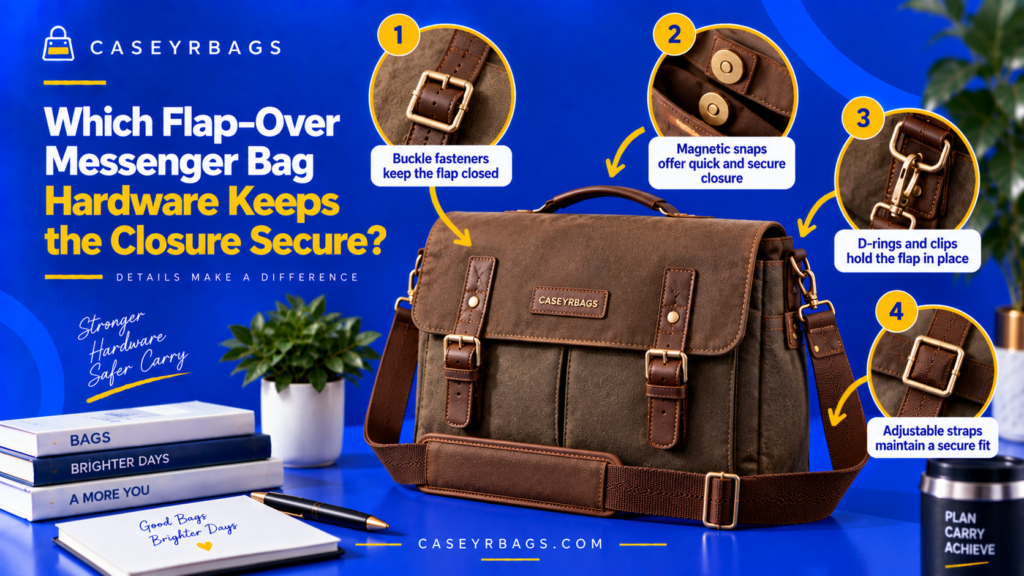
How Does Flap-Over Messenger Bag Closure Control Access?
A Flap-Over Messenger Bag controls access by placing a broad flap over the main opening and using one or more fasteners to determine when that opening becomes exposed. The user must release the closure and move the flap before reaching the main compartment, creating a deliberate access sequence rather than an always-open entry path.
The effectiveness of that system depends on more than the fastener itself. Flap overlap, fastener placement, flap stiffness, opening width, internal closures, item location, and load all affect how easily the user can release, expose, retrieve, and reclose the bag.
What Does Closure-Controlled Access Mean in a Flap-Over Messenger Bag?
Closure-controlled access means the main compartment is not fully exposed until the user performs a deliberate opening sequence. In a Flap-Over Messenger Bag, that sequence usually begins by releasing a fastener and moving the flap away from the main opening.
The flap provides the physical cover, while the fastener determines when that cover can move freely. Opening quality therefore depends on both the retention mechanism and the geometry of the flap and main opening.
The useful question is whether release, exposure, retrieval, and reclosure remain predictable and proportionate to the items being accessed. Within the broader Messenger Bag system, flap control supports work-item carry only when the opening itself remains usable.
Which Parts Create the Closure-Controlled Access System?
The system includes the front flap, flap overlap, primary fastener, fastener attachment, main opening, and any secondary internal closure. Each part affects either exposure, release, or retrieval.
Flap coverage establishes the physical barrier, fasteners regulate flap movement, and the main opening determines whether exposure becomes usable access after release.
Why Is Flap Coverage Not the Same as Sealing?
A closed flap can cover the opening while side gaps, seams, fabric, closure gaps, or the base remain potential exposure paths.
Covered opening ≠ sealed opening. Flap coverage should be evaluated as opening control rather than evidence of waterproof construction.
Why Is Closure Control Not the Same as Theft Prevention?
Fasteners can keep the flap in its intended closed position and require a deliberate release action before the opening is exposed.
Closure retention ≠ theft prevention. The system controls normal opening behavior without guaranteeing resistance to unauthorized access.
How Does Flap Coverage Control Main-Compartment Exposure?
Flap overlap determines how much of the main opening is physically covered before release and how far the flap must move before the opening becomes usable.
How Does Broader Flap Overlap Reduce Direct Exposure?
More overlap covers more of the opening and upper bag face, reducing the amount of the access area directly exposed while the flap remains closed.
More overlap → more opening coverage. The effect is physical coverage only and should not be interpreted as complete sealing or waterproofing.
How Can Insufficient Flap Overlap Reduce Access Control?
Limited overlap can leave edge sections or parts of the opening more visible and less physically covered when the flap is closed.
Less coverage changes exposure control but does not by itself prove poor retention. Fastener placement and opening geometry still matter.
When Can Too Much Flap Coverage Slow Access?
Excess overlap can require greater flap movement, more repositioning, or a larger lift path before the user reaches the main opening.
More overlap ↔ more flap movement. Coverage becomes inefficient when the extra movement adds friction without a useful access-control benefit.
How Do Different Fasteners Control Flap Access?
Fastener type changes the release action required before the flap can move, but no closure format is universally best for every retrieval pattern.
How Do Buckles or Side-Release Clips Control Access?
Buckles and clips use a positive mechanical release that must be intentionally disengaged before the flap can move.
Positive mechanical release → deliberate opening step. The added step can suit some tasks while becoming unnecessary friction for frequent retrieval.
How Do Snaps, Magnets, or Hook-and-Loop Fasteners Change the Sequence?
Snaps use localized release points, magnets rely on alignment and separation, and hook-and-loop uses a broader contact release.
Each format changes reach, release motion, and closure feel. None should be treated as universally fastest or best.
Why Can the Same Fastener Work Differently Across Bags?
Placement, fastener size, flap stiffness, load, and opening geometry can make the same closure type easy on one bag and awkward on another.
Hardware type alone does not determine access quality. For the dedicated mechanism, see Flap Hardware.
| Closure Format | Typical Release Character | Main Access Effect |
|---|---|---|
| Buckle / clip | Deliberate mechanical release | More explicit opening step |
| Snap | Localized release | Direct |
| Magnet | Alignment / release | Low-step |
| Hook-and-loop | Broad contact release | Direct but contact-dependent |
| Flap + zipper | Layered | Additional access step |
How Does Closure Placement Affect Access Speed?
Fastener position changes visibility, reach distance, and how much hand movement is required before the flap can be lifted.
How Does Central Closure Placement Affect Access?
A clearly visible central fastener can create a direct release path because the user can identify and reach one known closure point.
Visible central fastener → direct reach → lower search demand where the bag geometry supports that position.
How Do Two Separated Fasteners Change Access?
Two separated fasteners require two release points and additional hand movement across the flap before it can open fully.
Two release points → additional hand movement → more deliberate opening. More deliberate does not automatically mean better.
When Does Low or Hidden Placement Create Friction?
Low or hidden fasteners can increase search, lengthen reach, complicate one-handed release, or sit beneath the flap edge where they are harder to locate.
Low/hidden fastener → longer reach/search path → greater access friction, especially during repeated worn retrieval.
How Does Flap Stiffness Affect Opening Behavior?
Flap stiffness controls whether the flap holds a predictable shape, folds easily, or interferes with the opening while access is underway.
How Does a Structured Flap Behave During Opening?
A structured flap tends to preserve its shape during lifting and can remain easier to position away from the main opening.
Predictable shape → predictable movement. The trade-off is that a stiff flap may offer less adaptive movement around the hand or contents.
How Does a Flexible Flap Behave?
A flexible flap can fold and drape easily, making it adaptable to movement but also more likely to collapse back toward the opening.
Flexible flap → easier folding ↔ possible opening interference. Flexibility is useful only when the flap stays clear during retrieval.
When Does Flap Stiffness Become Access Friction?
Access friction appears when the flap resists lifting, requires awkward hold-open behavior, blocks visibility, or repeatedly falls into the hand path.
The useful stiffness level is the one that creates predictable movement without becoming a barrier.
| Flap Character | Opening Behavior | Main Trade-Off |
|---|---|---|
| Flexible | Adapts easily | May collapse into opening |
| Semi-structured | Predictable + adaptable | Balanced |
| Rigid | Holds shape | Less adaptive movement |
How Does Main-Opening Geometry Work With the Flap Closure?
Releasing the flap only exposes the opening; the opening still needs enough width, visibility, and hand clearance to support actual retrieval.
Why Does Opening Width Still Matter After the Flap Is Released?
A fully lifted flap can reveal an opening that remains too narrow for clear visibility or direct hand entry.
Flap released ≠ retrieval path clear. The exposed opening must still provide usable access to the intended item zones.
How Can Narrow Opening Geometry Create Continued Friction?
Limited width can reduce visibility, block the hand path, and force awkward item angles even after the primary closure has been released.
Fast flap release + restricted main opening → exposed but difficult retrieval. Access must be judged beyond the release step.
When Do Flap Access and Opening Geometry Work Well Together?
Useful geometry appears when the flap clears fully, the opening width is sufficient, interior zones are visible, and the hand can reach them directly.
Effective closure control ends in usable retrieval, not merely an exposed opening.
When Does an Internal Zipper Add Useful Secondary Access Control?
An internal zipper can create a second containment layer after the flap is opened, but the extra step is useful only when it serves a distinct storage need.
What Does an Internal Zipper Add After the Flap Is Opened?
The zipper retains the main chamber or a specific zone after the flap has already been released and moved.
Primary flap release → opening exposure → secondary zipper release → item retrieval. The sequence adds another deliberate access step.
When Is the Extra Step Justified?
A secondary zipper can be useful for lower-frequency contents or items that benefit from deliberate containment inside the flap-covered area.
The additional step should serve a clear storage role rather than duplicate the primary closure without purpose.
When Does Flap + Zipper Become Redundant for Routine Access?
Routine items can become unnecessarily slow to reach when every retrieval requires both flap release and an internal zipper without a distinct containment need.
More closure layers ≠ better access control for every item.
| Sequence | Steps | Access Consequence |
|---|---|---|
| Primary flap only | Release flap → lift flap → main opening | Shorter controlled sequence |
| Flap + internal zipper | Release flap → lift flap → open zipper → retrieve | Additional containment + extra step |
| Quick-access pocket | Use assigned pocket without main flap | Fewer main-compartment steps |
How Does Pocket Placement Work With Flap-Controlled Access?
Pocket location determines whether an item requires the full flap-opening sequence or can be reached through a shorter assigned path.
Which Pockets Reduce Unnecessary Main-Flap Opening?
Clearly assigned quick-access pockets can keep selected high-frequency items reachable without opening the main flap every time.
Quick-access pocket → fewer main-compartment steps. The pocket role should remain clear so frequently used items do not migrate between zones.
When Do Internal Pockets Increase Retrieval Steps?
Deep or flap-dependent internal pockets can require flap release, full lifting, main-opening entry, and additional reaching before the item is located.
Internal placement is useful when the extra steps match the item’s retrieval frequency and containment need.
Why Should Pocket Role Remain Predictable?
Clear item-to-pocket assignments reduce searching and repeated opening because the user knows which access path to use.
Clear location → less searching → fewer repeated opening actions.
How Does Retrieval Frequency Affect the Best Closure Sequence?
Access sequence should match retrieval frequency so repeated-use items do not accumulate unnecessary closure steps.
Why Do Frequent Items Need Fewer Unnecessary Barriers?
A small extra action becomes more meaningful when it is repeated many times during normal use.
Repeated release steps accumulate into routine access friction. Frequent items should use the shortest predictable path that still fits the bag’s control needs.
When Can Deliberate Multi-Step Closure Remain Appropriate?
Lower-frequency items or contents benefiting from more deliberate containment can reasonably sit behind an additional closure layer.
Multi-step access can be functional when retrieval frequency is low enough that the control benefit justifies the extra action.
Why Should Closure Complexity Follow Access Frequency?
Closure complexity should reflect how often the user needs the item and how much access control the storage role actually requires.
Access sequence should match retrieval frequency. More closure steps are not inherently better.
How Does Strap Position Affect Flap Access While the Bag Is Worn?
Worn access depends on whether the bag can move from its resting side position into a predictable access position where the flap and fastener remain reachable.
How Can the Bag Move From Side Carry Toward an Access Position?
The long strap can allow the bag to be guided toward the front or a more visible side position before the closure is released.
Side carry → controlled repositioning → fastener and flap become easier to see and reach.
How Does Strap Length Change Closure Reach?
Strap length changes resting height and the distance the hand must travel to reach the closure and lift the flap.
Strap position → closure reach path. A useful setting balances normal carry position with practical access.
When Does Worn Access Become Awkward?
Worn access becomes difficult when the closure sits outside comfortable reach, the bag rotates, the flap opens toward the body, or a heavy load resists repositioning.
Worn access should be tested in the intended carry position rather than assumed from tabletop opening behavior.
How Does Load Placement Affect Flap Closure?
Normal contents can change flap alignment, fastener position, and opening geometry, so the closure should be judged under realistic loading.
How Can Tall or Bulky Contents Push Against the Flap?
Bulky contents can apply upward or outward pressure that lifts the flap, changes overlap, or crowds the main opening.
Contents pushing outward → flap displacement → closure geometry changes. The effect can appear even before the bag is technically overfilled.
How Can Uneven Loading Affect Closure Alignment?
An end-heavy load can tilt the bag and move one fastener relative to its matching closure point.
Uneven load → bag tilt → fastener mismatch or uneven flap overlap. Internal balance therefore affects closure behavior.
Why Should the Flap Be Tested With the Normal Load?
An empty bag can show clean alignment that changes once realistic contents tension the body and opening.
Empty closure fit ≠ loaded closure fit. Normal loading provides the more relevant access test.
How Does Overfilling Reduce Flap-Controlled Access?
Overfilling adds pressure against the flap, fasteners, and opening and can make both release and reclosure less predictable.
How Does Overfilling Affect Fastener Alignment?
Excess contents can increase closure tension, push the flap outward, and shift fasteners away from their intended alignment.
Overfilling → flap displacement → fastener misalignment → harder release or reclosure.
How Does Overfilling Affect Flap Movement?
Packed contents can press into the flap and opening area, making the flap harder to lift clear or leaving too little hand space after release.
Overfilled chamber → restricted flap movement → poorer visibility and hand clearance.
Why Can a Bag Close but Still Have Poor Access?
A fastener can still engage while the opening remains crowded, the flap is under high tension, or routine retrieval requires rearranging contents.
Bag closes ≠ closure system is working efficiently.
How Does Flap Closure Affect Accidental Item Exposure?
The flap and fasteners can keep the intended opening covered during normal carry, but that retention function should not be expanded into theft-prevention claims.
How Does Flap Coverage Limit Direct Opening Exposure?
A lowered flap physically covers the main opening and reduces direct visual or physical exposure from the covered direction.
Physical coverage helps maintain the intended closed state without proving complete containment.
How Do Fasteners Help Keep the Flap in Its Intended Position?
Fasteners resist ordinary flap movement and keep the cover aligned over the opening until the user releases them.
Fastener engagement → flap remains closed → opening remains covered during normal handling.
Why Does This Not Equal Theft Prevention?
Closure hardware controls ordinary retention and opening sequence but does not guarantee resistance to deliberate unauthorized access.
Retention control ≠ anti-theft guarantee.
How Does Flap Closure Affect Weather Exposure?
Flap overlap can reduce direct exposure from some directions, but actual weather resistance depends on the full material and seam system.
How Can Flap Overlap Reduce Direct Exposure?
A flap that overlaps the opening can physically block some direct exposure from above or the front while it remains correctly positioned.
Flap overlap → physical cover → reduced direct exposure from some directions.
Why Does Flap Closure Not Make the Bag Waterproof?
Water can still enter through side gaps, seams, fabric, closure gaps, or the base depending on construction and conditions.
Flap coverage ≠ waterproofing and covered opening ≠ sealed opening.
What Determines Actual Weather Resistance?
Material treatment, seam construction, flap overlap, closure design, and manufacturer specifications determine the bag’s actual weather-resistance claims.
Weather performance should be verified from the specific bag design rather than inferred from flap presence.
When Does Flap Closure Become Too Complex for Routine Access?
Closure complexity becomes excessive when repeated release actions add more retrieval cost than the retention benefit they provide for routine items.
When Do Multiple Release Actions Become Redundant?
Redundancy appears when two or more closure layers protect the same routine zone without serving clearly different containment roles.
Repeated closures for one frequent-use zone → more steps → slower routine retrieval.
When Does One-Handed Opening Become Unnecessarily Difficult?
Poor reach, awkward fastener order, hidden hardware, or an unstable worn position can force multiple hand changes before the flap is free.
One-handed difficulty is a useful friction signal when frequent retrieval is part of the intended use.
How Should Closure Complexity Be Judged?
Judge each step by whether its retention or containment benefit justifies the retrieval effort it adds.
Retention benefit ↔ retrieval cost. No universal fastener count or closure format is automatically best.
How Can Flap-Over Messenger Access Friction Be Diagnosed?
Access friction is easiest to correct when the delay is identified at the exact stage where it occurs: before flap movement, after exposure, or during reclosure.
Does the Delay Occur Before the Flap Moves?
Check fastener reach, release difficulty, fastener count, and whether hardware is hidden or difficult to identify.
Delay before flap movement → inspect primary closure type and placement first.
Does the Delay Occur After the Flap Is Lifted?
Check main-opening width, visibility, internal zipper steps, and pocket position if the flap is already clear but the item remains difficult to reach.
Flap released ≠ retrieval path clear. The bottleneck may sit inside the exposed opening.
Does the Delay Occur During Reclosure?
Check overfilling, flap alignment, load position, and fastener alignment when closing the bag takes more effort than opening it.
Reclosure friction often points to loaded geometry rather than the release mechanism itself.
How Can Flap-Over Messenger Closure-Controlled Access Be Evaluated?
Real-use evaluation should inspect the closure system before loading, then test release, exposure, retrieval, reclosure, and worn access with the normal contents.
What Should Be Inspected Before Loading?
Inspect flap overlap, fastener type, fastener placement, flap structure, main opening, internal closure, and pocket roles before contents are added.
These checks identify likely access barriers before loaded geometry changes the flap or opening.
What Should Be Tested After Loading?
Test closure release, flap movement, opening visibility, frequent-item retrieval, reclosure, and worn access using the normal contents.
Post-load testing reveals whether pressure, imbalance, or bag position changes the access sequence.
Which Sequence Should Determine Closure-Access Fit?
- Load the bag normally.
- Close the main compartment.
- Lower the flap.
- Secure the primary fastener.
- Carry the bag normally.
- Move the bag into its normal access position.
- Release the flap closure.
- Lift the flap.
- Retrieve one frequent-use item.
- Return the item.
- Reclose and secure the flap.
- Confirm that access remains predictable without unnecessary steps.
Use the sequence in order so the closure is fully tested from normal loaded carry through release, exposure, retrieval, return, and reclosure.
Accept the system only when the same sequence remains predictable without unnecessary steps in the intended access position.
How Can Flap-Over Messenger Closure Mismatches Be Avoided?
Closure mismatch is avoided by evaluating function rather than counting fasteners or assuming that easy release proves easy retrieval.
Why Should Fastener Count Not Define Closure Quality?
One fastener can work well when it is reachable and proportionate to the opening, while multiple fasteners can add useful or redundant actions depending on the task.
Fastener count ≠ closure quality. Each release point should have a functional reason.
Why Should Easy Closure Release Not Be Judged Without Opening Geometry?
A fastener can release quickly while a narrow opening, hidden pocket, internal zipper, or deep chamber still slows item retrieval.
Easy release ≠ easy retrieval. The entire exposure-to-item path must remain usable.
What Should Be Verified Before Treating the Closure System as Effective?
Verify useful flap coverage, reachable fasteners, nonredundant steps, predictable flap movement, sufficient opening width, visible storage zones, justified secondary closure, and pocket roles matched to retrieval frequency.
Also verify practical worn access, stable loaded alignment, normal reclosure without excessive pressure, separate weather evaluation, and a predictable release → expose → retrieve → reclose sequence.
- Front flap clearly covers the intended main opening.
- Flap overlap supports controlled exposure without unnecessary movement.
- Flap coverage is not treated as complete sealing.
- Closure retention is not treated as theft prevention.
- Primary fastener is identifiable and reachable.
- Fastener count does not create redundant routine steps.
- Fastener placement supports the intended access position.
- Flap stiffness allows predictable opening.
- Flap does not repeatedly collapse into the access path.
- Main opening remains sufficiently wide after the flap is lifted.
- Opening visibility supports routine retrieval.
- Internal zipper has a clear secondary purpose where present.
- Secondary closure does not unnecessarily duplicate routine barriers.
- Pocket roles match retrieval frequency.
- Frequent items do not require avoidable closure layers.
- Worn access remains practical at the intended strap position.
- Normal loading does not distort flap alignment.
- Overfilling does not prevent normal release or reclosure.
- Fasteners align without excessive pressure.
- Weather exposure is evaluated separately from flap coverage.
- Closure system can be reopened and resecured predictably.
- Final access quality is judged through release, exposure, retrieval, and reclosure together.
Conclusion
A Flap-Over Messenger Bag controls access by using its flap and fasteners to determine when the main opening becomes exposed. Effective closure control creates a deliberate sequence in which the user releases the fastener, moves the flap, reaches the opening, retrieves the intended item, and restores the closure without unnecessary manipulation.
The best system balances coverage with usable movement, keeps fasteners identifiable and reachable, preserves sufficient opening width, and remains predictable when the bag is normally loaded and worn. More overlap, more fasteners, or an internal zipper are not automatically better. Flap-controlled access works best when coverage, fastener behavior, flap movement, opening geometry, item placement, loaded fit, and reclosure function as one predictable release → expose → retrieve → reclose sequence.
FAQs
Flap size alone does not determine access speed. A broad flap can still open efficiently when overlap, fastener reach, and flap movement remain practical.
Access becomes slower when excessive overlap, closure steps, stiffness, opening geometry, or item placement adds repeated manipulation between release and retrieval.
No closure format is universally better. Buckles, snaps, magnets, and hook-and-loop systems create different release actions and retention behavior.
The useful choice depends on placement, reach, flap stiffness, load, and routine-access frequency. A closure should be judged by the complete access sequence rather than hardware type alone.
A closed flap can reduce direct exposure and help retain the main opening in its intended covered position during normal carrying.
That function should not be treated as theft prevention. Closure control describes ordinary retention and access sequence; it does not guarantee resistance to unauthorized access.