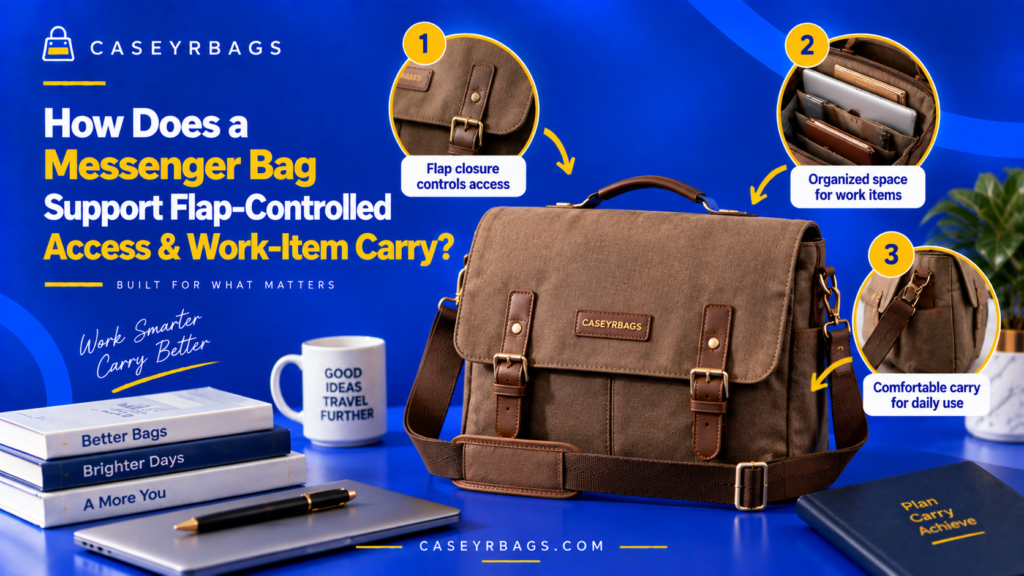
How Does a Messenger Bag Support Flap-Controlled Access & Work-Item Carry?
A Messenger Bag supports flap-controlled access by placing a broad front flap over the main opening, often combined with buckles, snaps, hook-and-loop, magnets, zippers, or other retention systems. This creates a deliberate access layer while allowing the bag to maintain a relatively broad opening for retrieving work-related contents.
Its work-item carry function comes from a generally rectangular body, flat storage zones, internal dividers, accessory pockets, and a shoulder- or crossbody-oriented strap. These features help separate documents, notebooks, compatible electronics, and smaller accessories while keeping the bag accessible during transport.
What Defines a Messenger Bag Through Flap-Controlled Access & Work-Item Carry?
A Messenger Bag typically uses a broad flap that folds over the upper or front portion of the main compartment. This creates a recognizable access architecture in which the opening is covered and exposed by moving the flap rather than relying only on an uncovered top opening.
The body is commonly wider than it is deep and often uses a rectangular or near-rectangular profile. This geometry supports flat or moderately thick work items such as documents, notebooks, folders, and appropriately sized electronics.
A long shoulder- or crossbody-oriented strap then supports side carry and allows repositioning for access. Within Everyday Carry, Messenger Bag identity comes from the combined flap + work-item body + long-strap carry system rather than one visible feature alone.
Which Features Create the Strongest Messenger Bag Identity?
A broad front flap, controlled main opening, rectangular work-item body, flat storage zones, internal organization, and a long shoulder- or crossbody-oriented strap create the strongest Messenger Bag signal.
Feature → functional role → Messenger Bag identity. Flap control manages exposure, the body supports work-item geometry, and the strap creates the side-carry path.
Which Features Are Secondary Rather Than Defining?
Decorative buckles, logos, color, exterior styling, grab handles, and detachable accessories can alter appearance or convenience without defining the category by themselves.
Secondary details matter only when they change the dominant access, work-storage, or carry architecture. Visual resemblance alone is a weak taxonomic signal.
Why Must Flap, Body, and Carry Geometry Be Evaluated Together?
A long strap can appear on many Shoulder Bags and Crossbody Bags, while a front flap can appear on satchels and other formats. Neither feature independently establishes Messenger identity.
Long strap alone ≠ Messenger Bag and front flap alone ≠ Messenger Bag. Identity is strongest when flap-controlled access, flat-item storage, and side-carry geometry operate together.
How Does the Front Flap Control Messenger Bag Access?
The front flap acts as the first structural layer between the user and the main chamber, controlling when the opening is covered and when it becomes visible and reachable.
How Does the Flap Cover the Main Opening?
With the flap lowered, the upper or front opening is physically covered; lifting the flap exposes the access path to the main chamber.
Flap closed → opening covered; flap lifted → main access exposed. This creates a deliberate first access step without sealing the bag.
How Does Flap Size Affect Compartment Exposure?
Broader coverage can overlap more of the opening and upper bag face, while shorter or narrower flaps may leave more side or edge area exposed.
More coverage changes opening exposure, not guaranteed security or waterproofing. Coverage should be judged as a physical access layer.
Why Is Flap Coverage Different From Complete Sealing?
Flap sides, seams, closure gaps, fabric, and lower edges can remain potential exposure paths even when the main opening is covered.
Covered opening ≠ sealed opening. For the subtype-specific retrieval mechanism, see Flap-Over Access.
How Do Flap Closures Change Access Control?
Closure systems add different release steps to the flap, so the useful design depends on retrieval frequency and the amount of deliberate retention the task needs.
How Do Buckles or Clips Affect Access?
Buckles or clips usually require an intentional mechanical release before the flap can be lifted, creating a clear retention step.
Deliberate release → added opening step → controlled access. The extra step can be useful or unnecessarily slow depending on retrieval frequency.
How Do Snaps, Magnets, or Hook-and-Loop Closures Affect Access?
Snaps create localized release points, magnets provide quick alignment and release, and hook-and-loop uses a broader contact area.
Each mechanism changes the release feel and sequence rather than establishing a universal best closure. Work-item frequency should guide the fit.
When Does Closure Complexity Slow Work-Item Retrieval?
Multiple redundant fasteners, difficult one-handed release, or frequent items behind several layers can make routine retrieval unnecessarily slow.
More closure steps ≠ better access for every work item. The hardware-specific follow-up is Flap Hardware, without treating retention as theft-proofing.
| Closure Format | Access Steps | Retention Character | Retrieval Effect |
|---|---|---|---|
| Buckle/clip | Moderate | Deliberate | Controlled |
| Snap | Low–moderate | Localized | Quick |
| Magnet | Low | Quick alignment | Fast |
| Hook-and-loop | Low–moderate | Broad contact | Direct |
| Flap + zipper | Higher | Layered | More deliberate |
How Does Messenger Bag Opening Geometry Support Retrieval?
A broad upper opening can work with the flap to expose flat work-item zones efficiently, but opening width and hand path still determine real retrieval quality.
Why Does a Wide Opening Suit Flat Work Items?
A broad opening can reduce the angle needed to insert or remove notebooks, folders, and compatible devices when their dimensions fit the usable chamber.
Broad opening → easier flat-item insertion/removal → lower retrieval friction. Exterior width still does not guarantee equivalent usable internal width.
How Can a Narrow Flap Gap Slow Access?
A restricted gap can reduce visibility, force awkward item angles, require the flap to be lifted farther, or block the hand path.
Flap release can be easy while retrieval remains difficult. The opening itself must still expose the intended storage zone.
When Does the Main Opening Remain Easy to Use?
Useful access combines sufficient opening width, predictable flap position, an unobstructed hand path, and visible compartment zones.
Easy flap release does not guarantee easy retrieval if the main opening remains restricted. Opening geometry and internal zoning must work together.
Why Does Messenger Bag Body Shape Suit Work Items?
A wide rectangular or near-rectangular body creates a flatter storage plane that can keep documents, notebooks, folders, and compatible devices more predictably oriented.
How Does a Wide Rectangular Body Support Documents?
A flatter storage plane reduces the need to fold paper-based items and gives documents a more predictable horizontal or vertical orientation.
Rectangular body → flatter storage plane → more predictable document position. Flat storage still does not guarantee crease prevention.
How Does Vertical or Horizontal Orientation Affect Item Fit?
Work-item dimensions must match the usable internal height and width rather than simply the bag’s exterior silhouette.
Orientation affects whether an item enters cleanly, remains flat, and can be retrieved without twisting. Fit should be checked against the actual interior.
Why Does Exterior Size Not Guarantee Usable Work-Item Capacity?
Padding, dividers, seams, closures, and internal sleeves can reduce the chamber dimensions available to the intended work item.
External dimensions ≠ usable internal dimensions. A large-looking bag can have less flat-item space than its exterior suggests.
| Work Item | Preferred Structural Zone | Fit Question |
|---|---|---|
| Document / Folder | Flat zone | Does it remain flat without forced folding? |
| Notebook | Main organized zone | Can it enter and leave cleanly? |
| Tablet | Sized device zone | Are actual dimensions compatible? |
| Small electronics | Separated zone | Can movement be controlled? |
| Cable pouch | Accessory/main zone | Does it avoid distorting flat items? |
How Does Internal Organization Support Work-Item Carry?
Purposeful internal zoning keeps flat work items, compatible electronics, and small accessories from mixing into one undifferentiated chamber.
How Do Dividers Separate Flat Work Items?
Defined vertical or horizontal zones keep documents, notebooks, and folders from mixing with smaller loose contents.
Defined zones → reduced mixing → predictable retrieval. Divider roles should be clear enough that item location becomes easier to remember.
How Do Smaller Pockets Organize Accessories?
Smaller pockets can assign pens, cables, chargers, cards, or compact tools to dedicated zones rather than allowing them to collect around flat items.
Accessory zoning works when each pocket has a useful role. It should reduce search and prevent bulky small items from distorting documents.
Why Can Too Many Pockets Reduce Work-Item Usability?
Excess pockets can fragment usable space, duplicate storage roles, and make the user check several similar locations for one item.
Work organization ≠ maximum pocket count. A few purposeful zones can outperform many ambiguous pockets.
How Should Documents Be Positioned in a Messenger Bag?
Paper-based work items benefit from a predictable flat zone that limits mixing with bulky accessories and keeps insertion and removal straightforward.
Why Do Documents Benefit From a Dedicated Flat Zone?
A dedicated flat zone keeps papers and folders in a predictable orientation and reduces mixing with objects that create uneven pressure or shape.
Dedicated document storage → more predictable orientation → easier retrieval. The structure supports flatness without guaranteeing perfect crease prevention.
How Can Bulky Accessories Affect Document Storage?
Chargers, pouches, bottles, or irregular objects can press against papers, create uneven surfaces, and make insertion or removal more difficult.
Bulky accessory pressure can bend or distort documents even when the bag body is rectangular. Separation matters as much as overall capacity.
Why Does Bag Structure Not Guarantee Document Protection?
Actual paper condition depends on bag rigidity, item placement, surrounding contents, and external pressure during use.
Flat storage ≠ crease-proof storage. Messenger structure can support document orientation without certifying complete protection.
How Does a Messenger Bag Carry Laptops or Tablets?
Device storage must be evaluated from actual compartment dimensions, separation, retention, and padding rather than inferred from the Messenger Bag label.
What Should a Device Compartment Provide?
A device zone should match the intended electronics, separate them from loose items, provide suitable retention, and include appropriate padding where the design offers it.
Correctly sized device zone → more stable positioning → better work-item separation. For the dedicated comparison of protective structure, see Laptop vs Unpadded.
Why Must Device Fit Be Verified Rather Than Assumed?
Messenger Bag label ≠ universal laptop compatibility because devices and internal compartments vary in height, width, thickness, and usable opening geometry.
Verify actual device and compartment dimensions before treating the zone as suitable. The narrower device-fit follow-up is Tablet Fit.
Why Does Padding Not Guarantee Complete Device Protection?
Padding can add cushioning, but actual protection also depends on construction, base separation, closure, device fit, and the nature of external impacts.
Padded sleeve ≠ certified impact protection. For the specific cushioning role and its limits, see Laptop Padding.
| Feature | What It Supports | What It Does Not Guarantee |
|---|---|---|
| Sized sleeve | Device positioning | Universal compatibility |
| Padding | Added cushioning | Impact-proofing |
| Retention strap | Movement control | Theft prevention |
| Raised/separated base | Reduced direct base contact | Complete drop protection |
How Does Messenger Bag Depth Affect Work-Item Carry?
Bag depth changes raw capacity, layering potential, outward load position, and the amount of organization needed to keep work items accessible.
How Does Shallow Depth Support Flat-Item Organization?
Shallower chambers can keep documents aligned, reduce stacked layers, and improve visual access to the main work-item zones.
Shallow depth can simplify organization when the intended contents fit. It is not automatically superior because some work kits need more volume.
How Does Greater Depth Expand Work-Item Capacity?
Additional depth can accommodate thicker notebooks, accessory pouches, chargers, and multiple content layers beyond the flat-item plane.
Greater depth → more volume and layering potential → higher organization demand. For the slimmer-body capacity question, see Slimline Capacity.
When Does Extra Depth Reduce Organization?
Excess depth can bury small items, increase stacking, concentrate dense contents outward, and make retrieval more dependent on pocket zoning.
More depth ≠ better work organization. Capacity helps only when the added volume remains structured and accessible.
How Does the Long Strap Support Messenger Bag Carry?
The long strap creates the primary side-carry system and lets the loaded bag move between a resting side position and a more accessible front/side position.
How Does Shoulder Carry Support the Bag?
A long strap over one shoulder suspends the bag along the side, with resting height determined by strap length, bag geometry, and load.
Long strap → single shoulder-supported suspension → side position. This is one carry mode within Messenger architecture, not the entire category definition.
How Does Crossbody Positioning Change Bag Control?
A diagonal strap path changes the body-facing position, movement range, and way the bag can be brought toward the front for retrieval.
Crossbody positioning does not guarantee stability or security. The adjacent carry architecture is Crossbody Bag.
Why Does Strap Adjustment Matter for Work-Item Carry?
Strap length changes resting height, access position, swing range, and body proximity, so the same bag can behave differently at different settings.
Long strap ≠ automatically stable carry. Adjustment should support predictable side carry and practical repositioning with the normal load.
How Do Strap Anchors Affect Messenger Bag Stability?
Anchor spacing and support determine how the long strap controls the orientation of a loaded rectangular body during side carry and repositioning.
How Does Anchor Spacing Affect Bag Tilt?
Separated anchors spread strap influence across a broader portion of the bag body and can reduce the amount of free pivoting around one attachment point.
Separated anchors → broader orientation control → more predictable loaded position. The benefit depends on the surrounding bag panels remaining stable.
How Can Uneven Loading Interact With Anchor Geometry?
An end-heavy load can make one side drop, rotate the bag, and create unequal tension even when both anchors are structurally sound.
Dense load at one end → bag tilt → uneven strap-anchor demand. Internal load balance remains part of orientation control.
Why Does Anchor Strength Not Determine Comfortable Load Capacity?
Strong anchors can keep the strap attached while the rest of the bag, strap, body geometry, or carried load still becomes impractical.
Strong anchors ≠ verified comfortable carry limit. The entire bag + strap + body + load system determines real carry behavior.
How Does Messenger Bag Carry Support Access While Worn?
Side carry can support worn retrieval when the bag can be repositioned toward the front or side without losing flap control or loaded orientation.
How Can the Bag Move From Side Carry Toward Front Access?
A Messenger Bag can often be guided from its side position toward a more visible front/side position where the flap and closure become easier to reach.
Side position → controlled repositioning → flap becomes visible and reachable. Not every strap or bag slides equally well under load.
How Does Flap Orientation Support This Retrieval Pattern?
When the flap faces outward or upward after repositioning, the user can release the closure, lift the flap, and expose the main opening.
Flap orientation and strap position work together. The access path becomes predictable only when both remain controllable.
When Does Worn Access Become Awkward?
A strap that is too short or long, a heavy load, excessive bag depth, complex closures, or poor anchor orientation can make repositioned access difficult.
Messenger-style access depends on both strap position and flap geometry. Worn access should be judged with the realistic loaded bag.
How Should Frequently Used Work Items Be Positioned?
Access frequency should determine storage priority so routine items use shorter retrieval paths while lower-frequency or fragile items occupy deeper or more protected zones.
Which Items Belong in Quick-Access Zones?
Frequently retrieved, compact items that do not require deep protection can use near-opening or clearly identified quick-access zones.
Quick-access placement should reduce repeated searching without being framed as guaranteed secure valuables storage. Frequency, not value, is the organizing principle.
Which Items Belong in the Main Organized Chamber?
Regular work items of medium size often fit best in the main organized chamber where dividers or sleeves keep their location predictable.
Routine-use items benefit from stable storage roles that remain easy to identify after the flap is opened.
Which Items Should Remain in Protected or Deeper Zones?
Less frequently retrieved or more fragile items can occupy separated deeper zones when that position does not bury higher-priority contents.
Access frequency should guide storage priority. Deeper placement is useful only when separation and retrieval remain predictable.
How Does Load Placement Affect Messenger Bag Carry?
Internal weight distribution changes how the rectangular body hangs from its anchors and whether the flap, opening, and work zones remain predictably aligned.
Where Should Dense Work Items Generally Sit?
Dense contents generally behave more predictably in a controlled central or body-facing region and inside a stable compartment rather than at one extreme end.
Centralized dense loading reduces the tendency for one side to drop while preserving more predictable access geometry.
What Happens When Heavy Accessories Collect in Outer Pockets?
Outer-heavy accessories increase outward pull, effective bag depth, and rotation potential and can also reduce flap alignment.
Dense outer zones can make both carry and access less controlled. Exterior convenience should not override loaded orientation.
How Does End-Heavy Packing Affect Messenger Bag Orientation?
Dense load at one end creates bag tilt and unequal demand across the strap anchors, especially during walking or repositioning.
Organized storage should also preserve predictable load geometry. Internal zoning should support both retrieval and balanced carry.
How Does Overfilling Affect Flap-Controlled Access?
Overfilling can distort the relationship between the main chamber, flap, fasteners, and internal zones even when the bag can still be physically closed.
How Does Overfilling Change Flap Closure?
Excess contents can lift the flap outward, increase closure tension, and misalign snaps, buckles, magnets, or other fasteners.
Overfilled chamber → flap displacement → closure friction. A closed bag can still have a poorly functioning access system.
How Does Overfilling Affect the Main Opening?
Contents can crowd the opening, compress dividers, stack work items, and block the hand path used for normal retrieval.
More contents can reduce usable access even while raw volume is technically available. Organization quality should be judged after loading.
Why Is Maximum Volume Different From Usable Work Capacity?
Available internal volume can exceed the amount that remains efficiently organized, accessible, and compatible with normal flap closure.
Available volume ≠ organized work-item capacity and bag closes ≠ bag is efficiently packed.
How Does the Flap Affect Weather Exposure?
The flap can reduce direct exposure to the main opening from some directions, but its protective effect remains limited by material, seams, closure geometry, and orientation.
How Can Flap Overlap Reduce Direct Exposure?
A physical cover over the opening can reduce direct exposure from above or the front when the flap overlaps the access area and stays properly positioned.
Flap closed → opening covered → direct exposure can be reduced. The effect depends on orientation and construction.
Why Does Flap Coverage Not Make the Messenger Bag Waterproof?
Water can still reach the interior through flap sides, seams, zipper gaps, fabric, or the base depending on the design.
Flap coverage ≠ waterproofing. Covered opening ≠ sealed opening, and no waterproof claim should be inferred from flap presence alone.
What Determines Actual Weather Resistance?
Material treatment, seam construction, closure design, flap overlap, and manufacturer specifications determine the bag’s actual weather-resistance claims.
Weather resistance should be verified from the specific design. Flap coverage is only one structural contributor.
How Does a Messenger Bag Differ From a Shoulder Bag?
Both formats can use single-strap side carry, so the stronger Messenger distinction comes from the combined flap, work-item body, and internal zoning architecture.
What Structural Feature Most Clearly Distinguishes Messenger-Style Access?
A broad flap covering a work-oriented main chamber is a stronger Messenger signal than a generic shoulder strap by itself.
Flap architecture matters because it controls a broad work-item opening rather than merely decorating a side-carry bag.
Can Both Bags Use Single-Strap Shoulder Carry?
Yes. Messenger Bags and generic Shoulder Bags can both use one long strap for side suspension.
Single shoulder strap alone does not define a Messenger Bag. Carry geometry must be interpreted with body and access architecture.
What Combination Provides the Clearest Distinction?
Flap architecture + rectangular work-item body + long strap + internal work zoning provides the clearest Messenger-specific structure.
The distinction is strongest when these features cooperate in normal use rather than appearing as isolated styling elements.
When Does a Messenger Bag Stop Functioning Well for Work-Item Carry?
The Messenger work-carry system weakens when access, organization, and loaded orientation stop reinforcing one another under realistic contents.
When Does the Main Compartment Become Too Mixed?
Documents mixed with bulky accessories, no stable device zone, and small items collecting at the bottom indicate that the work zones are no longer doing useful separation.
Poor work zoning → item mixing → repeated searching and repositioning → weaker work-carry performance.
When Does Flap Access Become Unnecessarily Slow?
Too many closure layers, an overfilled chamber, or difficult flap positioning can make frequent retrieval slower than the structural control justifies.
Access friction becomes excessive when routine items require repeated opening steps or rearrangement that does not add useful organization.
When Does the Carry System Become Poorly Controlled?
Strong end tilt, excessive swing, an outward-heavy load, or frequent manual repositioning indicate that the loaded body is no longer predictably oriented.
Poor loaded control weakens both carry and flap alignment. Messenger work carry depends on access architecture, zoning, and orientation functioning together.
How Can Messenger Bag Access & Work-Item Carry Be Evaluated?
Realistic evaluation should inspect the access system before loading, then test work-item fit, flap closure, side carry, and repositioned retrieval with the normal work contents.
What Should Be Inspected Before Loading?
Inspect flap coverage, closures, opening width, internal dividers, device sleeve, accessory pockets, strap, and anchors before contents are added.
These pre-load checks establish whether the bag has the structural features needed for controlled access and purposeful work zoning.
What Should Be Tested After Loading?
Test document insertion and removal, notebook retrieval, device fit where relevant, accessory retrieval, flap closure, side carry, and access while repositioned.
Loaded testing is required because real contents can change flap alignment, opening clearance, bag depth, and strap orientation.
Which Sequence Should Determine Work-Carry Fit?
- Identify the normal work items.
- Separate flat, dense, fragile, and small items.
- Load documents into a suitable flat zone.
- Place compatible electronics in intended protective compartments.
- Organize small accessories.
- Close the main chamber and flap.
- Carry the bag at its intended side position.
- Reposition it for access.
- Release the flap closure.
- Retrieve one frequent-use work item.
- Reclose the bag.
- Check whether contents remain organized and the bag orientation stays controlled.
Use the sequence in order so normal contents are classified before documents, compatible electronics, and accessories are assigned to their intended zones and the flap is closed.
Then test side carry, repositioned access, one frequent-use retrieval, reclosure, and final organization. Work-carry fit passes only when access and loaded orientation remain controlled.
How Can Messenger Bag Access & Work-Carry Mismatches Be Avoided?
Mismatches are avoided by preventing the flap, rectangular body, large chamber, or long strap from being treated as sufficient Messenger evidence on its own.
Why Is a Large Main Compartment Alone a Weak Work-Carry Signal?
Raw volume without zoning can produce item mixing, buried accessories, unstable dense loads, and slower retrieval.
Large capacity helps only when the contents remain separated and accessible. Volume should not replace purposeful organization.
Why Is a Front Flap Alone an Incomplete Messenger Bag Signal?
Flaps also appear on Shoulder Bags, satchels, Crossbody Bags, and other formats that may not use Messenger-style work-item geometry.
Front flap alone ≠ Messenger Bag. The category requires the combined flap, body, organization, and long-strap system.
What Should Be Verified Before Treating the Bag as Effective for Messenger-Style Work Carry?
Verify meaningful flap coverage, usable opening width, closure steps suited to retrieval frequency, rectangular fit for intended flat items, actual device compatibility, clear divider and pocket roles, controlled depth, and accessible frequent-use zones.
Also verify balanced dense-item placement, practical long-strap position, stable anchors, normal flap closure without overfilling, realistic repositioned access, and Messenger identity based on flap + body + work organization + strap together.
- Front flap clearly controls exposure of the main opening.
- Flap coverage is not confused with waterproofing.
- Closure control is not confused with theft-proofing.
- Main opening remains sufficiently accessible.
- Closure steps match access frequency.
- Rectangular body supports intended flat work items.
- Exterior size is not confused with usable internal dimensions.
- Documents have a suitable flat storage zone.
- Bulky accessories do not unnecessarily distort documents.
- Device compartments are checked for actual compatibility.
- Padding is not treated as guaranteed impact protection.
- Internal dividers have clear roles.
- Pocket count is not treated as organization quality.
- Frequently retrieved items occupy accessible zones.
- Dense items are not concentrated unnecessarily in outer pockets.
- End-heavy loading is limited.
- Bag depth remains compatible with access and organization.
- Long strap supports the intended carry position.
- Strap length allows practical repositioning.
- Strap anchors keep the loaded bag reasonably oriented.
- Overfilling does not prevent normal flap closure.
- Available volume is not confused with organized work-item capacity.
- Messenger identity is based on flap + body + work organization + strap together.
Conclusion
A Messenger Bag supports flap-controlled access through a broad cover that regulates exposure of the main opening and works with one or more closures to create deliberate entry to the bag. Its rectangular body, internal dividers, accessory zones, and long strap then support predictable transport and retrieval of work-related items.
The system works best when the flap closes normally, the opening remains usable, documents and compatible electronics occupy appropriate zones, small accessories remain separated, and the loaded body stays reasonably oriented during side carry and repositioned access. Messenger identity therefore comes from flap control, work-item geometry, purposeful organization, and long-strap carry functioning together—not from a flap, large chamber, long strap, device sleeve, or pocket count by itself.
FAQs
The flap covers the main opening and creates a deliberate first access layer before the work compartment is exposed.
It can keep the opening visually and structurally controlled, but that coverage does not imply complete sealing, waterproofing, or theft prevention. Those properties require separate design evidence.
Some Messenger Bags are suitable when the intended laptop fits the actual device compartment dimensions and the bag provides appropriate retention and padding.
Messenger Bag identity alone does not guarantee compatibility or protection. Device dimensions, usable sleeve size, padding construction, and base design should be verified separately.
Both formats may use a long single strap for side carry, so strap type alone does not distinguish them.
Messenger Bags are more strongly characterized by a broad flap over a work-oriented opening, a generally rectangular body, flat-item organization, and accessory zoning working together.