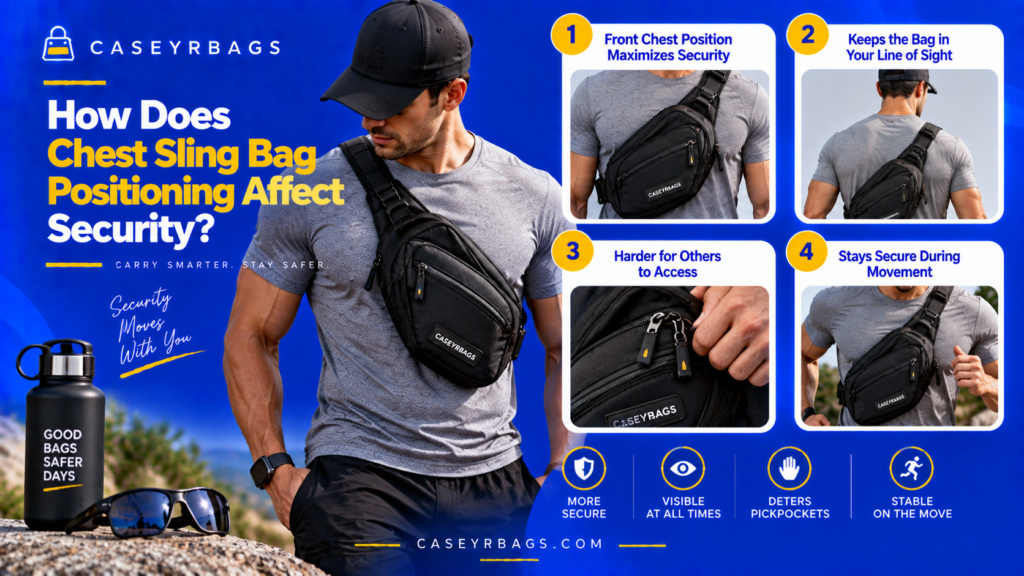
How Does Chest Sling Bag Positioning Affect Security?
Chest Sling Bag positioning affects security by changing how visible, reachable, and controllable the bag remains to the wearer. A close front-of-torso position can keep the bag within normal forward awareness while reducing uncontrolled movement that could change opening direction, pocket exposure, or the location of the main closure during ordinary movement.
Position alone does not secure the contents. Useful position-based access security also depends on bag height, body-facing contact, opening orientation, closure design, strap adjustment, pocket direction, rotational movement, and whether the loaded shape allows every closure to remain properly engaged. The practical goal is predictable wearer monitoring and a repeatable closed state rather than treating front carry as theft-proofing.
What Does Security Mean in Chest Sling Bag Positioning?
A Chest Sling Bag places the bag on or across the front of the torso rather than leaving it primarily behind the wearer. This usually places the bag within a more observable and immediately reachable area, so changes in position, rotation, and opening direction are easier for the wearer to notice during normal movement.
That visibility can improve awareness of the bag’s position, openings, and closures. However, security depends on whether the bag stays predictably oriented, remains close enough for practical monitoring, and allows the wearer to maintain deliberate control over its access points as the strap, load, and body position change.
Position-based security should therefore be evaluated through visibility, body contact, opening exposure, closure control, and item retention rather than through chest position alone. The position supports access control only when those elements continue working together in the loaded bag within the broader Sling Bag system.
Which positioning factors most directly affect security?
Chest height, body proximity, lateral position, opening orientation, closure exposure, strap stability, and pocket direction are the main positioning variables because each changes what the wearer can see, reach, and verify. A shift in any one of them can alter the geometry of the bag’s access points even when the bag still looks front-carried.
Position feature → access effect → security consequence is the useful reading order. The bag should remain predictably oriented, and its important openings should stay within practical wearer control rather than becoming harder to observe because the strap, load, or body position has changed.
Why can chest positioning improve wearer awareness?
Front-of-torso placement can keep the bag inside the wearer’s normal visual and physical awareness, making changes in bag height, orientation, zipper-pull location, or closure state easier to notice than when the bag sits primarily behind the body. This supports quicker recognition of unintended movement or an incomplete return to the closed state.
Awareness is a monitoring advantage, not a guarantee of protection. A visible bag can still have an outward-facing opening, an exposed pocket, or a partially engaged closure, so chest positioning should be judged by whether it makes those states easier for the wearer to verify and correct.
Why does front positioning not guarantee security?
Front positioning can coexist with exposed openings, loose strap adjustment, outward-facing pockets, incomplete closure, or an overfilled compartment. These conditions can reduce access control even though the bag remains visibly located on the chest, because the actual opening geometry and closure state may still be poorly controlled.
Visible carry improves awareness; it does not eliminate access risk. The practical question is whether the loaded bag preserves a predictable closed state and whether the wearer can readily recognize when position, rotation, or loading has changed that state.
How Does Chest Position Improve Bag Visibility?
Keeping the Sling Bag within the wearer’s forward field of awareness can make bag position, closure state, and unexpected movement easier to monitor, but visibility only supports access control when the openings themselves remain well managed.
How does front carry make bag position easier to monitor?
Front-of-torso placement keeps the bag within an area the wearer can more readily see, touch, and compare against its intended resting position. Changes in chest height, lateral offset, rotation, or body contact can therefore become more noticeable during ordinary movement and repeated access.
The benefit is practical awareness rather than automatic security. A bag can remain visible while still shifting, opening, or presenting an exposed pocket, so the useful test is whether front carry helps the wearer recognize and restore the intended position and closure state.
How does visibility help the wearer monitor openings?
When the main opening, zipper pull, or closure hardware remains within easier view, the wearer can check whether the access point has returned to its intended closed position. Bag orientation also becomes easier to notice, so an unexpected rotation or a zipper that has not been fully returned is less likely to go unnoticed.
Visibility supports security awareness by making closure state easier to verify. It does not make the closure itself stronger or prevent access, so the bag’s design, loading, and actual closure engagement remain separate parts of the position-security evaluation.
Why is visibility not sufficient by itself?
A visible bag can still contain exposed zipper tracks, open pockets, loose closures, or an opening that faces away from the wearer. Direct sight of the bag does not automatically reveal every access path, especially when overfilling, rotation, or pocket orientation changes how the bag sits.
Visibility supports security awareness; closure control completes it. The position should make it practical to notice orientation and closure state, while the closures themselves still need to be fully engaged and the load must allow them to operate normally.
How Does Body-Facing Contact Affect Access Security?
Body-facing contact reduces the free space around the bag and helps preserve predictable opening orientation. For the related placement question focused specifically on access position, see Chest Sling Body Access.
How can close body contact reduce uncontrolled bag movement?
Consistent torso contact reduces the free swing available to the bag, so the main opening, pockets, and closure hardware are less likely to change direction merely because the bag moves independently. A smaller movement zone can therefore make the access geometry more predictable during walking and routine repositioning.
Close contact supports predictable orientation rather than creating immobilization. The wearer still needs to check strap adjustment, load balance, and closure state because a bag can rotate or migrate even while part of its body-facing panel remains in contact with the torso.
How can body contact limit exposure of body-facing pockets?
A pocket positioned directly against the torso may have less open clearance around its access point while the bag remains properly chest-positioned. That reduced clearance can make the pocket less externally exposed than an outward-facing pocket, especially when the bag maintains close and predictable body contact.
This is an exposure condition, not an inaccessibility claim. Body-facing pockets can still be opened depending on design, closure location, movement, and bag orientation, so they should be evaluated by how much practical access space remains in the actual loaded position.
Why does close contact not prevent unauthorized access?
Body contact does not prevent access because openings may remain externally reachable depending on the bag design, closure position, lateral orientation, and movement of the bag. A close-fitting body panel only describes one relationship between the bag and torso; it does not control every zipper, pocket, or external opening.
Body contact ≠ access prevention. Position-based security remains strongest when body proximity works together with predictable opening direction, fully engaged closures, stable strap adjustment, and item placement that does not force the bag away from its intended chest geometry.
| Position | Body Contact | Opening Predictability | Main Limitation |
|---|---|---|---|
| Close | High | Higher | Still externally accessible |
| Moderate | Moderate | Variable | More movement |
| Loose | Low | Lower | Greater rotation / exposure |
How Does Chest Sling Bag Height Affect Security?
Chest height changes how directly the wearer can monitor the bag, how easily closures can be reached, and how much free movement the Sling Bag has, so the useful position balances awareness with practical access.
How can a relatively higher chest position affect monitoring?
A relatively higher chest position can keep the bag closer to the wearer’s forward awareness and may make zipper pulls, closure movement, and unexpected position changes easier to inspect. The shorter free-hanging distance can also help the bag remain closer to the intended chest plane when the strap and anchors support that position.
Higher placement is useful only while access remains functional. If the bag becomes difficult to open or forces an awkward closure angle, the increased visibility does not automatically produce better position-security fit; the practical balance between awareness, body contact, and usable closure operation matters more than maximum height.
How can a very low position affect security control?
A very low position can permit more swing, lateral movement, and rotational freedom, which may move the main opening or exposed pockets away from direct wearer monitoring. As the bag travels toward the side, the intended opening orientation can change even if the strap remains attached and structurally sound.
Lower chest carry is not automatically insecure, but the position should remain deliberate. The useful check is whether the wearer can still recognize closure state, maintain body-facing contact, and prevent uncontrolled migration that changes the bag’s access geometry.
Why is the highest possible position not automatically best?
The highest possible position can restrict access, create an awkward closure angle, interfere with natural movement, or make zipper and buckle operation harder. Those effects can increase access friction and may encourage incomplete reclosure even though the bag itself remains highly visible.
Useful chest height balances awareness, body contact, and practical closure access. No universal ideal height is supported because Sling Bag geometry, strap routing, body fit, and opening location vary; the loaded bag should be judged by whether position and closure operation remain predictable together.
| Carry Height | Visibility | Body Contact | Access Consideration |
|---|---|---|---|
| Very high | High | High potential | May restrict opening |
| Controlled chest | High | High | Balanced potential |
| Low chest | Moderate | Variable | More movement |
| Very low | Lower direct monitoring | Lower | Greater swing potential |
How Does Lateral Position Affect Chest Sling Bag Security?
Centered, front-side, and side-biased positions change what the wearer can see and how the main opening is reached, so lateral placement should remain intentional rather than drifting through uncontrolled migration.
How does a centered or near-centered position affect control?
A centered or near-centered chest position can keep both edges of the bag within easier direct awareness and make the overall orientation simpler to recognize. The main opening, zipper pull, and body-facing relationship can therefore be easier to compare with their intended positions during ordinary movement and after routine access.
Centered carry is not universally safest. The position is useful only when the bag remains comfortable to operate, its openings remain controllable, and the strap geometry can preserve the location without constant correction. Front-side carry may be equally functional for a different design or access pattern.
How does a front-side position change access?
A front-side position can place the bag closer to the dominant hand and make routine retrieval easier, but some of the bag may sit outside the direct center of the wearer’s view. This can change the opening angle and may require more deliberate monitoring of the side-facing edge or zipper path.
Front-side carry should be judged by whether that offset remains stable and intentional. The useful setup preserves a predictable opening direction and closure position while still allowing the wearer to verify the bag’s state without excessive rotation or strap looseness.
When can excessive side migration weaken position-based security?
Excessive migration toward the side or under the arm can turn the main opening away from the wearer, reduce direct visibility, and increase rotational movement. The concern is not the side position itself but an uncontrolled change that moves the bag outside its intended monitoring and access geometry.
Side position is not automatically insecure; uncontrolled migration is the concern. Check whether strap adjustment, anchor geometry, uneven loading, or repeated access is allowing the bag to drift away from the deliberately chosen chest or front-side position.
| Position | Wearer Awareness | Access Geometry | Main Watchpoint |
|---|---|---|---|
| Center chest | High direct awareness | Symmetrical monitoring | Do not assume universally safest |
| Front-side | Moderate–high | Direct hand access | Partial lateral orientation |
| Side migration | Reduced direct view | Opening angle changes | Uncontrolled movement |
How Does Main-Opening Orientation Affect Security?
The main opening determines where contents become exposed during use, so a chest-positioned bag only supports access control when the opening remains visible, reachable, and predictably oriented after movement.
How does an opening oriented toward the wearer affect control?
An opening oriented toward the wearer can make the closure easier to inspect and keep the opening path within a more directly monitored access zone. The wearer can more readily see whether a zipper, flap, or other closure has returned to its intended state after retrieval or movement.
This orientation supports control rather than guaranteeing security. The closure still has to be engaged, the bag must remain in its intended position, and the load must not distort the opening; wearer-oriented placement only makes those conditions easier to monitor.
What happens when the main opening faces outward?
When the main opening faces outward, the closure may become less directly visible and the access path can become more exposed relative to the wearer. The user may need to rotate the bag or change hand position simply to inspect whether the closure is fully engaged.
Outward orientation does not automatically make a bag unsafe, but it reduces direct monitoring. Evaluate whether the position is intentional, whether the closure state remains easy to verify, and whether normal movement can turn the opening farther away without the wearer noticing.
Why is opening direction more important than chest position alone?
A bag can sit squarely on the chest while its main opening points away from the wearer or its zipper pull rests in a less monitorable position. Chest location therefore cannot substitute for checking the orientation of the actual access point.
Correct bag position ≠ correct opening orientation. Position-based access security depends on whether the opening remains controllable in the loaded, moving bag and whether the wearer can verify closure state without relying on the general fact that the bag is front-carried. This remains a position-and-access control question rather than a guarantee against unauthorized access, so the observable geometry should guide the evaluation.
How Do Zipper & Closure Positions Affect Security?
Zipper pulls and closure hardware define the bag’s actual closed state, so their location should remain predictable enough for the wearer to inspect, engage, and restore after routine access.
How does zipper-pull position affect access awareness?
A zipper pull that returns to a predictable location gives the wearer a repeatable visual or tactile reference for whether the main opening has reached its intended closed position. If the pull migrates unpredictably because the bag rotates or the zipper path changes under load, closure-state verification becomes less straightforward.
Predictable pull position supports awareness but does not strengthen the zipper itself. The useful check is whether the wearer can consistently identify the closed position in the normal chest setup and after movement, access, and return-to-position cycles.
How do snaps, flaps, buckles, or secondary closures change access control?
Snaps, flaps, buckles, or secondary closures can add a deliberate opening step, cover part of the main opening, or reduce accidental exposure when they are correctly engaged. Their effect remains design-dependent because different mechanisms change reach, visibility, and access friction in different ways.
Additional closure layers only help when they are practical enough to use consistently. A closure that is awkward in the chosen chest position may be left incomplete after routine retrieval, so its real contribution depends on predictable operation and re-engagement rather than the number of mechanisms present.
When does closure complexity become counterproductive?
Closure complexity becomes counterproductive when routine access becomes cumbersome, the wearer must reposition the bag excessively, or one of several fasteners is regularly left partly engaged. More steps can increase deliberate access friction while also increasing the chance that the intended closed state is not fully restored.
More closure steps ≠ automatically greater practical security, and closure control ≠ theft-proofing. The useful system is one the wearer can operate, verify, and reclose consistently in the actual chest position without losing predictable bag orientation. Judge the result with the normal loaded setup, because a correct-looking empty position can change once weight, movement, and routine access are introduced.
| Closure Condition | Wearer Monitoring | Access Control |
|---|---|---|
| Predictable + fully engaged | High | Controlled |
| Exposed but visible | High | Depends on design |
| Hidden from wearer | Lower | Harder to verify |
| Partially closed | Misleading | Reduced |
How Does Strap Geometry Affect Chest Position Security?
The strap and anchor system determines whether the bag stays near its intended chest plane or migrates into a different orientation, so strap geometry supports security mainly by preserving predictable position.
How does diagonal strap tension keep the bag body-facing?
Upper and lower anchors combine with diagonal strap tension to hold the bag near an intended chest plane. When the geometry is compatible with the loaded bag, this support can reduce free rotation and help the body-facing panel remain consistently oriented against the torso.
The useful result is predictable geometry rather than rigid immobilization. Strap tension should preserve body-facing contact and opening orientation without forcing the bag into a distorted shape or making the closures unnecessarily difficult to operate. This remains a position-and-access control question rather than a guarantee against unauthorized access, so the observable geometry should guide the evaluation.
What happens when the strap is too loose?
A strap that is too loose can allow the bag to drop, rotate, or migrate laterally, changing both the chest height and the direction of the main opening. Pockets that were previously body-facing or visible can move toward the side, and closure monitoring can become less direct.
Looseness should be diagnosed from observed migration rather than assumed from strap feel alone. Tightening is useful when excessive free movement is the cause, but other problems such as uneven loading or poor anchor geometry may continue to change orientation even after adjustment.
Why is maximum strap tightness not the security goal?
Maximum tightness can restrict routine access, distort the bag body, or place closures at awkward angles. A bag that is difficult to open and reclose may encourage incomplete closure even though it appears firmly fixed against the chest.
Secure positioning requires controlled geometry—not maximum tension. The correct setting is the one that retains intended height and orientation while still allowing normal closure operation and deliberate access without excessive repositioning. The practical check is whether the normally loaded bag keeps position, orientation, and closure behavior predictable during ordinary movement and access.
How Does Strap Adjustment Retention Affect Security?
Position-based security depends on the bag remaining where it was intentionally placed, so the adjuster must retain strap length well enough to preserve chest height, lateral position, and opening orientation during normal use.
What happens when the strap gradually lengthens?
If the strap gradually lengthens, the bag can sit lower and gain more lateral movement, allowing the main opening or exposed pockets to rotate away from the position the wearer originally set. Direct monitoring may decrease even though the change occurs slowly enough to feel like normal settling.
This is adjustment creep rather than a one-time fit problem. Evaluate whether the bag keeps the same chest height and orientation after walking, repeated access, and ordinary movement, and correct the retention issue if the setting repeatedly drifts.
How does secure adjustment hardware help?
Adjustment hardware helps when it holds the selected strap length under the normal loaded bag, preserving chest height and the intended relation between the bag, torso, and opening. Stable adjustment makes the access geometry more predictable because the wearer is not repeatedly compensating for gradual strap change.
Adjustment retention does not define one universal strap length. Different bags and users need different settings; the important condition is that the chosen setting remains sufficiently stable for the bag to preserve its intended position and closure orientation.
Why is adjustment retention more important than one-time fit?
A one-time chest fit only shows where the bag begins. Position-based security depends on whether that height, lateral offset, and opening direction remain controlled after the strap carries the normal load and the wearer repeatedly moves, rotates, opens, and recloses the bag.
Initial chest position ≠ maintained chest position. The useful evaluation therefore checks retention over normal use, because a bag that repeatedly drifts away from its intended geometry cannot rely on the initial fitting position as proof of ongoing access control. A useful setup keeps the relevant access point easy for the wearer to verify without forcing the bag into an extreme position or adjustment.
How Does Pocket Orientation Affect Security?
Pocket direction changes how much external clearance surrounds an opening and how readily the wearer can monitor it, so accessible and protected zones should be distinguished without treating any pocket as theft-proof.
How do body-facing pockets change access conditions?
A body-facing pocket keeps its opening closer to the torso while the bag remains properly positioned, which can reduce the open external space directly around that access point. The wearer may need deliberate repositioning to reach the pocket, and the pocket can become less directly exposed than an outward-facing zone.
This geometry does not make the pocket inaccessible or theft-proof. Closure design, bag movement, lateral position, and strap looseness can all change the available access space, so the pocket should be evaluated in the real loaded position rather than by label alone.
How do outward-facing quick-access pockets change exposure?
Outward-facing quick-access pockets prioritize routine retrieval by keeping their openings immediately accessible from the exterior. That convenience can also create greater direct external accessibility and makes closure quality, opening direction, and wearer monitoring more important to the pocket’s access-control role.
An outward pocket is not automatically inappropriate. The useful question is whether the intended contents match the level of exposure and whether the closure remains fully engaged and predictable after repeated use, movement, and return to the normal chest position. Judge the result with the normal loaded setup, because a correct-looking empty position can change once weight, movement, and routine access are introduced.
Why should item importance match pocket exposure?
Items that need frequent routine access can use more accessible zones, while contents requiring greater access control may benefit from internal or body-facing placement that creates a more deliberate retrieval path. The goal is to align access priority with the amount of exposure created by the pocket’s location and opening direction.
Pocket accessibility and pocket security are related but not identical. This remains a general organization principle rather than anti-theft guidance; evaluate whether the chosen pocket keeps the item retained and the closure state easy for the wearer to monitor.
How Does Rotational Access Affect Chest Sling Bag Security?
Rotational access temporarily changes the bag’s position and opening direction, so the security state depends on whether the movement is deliberate and whether closure and chest position are fully restored afterward.
Why can deliberate rotation improve wearer access?
Deliberate rotation can bring an opening into a better hand position for inspection, retrieval, or closure operation while the bag remains attached to the strap. This can make a compartment easier for the wearer to see and control during the access cycle instead of requiring blind reach behind the body.
The security consequence depends on control of the transition and endpoint. Rotation should move the bag to a known access position rather than allowing uncontrolled swing, and the wearer should be able to identify when the opening is exposed and when it has been fully reclosed.
How can unintended rotation weaken access control?
Unintended rotation can turn the main opening away from the wearer, move an exposed pocket toward a less monitored position, or shift the entire bag outside direct chest awareness. The change may occur because of looseness, uneven loading, repeated movement, or a strap setting that does not retain the intended orientation.
Rotational access ≠ uncontrolled rotation. The useful check is whether the bag moves only when deliberately repositioned and whether ordinary movement leaves the opening, pockets, and closure hardware in predictable locations. The practical check is whether the normally loaded bag keeps position, orientation, and closure behavior predictable during ordinary movement and access.
What should happen after intentional access?
After intentional access, the compartment should be fully closed, closure state verified, and the bag returned to its intended chest position with the expected opening orientation restored. This completes the access cycle instead of leaving the Sling Bag in a temporary retrieval position.
The bag should return to its intended chest position with closures re-engaged and orientation restored. If repeated access leaves the strap twisted, the bag rotated, or the opening partly exposed, the access routine is weakening the intended position-security state. Judge the result with the normal loaded setup, because a correct-looking empty position can change once weight, movement, and routine access are introduced.
How Does Loaded Bag Shape Affect Security?
Overfilling and uneven loading can distort both chest position and closure alignment, so secure usable volume is the amount that can be carried while preserving predictable opening, closure, and body-facing geometry.
How can overfilling affect closure engagement?
Overfilling can place a zipper track under pressure, prevent a flap from lying naturally, change snap or buckle alignment, or keep part of the opening under constant outward force. The bag may still physically contain the load while no longer returning cleanly to its intended closed geometry.
The relevant signal is predictable closure engagement rather than maximum capacity. If the wearer must compress, twist, or repeatedly manipulate the bag to close it fully, the loaded shape is interfering with access control and should be corrected before relying on chest position.
How can uneven loading change chest orientation?
Uneven loading can make one side drop, rotate the bag around its strap, change the opening angle, or reduce consistent body-facing contact. The shift can expose a pocket or make the main closure less directly visible even when the strap itself has not changed length.
Load balance therefore belongs in the position-security model. Check whether the bag keeps its intended chest plane after normal contents are added and whether dense items pull one end away from the torso or change the position of openings and closures.
Why is maximum volume not the same as secure usable volume?
A Sling Bag may physically hold more than can be carried while preserving normal closure alignment, stable chest positioning, and predictable opening orientation. Additional contents can increase depth, distort the bag body, or create uneven pressure that changes how the closure behaves.
Available volume ≠ secure usable volume. The practical limit for this page is not a universal number; it is the point at which the loaded bag no longer preserves the position, closure state, and access geometry that allow the wearer to monitor and control it consistently.
How Does Frequent Access Affect Chest Sling Bag Security?
Repeated retrieval creates repeated opportunities for incomplete reclosure, strap twist, rotation, or position drift, so each access cycle should end by restoring both the closed state and the intended chest position.
How can frequent retrieval leave closures incomplete?
Frequent retrieval can leave a zipper short of its intended endpoint, a flap not fully reseated, or a snap or buckle disengaged if the wearer prioritizes speed over the full closure sequence. Small incomplete states can accumulate because the bag may still look generally closed from the outside.
The practical control is a consistent end state: retrieve, reclose, and verify. The wearer should be able to recognize the closed position of the relevant mechanism without adding unnecessary complexity that makes routine use so cumbersome that steps are skipped.
How can repeated access change bag position?
Repeated access can rotate the bag, twist the strap, change chest height, or pull the load toward one side. If the bag is left in that temporary position, the opening direction and pocket exposure can differ from the geometry that originally supported direct wearer monitoring.
Position should therefore be restored after the access action rather than assumed to correct itself. Check whether normal retrieval leaves the bag where it started and whether the strap adjuster and anchors preserve the intended chest orientation across repeated cycles.
What should happen after each access cycle?
Each access cycle should follow a predictable sequence: open deliberately → retrieve → close → verify → restore chest position. This sequence keeps routine retrieval from gradually turning into a different strap setting, lateral position, opening direction, or closure state.
Fast access should still end in a predictable closed state. The goal is not to slow use unnecessarily; it is to make the final closure and position repeatable enough that the wearer can recognize when something has not returned to the intended condition. A useful setup keeps the relevant access point easy for the wearer to verify without forcing the bag into an extreme position or adjustment.
When Does Chest Positioning Provide Less Security Than Expected?
Chest positioning provides less access-control benefit when the bag looks front-carried but no longer preserves direct monitoring, predictable opening orientation, or a fully engaged closure under the normal loaded setup.
What does a loose or low chest position suggest?
A loose or low chest position can indicate excessive rotation, reduced direct visibility, changing opening orientation, or increasing side migration. The bag may remain generally in front of the wearer while gaining enough freedom to move its access points away from the deliberately chosen monitoring zone.
The issue should be traced to observed geometry rather than the idea that low carry is inherently insecure. Check strap length, adjustment retention, anchors, and load balance to determine why the bag is moving and whether a controlled setting restores predictable position without excessive tightness.
What does an outward-facing opening suggest?
An outward-facing opening suggests that the wearer should verify whether the closure is fully engaged, whether contents become more exposed during movement, and whether the opening can still be readily inspected from the current position. The orientation may result from design, lateral migration, or rotation under load.
Outward direction is an exposure signal rather than proof of failure. The relevant question is whether the wearer can monitor and control the opening consistently and whether the bag can be returned to a position where closure state remains predictable after normal movement and access.
What does repeated position correction suggest?
Repeated correction suggests that the bag is not retaining its intended geometry. Possible causes include strap adjustment creep, anchor geometry that permits pivoting, uneven loading, or excessive depth that moves the loaded center away from the chest plane.
A bag that requires constant repositioning is not maintaining its intended security geometry. Identify the variable that is changing instead of repeatedly tightening the strap without diagnosis, because load shape or anchor behavior may continue to drive migration. This remains a position-and-access control question rather than a guarantee against unauthorized access, so the observable geometry should guide the evaluation.
How Can Chest Sling Bag Position-Security Problems Be Diagnosed?
Diagnosis should trace reduced access control to the geometry that changed—position, orientation, closure state, pocket exposure, or loading—rather than assuming chest carry itself is either secure or insecure.
What does poor visibility suggest?
Poor visibility can suggest that the bag sits too low, has migrated too far laterally, or has rotated away from the intended chest position. These changes can place the main opening or zipper pull outside the wearer’s easiest monitoring zone even though the bag remains attached to the same strap.
Inspect the actual position before changing multiple variables. Determine whether chest height, side migration, or unintended rotation is responsible, then correct the specific cause and observe whether direct awareness and opening control return without creating a new access or fit problem.
What does repeated opening exposure suggest?
Repeated opening exposure can point to poor opening orientation, incomplete closure engagement, overfilling, or rotational movement that turns the access point away from the wearer. The same visible symptom can therefore come from a closure problem, a position problem, or a load-shape problem.
Diagnose the mechanism by checking closure state first, then observing the loaded bag during normal movement and access. If the opening repeatedly changes orientation or remains under pressure, correct the specific geometry or loading condition rather than adding closure complexity without cause.
What does changing bag position suggest?
Changing bag position can suggest strap adjustment creep, anchor geometry that allows pivoting, uneven load distribution, or excessive depth. These variables change the forces acting on the bag and can move the opening or pockets away from the intended monitoring position.
Position-security problems should be traced to the geometry that changed. A useful correction targets the variable producing the movement and then retests the complete loaded bag to confirm that height, orientation, closure state, and wearer awareness remain predictable together. Judge the result with the normal loaded setup, because a correct-looking empty position can change once weight, movement, and routine access are introduced.
| Observed Problem | First Check | Then Inspect | Correction Goal |
|---|---|---|---|
| Bag no longer visible | Chest height | Lateral migration / rotation | Restore intended monitoring zone |
| Opening faces outward | Orientation | Strap / load / rotation | Restore controlled opening direction |
| Closure incomplete | Closure state | Overfill / access routine | Restore full engagement |
| Bag sits lower | Adjuster | Load and strap retention | Preserve selected height |
| Pocket overexposed | Pocket direction | Bag rotation / position | Restore intended pocket geometry |
How Should Chest Sling Bag Positioning & Security Be Evaluated?
Position-security fit should be evaluated with the normal loaded bag through a repeatable sequence that checks chest position, opening direction, closure state, movement, routine access, and return-to-position behavior.
What should be checked before loading?
Before loading, inspect the primary strap, adjuster, anchors, body-facing panel, main opening, zipper track, closure hardware, and internal and external pockets. This establishes whether the structural and access-control components are present, intact, and positioned as intended before load changes the bag’s shape.
The pre-load check does not prove the final security state. It creates a baseline so later changes in chest height, opening orientation, or closure alignment can be attributed to loading and movement rather than confused with a pre-existing hardware or geometry issue. This remains a position-and-access control question rather than a guarantee against unauthorized access, so the observable geometry should guide the evaluation.
What should be checked after loading?
After loading, observe chest height, body proximity, lateral position, opening orientation, closure alignment, loaded depth, and pocket exposure. Normal contents can change the bag body enough to rotate an opening, push a closure under pressure, or shift the resting plane away from the torso.
The loaded check should use the contents normally carried rather than an empty demonstration. Position-based access control depends on the geometry that exists during real use, so the wearer should confirm that the bag remains monitorable and closable without excessive correction.
Which sequence should determine position-security fit?
- Load the Chest Sling Bag with normal contents.
- Close every intended compartment.
- Put the bag in its normal chest position.
- Adjust the primary strap.
- Observe whether the bag remains close to the torso.
- Check whether the main opening is visible or easily monitored.
- Check closure orientation.
- Check external pocket exposure.
- Walk and move normally.
- Observe vertical, lateral, and rotational movement.
- Confirm the strap adjustment remains fixed.
- Access a routine-use compartment.
- Close it fully.
- Return the bag to its intended chest position.
- Confirm that the main opening and closures return to a predictable orientation.
- Check whether overfilling or uneven loading changes that position.
- Correct the specific positioning problem rather than relying on chest carry alone.
Use the ordered test with normal contents because position, closure state, movement, and access behavior need to be observed in the same loaded system. The sequence begins with complete closure and intentional chest positioning, then adds ordinary movement and a routine access cycle before checking whether the original position returns.
The final step is diagnosis rather than automatic tightening or added closures. If the test reveals migration, outward opening orientation, incomplete closure, or load distortion, correct the specific cause and repeat the sequence so the change can be evaluated against the same position-security conditions.
How Can Chest Sling Bag Position-Security Mismatches Be Avoided?
Position-security mismatches are avoided by treating front carry as one part of a complete access-control system rather than assuming that chest placement or extra closures can compensate for unstable geometry, poor loading, or incomplete reclosure.
Why is “carry it on the chest” an incomplete security rule?
Chest positioning does not correct incomplete closures, outward-facing openings, overfilling, loose strap adjustment, poor pocket placement, or uncontrolled rotation. A bag can remain on the chest while those conditions reduce the wearer’s ability to monitor or restore the intended closed state.
Position supports security only when access geometry is also controlled. The useful check combines chest height, body contact, opening direction, closure engagement, pocket exposure, loading, and return-to-position behavior instead of treating front carry as a complete answer by itself. Judge the result with the normal loaded setup, because a correct-looking empty position can change once weight, movement, and routine access are introduced.
Why is adding more closures also incomplete?
Additional closures cannot correct unstable bag position, poor strap adjustment, outward opening orientation, or load distortion. More fasteners may create a more deliberate opening sequence, but they also increase access friction and can be left incomplete if the chosen chest position makes them difficult to operate.
Closure design should support, not replace, stable geometry. First ensure that the bag remains predictably positioned and that the normal load allows the main access points to align correctly; then judge whether the existing closure sequence can be completed and verified consistently.
What should be verified before treating Chest Sling Bag positioning as security-supportive?
Verify that the bag remains within practical wearer awareness, the strap retains its setting, anchors preserve orientation, body contact stays consistent, the main opening remains controlled, and closure state is easy to verify. Pockets should match intended access priority, and loaded shape should not distort the closures or rotate the bag.
Repeated access should end with full reclosure and a return to the intended chest position, and chest carry should never be treated as theft-proofing. The final fit is security-supportive only when visibility, position, orientation, closure control, and item retention remain predictable together in the normal loaded bag.
- Bag remains in the intended chest position.
- Chest position is not treated as theft-proofing.
- Bag stays within practical wearer awareness.
- Front visibility is not confused with guaranteed security.
- Primary strap retains its adjustment.
- Strap is not excessively loose.
- Strap is not excessively tight.
- Anchors maintain predictable bag orientation.
- Anchor strength is not confused with stable geometry.
- Body-facing panel maintains useful torso contact.
- Body contact is not confused with access prevention.
- Bag height supports monitoring and normal access.
- Highest possible position is not automatically treated as best.
- Lateral position remains intentional.
- Bag does not migrate excessively toward the side.
- Main opening retains a predictable orientation.
- Correct chest position is not confused with correct opening orientation.
- Main closure can be fully engaged.
- Closure state is easy for the wearer to verify.
- More closure steps are not automatically treated as more secure.
- Closure control is not confused with theft-proofing.
- Body-facing pockets remain properly positioned.
- Outward-facing pockets are evaluated for exposure.
- Pocket accessibility is not confused with pocket security.
- Rotational access remains intentional.
- Bag returns to chest position after access.
- Loaded shape does not distort closures.
- Overfilling does not force openings apart.
- Uneven loading does not rotate the bag.
- Available volume is not confused with secure usable volume.
- Routine access ends with complete reclosure.
- Repeated access does not cause persistent strap or bag migration.
- Position-security problems are diagnosed before additional tightening.
- Final evaluation combines visibility, position, opening orientation, closure control, and item retention.
Conclusion
Chest Sling Bag positioning affects security by determining how visible and controllable the bag remains to the wearer, how closely it stays against the torso, and how its openings and pockets are oriented. A stable chest position can improve awareness and reduce uncontrolled movement, making closure state and bag orientation easier to monitor. However, chest placement is only one part of access security. Strap retention, anchor geometry, opening direction, closure design, pocket position, rotational movement, and loaded bag shape must preserve a predictable closed state. Chest Sling positioning supports security when the bag remains within practical awareness, returns to its intended body-facing position after access, and keeps closures controllable without treating front carry as guaranteed protection.
FAQs
Chest positioning can make a Sling Bag easier for the wearer to see, touch, and monitor, so changes in orientation or closure state may be noticed more readily.
It does not guarantee protection. Position-security still depends on strap stability, opening orientation, closures, pocket placement, loading, movement, and the surrounding situation.
There is no universal exact chest height or lateral position. The useful location is one where the bag stays close enough and visible enough for practical monitoring.
It should also remain predictably oriented and accessible without requiring excessive strap looseness, extreme tightness, or uncontrolled rotation simply to operate the intended openings and closures.
No. A body-facing opening may reduce direct exposure while the bag remains correctly positioned because there can be less open clearance around the access point.
Access control still depends on zipper construction, closure state, bag movement, loading, overall design, and whether the bag keeps the body-facing orientation during normal use.