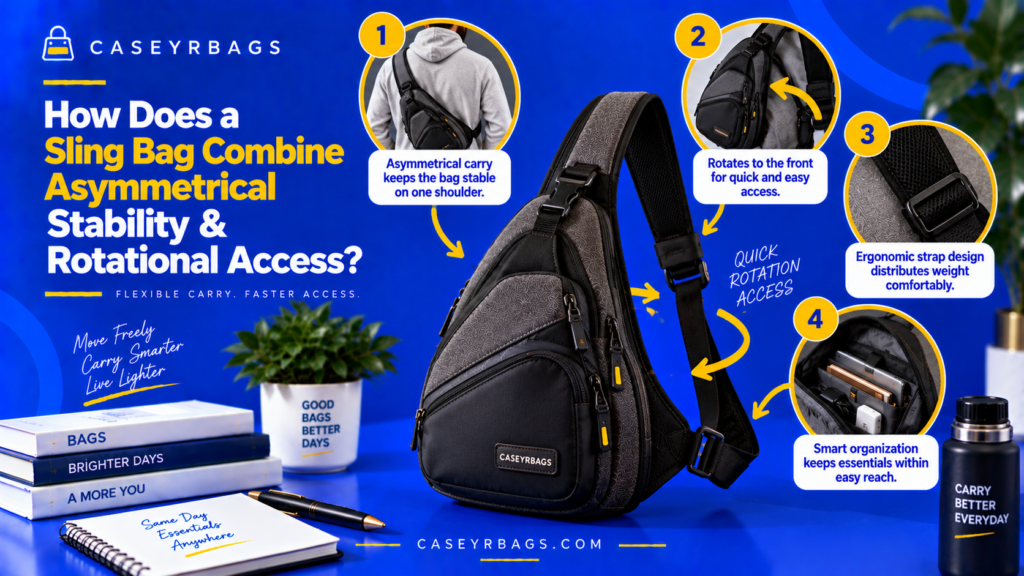
How Does a Sling Bag Combine Asymmetrical Stability & Rotational Access?
A Sling Bag combines asymmetrical stability with rotational access by using a single diagonal strap to hold a compact bag body against one side of the torso while allowing that body to move deliberately along a controlled path. Strap tension, anchor placement, bag depth, and internal load position determine how predictably the bag remains oriented during normal carry.
When access is needed, the same one-strap system can allow the bag to rotate from a rear or side position toward the front without being completely removed. Effective rotational access therefore depends on preserving enough movement for repositioning without creating excessive swing during ordinary carry.
What Do Asymmetrical Stability & Rotational Access Mean in a Sling Bag?
A Sling Bag is asymmetrical because its load is primarily supported through one diagonal strap path rather than two parallel shoulder straps. The bag usually rests on the back, side, front-side, or chest region depending on its design and strap adjustment.
Stability does not require the bag to become immobile. Instead, the bag should remain sufficiently close and predictably oriented that normal walking does not produce excessive swing, rotation, or constant manual repositioning.
Rotational access uses that same controlled mobility intentionally. The user allows the bag to move around the torso toward an accessible position, retrieves an item, and then moves the bag back to its preferred carry zone within the broader Everyday Carry system.
Which Features Create Asymmetrical Sling Bag Stability?
A diagonal strap path, useful anchor placement, appropriate strap tension, body-facing panel, compact depth, and controlled internal load all help the bag stay predictably oriented.
Feature → movement-control effect → stability consequence. No single feature creates stability by itself; the one-strap system depends on geometry and loading working together.
Which Features Enable Rotational Access?
A continuous strap path, sufficient strap mobility, compact bag shape, useful opening orientation, accessible closures, and a clear rotation path allow deliberate repositioning.
These features let the bag move around the torso while remaining attached, so access can occur without removing the strap completely.
Why Are Stability and Rotation Not Contradictory?
Stability controls unintended movement during walking and normal carry, while rotational access preserves intentional movement initiated by the user.
The goal is not zero movement. It is predictable transport plus deliberate mobility when access is needed.
How Does the Diagonal Strap Path Create Asymmetrical Stability?
The diagonal strap creates a single body-crossing support path that can pull the bag toward an intended carry plane instead of leaving it loosely suspended from one shoulder.
How Does a Diagonal Strap Create a Single Support Path?
The bag transfers load through its anchors into one diagonal strap that crosses the shoulder or torso support path.
Bag → anchors → diagonal strap → one shoulder/torso support path. The exact result depends on anchor geometry and strap adjustment.
How Does Diagonal Routing Differ From a Loose Single Shoulder Strap?
Diagonal routing can increase body contact, keep the bag position more controlled, and reduce the tendency for the load to fall directly away from one shoulder.
This is a design tendency rather than a guarantee; bag size, depth, load, and adjustment still shape the result.
Why Does Asymmetrical Support Not Automatically Mean Instability?
A one-strap system can remain stable when its strap path, anchors, body contact, and internal loading keep the bag predictably positioned.
Single support path ≠ uncontrolled load.
How Does Strap Anchor Placement Control Sling Bag Movement?
Anchor geometry determines how strap tension enters the bag body and therefore influences tilt, pivoting, body contact, and the orientation used during rotation.
How Does Wider Anchor Separation Affect Bag Orientation?
Greater separation between attachment points can spread strap influence across more of the bag body instead of concentrating it near one pivot location.
Greater separation → broader control of bag orientation → lower uncontrolled pivot-like movement potential.
How Does Anchor Height Affect the Strap Angle?
Upper and lower attachment height change the line of pull, resting angle, body contact, and tendency of one end to rotate outward.
Anchor height therefore affects both the carry position and the geometry through which the bag later rotates.
How Can Poor Anchor Geometry Increase Unwanted Movement?
Poorly placed anchors can let the bag tilt, allow one end to swing outward, or rotate the body-facing panel away from the torso.
Strong anchors ≠ effective anchor geometry.
| Anchor Pattern | Orientation Control | Main Movement Risk |
|---|---|---|
| Well-separated | Higher potential | Lower uncontrolled rotation |
| Closely spaced | More pivot-like | Rotation |
| Uneven placement | Asymmetrical orientation | Tilt |
| Weak surrounding structure | Variable | Deformation |
How Does Strap Length Affect Sling Bag Stability?
Strap length determines body proximity and free movement, so both excessive looseness and excessive shortening can weaken the combined stability-access function.
What Happens When the Strap Is Too Loose?
The bag can hang farther from the torso, swing through a larger range, and rotate less predictably during normal walking.
Strap too loose → body contact falls → swing range increases → rotation becomes less predictable.
What Happens When the Strap Is Excessively Short?
An overly short strap can restrict repositioning, make front rotation difficult, and force the bag into a carry angle that does not match its intended geometry.
More tension or shorter length is not automatically better if the bag loses its intended mobility.
What Defines a Functional Strap Setting?
A functional setting provides controlled body contact, manageable movement, practical rotation, and an opening that becomes usable at the access position.
Best strap length balances stability with intended mobility.
| Strap Setting | Body Proximity | Movement | Rotation |
|---|---|---|---|
| Very tight | High | Low | Restricted |
| Controlled | High–moderate | Manageable | Functional |
| Loose | Variable | Higher | Easy but less controlled |
| Very loose | Low | High | Unpredictable |
How Does Strap Tension Affect Asymmetrical Stability?
Useful strap tension keeps the bag near its intended carry plane without removing the movement needed for deliberate rotation.
How Does Appropriate Tension Keep the Bag Body-Facing?
Enough tension helps pull the bag toward the torso and reduces the amount of free outward movement during normal carry.
Enough tension → bag remains near intended carry plane → more predictable body-facing position.
Why Does Maximum Tension Not Create Maximum Useful Stability?
Excess tension can make the bag rigid in position, restrict rotation, and narrow the practical path into the access position.
More tension can improve proximity while simultaneously reducing rotational freedom.
How Should Tension Be Judged?
Judge it by whether the bag stays controlled during ordinary movement while still rotating deliberately when the user initiates access.
Enough tension to control unintended movement, enough freedom to permit intentional rotation. Strap tension ≠ complete stabilization.
How Does the Body-Facing Panel Support Sling Bag Stability?
The body-facing panel contributes through contact area and resting geometry, helping the bag settle into a predictable plane against the torso.
How Does a Broad Body-Facing Surface Affect Movement?
A broader contact area can provide a more predictable resting plane and reduce free pivoting compared with a small contact patch.
Greater contact area can support stability when strap tension and load placement also remain controlled.
How Does Contouring Affect the Bag Position?
Curved or shaped panels may follow the torso more closely depending on the bag design and user fit.
Contouring can improve contact without guaranteeing one universal resting position for every Sling Bag.
Does Body Contact Eliminate Movement?
No. Walking, load shift, strap movement, and intentional rotation still move the bag even when it rests closely against the body.
Body-facing stability ≠ zero movement. For the chest-oriented access-control question, see Chest Sling Security.
How Does Sling Bag Depth Affect Asymmetrical Stability?
Front-to-back depth moves the loaded center farther from or closer to the torso, changing the movement envelope of a one-strap bag.
How Does Shallow Depth Support Stable Sling Carry?
A shallow bag keeps more of the load close to the body-facing panel, reduces outward projection, and creates a smaller movement envelope.
Closer load center → lower pull-away potential → more compact movement.
How Does Greater Depth Change Bag Behavior?
A deeper bag carries more of its contents outward, increasing rotational tendency and making bounce or swing more visible.
More depth → farther outward load → greater swing/rotation potential.
Why Can Even a Shallow Sling Bag Become Unstable?
A loose strap, uneven packing, poor anchors, or shifting dense items can still create instability even when the body is compact.
Compact depth supports stability; it does not create stability alone.
How Does Internal Load Placement Affect Sling Bag Stability?
Where dense contents sit changes the effective load center, which can shift the bag inward, outward, or toward one end.
Where Should Dense Items Generally Sit?
Dense contents should generally occupy a controlled central or body-facing internal zone where practical rather than the outermost panel.
The exact position depends on the bag layout, but the goal is a predictable load center rather than a universal fixed spot.
What Happens When Dense Items Sit Near the Outer Panel?
Outer-heavy packing moves the load center farther from the torso and increases pull-away and rotation potential.
Outer-heavy load → load center moves outward → stronger rotation/pull-away potential.
How Does End-Heavy Loading Affect a Sling Bag?
When dense items collect at one end, that end can drop, the bag can rotate, and anchor demand becomes uneven.
Bag geometry cannot compensate fully for poor internal load placement.
| Load Pattern | Load Center | Carry Behavior |
|---|---|---|
| Body-facing | Closer | More predictable |
| Centered | Balanced | Controlled |
| Outer-heavy | Outward | More rotation |
| End-heavy | Offset | Tilt |
| Loose/shifting | Variable | Changing movement |
When Does an Optional Stabilizer Strap Improve Sling Bag Stability?
A secondary stabilizer can limit bag movement relative to the torso, but it also reduces the mobility that rotational access depends on.
What Does a Stabilizer Strap Do?
A secondary connection can limit relative motion between the Sling Bag and the torso by adding another temporary control path.
Secondary connection → less movement relative to torso → greater stability, depending on design.
When Can It Be Useful?
It can be useful during faster movement, with heavier loads, or when rotational movement is temporarily undesirable.
The stabilizer is optional and situational rather than a requirement for every Sling Bag.
What Tradeoff Does It Create?
More stabilization reduces immediate rotational freedom, so the user may need to disengage or loosen it before rotating the bag for access.
More stabilization → less immediate rotational mobility. For longer-distance bounce-control features, see Bounce-Control Features.
What Does Rotational Access Mean in a Sling Bag?
Rotational access is the deliberate movement of the attached Sling Bag from a rear or side carry position toward the front or front-side for retrieval.
How Does the Bag Move From Carry Position to Access Position?
The user intentionally guides the bag along the strap path from rear or side carry around the torso toward a front or front-side position.
Rear/side carry → controlled slide around torso → front/front-side access.
Why Is This Different From Swinging?
Rotation follows an intentional path and ends at a controlled access position, while swing is unintended movement generated by walking or bag momentum.
Rotational access ≠ uncontrolled swing.
Why Can Rotation Be Useful?
The bag stays attached, the opening becomes visible, contents become reachable, and the bag can later return to its original carry position.
For the subtype-specific retrieval mechanism, see Cross-Body Rotation.
- Rear Carry
- Side Transition
- Front-Side Position
- Access
- Return Rotation
How Does Strap Geometry Create the Rotational Path?
The same diagonal strap that supports carry must permit enough sliding and repositioning for the bag to move around the torso without losing control.
How Does a Diagonal Strap Guide Rotation Around the Body?
The strap remains supported while the bag changes position along the torso, so the bag can move without being fully removed.
Supported strap path → controlled bag travel → intentional positional change.
How Can Excessive Friction Limit Rotation?
Clothing interaction, strap texture, tight adjustment, or an engaged stabilizer can make the bag catch or require excessive lifting.
Too much friction turns the intended slide into a difficult repositioning action.
How Can Too Little Control Make Rotation Unpredictable?
An overly free setup can let the bag overshoot the access position, shift the strap, or swing rather than slide.
Functional rotation needs controlled mobility rather than maximum freedom.
How Does Bag Shape Affect Rotational Access?
Compact, smooth geometry generally moves around the torso more easily than deep or protruding shapes that catch against the body, arm, or clothing.
How Does a Compact Sling Bag Rotate Around the Side of the Body?
A compact body creates a smaller movement envelope, fewer projecting surfaces, and a shorter side-to-front path.
This can make intentional rotation more predictable when strap and load geometry are also suitable.
How Can Deep or Bulky Contents Interrupt Rotation?
Greater depth and bulky contents increase body contact, friction, and the chance that the bag catches against the arm or clothing.
Loaded shape therefore matters more than empty-bag shape.
Why Can Rigid Protruding Features Make Rotation Less Smooth?
Bulky pockets, rigid bottle zones, or projecting hardware can interrupt the rotational path even when the core bag body is compact.
Smooth rotational access depends partly on the external profile of the loaded bag.
How Does Opening Orientation Affect Rotational Access?
Rotating the bag into the front only becomes useful when the intended opening is visible, reachable, and oriented for controlled retrieval.
Which Opening Direction Supports Front Access?
The opening should become visible and reachable after rotation while allowing contents to remain contained during normal retrieval.
No single zipper direction is universally best because bag orientation and compartment design differ.
What Happens When the Opening Faces Away After Rotation?
The user may need to twist the wrist, rotate the bag again, or work with reduced visibility even though the bag has reached the front.
Position change alone does not guarantee usable access.
Why Does Rotation Alone Not Guarantee Good Access?
Successful rotational access requires both the bag position and the opening orientation to become functional together.
Correct bag position ≠ correct opening orientation.
How Do Zippers & Closures Affect Rotational Retrieval?
Once the bag reaches the access position, zipper and closure design determine how directly the user can expose and control the intended compartment.
How Can Zipper Placement Support Rotated Access?
A reachable pull, predictable opening path, and controlled exposure let the user access the compartment without unnecessary bag twisting.
Good closure placement turns successful rotation into practical retrieval.
When Does Closure Complexity Slow Rotational Access?
Multiple fasteners, hidden zipper pulls, or a need to support the bag with both hands can add friction after the bag has already reached the front.
Rotation can be mechanically successful while retrieval remains slow.
Why Does Fast Opening Not Automatically Mean Better Access Control?
Quick opening can improve retrieval speed without proving stronger retention or protection from unauthorized access.
Fast retrieval ≠ secure retention, and closure control ≠ theft-proofing. For the subtype-specific front-rotation question, see Front-Rotation Retrieval.
How Should Pockets Be Zoned for Rotational Access?
Pocket zoning should reflect the position the bag reaches after rotation so frequent-use items appear in predictable, reachable zones.
Where Should Frequent-Use Items Sit?
Frequently retrieved items should occupy zones that become visible, reachable, and near the accessible opening when the bag rotates forward.
Access priority should follow retrieval frequency rather than pocket count.
Where Should Lower-Frequency Items Sit?
Lower-frequency contents can occupy deeper main-chamber zones or secondary internal areas where immediate access is less important.
This preserves the fastest access path for the items used most often.
Why Can Too Many Pockets Weaken Rotational Access?
Too many similar pockets can force the user to search multiple zones and reduce confidence about where the intended item sits.
Rotational access works best when item location remains predictable.
How Does Sling Bag Load Affect Rotational Access?
The normally loaded bag rotates differently from the empty bag because added mass and uneven content distribution change inertia, tilt, and opening orientation.
How Does Heavier Loading Change Rotation?
More mass creates stronger downward pull, more inertia, and more effort during side-to-front repositioning.
No universal safe-weight threshold applies; the useful signal is whether loaded rotation remains controlled.
How Does Uneven Loading Change the Rotation Path?
End-heavy or outer-heavy contents can make the bag twist during transition and change the angle at which the opening reaches the front.
Uneven load → altered rotation path → less predictable access endpoint.
Why Should Rotation Be Tested With the Normal Load?
An empty bag can move freely while the same bag becomes slower, bulkier, or less predictable after real contents are added.
Empty-bag rotational ease ≠ loaded-bag rotational access.
How Does Bag Size Affect the Stability–Access Balance?
Compact size generally makes it easier to combine body-facing control with rotation because the bag has a smaller movement envelope and lower rotational inertia.
How Does Compact Size Support Body-Facing Stability?
A smaller body projects less, gives the strap less mass to control, and creates a more compact movement envelope.
Compact geometry can improve control without guaranteeing stability on its own.
How Does Increasing Bag Size Affect Rotation?
Larger Sling Bags create more torso contact, more loaded inertia, and a longer movement path around the body.
Added capacity therefore changes both stability and rotational access.
When Does the Load Begin to Exceed Sling Bag Logic?
Persistent movement, difficult rotation, frequent manual stabilization, or heavy reliance on secondary support indicate that the one-strap format is being pushed beyond its practical role.
Available volume ≠ appropriate one-strap load.
How Does Rotational Access Change Front, Side & Rear Carry Roles?
Different Sling Bag positions serve different tasks, so rotational access lets the user change position temporarily instead of treating one location as universally best.
What Role Does Rear Carry Serve?
Rear carry can support movement-oriented transport, keep the bag out of immediate hand space, and maintain a body-facing position during ordinary movement.
It is a transport role rather than an automatic access role.
What Role Does Front-Side Carry Serve?
Front-side carry can make the bag easier to observe, bring the closure closer to the hand, and preserve moderate mobility.
It can serve as an intermediate or semi-access position depending on the design.
What Role Does Front Access Position Serve?
Front access prioritizes retrieval, compartment visibility, and temporary bag control while the user interacts with contents.
Sling Bag positions can change according to the current task. For the chest-oriented placement question, see Chest Sling Body Access.
When Does Sling Bag Asymmetrical Stability Break Down?
Instability appears when strap, load, depth, or anchor behavior causes broad swing, persistent tilt, or repeated manual correction during normal movement.
What Indicates the Strap Is Too Loose?
Broad swing, visible bouncing, repeated repositioning, and loss of body contact indicate that the bag has too much free movement.
Loose strap → bag hangs farther away → swing range increases → rotation becomes less predictable.
What Indicates Poor Internal Loading?
Persistent tilt, one end pulling downward, or outward rotation indicates that dense contents are creating an offset load center.
Internal load placement must be corrected before blaming the strap system alone.
What Indicates the Bag Itself Is Too Bulky for Stable Sling Carry?
Strong outward projection, constant arm interference, or the need for continuous manual stabilization indicate that bag geometry is overpowering one-strap control.
For the subtype-specific bounce diagnosis, see Running Hydration Sling Bounce.
| Diagnostic Question | If Yes / What It Means |
|---|---|
| Strap too loose? | Reduce excessive free movement without eliminating rotation. |
| Anchors poorly oriented? | Check tilt and body-facing alignment. |
| Bag too deep? | Outward load center may be increasing swing. |
| Load outer-heavy? | Move dense items inward where practical. |
| Load end-heavy? | Rebalance the internal load. |
| Bag overfilled? | Reduce load to restore functional packed geometry. |
When Does Rotational Access Become Difficult?
Rotation friction appears when strap tension, stabilizer use, bag depth, protrusions, load, clothing interaction, or opening orientation blocks the side-to-front path.
What Indicates the Strap Is Too Tight for Rotation?
The bag cannot move around the torso naturally, the user must lift the strap significantly, or the intended front access position cannot be reached.
Excessive tension can stabilize transport while removing the mobility needed for access.
What Indicates the Bag Body Is Blocking Rotation?
Excessive depth, bulky exterior pockets, heavy loading, or contact with the arm and clothing can interrupt the rotation path.
Loaded external profile matters more than empty-bag appearance.
What Indicates Poor Opening Orientation After Rotation?
The zipper still faces away, the main compartment tilts, or the user must twist the bag manually after it reaches the front.
Successful rotation ends in usable access—not merely a different bag position.
| Diagnostic Question | If Yes / What It Means |
|---|---|
| Strap too tight? | Increase mobility without creating excessive swing. |
| Stabilizer engaged? | Disengage or loosen if rotational access is intended. |
| Bag too deep? | Check outward projection and body interference. |
| Exterior protrusion? | Identify pockets/hardware blocking the path. |
| Load too heavy? | Assess inertia and packed geometry. |
| Clothing friction? | Check strap/bag interaction with the worn surface. |
| Opening orientation poor? | Rotation path may be correct while access endpoint is wrong. |
When Does Rotational Access Reduce Sling Bag Stability?
Stability and access can conflict when strap adjustment is pushed toward either maximum looseness or maximum tightness.
How Can an Overly Loose Setup Prioritize Rotation Too Strongly?
An overly loose Sling Bag can move quickly but rest less predictably and generate uncontrolled swing during ordinary walking.
Maximum freedom improves mobility while weakening transport stability.
How Can an Overly Tight Setup Prioritize Stability Too Strongly?
An excessively tight bag can remain close to the torso yet rotate poorly and make retrieval difficult.
Maximum proximity can remove the intentional mobility that defines rotational access.
What Defines the Useful Middle Ground?
The useful setup keeps the bag stable during normal movement yet lets it rotate deliberately when the user initiates the transition.
Balance—not either extreme—is the goal.
| Strap/Bag Setup | Carry Stability | Rotational Access |
|---|---|---|
| Too tight | High | Low |
| Controlled | High–moderate | High |
| Loose | Moderate–low | Easy but less controlled |
| Very loose | Low | Unpredictable |
How Should Sling Bag Stability & Rotational Access Be Evaluated?
Evaluation should use the normally loaded bag so both movement control and rotational access are judged under realistic inertia, depth, and opening conditions.
What Should Be Inspected Before Loading?
Inspect the primary strap, strap adjuster, anchor points, body-facing panel, bag depth, zipper orientation, and optional stabilizer strap.
These checks establish whether the basic geometry can support both carry stability and deliberate rotation.
What Should Be Tested After Loading?
Test resting position, walking stability, swing, rotation, front access, and return to the original carry position.
Loaded testing reveals movement and access problems that an empty bag may hide.
Which Sequence Should Determine Sling Bag Fit?
- Load the Sling Bag normally.
- Identify the densest items.
- Position dense items in controlled internal zones.
- Adjust the strap to a normal carry position.
- Place the bag at its intended rear or side location.
- Walk normally.
- Observe swing, tilt, and outward movement.
- Rotate the bag deliberately toward the front.
- Confirm the bag reaches a usable access position.
- Open a frequent-use compartment.
- Retrieve an item.
- Reclose the compartment.
- Rotate the bag back to its original carry position.
- Readjust only if either stability or rotation repeatedly fails.
Use the sequence exactly so the normal load and densest items are established before strap adjustment and walking behavior are judged.
Then rotate forward, confirm a usable access position, retrieve and reclose one frequent item, return the bag to carry position, and readjust only if stability or rotation repeatedly fails.
How Can Sling Bag Stability & Rotational-Access Mismatches Be Avoided?
Mismatches are avoided by refusing to optimize one mechanism so aggressively that the other stops working.
Why Is “Tighten the Strap as Much as Possible” a Weak Stability Rule?
Maximum tightening can restrict rotation, distort the bag position, and make front access difficult even if the bag feels stable during static carry.
Useful stability preserves intentional mobility.
Why Is “Keep the Strap Loose for Easy Rotation” Also Weak?
Excess looseness increases swing, reduces body contact, and makes the resting position less predictable.
Easy rotation is not useful when normal carry becomes uncontrolled.
What Should Be Verified Before Treating the Sling Bag as Well Balanced?
Verify strap routing, anchors, strap length, tension, body contact, depth, internal load position, loaded swing, rotational path, opening orientation, closure reach, and return path.
Also confirm that dense items remain controlled, optional stabilization has a clear role, and fast access is not confused with theft-proofing or universal security.
- Single-strap asymmetry is not automatically treated as instability.
- Primary strap remains structurally sound.
- Anchor points remain secure.
- Anchor geometry keeps the bag predictably oriented.
- Strap length supports the intended carry position.
- Strap is not excessively loose.
- Strap is not excessively tight.
- Body-facing panel maintains useful torso contact.
- Body contact is not confused with zero movement.
- Bag depth remains compatible with one-strap carry.
- Dense contents are not unnecessarily outer-loaded.
- Contents are not heavily concentrated at one end.
- Loose contents are controlled.
- Optional stabilizer strap has a clear purpose where present.
- Stabilizer use is not allowed to unintentionally block intended rotation.
- Normal walking does not produce excessive uncontrolled swing.
- Bag can rotate without removing the strap.
- Rotation is deliberate rather than uncontrolled.
- Exterior pockets or hardware do not obstruct the rotation path.
- Loaded bag is tested rather than only empty bag.
- Front-access position places the closure within practical reach.
- Opening orientation remains usable after rotation.
- Frequently retrieved items occupy predictable access zones.
- Closure remains controllable during front retrieval.
- Rotation back to carry position remains straightforward.
- Fast access is not confused with security.
- Available capacity is not confused with appropriate one-strap load.
- Final fit balances stability during movement with intentional rotational mobility.
Conclusion
A Sling Bag combines asymmetrical stability and rotational access by using a diagonal one-strap system to keep a compact load close and predictably oriented during normal carry while preserving enough controlled mobility for the bag to move around the torso. Strap geometry, anchors, bag depth, and internal loading determine how stable that asymmetrical position remains.
A Sling Bag works best when its asymmetrical strap geometry controls unintended movement while preserving intentional movement: the bag remains close and stable during carry, rotates predictably into a front-access position when needed, and then returns to its original position without requiring removal or constant readjustment.
FAQs
Sling Bag stability comes from the combined diagonal strap path, anchor placement, body-facing contact, compact bag geometry, strap adjustment, and internal load position.
Strap count alone does not determine stability. A well-controlled one-strap system can remain predictably positioned while still allowing deliberate movement for access.
The user deliberately moves the bag along its diagonal strap path around the side of the torso until the main opening reaches a usable front or front-side position.
The strap, loaded bag shape, and depth must allow this movement without the bag catching, overshooting, or becoming difficult to control.
Not necessarily. A properly adjusted Sling Bag can limit unintended swing during normal movement while retaining enough controlled mobility for deliberate rotation.
Problems arise when the setup is excessively loose, excessively tight, too bulky, or poorly loaded. The useful goal is balance between transport stability and intentional access.