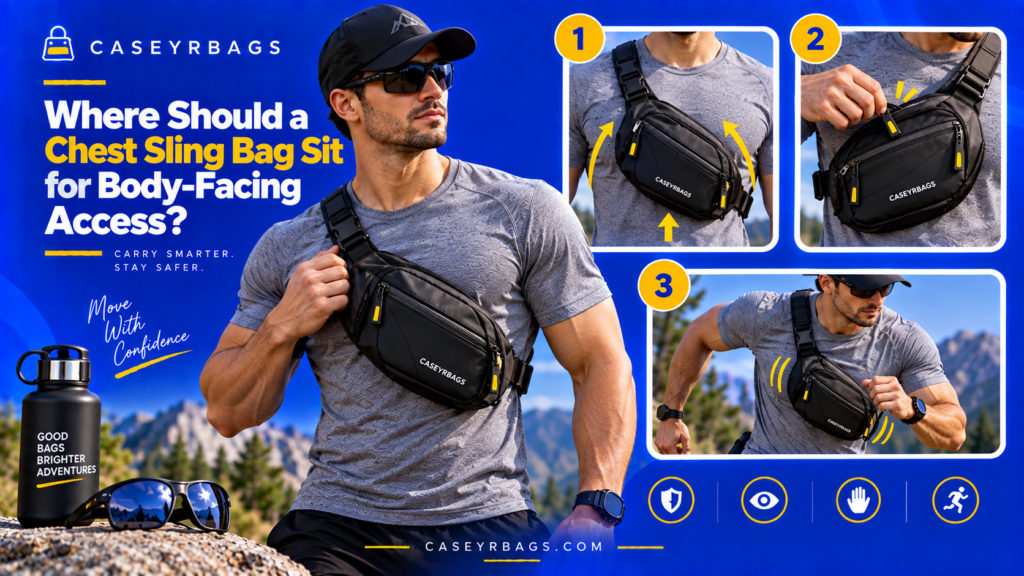
Where Should a Chest Sling Bag Sit for Body-Facing Access?
A Chest Sling Bag should sit in a front or front-side torso position where the bag remains close to the body and its main opening falls within a natural reach path. The exact height and lateral position depend on strap geometry, bag dimensions, opening orientation, body shape, and whether access is intended directly from the chest or after a small controlled rotation during routine use.
The useful position is not simply the highest, tightest, or most centered position. Body-facing access works best when the loaded bag stays predictably oriented during normal movement, can be opened without excessive twisting or strap adjustment, and can return naturally to its intended resting position after retrieval without repeated manual repositioning. The final test is therefore the loaded bag in real worn use, not its empty appearance.
A useful Chest Sling position is defined by loaded function: stable torso contact, a natural hand path, workable opening orientation, and easy return to the resting position. Higher, tighter, or perfectly centered is not automatically better.
What Does Body-Facing Access Mean in a Chest Sling Bag?
Body-facing access means that the Sling Bag rests against the front or front-side of the torso and remains accessible while it is still being worn. The wearer should not need to remove the bag completely to reach its intended main or routine-access compartment, and the access point should remain identifiable from the normal carry position.
The bag does not need to sit motionless or exactly at the center of the chest. A useful body-facing position allows controlled movement while preserving a predictable relationship between the wearer, the bag body, and the opening, so normal access does not depend on repeatedly correcting the bag’s position.
Access quality therefore depends on position, body contact, opening orientation, and hand path rather than on one exact chest location. Height and lateral placement are useful only when they support the complete worn-access relationship within the broader Sling Bag system.
Which position factors most directly affect body-facing access?
Chest height, lateral position, torso contact, bag angle, strap length, opening direction, and loaded depth work together to define body-facing access. A change in one variable can shorten or lengthen the hand path, alter the opening angle, or move the load farther from the torso. This changes the relationship between the bag body, torso contact, and the intended opening, so access should be judged from the worn position rather than from appearance alone.
No single factor should be treated as the complete answer; the useful position is the combination that keeps reach, contact, and opening behavior predictable.
Why does body-facing not mean chest-center only?
Body-facing access is defined by the bag’s relationship to the front torso, not by exact symmetry at the centerline. A front-side position can still maintain strong torso contact, a short reach path, and a usable opening when strap route, dominant hand, and bag geometry support it. This changes the relationship between the bag body, torso contact, and the intended opening, so access should be judged from the worn position rather than from appearance alone.
Centered placement is one possible solution, but forcing symmetry can worsen access when the opening or strap architecture works better slightly off center.
What defines a functional body-facing position?
A functional position keeps the loaded bag close and predictable while the intended opening remains reachable and controllable from the worn position. The wearer should be able to identify the opening, operate it, reclose it, and restore the bag without major twisting or repeated strap correction. This changes the relationship between the bag body, torso contact, and the intended opening, so access should be judged from the worn position rather than from appearance alone.
Function rather than symmetry defines the useful position, and normal movement should not repeatedly push the bag out of that workable relationship.
How Does Chest Height Affect Body-Facing Access?
Chest height changes vertical reach, opening clearance, and how much movement the bag has before the wearer begins access.
What happens when the bag sits relatively high?
A relatively high position can shorten vertical reach and increase body contact, keeping the opening close to the upper torso. That can improve visibility and positional control, but excessive height can crowd the opening, narrow the hand angle, and place the bag in the normal arm path. This changes the relationship between the bag body, torso contact, and the intended opening, so access should be judged from the worn position rather than from appearance alone.
Higher placement is therefore useful only when the opening remains easy to operate; height that forces downward correction before every retrieval is too restrictive.
What happens when the bag sits relatively low?
A lower position can make downward reach feel direct and can provide more room for small rotational movement during access. As the strap lengthens, however, the bag may gain more swing, lateral drift, and separation from the chest, making the opening less predictable before the hand reaches it. This changes the relationship between the bag body, torso contact, and the intended opening, so access should be judged from the worn position rather than from appearance alone.
Lower placement is not automatically easier; it works only while torso contact and opening location remain stable enough that the wearer does not need to capture the bag first.
What defines useful chest height?
Useful chest height places the opening inside a natural reach path while keeping the loaded bag sufficiently close and stable against the torso. The wearer should be able to approach the zipper or closure without raising the shoulder, pulling the bag downward, or first moving the load into a different position. This changes the relationship between the bag body, torso contact, and the intended opening, so access should be judged from the worn position rather than from appearance alone.
There is no universal anatomical height. The practical boundary is whether height supports repeatable access, body contact, arm clearance, and normal opening operation together.
| Position | Body Contact | Hand Reach | Main Tradeoff |
|---|---|---|---|
| Very high | High potential | Restricted angle | Crowded access |
| Upper chest | High | Short reach | Design-dependent |
| Mid/front chest | High–moderate | Direct | Balanced potential |
| Low chest | Variable | Longer/downward | More movement potential |
How Does Center vs Front-Side Position Affect Access?
Lateral position changes how directly the hand reaches the opening and how much of the bag remains in the wearer’s forward field of use.
How does a near-centered chest position affect access?
A near-centered position can keep the opening directly visible and make the bag’s resting angle easy to recognize during routine use. Because the bag stays near the torso centerline, either hand may reach some zones without large rotation, although the exact path depends on closure direction and bag width. This changes the relationship between the bag body, torso contact, and the intended opening, so access should be judged from the worn position rather than from appearance alone.
Centered carry should not be treated as mandatory. It is useful only when the actual opening and strap layout allow direct operation without awkward cross-body reach.
How does a front-side position affect access?
A moderate front-side position can shorten the hand path to a zipper or pocket located on the intended access side. This may reduce arm crossing and make one-hand operation more direct while the body-facing panel still rests against the torso rather than rotating fully under the arm. This changes the relationship between the bag body, torso contact, and the intended opening, so access should be judged from the worn position rather than from appearance alone.
The position remains functional only while direct visibility, torso contact, and opening orientation stay predictable; front-side does not mean abandoning body-facing carry.
When has the bag moved too far toward the side?
The bag has moved too far laterally when the main opening turns away, the body enters underarm space, or routine access requires rotating the bag back toward the chest. Reduced direct visibility, increased swing, and repeated side-to-front correction indicate that lateral offset has become migration rather than an intentional access position. This changes the relationship between the bag body, torso contact, and the intended opening, so access should be judged from the worn position rather than from appearance alone.
Side position is not inherently wrong; uncontrolled movement is the concern. The limit is reached when the chosen resting position no longer supports direct reach and stable torso contact.
How Does Torso Contact Affect Body-Facing Access?
Torso contact gives the Chest Sling Bag a stable reference surface, reducing uncontrolled movement while the hand approaches the opening.
How does body contact stabilize the opening?
Consistent torso contact reduces free bag movement, so the main opening stays in a more predictable location as the wearer reaches for it. The body-facing panel acts as a positional reference that limits swing and helps preserve bag angle during zipper or closure operation, especially with a normal loaded bag. This changes the relationship between the bag body, torso contact, and the intended opening, so access should be judged from the worn position rather than from appearance alone.
Useful contact is controlled rather than rigid. The goal is repeatable opening location, not immobilizing the bag against the body.
What happens when the bag hangs too far away from the torso?
When the bag hangs outward, the opening can change angle as the load swings or pivots during retrieval. The wearer may need a second hand to stabilize the bag, and small movements can shift the zipper pull or pocket farther from the expected reach path. This changes the relationship between the bag body, torso contact, and the intended opening, so access should be judged from the worn position rather than from appearance alone.
Outward suspension is a positioning problem when access depends on catching or holding the bag first. Torso contact should reduce that extra stabilization step without forcing excessive compression.
Why should the bag not be compressed as tightly as possible?
Maximum compression can reduce the clearance needed for fingers, zipper travel, and small intentional rotation even though it reduces gross movement. Excessive tension may distort bag shape, press the opening against the torso, or make a closure harder to operate from the chosen chest position. This changes the relationship between the bag body, torso contact, and the intended opening, so access should be judged from the worn position rather than from appearance alone.
Close body contact does not mean zero movement. Functional fit preserves enough clearance for normal opening and return while keeping the bag predictably supported.
| Body Relationship | Bag Movement | Opening Predictability |
|---|---|---|
| Close/controlled | Lower | Higher |
| Moderate | Moderate | Functional |
| Loose/outward | Higher | Variable |
| Over-compressed | Low | May restrict access |
How Does Strap Length Affect Chest Sling Bag Position?
Primary strap length sets the bag’s vertical and lateral resting position, so it directly changes height, body contact, and the reach path to the opening.
What happens when the strap is too short?
A strap that is too short raises the bag and can pull it into a steeper or more crowded angle against the upper torso. The opening may become harder to see or operate, useful rotation may shrink, and the wearer may repeatedly pull the bag downward before retrieval. This changes the relationship between the bag body, torso contact, and the intended opening, so access should be judged from the worn position rather than from appearance alone.
Shorter is not automatically better. The strap is too short when upward placement reduces opening clearance or turns every access cycle into manual repositioning.
What happens when the strap is too long?
A strap that is too long lets the bag sit lower and usually increases the distance through which it can swing or migrate laterally. Reduced torso contact can make the opening position less predictable, so the wearer may need to stabilize or rotate the bag before operating the closure. This changes the relationship between the bag body, torso contact, and the intended opening, so access should be judged from the worn position rather than from appearance alone.
Length is excessive when the bag no longer returns to a stable front or front-side position after normal movement without repeated adjustment.
What defines functional strap length?
Functional strap length places the bag where torso contact, hand reach, bag angle, and opening orientation work together with the normal carried load. The setting should allow the wearer to reach the intended opening directly, keep the bag within the chosen chest zone, and preserve enough movement for normal access. This changes the relationship between the bag body, torso contact, and the intended opening, so access should be judged from the worn position rather than from appearance alone.
There is no universal number. The useful length is the one that produces a repeatable worn-access position rather than merely a visually tight fit.
| Strap Length | Typical Position | Movement Freedom | Access Effect |
|---|---|---|---|
| Shorter | Higher / tighter | Lower | May crowd opening |
| Controlled | Intended chest/front-side | Moderate | Functional |
| Longer | Lower / more mobile | Higher | Less predictable |
How Does Strap Tension Affect Body-Facing Access?
Strap tension controls how closely the bag follows the torso, but useful tension must preserve opening clearance and normal worn access.
How does appropriate tension help the bag stay body-facing?
Appropriate tension keeps the bag near its intended torso plane so the opening remains in a predictable position when the wearer reaches for it. By reducing unnecessary separation, controlled tension limits swing and helps the body-facing panel maintain consistent contact without locking the bag rigidly in place. This changes the relationship between the bag body, torso contact, and the intended opening, so access should be judged from the worn position rather than from appearance alone.
The useful setting is the one that stabilizes the access position while leaving enough clearance to operate the zipper, pocket, or closure naturally.
How can excessive tension reduce access?
Excessive tension can compress the bag against the torso until the zipper path, pocket mouth, or hand clearance becomes restricted. It can also limit small intentional rotation and distort bag angle, forcing the wearer to loosen or pull the bag away before routine retrieval. This changes the relationship between the bag body, torso contact, and the intended opening, so access should be judged from the worn position rather than from appearance alone.
Tightness is excessive when it improves stillness but weakens actual access. Stability should support the opening path rather than replace it. A functional result keeps the bag close and predictably oriented while the intended opening remains reachable without repeated twisting, large rotation, or strap readjustment during normal use.
How can insufficient tension reduce access control?
Insufficient tension increases the free gap between bag and torso, allowing the bag to move while the hand is trying to operate the opening. That movement can change resting angle, zipper location, and lateral position, making access less repeatable from one retrieval to the next. This changes the relationship between the bag body, torso contact, and the intended opening, so access should be judged from the worn position rather than from appearance alone.
Useful tension stabilizes the access position without eliminating controlled mobility. If the bag must be caught or steadied first, the tension is not providing enough positional control.
How Does Bag Angle Affect Body-Facing Access?
Bag angle determines whether the main opening and zipper path face a practical hand direction even when the bag sits at an otherwise reasonable height.
How does a flatter body-facing angle affect access?
A flatter body-facing angle can keep the bag body predictable and hold the opening in a consistent relationship to the wearer’s hand path. With less uncontrolled tilt, the wearer is less likely to need secondary stabilization while operating the closure, and contents are less likely to collect at one extreme. This changes the relationship between the bag body, torso contact, and the intended opening, so access should be judged from the worn position rather than from appearance alone.
Flat does not mean perfectly horizontal. The useful angle is whichever keeps the intended opening reachable and repeatable for the actual bag design.
How can excessive diagonal tilt affect reach?
Excessive diagonal tilt can raise one end of the bag, lower the other, and redirect the zipper path away from the most natural hand movement. The wearer may need to cross the hand farther, rotate the bag, or stabilize the low end before opening, especially when contents shift toward one corner. This changes the relationship between the bag body, torso contact, and the intended opening, so access should be judged from the worn position rather than from appearance alone.
Tilt becomes a mismatch when bag height looks acceptable but the closure path still feels indirect or requires repeated correction.
What controls the resting bag angle?
Resting angle results from anchor geometry, strap tension, internal load, bag shape, and lateral position rather than from height alone. A dense item at one end or uneven anchor pull can change the angle even when strap length is unchanged, while front-side placement may alter how the bag settles. This changes the relationship between the bag body, torso contact, and the intended opening, so access should be judged from the worn position rather than from appearance alone.
Correct height with poor angle can still produce poor access. Evaluate the loaded geometry as a complete system before changing one variable.
How Does Main-Opening Orientation Affect Body-Facing Access?
Body-facing position is useful only when the main opening itself faces a direction the wearer can see, reach, and operate from the chosen resting position.
How does a wearer-facing or upward-accessible opening help?
A wearer-facing or upward-accessible opening keeps the zipper path visible and lets the hand approach the closure without major bag rotation. The wearer can often locate the pull, control the opening, retrieve an item, and reclose the compartment while maintaining the same body-facing relationship. This changes the relationship between the bag body, torso contact, and the intended opening, so access should be judged from the worn position rather than from appearance alone.
The direction is design-dependent; the functional test is whether the opening supports direct, controlled use from the actual worn position. A functional result keeps the bag close and predictably oriented while the intended opening remains reachable without repeated twisting, large rotation, or strap readjustment during normal use.
What happens when the opening faces too far outward or sideways?
An outward or side-facing opening can place the zipper pull outside the easiest line of sight and force the hand to approach at an awkward angle. The wearer may twist the bag, rotate it farther than intended, or use a second hand simply to bring the closure into a usable orientation. This changes the relationship between the bag body, torso contact, and the intended opening, so access should be judged from the worn position rather than from appearance alone.
Opening direction becomes a mismatch when routine access repeatedly depends on correcting the bag rather than operating it where it naturally rests.
Why is bag position not enough by itself?
A bag can sit close to the chest at a reasonable height while its main opening remains poorly aligned with the wearer’s hand path. Height and torso contact define where the bag is, but opening orientation defines how the intended compartment is actually reached and controlled. This changes the relationship between the bag body, torso contact, and the intended opening, so access should be judged from the worn position rather than from appearance alone.
Correct bag position does not guarantee correct opening orientation. Both have to work together before the position can be treated as effective body-facing access.
How Does Zipper Direction Affect the Reach Path?
Zipper direction changes how the access hand travels across the bag, so it should be evaluated in the actual worn position rather than on a table.
Where should the zipper pull begin or finish?
There is no universal start or finish point; the useful zipper arrangement is the one whose pull remains visible, graspable, and aligned with a natural hand path. A pull may work well at the upper, side, or angled edge depending on chest height, bag orientation, dominant hand, and closure construction. This changes the relationship between the bag body, torso contact, and the intended opening, so access should be judged from the worn position rather than from appearance alone.
Judge the path by direct operation while worn, not by assuming one zipper direction is always better for every Chest Sling design.
How can an awkward zipper direction weaken body-facing access?
An awkward zipper direction can make the hand cross over the bag, pull against the bag’s resting angle, or require a second hand to stabilize the load. If the pull starts on the far side or travels away from the natural reach, the wearer may rotate or twist the bag before opening. This changes the relationship between the bag body, torso contact, and the intended opening, so access should be judged from the worn position rather than from appearance alone.
The path is weak when the zipper itself creates repositioning that the resting chest position was supposed to avoid.
Why should zipper direction be tested while worn?
Tabletop opening behavior does not reproduce chest height, torso contact, strap tension, bag angle, or the real path of the access hand. A zipper that feels easy on a flat surface may point away from the wearer or compress against the torso once the loaded bag is worn. This changes the relationship between the bag body, torso contact, and the intended opening, so access should be judged from the worn position rather than from appearance alone.
Opening orientation must therefore be tested in the actual carry position, including normal loading and the intended access hand.
How Does Pocket Position Affect Body-Facing Access?
Pocket placement determines which contents can be reached directly from the body-facing position and which require deliberate repositioning.
Which pockets support direct body-facing access?
Pockets in predictable upper or front zones can support direct access when their openings remain visible and within a short, unobstructed hand path. These zones work best for routine-use items when the bag does not need to rotate substantially and the pocket mouth stays stable against the torso. This changes the relationship between the bag body, torso contact, and the intended opening, so access should be judged from the worn position rather than from appearance alone.
Direct access depends on the actual pocket direction and bag position; not every externally visible pocket is automatically easy to use while worn.
Which pockets may require intentional repositioning?
Far-side, lower, body-facing hidden, or rear-oriented pockets may require a small deliberate rotation or shift before the hand can reach them comfortably. That is not automatically a problem when the movement is predictable and occasional, especially for contents that are not needed frequently. This changes the relationship between the bag body, torso contact, and the intended opening, so access should be judged from the worn position rather than from appearance alone.
The mismatch appears when routine-use items are placed in zones that force major repositioning every time the bag is opened. A functional result keeps the bag close and predictably oriented while the intended opening remains reachable without repeated twisting, large rotation, or strap readjustment during normal use.
Why should pocket role match access frequency?
Frequent-use items benefit from predictable reach zones because repeated access amplifies even small amounts of twisting, searching, or bag movement. Lower-frequency contents can occupy deeper or less immediate pockets without weakening the main body-facing access task, provided those zones remain controllable when needed. This changes the relationship between the bag body, torso contact, and the intended opening, so access should be judged from the worn position rather than from appearance alone.
Not every pocket needs instant access. The useful organization matches access frequency to the reach path created by the worn position. A functional result keeps the bag close and predictably oriented while the intended opening remains reachable without repeated twisting, large rotation, or strap readjustment during normal use.
How Does Dominant-Hand Reach Affect Chest Sling Position?
The preferred access hand can influence lateral placement because a small front-side offset may shorten the reach path to the intended opening.
How can front-side positioning shorten the hand path?
A modest offset toward the intended access side can reduce cross-body reach and place the zipper or pocket closer to the hand’s normal movement path. For some strap and opening layouts, this makes one-hand operation easier while the body-facing panel still maintains stable contact with the front torso. This changes the relationship between the bag body, torso contact, and the intended opening, so access should be judged from the worn position rather than from appearance alone.
The benefit is conditional on design. The bag should not move so far sideways that contact, visibility, or opening orientation becomes less predictable.
Why should the bag not simply be shifted as far as possible toward the dominant side?
Excessive lateral shift can move the bag toward the underarm, reduce front-torso contact, and turn the main opening away from direct monitoring. The shorter hand path gained on one side may be offset by more rotation, arm interference, or reduced stability during opening. This changes the relationship between the bag body, torso contact, and the intended opening, so access should be judged from the worn position rather than from appearance alone.
Dominant-hand convenience should refine a functional body-facing position, not replace it with a fully side-biased position that needs correction before use. A functional result keeps the bag close and predictably oriented while the intended opening remains reachable without repeated twisting, large rotation, or strap readjustment during normal use.
What defines a useful hand-position relationship?
A useful hand-position relationship lets the intended hand reach the main opening directly while the bag remains in its stable front or front-side position. The hand should not need to pull the bag away, cross excessively over the torso, or rotate the load far enough to disturb body contact. This changes the relationship between the bag body, torso contact, and the intended opening, so access should be judged from the worn position rather than from appearance alone.
The test is practical: the access hand reaches and operates the opening without forcing the bag out of the position that made access predictable.
How Does Loaded Bag Depth Affect Body-Facing Position?
Loaded depth changes how far the load center sits from the torso, so position must be evaluated with normal contents rather than with an empty bag.
How does greater depth move the load away from the torso?
Greater front-to-back depth pushes the effective load center farther from the body-facing plane and increases the leverage created by normal movement. The bag may separate more, rotate more easily, or require additional stabilization when the wearer operates the opening, even if the strap setting has not changed. This changes the relationship between the bag body, torso contact, and the intended opening, so access should be judged from the worn position rather than from appearance alone.
Depth is therefore part of position geometry. A bag that sits well empty can behave differently once the normal load projects outward.
How can an overfilled bag change opening access?
Overfilling can push the bag outward, distort the zipper track, and reduce the stable contact area between the body-facing panel and the torso. During opening, the wearer may need to support the bag with a second hand because the load no longer rests predictably in the intended chest plane. This changes the relationship between the bag body, torso contact, and the intended opening, so access should be judged from the worn position rather than from appearance alone.
More available volume does not guarantee better worn access. Packing should preserve usable shape, opening alignment, and stable torso contact.
Why can an empty-bag fit be misleading?
An empty bag has less outward depth, lower inertia, and a different internal load center than the same bag carrying normal contents. Adding routine items can change bag angle, torso contact, zipper orientation, and how much the load moves during retrieval, so the original position may no longer function. This changes the relationship between the bag body, torso contact, and the intended opening, so access should be judged from the worn position rather than from appearance alone.
Empty position does not equal loaded position. Final fit should always be checked with the actual carried load and routine-access contents.
| Loaded Profile | Torso Contact | Access Stability |
|---|---|---|
| Shallow | High potential | Predictable |
| Moderate | Functional | Functional |
| Deep | Reduced potential | More movement |
| Uneven | Variable | Tilt / rotation |
When Should a Chest Sling Bag Rotate for Access?
Small intentional rotation can improve the hand angle to an opening, but it should complement a functional resting position rather than compensate for a poor one.
When can a small rotation improve access?
A small controlled rotation can move the zipper pull into clearer view, improve the opening angle, or bring a specific pocket into practical reach. Because the bag remains attached and close to the torso, this movement can reduce hand strain without requiring a full shift to a side or rear position. This changes the relationship between the bag body, torso contact, and the intended opening, so access should be judged from the worn position rather than from appearance alone.
Rotation is useful when it is minor, deliberate, and reversible. It should enhance access that is already mostly functional from the resting position.
When does excessive rotation suggest poor resting position?
Excessive rotation suggests a mismatch when every routine item requires moving the bag far from its intended chest zone before the opening can be used. Repeated strap loosening, large torso-side movement, or constant front-to-side correction indicates that the resting position and access position are fundamentally misaligned. This changes the relationship between the bag body, torso contact, and the intended opening, so access should be judged from the worn position rather than from appearance alone.
Easy rotation is not proof of good body-facing access. The main test is how much correction is required for ordinary retrieval.
What should happen after rotational access?
After intentional rotation, the wearer should complete retrieval, reclose the compartment, and return the bag to its intended front or front-side resting position. The strap, bag angle, and opening orientation should settle back predictably rather than requiring a separate adjustment cycle after each use. This changes the relationship between the bag body, torso contact, and the intended opening, so access should be judged from the worn position rather than from appearance alone.
Rotation should complement body-facing positioning, not create a second unstable carry state. Return-to-position behavior is part of the access test. A functional result keeps the bag close and predictably oriented while the intended opening remains reachable without repeated twisting, large rotation, or strap readjustment during normal use.
How Does Arm Movement Affect Chest Sling Bag Position?
Normal arm movement can displace a Chest Sling Bag if the selected position occupies the same path used by the arm during walking or routine activity.
What happens when the bag sits too close to the arm path?
Repeated arm contact can push the bag laterally, alter its angle, and obstruct zipper pulls or pocket openings during ordinary movement. Even a position that looks stable while standing may migrate once the arm repeatedly brushes the bag, which changes the hand path when access is later attempted. This changes the relationship between the bag body, torso contact, and the intended opening, so access should be judged from the worn position rather than from appearance alone.
The problem is not front-side placement itself; it is overlap with normal arm movement that makes the position inconsistent over time.
How can front-side placement avoid unnecessary arm interference?
A moderate front-side position can preserve useful torso contact while keeping the bag clear of the most repetitive part of the arm path. The exact offset depends on bag width, strap route, clothing, and the wearer’s natural movement, so the position should be adjusted by observed contact rather than a fixed rule. This changes the relationship between the bag body, torso contact, and the intended opening, so access should be judged from the worn position rather than from appearance alone.
The useful location is the one where body-facing access remains direct without the arm repeatedly pushing the bag away.
Why should arm clearance be tested dynamically?
Static fitting does not show the repeated shoulder and arm movement that occurs during ordinary walking, turning, or reaching. A bag may appear clear while standing but move into the arm path once the torso and strap begin moving together, causing gradual lateral displacement or zipper obstruction. This changes the relationship between the bag body, torso contact, and the intended opening, so access should be judged from the worn position rather than from appearance alone.
Static chest fit does not equal movement-compatible chest fit. Test the selected position during normal movement before treating it as stable.
When Is a Chest Sling Bag Positioned Too High?
A Chest Sling Bag is too high when the resting position restricts the hand path or crowds the opening enough that the wearer must move the bag before routine access.
What indicates excessive height?
Excessive height often appears as a difficult downward hand angle, an opening crowded against the upper torso, arm interference, or zipper travel that feels compressed. The bag may remain close and visible yet still fail the access task because the wearer cannot approach the closure directly from a normal hand position. This changes the relationship between the bag body, torso contact, and the intended opening, so access should be judged from the worn position rather than from appearance alone.
High position becomes excessive when access quality worsens even though body contact looks strong. Functional clearance matters more than maximum height.
What happens if the user must pull the bag downward for every access?
If the wearer repeatedly pulls the bag downward before opening it, the resting position and usable access position are not aligned. That repeated correction shows that the strap setting has placed the bag above the practical reach geometry even if the bag stays stable during movement. This changes the relationship between the bag body, torso contact, and the intended opening, so access should be judged from the worn position rather than from appearance alone.
A direct-access position should already place the opening within a workable hand path. Routine downward correction is a diagnostic signal, not a normal requirement.
What should be adjusted first?
When height is excessive, inspect strap length, bag angle, and lateral position before assuming the bag simply needs to remain high and tight. A small length change may lower the opening, while correcting tilt or front-side offset can improve the hand path without greatly reducing torso contact. This changes the relationship between the bag body, torso contact, and the intended opening, so access should be judged from the worn position rather than from appearance alone.
Adjust one variable at a time and retest the loaded bag. The goal is usable access with stable contact, not the lowest or loosest setting.
When Is a Chest Sling Bag Positioned Too Low?
A Chest Sling Bag is too low when extra strap length creates enough swing, reach distance, or lateral drift that the wearer must stabilize the bag before routine access.
What indicates excessive low positioning?
Excessive low positioning can show up as increased swing, drift toward the abdomen or side, greater reach distance, and reduced direct monitoring of the opening. The bag may feel easy to touch because it sits lower, yet the load can move more before the hand controls it, making zipper or pocket operation less predictable. This changes the relationship between the bag body, torso contact, and the intended opening, so access should be judged from the worn position rather than from appearance alone.
Low position becomes excessive when access begins with catching, lifting, or re-centering the bag rather than reaching the intended opening directly.
Why can a lower bag feel easier to reach but less stable?
A lower position often uses a longer strap, which increases the distance over which the bag can move relative to the torso. That extra movement freedom can make downward reach feel comfortable while also allowing more swing, rotation, and loss of body contact before the closure is operated. This changes the relationship between the bag body, torso contact, and the intended opening, so access should be judged from the worn position rather than from appearance alone.
Ease of reach and access stability are separate. A position is useful only when both remain functional with the normal loaded bag.
What defines the lower functional boundary?
The lower functional boundary is reached when the bag no longer remains close enough to the torso for the opening to stay predictably positioned during access. If the wearer must first stabilize a freely moving load, draw it upward, or rotate it back from the side, the resting position has dropped below the practical access zone. This changes the relationship between the bag body, torso contact, and the intended opening, so access should be judged from the worn position rather than from appearance alone.
Avoid exact anatomical measurements. The boundary is defined by repeatable worn behavior, not by a fixed point on the body.
How Can Poor Chest Sling Bag Positioning Be Diagnosed?
Poor positioning should be diagnosed by tracing access friction to the variable that changed: height, lateral offset, strap setting, angle, opening direction, or loaded shape.
What does repeated bag repositioning suggest?
Repeated repositioning suggests that chest height, lateral offset, strap length, or bag angle is not keeping the opening in a stable access relationship. The wearer may be correcting a bag that sits too high, too low, too far sideways, or at an angle that changes under load. This changes the relationship between the bag body, torso contact, and the intended opening, so access should be judged from the worn position rather than from appearance alone.
Treat the correction itself as evidence. A position that works only after manual relocation is not functioning as a reliable resting access position.
What does difficult zipper reach suggest?
Difficult zipper reach points first to opening orientation, zipper direction, excessive height, or far-side placement rather than automatically to the zipper hardware itself. The pull may be visible but outside the natural hand path, or the bag may require rotation because the opening faces away from the wearer. This changes the relationship between the bag body, torso contact, and the intended opening, so access should be judged from the worn position rather than from appearance alone.
Diagnose the geometry before changing the closure. The access problem may come from where the bag rests rather than from the zipper design.
What does repeated movement during retrieval suggest?
Repeated bag movement during retrieval suggests insufficient torso contact, loose strap tension, excessive loaded depth, or an unstable internal load that shifts the bag as it is opened. The wearer may need a second hand because the bag itself is moving away from the intended chest plane under the access force. This changes the relationship between the bag body, torso contact, and the intended opening, so access should be judged from the worn position rather than from appearance alone.
Access friction should be traced to the position variable causing it. Fix the movement source instead of compensating with more twisting or grip.
| Observed Friction | Inspect First | Likely Access Effect |
|---|---|---|
| Bag too high / too low | Height + strap length | Reach path shifts |
| Too far to one side | Lateral position | More rotation required |
| Opening faces away | Bag angle + opening orientation | Twist / reposition |
| Bag moves during opening | Torso contact + tension + depth | Second-hand stabilization |
How Should Chest Sling Bag Body-Facing Position Be Evaluated?
Body-facing position should be evaluated with the normal load through a repeatable worn-access test that includes opening, reclosure, movement, and return to position.
What should be checked before loading?
Before loading, inspect the primary strap, adjuster, anchors, body-facing panel, main opening, zipper direction, and pocket positions for normal operation and clear geometry. This establishes whether the bag’s basic structure can create the intended chest or front-side position before contents add depth, offset mass, or distortion. This changes the relationship between the bag body, torso contact, and the intended opening, so access should be judged from the worn position rather than from appearance alone.
The pre-load check is a baseline only. It does not prove final fit because empty position and loaded position can differ substantially.
What should be checked after loading?
After loading, observe chest height, lateral position, torso contact, bag angle, loaded depth, and opening orientation with the normal carried contents in place. Dense or bulky items can move the load center outward, change tilt, or alter how the zipper track sits against the torso even when strap length is unchanged. This changes the relationship between the bag body, torso contact, and the intended opening, so access should be judged from the worn position rather than from appearance alone.
Use the loaded state as the real access condition. The bag should still support direct reach, normal arm clearance, and predictable reclosure.
Which sequence should determine body-facing access fit?
A useful evaluation sequence starts with the normal load and then checks position, contact, opening, hand path, access, movement, and return in a controlled order. The purpose is to isolate the first point where the worn system stops behaving predictably rather than changing several adjustments at once. This changes the relationship between the bag body, torso contact, and the intended opening, so access should be judged from the worn position rather than from appearance alone.
Follow the exact sequence below, then adjust only the variable revealed by the test and repeat the cycle with the same normal load.
- Load the Sling Bag with normal contents.
- Close all intended compartments.
- Put the bag on.
- Position it on the front or front-side torso.
- Adjust strap length until the bag remains close without excessive compression.
- Observe bag height.
- Observe lateral position.
- Check body-facing contact.
- Check bag angle.
- Locate the main opening.
- Reach the zipper or closure naturally.
- Open the routine-access compartment.
- Retrieve an item.
- Return the item.
- Reclose the compartment.
- Confirm the bag did not require excessive rotation.
- Allow normal arm movement.
- Walk briefly.
- Confirm the bag remains in the intended position.
- Adjust height, lateral position, or strap length only where the test reveals a problem.
How Can Chest Sling Bag Positioning Mismatches Be Avoided?
Positioning mismatches are avoided by rejecting one-dimensional rules such as higher, tighter, or perfectly centered and instead testing complete worn access geometry.
Why is “wear it as high as possible” a weak access rule?
Wearing the bag as high as possible can shorten reach while also crowding the opening, restricting the hand angle, interfering with arm movement, or forcing the bag downward before use. The highest position may look controlled but still fail the actual retrieval task if the closure cannot be operated directly from that resting zone. This changes the relationship between the bag body, torso contact, and the intended opening, so access should be judged from the worn position rather than from appearance alone.
Higher position is not automatically better access. Use the position that preserves clearance, body contact, and a natural hand path together.
Why is “keep it directly centered” also incomplete?
Direct center placement can improve visibility, but some strap and opening geometries create a shorter, cleaner hand path from a modest front-side position. Forcing the bag to the center can override opening orientation, dominant-hand reach, body contact, or bag angle even when those variables point to a better offset. This changes the relationship between the bag body, torso contact, and the intended opening, so access should be judged from the worn position rather than from appearance alone.
Centered placement is one option rather than a rule. Choose the lateral position that keeps the loaded bag body-facing and the intended opening directly usable.
What should be verified before treating the position as body-facing-access compatible?
Verify that the loaded bag stays on the front or front-side torso, at a practical height and angle, with controlled strap tension, predictable body contact, and a usable opening path. The zipper should remain easy to locate, frequent-use pockets should be reachable, arm movement should not repeatedly displace the bag, and routine retrieval should not require major rotation. This changes the relationship between the bag body, torso contact, and the intended opening, so access should be judged from the worn position rather than from appearance alone.
Final fit also requires reclosure and return. The bag should settle back into its intended position without repeated manual correction after ordinary access.
Final Chest Sling Bag Body-Facing Access Checklist
- Bag sits on the front or front-side torso.
- Position is not defined by one universal anatomical point.
- Higher placement is not automatically treated as better.
- Lower placement is not automatically treated as easier.
- Centered placement is not automatically required.
- Front-side placement remains body-facing where geometry supports it.
- Strap length places the bag within a practical reach zone.
- Strap is not excessively short.
- Strap is not excessively long.
- Strap tension maintains useful body contact.
- Close fit is not confused with maximum compression.
- Body-facing contact is not confused with zero movement.
- Bag height allows normal closure operation.
- Lateral position remains intentional.
- Bag does not migrate excessively toward the underarm.
- Bag angle remains predictable.
- Opening orientation matches the intended hand path.
- Correct bag position is not confused with correct opening orientation.
- Zipper direction is evaluated while the bag is worn.
- Frequent-use pockets remain reachable.
- Dominant-hand reach does not require excessive cross-body movement.
- Loaded depth remains controlled.
- Empty-bag position is not used as the only fit test.
- Arm movement does not repeatedly displace the bag.
- Routine access does not require major strap adjustment.
- Small intentional rotation remains possible where useful.
- Rotation is not used to compensate for poor resting position.
- Bag can be opened, used, and reclosed while worn.
- Bag returns to its intended position after access.
- Position is evaluated during movement as well as while standing.
- Final fit balances body contact, reach, orientation, and access stability.
Conclusion
A Chest Sling Bag should sit on the front or front-side of the torso at a height and lateral position where the loaded bag remains close, predictably oriented, and within a natural hand path. The correct position comes from the interaction of strap length, torso contact, bag angle, loaded depth, and opening orientation rather than one universal chest point. A centered or modest front-side position can both work when the opening remains reachable and normal movement does not push the bag away. Small intentional rotation may improve access, but it should not compensate for a poor resting position. The best functional fit lets the wearer open, use, reclose, and restore the bag without excessive twisting, strap adjustment, or manual stabilization.
FAQs
There is no universal height. The useful position is high enough to remain close and predictable while still leaving the main opening within a natural hand path.
If the bag must be pulled downward, lifted upward, or repeatedly stabilized before access, adjust the height until reach, torso contact, and opening clearance work together.
Both can work. A centered position may improve direct visibility, while a moderate front-side position can shorten the reach path for some strap and opening layouts.
The bag should remain body-facing rather than drifting fully sideways. Choose the position that preserves torso contact, opening orientation, and direct worn access with the normal load.
The loaded bag should remain close to the torso, keep the main opening easy to locate, and stay clear of normal arm movement while you walk.
Routine access should allow opening, retrieval, reclosure, and return without major rotation or repeated strap adjustment. If correction is needed every time, the resting position needs refinement.