How Does Dome-Top Bowling Bag Opening Follow Its Curved Body?
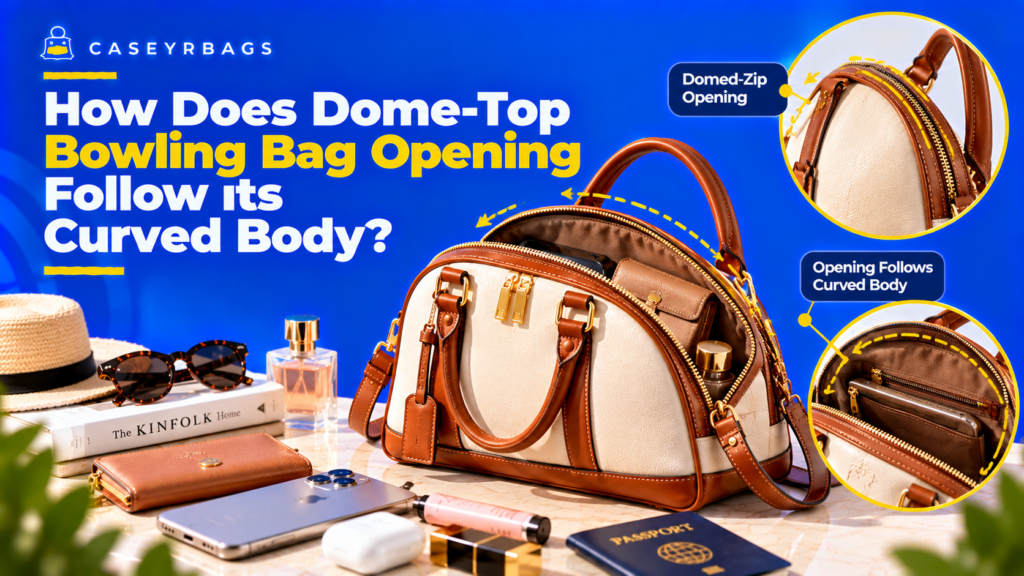
How Does Dome-Top Bowling Bag Opening Follow Its Curved Body? | CaseyrBags How Does Dome-Top Bowling Bag Opening Follow Its Curved Body? A Dome-Top Bowling Bag opening follows its curved body by routing the zipper along the arched crown and often through part of the shoulder transition rather than across a completely flat top edge. As the zipper opens, the connected upper panels separate along this curved route, exposing the chamber through an aperture that reflects the bag’s three-dimensional dome. The opening does not need to flatten the top completely. Side panels, gussets, seams, and reinforcement can continue supporting the lower body while the released upper section flexes outward, creating practical access without erasing the Bowling Bag’s rounded structural identity. KEY TAKEAWAY A Dome-Top Bowling Bag opening works when the zipper follows the crown and shoulder geometry, releases the upper panels along that curved route, and still lets the gussets and lower body preserve three-dimensional chamber depth. Useful access depends on the combined route, endpoint, panel, gusset, clearance, and load behavior—not zipper length alone. Geometry-Matched Curved Route + Controlled ReleaseThe track follows the dome, the panels separate naturally, depth remains, and representative items pass without forcing or severe distortion. Moderately Restricted Usable but One Variable Limits AccessHigh endpoints, shoulder stiffness, limited depth, or item angle narrows the aperture without fully breaking normal use. Mismatch Signal Obstruction, Distortion or CollapseLoad near the path, uneven release, rigid-item mismatch, over-reinforcement, or uncontrolled panel collapse prevents reliable three-dimensional access. How Does the Opening Follow Dome-Top Bowling Bag Geometry? The opening follows a three-dimensional upper body that already contains a crown, shoulder transitions, side depth, and a structured lower chamber. The zipper does not create that dome independently; it is routed within the existing curved construction. See Bowling Bag. As the slider moves, selected upper-panel connections release progressively along the crown and shoulders. Because the route changes direction across a curved surface, the panels can move upward, outward, and partly sideways instead of separating along one flat horizontal line. The lower seams and gussets continue preserving width and front-to-back depth while the upper panels move. The governing relationship is curved body → curved zipper route → controlled panel separation → three-dimensional chamber access. DOME-TOP BOWLING BAG OPENING ANATOMYSLIDEROPENING APERTUREMAIN CHAMBER / RETAINED DEPTHCASEYRBAGS.COM Figure 1. Dome-Top Bowling Bag Opening Anatomy Shows the dome crown, shoulder transition, curved zipper, slider, endpoints, released upper panel, gusset, chamber, aperture, and structured lower body. Which Geometric Zones Guide the Opening? The opening is guided by the crown, shoulder transitions, upper side zones, gusset depth, and the lower structured chamber. The crown, shoulder transitions, upper side zones, gusset depth, and lower structured chamber. Explain how they create the surface across which the closure must travel. This makes the mechanism visible and separates construction from vague claims such as “opens wide.” The opening to be interpreted across width, depth, and height. A curved top line without retained side depth does not prove useful three-dimensional access. This boundary prevents one successful item test from being generalized into unrestricted chamber access. What Does the Zipper Actually Release? The zipper releases selected upper-panel connections rather than detaching the entire upper body. The zipper releases selected upper-panel connections along its track. Remaining seams, gussets, reinforcement, and lower panels continue controlling how far and in which directions the surfaces can move. The strongest comparison changes one variable while preserving the rest of the opening system. The distinction remains: open zipper ≠ detached upper body. The closure permits controlled separation; it does not remove every structural constraint around the aperture. The target is usable three-dimensional access with retained structure, not maximum collapse or maximum stiffness. What Is the Core Curved-Opening Mechanism? The core mechanism combines a contour-following track with controlled panel release and retained chamber depth. The rule is a dome-following opening uses a curved track to release panels along the upper contour while the surrounding body retains enough three-dimensional structure to preserve the chamber. This keeps the result falsifiable and prevents zipper length from replacing the complete access decision. In classification terms, the opening works when the track follows the dome naturally, the panels separate without forcing, and usable chamber space appears without complete flattening, collapse, or severe distortion. Then return the reader to the complete parent type definition through Bowling Bag: Domed-Zip Geometry and Short-Trip Capacity. Use this approved upward link once only. The final outcome should name the first supported mismatch rather than use a broad label such as “bad zipper.” Where and How Does the Zipper Track the Crown and Shoulders? Zipper placement determines which upper zones can release. A crown-running route exposes the central upper chamber first, while shoulder descent can release more panel perimeter when the endpoints, seams, and gussets allow controlled movement. How Can the Track Cross the Dome Crown? A crown-running zipper follows the highest upper zone and releases the central part of the dome. A crown-running zipper crosses the highest upper zone and exposes the upper-central chamber. The track follows a changing arched surface rather than a single flat plane. The practical meaning appears only when the released panels, retained depth, and item path are evaluated together. The resulting movement is as the crown releases, the panels can rise and move outward around the arch. Preserve crown-following path ≠ complete chamber exposure. A pass in one access dimension cannot automatically compensate for failure in another. How Can the Track Continue Through the Shoulders? Shoulder descent extends the release path into the curved transitions between crown and side body. Some tracks descend partly into the shoulder transitions, changing direction with the body and releasing more upper-panel perimeter than a crown-only route. That distinction is especially important when flexible and rigid items behave differently at the same apparent chamber size. The potential benefit is conditional: added descent can broaden hand or soft-item access only when endpoint position, panel flexibility, seams, and gusset support permit useful movement. The result should remain qualified by the observed track, endpoint, panel, gusset, item,
What Defines Dome-Top Bowling Bag Geometry?
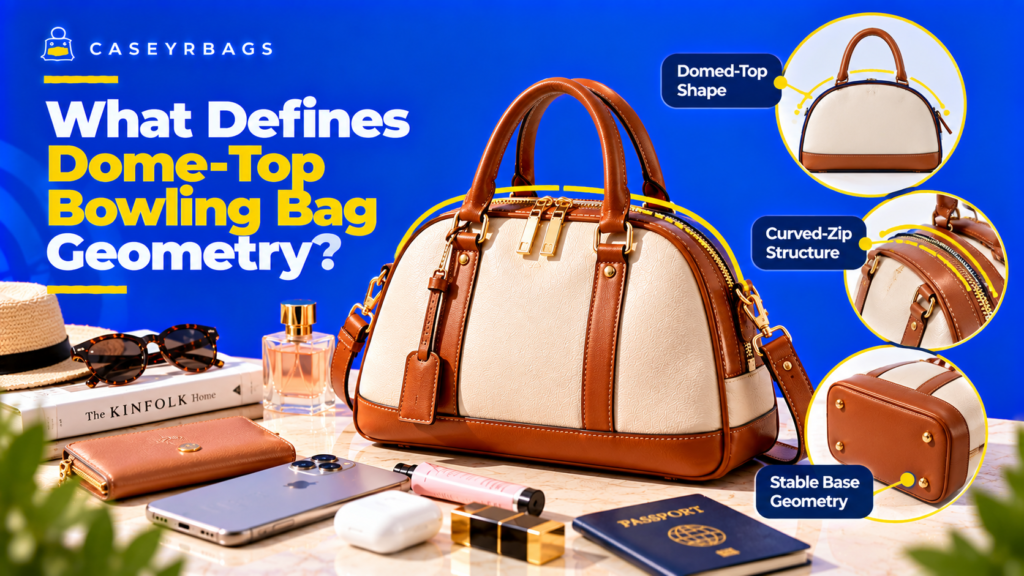
What Defines Dome-Top Bowling Bag Geometry? | CaseyrBags What Defines Dome-Top Bowling Bag Geometry? Dome-Top Bowling Bag geometry is defined by a structured lower chamber whose side walls rise into curved shoulders and then transition into an arched upper crown rather than a flat top. The dome is three-dimensional: front and back panels, side gussets, seams, and the zipper path work together to preserve width, depth, and curvature across the upper body. The shape does not require a rigid shell or a perfect semicircle. What matters is that the crown remains an intentional structural continuation of the bag’s lower footprint, with recognizable shoulder-to-top curvature and enough form control that the upper arch exists independently of temporary overfilling or random fabric bulging. KEY TAKEAWAY Dome-Top Bowling Bag geometry is a three-dimensional progression from a defined lower footprint through vertical body panels and controlled side depth into inward-curving shoulders and an arched crown. A curved zipper may follow that geometry, but it does not create the dome by itself. Integrated Dome Base → Wall → Shoulder → CrownFront, side, empty, and light-load views preserve the same three-dimensional progression with recognizable depth and crown continuity. Conditional Geometry Recognizable but SoftenedThe dome remains identifiable, but material softness, mild asymmetry, shallow crown height, or handle influence requires controlled comparison. Mismatch Signal Bulge, Slouch or Flat TopMissing side depth, weak shoulders, zipper-only curvature, load-created roundness, or an unintegrated crown prevents a clean Dome-Top classification. What Structurally Defines Dome-Top Bowling Bag Geometry? A Dome-Top Bowling Bag begins with a defined lower chamber rather than an isolated curved roof. The base establishes width and depth, while the front, back, and side panels rise from that footprint to create the three-dimensional body below the crown. See Bowling Bag. Those panels change direction near the upper body. Instead of ending at a flat horizontal edge, they curve inward through shoulder transitions that guide the structure toward the highest crown zone. The crown completes the dome while the gussets, seams, zipper placement, selective reinforcement, and handle anchors preserve enough continuity for the arch to remain recognizable. The governing progression is base → wall → shoulder → crown. DOME-TOP BOWLING BAG GEOMETRY ANATOMY CROWN APEX SHOULDER → CROWN DEFINED BASE CASEYRBAGS.COM Figure 1. Dome-Top Bowling Bag Geometry Anatomy Shows the defined base, vertical body, side gusset, shoulder transition, crown, apex, zipper arc, endpoint, and handle anchor as one integrated geometry. Which Geometric Zones Define the Form? The form is defined by a sequence of geometric zones rather than by one curved edge. The lower footprint, vertical body, shoulder transitions, upper crown, and apex. Explain each zone as part of one directional progression rather than a collection of unrelated curves. This keeps the classification tied to visible geometry instead of stylistic language. The form to remain three-dimensional across width, height, and depth. A bag with a curved front edge but no upper side depth does not yet provide complete Dome-Top evidence. This boundary allows normal softness and minor asymmetry without weakening the underlying classification method. Which Construction Features Preserve Those Zones? Construction features preserve the geometric zones by directing panel surfaces and retaining depth. Front and back panels, side gussets, curved or shaped seams, zipper path, reinforcement, and handle anchors. Explain what each feature can contribute to surface direction or shape retention. The most useful comparison isolates one geometric layer before changing another. No single feature proves the complete classification. A curved zipper, reinforced crown, deep gusset, or rounded panel must connect to the remaining base-to-crown geometry. The final judgment should identify the first supported mismatch rather than demand maximum stiffness or symmetry. What Is the Correct Structural Definition? The correct structural definition treats the dome as an integrated three-dimensional arch. The core rule is Dome-Top Bowling Bag geometry is an integrated three-dimensional arch—not simply a curved top edge. The dome must arise from the relationship among lower chamber, walls, shoulders, crown, and side depth. That makes the claim falsifiable and prevents one feature from standing in for the complete dome. In classification terms, the bag passes when the major zones remain recognizable in natural empty and lightly loaded states without depending on overfilling, handle pull, or one viewing angle. Then return the reader to the complete type definition through Bowling Bag: Domed-Zip Geometry and Short-Trip Capacity. Use this approved upward link once only. That distinction separates intentional geometry from temporary content pressure or random folds. How Do the Base, Vertical Walls, and Gussets Establish the Three-Dimensional Foundation? The upper dome can only be interpreted correctly when the lower body supplies a stable three-dimensional reference. Base width and depth, vertical wall rise, and gusset continuity establish the geometry from which the shoulders and crown develop. See Dome-Top Opening. What Does the Base Establish? The base creates the lower reference for width, depth, and body orientation. The base establishes lower width, lower depth, body orientation, and the starting geometry of the surrounding panels. The upper arch is interpreted relative to these lower dimensions. Practical classification depends on the complete progression rather than a single measurement. The distinction remains: defined base ≠ domed top. A wide, oval, or structured footprint creates the foundation but cannot independently create shoulders, crown height, or three-dimensional upper continuity. A successful observation in one zone does not automatically prove the remaining crown, depth, or shoulder relationships. How Do Vertical Walls Create the Lower Body Zone? Vertical walls create the straighter lower zone that makes the shoulder transition readable. Below the shoulders, the front, back, and side panels generally maintain more consistent width, depth, and vertical direction. This straighter lower region creates the contrast that makes the later inward curvature recognizable. The reader should look for repeatable relationships rather than perfect mathematical form. A dome becomes identifiable when the body changes direction progressively rather than ending in a separate roof-like piece. If the entire side is continuously soft and undefined, identify slouch or load dependence as competing explanations. The result should stay qualified to the observed construction and viewing conditions.
How Does a Bowling Bag Combine Domed-Zip Geometry & Short-Trip Capacity?
How Does a Bowling Bag Combine Domed-Zip Geometry & Short-Trip Capacity? | CaseyrBags How Does a Bowling Bag Combine Domed-Zip Geometry & Short-Trip Capacity? A Bowling Bag combines domed-zip geometry and short-trip capacity through a rounded upper body whose zipper follows the curved top while the side panels and base maintain a compact structured chamber below. The dome can provide additional central clearance and a broader access path than a narrow flat-top opening, making it easier to insert flexible clothing and selected travel essentials. Its short-trip capacity comes from using that rounded upper clearance together with controlled width, depth, and base support rather than maximizing total volume. The format works best for a deliberately limited load that remains easy to insert, close, retrieve, and carry without pushing the zipper path upward or distorting the Bowling Bag’s characteristic rounded profile. KEY TAKEAWAY A Bowling Bag works for a compact short trip when its rounded upper body and curved zipper provide practical access to a controlled chamber while the load stays proportionate enough to preserve normal closure, handle use, retrieval, and reserve space. Balanced Fit Domed Access + Controlled LoadOpening, chamber use, closure, handles, profile, reserve, and retrieval all remain functional with the intended compact trip load. Conditional Fit One Geometry Near the LimitDome clearance, rigid-item size, footwear, loaded depth, organization, or closure reserve remains usable but needs one controlled correction. Mismatch Signal Access or Closure Breaks DownRestricted opening, blocked dome, rigid-item dominance, excessive depth, fragmented space, forced closure, or disruptive retrieval indicates a capacity mismatch. What Defines Domed-Zip Geometry & Short-Trip Capacity in a Bowling Bag? Bowling Bag domed geometry begins with a rounded upper profile that rises from comparatively structured sides into an arched top. The zipper follows part of that curved upper zone, so access occurs across a three-dimensional opening rather than one narrow flat edge. See Fashion Bag Types. The zipper path determines how much of the chamber becomes usable during loading and retrieval. Central dome height can add clearance, but zipper endpoints, curved shoulders, panel stiffness, and the space required for normal closure still limit how much of the visible upper volume can be used. Short-trip capacity appears when that domed access connects to enough controlled width, depth, base support, and selective organization for a deliberately limited load. The system works only while clothing, toiletries, selected accessories, handles, closure, retrieval, and reserve space remain functional. BOWLING BAG STRUCTURAL ANATOMY CENTRAL DOME CLEARANCE MAIN CHAMBER STRUCTURED BASE CASEYRBAGS.COM Figure 1. Bowling Bag Structural Anatomy Shows the domed upper panel, curved zipper, endpoints, side panel, gusset, main chamber, structured base, handle, loaded depth, and central dome clearance. What Defines the Domed-Zip System? The domed-zip system is a relationship among the rounded upper profile, curved zipper path, endpoints, side transitions, and central height. The rounded upper profile, curved zipper path, zipper endpoints, structured side transitions, and central dome height. Explain how these features create three-dimensional access rather than a simple flat-top opening. That makes the mechanism observable and keeps the reader focused on what changes access, closure, or usable capacity. Every Bowling Bag can use different curves, endpoint positions, materials, and panel stiffness. Treat the system as a component relationship, not one universal shape or opening standard. This boundary prevents one successful packing arrangement from becoming a universal travel claim. What Defines Functional Short-Trip Capacity? Functional short-trip capacity is the amount of a deliberately limited travel load that remains usable rather than merely physically contained. The intended load as compact clothing, toiletries, personal essentials, and selected electronics or accessories. Keep footwear conditional because its fixed length and depth can consume a large share of the chamber. The most useful comparison keeps the bag and item set constant so only the tested geometry or packing variable changes. Capacity by continued usability: the load must remain easy to insert, close, retrieve, and carry while some reserve space and a controlled profile remain. Do not define it through a fixed number of travel days. The practical target is repeatable access and closure with a controlled loaded profile, not the largest possible fill. What Connects Domed Access to Short-Trip Capacity? Domed access and capacity connect through a single chain: opening geometry exposes the chamber, and controlled chamber geometry determines how effectively that access can be used. The core relationship is domed access makes the structured chamber usable; controlled chamber geometry turns that access into practical short-trip capacity. Trace dome, opening, chamber, contents, and closure as one chain. This condition matters because nominal volume can increase while practical access and retrieval become worse. Establish the boundary: neither visible dome volume nor total interior volume proves functional capacity. The actual result depends on whether the intended items can enter, settle, close, remain carryable, and be retrieved without chronic reshuffling. Reserve, handle use, and retrieval should remain part of the final decision rather than being treated as optional extras. How Do the Domed Top, Curved Zipper, and Endpoints Create Usable Access? The domed top creates potential upper clearance, but the zipper path determines how much of that geometry becomes practical access. Endpoint location and panel behavior therefore matter as much as total zipper length. See Dome-Top Opening. What Does the Domed Upper Shape Add? The domed upper shape adds central height and a rounded transition between the side panels. The arched top creates central vertical clearance, a rounded transition between the side panels, and potential space above the lower packed contents. It also produces the characteristic Bowling Bag silhouette rather than a flat rectangular top. The result should be judged from normal use rather than from maximum physical fill or a staged display. The distinction remains: visible dome volume ≠ fully usable storage volume. The zipper path, seams, curved shoulders, and required closure clearance reduce the part of that space that contents can occupy practically. This distinction preserves the Bowling Bag identity while preventing a compact fashion/travel format from being judged like an expandable Duffel. DOMED TOP → ZIPPER ACCESS ROUNDED STRUCTURE EXPANDED CENTRAL OPENING DIRECT
Why Does a Rigid-Base Bucket Bag Remain Upright?
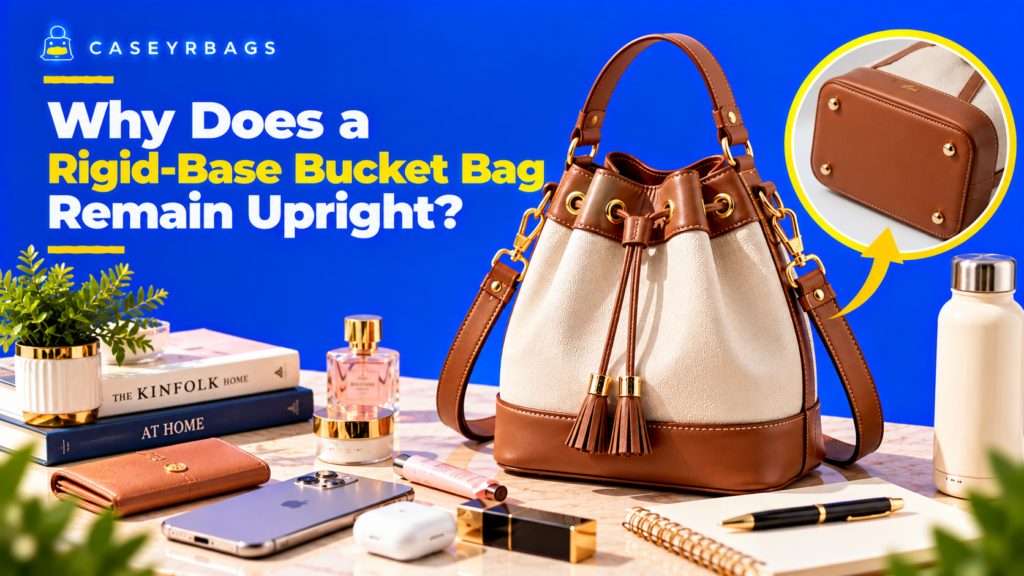
Why Does a Rigid-Base Bucket Bag Remain Upright? | CaseyrBags Why Does a Rigid-Base Bucket Bag Remain Upright? A Rigid-Base Bucket Bag can remain upright because its stiff lower panel preserves a broader and more consistent contact footprint than a fully soft base. That lower platform reduces bottom collapse, keeps the base perimeter more defined, and gives the gussets and lower side walls a stable boundary from which the vertical chamber can rise. Upright behavior is strongest when the loaded center remains within that support footprint. Base flatness, wall alignment, load height, and item distribution therefore matter alongside stiffness; the rigid base improves self-support, but it cannot prevent tipping when the load becomes strongly top-heavy, one-sided, or distorted beyond the footprint. KEY TAKEAWAY A Rigid-Base Bucket Bag remains upright when its lower panel preserves a broad, reasonably flat contact footprint, the perimeter and lower walls keep the chamber aligned, and the normal loaded center stays inside that effective support area. Rigidity improves self-support; it does not guarantee standing under every load or surface. Reliable Upright Support + Alignment + Contained LoadBroad contact, aligned lower walls, and a normal loaded center inside the effective footprint produce the strongest upright-resting result. Conditional Upright Support Margin Is NarrowThe bag stands under ordinary conditions but surface variation, high loading, or edge-near mass can reduce the available support margin. Mismatch Signal Rocking, Lean or TippingWarping, edge lift, collapsed lower walls, high or one-sided loading, overfill, or poor surface contact moves the system outside a reliable upright range. What Makes a Rigid-Base Bucket Bag Remain Upright? A Rigid-Base Bucket Bag remains upright when its lower panel resists folding and severe sag strongly enough to preserve a broad, usable contact footprint on a suitable surface. That support is comparative rather than absolute: the base improves the conditions for self-support without guaranteeing that every load will stand. The perimeter, seams, gussets, and lower side walls extend that base support into the chamber. When those parts stay aligned, the lower body rises from a predictable footprint instead of collapsing or folding sideways as soon as the bag is released. The final balance depends on where the effective loaded center sits relative to the contact footprint. Base geometry creates the support boundary, while wall structure, load height, item distribution, overfilling, and the supporting surface determine whether the bag remains generally vertical. For the complete parent structure, see Bucket Bag. RIGID-BASE BUCKET BAG UPRIGHT ANATOMY SUPPORTING SURFACE LOADED CENTER DENSE ITEM CONTACT FOOTPRINT / SUPPORT BOUNDARY CASEYRBAGS.COM Figure 1. Rigid-Base Bucket Bag Upright Anatomy Shows the rigid lower panel, contact footprint, support boundary, loaded center, lower walls, gusset, dense item, and supporting surface. Which Structural Features Support Upright Behavior? Upright behavior begins with a coordinated lower structure rather than with base stiffness alone. The rigid base panel resists collapse, a relatively flat contact area keeps more of the bottom on the surface, the perimeter defines the support outline, aligned seams transfer that geometry, and the gussets plus lower walls help the chamber rise vertically. Each feature contributes a different part of the resting-support system. No single feature proves the complete outcome. A stiff panel can still rock when warped, a broad base can still tip under an edge load, and aligned lower walls can still be overcome by a high loaded center. The final interpretation therefore remains conditional on the exact load, surface, footprint, and wall behavior observed. Which Load and Surface Variables Influence It? The same bag can stand or lean differently when load position, height, balance, or surface conditions change. Item mass and position alter the loaded center, side-to-side and front-to-back imbalance change the direction of lean, overfilling can spread the walls, and closure-zone crowding can raise upper mass. These variables can change upright behavior without any change in the base itself. The supporting surface is also a fixed condition. A bag that stands on a flat hard surface may respond differently on an inclined, uneven, or compressible surface, so surface variation must not be mistaken for a change in base construction. If a correction to the load does not change the result, the surface and lower structure should be checked next. What Is the Correct Upright-Resting Principle? The correct principle combines support geometry with load containment rather than treating rigidity as a guarantee. A stable footprint, controlled lower walls, and a loaded center that remains within the effective support area together create a stronger upright tendency under stated conditions. “Stronger” describes a directional improvement, not a universal self-standing promise. In practice, the structure passes when the normal load remains generally vertical, the base contacts the surface without material rocking or edge lift, and the bag does not require unusually careful item placement to avoid collapse or tipping. The result should be repeatable with the normal load rather than dependent on one staged pose. How Do Base Footprint, Rigidity, and Flatness Create Surface Support? Base footprint, useful rigidity, and geometric flatness work together to create surface support. A wide-looking or stiff-feeling base is not enough if the actual contact area is reduced by collapse, warping, edge lift, or an unsuitable supporting surface. How Does the Base Footprint Define the Support Boundary? The effective footprint is the practical support region beneath the loaded bag. Its useful width, depth, shape, and actual surface contact define the area available to resist lean. The outer edge of that contact region acts as the practical boundary beyond which the loaded center has progressively less support. When bottom collapse narrows or changes the effective footprint, the support margin decreases and the same load sits comparatively closer to an edge. Upright behavior therefore begins with a predictable lower contact footprint rather than with exterior dimensions alone. BASE FOOTPRINT → UPRIGHT SUPPORT DEFINED FOOTPRINTCENTER INSIDE COLLAPSED FOOTPRINTLESS SUPPORT MARGIN CENTER BEYOND AREATIPPING TENDENCY CASEYRBAGS.COM Figure 2. Base Footprint → Upright Support Compares a defined support footprint with collapse and a loaded center that reaches beyond the reduced contact region. How Does Useful Base Rigidity Preserve Contact?
How Does Rigid-Base Bucket Bag Structure Improve Stability?
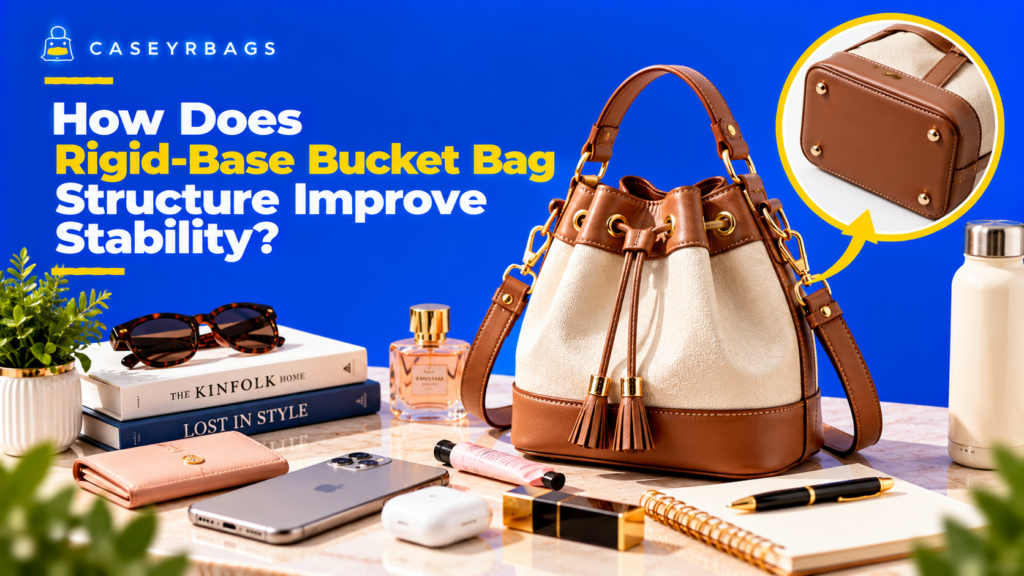
How Does Rigid-Base Bucket Bag Structure Improve Stability? | CaseyrBags How Does Rigid-Base Bucket Bag Structure Improve Stability? A Rigid-Base Bucket Bag improves stability by using a stiffened lower panel to preserve a recognizable footprint, spread concentrated loads, and reduce severe point sag when contents settle. The more controlled lower surface also gives the perimeter, seams, gussets, and flexible side walls a consistent structural boundary from which the loaded chamber can rise. The useful target is controlled lower-body deformation, not maximum hardness. A balanced base makes standing and suspended behavior more predictable under the normal load while allowing the upper bag to remain flexible; an under-rigid base can collapse, whereas an over-rigid base can create an abrupt, box-like transition that does not suit the rest of the structure. KEY TAKEAWAY A Rigid-Base Bucket Bag improves stability when its lower panel preserves the footprint, spreads localized loads, limits severe point sag, and gives the perimeter, seams, gussets, and flexible walls a predictable lower boundary—without turning the entire bag into a hard shell. Balanced Stability Controlled Lower FoundationThe footprint stays recognizable, severe local sag is limited, edges remain aligned, and standing plus suspended lower shape stay predictable under the normal load. Conditional State One Variable Near the LimitPerimeter response, transition behavior, dense-item placement, loaded depth, or suspension remains manageable but needs one controlled retest. Mismatch Signal Sag, Tilt or Transition Breaks DownCollapsed footprint, edge lift, twisting, severe point sag, abrupt hinge folds, overfill, or standing-only success indicates a named structural mismatch. What Makes a Rigid-Base Bucket Bag More Stable? A Rigid-Base Bucket Bag becomes more stable when its lower panel resists deformation more strongly than the flexible upper body, allowing the base to keep a recognizable footprint before and after normal contents are added. For the wider parent structure, see Bucket Bag. That lower resistance spreads some localized demand across a broader contact area, so one dense or narrow object is less likely to create a severe point sag that dictates the whole bottom shape. The governing principle is selective lower control: the base, perimeter, seams, gussets, and lower walls work together while the upper body and drawstring zone remain flexible enough to preserve Bucket Bag behavior. RIGID-BASE BUCKET BAG STRUCTURAL ANATOMYDENSE ITEMRIGID PANEL + CONTROLLED FOOTPRINTCASEYRBAGS.COM Figure 1. Rigid-Base Bucket Bag Structural Anatomy Shows the flexible upper body, side wall, gusset, lining, perimeter, base seam, rigid panel, reinforcement, load-contact zone, dense item, lower footprint, and loaded depth. Which Structural Effects Create Stability? The four primary effects separately: preserved footprint, reduced severe point sag, broader load distribution, and more predictable lower-body shape. Tie each effect to an observable empty-versus-loaded change. Judge the effect from the actual lower geometry and the normal loaded state rather than from empty appearance or stiffness by touch alone. No single effect proves the whole system stable. A bag may retain its base width but still tilt from edge loading, or reduce center sag while its perimeter twists; the combined evidence determines the outcome. Keep the same load and placement during retesting so structure, geometry, and load distribution remain distinguishable. Which Components Work With the Rigid Base? The reinforcement layer, base perimeter, base seam, side walls, gussets, lining, load placement, and suspension as connected components. Explain what structural role each contributes without turning the section into a manufacturing tutorial. Judge the effect from the actual lower geometry and the normal loaded state rather than from empty appearance or stiffness by touch alone. Show the dependency chain: the panel defines resistance, the perimeter preserves the outline, the seam transfers that geometry, walls and gussets guide the chamber, and the load reveals whether those relationships remain controlled. Keep the same load and placement during retesting so structure, geometry, and load distribution remain distinguishable. What Is the Correct Stability Principle? A rigid base improves stability by controlling lower-body deformation, not by eliminating movement throughout the bag. Preserve the distinction between a stable lower foundation and a rigid entire shell. Judge the effect from the actual lower geometry and the normal loaded state rather than from empty appearance or stiffness by touch alone. The principle into a decision: the structure passes when the normal load leaves the footprint recognizable, local sag controlled, edges aligned, and suspended lower shape predictable without requiring maximum stiffness. Keep the same load and placement during retesting so structure, geometry, and load distribution remain distinguishable. How Do Footprint Retention, Point-Sag Control, and Load Spread Work Together? Footprint retention, point-sag control, and load spreading are the core panel mechanics behind lower-body stability. They should be compared under the same bag shape, normal load, and item placement so the observed difference comes from structural response rather than a changed test condition. For the related upright behavior, see Rigid-Base Upright. How Does Base Rigidity Preserve the Footprint? A very soft base, whose center may drop and edges pull inward, with a controlled rigid base, whose width, depth, and perimeter remain more recognizable. Keep the same bag shape and normal load as the comparison basis. Judge the effect from the actual lower geometry and the normal loaded state rather than from empty appearance or stiffness by touch alone. The footprint matters: it gives the rest of the chamber a more stable geometric reference. Add the trade-off that an excessively hard platform may preserve a fixed outline while reducing adaptability and increasing stiffness contrast with the walls. Keep the same load and placement during retesting so structure, geometry, and load distribution remain distinguishable. BASE RIGIDITY → FOOTPRINT CONTROLSOFT BASECONTROLLED RIGIDEXCESSIVELY HARDVARIABLE FOOTPRINTRECOGNIZABLELESS ADAPTABLECASEYRBAGS.COM Figure 2. Base Rigidity → Footprint Control Compares soft, controlled, and excessively hard bases without treating maximum hardness as the goal. How Does a Rigid Base Reduce Point Sag? Point sag as localized downward deformation caused by a dense small object, narrow rigid item, or concentrated placement. Explain that a stiffened panel distributes part of this demand over a broader lower region. Judge the effect from the actual lower geometry and the normal loaded state rather than from empty
When Does a Soft Bucket Bag Need an Internal Zip Pocket?

When Does a Soft Bucket Bag Need an Internal Zip Pocket? | CaseyrBags When Does a Soft Bucket Bag Need an Internal Zip Pocket? A Soft Bucket Bag needs an internal zip pocket when small, important, or frequently accessed items repeatedly migrate through the flexible main chamber, become buried beneath larger contents, or require more reliable separation than the open compartment provides. The need becomes stronger in deeper bags where gravity, soft walls, and a variable drawstring opening increase search distance or reduce direct visibility. The zip pocket is most useful when it has a clear role—such as containing cards, keys, earbuds, or similar compact essentials—without consuming excessive main-chamber space. If the main chamber or existing open pockets already keep those items predictable, retained, and directly accessible, an additional zipped compartment may add complexity without solving a real problem. KEY TAKEAWAY A Soft Bucket Bag needs an internal zip pocket when important small items repeatedly migrate, become buried, mix with larger contents, or require more predictable ordinary retention than the main chamber or existing open pockets provide—and when the enclosed pocket solves that problem without excessive access or space cost. Functionally Justified Predictable Small-Item ZoneThe pocket repeatedly improves location, separation, ordinary retention, and direct retrieval enough to justify its zipper step and chamber cost. Optional / Alternative Existing Storage May Be EnoughAn open pocket, stable placement routine, or removable pouch already delivers comparable control with less fixed complexity. Mismatch Signal Pocket Creates New FrictionPoor placement, wrong dimensions, lining collapse, zipper obstruction, overfill, inward projection, or duplicated roles reduce the value of the enclosed zone. When Is an Internal Zip Pocket Functionally Necessary? An internal zip pocket becomes functionally necessary only when the Soft Bucket Bag’s normal chamber or existing organization repeatedly fails a specific small-item task such as predictable location, separation, ordinary retention, or direct retrieval. The strongest case appears when compact important items migrate through the flexible chamber, settle below larger contents, or become inconsistent to reach after normal movement. A controlled enclosed zone can shorten that retrieval path and keep an assigned item set separate from the main load. The feature remains optional when a shallow chamber, stable routine, key tether, or well-positioned open pocket already performs those jobs reliably. Pocket presence alone is not proof of better organization. For the wider structure, see Bucket Bag. SOFT BUCKET BAG INTERNAL ORGANIZATION ANATOMYDRAWSTRING OPENINGSLIP POCKETZIP POCKETHIGH-FREQ ITEMLOW CHAMBER ZONECASEYRBAGS.COM Figure 1. Soft Bucket Bag Internal Organization Anatomy Shows the drawstring opening, soft wall, lining, main chamber, open slip pocket, internal zip pocket, zipper opening, pocket base, high-frequency item, and low chamber zone. Which Signs Indicate a Real Pocket Need? A real pocket need appears when the same small item repeatedly becomes difficult to locate, separate, retain, or retrieve under the ordinary daily load. Repeated searching, small items settling beneath larger contents, important objects mixing with the general load, unpredictable post-movement location, or partial unloading for routine retrieval. Require a recurring normal-use pattern rather than one inconvenient packing event. Each symptom to a named item, chamber condition, and retrieval consequence. The pocket becomes a candidate only when the existing main chamber or open organization fails a specific location, separation, retention, or access task. The result should be retested with the same daily load so location, retention, retrieval, intrusion, and access costs remain directly comparable. Which Item Roles Most Strongly Justify Enclosure? The strongest candidates are compact items with a clear recurring role, high retrieval importance, or a strong tendency to migrate within the chamber. Compact items that are important, frequently retrieved, easy to lose in the chamber, or better separated from larger contents. Explain that role and geometry matter more than item count alone. A defined assigned set rather than “all small things.” A pocket with cards, keys, earbuds, or a few similar essentials can preserve predictable location; an undefined accumulation zone can recreate the same search problem. The result should be retested with the same daily load so location, retention, retrieval, intrusion, and access costs remain directly comparable. When Is the Zip Pocket Unnecessary? The zip pocket is unnecessary when the existing chamber or open organization already keeps assigned small items predictable and directly accessible. A simple load, shallow chamber, distinctive larger contents, effective open slip pocket, key tether, or established item placement may already provide predictable access and adequate ordinary retention. The judgment should be based on the actual loaded chamber and recurring use pattern rather than on pocket count or an empty interior photograph. The decision rule: if no recurring problem exists or the feature does not materially improve the normal retrieval test, the pocket is optional. Do not treat internal zippers as a mandatory sign of quality or completeness. The result should be retested with the same daily load so location, retention, retrieval, intrusion, and access costs remain directly comparable. Why Do Small Items Migrate in a Soft Bucket Bag? Small-item migration begins with the Soft Bucket Bag’s flexible chamber rather than with the absence of a zipper. Wall movement, gravity, larger contents, lining folds, and ordinary carry can shift compact objects away from their original positions. How Does Soft Construction Enable Movement? Soft construction allows the walls and lining to conform to contents, so objects can shift as the bag changes orientation. Flexible walls and lining conform to the load rather than fixing every object in one rigid position. As the bag changes orientation, internal surfaces and contents can shift relative to one another. The boundary: softness creates movement potential but does not automatically create disorganization. Item geometry, load density, pocketing, placement, chamber proportions, and routine determine whether migration becomes a real problem. The result should be retested with the same daily load so location, retention, retrieval, intrusion, and access costs remain directly comparable. How Does Gravity Move Small Items Toward Low Points? Gravity can move compact loose items toward the base, lining folds, and gaps beneath broader contents even when those items occupy little volume. Dense or compact loose objects can settle toward