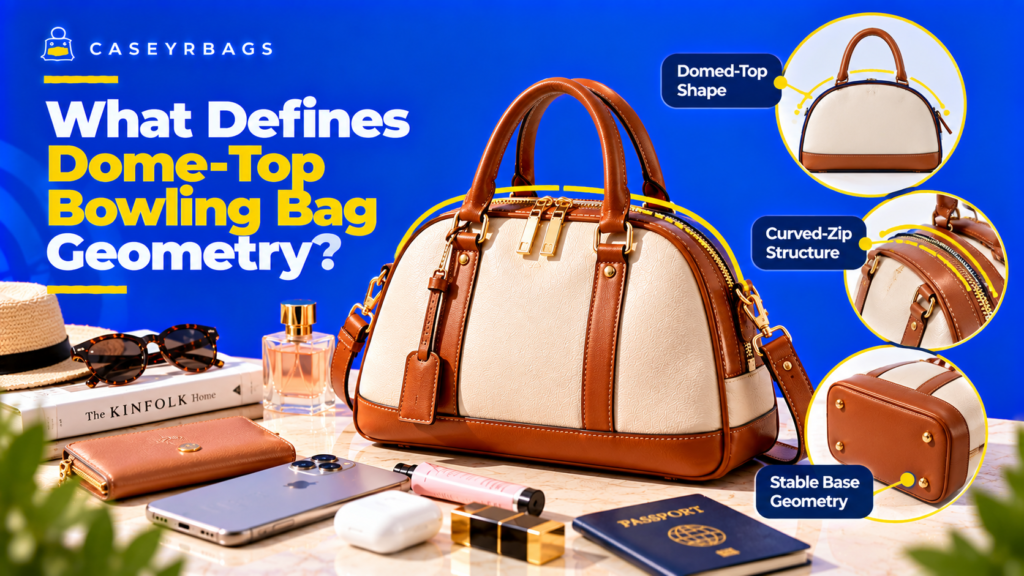
What Defines Dome-Top Bowling Bag Geometry?
Dome-Top Bowling Bag geometry is defined by a structured lower chamber whose side walls rise into curved shoulders and then transition into an arched upper crown rather than a flat top. The dome is three-dimensional: front and back panels, side gussets, seams, and the zipper path work together to preserve width, depth, and curvature across the upper body.
The shape does not require a rigid shell or a perfect semicircle. What matters is that the crown remains an intentional structural continuation of the bag’s lower footprint, with recognizable shoulder-to-top curvature and enough form control that the upper arch exists independently of temporary overfilling or random fabric bulging.
What Structurally Defines Dome-Top Bowling Bag Geometry?
A Dome-Top Bowling Bag begins with a defined lower chamber rather than an isolated curved roof. The base establishes width and depth, while the front, back, and side panels rise from that footprint to create the three-dimensional body below the crown. See Bowling Bag.
Those panels change direction near the upper body. Instead of ending at a flat horizontal edge, they curve inward through shoulder transitions that guide the structure toward the highest crown zone.
The crown completes the dome while the gussets, seams, zipper placement, selective reinforcement, and handle anchors preserve enough continuity for the arch to remain recognizable. The governing progression is base → wall → shoulder → crown.
Which Geometric Zones Define the Form?
The form is defined by a sequence of geometric zones rather than by one curved edge. The lower footprint, vertical body, shoulder transitions, upper crown, and apex. Explain each zone as part of one directional progression rather than a collection of unrelated curves. This keeps the classification tied to visible geometry instead of stylistic language.
The form to remain three-dimensional across width, height, and depth. A bag with a curved front edge but no upper side depth does not yet provide complete Dome-Top evidence. This boundary allows normal softness and minor asymmetry without weakening the underlying classification method.
Which Construction Features Preserve Those Zones?
Construction features preserve the geometric zones by directing panel surfaces and retaining depth. Front and back panels, side gussets, curved or shaped seams, zipper path, reinforcement, and handle anchors. Explain what each feature can contribute to surface direction or shape retention. The most useful comparison isolates one geometric layer before changing another.
No single feature proves the complete classification. A curved zipper, reinforced crown, deep gusset, or rounded panel must connect to the remaining base-to-crown geometry. The final judgment should identify the first supported mismatch rather than demand maximum stiffness or symmetry.
What Is the Correct Structural Definition?
The correct structural definition treats the dome as an integrated three-dimensional arch. The core rule is Dome-Top Bowling Bag geometry is an integrated three-dimensional arch—not simply a curved top edge. The dome must arise from the relationship among lower chamber, walls, shoulders, crown, and side depth. That makes the claim falsifiable and prevents one feature from standing in for the complete dome.
In classification terms, the bag passes when the major zones remain recognizable in natural empty and lightly loaded states without depending on overfilling, handle pull, or one viewing angle. Then return the reader to the complete type definition through Bowling Bag: Domed-Zip Geometry and Short-Trip Capacity. Use this approved upward link once only. That distinction separates intentional geometry from temporary content pressure or random folds.
How Do the Base, Vertical Walls, and Gussets Establish the Three-Dimensional Foundation?
The upper dome can only be interpreted correctly when the lower body supplies a stable three-dimensional reference. Base width and depth, vertical wall rise, and gusset continuity establish the geometry from which the shoulders and crown develop. See Dome-Top Opening.
What Does the Base Establish?
The base creates the lower reference for width, depth, and body orientation. The base establishes lower width, lower depth, body orientation, and the starting geometry of the surrounding panels. The upper arch is interpreted relative to these lower dimensions. Practical classification depends on the complete progression rather than a single measurement.
The distinction remains: defined base ≠ domed top. A wide, oval, or structured footprint creates the foundation but cannot independently create shoulders, crown height, or three-dimensional upper continuity. A successful observation in one zone does not automatically prove the remaining crown, depth, or shoulder relationships.
How Do Vertical Walls Create the Lower Body Zone?
Vertical walls create the straighter lower zone that makes the shoulder transition readable. Below the shoulders, the front, back, and side panels generally maintain more consistent width, depth, and vertical direction. This straighter lower region creates the contrast that makes the later inward curvature recognizable. The reader should look for repeatable relationships rather than perfect mathematical form.
A dome becomes identifiable when the body changes direction progressively rather than ending in a separate roof-like piece. If the entire side is continuously soft and undefined, identify slouch or load dependence as competing explanations. The result should stay qualified to the observed construction and viewing conditions.
How Do Side Gussets Preserve Three-Dimensional Depth?
Side gussets preserve front-to-back depth as the bag rises toward the shoulders. Gussets establish front-to-back depth, define the side profile, and carry the lower chamber into the shoulder transition. They prevent the crown from becoming only a two-dimensional front-view outline. The observation should remain consistent across the same bag, view, and load condition.
The distinction remains: true dome-top geometry requires controlled depth through the upper transition, not only a curved front outline. If depth collapses near the top, classify the evidence as Front-Only Curve or inspect further. If the expected relationship disappears when the bag is emptied or viewed from the side, another explanation should be tested.
How Do Shoulder Transitions and Crown Geometry Create the Upper Arch?
The shoulder transition is the point where the vertical body begins to curve inward and upward. Crown height, width, and apex position then determine whether the upper arch reads as shallow, balanced, or disproportionately pronounced.
What Defines a Progressive Shoulder Transition?
A progressive shoulder transition redirects the upper body inward without creating an abrupt roof-like break. The shoulder begins where the upper side geometry moves inward and upward toward the crown. A progressive curve guides the body into the arch without producing an abrupt box-to-roof appearance. This keeps the classification tied to visible geometry instead of stylistic language.
The distinction remains: dome identity depends on continuous curvature—not one universal shoulder radius. Evaluate whether both shoulders connect the body and crown coherently rather than measuring against an arbitrary fixed curve. This boundary allows normal softness and minor asymmetry without weakening the underlying classification method.
What Defines the Crown and Apex?
The crown is the upper arch between the shoulders, and the apex is its highest region. The crown as the upper arched zone connecting the two shoulder transitions and the apex as its highest point. Crown geometry controls central height, upper silhouette, and the visible strength of the dome. The most useful comparison isolates one geometric layer before changing another.
The distinction remains: domed crown ≠ perfect half-circle. The crown may be shallow, moderate, pronounced, broad, or narrow as long as it remains intentional, continuous, and proportionate to the lower body. The final judgment should identify the first supported mismatch rather than demand maximum stiffness or symmetry.
How Should Crown Height and Width Work Together?
Crown height and crown width must be interpreted together because each changes the apparent steepness and balance of the arch. A shallow crown creates a subtle arch, a high crown creates a stronger central rise, a broad crown can flatten the upper center, and a narrow crown concentrates the apex and steepens the shoulders. That makes the claim falsifiable and prevents one feature from standing in for the complete dome.
The boundary is crown height and width must be interpreted together with body width, depth, and height. More crown height or a narrower apex is not automatically better geometry. That distinction separates intentional geometry from temporary content pressure or random folds.
How Do Panels, Seams, and Material Structure Preserve the Dome?
Panels and seams turn flat material into controlled three-dimensional surface direction. Their shaping must preserve the crown without requiring a molded hard shell or allowing random softness to determine the entire profile.
How Do Front and Back Panels Create the Main Profile?
Front and back panels create the dominant visible rise from lower body to shoulder and crown. Shaped front and back panels establish shoulder curvature, crown height, and the main visible silhouette. Their cut lines guide the surface from the lower body toward the upper arch. Practical classification depends on the complete progression rather than a single measurement.
The two surfaces to cooperate with side depth. A strongly curved front panel paired with a flat or collapsed side transition supports only partial evidence of a three-dimensional dome. A successful observation in one zone does not automatically prove the remaining crown, depth, or shoulder relationships.
How Do Panel Seams Guide Curvature?
Panel seams guide curvature by redirecting flat material into repeatable three-dimensional surface changes. Curved seams can remove excess flat material, redirect surface tension, and connect separate panel zones into rounded transitions. Seam placement can therefore influence shoulder continuity and crown formation. The reader should look for repeatable relationships rather than perfect mathematical form.
The failure mode is misalignment, puckering, or uneven tension can flatten one side, shift the apex, or introduce irregular asymmetry. Maintain dome geometry comes from controlled panel shaping, not fabric softness alone. The result should stay qualified to the observed construction and viewing conditions.
How Does Material Structure Affect Dome Retention?
Material structure affects how clearly the dome remains visible when the bag is relaxed. Very soft material can allow shoulders to fold and the crown to collapse, making the shape more dependent on contents. Controlled structure can keep the arch recognizable while still allowing moderate flexibility. The observation should remain consistent across the same bag, view, and load condition.
The distinction remains: domed profile ≠ rigid shell. Semi-structured materials, shaped panels, seams, and selective support can preserve Dome-Top identity without converting the bag into a molded case. If the expected relationship disappears when the bag is emptied or viewed from the side, another explanation should be tested.
How Do the Zipper Path and Endpoints Integrate With Dome Geometry?
The zipper belongs to the dome system only when it follows an upper form that already exists through panels, gussets, shoulders, seams, and support. Its path can open and preserve the geometry, but it cannot independently create it.
How Can the Zipper Follow the Structural Crown?
The zipper can follow the upper arch when its track is integrated into already-shaped crown and shoulder panels. The zipper may run across the crown, around part of the shoulders, or through a curved upper-panel transition. An arched path can follow the natural contour rather than interrupting it with a flat line. This keeps the classification tied to visible geometry instead of stylistic language.
The dependency is shaped panels, gussets, shoulders, and crown geometry must already create the form beneath the closure. The zipper can preserve and open that structure but cannot replace it. This boundary allows normal softness and minor asymmetry without weakening the underlying classification method.
How Do Zipper Endpoints Affect Shoulder Continuity?
Zipper endpoints influence where the upper panels separate and where stiffness concentrates near the shoulder or gusset transition. Endpoints may terminate in the upper side walls, shoulder zones, or near gusset transitions. Their position affects where the panels separate, where local stiffness increases, and how the shoulder remains continuous. The most useful comparison isolates one geometric layer before changing another.
Endpoints to integrate with the upper shape rather than becoming the sole visible evidence of a dome. Inspect the geometry with the zipper relaxed and closed before assigning classification, then continue to How does Dome-Top Bowling Bag opening follow its curved body for the closely related opening-mechanism question. Use this approved lateral link once only. The final judgment should identify the first supported mismatch rather than demand maximum stiffness or symmetry.
Why Is a Curved Zipper Insufficient Evidence by Itself?
A curved zipper is insufficient because track curvature does not prove crown volume, shoulder shaping, or upper side depth. A zipper can curve across an otherwise flat, weakly shouldered, or load-dependent upper body. Track shape alone cannot prove crown volume, side depth, panel shaping, or repeatable empty geometry. That makes the claim falsifiable and prevents one feature from standing in for the complete dome.
The distinction remains: curved zipper ≠ complete dome geometry. Classification must come from the integrated base, walls, gussets, shoulders, crown, seams, and closure relationship. That distinction separates intentional geometry from temporary content pressure or random folds.
How Do Reinforcement and Handle Anchors Affect the Dome?
Selective reinforcement and handle anchors influence shape retention around the crown and shoulders. They should support the dome without introducing rigid plates, pinched anchor zones, or concentrated folds that distort the upper profile.
Which Zones May Need Selective Reinforcement?
Selective support is most useful where seams, zipper edges, shoulders, crown panels, or anchors are prone to collapse. Zipper edges, shoulder seams, crown panels, gusset transitions, and handle-anchor zones as areas that may benefit from support. Reinforcement can resist inward collapse and preserve intended curvature. Practical classification depends on the complete progression rather than a single measurement.
Tie the claim to observation: supported zones should retain continuity without appearing as isolated hard plates. Do not infer reinforcement quality solely from thickness or stiffness by touch. A successful observation in one zone does not automatically prove the remaining crown, depth, or shoulder relationships.
When Does Reinforcement Become Excessive?
Reinforcement becomes excessive when local support turns into a hard shell or creates abrupt stiffness transitions. Excessive reinforcement can produce a hard upper shell, abrupt stiffness transitions, reduced flexibility, or flattened attachment zones. More support can therefore weaken the intended relationship between structure and moderate softness. The reader should look for repeatable relationships rather than perfect mathematical form.
The distinction remains: reinforcement should preserve the dome without turning the upper body into a rigid shell. Evaluate empty and lightly loaded behavior rather than treating maximum hardness as the goal. The result should stay qualified to the observed construction and viewing conditions.
How Do Handle Anchors and Short Handles Interact With the Crown?
Handle anchors can preserve or distort crown geometry depending on spacing, placement, and pull concentration. Anchors commonly sit on upper front or back panels, shoulder zones, or reinforced body areas. Proportionate spacing can distribute pull while concentrated anchors can pinch the crown, flatten a local zone, or create suspension folds. The observation should remain consistent across the same bag, view, and load condition.
The distinction remains: handle placement interacts with the dome but does not create Dome-Top identity by itself. Compare the relaxed bag with the handles under light tension and confirm that the central crown remains identifiable. If the expected relationship disappears when the bag is emptied or viewed from the side, another explanation should be tested.
How Do Width, Depth, Body Height, and Base-to-Crown Proportion Affect Identity?
Dome identity is relational rather than dependent on crown height alone. Width, front-to-back depth, vertical-body height, shoulder position, crown width, crown height, and apex concentration all affect how the geometry reads.
How Does Body Width Change Apparent Crown Curvature?
Body width changes how steep or shallow the same crown rise appears. The same vertical crown rise can appear shallower across a wider body and steeper across a narrower body. Width changes the visual and geometric relationship between shoulders and apex. This keeps the classification tied to visible geometry instead of stylistic language.
The distinction remains: dome shape is relational; crown height cannot be evaluated independently from body width. Avoid universal height-to-width thresholds unless a specific method and product family justify them. This boundary allows normal softness and minor asymmetry without weakening the underlying classification method.
Why Must Front-to-Back Depth Remain Part of the Classification?
Front-to-back depth confirms whether the apparent arch is genuinely three-dimensional. Sufficient depth supports a rounded side profile, upper-gusset curvature, and a genuinely three-dimensional crown. Very little depth can flatten the dome despite a convincing front-view arch. The most useful comparison isolates one geometric layer before changing another.
The distinction remains: dome geometry requires width, height, and depth to work together. Classify from combined views and do not let the most flattering angle determine the result. The final judgment should identify the first supported mismatch rather than demand maximum stiffness or symmetry.
What Defines Balanced Base-to-Crown Proportion?
Balanced proportion connects the crown to the lower chamber rather than allowing either zone to dominate. A very shallow dome can make the bag read like a flat-top holdall, while a dominant high crown can exaggerate upper volume and weaken proportional Bowling Bag balance. That makes the claim falsifiable and prevents one feature from standing in for the complete dome.
Balance as visual and structural integration between lower chamber, body height, shoulders, crown width, crown height, and depth. The target is not maximum arch height but a coherent complete form. That distinction separates intentional geometry from temporary content pressure or random folds.
What Do Empty and Lightly Loaded States Reveal About the Dome?
The natural empty state and a light representative load reveal whether the dome comes from construction or from contents. A valid dome may soften when empty, but its main base-to-shoulder-to-crown progression should remain interpretable.
What Should Remain Recognizable When the Bag Is Empty?
The empty state should still reveal the main footprint, vertical body, shoulders, crown, depth, zipper path, and seam relationships. The defined base, vertical body zone, shoulder transitions, crown arc, side depth, zipper path, and major seam relationships. These elements should remain interpretable without heavy contents manufacturing the shape. Practical classification depends on the complete progression rather than a single measurement.
The empty bag does not need to stand perfectly or preserve every curve rigidly. Some controlled softening is compatible with Dome-Top geometry when the complete progression remains recognizable. A successful observation in one zone does not automatically prove the remaining crown, depth, or shoulder relationships.
What Can a Light Representative Load Clarify?
A light load can clarify intended curvature by filling minor slack without inventing a new geometry. Moderate light loading can fill loose panels, clarify intended curvature, stabilize the crown, and reveal whether front and side geometry cooperate. The load should reveal an existing design rather than create a new one. The reader should look for repeatable relationships rather than perfect mathematical form.
The bag, zipper state, handles, viewing angles, and load fixed during comparison. If the dome becomes clearer while retaining the same base-to-crown relationships, light loading supports the classification. The result should stay qualified to the observed construction and viewing conditions.
What Does Excessive Loading Reveal?
Excessive loading shows how content pressure can obscure or manufacture roundness that is not part of the underlying structure. Overfilling can flatten the crown, push shoulders outward, distort the zipper arc, shift the apex, and create generalized roundness. These effects obscure rather than validate the underlying structure. The observation should remain consistent across the same bag, view, and load condition.
The distinction remains: loaded shape may clarify inherent geometry, but it should not have to manufacture the dome from an otherwise shapeless body. Remove excess contents before diagnosing the construction. If the expected relationship disappears when the bag is emptied or viewed from the side, another explanation should be tested.
How Is a Structural Dome Different From a Rounded Bulge or Soft Slouch?
A structural dome repeats the same geometric relationships across empty and light-load states. Rounded bulges and soft slouch instead depend more heavily on content pressure, gravity, and unsupported material behavior.
What Creates a Repeatable Structural Dome?
A repeatable structural dome is guided by panels, gussets, seams, shoulders, crown shape, support, and closure integration. Shaped panels, controlled gusset depth, curved seams, progressive shoulders, crown geometry, selective reinforcement, and an integrated zipper path. These features guide the surface before the bag is heavily loaded. This keeps the classification tied to visible geometry instead of stylistic language.
Repeatability across natural empty and light-load states. Minor material softening may occur, but the same major base, shoulder, crown, and depth relationships should remain identifiable. This boundary allows normal softness and minor asymmetry without weakening the underlying classification method.
What Creates a Rounded Fabric Bulge?
A rounded bulge is primarily a load-dependent deformation rather than a repeatable structural progression. Soft material, localized contents, and overfilling can push panels outward and create temporary roundness without controlled shoulders, crown continuity, or repeatable side depth. The most useful comparison isolates one geometric layer before changing another.
The distinction remains: structural dome = repeatable geometry; rounded bulge = load-dependent deformation. Empty the bag or reduce the load and observe whether the upper arch disappears or becomes irregular. The final judgment should identify the first supported mismatch rather than demand maximum stiffness or symmetry.
How Is Dome Geometry Different From Soft Slouch?
Slouch describes deformation behavior, while dome describes intended geometry. Slouch results from gravity, low material stiffness, unsupported panels, and folding behavior, while dome control comes from intentional panel, seam, gusset, and support relationships. That makes the claim falsifiable and prevents one feature from standing in for the complete dome.
The distinction remains: slouch = deformation behavior; dome = intended structural geometry. A Dome-Top Bowling Bag can remain moderately soft, but its upper progression must survive beyond random folds. That distinction separates intentional geometry from temporary content pressure or random folds.
| Evidence | Structural Dome | Rounded Bulge |
|---|---|---|
| Empty recognition | Main geometry remains readable | Often weak or absent |
| Panel definition | Shaped and guided | Load-driven expansion |
| Shoulder transition | Progressive and repeatable | Irregular or missing |
| Crown intention | Integrated upper arch | Temporary outward roundness |
| Depth continuity | Front and side evidence agree | May be front-only |
| Repeatability | Empty + light load | Depends on contents |
| Load dependence | Low–moderate | High |
How Is Dome-Top Geometry Different From Flat-Top Form and Perfect Symmetry?
Dome-top and flat-top Bowling Bag forms differ in the way the upper body changes direction. Classification also allows normal construction asymmetry, provided the major base, shoulders, crown, apex region, and side depth remain coherent.
What Separates Dome-Top From Flat-Top Geometry?
Dome-top geometry uses inward shoulders and elevated central crown height, while flat-top geometry ends more horizontally or angularly. A flat top uses a relatively horizontal upper edge, limited crown rise, and a straighter or more angular transition, while a dome top uses inward shoulders, elevated central height, and an arched crown. Practical classification depends on the complete progression rather than a single measurement.
The distinction remains: classify from the integrated upper-body geometry—not from zipper shape alone. A curved track on a mostly horizontal top remains insufficient evidence of a structural dome. A successful observation in one zone does not automatically prove the remaining crown, depth, or shoulder relationships.
Does Dome-Top Geometry Require Perfect Symmetry?
Perfect symmetry is not required in a flexible sewn product. Slight asymmetry can result from material softness, zipper position, normal construction tolerance, resting orientation, or handle loading. These variations do not automatically remove dome identity. The reader should look for repeatable relationships rather than perfect mathematical form.
The major relationships—base, vertical body, both shoulders, crown, apex region, and depth—to remain coherent. Preserve recognizable dome geometry ≠ mathematically perfect symmetry. The result should stay qualified to the observed construction and viewing conditions.
Why Must the Bag Be Observed From More Than One Angle?
Multiple views are necessary because front curvature alone cannot prove side depth or crown continuity. The front view reveals width and shoulder curvature, the side view reveals depth and upper-gusset continuity, the top view reveals crown and zipper relationships, and a three-quarter view shows how the surfaces connect. The observation should remain consistent across the same bag, view, and load condition.
The classification rule is one flattering view cannot compensate for missing depth, flat side geometry, or load-created curvature. Use combined views before selecting Dome-Top, Flat-Top, Front-Only Curve, or Insufficient Evidence. If the expected relationship disappears when the bag is emptied or viewed from the side, another explanation should be tested.
| Feature | Dome-Top | Flat-Top |
|---|---|---|
| Shoulder transition | Curves inward progressively | Limited or angular |
| Crown | Arched upper zone | Minimal crown rise |
| Central top height | Elevated | Relatively even |
| Zipper relationship | Often follows arch | May remain flatter |
| Upper silhouette | Rounded / arched | Horizontal / squared |
| Front-to-side continuity | Three-dimensional | Less crown depth |
When Is the Crown Too Shallow or Excessively Pronounced?
Both a nearly flat crown and an extremely dominant crown can weaken the proportional Dome-Top reading. The useful range is an integrated arch that remains visibly connected to the lower width, depth, and body height.
Which Signs Indicate an Overly Shallow Dome?
An overly shallow dome shows too little transition from vertical body to meaningful crown rise. A nearly horizontal upper profile, weak shoulder transition, little central rise, limited apex definition, and minimal difference between vertical body and crown zones. This keeps the classification tied to visible geometry instead of stylistic language.
Other Bowling Bag features may remain recognizable while the Dome-Top descriptor becomes weaker. The arch must be meaningful rather than a negligible rounding of an otherwise flat top. This boundary allows normal softness and minor asymmetry without weakening the underlying classification method.
Which Signs Indicate an Excessively Pronounced Crown?
An excessively pronounced crown dominates the lower body and concentrates too much geometry near the apex. A crown that dominates the body, concentrates into a narrow apex, creates very steep shoulders, exaggerates upper volume, or appears disconnected from the lower chamber. The most useful comparison isolates one geometric layer before changing another.
A very high crown can still be a dome but may depart from balanced Bowling Bag proportions. Preserve recognizable geometry depends on proportional integration—not maximum arch height. The final judgment should identify the first supported mismatch rather than demand maximum stiffness or symmetry.
What Can Dome-Top Geometry Prove—and What Can It Not Prove?
Dome-top geometry can support structural classification, but it cannot prove unrelated performance or quality claims. Complete geometry can support a structural classification and explain likely shape behavior under empty or light-load conditions. It does not independently prove capacity, access quality, durability, material quality, protection, comfort, or load rating. That makes the claim falsifiable and prevents one feature from standing in for the complete dome.
Separate evidence for those outcomes and preserve gray zones when material softness or mild asymmetry affects appearance. The final claim should identify the observed geometric relationships rather than rank product quality. That distinction separates intentional geometry from temporary content pressure or random folds.
How Should Weak Dome-Top Geometry Be Diagnosed and Evaluated?
Diagnosis should identify the first missing geometric layer while keeping viewing angle, zipper state, handle state, resting position, and light load controlled. The final classification should come from combined front, side, empty, and lightly loaded evidence.
Which Symptom Points to Which Missing Geometric Layer?
Each visible symptom should be traced to the first missing geometric layer rather than to a vague impression of roundness. Map “the top looks flat” to crown height, shoulder shaping, seam direction, or upper reinforcement; map “the front looks domed but the side looks flat” to gusset depth, side-panel curvature, or collapsed upper transition. Practical classification depends on the complete progression rather than a single measurement.
Map “the dome appears only when stuffed” to weak material support, insufficient panel shaping, seam geometry, or load-created bulging. Diagnose the missing layer rather than judging the bag from one viewing angle. A successful observation in one zone does not automatically prove the remaining crown, depth, or shoulder relationships.
What Should Be Inspected Before and After Light Loading?
The empty and lightly loaded observations should inspect the same geometric zones under fixed conditions. While empty, inspect the footprint, front and back panel rise, gusset depth, shoulder start, crown, apex, zipper path, endpoints, seams, reinforcement clues, and relaxed handle-anchor zones. The reader should look for repeatable relationships rather than perfect mathematical form.
After adding a fixed light load, observe crown retention, shoulder continuity, front-to-back depth, major symmetry, zipper alignment, handle interaction, and whether the intended dome becomes clearer rather than newly created. The result should stay qualified to the observed construction and viewing conditions.
Which 20-Step Sequence Determines the Final Classification?
The final classification should follow one fixed sequence from lower footprint through crown and light-load confirmation. This fixed sequence: (1) empty the Bowling Bag; (2) place it in its natural resting position; (3) identify the lower footprint; (4) observe the front-panel rise; (5) observe the back-panel rise; (6) inspect side-gusset depth; (7) identify where the vertical body begins curving inward; (8) trace both shoulder transitions; (9) locate the highest crown point; (10) compare crown height with body width; (11) observe the bag from the side; (12) confirm that depth continues through the upper transition; (13) trace the zipper path; (14) locate zipper endpoints; (15) inspect panel and shoulder seams; (16) check whether the dome is visible without heavy contents; (17) add a light representative load; (18) observe whether the intended dome becomes clearer rather than being newly created; (19) check that the crown remains integrated with the lower body; (20) classify the bag as Dome-Top only when the complete base-to-wall-to-shoulder-to-crown geometry remains structurally recognizable. The observation should remain consistent across the same bag, view, and load condition.
Select Integrated Dome-Top Geometry only when front, side, empty, and light-load evidence support the same progression. Otherwise select the first supported outcome—Shallow Dome, Excessively Pronounced Crown, Flat Top, Front-Only Curve, Weak Shoulder, Crown Mismatch, Panel/Seam Mismatch, Insufficient Support, Over-Reinforced, Handle Distortion, Rounded Bulge, Soft Slouch, or Insufficient Evidence—and state the remaining uncertainty. If the expected relationship disappears when the bag is emptied or viewed from the side, another explanation should be tested.
- empty the Bowling Bag
- place it in its natural resting position
- identify the lower footprint
- observe the front-panel rise
- observe the back-panel rise
- inspect side-gusset depth
- identify where the vertical body begins curving inward
- trace both shoulder transitions
- locate the highest crown point
- compare crown height with body width
- observe the bag from the side
- confirm that depth continues through the upper transition
- trace the zipper path
- locate zipper endpoints
- inspect panel and shoulder seams
- check whether the dome is visible without heavy contents
- add a light representative load
- observe whether the intended dome becomes clearer rather than being newly created
- check that the crown remains integrated with the lower body
- classify the bag as Dome-Top only when the complete base-to-wall-to-shoulder-to-crown geometry remains structurally recognizable
- The H1 is answered directly in two concise production paragraphs.
- One disclaimer follows the H1 production copy.
- Technical Blogpost Mode leads; diagnostic support remains secondary.
- The central entity stays Dome-Top Bowling Bag geometry.
- Dome top is defined as three-dimensional structural geometry.
- The lower footprint is evaluated as a reference rather than complete proof.
- The vertical body zone is identified.
- Gusset depth is included in classification.
- Front-view curvature is not evaluated alone.
- Shoulder transitions are identified and assessed for continuity.
- No universal shoulder radius is required.
- Crown, apex, crown height, and crown width are distinguished.
- The crown is not required to be semicircular.
- Crown proportion is evaluated against width, depth, and body height.
- Front and back panel shaping is evaluated.
- Panel seams are evaluated for geometric direction and alignment.
- Material softness is not automatically classified as slouch.
- Dome profile is not confused with hard-shell construction.
- The zipper path and endpoints are evaluated.
- A curved zipper is not treated as sufficient evidence alone.
- Selective reinforcement and excessive reinforcement are both considered.
- Handle anchors are treated as interacting rather than defining elements.
- Empty geometry is inspected without requiring perfect self-standing.
- Light-load geometry is observed separately.
- Overfilled shape is not used as classification proof.
- Structural dome is distinguished from rounded bulge.
- Dome geometry is distinguished from soft slouch.
- Dome-top and flat-top forms remain separate.
- Perfect mathematical symmetry is not required.
- Multiple viewing angles are required.
- Shallow and excessively pronounced crown boundaries are explicit.
- Geometry claims remain separate from capacity, durability, and quality claims.
- Diagnosis checks competing causes and changes one observation variable at a time.
- Exactly nine proof assets are specified and only four are SVGs.
- Exactly two approved reader-facing links are inserted once each: one upward and one lateral; no unapproved link is added.
- The article ends with a qualified, falsifiable geometry classification.
Conclusion
Dome-Top Bowling Bag geometry comes from the relationship between a stable lower footprint, vertically rising body panels, controlled side depth, inward-curving shoulders, and an arched crown. Gussets, shaped seams, selective reinforcement, handle integration, and the zipper path preserve that upper form, but the structural dome already exists through the complete panel-and-depth relationship.
The crown does not need to form a perfect semicircle or behave like a rigid shell. It needs to remain a recognizable, proportionate upper arch that exists independently of temporary overfilling and stays integrated with the bag’s lower width, depth, and body height across natural empty and lightly loaded observations.
FAQs
Does a Bowling Bag Need a Curved Zipper to Be Dome-Top?
A curved zipper commonly follows the domed upper structure, but zipper curvature alone does not define the geometry. The bag must also show an integrated transition from the lower body through curved shoulders into a recognizable three-dimensional crown.
Inspect the zipper as one supporting component alongside panels, gussets, seams, depth, and crown shape. A curved track on an otherwise flat or load-dependent upper body is insufficient evidence.
Does a Dome-Top Bowling Bag Need to Be Rigid?
No. Semi-structured materials, shaped panels, seams, gussets, and selective reinforcement can preserve the dome while allowing moderate flexibility.
The distinction remains: domed profile ≠ rigid shell. Judge whether the major base-to-shoulder-to-crown relationship remains recognizable rather than whether every panel resists movement.
How Is a True Dome Different From a Bowling Bag That Looks Rounded When Full?
A true dome comes from the bag’s underlying panel, seam, gusset, shoulder, and crown geometry and remains recognizable when the bag is empty or lightly loaded.
A simple rounded bulge appears primarily because packed contents push soft material outward. Reduce the load and confirm whether the upper arch remains coherent before assigning Dome-Top classification.