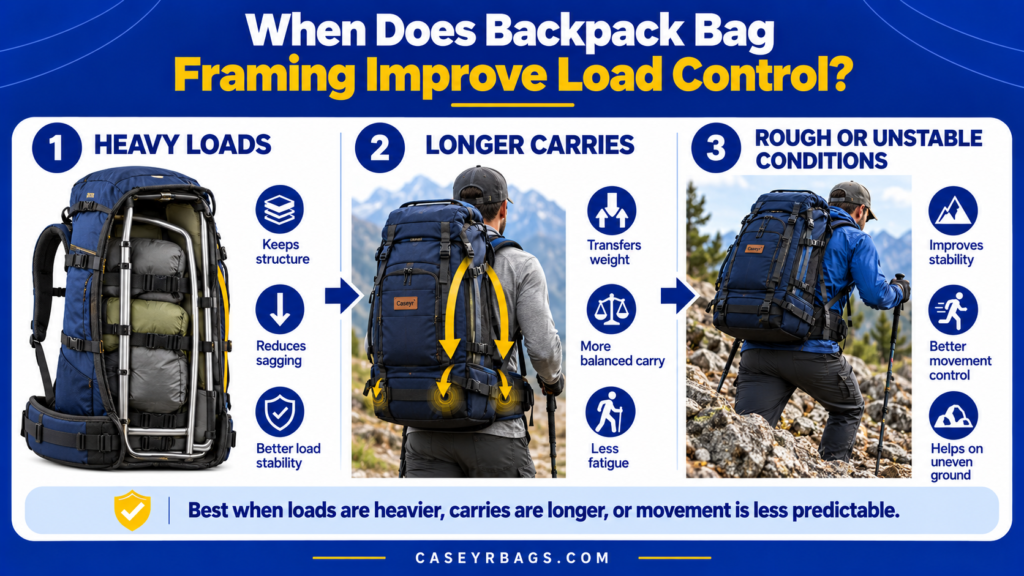
When Does Backpack Bag Framing Improve Load Control?
Backpack Bag framing improves load control when added structural support helps the bag maintain a more stable form, resist unwanted deformation, and keep the relationship between the Backpack body and its normal load more predictable during movement. Framing becomes relevant when soft structure repeatedly collapses, folds, shifts, or changes shape enough to disturb load position or rear-panel stability.
Framing ≠ higher safe load capacity, structural stability ≠ weight reduction, and framing ≠ automatic load balance. Its value still depends on internal load position, stable contents, Backpack design, back-panel structure, strap support, and normal carrying conditions. Framing should solve a real structural-control problem rather than compensate for strongly off-center contents, loose items, poor adjustment, or an unusual maximum load that does not represent everyday use.
What Does Framing Do in a Backpack Bag?
Backpack framing adds structural support to the bag body so the Backpack can resist unwanted deformation and retain a more predictable form under its normal load. The support may stabilize the rear structure, main load zone, side shape, or other structural areas that would otherwise fold, collapse, or change position as pressure increases.
Structure affects the relationship between the contents and the bag body. When the bag retains useful shape, load position can remain more consistent, internal pressure is distributed through a more stable structure, and movement becomes easier to interpret. The broader Backpack Bag page places framing within balanced loading, load stability, compartment structure, and modular organization.
Framing supports the bag structure; it does not automatically balance the contents. An off-center dense item, overloaded side storage, shifting contents, or poor strap adjustment can still create asymmetry even when the Backpack remains rigid. Useful framing therefore works with controlled loading and normal adjustment rather than replacing them.
How Does Framing Support Backpack Structure?
Framing supports Backpack structure by resisting excessive folding, collapse, or shape change when the normal load places pressure on the bag body. The frame or structural support helps the Backpack maintain a more defined relationship between the rear structure, main load zone, sides, and base instead of allowing those areas to deform freely.
Backpack load → structural demand → framing support → controlled bag form. The purpose is structural control, not unlimited strength. A framed Backpack can still deform under unsuitable loading, and framing does not establish a universal safe capacity. Its value is whether the structure remains more predictable under the load the bag normally carries.
How Does Framing Help Maintain Bag Shape?
Framing helps maintain bag shape by supporting shape retention around the rear panel, main load zone, and structural sides. When these areas keep a more consistent form, dense items are less likely to force the bag into repeated folds or bulges that move the effective load position during normal carrying.
More stable bag form → more predictable load relationship. Shape retention does not mean the bag must remain perfectly rigid or unchanged. Controlled flexibility can still be functional. The important question is whether the normal load causes enough deformation to make bag position, internal support, or movement noticeably less predictable.
Why Does Framing Not Automatically Balance the Load?
Framing does not automatically balance the load because stable structure and balanced contents are different conditions. Off-center dense items, overloaded side storage, uneven compartment loading, or shifting contents can create asymmetric pressure inside a Backpack even when the frame prevents the bag body from collapsing.
Stable structure ≠ balanced contents. Framing can make the bag body resist deformation while the internal load remains strongly offset. That means one side can still experience more structural demand, the bag can still tilt, and the strap system can still receive uneven load behavior. Internal balance must therefore be checked separately.
When Does Backpack Structure Need More Load Control?
Additional structural control becomes useful when the Backpack’s normal load repeatedly changes the bag’s form or position enough to reduce predictable load stability.
When Does Bag-Body Deformation Become Relevant?
Bag-body deformation becomes relevant when the normal load repeatedly causes the Backpack to collapse, fold around dense contents, sag strongly, lose useful rear-panel shape, or change position during movement. The key signal is not minor flexibility but repeated structural change that makes the load relationship less predictable.
No universal deformation threshold is needed. The practical question is whether the shape change interferes with stable load position, bag centerline, or movement control during ordinary use. A flexible bag can remain functional when its normal load stays controlled, while a visibly rigid bag can still perform poorly if the contents are unstable.
How Can Load Movement Expose Structural Weakness?
Load movement can expose structural weakness because shifting contents repeatedly change where pressure is applied to the bag body. A loose dense item may push against different panels as the Backpack moves, causing the structure to bulge, fold, or change shape even when the unloaded bag looks stable.
Shifting contents → changing structural pressure → changing Backpack shape. The movement may originate from poor internal organization rather than insufficient framing, so the first correction should not automatically be more structure. Secure the contents and then observe whether the bag body still loses useful control under the normal load.
Why Should the Normal Load Be Evaluated Before Framing?
The normal load should be evaluated before framing because structural support should solve a repeatable everyday problem, not a condition created only by an unusual maximum load. Empty-bag stiffness does not reveal how the Backpack will behave once dense items, compartments, side storage, and movement create real structural demand.
Evaluate structure under the load the Backpack normally carries. If the bag remains controlled with ordinary contents, extra framing may add little useful benefit. If repeated deformation, rear-panel collapse, or unstable shape appears under that same load even after contents are stabilized, framing becomes a more relevant structural response.
| Condition | Bag Behavior | Load-Control Effect | Main Check |
|---|---|---|---|
| Stable structure | Shape remains controlled | Predictable load relationship | Maintain normal loading |
| Repeated deformation | Shape changes under load | Load position may become less predictable | Check structure and load placement |
| Off-center deformation | One side distorts more | Asymmetric behavior | Check internal distribution |
| Shifting load | Structure changes dynamically | Variable stability | Control contents first |
How Does Framing Affect Backpack Load Position?
Framing affects load position by helping the Backpack maintain the structural shape that supports the contents instead of allowing the bag body to deform freely around changing pressure points.
How Can Structural Support Help Keep Dense Items Controlled?
Structural support can help keep dense items controlled by preserving a consistent main load zone and reducing collapse around concentrated pressure points. When the bag body keeps useful shape, dense items are less likely to force nearby panels into repeated folds that change the effective position of the load.
Framing supports load position but does not determine where items should be placed. A frame can preserve the shape around a poorly positioned dense object without correcting the offset itself. Stable item placement still matters, and framing works best when the internal load already presents a reasonably controlled structural demand.
Why Can an Off-Center Load Still Distort a Framed Backpack?
An off-center load can still distort a framed Backpack because concentrated pressure on one side creates asymmetric structural demand. Framing can resist deformation, but it cannot make the internal load symmetrical or remove the force created by a dense item that sits far from the bag centerline.
Off-center dense load → asymmetric structural demand → uneven bag behavior may remain. A rigid-looking Backpack can therefore tilt or show different side pressure even when its frame remains intact. Internal distribution should be corrected before assuming that more stiffness is needed to solve the visible asymmetry.
How Does Load Stability Affect Framing Performance?
Load stability affects framing performance because stable contents create more consistent pressure against the bag structure, while shifting contents create changing pressure points. Predictable structural demand allows framing to support a repeatable bag shape instead of responding to a load center that changes throughout movement.
Stable contents → more consistent structural demand; shifting contents → changing structural demand. Framing works with stable loading, not instead of it. If loose items continue moving, the frame may preserve the outer form while the internal load still changes position and affects bag behavior.
| Internal Load Condition | Structural Demand | Framing Effect | Main Correction |
|---|---|---|---|
| Centered stable load | Predictable pressure | Supports controlled form | Maintain load control |
| Off-center dense load | Asymmetric pressure | May resist deformation but not rebalance load | Reposition dense item |
| Shifting contents | Changing pressure points | Structural response becomes variable | Control movement first |
| Overloaded side storage | One-sided demand | Can preserve shape while tilt remains | Reduce asymmetry |
How Does Framing Help Control Backpack Movement?
Framing can improve movement control by helping the Backpack retain a more stable structural form as the wearer walks, changes direction, or experiences normal load movement.
How Does Shape Retention Affect Bag Movement?
Shape retention affects bag movement because a controlled structure provides a more consistent position from which the load and strap system behave. When the bag body repeatedly folds or bulges, the effective load position can change during movement and make the Backpack harder to predict.
Controlled bag shape → more predictable bag position → more predictable movement. Framing does not eliminate motion, nor should a Backpack be expected to remain completely fixed. The benefit is reduced structural change, which can make ordinary swing, tilt, and repositioning easier to interpret and control.
How Can Framing Reduce Repeated Structural Shifting?
Framing can reduce repeated structural shifting by resisting the bag-body changes that move the main load zone, alter the centerline, or increase the need for repositioning. A more controlled structure gives the internal load a more consistent support environment during normal walking and directional changes.
Reduced structural change can improve movement predictability. The frame is not controlling every object directly; it is stabilizing the structure around those objects. If the contents remain loose, internal movement can continue even while the outer bag shape stays relatively controlled, so both conditions must be checked.
Why Can a Framed Backpack Still Move Excessively?
A framed Backpack can still move excessively when loose contents shift, shoulder straps are poorly adjusted, the bag is very deep, the internal load is off-center, or external storage creates unstable pressure. Framing controls the structure, but these other variables can still change bag position and movement.
Framing controls structure, not every cause of Backpack movement. Excessive swing or repeated tilt should therefore trigger checks of internal load stability, bag depth, strap adjustment, and external storage before more rigidity is considered. The frame may already be functioning correctly while another part of the complete support system remains mismatched.
How Does Framing Interact With the Backpack Back Panel?
Framing and the back panel work together by helping maintain the rear structure that positions the Backpack and supports a more consistent relationship between the bag body and its load.
Why Does Back-Panel Stability Matter?
Back-panel stability matters because the rear structure provides a major reference surface for bag position, structural shape, and the relationship between the load and shoulder-strap system. Excessive folding or collapse can change how the Backpack sits and how internal pressure is expressed through the bag body.
A stable back panel does not need to be maximally rigid. It needs enough control for the normal load and bag design. When the rear structure repeatedly loses shape, bag position can become less predictable, but when it remains controlled, the rest of the structural system has a more consistent base from which to operate.
How Can Framing Support Back-Panel Shape?
Framing can support back-panel shape by resisting repeated bending, collapse, or uneven pressure that would otherwise distort the rear structure under load. This support can help the Backpack maintain a more predictable position relative to the strap system during normal movement.
Structural support → more stable rear form → more predictable bag position. This is a mechanical relationship, not a posture or medical claim. The benefit should be judged through loaded bag behavior: whether the rear structure stays controlled and whether that control improves the stability of the complete Backpack.
Why Does a Stable Back Panel Not Guarantee Balanced Loading?
A stable back panel does not guarantee balanced loading because internal contents can remain off-center, side storage can be uneven, and shoulder straps can be adjusted asymmetrically. Rear structural control preserves shape, but it does not automatically center the forces being applied to that structure.
Back-panel stability ≠ internal load balance. A rigid rear panel can remain visually straight while a dense item creates stronger pressure on one side. Load placement and strap adjustment must therefore be checked separately instead of treating rear-panel stability as proof that the complete Backpack is balanced.
How Does Framing Interact With Shoulder-Strap Support?
Framing and shoulder straps perform different but connected roles: framing controls the Backpack structure while the strap system supports and positions that structure during carrying.
Why Can Straps Not Replace Structural Control?
Straps support and position the Backpack, but they cannot fully prevent a soft bag body from folding, sagging, or deforming around unstable contents. Tightening the straps can change bag position and angle while leaving the underlying structural behavior of the bag body unchanged.
Strap adjustment ≠ structural framing. The strap system manages carrying support, while framing manages shape control. If the structure repeatedly collapses under a stable normal load, tighter straps may move the deformed bag closer without solving the structural problem that caused the deformation in the first place.
Why Can Framing Not Replace Correct Strap Adjustment?
Framing cannot replace correct strap adjustment because a stable bag body can still hang too loosely, sit asymmetrically, or move excessively when the shoulder-strap system is poorly adjusted. Structural stiffness controls the bag form, but adjustment determines how that form is positioned during carrying.
Structural control and carrying support must work together. A well-framed Backpack can remain unstable if one strap is much looser, while properly adjusted straps cannot fully correct structural collapse. The complete system should therefore be evaluated as connected functions rather than treating framing or adjustment as substitutes for each other.
Why Must Internal Loading Still Be Checked First?
Internal loading should still be checked first because poor load position can create asymmetric structural demand that framing and strap adjustment cannot fully correct. A dense item shifted to one side may deform the bag unevenly, move the centerline, and encourage one-sided strap compensation.
Poor internal loading → asymmetric structural demand → strap compensation → framing cannot fully correct the cause. Stabilizing dense and loose contents makes it easier to determine whether the remaining instability truly comes from insufficient structure. Without that step, added framing may simply disguise a loading problem.
When Does Framing Add Meaningful Load Control?
Framing adds meaningful load control when it solves a repeatable structural problem under the Backpack’s normal load rather than merely making the bag feel more rigid.
When Does Soft Structure Stop Providing Enough Control?
Soft structure stops providing enough control when the normal load repeatedly causes major bag deformation, unstable rear structure, changing load position, recurring structural sag, or movement that becomes difficult to predict. The issue should appear during normal use rather than only under an unusual maximum load.
No universal weight threshold defines the point. The observable question is whether the existing structure can keep the normal load relationship stable after contents are controlled and the straps are adjusted appropriately. If not, additional structural support becomes a more plausible response to the actual problem.
When Does Structural Support Improve Load Predictability?
Structural support improves load predictability when repeatable structural instability is reduced by framing and the Backpack maintains a more consistent bag form, rear structure, and main load position during ordinary movement. The improvement should be visible in the loaded bag rather than inferred from stiffness alone.
Repeatable structural instability → appropriate framing support → more predictable bag form and load position. The benefit must be observable under normal use. If the same instability remains after added structure, the primary cause may instead be internal load movement, bag depth, one-sided storage, or adjustment.
When Is More Rigidity Not the Answer?
More rigidity is not the answer when the normal load already remains controlled, the main problem is poor item placement, movement comes primarily from loose contents, or the issue begins with strap adjustment instead of bag structure. Added stiffness in those cases does not address the actual cause.
More structure should solve a structural problem. Maximum rigidity is not the objective, and flexible construction can remain effective when it controls the normal load. Once framing’s role is clear, the related question of how the Backpack itself changes under greater demand is covered in Heavy-Load Structure.
How Does Internal Loading Affect Backpack Framing?
Internal loading affects framing because the frame responds to the location, concentration, and movement of the load inside the Backpack.
Why Should Dense Items Remain Reasonably Controlled?
Dense items should remain reasonably controlled because concentrated structural demand can create localized deformation, left-right pressure differences, or repeated bulging even when the Backpack includes framing. Stable placement keeps the pressure pattern more predictable and allows structural support to respond consistently.
Controlled dense items → more predictable structural demand. This does not require one universal item location, but it does require avoiding strong lateral offset and uncontrolled movement. Framing can resist the resulting pressure, yet it cannot remove the force created by a dense item positioned poorly.
How Do Side Pockets Affect Structural Balance?
Side pockets affect structural balance because strong one-sided external loading adds asymmetric demand to the complete Backpack. A dense item carried externally can change bag shape, increase tilt, and make one side of the frame or bag body resist more pressure than the other.
External storage remains part of the complete load. A centered main compartment does not guarantee centered structural demand when one side pocket is heavily loaded. Check external storage before assuming that asymmetric bag behavior proves a framing problem or requires greater structural stiffness.
How Do Shifting Contents Affect Framing?
Shifting contents affect framing by moving pressure points from one part of the bag body to another during movement. As the load center changes, the frame and panels experience changing structural demand, which can alter bag position even if the frame itself remains intact.
Moving contents → changing pressure points → changing structural demand. Framing cannot make uncontrolled contents stationary. When structural behavior changes after walking, turning, or setting the bag down, the internal load should be stabilized before the frame is judged as insufficient.
How Can Backpack Framing Be Evaluated?
Backpack framing should be evaluated under the normal load by observing whether the structure remains controlled, the load stays reasonably stable, and framing adds useful support without disguising poor load placement.
What Should Be Checked Before Loading?
Before loading, inspect the bag-body condition, back-panel structure, framing components where present, obvious deformation, left-right asymmetry, and visible structural damage. This establishes whether the Backpack begins from a coherent unloaded condition before the normal contents create pressure through the structure.
An unloaded inspection cannot determine final framing performance, but it can reveal damaged or distorted structure that would make later observations unreliable. Confirm that the rear structure, sides, base, and any frame elements appear intact before judging how they respond once the normal load is introduced.
What Should Be Checked After Loading?
After loading, observe bag shape, left-right deformation, back-panel stability, load movement, bag tilt, repeated collapse, and structural response while walking. The goal is to see whether the Backpack retains a useful form and whether the load remains predictably positioned during ordinary movement.
If deformation appears, first determine whether it comes from unstable contents, one-sided storage, or poor adjustment. Framing should be credited only for the structural control it actually provides, and it should not be blamed for movement that begins elsewhere in the complete carrying system.
Which Criteria Should Determine Whether Framing Helps?
- Identify the normal load.
- Stabilize loose contents.
- Center dense items where practical.
- Observe unloaded Backpack structure.
- Load the Backpack normally.
- Check bag-body deformation.
- Check back-panel stability.
- Put on and adjust the Backpack normally.
- Walk and observe structural movement.
- Determine whether framing provides meaningful control beyond correct loading and adjustment.
Framing helps when the normal load still creates repeatable structural instability after contents are controlled and the Backpack is adjusted normally, and when added support visibly improves bag shape, rear-panel control, load position, or movement predictability. The decision should remain descriptive and mechanical rather than being converted into a numerical score or universal stiffness threshold.
When Is Backpack Framing Unnecessary?
Backpack framing may provide little additional value when the normal load already remains structurally controlled, stable, and predictable without added support.
When Can Soft Backpack Structure Work Well?
Soft Backpack structure can work well when the contents are controlled, the load demand is appropriate for the bag design, deformation does not disrupt stability, and the bag retains enough useful shape during movement. Flexibility by itself is not evidence of poor load control.
A soft Backpack can remain predictable when its compartments, materials, load position, and strap support work together. The relevant test is loaded behavior, not visual rigidity. If the bag does not repeatedly collapse, distort, or shift under the normal load, added framing may solve no meaningful structural problem.
Why Is Maximum Rigidity Not the Goal?
Maximum rigidity is not the goal because useful structural control means having enough support for the real load and use context, not resisting every possible shape change. Greater stiffness can reduce flexibility and add structural complexity without improving load position or movement in a noticeable way.
Useful structural control ≠ maximum stiffness. The correct level is the one that keeps the normal load relationship predictable while preserving the intended design behavior of the Backpack. More rigid construction should not be treated as automatically more advanced, stable, or capable.
How Can Unnecessary Framing Create a Mismatch?
Unnecessary framing can create a mismatch when extra structure adds complexity, reduces useful flexibility, or changes the bag’s handling without producing an observable load-control benefit. Structural support should exist for a functional reason tied to actual deformation, load position, or movement behavior.
This is not a buying recommendation or a rule against framing. It is a fit principle: added structure should address an identified structural need. When the normal load already remains controlled, additional rigidity may simply change the Backpack’s character rather than improve its practical load control.
How Can Backpack Framing Mismatches Be Avoided?
Backpack framing mismatches are avoided by matching structural support to actual load behavior instead of assuming that greater stiffness automatically creates better load control.
Why Should Poor Loading Be Corrected Before Blaming the Frame?
Poor loading should be corrected before blaming the frame because unstable Backpack behavior can begin with dense-item offset, shifting contents, one-sided storage, or poor strap adjustment. These conditions create structural demand that can look like insufficient framing even when the bag body is functioning as intended.
Poor load position → unstable Backpack behavior → structural problem may be misdiagnosed. Stabilize the contents, check side pockets, and adjust the straps normally before deciding that more structure is required. This separates a true structural-control problem from an internal-loading problem that framing cannot fully correct.
Why Should Framing Not Be Used to Justify Excessive Load?
Framing should not be used to justify excessive load because structural support and safe carrying capacity are different concepts. A frame may help the bag retain shape or control movement, but it does not reduce the total weight or establish how much load the Backpack can safely carry.
Structural support ≠ safe carrying capacity. No universal weight limit follows from the presence of framing, and greater stiffness should not be interpreted as permission to load the Backpack more heavily. Manufacturer guidance and the intended bag design remain separate from the structural-control principles described here.
What Should Be Verified Before Relying on Backpack Framing?
- Normal load has been identified.
- Dense contents are reasonably controlled.
- Loose items are not shifting freely.
- One-sided storage is not creating major imbalance.
- Bag-body shape is observed under load.
- Back-panel structure remains controlled.
- Left-right deformation is checked.
- Framing is not compensating for poor internal loading.
- Shoulder straps are adjusted normally.
- Bag position remains reasonably stable.
- Structural movement is checked during walking.
- Framing provides an observable structural benefit where needed.
- Maximum rigidity is not treated as the goal.
- Structural stability is not confused with lower total weight.
- Framing is not treated as permission for excessive load.
Apply the checklist with the Backpack’s normal contents and repeat the evaluation after ordinary movement. Framing is useful when structural control remains the actual limiting factor after contents, side storage, and strap adjustment have been checked. If the same instability persists without clear structural improvement, return to the load relationship before adding or blaming more structure.
Conclusion
Backpack Bag framing improves load control when structural support helps the bag maintain a more predictable form, resist unwanted deformation, and keep the relationship between the Backpack body and its normal load more stable during movement. Shape control, back-panel stability, internal load position, movement behavior, and shoulder-strap interaction all influence whether framing provides a meaningful structural benefit.
Framing ≠ higher safe load capacity, structural stability ≠ weight reduction, framing ≠ automatic load balance, and more rigidity ≠ automatically better load control. The value of Backpack framing is not simply that it makes the bag more rigid; it is whether that structure provides observable control over bag shape, load position, and movement under normal carrying conditions without compensating for poor internal loading.
FAQs
No. Framing is not necessary for every Backpack. Its usefulness depends on the normal load, bag structure, deformation, movement, back-panel behavior, and whether flexible construction already keeps the contents controlled. Framing becomes more relevant when added structure solves a repeatable structural-control problem.
No. Framing can help control the structure and position of a load, but it does not reduce the actual total weight being carried. Structural support may make bag behavior more predictable, yet weight reduction and load-control structure remain separate concepts.
Not automatically. Framing may help the Backpack retain structure, but off-center dense items, overloaded side pockets, shifting contents, and uneven internal distribution can still create asymmetric demand. Structural control works with stable loading, not instead of it, so the load itself should be corrected first.