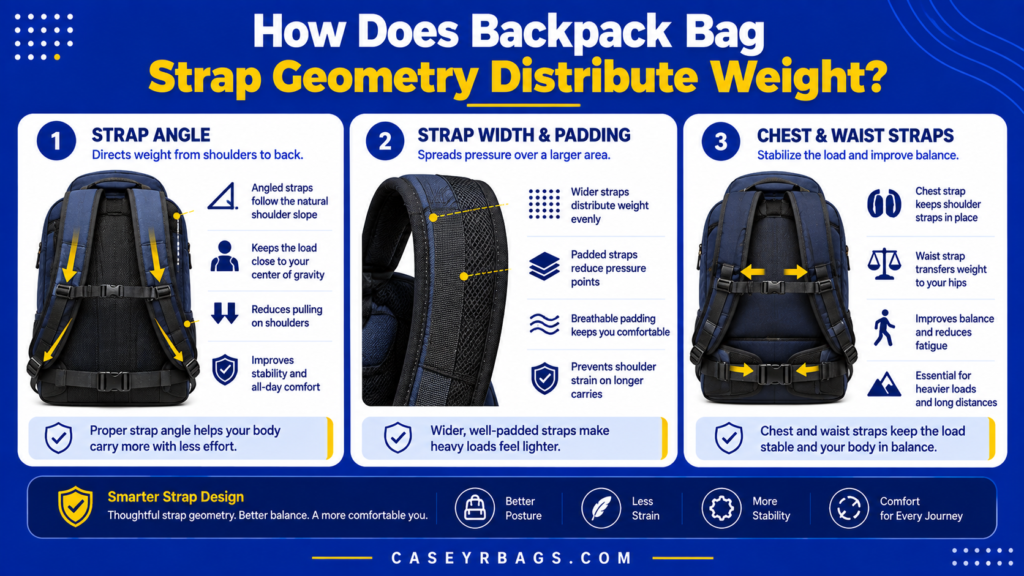
How Does Backpack Bag Strap Geometry Distribute Weight?
Backpack Bag strap geometry distributes weight by transferring load from the bag body through upper and lower anchors into two shoulder-strap paths whose spacing, angle, width, adjustment, and position influence how the load is supported. The strap system works together with the back panel, bag position, contact area, and internal load placement rather than functioning as an isolated pair of straps.
Symmetrical straps ≠ automatically symmetrical loading, strap geometry ≠ total load capacity, and load distribution ≠ load reduction. Geometry changes how force moves through the system, while an off-center dense item, unequal adjustment, bag tilt, side-pocket loading, or moving contents can still change left-right strap demand. The complete Backpack system must therefore be evaluated through its anchors, strap path, adjustment, bag position, and internal load relationship.
What Does Strap Geometry Mean for Backpack Bag Weight Distribution?
Backpack strap geometry describes the connected arrangement of upper anchors, lower anchors, shoulder straps, spacing, angle, width, and adjustment that creates the load-transfer paths between the bag body and the carrying surface. The loaded bag first transfers force into attachment points before that force continues through the straps.
The left and right strap paths provide two support routes, but they may not carry identical demand. Internal load placement, bag tilt, side-pocket loading, unequal adjustment, and moving contents can make one side work harder. The Backpack Bag explains how this strap system fits within balanced loading and modular organization.
Straps can support and stabilize the load, but they cannot make an internally unbalanced load disappear. Geometry determines force direction and contact; it does not reduce total Backpack weight. Reliable evaluation therefore combines anchor placement, strap path, bag position, adjustment, and internal load instead of treating visible symmetry as a complete explanation.
Which Strap Components Directly Control the Backpack Load Path?
Upper anchors, lower anchors, the shoulder straps, adjustment hardware, attachment width, and the back-panel connection directly shape the Backpack load path. Upper anchors determine where load enters the strap system near the bag body, while lower anchors help define the return path and the angle through which the straps control the lower part of the bag.
Component → force-transfer role → distribution consequence. Adjustment hardware changes effective strap length, attachment width affects how force enters the panel, and the back-panel connection influences the position from which the bag is supported. No component should be judged alone because each one changes the geometry available to the next part of the path.
How Does Backpack Weight Move Through the Strap System?
Backpack weight moves from the loaded bag body into the strap anchors, through strap tension, across the contact area, and into the supported carrying system. The bag body, straps, and back contact therefore act as one mechanical relationship rather than as separate parts with independent load behavior.
Loaded bag body → strap anchors → strap tension → contact area → supported load. A change in one part can alter the rest of the path: shifting contents can change bag balance, bag balance can change strap tension, and strap tension can change contact distribution. This sequence describes load transfer, not load reduction, because the total Backpack load still remains within the system.
Why Do Two Straps Not Automatically Carry Equal Weight?
Two straps do not automatically carry equal weight because the left and right support paths respond to the actual bag position and internal load, not merely to visual symmetry. Uneven contents, unequal adjustment, bag tilt, asymmetric anchor placement, one-sided external pockets, or changing load movement can make one strap experience more demand than the other.
Two straps create two support paths, not guaranteed 50/50 loading. A symmetrical strap pair can still receive asymmetric force when the bag itself is unbalanced. For the related question of why a Backpack uses a paired support system in the first place, see Shoulder Straps.
How Does Strap Anchor Placement Affect Weight Distribution?
Upper and lower strap anchors define the endpoints of the Backpack strap path, so their placement influences strap direction, bag position, and how load transfers into the two shoulder straps.
How Do Upper Strap Anchors Influence the Load Path?
Upper strap anchors influence the load path through their spacing, height, integration with the bag body, and left-right symmetry. Their position determines where tension leaves the upper Backpack structure and begins traveling through each shoulder strap, so even small design differences can alter strap direction before the load reaches the contact region.
Upper anchor position → strap direction → upper load transfer. The useful question is not whether anchors are simply wide or narrow but whether both sides form coherent paths with the bag body and lower anchors. A strong-looking anchor does not by itself prove balanced loading when the internal load or opposite strap path remains asymmetric.
How Do Lower Anchors Affect Bag Position & Stability?
Lower anchors affect bag position because they define the lower endpoint from which each strap returns to the Backpack body. Their position influences strap angle, lower-bag control, adjustment range, and how closely the bag remains aligned with the intended support zone during ordinary movement.
Lower anchor position → strap path → bag control. Moving the lower endpoint changes the effective line between upper and lower anchors, which can alter bag height, angle, and movement. Lower anchors are therefore not merely adjustment points; they are structural parts of the complete strap geometry and should be inspected for left-right consistency.
Why Must Upper & Lower Anchors Work as One Geometry?
Upper and lower anchors must work as one geometry because changing either endpoint changes the effective strap angle, strap path, and relationship between the bag body and the carrying surface. A well-positioned upper anchor cannot create a coherent path if the lower anchor pulls the strap in a conflicting direction.
Anchor placement should be evaluated as a connected path, not as isolated attachment points. The complete path determines how adjustment affects bag position and how tension reaches the supported contact region. Visual symmetry at one endpoint is therefore insufficient when the opposite endpoint, bag shape, or internal load creates a different effective path.
| Anchor Feature | Strap Effect | Bag-Position Effect | Distribution Consequence |
|---|---|---|---|
| Symmetrical upper anchors | Comparable upper paths | Supports level positioning | Creates balanced potential |
| Different upper anchor positions | Different strap directions | Can alter left-right position | May create unequal demand |
| Lower anchor moved outward/inward | Changes strap angle | Changes lower-bag control | Changes effective geometry |
| Weak body integration | Unstable force entry | May distort bag position | Reduces predictable transfer |
How Do Strap Spacing & Angle Change Backpack Weight Distribution?
Strap spacing and angle change where the two support paths sit relative to the bag body and the direction through which strap tension transfers the load.
How Does Strap Spacing Affect Left-Right Load Support?
Strap spacing changes the lateral relationship between the two support paths. Closer spacing creates a narrower support path, while wider spacing creates a broader one, but neither arrangement is universally superior because effectiveness depends on bag dimensions, anchor geometry, strap path, body shape, and internal load position.
Spacing should be evaluated through behavior rather than a universal measurement. A wider path can still receive asymmetric demand if the load is offset, while a narrower path can remain stable when the bag and anchors are designed coherently. Strap spacing therefore changes support geometry without determining the complete quality of weight distribution by itself.
How Does Strap Angle Affect the Direction of Load Transfer?
Strap angle affects force direction because the strap path may run more vertically, diagonally, inward, or outward depending on upper and lower anchor positions, adjustment, and bag geometry. That direction influences how tension travels from the loaded bag toward the contact region and how the Backpack is controlled relative to the back panel.
Anchor geometry → strap angle → force direction. Angle should be treated as a mechanical relationship rather than a comfort or medical rule. There is no universal ideal degree because different Backpack bodies, anchor layouts, strap shapes, and user dimensions create different functional paths while still supporting stable load transfer.
Why Is Symmetrical Strap Geometry Important but Not Sufficient?
Symmetrical strap geometry is important because comparable left and right paths provide the potential for similar force transfer, but geometry alone cannot guarantee equal demand. An off-center dense item, one-sided pocket loading, bag tilt, or moving contents can make the internal load asymmetric even when the straps and anchors appear perfectly mirrored.
Geometric symmetry + load asymmetry = potentially uneven strap tension. Visual symmetry is therefore a starting condition rather than a final proof of balance. The loaded Backpack must still be checked for bag position, internal content location, and movement because the strap system responds to the actual load it receives.
How Does Strap Width Affect Backpack Load Contact?
Strap width affects how strap tension is spread across the contact region, but changing contact area does not reduce the Backpack’s total load or guarantee balanced distribution.
How Does a Wider Strap Change Contact Distribution?
A wider strap increases the available contact area over which the same strap force can be spread. When other conditions remain comparable, that broader contact path changes how force is distributed across the supported region without changing the total Backpack load carried by the system.
Same strap force + larger contact area → force spread across more area. Wider contact area ≠ lower total load. Width can modify contact distribution, but the actual result still depends on strap angle, contour, material behavior, anchor position, adjustment, and whether the internal load sends comparable demand into both sides of the system.
Why Is Strap Width Alone Not Enough to Determine Distribution Quality?
Strap width alone cannot determine distribution quality because width describes only one part of the contact path. Anchor placement, strap angle, material stiffness, contour, adjustment, bag position, and internal load placement all influence how tension reaches the strap and where that force is directed.
Width modifies contact, not the complete load-transfer system. A wide strap attached through poor geometry can still receive unstable or one-sided demand, while a narrower strap can function predictably within a coherent design. Width should therefore be evaluated together with anchors, path, adjustment, and actual loaded bag behavior rather than treated as a stand-alone quality measure.
How Does Strap Shape Interact With Backpack Geometry?
Strap shape interacts with Backpack geometry because straight, curved, contoured, tapered, or variable-width straps create different paths and contact regions between the upper and lower anchors. Shape can change how the strap sits through the support path and where its width increases or decreases along that path.
A contoured strap can alter contact geometry, but it cannot correct an off-center internal load or incompatible anchor placement by itself. Strap shape should therefore be evaluated alongside upper and lower anchors, bag-body geometry, adjustment, and loaded position. The practical question is whether the shape supports a coherent path rather than whether one contour is universally superior.
| Strap Feature | Geometric Effect | Contact Effect | What It Does Not Determine |
|---|---|---|---|
| Narrower strap | Smaller contact path | More concentrated contact | Total Backpack load |
| Wider strap | Broader contact path | Spreads contact area | Safe load limit |
| Tapered strap | Changes width along path | Variable contact area | Automatic balance |
| Contoured strap | Changes strap path | Adapts contact geometry | Internal load distribution |
How Does Strap Adjustment Change Backpack Weight Distribution?
Strap adjustment changes Backpack load behavior by changing strap length, bag height, bag angle, and left-right tension within the existing anchor geometry.
How Does Shortening or Lengthening Both Straps Change Bag Position?
Shortening or lengthening both straps changes bag height, distance from the back, strap angle, and the amount of movement available within the existing anchor geometry. Shorter settings can bring the bag closer or higher, while longer settings can increase separation or movement depending on the design.
Strap length → bag position → load behavior. Adjustment changes the working geometry rather than creating a new structural system. The goal is to keep the Backpack controlled within its intended relationship, not to force one universal strap length. Excessive tightening or excessive looseness can both move the bag away from a stable position.
What Happens When Left & Right Straps Are Adjusted Unevenly?
Uneven left and right adjustment can shift the Backpack’s position, create visible tilt, change left-right strap tension, and cause repeated movement toward one side. Even when the anchor geometry is symmetrical, different effective strap lengths create different working paths and can exaggerate an already uneven internal load.
Unequal adjustment can create or exaggerate asymmetry. Small differences may be intentional within some designs, but persistent one-sided compensation should trigger a check of the internal load, bag position, and anchors before further tightening. Adjustment should refine an already reasonable load relationship rather than become the primary method for hiding imbalance.
Why Can Over-Adjustment Reduce Rather Than Improve Stability?
Over-adjustment can reduce stability when excessive tightening distorts the intended strap path or when excessive loosening allows the bag to hang farther away and move more freely. Either extreme can change bag height, angle, and the relationship between the back panel and the two strap paths.
Adjustment should refine an already reasonable load relationship, not compensate for major internal imbalance. A strap that is tightened aggressively to correct visible tilt may hide the symptom while leaving the dense-item offset unchanged. Likewise, excessive looseness can increase movement even when the internal load is centered. No universal strap length applies to every Backpack.
How Does Internal Load Placement Affect Strap Weight Distribution?
Internal load placement affects strap weight distribution because an off-center or shifting load changes the Backpack’s balance before force reaches the two strap paths.
How Does an Off-Center Load Change Strap Tension?
An off-center dense item shifts the Backpack’s internal load center before force reaches the strap system. When the bag tends left or right, the corresponding strap path may experience greater demand even if both straps have symmetrical anchors, equal visible length, and comparable width.
Dense item shifted left/right → changed bag balance → unequal strap demand. Strap geometry cannot fully neutralize a strongly offset load because the system can only distribute the force presented by the bag body. Persistent asymmetry should therefore trigger an internal-load check before one strap is tightened as compensation.
How Do Shifting Contents Change Weight Distribution During Movement?
Shifting contents change weight distribution because lateral or vertical movement changes the Backpack’s load center while the bag is already in motion. Loose objects can move toward one side, collapse into empty space, or change pressure against the bag body, creating variable tension in the left and right strap paths.
Load movement → changing bag balance → changing strap tension. A system that appears symmetrical when stationary can behave differently after walking, turning, lifting, or setting the Backpack down. Stable internal placement is therefore part of strap-geometry evaluation because the straps respond to the moving load rather than to the original packed position alone.
Why Should Dense Items Remain Controlled Within the Bag Body?
Dense items should remain controlled because stable placement keeps the relationship between the bag body, load center, left strap path, and right strap path more predictable. When a dense object remains fixed, changes in strap tension are more likely to reflect actual geometry or adjustment rather than internal movement.
This does not require a detailed packing formula or one universal item location. The mechanical requirement is controlled placement that avoids strong lateral offset and excessive movement. A centered item that slides freely can still produce changing strap demand, so restraint and stability matter alongside initial position.
| Internal Load | Expected Bag Behavior | Strap Consequence |
|---|---|---|
| Centered stable load | More symmetrical bag position | More comparable strap demand |
| Left-offset dense load | Bag tends left | Greater left-side demand possible |
| Right-offset dense load | Bag tends right | Greater right-side demand possible |
| Shifting load | Changing bag position | Variable strap demand |
How Does Backpack Position Against the Back Affect Load Distribution?
Backpack position affects load distribution because the bag’s distance, angle, and movement relative to the back change the effective geometry through which the straps support it.
Why Does a Bag Positioned Closer to the Back Behave Differently?
A bag positioned closer to the back can behave differently because a controlled position reduces free swing, exaggerated backward movement, and repeated changes in bag angle. When the bag body remains closer to its intended support zone, the strap paths operate through a more stable relationship during ordinary movement.
Controlled bag position → more stable strap geometry. This is a mechanical statement rather than a medical fitting rule. A close position does not guarantee balance when dense contents are offset, and an intentionally different design can still function predictably. The useful check is whether the bag maintains stable geometry rather than whether it matches one universal distance.
How Can a Bag Hanging Farther Away Change the Strap Load Path?
A bag hanging farther away can change the strap load path by altering strap angle, increasing available bag movement, and changing the direction through which tension reaches the support system. Greater separation can also make bag angle more sensitive to shifting contents or changes in adjustment.
Greater bag separation → changed effective geometry → potentially less predictable load behavior. The effect depends on bag design, depth, structure, and internal loading, so greater distance is not automatically wrong. The important distinction is whether the bag remains controlled or repeatedly swings, tilts, or changes strap demand during normal movement.
Why Does Bag-Body Shape Matter Alongside Strap Geometry?
Bag-body shape matters because strap geometry operates through the structure from which the anchors emerge. Bag depth, rigidity, load bulge, back-panel shape, and internal deformation can change the effective position of the load even when the straps themselves remain unchanged.
Strap geometry operates through the bag body, not independently of it. A deep or bulging load can move the center farther from the back panel, while a more controlled structure can keep anchor relationships more predictable. Strap evaluation should therefore include bag shape and loaded deformation rather than examining the straps in isolation.
How Can Backpack Strap Weight Distribution Be Evaluated?
Backpack strap weight distribution should be evaluated by checking the complete relationship between anchors, strap paths, adjustment, bag position, and internal load before treating any one feature as the cause of imbalance.
What Should Be Checked Before Loading the Backpack?
Before loading the Backpack, inspect the upper anchors, lower anchors, strap integrity, left-right geometry, adjustment hardware, and visible twisting. These checks establish whether the strap system begins from a coherent mechanical condition before internal load placement introduces additional variables.
Look for comparable left-right anchor relationships, straps that follow intended paths, adjustment hardware that moves properly, and no visible damage that changes the geometry. An unloaded inspection cannot prove final weight distribution, but it can identify structural issues that would make a later loaded comparison unreliable.
What Should Be Checked After the Backpack Is Loaded?
After loading, check whether the Backpack sits reasonably level, both straps follow comparable paths, one side is not visibly more tensioned, dense contents remain stable, and the bag does not repeatedly shift toward one side. These observations connect the unloaded geometry with the actual loaded behavior.
A persistent difference should trigger a sequence rather than an immediate strap adjustment: check the internal load, side pockets, bag tilt, anchor condition, and movement first. The goal is to identify whether the imbalance originates in the strap system or enters the system from the bag body.
Which Criteria Should Determine Final Strap Adjustment?
- Identify the normal load.
- Center and stabilize dense items.
- Put on both straps.
- Adjust both sides gradually.
- Check Backpack position.
- Check left-right tilt.
- Walk normally.
- Check repeated load movement.
- Reassess internal loading before using strap adjustment to correct persistent imbalance.
Final adjustment should refine a Backpack whose internal load and strap paths are already reasonably coherent. Adjust both sides gradually, check bag position and tilt, then observe whether movement changes the relationship. If persistent asymmetry remains, return to internal load placement and anchor condition before tightening one side further. This sequence keeps adjustment from becoming a substitute for correcting the actual source of imbalance. A final setting should remain stable during normal movement without requiring extreme one-sided compensation or repeatedly recreating visible tilt during use.
How Can Backpack Strap-Geometry Mismatches Be Avoided?
Backpack strap-geometry mismatches are avoided by separating true strap-path problems from imbalance caused by internal load position, bag shape, or inappropriate adjustment.
Why Is Matching Strap Length Alone a Weak Balance Rule?
Matching strap length alone is a weak balance rule because equal visible lengths do not account for internal load position, bag-body asymmetry, anchor differences, external pocket loading, or moving contents. Two straps can be adjusted to the same length while one side still receives greater demand from the loaded bag.
Equal adjustment ≠ guaranteed equal strap load. Strap length is only one variable inside a larger geometry. The correct check is whether comparable strap paths, stable internal loading, level bag position, and controlled movement occur together. Length should therefore be used to refine the system, not as proof that the system is already balanced.
Why Can Tightening One Strap Be the Wrong Response to an Uneven Load?
Tightening one strap can reduce visible tilt by repositioning the bag, but it may leave the underlying internal imbalance unchanged. If a dense item sits strongly to one side, shortening the opposite strap can make the bag look more centered while still forcing the strap system to manage an asymmetric load.
Uneven load → fix load position first → then refine strap adjustment. One-sided tightening should not be the first response to persistent imbalance because it can create a new geometry problem while hiding the original cause. Recheck internal contents, side pockets, and movement before making further asymmetric adjustment.
What Should Be Verified Before Relying on Backpack Strap Geometry for Balanced Loading?
- Upper strap anchors are intact.
- Lower strap anchors are intact.
- Left-right anchor placement is reasonably symmetrical by design.
- Straps are not twisted.
- Strap width is consistent with the intended Backpack design.
- Both adjustment systems function correctly.
- Dense internal items are reasonably centered.
- Side pockets are not creating major one-sided loading.
- Loose contents are controlled.
- Both straps are used as intended.
- Backpack sits reasonably level.
- One strap does not require extreme compensation.
- Bag position remains stable during movement.
- Persistent asymmetry triggers an internal-load check.
- Strap geometry is not being treated as permission for excessive total load.
- Weight distribution is evaluated as a complete bag-and-strap system.
Apply the checklist with the normal Backpack load and repeat the evaluation after ordinary movement. Confirm anchor integrity, comparable left-right geometry, stable bag position, controlled dense items, functioning adjustment, and no persistent need for one-sided compensation. If asymmetry remains, return to the internal load and complete strap path before changing adjustment again. Reliable geometry is the condition in which the loaded bag, anchors, straps, and internal contents continue to behave predictably as one system.
Conclusion
Backpack Bag strap geometry distributes weight by creating two connected load paths between the bag body and shoulder straps, with upper anchors, lower anchors, spacing, angle, width, adjustment, bag position, and internal loading determining how those paths behave. The system works through the complete relationship between the loaded Backpack and its contact areas.
Symmetrical straps ≠ automatically symmetrical loading, strap geometry ≠ total load capacity, and load distribution ≠ load reduction. CaseyrBags evaluates Backpack strap geometry as a complete load-transfer system in which anchors, strap path, contact area, adjustment, bag position, and internal load placement must work together. Effective distribution occurs when those elements create stable left-right support without relying on one visible strap feature or one-sided adjustment to hide internal imbalance.
FAQs
No. Two straps create two support paths, but actual left-right loading still depends on internal load placement, strap adjustment, bag position, anchor geometry, side-pocket loading, and movement. A visually symmetrical Backpack can therefore place greater demand on one strap when the loaded bag itself is asymmetric.
Wider straps can spread contact across a larger area, but they do not reduce total Backpack load or guarantee balanced distribution. Anchor geometry, strap angle, contour, adjustment, bag position, and internal load still determine how force reaches each strap and whether the complete system remains stable.
Adjustment can change bag position and strap tension, but significant internal imbalance should be corrected at the load before one strap is used as compensation. If a dense item or side pocket causes persistent offset, reposition the load first, then refine both straps gradually and recheck movement.