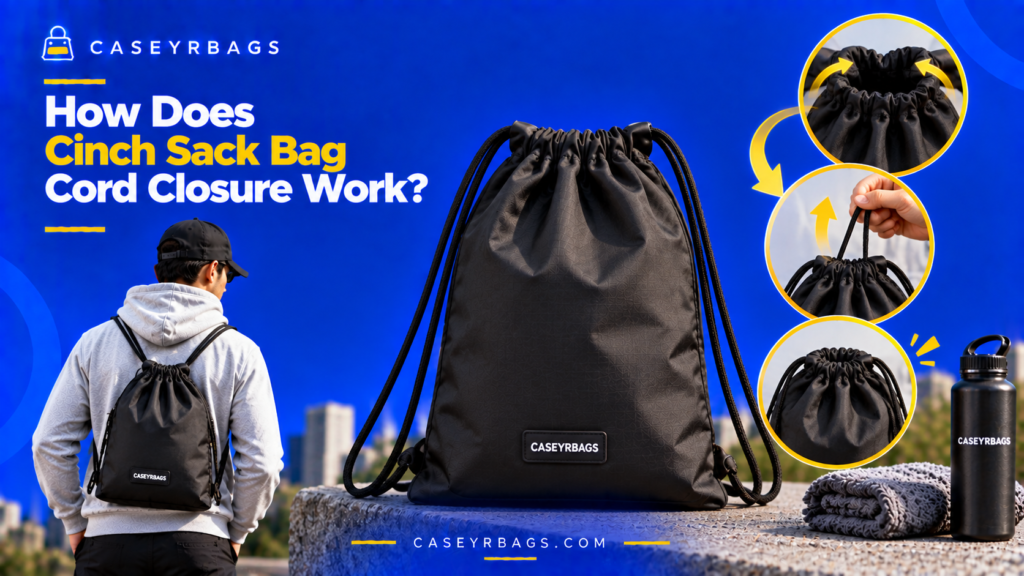
How Does Cinch Sack Bag Cord Closure Work?
A Cinch Sack Bag cord closure works by routing one or more drawcords around or through a flexible upper perimeter. When the user pulls the cord, slack decreases and tension travels through the route, drawing sections of the upper edge together. The fabric gathers into folds, which reduces the effective size of the opening without creating a rigid lid.
Releasing the cord reverses the mechanism: tension falls, slack returns, and the gathered upper edge can spread so the opening expands again. Reliable closure therefore depends on predictable cord routing, workable channel or guide-point resistance, flexible gathering space, load clearance near the upper edge, and a retention method that does not prevent normal reopening. A cinched opening controls access size; it is not automatically locked or sealed.
What Is a Cinch Sack Bag Cord Closure?
A Cinch Sack Bag uses a flexible upper opening controlled by one or more drawcords rather than a rigid frame or fixed lid. The cord passes through a channel, eyelets, loops, or related guide points that keep the closure mechanism aligned with the movable upper perimeter.
Pulling the cord reduces slack and transfers tension around that route. Because the upper material can slide, fold, and bunch, the opening contracts as more of the perimeter becomes gathered instead of remaining fully spread.
The complete mechanism therefore depends on cord movement, guided tension, flexible gathering, controllable retention, and reversible release. This subtype mechanism belongs to the broader Drawstring Bag structure, where cord-controlled access and flexible form operate as one system.
Which components make up the cord closure?
Which components make up the cord closure should be evaluated through the actual drawcord path, upper-edge movement, load position, and reversible opening cycle. A useful observation connects the visible behavior to the specific mechanism that changes tension, gathering, opening size, or retention.
Test the condition with the normal intended load and compare both the cinching and reopening phases. The governing distinction is: Component → mechanical role → closure effect. Keep the cord setting or structural feature only when it improves predictable closure without creating excessive resistance, uneven gathering, blocked folds, unexplained loosening, or difficult release.
What changes between the open and cinched states?
In the open state, cord tension is low, the upper edge is spread, and the effective opening remains relatively large. In the cinched state, cord tension is higher, the upper fabric has gathered into folds, and the effective opening is smaller even though the original fabric perimeter still exists.
Test the condition with the normal intended load and compare both the cinching and reopening phases. Keep the cord setting or structural feature only when it improves predictable closure without creating excessive resistance, uneven gathering, blocked folds, unexplained loosening, or difficult release.
Why does the mechanism require a flexible opening?
Why does the mechanism require a flexible opening because the cinch sack closes because the upper edge can change shape around the cord path.. The important mechanical test is whether that condition changes cord travel, tension transfer, fabric gathering, effective opening size, retention, or release in a predictable way.
Test the condition with the normal intended load and compare both the cinching and reopening phases. The governing distinction is: The Cinch Sack closes because the upper edge can change shape around the cord path.. Keep the cord setting or structural feature only when it improves predictable closure without creating excessive resistance, uneven gathering, blocked folds, unexplained loosening, or difficult release.
What Happens When the Cinch Sack Cord Is Pulled?
Explain the first mechanical action that transforms an open bag into a cinched bag.
How does pulling create cord tension?
Pulling the free cord reduces slack in the routed drawcord. As slack decreases, the user’s pull becomes tension that travels through the channel, loops, or eyelets around the upper perimeter. The cord therefore acts as the force-transfer element that initiates closure rather than directly compressing the entire bag body.
Test the condition with the normal intended load and compare both the cinching and reopening phases. The governing distinction is: User pulls free cord length → slack decreases → tension increases through routed cord. Keep the cord setting or structural feature only when it improves predictable closure without creating excessive resistance, uneven gathering, blocked folds, unexplained loosening, or difficult release.
How does that tension reach the opening perimeter?
Tension reaches the opening perimeter through the specific route created by channel sections, eyelets, loops, and upper-edge guides. Each routing point changes direction or maintains the cord near the flexible edge so the user’s pull can reach multiple parts of the opening instead of remaining concentrated only at the free cord end.
Test the condition with the normal intended load and compare both the cinching and reopening phases. Keep the cord setting or structural feature only when it improves predictable closure without creating excessive resistance, uneven gathering, blocked folds, unexplained loosening, or difficult release.
Why does the fabric move instead of the cord simply becoming tighter?
The fabric moves because the upper perimeter is flexible and free to slide, fold, or bunch around the tensioned cord. Once slack is reduced, continued pulling draws sections of that movable edge toward one another, so the material gathers instead of allowing the cord to become tight around a completely rigid opening.
Test the condition with the normal intended load and compare both the cinching and reopening phases. The governing distinction is: Cord tension + movable fabric perimeter → material drawn together. Keep the cord setting or structural feature only when it improves predictable closure without creating excessive resistance, uneven gathering, blocked folds, unexplained loosening, or difficult release.
How Does the Upper Edge Gather During Cinching?
Explain how tension changes the geometry of the opening.
How does flexible fabric respond to cord tension?
Flexible fabric respond to cord tension affects the Cinch Sack closure because 2 focused paragraphs. The useful effect is a predictable change in cord travel, gathering, opening size, retention, or release without introducing binding, asymmetric folds, excessive stress, or reopening difficulty.
Test the condition with the normal intended load and compare both the cinching and reopening phases. Keep the cord setting or structural feature only when it improves predictable closure without creating excessive resistance, uneven gathering, blocked folds, unexplained loosening, or difficult release. Do not treat a smaller opening as locking or sealing.
Why does gathering make the opening smaller?
Why does gathering make the opening smaller because distributed edge → gathered edge → reduced effective opening. The important mechanical test is whether that condition changes cord travel, tension transfer, fabric gathering, effective opening size, retention, or release in a predictable way.
Test the condition with the normal intended load and compare both the cinching and reopening phases. The governing distinction is: Distributed edge → gathered edge → reduced effective opening. Keep the cord setting or structural feature only when it improves predictable closure without creating excessive resistance, uneven gathering, blocked folds, unexplained loosening, or difficult release.
Why does gathering rarely create a perfectly sealed opening?
Why does gathering rarely create a perfectly sealed opening because reduced opening ≠ sealed opening. The important mechanical test is whether that condition changes cord travel, tension transfer, fabric gathering, effective opening size, retention, or release in a predictable way.
Test the condition with the normal intended load and compare both the cinching and reopening phases. The governing distinction is: Reduced opening ≠ sealed opening. Keep the cord setting or structural feature only when it improves predictable closure without creating excessive resistance, uneven gathering, blocked folds, unexplained loosening, or difficult release.
How Does Cord Routing Control the Cinch?
Explain why the path followed by the cord determines how evenly tension reaches the opening.
How does a perimeter cord channel work?
A perimeter cord channel work affects the Cinch Sack closure because cord passes around upper perimeter → tension distributed along channel → edge gathers. The useful effect is a predictable change in cord travel, gathering, opening size, retention, or release without introducing binding, asymmetric folds, excessive stress, or reopening difficulty.
Test the condition with the normal intended load and compare both the cinching and reopening phases. The governing distinction is: Cord passes around upper perimeter → tension distributed along channel → edge gathers. Keep the cord setting or structural feature only when it improves predictable closure without creating excessive resistance, uneven gathering, blocked folds, unexplained loosening, or difficult release.
How do separate loops or eyelets change the path?
Separate loops or eyelets change the path affects the Cinch Sack closure because 2 focused paragraphs. The useful effect is a predictable change in cord travel, gathering, opening size, retention, or release without introducing binding, asymmetric folds, excessive stress, or reopening difficulty.
Test the condition with the normal intended load and compare both the cinching and reopening phases. Keep the cord setting or structural feature only when it improves predictable closure without creating excessive resistance, uneven gathering, blocked folds, unexplained loosening, or difficult release. Do not treat a smaller opening as locking or sealing.
What happens when cord routing is uneven?
What happens when cord routing is uneven should be evaluated through the actual drawcord path, upper-edge movement, load position, and reversible opening cycle. A useful observation connects the visible behavior to the specific mechanism that changes tension, gathering, opening size, or retention.
Test the condition with the normal intended load and compare both the cinching and reopening phases. The governing distinction is: Closure quality depends on predictable tension routing—not pulling force alone.. Keep the cord setting or structural feature only when it improves predictable closure without creating excessive resistance, uneven gathering, blocked folds, unexplained loosening, or difficult release.
How Do Cord Channels Affect Closure Movement?
Explain the role of the fabric tunnel or upper hem through which the cord moves.
How does the channel guide the cord?
The channel guide the cord affects the Cinch Sack closure because 2 focused paragraphs. The useful effect is a predictable change in cord travel, gathering, opening size, retention, or release without introducing binding, asymmetric folds, excessive stress, or reopening difficulty.
Test the condition with the normal intended load and compare both the cinching and reopening phases. Keep the cord setting or structural feature only when it improves predictable closure without creating excessive resistance, uneven gathering, blocked folds, unexplained loosening, or difficult release. Do not treat a smaller opening as locking or sealing.
What can increase resistance inside the channel?
What can increase resistance inside the channel should be evaluated through the actual drawcord path, upper-edge movement, load position, and reversible opening cycle. A useful observation connects the visible behavior to the specific mechanism that changes tension, gathering, opening size, or retention.
Test the condition with the normal intended load and compare both the cinching and reopening phases. Keep the cord setting or structural feature only when it improves predictable closure without creating excessive resistance, uneven gathering, blocked folds, unexplained loosening, or difficult release. Do not treat a smaller opening as locking or sealing.
What indicates that the channel is interfering with closure?
What indicates that the channel is interfering with closure should be evaluated through the actual drawcord path, upper-edge movement, load position, and reversible opening cycle. A useful observation connects the visible behavior to the specific mechanism that changes tension, gathering, opening size, or retention.
Test the condition with the normal intended load and compare both the cinching and reopening phases. The governing distinction is: A functioning channel should guide the cord without unnecessarily preventing movement.. Keep the cord setting or structural feature only when it improves predictable closure without creating excessive resistance, uneven gathering, blocked folds, unexplained loosening, or difficult release.
How Do Eyelets & Guide Points Affect Cord Closure?
Explain how discrete routing points influence cord direction and concentrated force.
What role do eyelets or loops play?
What role do eyelets or loops play should be evaluated through the actual drawcord path, upper-edge movement, load position, and reversible opening cycle. A useful observation connects the visible behavior to the specific mechanism that changes tension, gathering, opening size, or retention.
Test the condition with the normal intended load and compare both the cinching and reopening phases. Keep the cord setting or structural feature only when it improves predictable closure without creating excessive resistance, uneven gathering, blocked folds, unexplained loosening, or difficult release. Do not treat a smaller opening as locking or sealing.
Why can guide points become stress concentrations?
Why can guide points become stress concentrations because cord tension → localized contact → force transferred into surrounding material. The important mechanical test is whether that condition changes cord travel, tension transfer, fabric gathering, effective opening size, retention, or release in a predictable way.
Test the condition with the normal intended load and compare both the cinching and reopening phases. The governing distinction is: Cord tension → localized contact → force transferred into surrounding material. Keep the cord setting or structural feature only when it improves predictable closure without creating excessive resistance, uneven gathering, blocked folds, unexplained loosening, or difficult release.
What should reinforcement around guide points accomplish?
What should reinforcement around guide points accomplish should be evaluated through the actual drawcord path, upper-edge movement, load position, and reversible opening cycle. A useful observation connects the visible behavior to the specific mechanism that changes tension, gathering, opening size, or retention.
Test the condition with the normal intended load and compare both the cinching and reopening phases. The governing distinction is: Cord-guide reinforcement supports the closure mechanism but does not determine total bag load capacity by itself.. Keep the cord setting or structural feature only when it improves predictable closure without creating excessive resistance, uneven gathering, blocked folds, unexplained loosening, or difficult release.
How Does Cord Tension Affect Opening Size?
Explain the relationship between applied tension and effective opening size.
What does low cord tension produce?
What does low cord tension produce is best understood through 2 focused paragraphs. The condition matters because the Cinch Sack closure is a reversible opening-control mechanism: each component must support contraction, control, and later reopening rather than only making the bag feel tighter.
Test the condition with the normal intended load and compare both the cinching and reopening phases. Keep the cord setting or structural feature only when it improves predictable closure without creating excessive resistance, uneven gathering, blocked folds, unexplained loosening, or difficult release. Do not treat a smaller opening as locking or sealing.
What does increased tension produce?
What does increased tension produce is best understood through 2 focused paragraphs. The condition matters because the Cinch Sack closure is a reversible opening-control mechanism: each component must support contraction, control, and later reopening rather than only making the bag feel tighter.
Test the condition with the normal intended load and compare both the cinching and reopening phases. Keep the cord setting or structural feature only when it improves predictable closure without creating excessive resistance, uneven gathering, blocked folds, unexplained loosening, or difficult release. Do not treat a smaller opening as locking or sealing.
Why is maximum tension not the goal?
Why is maximum tension not the goal because more cord tension ≠ automatically better closure. The important mechanical test is whether that condition changes cord travel, tension transfer, fabric gathering, effective opening size, retention, or release in a predictable way.
Test the condition with the normal intended load and compare both the cinching and reopening phases. The governing distinction is: More cord tension ≠ automatically better closure. Keep the cord setting or structural feature only when it improves predictable closure without creating excessive resistance, uneven gathering, blocked folds, unexplained loosening, or difficult release.
| Cord Condition | Upper Edge | Opening State | Access |
|---|---|---|---|
| Released | Spread | Wide | High |
| Light tension | Partly gathered | Reduced | Easy |
| Functional cinch | Gathered | Small | Restricted |
| Excessive tension | Highly compressed | Distorted potential | Difficult |
How Does Friction Help or Hinder the Cinch Mechanism?
Explain why cord movement needs neither zero friction nor excessive resistance.
How can friction help the cord remain in position?
Friction help the cord remain in position affects the Cinch Sack closure because 2 focused paragraphs. The useful effect is a predictable change in cord travel, gathering, opening size, retention, or release without introducing binding, asymmetric folds, excessive stress, or reopening difficulty.
Test the condition with the normal intended load and compare both the cinching and reopening phases. Keep the cord setting or structural feature only when it improves predictable closure without creating excessive resistance, uneven gathering, blocked folds, unexplained loosening, or difficult release. Do not treat a smaller opening as locking or sealing.
How can excessive friction weaken operation?
Excessive friction weaken operation affects the Cinch Sack closure because 2 focused paragraphs. The useful effect is a predictable change in cord travel, gathering, opening size, retention, or release without introducing binding, asymmetric folds, excessive stress, or reopening difficulty.
Test the condition with the normal intended load and compare both the cinching and reopening phases. Keep the cord setting or structural feature only when it improves predictable closure without creating excessive resistance, uneven gathering, blocked folds, unexplained loosening, or difficult release. Do not treat a smaller opening as locking or sealing.
Why would extremely low resistance also change control?
Why would extremely low resistance also change control because smooth cord movement and controlled cord retention are related but different requirements.. The important mechanical test is whether that condition changes cord travel, tension transfer, fabric gathering, effective opening size, retention, or release in a predictable way.
Test the condition with the normal intended load and compare both the cinching and reopening phases. The governing distinction is: Smooth cord movement and controlled cord retention are related but different requirements.. Keep the cord setting or structural feature only when it improves predictable closure without creating excessive resistance, uneven gathering, blocked folds, unexplained loosening, or difficult release.
| Cord Movement | Pull Effort | Control Effect |
|---|---|---|
| High friction | High | Binding potential |
| Moderate | Controlled | Functional |
| Low | Easy | Less passive resistance |
| Uneven | Variable | Irregular cinching |
How Does the Cord Stay Cinched After Pulling?
Explain that maintaining the reduced opening depends on the specific cord system rather than tension alone. For the related tension-retention question, see Cinch Sack Security.
What can maintain the cord position?
The cord can remain cinched through design-dependent resistance or retention features such as routing friction, cord interaction, a cord lock, a knot, or carry tension. The mechanism does not rely on one universal retention method, so the reduced opening should be evaluated according to the actual construction rather than assumed to stay closed from tension alone.
Test the condition with the normal intended load and compare both the cinching and reopening phases. Keep the cord setting or structural feature only when it improves predictable closure without creating excessive resistance, uneven gathering, blocked folds, unexplained loosening, or difficult release.
Why can the opening loosen if tension is not retained?
Why can the opening loosen if tension is not retained because tension decreases → gathered edge can spread → opening enlarges. The important mechanical test is whether that condition changes cord travel, tension transfer, fabric gathering, effective opening size, retention, or release in a predictable way.
Test the condition with the normal intended load and compare both the cinching and reopening phases. The governing distinction is: Tension decreases → gathered edge can spread → opening enlarges. Keep the cord setting or structural feature only when it improves predictable closure without creating excessive resistance, uneven gathering, blocked folds, unexplained loosening, or difficult release.
Why is retained tension different from secure locking?
Why is retained tension different from secure locking because cord position retention ≠ tamper-resistant locking. The important mechanical test is whether that condition changes cord travel, tension transfer, fabric gathering, effective opening size, retention, or release in a predictable way.
Test the condition with the normal intended load and compare both the cinching and reopening phases. The governing distinction is: Cord position retention ≠ tamper-resistant locking. Keep the cord setting or structural feature only when it improves predictable closure without creating excessive resistance, uneven gathering, blocked folds, unexplained loosening, or difficult release.
How Does the Cinch Sack Reopen?
Explain the reverse mechanical sequence.
What happens when cord tension is released?
What happens when cord tension is released should be evaluated through the actual drawcord path, upper-edge movement, load position, and reversible opening cycle. A useful observation connects the visible behavior to the specific mechanism that changes tension, gathering, opening size, or retention.
Test the condition with the normal intended load and compare both the cinching and reopening phases. The governing distinction is: Cord tension falls → fabric gains freedom to move outward. Keep the cord setting or structural feature only when it improves predictable closure without creating excessive resistance, uneven gathering, blocked folds, unexplained loosening, or difficult release.
How does the upper perimeter expand again?
The upper perimeter expand again affects the Cinch Sack closure because 2 focused paragraphs. The useful effect is a predictable change in cord travel, gathering, opening size, retention, or release without introducing binding, asymmetric folds, excessive stress, or reopening difficulty.
Test the condition with the normal intended load and compare both the cinching and reopening phases. Keep the cord setting or structural feature only when it improves predictable closure without creating excessive resistance, uneven gathering, blocked folds, unexplained loosening, or difficult release. Do not treat a smaller opening as locking or sealing.
What indicates poor reopening behavior?
What indicates poor reopening behavior should be evaluated through the actual drawcord path, upper-edge movement, load position, and reversible opening cycle. A useful observation connects the visible behavior to the specific mechanism that changes tension, gathering, opening size, or retention.
Test the condition with the normal intended load and compare both the cinching and reopening phases. The governing distinction is: An effective cinch closure should support both predictable closing and predictable reopening.. Keep the cord setting or structural feature only when it improves predictable closure without creating excessive resistance, uneven gathering, blocked folds, unexplained loosening, or difficult release.
How Do Dual Cords Change the Closure Mechanism?
Explain how two-sided cord systems can gather the opening from opposing directions.
How can two cords distribute closure movement?
Two cords distribute closure movement affects the Cinch Sack closure because opposing cord pulls → upper edge drawn from both sides. The useful effect is a predictable change in cord travel, gathering, opening size, retention, or release without introducing binding, asymmetric folds, excessive stress, or reopening difficulty.
Test the condition with the normal intended load and compare both the cinching and reopening phases. The governing distinction is: Opposing cord pulls → upper edge drawn from both sides. Keep the cord setting or structural feature only when it improves predictable closure without creating excessive resistance, uneven gathering, blocked folds, unexplained loosening, or difficult release.
Why can dual cords improve symmetry?
Why can dual cords improve symmetry because 2 focused paragraphs. The important mechanical test is whether that condition changes cord travel, tension transfer, fabric gathering, effective opening size, retention, or release in a predictable way.
Test the condition with the normal intended load and compare both the cinching and reopening phases. Keep the cord setting or structural feature only when it improves predictable closure without creating excessive resistance, uneven gathering, blocked folds, unexplained loosening, or difficult release. Do not treat a smaller opening as locking or sealing. Loaded behavior is more informative than an empty-bag test because contents can occupy the gathering zone.
What can still create uneven dual-cord closure?
What can still create uneven dual-cord closure should be evaluated through the actual drawcord path, upper-edge movement, load position, and reversible opening cycle. A useful observation connects the visible behavior to the specific mechanism that changes tension, gathering, opening size, or retention.
Test the condition with the normal intended load and compare both the cinching and reopening phases. The governing distinction is: Two cords can support balanced gathering but do not guarantee identical tension.. Keep the cord setting or structural feature only when it improves predictable closure without creating excessive resistance, uneven gathering, blocked folds, unexplained loosening, or difficult release.
How Can Carry Cords Also Operate the Closure?
Explain designs where the cords serve both as shoulder straps and opening-control elements.
How does carry tension interact with the upper opening?
Carry tension interact with the upper opening affects the Cinch Sack closure because cord path around opening + lower anchors → carrying tension can maintain upper-edge gathering. The useful effect is a predictable change in cord travel, gathering, opening size, retention, or release without introducing binding, asymmetric folds, excessive stress, or reopening difficulty.
Test the condition with the normal intended load and compare both the cinching and reopening phases. The governing distinction is: Cord path around opening + lower anchors → carrying tension can maintain upper-edge gathering. Keep the cord setting or structural feature only when it improves predictable closure without creating excessive resistance, uneven gathering, blocked folds, unexplained loosening, or difficult release.
What happens when the bag is removed from the shoulders?
What happens when the bag is removed from the shoulders should be evaluated through the actual drawcord path, upper-edge movement, load position, and reversible opening cycle. A useful observation connects the visible behavior to the specific mechanism that changes tension, gathering, opening size, or retention.
Test the condition with the normal intended load and compare both the cinching and reopening phases. Keep the cord setting or structural feature only when it improves predictable closure without creating excessive resistance, uneven gathering, blocked folds, unexplained loosening, or difficult release. Do not treat a smaller opening as locking or sealing.
Why is the dual-role cord system structurally efficient?
Why is the dual-role cord system structurally efficient because dual-function cords simplify components while increasing the importance of correct routing and reinforcement.. The important mechanical test is whether that condition changes cord travel, tension transfer, fabric gathering, effective opening size, retention, or release in a predictable way.
Test the condition with the normal intended load and compare both the cinching and reopening phases. The governing distinction is: Dual-function cords simplify components while increasing the importance of correct routing and reinforcement.. Keep the cord setting or structural feature only when it improves predictable closure without creating excessive resistance, uneven gathering, blocked folds, unexplained loosening, or difficult release.
How Does Load Position Affect Cord Closure?
Explain how contents near the upper opening can interfere with gathering.
What happens when bulky contents extend into the closure zone?
What happens when bulky contents extend into the closure zone should be evaluated through the actual drawcord path, upper-edge movement, load position, and reversible opening cycle. A useful observation connects the visible behavior to the specific mechanism that changes tension, gathering, opening size, or retention.
Test the condition with the normal intended load and compare both the cinching and reopening phases. Keep the cord setting or structural feature only when it improves predictable closure without creating excessive resistance, uneven gathering, blocked folds, unexplained loosening, or difficult release. Do not treat a smaller opening as locking or sealing.
How can rigid contents affect gathering?
Rigid contents affect gathering affects the Cinch Sack closure because 2 focused paragraphs. The useful effect is a predictable change in cord travel, gathering, opening size, retention, or release without introducing binding, asymmetric folds, excessive stress, or reopening difficulty.
Test the condition with the normal intended load and compare both the cinching and reopening phases. Keep the cord setting or structural feature only when it improves predictable closure without creating excessive resistance, uneven gathering, blocked folds, unexplained loosening, or difficult release. Do not treat a smaller opening as locking or sealing.
Why should the closure zone retain enough flexible space?
Why should the closure zone retain enough flexible space because the upper perimeter needs room to gather around the load rather than being forced against it.. The important mechanical test is whether that condition changes cord travel, tension transfer, fabric gathering, effective opening size, retention, or release in a predictable way.
Test the condition with the normal intended load and compare both the cinching and reopening phases. The governing distinction is: The upper perimeter needs room to gather around the load rather than being forced against it.. Keep the cord setting or structural feature only when it improves predictable closure without creating excessive resistance, uneven gathering, blocked folds, unexplained loosening, or difficult release.
How Does Overfilling Affect Cinch Closure?
Explain why physical storage volume can exceed functional closure-compatible volume.
How does overfilling reduce available gathering material?
Overfilling reduce available gathering material affects the Cinch Sack closure because contents occupy upper chamber → fabric already extended → less free perimeter movement. The useful effect is a predictable change in cord travel, gathering, opening size, retention, or release without introducing binding, asymmetric folds, excessive stress, or reopening difficulty.
Test the condition with the normal intended load and compare both the cinching and reopening phases. The governing distinction is: Contents occupy upper chamber → fabric already extended → less free perimeter movement. Keep the cord setting or structural feature only when it improves predictable closure without creating excessive resistance, uneven gathering, blocked folds, unexplained loosening, or difficult release.
Why does pulling harder not solve overfilling?
Why does pulling harder not solve overfilling because 2 focused paragraphs. The important mechanical test is whether that condition changes cord travel, tension transfer, fabric gathering, effective opening size, retention, or release in a predictable way.
Test the condition with the normal intended load and compare both the cinching and reopening phases. Keep the cord setting or structural feature only when it improves predictable closure without creating excessive resistance, uneven gathering, blocked folds, unexplained loosening, or difficult release. Do not treat a smaller opening as locking or sealing.
Why is total volume different from closure-compatible volume?
Why is total volume different from closure-compatible volume because available volume ≠ usable cinch-closure volume. The important mechanical test is whether that condition changes cord travel, tension transfer, fabric gathering, effective opening size, retention, or release in a predictable way.
Test the condition with the normal intended load and compare both the cinching and reopening phases. The governing distinction is: Available volume ≠ usable cinch-closure volume. Keep the cord setting or structural feature only when it improves predictable closure without creating excessive resistance, uneven gathering, blocked folds, unexplained loosening, or difficult release.
How Does Cord Thickness Affect Closure Behavior?
Explain cord dimensions as one system variable without treating thickness as a performance ranking.
How can a thicker cord affect handling?
A thicker cord affect handling affects the Cinch Sack closure because 2 focused paragraphs. The useful effect is a predictable change in cord travel, gathering, opening size, retention, or release without introducing binding, asymmetric folds, excessive stress, or reopening difficulty.
Test the condition with the normal intended load and compare both the cinching and reopening phases. Keep the cord setting or structural feature only when it improves predictable closure without creating excessive resistance, uneven gathering, blocked folds, unexplained loosening, or difficult release. Do not treat a smaller opening as locking or sealing.
How can a thinner cord affect the system?
A thinner cord affect the system affects the Cinch Sack closure because 2 focused paragraphs. The useful effect is a predictable change in cord travel, gathering, opening size, retention, or release without introducing binding, asymmetric folds, excessive stress, or reopening difficulty.
Test the condition with the normal intended load and compare both the cinching and reopening phases. Keep the cord setting or structural feature only when it improves predictable closure without creating excessive resistance, uneven gathering, blocked folds, unexplained loosening, or difficult release. Do not treat a smaller opening as locking or sealing.
Why is neither universally better?
Why is neither universally better because cord thickness alone does not determine closure quality.. The important mechanical test is whether that condition changes cord travel, tension transfer, fabric gathering, effective opening size, retention, or release in a predictable way.
Test the condition with the normal intended load and compare both the cinching and reopening phases. The governing distinction is: Cord thickness alone does not determine closure quality.. Keep the cord setting or structural feature only when it improves predictable closure without creating excessive resistance, uneven gathering, blocked folds, unexplained loosening, or difficult release.
How Does Cord Material Affect Closure Movement?
Explain how surface and flexibility characteristics influence cord travel without unsupported material rankings.
How can cord flexibility influence routing?
Cord flexibility influence routing affects the Cinch Sack closure because 2 focused paragraphs. The useful effect is a predictable change in cord travel, gathering, opening size, retention, or release without introducing binding, asymmetric folds, excessive stress, or reopening difficulty.
Test the condition with the normal intended load and compare both the cinching and reopening phases. Keep the cord setting or structural feature only when it improves predictable closure without creating excessive resistance, uneven gathering, blocked folds, unexplained loosening, or difficult release. Do not treat a smaller opening as locking or sealing.
How can surface texture affect movement?
Surface texture affect movement affects the Cinch Sack closure because 2 focused paragraphs. The useful effect is a predictable change in cord travel, gathering, opening size, retention, or release without introducing binding, asymmetric folds, excessive stress, or reopening difficulty.
Test the condition with the normal intended load and compare both the cinching and reopening phases. Keep the cord setting or structural feature only when it improves predictable closure without creating excessive resistance, uneven gathering, blocked folds, unexplained loosening, or difficult release. Do not treat a smaller opening as locking or sealing.
Why should cord material be evaluated as part of the system?
Why should cord material be evaluated as part of the system because cord material performance is system-dependent rather than independent.. The important mechanical test is whether that condition changes cord travel, tension transfer, fabric gathering, effective opening size, retention, or release in a predictable way.
Test the condition with the normal intended load and compare both the cinching and reopening phases. The governing distinction is: Cord material performance is system-dependent rather than independent.. Keep the cord setting or structural feature only when it improves predictable closure without creating excessive resistance, uneven gathering, blocked folds, unexplained loosening, or difficult release.
What Causes Uneven Cinch Closure?
Identify why one section of the opening may gather more than another.
What does one-sided gathering suggest?
What does one-sided gathering suggest is best understood through 2 focused paragraphs. The condition matters because the Cinch Sack closure is a reversible opening-control mechanism: each component must support contraction, control, and later reopening rather than only making the bag feel tighter.
Test the condition with the normal intended load and compare both the cinching and reopening phases. Keep the cord setting or structural feature only when it improves predictable closure without creating excessive resistance, uneven gathering, blocked folds, unexplained loosening, or difficult release. Do not treat a smaller opening as locking or sealing.
What does a twisted upper edge suggest?
What does a twisted upper edge suggest is best understood through 2 focused paragraphs. The condition matters because the Cinch Sack closure is a reversible opening-control mechanism: each component must support contraction, control, and later reopening rather than only making the bag feel tighter.
Test the condition with the normal intended load and compare both the cinching and reopening phases. Keep the cord setting or structural feature only when it improves predictable closure without creating excessive resistance, uneven gathering, blocked folds, unexplained loosening, or difficult release. Do not treat a smaller opening as locking or sealing.
What does repeated uneven closure suggest?
What does repeated uneven closure suggest is best understood through uneven gathering is usually a routing, fabric, or load-distribution problem—not merely insufficient tension.. The condition matters because the Cinch Sack closure is a reversible opening-control mechanism: each component must support contraction, control, and later reopening rather than only making the bag feel tighter.
Test the condition with the normal intended load and compare both the cinching and reopening phases. The governing distinction is: Uneven gathering is usually a routing, fabric, or load-distribution problem—not merely insufficient tension.. Keep the cord setting or structural feature only when it improves predictable closure without creating excessive resistance, uneven gathering, blocked folds, unexplained loosening, or difficult release.
When Does Cinch Sack Cord Closure Become Difficult?
Identify the primary mechanical conditions that increase closure friction or reduce control.
What does unusually high pull resistance suggest?
What does unusually high pull resistance suggest is best understood through 2 focused paragraphs. The condition matters because the Cinch Sack closure is a reversible opening-control mechanism: each component must support contraction, control, and later reopening rather than only making the bag feel tighter.
Test the condition with the normal intended load and compare both the cinching and reopening phases. Keep the cord setting or structural feature only when it improves predictable closure without creating excessive resistance, uneven gathering, blocked folds, unexplained loosening, or difficult release. Do not treat a smaller opening as locking or sealing.
What does incomplete closure after a strong pull suggest?
What does incomplete closure after a strong pull suggest is best understood through 2 focused paragraphs. The condition matters because the Cinch Sack closure is a reversible opening-control mechanism: each component must support contraction, control, and later reopening rather than only making the bag feel tighter.
Test the condition with the normal intended load and compare both the cinching and reopening phases. Keep the cord setting or structural feature only when it improves predictable closure without creating excessive resistance, uneven gathering, blocked folds, unexplained loosening, or difficult release.
What does repeated spontaneous loosening suggest?
What does repeated spontaneous loosening suggest is best understood through 2 focused paragraphs. The condition matters because the Cinch Sack closure is a reversible opening-control mechanism: each component must support contraction, control, and later reopening rather than only making the bag feel tighter.
Test the condition with the normal intended load and compare both the cinching and reopening phases. Keep the cord setting or structural feature only when it improves predictable closure without creating excessive resistance, uneven gathering, blocked folds, unexplained loosening, or difficult release. Do not treat a smaller opening as locking or sealing.
How Can Cinch Sack Cord-Closure Problems Be Diagnosed?
Separate cord-movement problems from gathering, load, and retention problems.
What should be checked if the cord will not move smoothly?
What should be checked if the cord will not move smoothly should be evaluated through the actual drawcord path, upper-edge movement, load position, and reversible opening cycle. A useful observation connects the visible behavior to the specific mechanism that changes tension, gathering, opening size, or retention.
Test the condition with the normal intended load and compare both the cinching and reopening phases. Keep the cord setting or structural feature only when it improves predictable closure without creating excessive resistance, uneven gathering, blocked folds, unexplained loosening, or difficult release.
What should be checked if the cord moves but the opening stays large?
What should be checked if the cord moves but the opening stays large should be evaluated through the actual drawcord path, upper-edge movement, load position, and reversible opening cycle. A useful observation connects the visible behavior to the specific mechanism that changes tension, gathering, opening size, or retention.
Test the condition with the normal intended load and compare both the cinching and reopening phases. Keep the cord setting or structural feature only when it improves predictable closure without creating excessive resistance, uneven gathering, blocked folds, unexplained loosening, or difficult release.
What should be checked if the opening closes but will not stay controlled?
What should be checked if the opening closes but will not stay controlled should be evaluated through the actual drawcord path, upper-edge movement, load position, and reversible opening cycle. A useful observation connects the visible behavior to the specific mechanism that changes tension, gathering, opening size, or retention.
Test the condition with the normal intended load and compare both the cinching and reopening phases. The governing distinction is: Cord movement, fabric gathering, and tension retention should be diagnosed as separate stages.. Keep the cord setting or structural feature only when it improves predictable closure without creating excessive resistance, uneven gathering, blocked folds, unexplained loosening, or difficult release.
How Should Cinch Sack Bag Cord Closure Be Evaluated?
Provide a repeatable test for the complete open-to-close-to-open mechanism.
What should be inspected before loading?
Before loading, inspect the drawcord condition, upper channel, flexible edge, eyelets or guide points, cord exits, and any retention feature. These parts establish the intended route and movement state before the contents introduce pressure near the closure zone or change how the upper edge gathers.
Test the condition with the normal intended load and compare both the cinching and reopening phases. Keep the cord setting or structural feature only when it improves predictable closure without creating excessive resistance, uneven gathering, blocked folds, unexplained loosening, or difficult release. Do not treat a smaller opening as locking or sealing.
What should be observed after loading?
After loading, observe closure-zone clearance, upper-edge flexibility, cord movement, gathering symmetry, final opening size, and whether the selected cinched state remains controlled. A normal load should not block folds, force one side of the opening outward, or require unusually high pulling force merely to produce a predictable closure.
Test the condition with the normal intended load and compare both the cinching and reopening phases. Keep the cord setting or structural feature only when it improves predictable closure without creating excessive resistance, uneven gathering, blocked folds, unexplained loosening, or difficult release.
Which sequence should determine cord-closure function?
The evaluation sequence should test the same Cinch Sack through full release, opening expansion, normal loading, pulling, gathering, retention, carrying where relevant, release, reopening, and repetition. This shows whether the complete reversible mechanism works under the intended load rather than only when the bag is empty.
Test the condition with the normal intended load and compare both the cinching and reopening phases. Keep the cord setting or structural feature only when it improves predictable closure without creating excessive resistance, uneven gathering, blocked folds, unexplained loosening, or difficult release.
- Empty the Cinch Sack.
- Release the cord fully.
- Expand the main opening.
- Trace the cord route.
- Inspect channels and guide points.
- Load normal intended contents.
- Keep the upper gathering zone reasonably clear.
- Pull the cord normally.
- Observe whether tension travels around the opening.
- Check whether the upper edge gathers evenly.
- Confirm the effective opening becomes smaller.
- Stop before unnecessary excessive tension.
- Check whether the chosen closure state remains controlled.
- Carry or move the bag normally where appropriate.
- Recheck the opening.
- Release the closure.
- Confirm the cord moves back through the route.
- Expand the opening.
- Repeat the cycle.
- Diagnose any recurring problem by mechanism rather than pulling harder.
How Can Cinch Sack Cord-Closure Mismatches Be Avoided?
Prevent maximum tension or minimal opening size from being mistaken for correct closure function.
Why is “pull the cord as tight as possible” a weak closure rule?
Why is “pull the cord as tight as possible” a weak closure rule because 2 focused paragraphs. The important mechanical test is whether that condition changes cord travel, tension transfer, fabric gathering, effective opening size, retention, or release in a predictable way.
Test the condition with the normal intended load and compare both the cinching and reopening phases. Keep the cord setting or structural feature only when it improves predictable closure without creating excessive resistance, uneven gathering, blocked folds, unexplained loosening, or difficult release. Do not treat a smaller opening as locking or sealing.
Why is “make the opening as small as possible” also incomplete?
Why is “make the opening as small as possible” also incomplete because minimum opening size is not automatically maximum functional closure quality.. The important mechanical test is whether that condition changes cord travel, tension transfer, fabric gathering, effective opening size, retention, or release in a predictable way.
Test the condition with the normal intended load and compare both the cinching and reopening phases. The governing distinction is: Minimum opening size is not automatically maximum functional closure quality.. Keep the cord setting or structural feature only when it improves predictable closure without creating excessive resistance, uneven gathering, blocked folds, unexplained loosening, or difficult release.
What should be verified before treating the cord closure as functional?
What should be verified before treating the cord closure as functional should be evaluated through the actual drawcord path, upper-edge movement, load position, and reversible opening cycle. A useful observation connects the visible behavior to the specific mechanism that changes tension, gathering, opening size, or retention.
Test the condition with the normal intended load and compare both the cinching and reopening phases. Keep the cord setting or structural feature only when it improves predictable closure without creating excessive resistance, uneven gathering, blocked folds, unexplained loosening, or difficult release.
- Cord follows the intended upper-edge route.
- Cord remains free of major twisting.
- Channel guides the cord predictably.
- Eyelets or loops maintain the intended direction.
- Guide-point reinforcement remains stable.
- Upper edge remains flexible enough to gather.
- Cord pull reduces slack.
- Tension transfers around the opening.
- Fabric gathering reduces the effective opening.
- Gathering remains reasonably even.
- Cinch closure is not treated as secure locking.
- Smaller opening is not treated as a sealed opening.
- Cinch closure is not treated as waterproofing.
- Maximum cord tension is not treated as the goal.
- More tension is not assumed to mean better closure.
- Cord thickness is not treated as the sole performance variable.
- Cord material is evaluated with the routing system.
- Friction is sufficient for control without excessive binding.
- Upper closure zone remains compatible with the load.
- Bulky contents do not unnecessarily block gathering.
- Available bag volume is not confused with closure-compatible volume.
- Dual cords remain predictably routed where present.
- Dual cords are not assumed to produce perfectly equal tension.
- Carry cords and closure cords are distinguished where separate.
- Dual-purpose cords are evaluated for both roles where integrated.
- Cord retention mechanism works as designed.
- Tension retention is not confused with security locking.
- Bag can reopen after the cord is released.
- Reopening does not require excessive force.
- Closure is evaluated with the bag loaded.
- Uneven cinching is diagnosed before more tension is applied.
- Complete performance is evaluated through opening, pulling, gathering, retention, release, and reopening.
Conclusion
Cinch Sack Bag cord closure works by transferring pulling force through a drawcord routed around or through the flexible upper perimeter. As slack decreases and tension rises, the upper edge gathers along that path, so more of the fabric folds together and the effective opening becomes smaller. Channels, loops, eyelets, and guide points help direct that tension, while friction and any retention method influence how the chosen cinched state remains controlled. The mechanism reverses when tension is released: slack returns, the gathered material spreads, and the opening expands again. Reliable closure therefore depends on coordinated routing, gathering space, manageable resistance, load clearance near the upper edge, and predictable reopening rather than simply pulling the cord harder.
FAQs
The drawcord runs around or through the flexible upper edge. Pulling reduces slack and increases tension through that guided path.
As tension rises, sections of the upper edge slide or fold together, creating gathered fabric. The original perimeter remains, but the effective open space becomes smaller.
Incomplete closure can result from bulky contents near the upper edge, uneven routing, channel binding, limited free fabric, or asymmetric gathering.
Pulling harder does not necessarily fix those causes. The problem should be traced to the blocked movement, load interference, or routing condition that prevents the upper edge from gathering normally.
Not inherently. The drawcord controls opening size, while some designs may use friction, knots, cord locks, or carrying tension to retain the cinched state.
Those features can help hold cord position, but tension retention should not automatically be treated as secure locking, sealing, waterproofing, or guaranteed item retention.