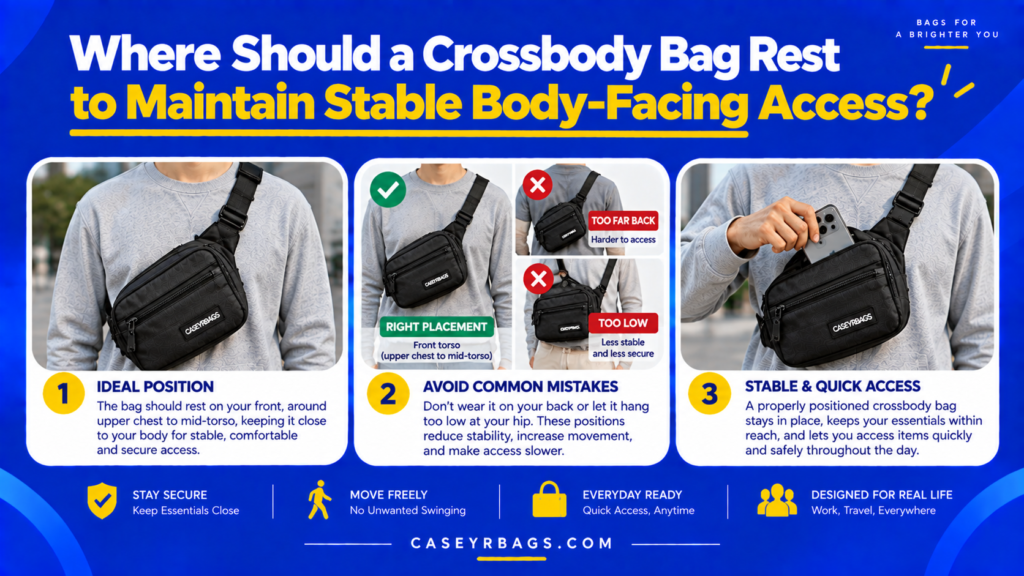
Where Should a Crossbody Bag Rest to Maintain Stable Body-Facing Access?
A Crossbody Bag should rest in a position where its main body stays predictably close to the torso or hip without excessive swinging, rotation, or outward pull. For many designs, a front-side or side position can provide a practical balance between stable body contact and easy repositioning for access.
The exact position depends on bag size, depth, strap length, anchor geometry, load placement, and opening design. The most functional resting zone is one that remains controlled during movement but can still be rotated or shifted toward the front for deliberate retrieval. No single height or body location is universally ideal.
What Does a Stable Body-Facing Resting Position Mean for a Crossbody Bag?
A stable resting position keeps the Crossbody Bag close enough to the body that it does not swing, rotate, or pull outward excessively during normal movement. The bag should remain in a reasonably predictable location instead of requiring repeated manual correction.
Body-facing access means the bag can be repositioned toward an accessible zone while the opening and contents remain controlled. Routine retrieval should not require complete detachment or removal where the design is intended for on-body access.
The best position balances movement control with access. Within the broader Crossbody Bag system, a position that maximizes stability while making retrieval awkward—or maximizes access while allowing excessive movement—can still be a poor overall fit.
Which Factors Determine Where a Crossbody Bag Naturally Rests?
Strap length, anchor position, bag width, bag depth, internal load, strap angle, and body contact all influence the resting zone. Each factor changes either where the bag hangs, how closely it follows the body, or how freely it can move during normal activity.
Factor → resting position → stability/access consequence. Strap adjustment sets the broad height, anchors influence orientation, geometry changes body contact, and the loaded center determines whether the bag remains predictable or drifts away from its intended zone.
What Makes a Resting Position Stable?
A stable position keeps the bag in a predictable location with controlled swing, limited rotation, reasonable body contact, and a load that does not repeatedly shift the bag away from its resting zone. Some movement can remain normal.
Stable position = predictable movement, not zero movement. The useful test is whether normal walking or minor repositioning creates repeated correction, strong outward pull, or changing orientation that interferes with access.
What Makes a Resting Position Accessible?
An accessible resting zone allows easy hand reach, manageable rotation toward the front, a visible or predictable opening, and a controlled return after retrieval. The bag does not need to remain in the exact same position for both carrying and opening.
Useful access depends on the transition as much as the resting point. The bag should move along a short, understandable path into the access position and then return without strap binding, flipping, or repeated manual correction.
How Does Front Carry Affect Crossbody Stability & Access?
Front carry reduces the distance between the resting zone and the access zone, which can improve visibility and hand reach while increasing the chance that a larger bag interferes with normal movement.
How Does Front Positioning Improve Visual and Hand Access?
A front position can place the main opening within direct view and easy hand reach, reducing the amount of rotation needed before retrieval. This can make opening and closing more deliberate when the bag remains controlled against the body.
Front position → direct visual and hand access → minimal repositioning. The benefit concerns access management, not theft prevention, and the bag still needs appropriate closure control and stable load placement.
When Can Front Carry Interfere With Movement?
A wider or deeper bag can occupy more of the front body zone and may interfere during walking, bending, or sitting. The same location that gives direct access can therefore become less convenient when the bag’s physical profile is large.
Direct access does not automatically mean best carry stability. Front carry should be judged by whether the bag remains out of the way during normal movement while preserving predictable opening access.
When Is Front Carry Most Functionally Useful?
Front carry can be useful during short access-heavy periods, with compact bag profiles, or when frequent retrieval makes repeated rotation inefficient. It can also serve as a temporary access position rather than the permanent resting zone.
Front carry is one functional option, not the universal answer. If it creates walking interference, poor body contact, or awkward load behavior, a front-side or side position may provide a better carry/access balance.
Why Can Front-Side Carry Balance Stability & Access?
Front-side carry places the bag partly against the front and side of the torso, often shortening the access path while preserving more freedom for normal movement than full front carry.
How Does Front-Side Positioning Maintain Body Contact?
A front-side position can spread contact across part of the front and side body zone, helping the bag maintain a predictable plane when its depth, anchors, and load remain controlled. This can reduce the need for large corrective movements.
Bag rests partly against front/side torso → wider body-facing contact → controlled orientation. Actual stability still depends on bag dimensions, anchor geometry, strap setting, and internal load.
How Does Front-Side Carry Simplify Access?
Because the bag begins closer to the front, it may need only a short slide or rotation before the main opening reaches a usable access position. This reduces the distance between carry and retrieval compared with a farther side position.
Carry position → short repositioning path → access. The advantage is strongest when the strap and anchors permit smooth movement without allowing the bag to swing freely after the access movement ends.
When Does Front-Side Positioning Become Unstable?
Excessive bag depth, a long strap, dense outward loading, poor anchor geometry, or an oversized body can make the bag project away from the torso and rotate despite the favorable resting zone.
Front-side carry works only when the bag remains structurally controlled. A useful body location cannot compensate for poor load distribution or a bag geometry that repeatedly pulls away from the body.
| Resting Position | Stability Potential | Access Path | Main Trade-Off |
|---|---|---|---|
| Front | High visual/access control | Minimal repositioning | Can interfere with movement |
| Front-side | Balanced body contact | Short repositioning | Bag geometry matters |
| Side/hip | Natural carry position | Usually requires forward rotation | Greater movement potential in some designs |
How Does Side or Hip Carry Change Crossbody Bag Behavior?
Side or hip carry can provide a natural resting tendency for many Crossbody designs, but it usually increases the distance the bag must travel before the opening reaches a direct access position.
Why Does a Crossbody Bag Often Settle Naturally Near the Side or Hip?
Gravity, diagonal strap path, anchor geometry, and body contour can guide the bag toward the side or hip because the strap pulls diagonally across the torso while the bag seeks a lower resting position. This can create a stable everyday carry zone.
The result is not universal. Bag depth, strap angle, load position, and body geometry can shift the natural resting point forward or rearward, so the side/hip area should be tested rather than assumed.
How Can Side Carry Increase Movement?
A long strap or deep bag can create a larger swing arc at the side, allowing more forward-backward shifting and rotation during walking. Direct visibility can also decrease when the bag sits farther toward the rear.
Side position → greater movement freedom → potentially more swing. The effect remains design-dependent and should be judged through repeated movement rather than from position alone.
How Should a Side-Carried Bag Be Accessed?
A side-carried bag should move through a controlled forward rotation, become stable in the access position, allow opening and retrieval, then return to the original carry zone. The strap should guide this movement rather than bind or flip.
Side position → controlled forward rotation → open/retrieve → return. Good side carry should allow deliberate repositioning instead of uncontrolled swinging that changes bag orientation before or after access.
How High Should a Crossbody Bag Rest?
Vertical height changes body contact, movement range, and access angle, so useful height should be determined by functional behavior rather than a universal measurement.
How Does a Higher Resting Position Affect Stability?
A higher position can increase torso contact, shorten the swing arc, and reduce vertical movement because the bag has less room to travel. This can improve positional control when the bag geometry is compatible with that height.
Higher position → closer contact / shorter movement range. The trade-off can be a tighter access angle or more interference with upper-body movement, so higher does not automatically mean more functional.
How Does a Lower Resting Position Affect Access and Movement?
A lower position can make downward hand reach and forward rotation easier while giving the bag more room to swing or move around the hip. It may also increase interaction with the leg during walking.
Lower position → greater repositioning freedom / larger swing potential. The useful lower limit appears when movement, bounce, or body separation becomes harder to control than the access benefit justifies.
How Can the Correct Height Be Identified Without a Fixed Measurement?
Test whether the bag stays close to the body, avoids excessive bounce, does not interfere with normal movement, remains easy to rotate for access, and keeps the opening controllable. These observations are more useful than a fixed centimeter rule.
Functional behavior matters more than a universal measurement. The correct height is the one that keeps movement predictable while preserving an access angle that works for the specific bag and load.
How Does Strap Length Determine the Resting Position?
Strap length translates directly into bag height, body contact, and movement freedom, so adjustment should be made around both the resting zone and the intended access path.
What Happens When the Strap Is Shortened?
Shortening the strap usually moves the bag higher and closer to the body, reducing the free movement range available between the shoulder and the bag. This can increase body contact and reduce some swing.
Shorter strap → higher/closer bag position. The access angle also changes, and excessive shortening can make repositioning harder or force the bag into a height that conflicts with its anchor geometry.
What Happens When the Strap Is Lengthened?
Lengthening the strap usually lowers the resting position and gives the bag more freedom to move. Forward rotation for access may become easier because the bag can travel through a larger arc.
Longer strap → lower resting position → greater movement freedom. The trade-off is increased swing and greater body separation if the bag depth or load allows the body to project outward.
Why Should Strap Length Be Adjusted Around the Intended Access Movement?
The strap should allow the bag to move from carry to access and back without extreme loosening or tightening. A useful setting preserves enough movement for retrieval while keeping the normal resting zone controlled.
Carry → reposition → access → return should remain one connected path. Correct strap length supports both resting position and access movement rather than optimizing only one stage.
| Strap Setting | Bag Height | Body Contact | Swing Potential | Access Repositioning |
|---|---|---|---|---|
| Shorter | Higher | Usually closer | Lower potential | More deliberate |
| Moderate | Mid-zone | Balanced | Moderate | Controlled |
| Longer | Lower | Potentially reduced | Higher potential | Easier forward rotation |
How Do Bag Depth & Shape Affect the Best Resting Position?
A slim Crossbody and a deep Crossbody can behave differently at the same strap length because outward projection changes body contact, rotation, and movement clearance.
Why Can a Slim Crossbody Rest Closer to the Body?
A smaller depth keeps more of the load close to the body-facing panel and reduces outward projection. This can make front or front-side positions easier to maintain without strong rotation or pull away from the torso.
Smaller depth → load closer to body-facing panel → less outward projection. A slim profile is not automatically the best overall fit because capacity, width, access, and load distribution still matter.
Why Can Deeper Bags Require More Careful Positioning?
Greater depth moves contents farther from the body-facing plane and can increase swing, rotation, and interference during front carry. A deeper body may therefore work better in a position that preserves stronger contact or a more controlled load relationship.
Greater bag depth → more outward projection → greater swing/rotation potential. The useful resting zone should reduce repeated pull-away behavior without assuming one universal side or height.
How Does Bag Width Interact With Body Position?
A wider bag can create broader body contact while extending farther across the torso. That larger footprint can affect how the bag rotates between carry and access positions and how much clearance it needs during movement.
The useful resting zone depends on the bag’s complete geometry, not strap length alone. Width, depth, anchor placement, and load distribution should be evaluated together.
| Bag Profile | Body Contact | Movement Potential | Position Consideration |
|---|---|---|---|
| Slim | Closer | Lower to moderate | Front/front-side often manageable |
| Moderate depth | Variable | Moderate | Position + strap length matter |
| Deep | Greater projection | Higher potential | Requires stronger load/position control |
| Wide + shallow | Broad contact | Design-dependent | Rotation clearance matters |
How Does Internal Load Placement Change the Resting Position?
The same Crossbody Bag can sit differently depending on where dense and loose contents are positioned because the packed load changes outward pull, tilt, and anchor demand.
How Do Dense Items Near the Body-Facing Panel Affect Bag Position?
Dense items closer to the body-facing side can keep the load center nearer the plane the strap and anchors are trying to control. This can make the resting position more predictable without creating a medical rule about carrying weight.
Dense item closer to body-facing side → more controlled load relationship. The benefit is strongest when the item is also reasonably centered instead of creating a strong left-right imbalance.
How Do Outward-Loaded Pockets Pull the Bag Away From the Body?
A dense outer pocket concentrates weight farther from the body-facing plane, increasing outward pull and the potential for tilt or rotation. The bag may appear correctly positioned at rest but shift when walking.
Dense outer pocket → outward weight concentration → greater tilt/rotation potential. If the outer load repeatedly pulls the bag away from its resting zone, load placement should be corrected before strap height alone is changed.
How Does Left-Right Imbalance Change Resting Orientation?
One-sided loading can produce uneven anchor demand, persistent tilt, rotation, and repeated manual repositioning. The resting zone becomes unstable because the load continually pulls the bag away from its intended orientation.
The bag cannot maintain a stable resting position if its internal load continually shifts that position. Centering or retaining dense contents is therefore part of evaluating body-facing access.
How Does Opening Orientation Affect the Best Carry Position?
The bag should rest where its main opening remains predictable during both normal carry and the movement into an access position.
How Does an Upward-Facing Opening Affect Position Choice?
An upward-facing opening can support content containment and a predictable access direction when the bag remains reasonably level. The useful resting position is one that preserves that orientation until the user deliberately repositions the bag.
Opening orientation influences both carry and access. A position that repeatedly tilts the opening outward or downward may require more correction even if the bag itself feels easy to reach.
When Can the Main Opening Rotate Into an Awkward Position?
Bag tilt, a loose strap, weak anchor control, one-sided loading, or excessive side rotation can turn the opening away from the intended access direction. This can make the bag harder to open predictably.
The opening should be evaluated through movement, not only while the bag is still. If its direction changes repeatedly during walking or access rotation, the resting position or load may be mismatched.
Why Should the Opening Remain Controlled While the Bag Is Repositioned?
The bag should move from carry position toward access while keeping the opening oriented, then allow retrieval, closure, and a controlled return. This avoids unnecessary exposure of the entire compartment during routine access.
Carry position → rotate toward access → opening remains oriented → retrieve → close → return. Access should not require exposing the full compartment unnecessarily when the design supports more controlled retrieval.
How Should a Crossbody Bag Move From Carry Position to Access Position?
Carry position and access position can be slightly different because the first prioritizes stable movement while the second prioritizes opening visibility and reach.
Why Can Carry Position and Access Position Be Slightly Different?
The carry position can favor body contact and limited movement, while the access position can bring the opening farther forward for visibility and hand reach. The bag can move between those zones without being removed.
Carry position → prioritizes stability; access position → prioritizes visibility and reach. The system works when the transition remains short, controlled, and reversible.
What Makes the Repositioning Path Controlled?
Smooth strap movement, stable anchors, limited swing, predictable rotation, and a closure that stays controlled all support a clean transition. The bag should follow the intended path rather than flip or drift during repositioning.
A controlled path preserves both orientation and load stability. The user should be able to rotate or slide the bag, access contents, then return it without repeated corrective movements.
What Indicates That Repositioning Is Too Difficult?
Difficulty is evident when the bag must be removed, the strap binds, the body flips, contents shift heavily, the closure rotates away, or repeated manual correction is required. These signs show that the resting and access zones are not working together.
Stable access depends on the transition, not only the resting point. If moving into access repeatedly destabilizes the bag, strap length, body position, anchors, load, or bag depth should be reevaluated.
When Is a Crossbody Bag Resting Too High, Low, Frontward, or Rearward?
A poor resting position reveals itself through repeated movement or access correction rather than through one universal height or front-to-side measurement.
What Suggests the Bag Is Resting Too High for Its Design?
A difficult opening angle, limited forward rotation, interference with normal movement, or a strap and anchor path that appears forced can indicate that the bag is sitting too high for its geometry.
The issue is functional, not medical. If the higher position reduces movement but repeatedly makes routine access awkward, the trade-off may no longer support the overall carry/access fit.
What Suggests the Bag Is Resting Too Low?
Excessive swing, repeated bounce, leg or hip interference, strong pull away from the body, or greater rotation can indicate that the bag sits too low for the current load and strap geometry.
A lower position is not automatically unsuitable, but it becomes a mismatch when the additional movement freedom repeatedly overpowers the access benefit.
What Suggests the Front-to-Side Position Is Wrong?
Constant manual repositioning, poor opening visibility, repeated rotation, unstable body contact, or difficulty returning after access all suggest that the front-to-side location is not functioning well.
Wrong position reveals itself through repeated movement or access correction. The correct zone should reduce those repeated adjustments rather than require the user to constantly manage the bag.
How Can the Best Crossbody Resting Position Be Evaluated?
A repeatable position test should use the normal load and observe both walking behavior and the complete access transition before the final resting zone is chosen.
What Should Be Checked Before Adjusting Position?
Identify bag size, bag depth, normal load, strap range, anchor layout, and opening direction before changing the resting zone. These factors establish the structural conditions that any position must accommodate.
Starting with the real load prevents an empty-bag position from being mistaken for a functional carry position. The packed bag is the system that must remain stable and accessible.
What Should Be Tested During Normal Movement?
Observe swing, rotation, body contact, bag height, one-sided pull, and interference with walking or sitting. These conditions show whether the resting position remains predictable during ordinary movement.
Then compare those movement results with the access requirement. A stable-looking position that fails during retrieval is not a complete fit, just as an easy-access position that swings excessively is not a complete fit.
Which Sequence Should Determine the Final Resting Position?
- Load the bag normally.
- Position dense items predictably.
- Start with a moderate strap setting.
- Test front-side or side resting position.
- Walk normally.
- Observe swing and rotation.
- Reposition the bag toward the front.
- Open and retrieve a routine item.
- Close the bag.
- Return it to the carry position.
- Adjust height or position until both movement and access remain controlled.
Use the sequence in order so the evaluation begins with the actual packed bag and a moderate starting position before movement is judged. Walking, repositioning, retrieval, closure, and return-to-carry should all be tested as one connected process.
Adjust height or front-to-side position only after observing the complete cycle. The final resting zone should preserve controlled movement and controlled access together rather than maximizing either one in isolation.
How Can Crossbody Resting-Position Mismatches Be Avoided?
Position mismatches are avoided by evaluating bag height, front-to-side location, load control, opening orientation, and access transition together instead of choosing one feature as the answer.
Why Is “Wear It as High as Possible” a Weak Rule?
Excessively high positioning can reduce repositioning freedom, make the opening harder to reach, and create a poor match with the bag’s anchor angle or geometry. A tighter-looking position is not automatically a more functional one.
Higher does not automatically mean more functional. The useful height is the one that reduces unnecessary movement while preserving practical access and normal movement clearance.
Why Is Choosing Position From Access Alone a Mistake?
The easiest-to-open position can create excessive movement, poor body contact, or repeated swing during walking. A bag that sits perfectly for retrieval may therefore be a poor resting position for the rest of the carry cycle.
Access position and carry position must work together. The best system allows a short transition between them rather than forcing one location to optimize every task.
What Should Be Verified Before Settling on the Final Position?
Verify that the normal load is used, dense items remain controlled, strap length supports the intended height, anchors remain stable, body contact stays predictable, and excessive swing, repeated rotation, or strong outward pull are absent.
Also confirm that bag depth suits the position, front-side or side carry remains controlled, the opening stays correctly oriented, routine access does not require full removal where not intended, and the bag returns easily after retrieval.
- Normal bag load is used during testing.
- Dense items are reasonably controlled.
- Strap length supports the intended height.
- Both anchors remain stable.
- Bag rests predictably against the body.
- Bag does not swing excessively during normal walking.
- Bag does not repeatedly rotate.
- Bag does not pull strongly away from the body.
- Bag depth suits the chosen position.
- Front-side or side position allows controlled carry.
- Main opening remains correctly oriented.
- Bag can move into an access position without full removal where intended.
- Routine contents can be retrieved predictably.
- Bag can return easily to its resting position.
- Higher carry is not automatically treated as better.
- Lower carry is not automatically treated as easier.
- Front carry is not treated as guaranteed security.
- Resting position is evaluated through both movement and access behavior.
Conclusion
A Crossbody Bag should rest where it maintains consistent body contact without excessive swinging, rotation, or outward pull while remaining easy to shift toward an accessible front-facing position. Depending on bag geometry, load, strap setting, and anchor layout, this may be at the front-side, side, or hip rather than at one universal point.
The strongest fit is a functional zone that works through the full carry cycle. The loaded bag should remain predictable during movement, keep its opening oriented, move into access through a short controlled path, and return easily afterward. The best Crossbody resting position is therefore the one where body contact, movement control, opening orientation, access transition, and return-to-carry behavior remain compatible.
FAQs
Front carry can provide more direct access, while front-side or hip carry may provide a more natural resting position during normal movement.
The better location depends on bag size, depth, strap geometry, load, and how easily the bag can be repositioned. No position is universally best.
There is no universal height. The bag should sit high enough to limit excessive movement without being forced into an awkward position.
It should also remain low enough that routine repositioning and access are practical for that specific bag. Functional behavior matters more than a fixed measurement.
Possible causes include excessive strap length, greater bag depth, uneven contents, shifting items, anchor geometry, or a front-to-side position that does not match the load.
Repeated swing, tilt, or rotation should trigger a multi-factor position check rather than one automatic adjustment such as shortening the strap.