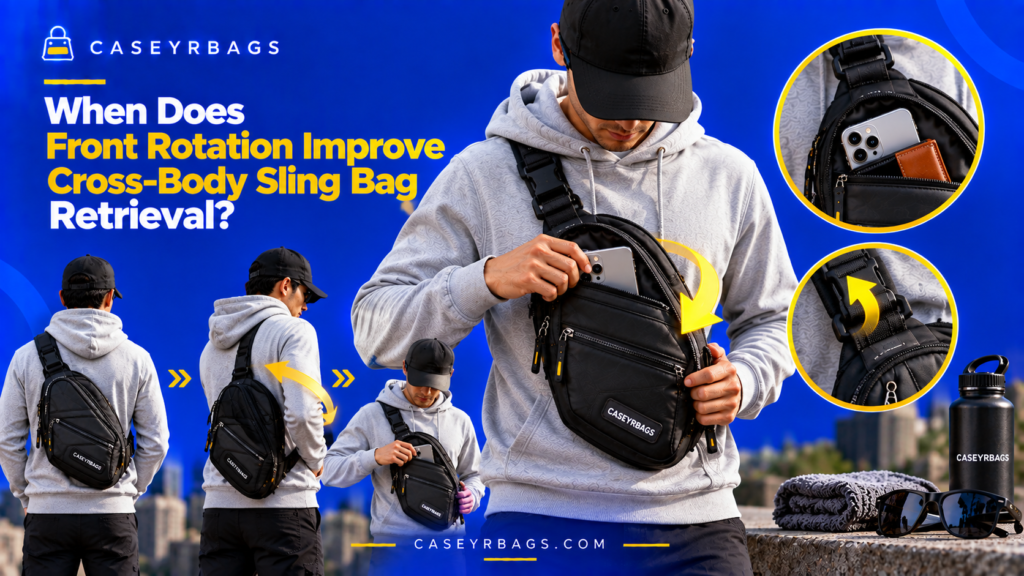
When Does Front Rotation Improve Cross-Body Sling Bag Retrieval?
Front rotation improves Cross-Body Sling Bag retrieval when moving the loaded bag forward removes a real access barrier. A rear, rear-side, or side resting position may place the intended compartment outside a practical hand path, while a controlled front or front-side transition can bring the closure and storage zone into easier reach, improve useful visibility, and create a more stable opening position.
The benefit is conditional rather than automatic. If direct side access already works, the opening remains poorly oriented, or the forward endpoint adds swing, searching, or return effort, rotation can make retrieval less efficient. The useful amount of rotation is therefore the minimum movement that improves the complete locate, reach, open, retrieve, reclose, and return cycle with the normal carried load.
What Does “Front Rotation Improves Retrieval” Actually Mean?
A Cross-Body Sling Bag may rest behind the torso, at the rear-side, or along the side because those positions can support compact everyday carry. Those same positions can also place a frequent-use compartment outside the most direct hand or visual access path.
Front rotation changes that relationship by moving the intended storage zone toward the front or front-side. The movement is useful when it shortens reach, improves opening visibility, or gives the wearer a more stable endpoint for operating the closure and retrieving the intended item.
The result should be judged across the full access cycle rather than from forward movement alone. This retrieval-specific behavior sits within the broader Sling Bag system: carry position → controlled rotation → usable endpoint → retrieval → reclosure → return.
Which retrieval steps can front rotation improve?
The most relevant options are locating the compartment, reaching the closure, stabilizing the bag, and opening the compartment. Their value depends on whether the rotated endpoint places the intended storage zone within a practical hand path while keeping the bag controlled enough for normal opening and retrieval.
Test the condition with the normal carried load and compare it with direct access from the resting position. A front-side endpoint may be sufficient; farther rotation is not automatically better. The governing distinction is: Access barrier → rotational change → retrieval improvement. Keep the change only when it reduces total retrieval friction without adding excessive swing, twisting, searching, closure difficulty, or return-path correction.
Why is moving the bag forward not enough by itself?
Why is moving the bag forward not enough by itself because forward movement only matters when it improves the complete retrieval geometry.. The relevant test is whether the change improves reach, opening control, item location, reclosure, or return without creating another repositioning step.
Test the condition with the normal carried load and compare it with direct access from the resting position. A front-side endpoint may be sufficient; farther rotation is not automatically better. The governing distinction is: Forward movement only matters when it improves the complete retrieval geometry.. Keep the change only when it reduces total retrieval friction without adding excessive swing, twisting, searching, closure difficulty, or return-path correction.
What defines a real retrieval improvement?
A real retrieval improvement exists when front rotation removes more access friction than the movement itself adds. The useful change should simplify locating the compartment, reaching the closure, stabilizing the bag, opening it, retrieving the intended item, and preparing the bag for a controlled return.
Test the condition with the normal carried load and compare it with direct access from the resting position. A front-side endpoint may be sufficient; farther rotation is not automatically better. The governing distinction is: Front rotation improves retrieval when it removes more access friction than the rotational movement itself adds.. Keep the change only when it reduces total retrieval friction without adding excessive swing, twisting, searching, closure difficulty, or return-path correction.
When Does the Resting Carry Position Make Front Rotation Useful?
Identify starting positions where rotation creates meaningful access improvement.
When does rear carry benefit most from front rotation?
This condition is useful when intended pocket cannot be reached directly, zipper cannot be seen, and bag must otherwise be removed. The practical question is whether front rotation creates a clearer, shorter, or more stable retrieval path than direct access from the bag’s normal resting position.
Test the condition with the normal carried load and compare it with direct access from the resting position. A front-side endpoint may be sufficient; farther rotation is not automatically better. Keep the change only when it reduces total retrieval friction without adding excessive swing, twisting, searching, closure difficulty, or return-path correction.
When does rear-side or side carry benefit from rotation?
This condition is useful when compartment is reachable but awkward, opening faces backward, and arm or torso blocks hand path. The practical question is whether front rotation creates a clearer, shorter, or more stable retrieval path than direct access from the bag’s normal resting position.
Test the condition with the normal carried load and compare it with direct access from the resting position. A front-side endpoint may be sufficient; farther rotation is not automatically better. Keep the change only when it reduces total retrieval friction without adding excessive swing, twisting, searching, closure difficulty, or return-path correction.
When is front rotation unnecessary?
Front rotation is unnecessary when the resting position already gives direct closure reach, stable bag control, adequate opening visibility, and straightforward item retrieval. In that situation, moving the bag farther forward adds a transition without removing a meaningful access barrier.
Test the condition with the normal carried load and compare it with direct access from the resting position. A front-side endpoint may be sufficient; farther rotation is not automatically better. The governing distinction is: Rotation is useful when it removes an existing access barrier.. Keep the change only when it reduces total retrieval friction without adding excessive swing, twisting, searching, closure difficulty, or return-path correction.
| Retrieval Condition | Direct Access | Front Rotation | Interpretation |
|---|---|---|---|
| Pocket already at hand | Direct | Adds movement | Rotation benefit low |
| Opening partly reachable but awkward | Conditional | May shorten hand path | Rotation may help |
| Opening hidden behind torso | Difficult | Brings access zone forward | Strong potential benefit |
| Bag unstable after rotation | Variable | Adds stabilization need | Benefit reduced |
| Opening still faces away | Difficult | Still indirect | Rotation alone does not solve retrieval |
| Rotation + return adds more steps | Simpler | More complex | Direct access may be preferable |
How Does Front Rotation Change the Hand Reach Path?
Explain how bringing the bag forward can reduce awkward reaching.
How can rotation shorten the reach distance?
Rotation shorten the reach distance can improve retrieval when bag moves toward access hand → hand travels less around torso. The mechanism should reduce a specific barrier such as indirect reach, poor opening visibility, unstable bag control, or an awkward closure path.
Test the condition with the normal carried load and compare it with direct access from the resting position. A front-side endpoint may be sufficient; farther rotation is not automatically better. The governing distinction is: Bag moves toward access hand → hand travels less around torso. Keep the change only when it reduces total retrieval friction without adding excessive swing, twisting, searching, closure difficulty, or return-path correction.
How can rotation reduce shoulder or arm crossing?
Rotation reduce shoulder or arm crossing can improve retrieval when 2 focused paragraphs. The mechanism should reduce a specific barrier such as indirect reach, poor opening visibility, unstable bag control, or an awkward closure path.
Test the condition with the normal carried load and compare it with direct access from the resting position. A front-side endpoint may be sufficient; farther rotation is not automatically better. Keep the change only when it reduces total retrieval friction without adding excessive swing, twisting, searching, closure difficulty, or return-path correction. Observe the loaded bag rather than relying on empty-bag behavior.
When does further rotation stop improving the hand path?
This condition is useful when excessive cross-body reach, wrist rotation, and additional bag repositioning. The practical question is whether front rotation creates a clearer, shorter, or more stable retrieval path than direct access from the bag’s normal resting position.
Test the condition with the normal carried load and compare it with direct access from the resting position. A front-side endpoint may be sufficient; farther rotation is not automatically better. The governing distinction is: Shortest practical hand path—not maximum rotation—is the goal.. Keep the change only when it reduces total retrieval friction without adding excessive swing, twisting, searching, closure difficulty, or return-path correction.
When Does Front Rotation Improve Opening Visibility?
Explain when forward movement makes the intended opening easier to identify and operate.
How does rotation bring the opening into view?
Rotation bring the opening into view affects front-rotation retrieval because rear/side opening → frontward rotation → closure enters wearer’s visual field. The effect is useful only when it improves the wearer’s ability to reach, open, use, and reclose the intended storage zone at a stable endpoint.
Test the condition with the normal carried load and compare it with direct access from the resting position. A front-side endpoint may be sufficient; farther rotation is not automatically better. The governing distinction is: Rear/side opening → frontward rotation → closure enters wearer’s visual field. Keep the change only when it reduces total retrieval friction without adding excessive swing, twisting, searching, closure difficulty, or return-path correction.
Why can better visibility improve retrieval?
Why can better visibility improve retrieval because 2 focused paragraphs. The relevant test is whether the change improves reach, opening control, item location, reclosure, or return without creating another repositioning step.
Test the condition with the normal carried load and compare it with direct access from the resting position. A front-side endpoint may be sufficient; farther rotation is not automatically better. Keep the change only when it reduces total retrieval friction without adding excessive swing, twisting, searching, closure difficulty, or return-path correction. Observe the loaded bag rather than relying on empty-bag behavior.
When does front rotation fail to improve visibility?
This condition is useful when opening faces outward, flap covers access path, bag angle hides closure, and pocket remains on far side. The practical question is whether front rotation creates a clearer, shorter, or more stable retrieval path than direct access from the bag’s normal resting position.
Test the condition with the normal carried load and compare it with direct access from the resting position. A front-side endpoint may be sufficient; farther rotation is not automatically better. The governing distinction is: Front position helps visibility only when opening orientation supports it.. Keep the change only when it reduces total retrieval friction without adding excessive swing, twisting, searching, closure difficulty, or return-path correction.
When Does Front Rotation Improve Bag Stability During Retrieval?
Explain when the front access position gives the wearer better control of the bag during opening.
How can front torso contact stabilize the bag?
Front torso contact stabilize the bag can improve retrieval when 2 focused paragraphs. The mechanism should reduce a specific barrier such as indirect reach, poor opening visibility, unstable bag control, or an awkward closure path.
Test the condition with the normal carried load and compare it with direct access from the resting position. A front-side endpoint may be sufficient; farther rotation is not automatically better. Keep the change only when it reduces total retrieval friction without adding excessive swing, twisting, searching, closure difficulty, or return-path correction. Observe the loaded bag rather than relying on empty-bag behavior.
How can the wearer support the bag more easily in front?
The wearer support the bag more easily in front can improve retrieval when 2 focused paragraphs. The mechanism should reduce a specific barrier such as indirect reach, poor opening visibility, unstable bag control, or an awkward closure path.
Test the condition with the normal carried load and compare it with direct access from the resting position. A front-side endpoint may be sufficient; farther rotation is not automatically better. Keep the change only when it reduces total retrieval friction without adding excessive swing, twisting, searching, closure difficulty, or return-path correction.
When is the front endpoint still unstable?
This condition is useful when strap too loose, bag hanging too low, excessive depth, and uneven loading. The practical question is whether front rotation creates a clearer, shorter, or more stable retrieval path than direct access from the bag’s normal resting position.
Test the condition with the normal carried load and compare it with direct access from the resting position. A front-side endpoint may be sufficient; farther rotation is not automatically better. The governing distinction is: Front location ≠ stable retrieval endpoint. Keep the change only when it reduces total retrieval friction without adding excessive swing, twisting, searching, closure difficulty, or return-path correction.
How Much Front Rotation Is Actually Needed?
Prevent full front rotation from becoming the default when a smaller movement already provides adequate access.
When is partial front-side rotation enough?
This condition is useful when zipper becomes reachable, intended pocket enters view, hand path becomes direct, and bag remains stable. The practical question is whether front rotation creates a clearer, shorter, or more stable retrieval path than direct access from the bag’s normal resting position.
Test the condition with the normal carried load and compare it with direct access from the resting position. A front-side endpoint may be sufficient; farther rotation is not automatically better. Keep the change only when it reduces total retrieval friction without adding excessive swing, twisting, searching, closure difficulty, or return-path correction.
When might fuller front rotation be useful?
This condition is useful when large main compartment needs wider visual access, closure spans upper bag surface, and both hands are needed for organization. The practical question is whether front rotation creates a clearer, shorter, or more stable retrieval path than direct access from the bag’s normal resting position.
Test the condition with the normal carried load and compare it with direct access from the resting position. A front-side endpoint may be sufficient; farther rotation is not automatically better. Keep the change only when it reduces total retrieval friction without adding excessive swing, twisting, searching, closure difficulty, or return-path correction.
Why is maximum rotation not the retrieval goal?
Why is maximum rotation not the retrieval goal because useful rotation ends when access becomes functional—not when the bag reaches the maximum possible front position.. The relevant test is whether the change improves reach, opening control, item location, reclosure, or return without creating another repositioning step.
Test the condition with the normal carried load and compare it with direct access from the resting position. A front-side endpoint may be sufficient; farther rotation is not automatically better. The governing distinction is: Retrieval Benefit = Access Friction Removed − Rotation/Return Friction Added. Keep the change only when it reduces total retrieval friction without adding excessive swing, twisting, searching, closure difficulty, or return-path correction.
| Rotation Endpoint | Reach | Visibility | Movement Required |
|---|---|---|---|
| Side | Limited–moderate | Lower | Minimal |
| Front-side | High potential | High | Moderate |
| Center-front | High for some layouts | High | More |
| Over-rotated | Variable | Variable | Unnecessary |
How Does Strap Length Affect the Benefit of Front Rotation?
Explain why movement must be possible without creating excessive free motion.
What happens when the strap is too short?
When this condition occurs, bag cannot slide forward easily, wearer lifts strap manually, and front endpoint becomes difficult to reach. That change can alter endpoint stability, opening visibility, zipper reach, or the amount of extra movement needed before the intended item becomes accessible.
Test the condition with the normal carried load and compare it with direct access from the resting position. A front-side endpoint may be sufficient; farther rotation is not automatically better. Keep the change only when it reduces total retrieval friction without adding excessive swing, twisting, searching, closure difficulty, or return-path correction.
What happens when the strap is too long?
When this condition occurs, rotation becomes easy, bag drops lower, endpoint becomes less controlled, and swing increases. That change can alter endpoint stability, opening visibility, zipper reach, or the amount of extra movement needed before the intended item becomes accessible.
Test the condition with the normal carried load and compare it with direct access from the resting position. A front-side endpoint may be sufficient; farther rotation is not automatically better. Keep the change only when it reduces total retrieval friction without adding excessive swing, twisting, searching, closure difficulty, or return-path correction.
What defines a useful strap setting for front rotation?
A useful result is defined by the strap should allow the necessary rotation while keeping both the carry position and access endpoint predictable.. This matters because front rotation is valuable only when the final access geometry makes the intended compartment easier to use, not simply because the bag has moved farther forward.
Test the condition with the normal carried load and compare it with direct access from the resting position. A front-side endpoint may be sufficient; farther rotation is not automatically better. The governing distinction is: More rotation freedom ≠ better retrieval. Keep the change only when it reduces total retrieval friction without adding excessive swing, twisting, searching, closure difficulty, or return-path correction.
How Does Anchor Geometry Affect Front Rotation?
Explain how strap attachment points influence bag angle during the side-to-front transition.
How can effective anchor geometry preserve orientation?
Effective anchor geometry preserve orientation can improve retrieval when controlled attachment geometry → bag maintains usable angle during rotation. The mechanism should reduce a specific barrier such as indirect reach, poor opening visibility, unstable bag control, or an awkward closure path.
Test the condition with the normal carried load and compare it with direct access from the resting position. A front-side endpoint may be sufficient; farther rotation is not automatically better. The governing distinction is: Controlled attachment geometry → bag maintains usable angle during rotation. Keep the change only when it reduces total retrieval friction without adding excessive swing, twisting, searching, closure difficulty, or return-path correction.
How can pivot-heavy geometry reduce retrieval benefit?
Pivot-heavy geometry reduce retrieval benefit can improve retrieval when 2 focused paragraphs. The mechanism should reduce a specific barrier such as indirect reach, poor opening visibility, unstable bag control, or an awkward closure path.
Test the condition with the normal carried load and compare it with direct access from the resting position. A front-side endpoint may be sufficient; farther rotation is not automatically better. Keep the change only when it reduces total retrieval friction without adding excessive swing, twisting, searching, closure difficulty, or return-path correction. Observe the loaded bag rather than relying on empty-bag behavior.
Why does endpoint orientation matter more than smooth movement alone?
Why does endpoint orientation matter more than smooth movement alone because smooth rotation ≠ useful rotation if the bag arrives at the wrong angle.. The relevant test is whether the change improves reach, opening control, item location, reclosure, or return without creating another repositioning step.
Test the condition with the normal carried load and compare it with direct access from the resting position. A front-side endpoint may be sufficient; farther rotation is not automatically better. The governing distinction is: Smooth rotation ≠ useful rotation if the bag arrives at the wrong angle.. Keep the change only when it reduces total retrieval friction without adding excessive swing, twisting, searching, closure difficulty, or return-path correction.
How Does Loaded Bag Depth Affect Front Rotation?
Explain why bag thickness changes both the rotational path and front-access stability.
How does shallow loaded depth support rotation?
Shallow loaded depth support rotation affects front-rotation retrieval because 2 focused paragraphs. The effect is useful only when it improves the wearer’s ability to reach, open, use, and reclose the intended storage zone at a stable endpoint.
Test the condition with the normal carried load and compare it with direct access from the resting position. A front-side endpoint may be sufficient; farther rotation is not automatically better. Keep the change only when it reduces total retrieval friction without adding excessive swing, twisting, searching, closure difficulty, or return-path correction.
How can greater depth reduce the retrieval benefit?
Greater depth reduce the retrieval benefit can improve retrieval when 2 focused paragraphs. The mechanism should reduce a specific barrier such as indirect reach, poor opening visibility, unstable bag control, or an awkward closure path.
Test the condition with the normal carried load and compare it with direct access from the resting position. A front-side endpoint may be sufficient; farther rotation is not automatically better. Keep the change only when it reduces total retrieval friction without adding excessive swing, twisting, searching, closure difficulty, or return-path correction. Observe the loaded bag rather than relying on empty-bag behavior.
Why should front rotation be tested with the actual load?
Why should front rotation be tested with the actual load because empty-bag rotation ≠ loaded retrieval performance. The relevant test is whether the change improves reach, opening control, item location, reclosure, or return without creating another repositioning step.
Test the condition with the normal carried load and compare it with direct access from the resting position. A front-side endpoint may be sufficient; farther rotation is not automatically better. The governing distinction is: Empty-bag rotation ≠ loaded retrieval performance. Keep the change only when it reduces total retrieval friction without adding excessive swing, twisting, searching, closure difficulty, or return-path correction.
When Does Opening Orientation Make Front Rotation Useful?
Explain why main-opening direction determines whether forward movement creates an actual retrieval advantage.
Which opening orientation benefits from front rotation?
The most relevant options are visible, reachable, operable, and stable. Their value depends on whether the rotated endpoint places the intended storage zone within a practical hand path while keeping the bag controlled enough for normal opening and retrieval.
Test the condition with the normal carried load and compare it with direct access from the resting position. A front-side endpoint may be sufficient; farther rotation is not automatically better. Keep the change only when it reduces total retrieval friction without adding excessive swing, twisting, searching, closure difficulty, or return-path correction.
What happens when the opening remains on the far side?
When this condition occurs, second rotation required, bag manually twisted, and hand reaches around front panel. That change can alter endpoint stability, opening visibility, zipper reach, or the amount of extra movement needed before the intended item becomes accessible.
Test the condition with the normal carried load and compare it with direct access from the resting position. A front-side endpoint may be sufficient; farther rotation is not automatically better. Keep the change only when it reduces total retrieval friction without adding excessive swing, twisting, searching, closure difficulty, or return-path correction.
Why can side access outperform front rotation in some designs?
Why can side access outperform front rotation in some designs because front rotation is beneficial only when the access architecture benefits from it.. The relevant test is whether the change improves reach, opening control, item location, reclosure, or return without creating another repositioning step.
Test the condition with the normal carried load and compare it with direct access from the resting position. A front-side endpoint may be sufficient; farther rotation is not automatically better. The governing distinction is: Front rotation is beneficial only when the access architecture benefits from it.. Keep the change only when it reduces total retrieval friction without adding excessive swing, twisting, searching, closure difficulty, or return-path correction.
| After Rotation | Opening Visibility | Hand Reach | Rotation Benefit |
|---|---|---|---|
| Faces wearer | High | Direct | Strong potential |
| Faces upward | High | Direct | Strong potential |
| Faces side | Variable | Variable | Design-dependent |
| Faces away | Low | Indirect | Low |
How Does Zipper Direction Affect the Value of Front Rotation?
Explain whether rotation places the zipper pull and opening travel within a better hand path.
When does front rotation bring the zipper pull into easier reach?
This condition is useful when rear-side, far edge, and visually hidden zone. The practical question is whether front rotation creates a clearer, shorter, or more stable retrieval path than direct access from the bag’s normal resting position.
Test the condition with the normal carried load and compare it with direct access from the resting position. A front-side endpoint may be sufficient; farther rotation is not automatically better. Keep the change only when it reduces total retrieval friction without adding excessive swing, twisting, searching, closure difficulty, or return-path correction.
When does rotation add another zipper step?
This condition is useful when zipper pull ends opposite side, hand must cross bag, and second hand rotates bag farther. The practical question is whether front rotation creates a clearer, shorter, or more stable retrieval path than direct access from the bag’s normal resting position.
Test the condition with the normal carried load and compare it with direct access from the resting position. A front-side endpoint may be sufficient; farther rotation is not automatically better. Keep the change only when it reduces total retrieval friction without adding excessive swing, twisting, searching, closure difficulty, or return-path correction.
Why should the entire zipper travel be evaluated?
Why should the entire zipper travel be evaluated because reachable zipper pull ≠ complete compartment access. The relevant test is whether the change improves reach, opening control, item location, reclosure, or return without creating another repositioning step.
Test the condition with the normal carried load and compare it with direct access from the resting position. A front-side endpoint may be sufficient; farther rotation is not automatically better. The governing distinction is: Reachable zipper pull ≠ complete compartment access. Keep the change only when it reduces total retrieval friction without adding excessive swing, twisting, searching, closure difficulty, or return-path correction.
Which Pocket Locations Benefit Most From Front Rotation?
Explain how pocket role determines whether rotation meaningfully improves retrieval.
Which frequent-use pockets benefit from front rotation?
The most relevant options are top-front pockets, upper main-compartment zones, and front-side pockets that become wearer-facing. Their value depends on whether the rotated endpoint places the intended storage zone within a practical hand path while keeping the bag controlled enough for normal opening and retrieval.
Test the condition with the normal carried load and compare it with direct access from the resting position. A front-side endpoint may be sufficient; farther rotation is not automatically better. Keep the change only when it reduces total retrieval friction without adding excessive swing, twisting, searching, closure difficulty, or return-path correction.
Which pockets may gain little from rotation?
The most relevant options are already accessible side pockets, low-frequency deep zones, and pockets whose openings remain hidden. Their value depends on whether the rotated endpoint places the intended storage zone within a practical hand path while keeping the bag controlled enough for normal opening and retrieval.
Test the condition with the normal carried load and compare it with direct access from the resting position. A front-side endpoint may be sufficient; farther rotation is not automatically better. Keep the change only when it reduces total retrieval friction without adding excessive swing, twisting, searching, closure difficulty, or return-path correction.
Why should pocket priority determine rotational access?
Why should pocket priority determine rotational access because rotation should primarily improve access to the items that actually need frequent retrieval.. The relevant test is whether the change improves reach, opening control, item location, reclosure, or return without creating another repositioning step.
Test the condition with the normal carried load and compare it with direct access from the resting position. A front-side endpoint may be sufficient; farther rotation is not automatically better. The governing distinction is: Rotation should primarily improve access to the items that actually need frequent retrieval.. Keep the change only when it reduces total retrieval friction without adding excessive swing, twisting, searching, closure difficulty, or return-path correction.
| Pocket Role | Benefit From Front Rotation |
|---|---|
| Frequent-use | High where orientation aligns |
| Routine main compartment | Moderate–high |
| Low-frequency internal | Lower |
| Already side-accessible | Low / optional |
How Does Internal Load Placement Affect Front-Rotation Retrieval?
Explain why rotation benefit depends on the bag remaining correctly oriented after moving forward.
How does balanced loading support a stable front endpoint?
Balanced loading support a stable front endpoint affects front-rotation retrieval because controlled internal load center → bag arrives at predictable angle. The effect is useful only when it improves the wearer’s ability to reach, open, use, and reclose the intended storage zone at a stable endpoint.
Test the condition with the normal carried load and compare it with direct access from the resting position. A front-side endpoint may be sufficient; farther rotation is not automatically better. The governing distinction is: Controlled internal load center → bag arrives at predictable angle. Keep the change only when it reduces total retrieval friction without adding excessive swing, twisting, searching, closure difficulty, or return-path correction.
How does end-heavy loading reduce retrieval benefit?
End-heavy loading reduce retrieval benefit affects front-rotation retrieval because 2 focused paragraphs. The effect is useful only when it improves the wearer’s ability to reach, open, use, and reclose the intended storage zone at a stable endpoint.
Test the condition with the normal carried load and compare it with direct access from the resting position. A front-side endpoint may be sufficient; farther rotation is not automatically better. Keep the change only when it reduces total retrieval friction without adding excessive swing, twisting, searching, closure difficulty, or return-path correction.
How does outward-heavy loading affect rotation?
Outward-heavy loading affect rotation affects front-rotation retrieval because rotation cannot fully compensate for unstable internal loading.. The effect is useful only when it improves the wearer’s ability to reach, open, use, and reclose the intended storage zone at a stable endpoint.
Test the condition with the normal carried load and compare it with direct access from the resting position. A front-side endpoint may be sufficient; farther rotation is not automatically better. The governing distinction is: Rotation cannot fully compensate for unstable internal loading.. Keep the change only when it reduces total retrieval friction without adding excessive swing, twisting, searching, closure difficulty, or return-path correction.
When Does Front Rotation Improve Visual Item Search?
Explain when front positioning helps not only opening access but also item identification.
How can front positioning improve interior visibility?
Front positioning improve interior visibility can improve retrieval when 2 focused paragraphs. The mechanism should reduce a specific barrier such as indirect reach, poor opening visibility, unstable bag control, or an awkward closure path.
Test the condition with the normal carried load and compare it with direct access from the resting position. A front-side endpoint may be sufficient; farther rotation is not automatically better. Keep the change only when it reduces total retrieval friction without adding excessive swing, twisting, searching, closure difficulty, or return-path correction. Observe the loaded bag rather than relying on empty-bag behavior.
Why can front rotation still leave poor item retrieval?
Why can front rotation still leave poor item retrieval because 2 focused paragraphs. The relevant test is whether the change improves reach, opening control, item location, reclosure, or return without creating another repositioning step.
Test the condition with the normal carried load and compare it with direct access from the resting position. A front-side endpoint may be sufficient; farther rotation is not automatically better. Keep the change only when it reduces total retrieval friction without adding excessive swing, twisting, searching, closure difficulty, or return-path correction. Observe the loaded bag rather than relying on empty-bag behavior.
Why should rotation and organization be evaluated separately?
Why should rotation and organization be evaluated separately because rotation improves access position; organization determines item location.. The relevant test is whether the change improves reach, opening control, item location, reclosure, or return without creating another repositioning step.
Test the condition with the normal carried load and compare it with direct access from the resting position. A front-side endpoint may be sufficient; farther rotation is not automatically better. The governing distinction is: Rotation improves access position; organization determines item location.. Keep the change only when it reduces total retrieval friction without adding excessive swing, twisting, searching, closure difficulty, or return-path correction.
When Does Front Rotation Reduce the Need to Remove the Bag?
Explain when rotation provides the practical benefit of keeping the bag worn.
When can the bag remain fully worn during retrieval?
This condition is useful when front endpoint is stable, closure is reachable, and intended compartment opens normally. The practical question is whether front rotation creates a clearer, shorter, or more stable retrieval path than direct access from the bag’s normal resting position.
Test the condition with the normal carried load and compare it with direct access from the resting position. A front-side endpoint may be sufficient; farther rotation is not automatically better. Keep the change only when it reduces total retrieval friction without adding excessive swing, twisting, searching, closure difficulty, or return-path correction.
When might removal still be easier?
This condition is useful when large-item retrieval, deep repacking, and major compartment reorganization. The practical question is whether front rotation creates a clearer, shorter, or more stable retrieval path than direct access from the bag’s normal resting position.
Test the condition with the normal carried load and compare it with direct access from the resting position. A front-side endpoint may be sufficient; farther rotation is not automatically better. Keep the change only when it reduces total retrieval friction without adding excessive swing, twisting, searching, closure difficulty, or return-path correction.
Why is keeping the bag worn not automatically better?
Why is keeping the bag worn not automatically better because worn retrieval is useful only when it reduces total access effort.. The relevant test is whether the change improves reach, opening control, item location, reclosure, or return without creating another repositioning step.
Test the condition with the normal carried load and compare it with direct access from the resting position. A front-side endpoint may be sufficient; farther rotation is not automatically better. The governing distinction is: Worn retrieval is useful only when it reduces total access effort.. Keep the change only when it reduces total retrieval friction without adding excessive swing, twisting, searching, closure difficulty, or return-path correction.
When Does Front Rotation Add More Friction Than It Removes?
Identify when rotating forward is unnecessary or counterproductive.
When is direct side access already better?
This condition is useful when pocket already sits at hand, zipper direction supports side access, and no visual search is required. The practical question is whether front rotation creates a clearer, shorter, or more stable retrieval path than direct access from the bag’s normal resting position.
Test the condition with the normal carried load and compare it with direct access from the resting position. A front-side endpoint may be sufficient; farther rotation is not automatically better. Keep the change only when it reduces total retrieval friction without adding excessive swing, twisting, searching, closure difficulty, or return-path correction.
When can full front rotation add unnecessary steps?
This condition is useful when long rotation distance, strap repositioning, zipper was already accessible earlier, and return path becomes longer. The practical question is whether front rotation creates a clearer, shorter, or more stable retrieval path than direct access from the bag’s normal resting position.
Test the condition with the normal carried load and compare it with direct access from the resting position. A front-side endpoint may be sufficient; farther rotation is not automatically better. Keep the change only when it reduces total retrieval friction without adding excessive swing, twisting, searching, closure difficulty, or return-path correction.
When does repeated front rotation signal poor storage zoning?
This condition is useful when full rotation, opening main compartment, and searching. The practical question is whether front rotation creates a clearer, shorter, or more stable retrieval path than direct access from the bag’s normal resting position.
Test the condition with the normal carried load and compare it with direct access from the resting position. A front-side endpoint may be sufficient; farther rotation is not automatically better. The governing distinction is: Front rotation should solve a retrieval problem—not become an unnecessary ritual.. Keep the change only when it reduces total retrieval friction without adding excessive swing, twisting, searching, closure difficulty, or return-path correction.
How Does Front Rotation Affect the Return Path?
Explain why retrieval efficiency includes restoring the normal carry position.
Why should the compartment be closed before return rotation?
Why should the compartment be closed before return rotation because 2 focused paragraphs. The relevant test is whether the change improves reach, opening control, item location, reclosure, or return without creating another repositioning step.
Test the condition with the normal carried load and compare it with direct access from the resting position. A front-side endpoint may be sufficient; farther rotation is not automatically better. Keep the change only when it reduces total retrieval friction without adding excessive swing, twisting, searching, closure difficulty, or return-path correction. Observe the loaded bag rather than relying on empty-bag behavior.
What makes the return path efficient?
A useful result is defined by retrieve → reclose → reverse rotation → normal carry. This matters because front rotation is valuable only when the final access geometry makes the intended compartment easier to use, not simply because the bag has moved farther forward.
Test the condition with the normal carried load and compare it with direct access from the resting position. A front-side endpoint may be sufficient; farther rotation is not automatically better. The governing distinction is: Retrieve → reclose → reverse rotation → normal carry. Keep the change only when it reduces total retrieval friction without adding excessive swing, twisting, searching, closure difficulty, or return-path correction.
When does the return path cancel the retrieval benefit?
This condition is useful when strap twists, bag catches, resting position must be rebuilt, and manual readjustment is required every time. The practical question is whether front rotation creates a clearer, shorter, or more stable retrieval path than direct access from the bag’s normal resting position.
Test the condition with the normal carried load and compare it with direct access from the resting position. A front-side endpoint may be sufficient; farther rotation is not automatically better. The governing distinction is: Retrieval improvement includes the complete access-and-return cycle.. Keep the change only when it reduces total retrieval friction without adding excessive swing, twisting, searching, closure difficulty, or return-path correction.
When Does Front Rotation Fail to Improve Retrieval?
Identify conditions where forward rotation provides little or no practical benefit.
What if the front endpoint is unstable?
What if the front endpoint is unstable should be evaluated through loose strap, excessive loaded depth, poor anchor geometry, and uneven internal load. The condition matters only if it changes the complete retrieval sequence in a useful and repeatable way.
Test the condition with the normal carried load and compare it with direct access from the resting position. A front-side endpoint may be sufficient; farther rotation is not automatically better. Keep the change only when it reduces total retrieval friction without adding excessive swing, twisting, searching, closure difficulty, or return-path correction.
What if the bag rotates smoothly but the compartment remains difficult to use?
What if the bag rotates smoothly but the compartment remains difficult to use should be evaluated through opening orientation, zipper direction, pocket location, and overfilling. The condition matters only if it changes the complete retrieval sequence in a useful and repeatable way.
Test the condition with the normal carried load and compare it with direct access from the resting position. A front-side endpoint may be sufficient; farther rotation is not automatically better. Keep the change only when it reduces total retrieval friction without adding excessive swing, twisting, searching, closure difficulty, or return-path correction.
What if rotation takes longer than direct retrieval?
What if rotation takes longer than direct retrieval should be evaluated through a rotational feature is valuable only when it reduces overall retrieval friction.. The condition matters only if it changes the complete retrieval sequence in a useful and repeatable way.
Test the condition with the normal carried load and compare it with direct access from the resting position. A front-side endpoint may be sufficient; farther rotation is not automatically better. The governing distinction is: A rotational feature is valuable only when it reduces overall retrieval friction.. Keep the change only when it reduces total retrieval friction without adding excessive swing, twisting, searching, closure difficulty, or return-path correction.
How Can Poor Front-Rotation Retrieval Be Diagnosed?
Trace the problem separately to movement, endpoint, opening, or organization.
What does difficult forward movement suggest?
What does difficult forward movement suggest should be evaluated through strap length, strap tension, body friction, and loaded depth. The condition matters only if it changes the complete retrieval sequence in a useful and repeatable way.
Test the condition with the normal carried load and compare it with direct access from the resting position. A front-side endpoint may be sufficient; farther rotation is not automatically better. Keep the change only when it reduces total retrieval friction without adding excessive swing, twisting, searching, closure difficulty, or return-path correction. Observe the loaded bag rather than relying on empty-bag behavior.
What does a poor front endpoint suggest?
What does a poor front endpoint suggest should be evaluated through anchor geometry, bag angle, strap looseness, and uneven load. The condition matters only if it changes the complete retrieval sequence in a useful and repeatable way.
Test the condition with the normal carried load and compare it with direct access from the resting position. A front-side endpoint may be sufficient; farther rotation is not automatically better. Keep the change only when it reduces total retrieval friction without adding excessive swing, twisting, searching, closure difficulty, or return-path correction.
What does poor retrieval after a good endpoint suggest?
What does poor retrieval after a good endpoint suggest should be evaluated through zipper direction, opening orientation, pocket zoning, and internal organization. The condition matters only if it changes the complete retrieval sequence in a useful and repeatable way.
Test the condition with the normal carried load and compare it with direct access from the resting position. A front-side endpoint may be sufficient; farther rotation is not automatically better. The governing distinction is: Diagnose movement, endpoint, and retrieval separately.. Keep the change only when it reduces total retrieval friction without adding excessive swing, twisting, searching, closure difficulty, or return-path correction.
How Should Front-Rotation Retrieval Be Evaluated?
Provide a direct comparison between retrieval from the normal carry position and retrieval after front rotation.
What should be checked before the comparison?
Before comparing retrieval methods, inspect the normal resting position, strap adjustment, loaded depth, opening orientation, intended frequent-use pocket, and internal load placement. These conditions establish the starting geometry so the later rotation test is not distorted by an unrelated fit or packing problem.
Test the condition with the normal carried load and compare it with direct access from the resting position. A front-side endpoint may be sufficient; farther rotation is not automatically better. Keep the change only when it reduces total retrieval friction without adding excessive swing, twisting, searching, closure difficulty, or return-path correction.
What should be compared?
Compare direct retrieval from the normal resting position with the full rotated sequence: rotate, retrieve, reclose, and return. The comparison should include reach, visibility, bag stability, the number of repositioning steps, and the effort required to restore normal carry.
Test the condition with the normal carried load and compare it with direct access from the resting position. A front-side endpoint may be sufficient; farther rotation is not automatically better. Keep the change only when it reduces total retrieval friction without adding excessive swing, twisting, searching, closure difficulty, or return-path correction.
Which sequence should determine whether front rotation improves retrieval?
The comparison sequence should test the same loaded bag and the same routine-use item under both direct and front-rotated access. This keeps the evaluation focused on whether rotation changes the complete retrieval process rather than merely making the forward movement feel easier.
Test the condition with the normal carried load and compare it with direct access from the resting position. A front-side endpoint may be sufficient; farther rotation is not automatically better. Keep the change only when it reduces total retrieval friction without adding excessive swing, twisting, searching, closure difficulty, or return-path correction.
- Load the Cross-Body Sling Bag normally.
- Place a routine-use item in its intended pocket.
- Wear the bag in its normal resting position.
- Attempt normal direct access without rotation.
- Note reach difficulty, visibility, and bag stability.
- Reclose the compartment.
- Return to the normal carry position.
- Rotate the loaded bag toward the front.
- Stop as soon as the intended opening becomes practically usable.
- Note whether the hand path is shorter.
- Check opening visibility.
- Check bag stability.
- Open the compartment.
- Retrieve the same item.
- Return the item.
- Reclose the compartment.
- Rotate the bag back.
- Compare the complete number and difficulty of actions.
- Use front rotation only where it clearly reduces overall retrieval friction.
How Can Front-Rotation Retrieval Mismatches Be Avoided?
Prevent maximum rotation or maximum mobility from being mistaken for better retrieval.
Why is “rotate fully to the front” an incomplete rule?
Why is “rotate fully to the front” an incomplete rule because more rotation ≠ more retrieval improvement. The relevant test is whether the change improves reach, opening control, item location, reclosure, or return without creating another repositioning step.
Test the condition with the normal carried load and compare it with direct access from the resting position. A front-side endpoint may be sufficient; farther rotation is not automatically better. The governing distinction is: More rotation ≠ more retrieval improvement. Keep the change only when it reduces total retrieval friction without adding excessive swing, twisting, searching, closure difficulty, or return-path correction.
Why is “loosen the strap for easier rotation” also incomplete?
Why is “loosen the strap for easier rotation” also incomplete because 2 focused paragraphs. The relevant test is whether the change improves reach, opening control, item location, reclosure, or return without creating another repositioning step.
Test the condition with the normal carried load and compare it with direct access from the resting position. A front-side endpoint may be sufficient; farther rotation is not automatically better. Keep the change only when it reduces total retrieval friction without adding excessive swing, twisting, searching, closure difficulty, or return-path correction. Observe the loaded bag rather than relying on empty-bag behavior.
What should be verified before treating front rotation as retrieval-improving?
What should be verified before treating front rotation as retrieval-improving should be evaluated through resting position creates a real access limitation, rotation reduces that limitation, strap movement remains controlled, and loaded depth permits movement. The condition matters only if it changes the complete retrieval sequence in a useful and repeatable way.
Test the condition with the normal carried load and compare it with direct access from the resting position. A front-side endpoint may be sufficient; farther rotation is not automatically better. Keep the change only when it reduces total retrieval friction without adding excessive swing, twisting, searching, closure difficulty, or return-path correction.
- Normal resting position is clearly identified.
- Front rotation is used only where direct access is limited.
- Uncontrolled swing is not treated as rotational access.
- Rotation shortens or simplifies the hand path.
- Shorter reach is not confused with complete retrieval efficiency.
- Front-side access is considered before full-center rotation.
- Maximum rotation is not treated as the goal.
- Strap permits controlled movement.
- Strap is not excessively tight.
- Strap is not excessively loose.
- Anchor geometry preserves bag orientation.
- Body-facing friction guides rather than blocks rotation.
- Loaded depth remains compatible with torso clearance.
- Empty-bag rotation is not used as the only test.
- External features do not repeatedly catch during rotation.
- Front endpoint remains stable.
- Front position is not automatically treated as the best endpoint.
- Main opening becomes easier to identify or reach.
- Correct endpoint is not confused with correct opening orientation.
- Zipper direction works at the chosen endpoint.
- Frequent-use pockets benefit from the rotation.
- Pockets already accessible from the side are not forced into a front-rotation workflow.
- Internal load remains balanced.
- End-heavy loading does not distort the access endpoint.
- Outward-heavy packing does not create excessive swing.
- Interior visibility actually improves where visual search is needed.
- Poor internal organization is not blamed on rotational geometry.
- Bag can remain worn where that reduces total effort.
- Bag removal remains acceptable where rotation offers no benefit.
- Compartment can be fully reclosed.
- Return path remains controlled.
- Strap does not require repeated resetting.
- Bag returns to its normal carry position.
- Front rotation is evaluated through the complete retrieval cycle.
- Final judgment is based on reduced total retrieval friction rather than movement alone.
Conclusion
Front rotation improves Cross-Body Sling Bag retrieval when the normal rear or side position makes the intended compartment difficult to reach, see, or operate and moving the bag forward creates a shorter, clearer, and more stable access path. The strongest benefit appears when the first useful front or front-side endpoint places the opening, zipper path, and frequent-use storage within practical hand and visual access. Rotation does not help simply because the bag can move farther forward. If direct side access already works, the opening remains poorly oriented, or the endpoint adds instability, searching, or return effort, extra movement can increase retrieval friction. The useful endpoint is therefore the one that simplifies retrieval and still allows normal reclosure and return.
FAQs
No. A front-side endpoint may already provide enough visibility, closure reach, and bag stability for routine retrieval.
The useful endpoint is the minimum rotation that creates practical access. Moving farther forward adds value only when it removes another real barrier without increasing return effort.
Front rotation is more useful when side access leaves the opening hidden, the hand path awkward, or the bag difficult to control during opening.
If the intended side pocket is already direct, stable, and easy to reclose, additional rotation may add movement without improving the complete retrieval cycle.
Front rotation can slow retrieval when it adds unnecessary movement, produces an unstable endpoint, leaves the zipper poorly oriented, or increases the return distance.
Rotation improves retrieval only when it removes more access friction than it adds across reaching, opening, item location, reclosure, and restoring the normal carry position.