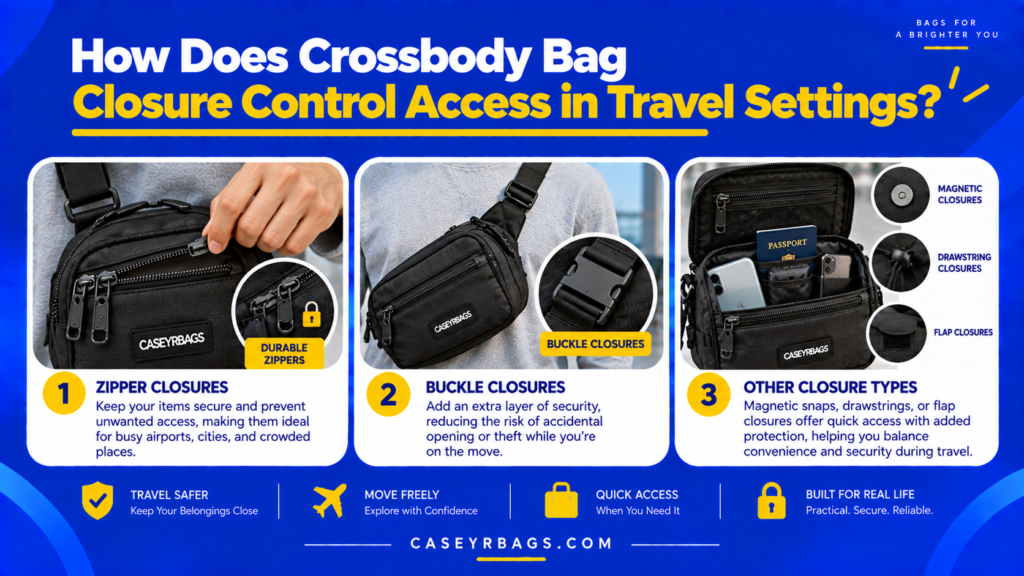
How Does Crossbody Bag Closure Control Access in Travel Settings?
A Crossbody Bag closure controls travel access by determining how deliberately the bag must be opened, how much of the compartment becomes exposed, and how quickly the user can retrieve an item. Zippers, flaps, snaps, magnets, and other closure systems create different balances between retention and retrieval speed.
Travel use adds repeated movement, seated transitions, short retrieval tasks, and changing access frequency. The most effective closure system keeps important contents contained while allowing necessary items to be reached without fully opening or removing the bag each time. Closure control ≠ theft-proofing, and faster retrieval ≠ better access for every item.
What Does Closure-Controlled Access Mean in a Crossbody Bag?
Closure-controlled access means the user must intentionally operate a zipper, flap, snap, magnet, or similar mechanism before reaching the contents. The closure creates a boundary between carried items and the surrounding travel environment.
Different closures create different levels of opening effort and exposure. A full zipper can keep most of the main opening closed until deliberately opened, while a flap or lighter closure may allow faster access but expose the compartment differently.
Effective travel access does not require maximum closure complexity. Within the broader Crossbody Bag system, the useful closure matches access frequency and item importance while allowing the bag to return quickly to a controlled closed state.
Which Closure Types Most Directly Affect Crossbody Travel Access?
Zippers, flaps, snaps, magnetic closures, hook-and-loop systems where relevant, and open secondary pockets all change how much effort is required before contents become reachable. Each creates a different relationship among opening speed, containment, exposure, and reclosure.
Closure → opening effort → exposure level → travel consequence. A more complete closure can support stronger containment, while a lighter closure can support faster routine retrieval. The right role depends on the pocket and the frequency of access.
How Does a Closure Change the Access Sequence?
Every closure adds one or more actions between reaching the bag and retrieving an item. The typical path is reach bag → locate closure → open → retrieve → close → return to carry, with each added step affecting speed and handling.
A useful closure keeps those steps predictable. More steps can be appropriate when stronger containment matters, but unnecessary steps can create repeated repositioning or encourage the user to leave a compartment partly open during movement.
Why Does Stronger Closure Not Automatically Mean Better Travel Access?
Stronger or more layered closures can slow retrieval, require two-handed operation, become awkward while seated, or force more bag repositioning. Those effects can reduce travel usability even when containment is high.
Travel closure quality depends on appropriate control, not maximum resistance. The strongest closure is useful only when the access role and contents justify the extra effort without creating avoidable friction.
How Do Different Closure Types Change Travel Access?
Common Crossbody closures differ mainly in how much of the opening they control, how quickly they can be operated, and how directly they return to a closed state.
How Does a Zipper Control the Main Opening?
A fully closed zipper contains the opening; partial opening creates a narrower access window; full opening exposes more of the compartment. This lets the user vary how much of the main space becomes reachable at one time.
Full zipper → deliberate opening → greater opening control. Partly opened zipper → narrower access window → reduced compartment exposure. That flexibility is useful, but a zipper is not automatically the best closure for every pocket or access frequency.
How Does a Flap Change Access Behavior?
A flap creates staged access because the covering layer must be moved before a secondary closure or compartment becomes reachable. It can provide opening coverage and visual shielding while adding another action to the retrieval sequence.
Lift flap → expose secondary closure or compartment → retrieve. The added step can be useful where coverage matters, but repeated routine access can become slower if the flap must be managed every time.
How Do Snaps or Magnetic Closures Change Retrieval Speed?
Snaps and magnetic closures can support quick opening and fast reclosure with relatively little manipulation. They can work well for routine-access zones when a lighter level of containment is acceptable.
Snap or magnet → fast open/reclose → different retention level from a fully zipped compartment. They should not be labeled universally weak; their suitability depends on the pocket role, contents, alignment, and travel use.
| Closure Type | Access Speed | Opening Control | Typical Trade-Off |
|---|---|---|---|
| Full zipper | Moderate | High | More deliberate opening |
| Flap | Moderate | Medium–high | Additional access step |
| Snap | Fast | Moderate | Partial opening control |
| Magnet | Fast | Moderate | Retention depends on design |
| Open pocket | Very fast | Low | Greater exposure |
How Does Opening Orientation Affect Travel Access Control?
Closure type alone does not determine access control because the direction the opening faces can change containment, exposure, and how much repositioning is needed.
How Does an Upward-Facing Opening Affect Item Containment?
An opening that remains upward can keep contents supported by the compartment geometry while the bag is accessed. This can reduce accidental spill potential compared with an opening that rotates downward or outward during use.
Upward opening → controlled vertical access. The benefit depends on the bag staying reasonably oriented during retrieval; a tilted or rotating bag can change the effective opening direction even when the zipper path itself is unchanged.
How Does a Body-Facing Opening Change Access Exposure?
A body-facing opening stays closer to the wearer and can reduce direct outward exposure during access. It may also require deliberate repositioning so the user can see or reach the zipper path comfortably.
Body-facing opening → more shielded orientation → controlled exposure potential. This does not guarantee security or theft prevention because closure operation, user behavior, load, and bag position still matter.
When Can an Outward-Facing Opening Create Access Problems?
Problems can appear when the bag rotates outward, the compartment opens widely, contents become more externally exposed, or movement continues during retrieval. The opening may remain mechanically functional while becoming harder to control.
Closure effectiveness depends partly on which direction the opening faces when used. If repeated travel movement exposes too much of the compartment, Secondary Fastening becomes a separate threshold question only after normal closure behavior has been understood.
How Does Body-Facing Carry Work With the Closure System?
Carry position determines where the closure sits relative to the hands and body, while the closure itself determines how the compartment opens once the bag is in position.
How Does Front-Side Carry Change Closure Reach?
A front-side position can place the closure within direct hand reach and make its location easier to see, often reducing the amount of bag rotation required before opening. The benefit depends on bag size and closure placement.
Front-side carry → shorter reach path → potentially simpler closure operation. The position can support access control, but it does not replace the closure or guarantee that the opening remains contained.
How Does Side or Hip Carry Change the Opening Sequence?
A side or hip position usually requires the bag to rotate forward before the user operates the closure. After retrieval, the compartment should be closed before the bag returns to the normal resting zone.
Side carry → rotate bag forward → operate closure → retrieve → close → return. A useful closure remains manageable through that repositioning path without binding, flipping, or forcing full bag removal.
Why Does Body-Facing Carry Not Replace a Closure?
Body position controls where the bag sits, while the closure controls whether and how the compartment opens. These are related but distinct parts of access control.
Position and closure solve different parts of access control. A body-facing bag with an uncontrolled opening can still expose contents unnecessarily, while a strong closure on an unstable bag can still be difficult to operate.
| Carry Position | Closure Reach | Repositioning Need | Exposure Control |
|---|---|---|---|
| Front | Direct | Low | High visibility/control |
| Front-side | Easy | Low to moderate | Balanced |
| Side/hip | Indirect | Moderate | Depends on forward rotation |
| Rearward side | Reduced visibility | Higher | Requires more deliberate repositioning |
How Does Travel Movement Change Closure Requirements?
Walking, seated use, and repeated travel transitions change closure demands because the bag moves through different access states while still needing predictable containment and reset.
What Closure Behavior Matters While Walking?
During walking, the main requirement is a reliable closed state with controlled zipper position, limited accidental opening, and flaps that do not move excessively. The closure should remain predictable while the bag experiences normal motion.
Walking adds repeated movement without constant retrieval. The closure therefore needs to stay closed until intentionally operated rather than requiring constant visual or manual correction.
What Closure Behavior Matters While Seated or in Transit?
Seated use favors manageable opening width, direct access without unnecessary full removal, easy reclosure, and limited spill potential. A closure that works while standing may behave differently when space or movement is restricted.
Seated access should be tested because body position changes the bag angle and the hand path to the opening. The useful closure remains operable without forcing the compartment wider than necessary.
What Closure Behavior Matters During Repeated Transitions?
Entering transport, leaving transport, moving between waiting and walking, and making short stops create repeated closure cycles. Each cycle rewards a system that can open, retrieve, and reset consistently.
Frequent travel transitions favor closures that can be opened and reset predictably. Reset reliability matters because a closure that is inconvenient to reclose can be left partially open during later movement.
| Travel Context | Access Frequency | Closure Need | Reset Importance |
|---|---|---|---|
| Walking | Low to occasional | Reliable closed state | High |
| Seated/in transit | Moderate | Controlled opening width | High |
| Repeated transitions | Frequent cycles | Predictable open/reclose | Very high |
| Short stops | Brief retrieval | Fast but controlled access | High |
How Should Crossbody Bag Pockets Use Different Closure Levels?
Pocket hierarchy should match closure strength to access frequency and item importance so routine retrieval does not force repeated opening of the main compartment.
Which Items Need the Strongest Access Control?
Items that are important, difficult to replace, rarely retrieved, or easy to lose generally benefit from more controlled internal storage. The key characteristics are access frequency and consequence, not one mandatory item list.
Lower-frequency important contents → stronger containment role. These items can tolerate slower retrieval because they do not need repeated access, allowing the main or protected storage zone to prioritize closure control.
Which Items Can Use Faster-Access Closures?
Frequently retrieved, low-bulk items with low consequence if briefly exposed can use faster-access zones where the closure is lighter or simpler. This reduces the need to open the main compartment for every routine task.
Quick-access zone → lighter closure → faster routine retrieval. The pocket should still match the contents and should not be overloaded until its opening or alignment becomes difficult to control.
Why Should One Pocket Not Handle Every Access Need?
Using the main compartment for every small routine item creates repeated full opening, exposes unrelated contents, slows retrieval, and disturbs organization. One pocket then performs conflicting roles.
Closure hierarchy should match access hierarchy. Separate quick access, routine controlled access, and main protected storage so each zone can use an appropriate level of closure.
How Does Closure Placement Affect One-Handed Travel Access?
Closure geometry can support simple controlled retrieval while the bag remains worn, but one-handed operation is a possible convenience rather than a universal design requirement.
When Can a Zipper Be Operated While the Bag Remains Worn?
Zipper orientation, pull size, bag stability, body position, and opening tension determine whether the zipper can be moved while the bag remains on the body. A stable front-side position often reduces the amount of support needed from the second hand.
One-handed operation is easiest when the bag resists rotation and the zipper path is clear. It should not be treated as mandatory if two-handed control produces a more predictable opening without requiring removal.
When Does Closure Operation Require Two Hands?
A flexible bag body, stiff zipper path, secondary flap, large opening, or rotating bag can require one hand to stabilize the body while the other operates the closure. This can still be functional travel access.
Two-handed use is not automatically poor design. The problem appears only when closure operation causes repeated removal, excessive repositioning, or loss of opening control during routine travel use.
Why Does Bag Stability Matter During Closure Operation?
A stable bag body gives the closure a fixed path to move against, making opening and reclosure more predictable. A swinging or rotating bag changes the geometry while the user is trying to operate the closure.
Stable bag body → easier closure control; swinging bag → harder opening and reclosure. Access control therefore depends on bag stability as well as closure design.
How Should Access Speed & Closure Retention Be Balanced?
Travel access works best when fast retrieval is reserved for frequent-use zones while stronger closure control is used where containment matters more than speed.
When Is Faster Access the Higher Priority?
Faster access becomes more useful for repeated short retrieval, frequently used small items, and travel situations where brief opening can be controlled without exposing unrelated contents. The goal is to reduce repetitive handling.
Fast access should remain role-specific. Quick access ≠ appropriate access for every item, and a lighter closure should not be extended to contents that need stronger containment.
When Is Stronger Closure Control the Higher Priority?
Stronger closure control becomes more useful for infrequently accessed items, contents that should remain fully contained, and movement-heavy situations where accidental opening or wide exposure would be disruptive.
Greater containment can justify more deliberate access. The benefit concerns retention and exposure control, not theft-proofing or guaranteed security.
How Should the Final Closure Balance Be Chosen?
- Identify access frequency.
- Identify item importance.
- Determine acceptable exposure.
- Identify normal carry position.
- Test opening while standing.
- Test opening while seated.
- Close the compartment.
- Confirm the bag returns easily to travel carry.
Use the sequence in order so the decision starts with access frequency and item importance before exposure, carry position, and operation are judged. Standing and seated tests reveal whether the same closure remains practical across travel states.
Close the compartment and return the bag to travel carry before deciding the fit. A closure balance is successful only when retrieval and reset both remain predictable without unnecessary exposure or excessive friction.
When Does Closure Complexity Reduce Travel Usability?
Closure complexity becomes excessive when extra layers add repeated handling, bag removal, or difficult angles without providing meaningful containment for the actual access role.
When Do Multiple Closure Layers Become Excessive?
A flap + zipper + secondary fastener can be appropriate for some compartments, but repeated routine access may turn the same combination into unnecessary friction. Each added layer should solve a real containment or access problem.
More closure steps ≠ automatically more secure travel use. Complexity becomes excessive when the user repeatedly bypasses, leaves open, or struggles with layers that do not match the pocket’s access frequency.
How Can Closure Complexity Cause Unnecessary Bag Repositioning?
A difficult opening angle, need to remove the bag, repeated strap adjustment, or an obstructed zipper path can force the user to reposition the Crossbody more than the access task requires.
Poor closure geometry → more bag repositioning → slower retrieval and greater exposure. The problem may be caused by closure placement, bag position, or pocket zoning rather than closure strength alone.
When Should a Simpler Closure Be Preferred?
A simpler closure can be appropriate when access is frequent, the consequence of brief exposure is low, and the pocket already sits in a controlled body-facing zone. The closure can then prioritize predictable routine use.
Closure complexity should match actual access risk and frequency. Simpler does not mean uncontrolled; it means using only the level of closure needed for that pocket’s role.
How Can Closure-Related Travel Access Problems Be Diagnosed?
Access friction should be diagnosed across closure type, bag position, load, and pocket organization because the same symptom can come from more than one cause.
What Does Repeated Difficulty Opening the Bag Suggest?
Repeated opening difficulty can result from zipper orientation, bag instability, an overfilled compartment, a blocked closure path, or an awkward resting position. The closure itself may be functional while surrounding conditions make it hard to operate.
Diagnose the opening path before replacing the closure concept. Observe whether the bag rotates, whether contents press against the zipper, and whether the hand can reach the closure predictably in the normal carry position.
What Does Repeated Accidental Exposure Suggest?
Repeated accidental exposure can indicate incomplete closure, unsuitable pocket assignment, poor opening orientation, an overfilled compartment, or a retention level that does not match the contents.
The correction depends on the cause. A stronger closure may help in some cases, while better pocket zoning, full reclosure, or a more controlled opening direction may solve others.
What Does Repeated Main-Compartment Opening Suggest?
Repeated main-compartment access often suggests that routine items need a dedicated quick-access pocket, clearer pocket zoning, or a different closure level. The problem may be organizational rather than mechanical.
Access friction may be an organization problem rather than a closure problem. If small routine items repeatedly force full opening, the hierarchy between quick access and main storage should be reviewed.
How Should Crossbody Travel Closure Performance Be Evaluated?
Travel closure performance should be tested with the normal load, all compartments closed, and the bag worn through realistic walking, repositioning, retrieval, and reset steps.
What Should Be Checked Before Travel Use?
Inspect zipper operation, flap alignment, snaps or magnets, closure attachment, pocket assignment, and opening orientation before movement begins. These checks establish whether the closure system starts from a predictable mechanical condition.
Also verify that frequently accessed and low-frequency important contents are assigned to appropriate zones. Closure performance cannot be judged fairly if pocket roles are mismatched before the test begins.
What Should Be Tested While the Bag Is Worn?
Walk with every closure closed, reposition the bag forward, open the routine-access pocket, open the main compartment, and close both again. The test should reveal whether movement changes closure reach or opening control.
Observe standing and seated access where relevant, plus how quickly the bag returns to a closed state. A closure system that works only while the bag is removed does not fully represent on-body travel performance.
Which Sequence Should Determine Final Travel Access Fit?
- Load the bag normally.
- Close every compartment.
- Wear the bag in its normal resting position.
- Walk normally.
- Reposition it for access.
- Retrieve a frequent-use item.
- Reclose the pocket.
- Access the main compartment.
- Close it fully.
- Return the bag to its carry position.
- Adjust pocket assignments if routine access repeatedly exposes unnecessary contents.
Use the sequence in the listed order so the test begins with a fully closed, normally loaded bag and then follows the actual travel cycle through walking, repositioning, routine retrieval, main-compartment access, and closure reset.
Finish by returning the bag to its carry position and adjusting pocket assignments only if routine access repeatedly exposes unrelated contents. Do not collapse the process into a score; the result should remain an observed travel-fit judgment.
How Can Crossbody Closure Mismatches Be Avoided in Travel Settings?
Closure mismatches are avoided by preventing the strongest or fastest closure from becoming the universal answer and instead matching each access zone to frequency, containment need, and travel behavior.
Why Is Using the Strongest Closure Everywhere a Weak Strategy?
Using maximum closure strength for every pocket can slow retrieval, add unnecessary handling, weaken access hierarchy, and force repeated bag removal. Routine items then become harder to reach than their role requires.
Different travel items need different levels of access control. Strong closure should be reserved for compartments where the containment benefit justifies more deliberate opening.
Why Is Using Only Quick-Access Closures Also a Weak Strategy?
Using only fast, light closures can reduce containment, increase accidental opening, create unnecessary exposure, and blur the distinction between routine items and contents that should remain more controlled.
Quick access should remain a specific role rather than the default for the entire bag. A useful Crossbody combines faster zones with more controlled storage instead of forcing one closure level everywhere.
What Should Be Verified Before Relying on a Crossbody Closure System for Travel?
Verify that the main compartment has a deliberate closure, all closure attachments operate normally, opening orientation remains controlled while worn, frequently accessed items use appropriate zones, and important low-frequency items remain in more controlled compartments.
Also confirm that quick-access pockets are not overloaded, routine access does not require full removal where not intended, closures reset quickly, zippers are not left partly open, flaps remain controlled, snaps or magnets align, and body-facing carry is not treated as theft prevention.
- Main compartment has a deliberate closure.
- Main closure operates normally.
- Closure attachment remains secure.
- Opening orientation remains controlled while worn.
- Frequently accessed items have appropriate storage zones.
- Important low-frequency items are kept in more controlled compartments.
- Quick-access pockets are not overloaded.
- Open pockets are used only where their exposure level is acceptable.
- Bag does not need to be fully removed for routine access where on-body use is intended.
- Closure can be reset quickly after retrieval.
- Zippers are not routinely left partly open during movement.
- Flaps remain controlled during walking.
- Snaps or magnets align and close correctly.
- Main-compartment access does not unnecessarily expose every item.
- Closure complexity matches actual access frequency.
- Body-facing position is not treated as theft prevention.
- Strong closure is not treated as guaranteed security.
- Travel access is evaluated through both retention and retrieval speed.
Conclusion
Crossbody Bag closures control access in travel settings by determining how deliberately each compartment opens, how much of the contents become exposed, and how quickly the bag can return to a closed state after retrieval. Zippers, flaps, snaps, magnets, opening orientation, and pocket hierarchy can therefore create different access levels within the same bag.
The strongest travel system does not use maximum closure everywhere. It matches containment to item importance and retrieval frequency, keeps openings predictable while walking or seated, and supports quick closure reset after use. A Crossbody Bag controls travel access most effectively when fast access is available where useful, stronger containment is used where needed, and unnecessary exposure of the rest of the bag is minimized.
FAQs
Zippers provide strong opening control for many main compartments because they allow deliberate access and variable opening width.
The best closure still depends on access frequency, bag orientation, and whether faster secondary access is useful. A zipper is not universally best for every pocket.
Magnetic closures can provide convenient retention for some pockets and support quick opening plus quick reclosure during routine use.
They provide a different level of opening control from a full zipper, so suitability depends on the contents and access role. Magnetic closure ≠ guaranteed security.
No. Placing every item in the main compartment can create unnecessary repeated opening and expose unrelated contents during small routine retrieval tasks.
A clear hierarchy of quick-access and more controlled storage zones can provide better travel access management while keeping the main compartment reserved for items needing stronger containment.