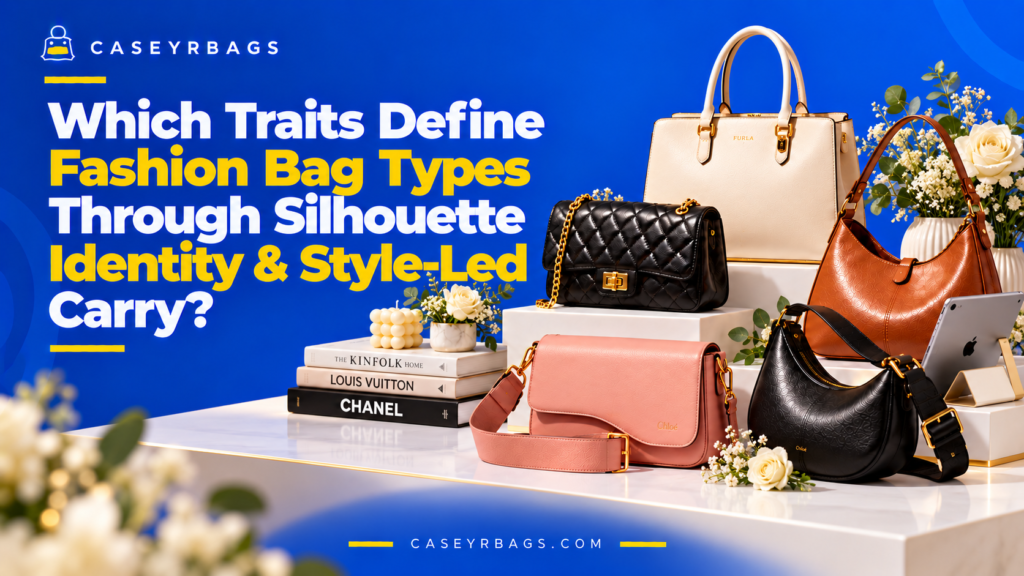
Which Traits Define Fashion Bag Types Through Silhouette Identity & Style-Led Carry?
Fashion Bag Types are primarily defined by recurring combinations of silhouette, proportion, structure, handle or strap geometry, opening shape, and carry position. These traits create recognizable visual forms such as compact horizontal bags, curved shoulder forms, drawstring-based bodies, rigid top-handle structures, or soft slouching shapes even when materials and decoration vary.
Style-led carry adds another layer of identity because the way a bag sits in the hand, on the shoulder, under the arm, across the torso, or against the body can become part of the type’s recognizable presentation. Fashion Bag Type identity therefore comes from the interaction between visual form and carry behavior rather than from trend, ornament, or one isolated feature.
What Defines Silhouette Identity & Style-Led Carry in Fashion Bag Types?
Silhouette identity is the recognizable external form created by the relationship between the bag’s width, height, depth, curvature, structural firmness, opening, and base. A Fashion Bag Type becomes visually recognizable when these characteristics recur strongly enough to distinguish it from neighboring forms.
Style-led carry describes how the handle or strap system places that silhouette in relation to the body. Hand carry, elbow carry, shoulder carry, underarm positioning, and cross-body placement can each change how the bag is presented and can reinforce or weaken the visual identity created by the body itself.
These two systems work together because the bag is rarely experienced as an isolated object. Its shape, proportions, and structure interact with its worn or held position, creating a combined object silhouette + body relationship that helps establish category identity. For the complete category framework, return to the Bag Types Hub.
Which traits most strongly create silhouette identity?
Relevant evidence includes width-to-height proportion, depth, curvature, base shape, structural firmness, and opening shape. This shows how each changes the visible outline or controls whether that outline persists. The normal loaded and carried form is the stronger reference whenever soft panels, strap tension, or body contact can alter the empty display shape.
For each major trait use Trait → visual form → type-recognition effect. Silhouette identity is produced by the recurring relationship among these attributes rather than one isolated measurement. When several cues agree, type recognition becomes more stable; when they conflict, the bag should be treated as conditional or hybrid rather than forced into a one-trait label.
Which traits most strongly create style-led carry?
Relevant evidence includes handle drop, strap length, strap-anchor position, carry position, and bag orientation against the body. This shows how these determine where the silhouette appears relative to the wearer. The useful test is whether the trait changes the dominant outline, the bag’s relationship to the body, or the way the opening and carry system behave in normal use.
Style-led carry is not merely decorative. The same handle/strap geometry also performs suspension, movement-control, access-orientation, and body-contact functions. The normal loaded and carried form is the stronger reference whenever soft panels, strap tension, or body contact can alter the empty display shape.
Why should silhouette and carry be evaluated together?
The useful relationship is Body form + carry geometry → recognizable presentation. This shows how the object silhouette and body relationship are experienced simultaneously in normal use. When several cues agree, type recognition becomes more stable; when they conflict, the bag should be treated as conditional or hybrid rather than forced into a one-trait label.
The governing boundary is Fashion Bag Type identity usually emerges from a feature combination rather than one isolated characteristic. The useful test is whether the trait changes the dominant outline, the bag’s relationship to the body, or the way the opening and carry system behave in normal use.
How Does Silhouette Create Fashion Bag Type Identity?
This matters because the outer outline often provides the fastest visual classification cue. The section tests this cue as part of the combined structural-and-carry pattern rather than as a standalone label.
Which silhouette families commonly create strong identity?
Rectangular, crescent, bucket-like, trapezoidal, rounded, and elongated-horizontal bodies create different dominant outlines. Direction, curvature, and base geometry should be read together because they determine the strongest first visual cue. The Moon Bag shows how a semicircular outline can strengthen shape recognition.
These forms are shape families rather than universal type names. Similar silhouettes can occur across different Fashion Bag Types, so structure and carry geometry must confirm the classification. The Canteen Bag provides a circular example where geometry remains the primary recognition cue. Recognition becomes stronger when the same shape relationship persists after loading.
Why can similar construction produce different type identities?
Curvature, width, taper, base shape, and height can alter the dominant outline even when two bags use similar materials or construction methods. Those geometric differences can shift recognition because the eye reads the external form before surface styling. The Crescent Bag illustrates this effect through curved body geometry.
Small geometric changes matter only when they materially change the recurring silhouette. Classification should therefore compare proportion, structural firmness, opening architecture, and carry system instead of relying on one visual detail. The strongest identity remains the pattern that persists in normal loaded and carried use.
Why is silhouette not fixed by empty appearance alone?
Soft and semi-structured bags may sag, expand, curve, or change their lower outline after normal contents are added. That loaded response can become part of the recurring identity, so empty display shape alone is not enough. The Barrel Bag offers a cylindrical example where loaded form still matters.
The governing boundary is Empty silhouette ≠ loaded silhouette. Classification should account for the normal-use form and ask whether proportion, structure, opening, and carry geometry remain recognizable after loading. A temporary showroom outline should not outweigh the silhouette the bag repeatedly produces in use.
Linear identity
Softened identity
Vertical gathered identity
Width-dominant identity
Boundary: one silhouette does not equal one universal bag name.
How Do Proportions Distinguish Fashion Bag Types?
This shows how width, height, and depth relationships change visual classification. The section tests this cue as part of the combined structural-and-carry pattern rather than as a standalone label.
How does width-to-height ratio affect identity?
Width-dominant bodies may appear elongated, underarm-oriented, or visually horizontal, while height-dominant bodies can appear vertical, pouch-like, or bucket-like depending on other structural traits. For classification, this evidence should be read with proportion, structural firmness, opening architecture, and the primary carry system rather than in isolation.
Width-to-height relationship supplies visual direction rather than a complete category. Structure, opening form, and carry geometry must still confirm classification. A recurring structural cue deserves more weight than temporary color, branding, ornament, or trend styling because those surface variables can change without changing the base type. The East-West Bag is a clear width-dominant example. The East-West Bag is a direct example of width-dominant proportion.
How does depth affect the perceived silhouette?
This shows how greater depth creates a stronger side profile, more three-dimensional volume, and potentially a boxier form. A recurring structural cue deserves more weight than temporary color, branding, ornament, or trend styling because those surface variables can change without changing the base type.
Contrast shallow depth, which creates a flatter presentation and may reinforce horizontal or body-adjacent visual identity. The normal loaded and carried form is the stronger reference whenever soft panels, strap tension, or body contact can alter the empty display shape. A recurring structural cue deserves more weight than temporary color, branding, ornament, or trend styling because those surface variables can change without changing the base type.
Why should proportions be evaluated as relationships?
The governing boundary is Absolute size ≠ silhouette proportion. The normal loaded and carried form is the stronger reference whenever soft panels, strap tension, or body contact can alter the empty display shape. When several cues agree, type recognition becomes more stable; when they conflict, the bag should be treated as conditional or hybrid rather than forced into a one-trait label.
Mini and large versions can preserve the same structural proportion and therefore maintain related type identity despite different absolute dimensions. The useful test is whether the trait changes the dominant outline, the bag’s relationship to the body, or the way the opening and carry system behave in normal use.
| Proportion Pattern | Visual Effect |
|---|---|
| Wide + shallow | Horizontal / elongated |
| Tall + narrow | Vertical |
| Wide + deep | Box-like |
| Rounded + moderate depth | Soft dimensional |
| Tapered | Directional silhouette |
How Does Structural Firmness Affect Fashion Bag Identity?
This shows how rigid, semi-structured, and soft construction control silhouette persistence. The section tests this cue as part of the combined structural-and-carry pattern rather than as a standalone label.
How does structured construction preserve form?
This shows how defined edges, stable bases, supported openings, and limited panel collapse help preserve repeatable geometry both empty and loaded. The useful test is whether the trait changes the dominant outline, the bag’s relationship to the body, or the way the opening and carry system behave in normal use.
Connect shape persistence to recognition: when structure controls the body, classification becomes less dependent on item placement. When several cues agree, type recognition becomes more stable; when they conflict, the bag should be treated as conditional or hybrid rather than forced into a one-trait label. A Box Bag illustrates strong shape persistence. The Box Bag demonstrates how rigid form can preserve silhouette.
How does soft construction create identity?
Slouch, drape, body conformity, and load-responsive curvature as structural behaviors rather than defects. When several cues agree, type recognition becomes more stable; when they conflict, the bag should be treated as conditional or hybrid rather than forced into a one-trait label.
This shows how repeatable softness can itself become type identity when the bag consistently produces a recognizable hanging or worn form. This keeps the classification structural and repeatable across materials, finishes, scales, and styling contexts. The normal loaded and carried form is the stronger reference whenever soft panels, strap tension, or body contact can alter the empty display shape. A Slouchy Bag illustrates repeatable load-responsive softness. The Slouchy Bag shows how repeatable softness can become identity.
Why should structure not be equated with formality?
The governing boundary is Structured construction ≠ automatically formal and Soft construction ≠ automatically casual. This keeps the classification structural and repeatable across materials, finishes, scales, and styling contexts. A recurring structural cue deserves more weight than temporary color, branding, ornament, or trend styling because those surface variables can change without changing the base type.
Structure describes form control; formality or casual styling is a separate context influenced by finish, decoration, material, and use. For classification, this evidence should be read with proportion, structural firmness, opening architecture, and the primary carry system rather than in isolation.
Strong shape persistence
Controlled flexibility
Load-responsive form
How Does Body Geometry Distinguish Neighboring Fashion Bag Types?
This shows how panel shape and curvature create identity beyond basic dimensions. The section tests this cue as part of the combined structural-and-carry pattern rather than as a standalone label.
How do curved panels affect the silhouette?
Curved panels soften corners, create crescent-like bodies, alter upper-edge direction, and shift the dominant visual line. These effects should be read with proportion and structural firmness because curvature matters most when it persists as part of the body architecture. The Hobo Bag shows how curved slouch can become a structural cue.
Curvature can separate bags with similar width, height, and depth when their outer outlines remain structurally different. The Bowling Bag provides a contrasting domed example, showing why neighboring types should be compared through recurring geometry rather than decoration or trend styling.
How do gussets and side panels affect identity?
Gussets and defined side panels create depth, preserve side shape, and produce box-like or expandable volumes. These components affect silhouette and capacity behavior directly rather than functioning as hidden construction details. The Accordion Handbag-Style Bag demonstrates how gusset-led expansion can become part of visible type identity.
Side architecture should be evaluated in the normal loaded state because depth, panel tension, and opening behavior can change once contents are added. When gussets consistently control expansion and side profile, they become stronger classification evidence than temporary surface styling or ornament.
Why does panel geometry matter more than decoration?
Panel geometry creates structural identity; decoration modifies appearance. Curves, flares, seams, gussets, and panel boundaries remain meaningful even when color, print, branding, or hardware finishes change. The Trapeze Bag shows how flared geometry can distinguish a neighboring form without depending on decoration.
A useful test is to mentally remove surface styling and ask whether the body remains structurally distinctive. If the outline, proportion, opening, and carry relationship still point to the same family, panel geometry is doing the classification work rather than trend or ornament.
How Do Handles Define Style-Led Carry?
This shows how handle geometry determines both carry method and visual presentation. The section tests this cue as part of the combined structural-and-carry pattern rather than as a standalone label.
How do short handles affect bag presentation?
This shows how short handles may support hand, wrist, or elbow carry depending on usable opening and handle drop. The useful test is whether the trait changes the dominant outline, the bag’s relationship to the body, or the way the opening and carry system behave in normal use.
This shows how these positions keep the bag relatively separate from the torso, allowing the body silhouette and handle geometry to remain visually prominent. A recurring structural cue deserves more weight than temporary color, branding, ornament, or trend styling because those surface variables can change without changing the base type. The Top-Handle Handbag-Style Bag shows how short-handle carry can reinforce presentation.
How does handle placement affect silhouette?
This shows how handles can reinforce symmetry, pull upper edges inward, create vertical visual lines, or influence top-edge resting geometry. When several cues agree, type recognition becomes more stable; when they conflict, the bag should be treated as conditional or hybrid rather than forced into a one-trait label.
This matters because handle placement can become a recognition cue even before the bag is carried. This keeps the classification structural and repeatable across materials, finishes, scales, and styling contexts. The normal loaded and carried form is the stronger reference whenever soft panels, strap tension, or body contact can alter the empty display shape. The Bracelet Bag shows how ring-handle geometry can become a dominant carry cue.
Why can handle length not identify the type alone?
The governing boundary is Handle drop ≠ complete bag-type identity. This keeps the classification structural and repeatable across materials, finishes, scales, and styling contexts. A recurring structural cue deserves more weight than temporary color, branding, ornament, or trend styling because those surface variables can change without changing the base type.
Body geometry, opening architecture, structure, and loaded presentation must confirm the type. For classification, this evidence should be read with proportion, structural firmness, opening architecture, and the primary carry system rather than in isolation. The useful test is whether the trait changes the dominant outline, the bag’s relationship to the body, or the way the opening and carry system behave in normal use.
How Do Shoulder Straps Affect Fashion Bag Type Identity?
This shows how strap length and attachment geometry change where the silhouette sits against the body. The section tests this cue as part of the combined structural-and-carry pattern rather than as a standalone label.
How does a short shoulder strap affect positioning?
Shorter shoulder straps raise the bag toward the torso or underarm and increase body contact. This changes the silhouette-body relationship, exposing more of the upper edge and side profile while reducing the distance between bag and wearer. The effect should be read with body geometry and strap-anchor placement.
A higher position can become a recurring recognition cue, but it is not sufficient by itself. The Satchel Bag shows how strap geometry works with a distinct structural body, illustrating why carry position must reinforce rather than replace type identity.
How does a longer strap change presentation?
Longer straps can lower the bag toward the hip, increase movement, and sometimes enable cross-body use. That lower placement changes worn presentation and may expose different parts of the silhouette, yet the underlying structural family can remain the same when body geometry and opening architecture are unchanged.
The Pochette Bag shows how a longer convertible strap can alter worn presentation without becoming the entire classification. Strap length should therefore be evaluated with anchor location, depth, body orientation, and the normal loaded silhouette rather than treated as a standalone label.
Why is strap length only part of the identity?
Anchor location, body width, depth, and bag orientation interact with strap length. The normal loaded and carried form is the stronger reference whenever soft panels, strap tension, or body contact can alter the empty display shape. When several cues agree, type recognition becomes more stable; when they conflict, the bag should be treated as conditional or hybrid rather than forced into a one-trait label.
The governing boundary is Longer strap ≠ automatically different bag type. The useful test is whether the trait changes the dominant outline, the bag’s relationship to the body, or the way the opening and carry system behave in normal use.
How Does Carry Position Contribute to Style Identity?
This shows how hand, elbow, shoulder, underarm, and cross-body positions change the presentation of the same bag form. The section tests this cue as part of the combined structural-and-carry pattern rather than as a standalone label.
How can hand or elbow carry emphasize silhouette?
This shows how the bag remains relatively separate from the torso, making body shape, handle geometry, base form, and opening line easier to see. This keeps the classification structural and repeatable across materials, finishes, scales, and styling contexts. The useful test is whether the trait changes the dominant outline, the bag’s relationship to the body, or the way the opening and carry system behave in normal use.
This matters because this can strengthen type recognition when object-level structural traits are already distinctive. When several cues agree, type recognition becomes more stable; when they conflict, the bag should be treated as conditional or hybrid rather than forced into a one-trait label.
How can shoulder or underarm carry change the silhouette-body relationship?
This shows how the bag may sit closer to the torso, expose more side profile, compress its upper edge, or change resting curvature. When several cues agree, type recognition becomes more stable; when they conflict, the bag should be treated as conditional or hybrid rather than forced into a one-trait label.
This matters because carried appearance can differ from isolated display appearance without changing base architecture. This keeps the classification structural and repeatable across materials, finishes, scales, and styling contexts. The normal loaded and carried form is the stronger reference whenever soft panels, strap tension, or body contact can alter the empty display shape. The Baguette Bag is a clear example of compact underarm positioning.
Why does carry position not define the type alone?
The governing boundary is Carry position ≠ complete bag-type identity. This keeps the classification structural and repeatable across materials, finishes, scales, and styling contexts. A recurring structural cue deserves more weight than temporary color, branding, ornament, or trend styling because those surface variables can change without changing the base type.
The same bag may support multiple carry modes without changing its underlying structural family. For classification, this evidence should be read with proportion, structural firmness, opening architecture, and the primary carry system rather than in isolation. The useful test is whether the trait changes the dominant outline, the bag’s relationship to the body, or the way the opening and carry system behave in normal use.
| Carry Position | Visual Relationship |
|---|---|
| Hand | Silhouette remains visually isolated |
| Elbow | Bag hangs below the arm |
| Shoulder | Torso-adjacent presentation |
| Underarm | High body-facing position |
| Cross-Body | Diagonal strap + opposite-side placement |
How Does Opening Shape Reinforce Fashion Bag Identity?
This shows how the upper opening contributes to both silhouette and access character. The section tests this cue as part of the combined structural-and-carry pattern rather than as a standalone label.
How can open, framed, zippered, or gathered openings alter form?
This shows how open tops preserve broad upper lines, frames create rigid top geometry, zippers pull panels together, and drawstrings contract the upper body. The normal loaded and carried form is the stronger reference whenever soft panels, strap tension, or body contact can alter the empty display shape.
Connect each mechanism to silhouette rather than treating opening style as access-only architecture. A recurring structural cue deserves more weight than temporary color, branding, ornament, or trend styling because those surface variables can change without changing the base type. For classification, this evidence should be read with proportion, structural firmness, opening architecture, and the primary carry system rather than in isolation. The Bucket Bag shows how a gathered opening can reinforce silhouette.
How does opening orientation affect presentation?
Horizontal, curved, framed, and gathered openings can repeat or reinforce the dominant body direction. Opening orientation becomes especially important when the upper edge is a strong visual cue, because it can strengthen linear, curved, rigid, or contracted silhouette behavior across the top of the bag.
The Doctor Bag shows how a rigid framed opening can become a strong recognition cue. Even then, the opening should be read with proportion, body structure, and carry geometry so one access feature does not replace the complete type pattern.
Why is opening style not enough to determine bag type?
Closure/opening mechanism ≠ complete structural identity. Zippers, frames, open tops, and drawstrings appear across multiple Fashion Bag families, so the mechanism must be interpreted together with silhouette, proportion, structural firmness, and body geometry rather than used as an independent type label.
The Frame Bag demonstrates why opening architecture must be read with body structure. A framed opening can reinforce identity strongly, but classification remains reliable only when the rest of the bag supports the same structural-and-carry pattern. The opening is supporting evidence, not a substitute for body geometry.
How Does Closure Placement Affect Style-Led Carry?
This shows how closures become visible structural cues without becoming the sole category determinant. The section tests this cue as part of the combined structural-and-carry pattern rather than as a standalone label.
When does closure placement strongly affect identity?
Central flaps, top frames, visible drawstrings, and turn-lock positions can become strong visual cues when they visibly interact with the body. The Saddle Bag shows how flap placement can reinforce a tapered silhouette rather than function as decoration alone.
Closure placement matters most when it reinforces body geometry and opening shape. The Kelly Bag shows how a turn-lock supports an already rigid top-handle identity, demonstrating that the closure strengthens a larger structural pattern instead of defining the type by itself. Its value increases when the same cue remains visible during normal carry.
How can closure hardware affect visual balance?
Closure hardware can create focal points, reinforce symmetry, and add structural emphasis when it changes how the opening or panels behave. The Birkin Bag shows how closure layout interacts with double-handle structure rather than operating as an isolated decorative cue.
Visual reinforcement should not replace category evidence. The Flap Bag demonstrates a closure-led cue that still depends on the complete body pattern. Silhouette, proportion, opening geometry, and carry system must continue to support the same classification. Structural relevance depends on whether that hardware changes opening or carry behavior.
Why should hardware not dominate classification?
Visible closure hardware ≠ bag-type identity by itself. Hardware can be visually dominant without changing the underlying family, so classification should first establish silhouette, proportion, structural firmness, opening architecture, and primary carry geometry before treating the closure as supporting evidence.
The Knot Bag shows how interlocking handles can create closure without separate hardware. This reinforces the broader rule that a closure mechanism is most useful for classification when it materially interacts with body and carry geometry rather than merely attracting attention. Decorative prominence alone should never outweigh the dominant structural pattern.
How Does Hardware Reinforce Fashion Bag Type Identity?
Distinguish functional structural hardware from purely decorative detailing. The section tests this cue as part of the combined structural-and-carry pattern rather than as a standalone label.
Which hardware elements can affect structure?
Relevant evidence includes rings, buckles, strap attachments, frames, and closure plates where they materially affect suspension, opening, closure, or panel relationships. For classification, this evidence should be read with proportion, structural firmness, opening architecture, and the primary carry system rather than in isolation.
Hardware becomes classification-relevant when removing it would materially alter structural or carry geometry. A recurring structural cue deserves more weight than temporary color, branding, ornament, or trend styling because those surface variables can change without changing the base type. For classification, this evidence should be read with proportion, structural firmness, opening architecture, and the primary carry system rather than in isolation.
How can decorative hardware alter perception without changing type?
Visual emphasis, ornamentation, shine, contrast, and focal detailing. A recurring structural cue deserves more weight than temporary color, branding, ornament, or trend styling because those surface variables can change without changing the base type. The useful test is whether the trait changes the dominant outline, the bag’s relationship to the body, or the way the opening and carry system behave in normal use.
These features may strongly alter aesthetic presentation while leaving core silhouette and structural architecture unchanged. The normal loaded and carried form is the stronger reference whenever soft panels, strap tension, or body contact can alter the empty display shape.
What distinction should be maintained?
The governing rule is Structural hardware affects carry or closure geometry; decorative hardware affects appearance without necessarily changing bag type. The normal loaded and carried form is the stronger reference whenever soft panels, strap tension, or body contact can alter the empty display shape.
Apply this distinction whenever hardware appears visually dominant. The useful test is whether the trait changes the dominant outline, the bag’s relationship to the body, or the way the opening and carry system behave in normal use. For classification, this evidence should be read with proportion, structural firmness, opening architecture, and the primary carry system rather than in isolation.
How Do Materials & Surface Treatments Affect Silhouette Recognition?
This shows how material behavior modifies structural form without replacing it. The section tests this cue as part of the combined structural-and-carry pattern rather than as a standalone label.
How can material stiffness reinforce silhouette?
This shows how stiffer materials sharpen edges, stabilize walls, retain the top line, and strengthen panel geometry. The useful test is whether the trait changes the dominant outline, the bag’s relationship to the body, or the way the opening and carry system behave in normal use.
Material stiffness reinforces an existing structural pattern rather than independently becoming the bag type. When several cues agree, type recognition becomes more stable; when they conflict, the bag should be treated as conditional or hybrid rather than forced into a one-trait label. The Ruffle Handbag-Style Bag shows how surface treatment can modify presentation without replacing structure.
How can soft materials alter the same pattern?
Soft materials can introduce drape, collapse, softened corners, and rounded loaded form while leaving the underlying structural family recognizable. Material response matters because it changes how sharply the same panel geometry appears, especially after loading, but it does not automatically create a new bag type.
The Bermuda Bag shows how material and frame systems can modify an established silhouette. Classification should therefore separate surface and stiffness effects from the recurring proportion, opening, panel geometry, and carry architecture that define the base type. Loaded behavior should confirm whether the material merely modifies or actually changes form.
Why does material alone not define the type?
The governing boundary is Material identity ≠ structural bag-type identity. This keeps the classification structural and repeatable across materials, finishes, scales, and styling contexts. A recurring structural cue deserves more weight than temporary color, branding, ornament, or trend styling because those surface variables can change without changing the base type.
The same structural family can exist in multiple materials when proportion, silhouette, opening, and carry architecture remain identifiable. For classification, this evidence should be read with proportion, structural firmness, opening architecture, and the primary carry system rather than in isolation.
How Does Bag Scale Affect Fashion Type Identity?
This shows how mini, compact, medium, or oversized scale modifies presentation without always creating a new type. The section tests this cue as part of the combined structural-and-carry pattern rather than as a standalone label.
How can smaller scale change carry behavior?
Smaller scale often shifts the bag toward hand-dominant carry and a reduced storage role while making handles, closure hardware, and upper-body geometry more visually prominent. Because less body area is available to communicate form, these concentrated details can contribute more strongly to recognition.
Scale still modifies presentation rather than automatically replacing the underlying type. Compare the smaller version with its full-size structural pattern, then confirm that proportion, opening architecture, handle or strap geometry, and loaded form remain related before treating size as evidence of a new category.
How can larger scale change presentation?
Greater body interaction, more visible depth, and stronger functional-storage influence. A recurring structural cue deserves more weight than temporary color, branding, ornament, or trend styling because those surface variables can change without changing the base type. The useful test is whether the trait changes the dominant outline, the bag’s relationship to the body, or the way the opening and carry system behave in normal use.
Scale can materially change worn behavior while the underlying geometry remains related. The normal loaded and carried form is the stronger reference whenever soft panels, strap tension, or body contact can alter the empty display shape. This keeps the classification structural and repeatable across materials, finishes, scales, and styling contexts.
When does scale create actual category drift?
Meaningful drift occurs when scale materially alters silhouette, carry method, opening behavior, or normal load role. The normal loaded and carried form is the stronger reference whenever soft panels, strap tension, or body contact can alter the empty display shape.
The governing boundary is Scale variation ≠ automatically new bag type. The useful test is whether the trait changes the dominant outline, the bag’s relationship to the body, or the way the opening and carry system behave in normal use. The normal loaded and carried form is the stronger reference whenever soft panels, strap tension, or body contact can alter the empty display shape. Compare Small & Compact Bag Types when scale narrows toward essentials-only carry.
How Does Loaded Form Affect Fashion Bag Type Identity?
This matters because real worn silhouette may differ from empty display shape. The section tests this cue as part of the combined structural-and-carry pattern rather than as a standalone label.
How do contents affect structured bags?
Structured bodies may retain most of their outline while developing localized bulging or closure distortion under heavier loads. The useful test is whether the trait changes the dominant outline, the bag’s relationship to the body, or the way the opening and carry system behave in normal use.
This matters because classification should still verify that normal intended loads preserve the defining geometry. When several cues agree, type recognition becomes more stable; when they conflict, the bag should be treated as conditional or hybrid rather than forced into a one-trait label.
How do contents affect soft bags?
Sag, base expansion, side-wall drape, and altered curvature. When several cues agree, type recognition becomes more stable; when they conflict, the bag should be treated as conditional or hybrid rather than forced into a one-trait label. For classification, this evidence should be read with proportion, structural firmness, opening architecture, and the primary carry system rather than in isolation.
This matters because item distribution becomes an active contributor to final silhouette in flexible Fashion Bag Types. This keeps the classification structural and repeatable across materials, finishes, scales, and styling contexts. The normal loaded and carried form is the stronger reference whenever soft panels, strap tension, or body contact can alter the empty display shape.
When does loading obscure the intended type identity?
Identity becomes unstable when normal contents consistently distort defining proportions, opening geometry, or carry relationship. This keeps the classification structural and repeatable across materials, finishes, scales, and styling contexts. A recurring structural cue deserves more weight than temporary color, branding, ornament, or trend styling because those surface variables can change without changing the base type.
The governing boundary is Display shape ≠ real-use silhouette. For classification, this evidence should be read with proportion, structural firmness, opening architecture, and the primary carry system rather than in isolation. The useful test is whether the trait changes the dominant outline, the bag’s relationship to the body, or the way the opening and carry system behave in normal use.
| Condition | Likely Identity Effect |
|---|---|
| Empty Structured | Loaded form usually remains similar |
| Empty Soft | Normal loading may create major curvature or drape changes |
| Overfilled | Defining proportions and opening geometry can become distorted |
When Does Style-Led Carry Become Functionally Important?
This matters because visual carry geometry can still have practical consequences. The section tests this cue as part of the combined structural-and-carry pattern rather than as a standalone label.
How does carry position affect access?
This shows how hand path, opening visibility, bag rotation, and item retrieval change among hand, elbow, shoulder, underarm, and cross-body positions. For classification, this evidence should be read with proportion, structural firmness, opening architecture, and the primary carry system rather than in isolation.
This matters because visually distinctive carry position therefore influences actual use as well as presentation. A recurring structural cue deserves more weight than temporary color, branding, ornament, or trend styling because those surface variables can change without changing the base type. For classification, this evidence should be read with proportion, structural firmness, opening architecture, and the primary carry system rather than in isolation.
How does handle or strap design affect load control?
This shows how handles and straps limit carry options, alter bag movement, and determine body contact. A recurring structural cue deserves more weight than temporary color, branding, ornament, or trend styling because those surface variables can change without changing the base type.
This shows how these mechanical effects coexist with the same components’ visual role. The normal loaded and carried form is the stronger reference whenever soft panels, strap tension, or body contact can alter the empty display shape. This keeps the classification structural and repeatable across materials, finishes, scales, and styling contexts.
Why is style-led carry not function-free?
The governing boundary is Style-led carry ≠ function-free carry. The normal loaded and carried form is the stronger reference whenever soft panels, strap tension, or body contact can alter the empty display shape. When several cues agree, type recognition becomes more stable; when they conflict, the bag should be treated as conditional or hybrid rather than forced into a one-trait label.
A carry system can simultaneously define presentation and perform suspension, movement-control, and access roles. The useful test is whether the trait changes the dominant outline, the bag’s relationship to the body, or the way the opening and carry system behave in normal use.
How Can Similar Fashion Bag Types Be Distinguished?
Provide a trait-combination method for separating neighboring categories. The section tests this cue as part of the combined structural-and-carry pattern rather than as a standalone label.
Which traits should be compared first?
The first comparison should prioritize dominant silhouette, proportions, structural firmness, primary carry geometry, and opening form. The useful test is whether the trait changes the dominant outline, the bag’s relationship to the body, or the way the opening and carry system behave in normal use.
This matters because these provide stronger structural evidence than color, branding, decoration, or trend labels. When several cues agree, type recognition becomes more stable; when they conflict, the bag should be treated as conditional or hybrid rather than forced into a one-trait label.
Which traits should be treated as secondary?
Treat decoration, color, branding, and seasonal finish as secondary unless they materially alter structure. When several cues agree, type recognition becomes more stable; when they conflict, the bag should be treated as conditional or hybrid rather than forced into a one-trait label.
These features can strengthen aesthetic presentation without usually determining type. This keeps the classification structural and repeatable across materials, finishes, scales, and styling contexts. The normal loaded and carried form is the stronger reference whenever soft panels, strap tension, or body contact can alter the empty display shape.
What if two bags share several traits?
Classification should come from the dominant combined structural pattern rather than one minor difference. This keeps the classification structural and repeatable across materials, finishes, scales, and styling contexts. A recurring structural cue deserves more weight than temporary color, branding, ornament, or trend styling because those surface variables can change without changing the base type.
The governing boundary is Category overlap is possible without eliminating useful type distinctions. For classification, this evidence should be read with proportion, structural firmness, opening architecture, and the primary carry system rather than in isolation. The useful test is whether the trait changes the dominant outline, the bag’s relationship to the body, or the way the opening and carry system behave in normal use.
When Does a Fashion Bag Become Difficult to Classify?
Key indicators include hybrid designs and conflicting structural signals. The section tests this cue as part of the combined structural-and-carry pattern rather than as a standalone label.
What creates classification ambiguity?
Relevant evidence includes one silhouette combined with another type’s handle system, convertible straps, unusual proportions, and hybrid closure architecture. For classification, this evidence should be read with proportion, structural firmness, opening architecture, and the primary carry system rather than in isolation.
This shows how ambiguity develops when several strong cues point toward different families. A recurring structural cue deserves more weight than temporary color, branding, ornament, or trend styling because those surface variables can change without changing the base type. For classification, this evidence should be read with proportion, structural firmness, opening architecture, and the primary carry system rather than in isolation.
Why do convertible bags create special problems?
This shows how one bag can change carry position, strap geometry, and silhouette behavior without changing every underlying structural component. A recurring structural cue deserves more weight than temporary color, branding, ornament, or trend styling because those surface variables can change without changing the base type.
This matters because a secondary carry configuration should not automatically overwrite the primary architecture. The normal loaded and carried form is the stronger reference whenever soft panels, strap tension, or body contact can alter the empty display shape. A recurring structural cue deserves more weight than temporary color, branding, ornament, or trend styling because those surface variables can change without changing the base type.
How should hybrid bags be treated?
The governing rule is Identify the dominant base structure first, then describe secondary or convertible carry traits separately. The normal loaded and carried form is the stronger reference whenever soft panels, strap tension, or body contact can alter the empty display shape.
Hybrid classification should preserve primary identity while acknowledging meaningful secondary modes. The useful test is whether the trait changes the dominant outline, the bag’s relationship to the body, or the way the opening and carry system behave in normal use. The normal loaded and carried form is the stronger reference whenever soft panels, strap tension, or body contact can alter the empty display shape.
How Can Fashion Bag Type Classification Problems Be Diagnosed?
Key indicators include whether confusion comes from silhouette, structure, carry geometry, or decorative distraction. The section tests this cue as part of the combined structural-and-carry pattern rather than as a standalone label.
What if the silhouette seems clear but the carry type conflicts?
Relevant checks include strap attachment, handle geometry, convertible components, and loaded orientation. The useful test is whether the trait changes the dominant outline, the bag’s relationship to the body, or the way the opening and carry system behave in normal use.
Determine whether the carry system is the primary architecture or a secondary feature modifying an otherwise stable body type. When several cues agree, type recognition becomes more stable; when they conflict, the bag should be treated as conditional or hybrid rather than forced into a one-trait label.
What if decoration dominates perception?
Strip analysis back to body geometry, proportion, opening, and carry structure. When several cues agree, type recognition becomes more stable; when they conflict, the bag should be treated as conditional or hybrid rather than forced into a one-trait label.
Classification should still work when color, branding, ornament, and trend context are mentally removed. This keeps the classification structural and repeatable across materials, finishes, scales, and styling contexts. The normal loaded and carried form is the stronger reference whenever soft panels, strap tension, or body contact can alter the empty display shape.
What if the bag changes shape significantly when loaded?
Evaluate empty form, normal loaded form, and dominant recurring silhouette. This keeps the classification structural and repeatable across materials, finishes, scales, and styling contexts. A recurring structural cue deserves more weight than temporary color, branding, ornament, or trend styling because those surface variables can change without changing the base type.
The governing boundary is Classify the structural system before the styling details, while allowing normal loaded behavior to affect the final judgment. For classification, this evidence should be read with proportion, structural firmness, opening architecture, and the primary carry system rather than in isolation.
How Should Fashion Bag Silhouette & Style-Led Carry Be Evaluated?
Provide a repeatable visual-and-functional classification test. The section tests this cue as part of the combined structural-and-carry pattern rather than as a standalone label.
What should be inspected while the bag is empty?
Relevant checks include width, height, depth, curvature, base, opening, handles, straps, and structural firmness. For classification, this evidence should be read with proportion, structural firmness, opening architecture, and the primary carry system rather than in isolation. The normal loaded and carried form is the stronger reference whenever soft panels, strap tension, or body contact can alter the empty display shape.
Empty inspection establishes underlying architecture before loading and body interaction modify presentation. A recurring structural cue deserves more weight than temporary color, branding, ornament, or trend styling because those surface variables can change without changing the base type.
What should be observed while carried?
Observe body position, bag orientation, handle/strap tension, silhouette-body relationship, movement, and opening orientation. A recurring structural cue deserves more weight than temporary color, branding, ornament, or trend styling because those surface variables can change without changing the base type. A recurring structural cue deserves more weight than temporary color, branding, ornament, or trend styling because those surface variables can change without changing the base type.
This shows how worn behavior confirms whether carry geometry reinforces or weakens the identity suggested by the isolated object. The normal loaded and carried form is the stronger reference whenever soft panels, strap tension, or body contact can alter the empty display shape.
Which sequence should determine type identity?
Steps 1–9 as empty-form inspection covering silhouette, proportion, base, firmness, handle/strap architecture, strap anchors, and opening. The normal loaded and carried form is the stronger reference whenever soft panels, strap tension, or body contact can alter the empty display shape.
Steps 10–18 as closure/hardware analysis, loading, loaded-form observation, primary and secondary carry tests, neighboring-type comparison, and final dominant-pattern classification. The useful test is whether the trait changes the dominant outline, the bag’s relationship to the body, or the way the opening and carry system behave in normal use.
- Observe the empty bag from the front.
- Identify the dominant silhouette.
- Compare width, height, and depth.
- Inspect the base geometry.
- Determine whether the body is rigid, semi-structured, or soft.
- Identify the primary handle system.
- Identify any shoulder or cross-body strap.
- Inspect strap-anchor position.
- Inspect the main opening.
- Identify the closure system.
- Separate structural hardware from decoration.
- Load the bag with a normal intended load.
- Observe whether the silhouette changes.
- Carry it in its primary intended position.
- Observe the relationship between bag and body.
- Test secondary carry modes where present.
- Compare the complete pattern with neighboring Fashion Bag Types.
- Classify from the dominant structural-and-carry combination rather than one isolated trait.
How Can Fashion Bag Type Misclassification Be Avoided?
Prevent trend, decoration, or one carry trait from replacing full structural classification. The section tests this cue as part of the combined structural-and-carry pattern rather than as a standalone label.
Why is “it looks fashionable, so it is a Fashion Bag Type” incomplete?
Current fashionability, color, surface finish, ornament, popularity, or branding does not establish a structural category. The useful test is whether the trait changes the dominant outline, the bag’s relationship to the body, or the way the opening and carry system behave in normal use.
The governing boundary is Fashion appearance ≠ structural Fashion Bag Type identity. When several cues agree, type recognition becomes more stable; when they conflict, the bag should be treated as conditional or hybrid rather than forced into a one-trait label. The useful test is whether the trait changes the dominant outline, the bag’s relationship to the body, or the way the opening and carry system behave in normal use.
Why is “it is carried on the shoulder, so it is a Shoulder Bag” incomplete?
Many structurally different bag families support shoulder carry as either a primary or secondary mode. When several cues agree, type recognition becomes more stable; when they conflict, the bag should be treated as conditional or hybrid rather than forced into a one-trait label.
The governing boundary is Carry position ≠ complete bag-type identity. This keeps the classification structural and repeatable across materials, finishes, scales, and styling contexts. The normal loaded and carried form is the stronger reference whenever soft panels, strap tension, or body contact can alter the empty display shape.
What should be verified before assigning a Fashion Bag Type?
Verify identifiable silhouette, supporting proportions, understood structural firmness, and handle/strap geometry that reinforces rather than contradicts the classification. This keeps the classification structural and repeatable across materials, finishes, scales, and styling contexts. A recurring structural cue deserves more weight than temporary color, branding, ornament, or trend styling because those surface variables can change without changing the base type.
Verify opening and closure compatibility, structural/decorative hardware roles, normal loaded shape, primary carry position, secondary carry modes, and absence of trend or branding as primary evidence. The useful test is whether the trait changes the dominant outline, the bag’s relationship to the body, or the way the opening and carry system behave in normal use.
- Fashion Bag Type is defined structurally, not by trend alone.
- Silhouette is identified first.
- Width-to-height relationship is considered.
- Depth is considered.
- Absolute size is not confused with proportion.
- Base geometry is evaluated.
- Curvature is evaluated.
- Structural firmness is evaluated.
- Structured construction is not automatically treated as formal.
- Soft construction is not automatically treated as casual.
- Empty silhouette is distinguished from loaded silhouette.
- Panel geometry is separated from decoration.
- Handle drop is evaluated.
- Handle drop is not treated as complete type identity.
- Strap length is evaluated.
- Strap length is not treated as complete type identity.
- Strap-anchor position is considered.
- Primary carry position is identified.
- Carry position is not used as the only classification trait.
- Hand, elbow, shoulder, underarm, and cross-body carry are treated as relational positions.
- Main opening is evaluated.
- Closure geometry is considered.
- Closure hardware is not treated as complete identity.
- Structural hardware is distinguished from decorative hardware.
- Material behavior is considered.
- Material alone is not used to define type.
- Scale is evaluated as a modifier.
- Scale variation is not automatically treated as a new bag type.
- Loaded form is observed.
- Style-led carry is not confused with function-free carry.
- Neighboring types are compared through combined traits.
- Convertible bags are treated as hybrid systems.
- Structural system is evaluated before styling details.
- Trend popularity is not treated as structural evidence.
- Final classification combines silhouette, proportion, structure, opening, and carry geometry.
Conclusion
Fashion Bag Types are defined most reliably through recurring combinations of silhouette, proportion, structural firmness, opening geometry, handle or strap design, and carry position. These characteristics create recognizable visual identities that remain meaningful even when color, material, decoration, or trend context changes.
Style-led carry strengthens that identity because the way a bag is held or worn changes how its silhouette interacts with the body. A top-handle form, compact underarm shape, curved shoulder bag, or long-strap body-facing design may each create a distinct presentation, but the final type should always be identified from the complete structural-and-carry pattern rather than one isolated feature.
FAQs
Silhouette is often the strongest first visual cue because it establishes the dominant outer form and quickly separates broad shape families.
It still needs confirmation through proportion, structural firmness, opening design, handles or straps, carry position, and loaded behavior because several Fashion Bag Types can share broadly similar outlines.
Yes. Convertible handles or straps can allow hand, shoulder, underarm, or cross-body carry without automatically changing the bag’s base structural type.
The underlying silhouette, proportion, opening, and primary architecture remain the stronger identifiers, while secondary carry modes should be described separately when they materially change presentation.
Materials and decoration can strongly change surface presentation, stiffness, drape, color emphasis, and the visual prominence of hardware or finishing.
They usually modify rather than independently determine structural identity, so classification should prioritize silhouette, proportion, structural firmness, opening architecture, and carry geometry before surface styling.