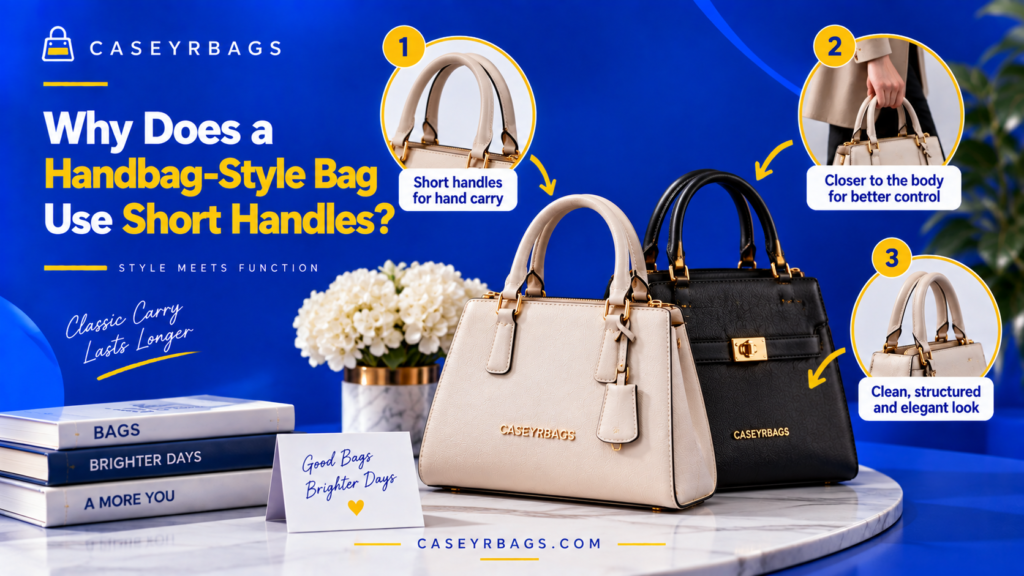
Why Does a Handbag-Style Bag Use Short Handles?
A Handbag-Style Bag uses short handles because they create a direct hand or forearm carry path that keeps the bag close to the point of support. This suits a compact structured bag whose body, opening, and contents are intended to remain predictably oriented during everyday handling.
Short handles also reinforce the bag’s structural identity by limiting long suspension, supporting controlled lifting, and making it easier to stabilize the bag while opening or retrieving personal items. Their usefulness still depends on handle drop, bag width, anchors, load, and the intended carry mode.
What Functional Role Do Short Handles Serve on a Handbag-Style Bag?
Short handles connect the bag directly to the carrying hand or forearm rather than creating a long suspension path from the shoulder. This keeps the bag close to the point where it is being controlled.
Because the bag remains near the hand, short handles can support deliberate lifting, repositioning, setting down, and opening. This complements the structured access pattern common to Handbag-Style Bags.
Their role is therefore both carry-related and structural. Within the broader Handbag-Style Bag system, short handles help define how the bag moves while reinforcing the compact body-access-carry relationship of the form.
Which Functions Do Short Handles Perform?
Short handles support hand carry, forearm carry where the opening permits it, lifting, repositioning, stabilization, and access control. Each function keeps the primary point of control close to the bag body.
Handle function → bag-control effect → Handbag-Style consequence. Their value comes from the direct support relationship rather than from appearance alone.
Why Are Short Handles More Than a Decorative Feature?
Handle geometry determines where the bag is supported and therefore influences the primary carry mode, suspension distance, bag position, and how quickly the bag can be stabilized.
Handle geometry → primary carry mode. Decorative treatment can change appearance, but the carry path is what makes short handles structurally important.
Why Do Short Handles Work Especially Well With Structured Bag Bodies?
Direct support works predictably when the bag body retains enough shape that lifting does not cause uncontrolled collapse or shifting orientation.
Direct support + stable body → predictable bag orientation. Short handles reinforce structure when the bag body retains a controlled shape.
How Do Short Handles Create Direct Hand Carry?
The mechanical advantage of short handles is the compact suspension path they create between the hand and the bag body.
How Does Limited Handle Drop Keep the Bag Near the Hand?
Limited handle drop creates a short suspension distance, so the bag hangs directly below the carrying hand instead of farther down a long strap.
Short suspension distance → bag remains directly below carrying hand → stronger direct-control relationship. The bag stays close to the point from which it is lifted and repositioned.
How Does Direct Hand Carry Improve Bag Control?
Direct hand support makes lifting, repositioning, orientation correction, and immediate stabilization easier because the support point is close to the bag.
The short carry path reduces the amount of free suspension between hand and body. That makes the bag easier to deliberately place without claiming zero movement.
Why Does Direct Control Not Mean Reduced Bag Weight?
A shorter suspension path changes how the bag is controlled, but it does not reduce the actual mass of the contents or remove load from the carrying hand.
Shorter suspension changes control geometry; it does not reduce the load itself. Direct carry control ≠ weight reduction.
How Does Handle Drop Determine Handbag Carry Mode?
Handle drop controls the available clearance beneath the handles and therefore influences whether the bag is primarily carried by hand, forearm, or a more shoulder-oriented path.
What Does a Short Handle Drop Support?
A short drop typically supports hand carry, close lifting, and compact bag positioning by keeping the handles near the upper bag structure.
This geometry strongly reinforces short-handle identity when the body and access system support the same compact carry role.
When Can a Slightly Larger Drop Support Forearm Carry?
A somewhat larger opening beneath the handles may allow the hand to pass through so the handles can rest lower on the forearm, depending on bag width and handle geometry.
Forearm compatibility is functional rather than numeric. When this transition matters, Elbow Carry is the closest supporting question; no universal handle-drop measurement guarantees the same fit across different bags or users.
When Does a Longer Drop Begin to Shift the Carry Identity?
As clearance increases, forearm use becomes easier and possible shoulder compatibility can appear, making the carry architecture more hybrid.
Increasing clearance → forearm / possible shoulder compatibility. At some point long suspension becomes more dominant and the short-handle identity weakens.
| Handle Drop Character | Primary Carry Behavior | Identity Signal |
|---|---|---|
| Very short | Hand carry | Strong short-handle identity |
| Short | Hand / possible forearm | Strong |
| Moderate | Forearm / hybrid | Mixed |
| Long shoulder clearance | Shoulder-oriented | Weaker short-handle identity |
How Do Short Handles Affect Handbag Position?
Limited suspension keeps the Handbag-Style Bag in a compact carry zone whose position changes mainly with whether support comes from the hand or forearm.
Where Does the Bag Sit During Hand Carry?
During hand carry, the bag hangs directly below the hand and maintains a compact vertical relationship with the support point.
Hand support → bag directly below hand → controlled lower position. This makes deliberate lifting and set-down behavior straightforward.
How Does Forearm Carry Change Bag Position?
Forearm support moves the bag closer to the upper side or elbow region, depending on handle drop, bag width, and available clearance.
The position becomes closer to the body than low hand carry while still remaining different from a dedicated shoulder-supported suspension path.
Why Can Short Suspension Reduce Uncontrolled Swing?
A shorter free suspension path gives the bag less distance through which to move before the hand can correct it, reducing movement opportunity.
Shorter free suspension path → smaller movement range potential. Short handles can limit movement opportunity without eliminating bag motion.
How Do Handle Anchors Support Short-Handle Control?
Handle anchors transfer support into the upper bag body and influence how predictably the bag stays oriented under direct hand or forearm carry.
How Do Separated Handle Anchors Help Stabilize the Bag?
Separated attachment points spread the handle load across a broader part of the bag body and reduce reliance on one concentrated pivot area.
Separated anchors → broader load entry into bag body → more predictable orientation. The geometry supports control when the surrounding panels remain stable.
Why Does Anchor Reinforcement Matter?
Reinforcement helps maintain handle attachment, preserve the upper-panel shape, and reduce local deformation when the bag is lifted.
Structural reinforcement supports durability and geometry retention, but it does not itself determine the primary carry mode.
Why Is Anchor Strength Different From Carry Geometry?
Strong anchors can be located in a geometry that still allows more pivoting, while moderate spacing can provide different orientation behavior.
Strong anchors support durability; anchor placement influences orientation. Anchor strength ≠ carry geometry.
How Do Short Handles Support Structured Access?
Direct handle control can stabilize the bag and its main opening, but the handles must remain clear enough that they do not become an access barrier.
How Can the Handle Stabilize the Bag During Opening?
The user can hold a short handle to steady the bag, control orientation, and keep the main opening presented in a predictable position during retrieval.
Direct control reduces the need to reshape or chase a moving opening. The handle becomes part of the access system rather than only a carry component.
How Do Short Handles Work With a Structured Opening?
A stable handle position combined with stable opening geometry helps the bag remain predictable while the closure is opened and contents are reached.
Stable handle control + stable opening geometry → predictable retrieval position. Carry and access work best when they reinforce the same orientation.
When Do Handles Interfere With Access?
Handles can fall across the opening, anchor tabs can narrow the entry, or rigid handles can obstruct the zipper path and force repositioning.
Short handles should support the opening path, not occupy it. Interference turns a control feature into an access barrier.
Why Do Short Handles Suit Compact Personal-Item Carry?
Compact personal-item storage pairs well with direct hand or forearm support because the bag can remain close, controlled, and easy to reposition without requiring a long suspension system.
How Does Compact Bag Volume Complement Hand Carry?
A compact load usually requires less physical envelope around the carrying hand and can remain predictable under direct suspension without large changes in bag orientation.
Compact load → manageable direct suspension → predictable bag position. This is a proportional relationship, not a universal size limit.
How Does Organized Personal-Item Storage Support Short-Handle Use?
Smaller purposeful zones, predictable retrieval, and controlled opening geometry let the user stabilize the bag and access contents without changing carry systems.
Organization strengthens the direct-control relationship because the bag can be set down, opened, used, and lifted again through the same handle system.
When Can Excessive Loading Undermine Short-Handle Carry?
Greater load can increase downward pull, make lifting harder, distort the handles or upper edge, and reduce access quality when the bag becomes crowded.
Handle strength ≠ comfortable unlimited load. Strong handles preserve structure but do not make excessive weight easier to control or access.
How Does Bag Width Affect Short-Handle Fit?
Bag width changes the span the handles must cross, so the same nominal handle drop can create different usable clearance on different bags.
How Does a Wider Bag Change the Handle Opening?
Wider anchor spacing forces the handle curve to span more of the bag top before rising, which changes the shape and usable size of the opening beneath it.
Wider anchor spacing → larger span → different usable clearance. The numerical drop does not fully describe the resulting hand or forearm opening.
Why Can Two Bags With the Same Handle Drop Fit Differently?
Bag width, anchor spacing, handle stiffness, and handle curvature all change how the listed drop becomes real clearance.
Equal nominal drop can therefore produce different hand or forearm fit. Handle drop must be interpreted with the bag geometry that shapes it.
When Does Width Reduce Forearm Usability?
A wider bag can create difficult hand or arm entry, excessive handle spread, or an awkward carry angle even when the measured drop appears sufficient.
Nominal handle drop does not fully describe usable handle clearance. Width and span remain part of the fit question.
| Bag Geometry | Handle Effect | Main Fit Question |
|---|---|---|
| Narrow | More compact handle span | Is drop sufficient? |
| Wide | Larger span | Does handle opening remain usable? |
| Shallow | Bag remains closer | Is carry stable? |
| Deep | Greater outward projection | Does load stay controllable? |
How Does Bag Depth Affect Short-Handle Carry?
Bag depth changes outward projection, so even appropriately short handles can feel less controlled when the body and load extend farther away from the support line.
How Does a Shallow Bag Support Compact Carry?
Smaller depth keeps more of the load near the bag’s centerline and reduces how far the body projects outward from the direct support path.
Smaller depth → load remains nearer centerline → compact carry behavior. Shallow geometry supports control without guaranteeing it.
How Does Greater Depth Affect Hand-Controlled Movement?
Greater depth increases outward projection and can increase rotation potential, especially when contents are uneven or concentrated toward the outer side.
The bag can remain directly held while the deeper body still creates more movement and orientation demand.
Why Can Short Handles Not Fully Correct Excessive Bag Depth?
Short handles control suspension distance, while bag depth controls the front-to-back load geometry of the bag body and contents.
Handle length controls suspension distance; bag depth controls outward load geometry. One variable cannot fully correct the other.
How Does Internal Load Placement Affect Short-Handle Control?
Internal load placement changes how evenly the bag hangs from its handle anchors even when the handle geometry itself is stable.
How Does Centered Loading Support Handle Control?
A centered load places more even demand across the handle anchors and reduces the tendency for one end of the bag to pull downward.
Centered load → more even anchor demand → predictable orientation. Direct support works best when the internal load is controlled.
How Does End-Heavy Loading Affect the Bag?
Dense contents concentrated at one end can make that side hang lower, increase uneven handle tension, and create visible tilt during lifting.
End-heavy load → uneven handle tension → tilt. The handle system can remain structurally sound while orientation becomes less predictable.
How Does Overfilling Weaken the Advantage of Short Handles?
Overfilling can distort the upper edge, crowd the main opening, increase handle demand, and make lifting or repositioning less controlled.
Direct carry works best when the internal load remains controlled. Overfilling can weaken both carry and access at the same time.
Why Can Short Handles Support Forearm Carry Without Becoming Shoulder Handles?
Forearm compatibility uses the same short-handle system at a different support point on the arm; it does not automatically create the clearance or long suspension associated with shoulder carry.
What Makes Forearm Carry Different From Shoulder Carry?
In forearm carry, the handles rest lower on the arm after the hand passes through the opening, while shoulder carry requires enough clearance to pass over and remain supported from the shoulder.
The two modes use different support positions and clearance requirements. Forearm carry can remain within a compact short-handle system.
Why Does Forearm Compatibility Not Change Handbag-Style Identity?
A bag can support both hand and forearm use while the same short handles remain the primary carry structure and the bag keeps its structured access system.
Forearm compatibility ≠ shoulder-handle identity. The primary architecture remains short-handle oriented as long as direct compact carry dominates.
When Does the Design Become More Shoulder-Oriented?
The carry becomes more shoulder-oriented when handle drop increases substantially, shoulder clearance becomes intentional, and long suspension becomes the dominant support path.
The shift is functional rather than numerical. No single universal drop measurement defines the transition.
Why Can a Handbag-Style Bag Still Include a Long Strap?
An optional long strap can add versatility without replacing the short handles when the bag’s main structure and everyday handling remain centered on direct hand or forearm carry.
What Role Can a Detachable Shoulder Strap Serve?
A detachable long strap can provide an alternate longer carry mode, a hands-free option, or a way to move between carry styles when needed.
This secondary path adds versatility rather than automatically redefining the bag. The primary structure still determines the dominant identity.
Why Do Short Handles Remain Structurally Important?
Short handles still provide direct lifting, primary bag orientation, compact carry, and immediate control around the main opening even when a long strap is available.
They remain the core handling system when the bag is designed to be picked up, placed, stabilized, and accessed through them.
When Does the Long Strap Become the Dominant Carry Signal?
The long strap becomes dominant when the bag is primarily designed and normally used around shoulder or crossbody suspension rather than direct short-handle carry.
Secondary strap presence ≠ automatic change of primary bag identity. Dominance depends on the actual carry architecture.
| Carry Feature | Primary Role | Identity Effect |
|---|---|---|
| Short handles | Hand/forearm carry | Strong Handbag-Style signal |
| Detachable shoulder strap | Secondary mobility | Adds versatility |
| Long fixed strap | Shoulder-oriented carry | May shift category emphasis |
How Do Short Handles Distinguish a Handbag-Style Bag From a Shoulder Bag?
The strongest distinction is the primary support path: direct short hand/forearm suspension versus longer shoulder-supported suspension.
What Is the Main Carry-Path Difference?
Handbag-Style carry uses short hand or forearm suspension, while a Shoulder Bag uses a longer strap designed to support the bag from the shoulder.
Short hand/forearm suspension and longer shoulder suspension create different bag positions, clearances, and movement relationships.
Can Both Have Structured Bodies?
Yes. Handbag-Style Bags and Shoulder Bags can both use structured or semi-structured bodies and deliberate closures.
Structure alone does not distinguish the two. Primary handle geometry and access architecture must also be considered.
Which Combination Gives the Clearest Identity?
Primary handle geometry, opening architecture, and bag structure together show whether the bag is built around short-handle control or shoulder suspension.
The complete body-access-carry system provides the clearest classification. No single feature should override the dominant function.
How Do Short Handles Differ From Tote Bag Handles?
Both Tote and Handbag-Style Bags can use paired handles, so the difference comes from handle role combined with body and access architecture.
Why Can Tote Handles Be More Adaptable?
Many Tote designs use handle geometry that can support hand carry and, with sufficient drop, shoulder carry as part of their adaptable utility role.
Tote handles therefore often span a broader carry range. The exact behavior still depends on width, drop, and construction.
Why Are Handbag Handles Usually More Compact in Role?
Handbag handles typically reinforce shorter suspension, a more structured body, and controlled personal-item access around a compact carry zone.
The carry role is narrower and more directly connected to lifting, orientation, and retrieval around the upper bag structure.
Why Can Handle Length Alone Not Separate Tote and Handbag Identity?
Short or medium handles can appear on both bag types, so handle length by itself cannot explain whether the bag is open-volume utility or structured personal-item carry.
Bag classification requires body, access, and carry signals together. Handle length alone ≠ bag classification.
When Do Short Handles Become a Poor Fit for the Bag?
Short handles become a poor fit when their clearance, strength, spacing, or carry role no longer matches the bag size, packed load, or intended handling behavior.
When Is Handle Drop Too Short?
Handle drop is too short for the intended use when hand entry becomes difficult, forearm clearance fails where forearm carry is intended, access is obstructed, or lifting angle becomes awkward.
Shortest is not automatically best. Usable clearance should match the bag width and intended carry mode.
When Is the Handle System Too Small for the Load?
Excessive handle tension, repeated need for two-handed support, persistent bag tilt, or difficult repositioning can show that the handle system and load no longer work comfortably together.
Strong handles do not create unlimited-load permission. Load amount and geometry remain part of the carry system.
When Do Short Handles Stop Supporting the Intended Carry Identity?
Short-handle identity weakens when the bag depends primarily on a longer strap because the short handles are no longer practical for normal lifting, movement, or access.
At that point the primary carry architecture has shifted. Classification should follow the system that dominates normal use.
How Can Short-Handle Function Be Evaluated?
Short-handle evaluation should combine pre-load geometry checks with real loaded tests of hand carry, forearm use where intended, orientation, access, and repositioning.
What Should Be Inspected Before Loading?
Inspect handle condition, handle drop, handle width, anchor positions, bag width, and opening geometry before normal contents are added.
These checks establish the usable handle opening and show whether the handles and main opening are likely to compete for space.
What Should Be Tested After Loading?
Test hand carry, forearm carry where intended, lifting, bag orientation, opening access, and repositioning with the normal contents in place.
Loaded testing matters because bag width, depth, and internal weight can change how the same handle geometry behaves in real use.
Which Sequence Should Determine Short-Handle Fit?
- Load the bag normally.
- Identify the primary handles.
- Lift the bag by hand.
- Observe orientation.
- Walk a short normal distance.
- Test forearm carry where intended.
- Set the bag down.
- Open the main compartment.
- Retrieve a routine item.
- Lift the bag again.
- Confirm handles support both carry and access without unnecessary interference.
Use the sequence in order so the bag is evaluated loaded, first through hand carry and orientation, then through short-distance movement and forearm carry only where that mode is intended.
Set the bag down, test opening and routine retrieval, then lift it again. Accept the fit only when the handles support both direct carry and structured access without unnecessary interference.
How Can Short-Handle Classification Mismatches Be Avoided?
Classification mismatches are avoided by treating short handles as one strong signal inside a larger system of body structure, opening architecture, bag geometry, load, and primary versus secondary carry modes.
Why Are Short Handles Alone an Incomplete Category Signal?
Short handles also appear on totes, briefcase-style bags, travel bags, and utility bags, so their presence alone does not uniquely identify Handbag-Style structure.
Short handles ≠ complete Handbag-Style identity. Their meaning depends on how they work with body and access architecture.
Why Should Optional Long Straps Not Automatically Override the Short Handles?
An optional long strap can remain secondary while short handles continue to control lifting, orientation, and normal access.
Primary versus secondary architecture matters more than accessory presence. Optional long strap ≠ automatic category change.
What Should Be Verified Before Treating Short Handles as a Defining Handbag Feature?
Verify that the handles are structurally integrated, handle drop supports direct hand carry, forearm carry works where intended, shoulder clearance is not assumed, width and drop are evaluated together, anchors remain secure, and the bag stays predictably oriented.
Also confirm that the handles support lifting and access without obstruction, internal load remains controlled, overfilling does not distort the system, optional long straps remain correctly classified, and body structure, access architecture, and carry mode reinforce one another.
- Short handles are structurally integrated into the bag.
- Handle drop supports direct hand carry.
- Forearm carry works where intended.
- Shoulder clearance is not assumed.
- Handle drop is evaluated relative to bag width.
- Handle anchors remain secure.
- Anchor placement keeps the bag predictably oriented.
- Bag body retains enough shape for direct handle control.
- Handles do not repeatedly obstruct the main opening.
- Handles support lifting and repositioning.
- Internal load remains reasonably controlled.
- Dense contents do not create persistent bag tilt.
- Overfilling does not distort the handle/opening system.
- Short handles are not treated as weight reduction.
- Strong handles are not treated as unlimited-load permission.
- Optional long straps are identified as primary or secondary correctly.
- Short handles are not used as the only category signal.
- Body structure, access architecture, and carry mode reinforce one another.
- Final identity remains centered on structured access + short-handle carry.
Conclusion
A Handbag-Style Bag uses short handles because they create a compact direct carry path that supports hand or forearm handling, keeps the structured bag easy to orient, and allows deliberate lifting and repositioning around a controlled main opening. This geometry suits a personal-item bag whose shape and access points remain predictable.
Short handles are therefore functional rather than decorative. Their value depends on handle drop, bag width, anchor geometry, bag depth, internal load placement, and whether optional longer straps remain secondary. They become a defining Handbag-Style feature when direct hand or forearm support, predictable bag orientation, stable anchors, and structured access operate together as one primary carry system without being mistaken for weight reduction or a complete category definition by themselves.
FAQs
Handbag-Style handles are primarily designed for direct hand or forearm support, so the bag stays close to the support point.
Shoulder Bag straps use greater length or drop to create a shoulder-supported suspension path. The two carry systems therefore use different clearance and suspension geometry.
Yes. An optional longer strap can provide a secondary shoulder or hands-free carry mode.
Short handles can still remain the primary structural carry feature when they continue to control lifting, orientation, set-down behavior, and routine access around the structured bag body.
Shorter suspension can provide more direct control and reduce the free movement available between the hand and bag body.
Actual control also depends on bag size, bag depth, anchor geometry, handle spacing, and internal load placement. Shorter alone does not guarantee better control.