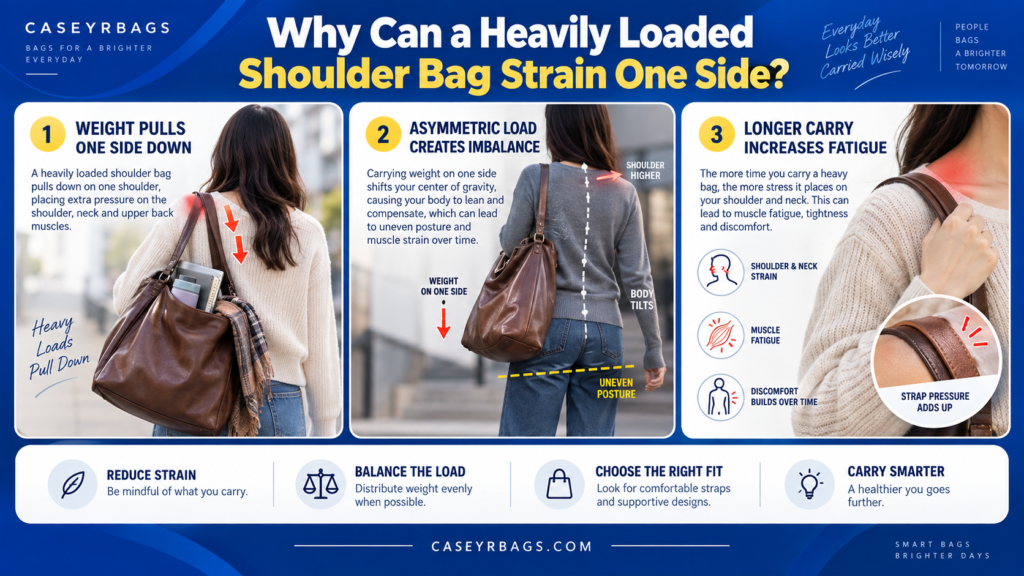
Why Can a Heavily Loaded Shoulder Bag Strain One Side?
A heavily loaded Shoulder Bag can strain one side because most of the suspended load travels through a single strap and one shoulder-side support path rather than being divided across two shoulder straps. As the load increases, that one-sided strap path must manage more downward weight, bag movement, and positional control.
The effect can become stronger when dense contents sit far from the body, the bag hangs low, the strap has a small contact area, contents shift, or the bag is carried for longer periods. The issue is therefore not simply that the bag is heavy, but how that load is positioned and controlled.
Why Does a Heavy Shoulder Bag Create One-Sided Carrying Demand?
A Shoulder Bag normally uses one primary strap supported by one shoulder side at a time. This means the bag’s suspended load enters the carrying system through an asymmetric support path rather than being divided across both shoulders.
As the packed load becomes heavier, the same one-sided pathway must support greater demand. The strap, anchors, bag body, and wearer all interact with the increased load, while bag movement can add further variation during walking.
Heavy loading therefore becomes more demanding when total weight, load distance, movement, and duration combine. Within the broader Shoulder Bag system, the bag may remain structurally intact while still becoming impractical or uncomfortable to carry.
How Does the Single Strap Carry a Heavy Shoulder Bag Load?
Packed contents load the bag body and base, which transfer force into the strap anchors. The anchors then feed that demand into one continuous strap supported primarily by one shoulder side.
Contents → bag body/base → anchors → strap → one shoulder-side support path. One strap creates one primary suspension path even when two attachment points help control the bag body.
Why Does Increasing Bag Weight Increase One-Sided Demand?
Greater packed load increases the demand passing through the same asymmetric support system. More total mass must be supported, positioned, and controlled during both still carry and movement.
Greater packed load → greater demand through the same one-sided path. The amount that feels tolerable varies, so the relationship should not be converted into one universal safe-weight threshold.
Why Is a Structurally Strong Bag Not Necessarily Comfortable When Heavily Loaded?
Strong stitching, anchors, panels, and materials can keep the bag structurally intact under a substantial load. That structural capacity answers what the bag may withstand.
Bag strength does not establish what a person can comfortably carry. Structural load capacity ≠ comfortable carry capacity.
How Does Increasing Load Change Shoulder Bag Carry Behavior?
More load strengthens the same one-sided support demand and can make strap tension, bag movement, and repositioning more noticeable.
How Does Greater Load Change Strap Tension?
As packed load increases, more demand enters the strap-and-anchor system. The same strap must support a greater suspended load through the one-sided path.
More load → greater strap and anchor demand. The article keeps this relationship qualitative rather than converting it into exact biomechanical calculations.
How Can Heavier Loading Make Bag Movement More Noticeable?
A heavier bag can develop more noticeable swing momentum, stronger downward pull, and greater resistance to repositioning. Shifting contents can also create larger changes in how the bag behaves.
The heavier the packed system becomes, the more important predictable movement and stable internal loading become. Movement adds variability to an already demanding load.
Why Can a Dense Small Load Feel More Demanding Than a Bulky Light Load?
A compact dense object can add substantial weight without making the bag look especially full, while bulky lightweight items may occupy more volume with less actual mass.
Volume ≠ weight. Carrying demand follows the packed load and its position, not the visual size of the contents alone.
| Load Character | Bag Appearance | Carrying Demand |
|---|---|---|
| Light + bulky | Large volume | Lower weight demand |
| Dense + compact | Small volume | Higher potential demand |
| Heavy + stable | Controlled shape | High one-sided support demand |
| Heavy + shifting | Variable shape | High + unstable demand |
How Does Strap Width Affect Heavy-Load Strain?
Strap width changes the contact area through which the same heavy bag load is applied, but it does not reduce the actual packed weight.
Why Can a Narrow Strap Feel More Concentrated Under a Heavy Load?
With the same packed load, a narrower strap applies the carrying demand through a smaller contact area. The interface can therefore feel more concentrated.
Same load + smaller contact area → more concentrated strap contact. This is a mechanical interface explanation rather than a medical pressure calculation.
How Does a Wider Strap Change the Carrying Interface?
A wider strap distributes the same packed load across a broader strap surface and can make the contact interface less concentrated.
Wider strap ≠ lighter bag. Actual weight, bag depth, duration, and internal load position remain unchanged.
When Does Strap Width Provide Little Benefit?
Strap width provides limited benefit when excessive total load, long duration, poor load position, deep bag geometry, or strong movement is the main source of demand.
Width changes contact distribution, not the full heavy-load system. The root cause still needs direct correction.
How Does Strap Padding Affect a Heavily Loaded Shoulder Bag?
Padding can improve the surface interface, but it cannot reduce packed mass, eliminate one-sided suspension, or correct outer-heavy loading.
How Can Padding Alter Strap Contact?
Padding can create a softer interface, reduce hard-edge contact, and help the strap conform more smoothly to the support area.
These changes can refine contact quality when the strap surface itself is part of the mismatch. They do not remove the load entering the system.
Why Does Padding Not Reduce Asymmetric Load?
Padding changes the interface between strap and support area, but total bag weight and the one-sided support path remain the same.
Padding changes contact quality while bag weight and asymmetric suspension remain. Padding ≠ reduced load.
When Is Padding Being Used to Hide a Larger Loading Problem?
If the bag still feels excessively demanding, requires repeated shoulder switching, pulls strongly outward, or needs constant hand support, the main problem likely extends beyond surface contact.
Padding should refine contact, not justify an excessive load. Load reduction or reorganization addresses the demand more directly.
How Does Bag Depth Increase One-Sided Strain?
Bag depth changes how far dense contents can sit from the body-facing panel, which can increase outward pull and rotation potential under heavy load.
How Does a Deep Bag Move Contents Farther Outward?
Greater bag depth creates more front-to-back space between the body-facing panel and outer panel. Dense items can therefore sit farther away from the body.
Greater depth → greater possible load distance. The potential becomes most relevant when heavy contents occupy the outer portion of that depth.
Why Does an Outward Load Feel Different From a Close Load?
A heavy load positioned farther from the body-facing side can create stronger pull-away and rotational behavior than the same mass positioned closer to the body-facing plane.
Load farther from the body-facing side → greater outward pull and rotation potential. This remains a mechanical carry explanation rather than a medical torque claim.
Why Can a Shallow Bag Still Strain One Side When Heavily Loaded?
A shallow bag reduces outward distance but does not remove the total mass supported through the single strap. A compact heavy load can therefore remain demanding even when carried close.
Close load ≠ light load. Positioning can reduce one variable without removing the underlying weight demand.
How Does Internal Load Placement Amplify One-Sided Strain?
Poor packing can make the same heavy Shoulder Bag more demanding by shifting the effective load center outward, sideways, or dynamically during movement.
How Do Dense Outer-Pocket Contents Change the Load Center?
Dense outer contents move the effective load center away from the body-facing plane and can increase pull-away, rotation, and movement.
Dense outer load → outward load-center shift → stronger pull/rotation potential. Repositioning the item closer to the body-facing or central zone addresses the source directly.
How Does End-Heavy Loading Affect the Bag?
Dense contents concentrated at one end create lateral load shift, bag tilt, and unequal demand across the anchor zones.
End-heavy load → side tilt → uneven anchor demand. The total weight may be unchanged, but the bag becomes less predictably oriented.
How Do Loose Heavy Items Change Carrying Strain?
A loose heavy item changes position as the bag moves, which shifts the effective load center and changes strap demand from moment to moment.
A stable heavy load remains demanding, but an unstable heavy load adds movement to that demand. Stabilization therefore matters even when total weight is unchanged.
| Load Position | Load-Center Effect | Bag Behavior |
|---|---|---|
| Body-facing | Closer | More predictable |
| Centered | Balanced within bag | Stable |
| Outer-heavy | Farther outward | Pull-away / rotation |
| End-heavy | Lateral shift | Tilt |
| Loose heavy load | Variable | Repeated movement |
How Does Shoulder Bag Resting Position Affect Heavy-Load Strain?
Resting height changes body contact, suspension distance, and movement freedom, so the same heavy load can behave differently at higher, mid-side, and lower positions.
How Can a Higher Side Position Reduce Movement?
A higher side position can create closer body contact, shorten the swing path, and keep the bag’s location more predictable during normal movement.
Higher position can improve control without eliminating the underlying heavy load. The weight demand remains present even when swing is reduced.
How Can a Low Bag Position Make a Heavy Load More Demanding?
A lower position lengthens the suspension distance and gives the bag more movement freedom, which can increase swing and pull during walking.
Longer suspension distance → greater movement freedom → more swing potential. Low carry is not automatically wrong, but heavy loads become more sensitive to that movement.
Why Should the Strap Not Simply Be Shortened as Much as Possible?
Excessive shortening can restrict clearance, concentrate contact, make access harder, or distort the bag’s position. Reducing swing can therefore create a different fit problem.
Higher can improve control without eliminating heavy-load demand. The useful position balances movement control with practical clearance and access.
| Bag Position | Body Contact | Swing Potential | Heavy-Load Concern |
|---|---|---|---|
| Higher side | Higher | Lower | Contact concentration |
| Mid-side | Moderate–high | Moderate | Overall fit |
| Lower side | Variable | Greater | Swing and pull |
How Does Bag Movement Increase One-Sided Load Demand?
A moving heavy bag creates changing strap tension and orientation, so movement control becomes increasingly important as packed load rises.
How Does Swing Change Strap Demand?
Forward-back movement repeatedly changes strap tension and bag position, creating a less constant support relationship than a stable hanging load.
The result is additional control demand. Swing does not add bag weight, but it makes the heavy load less predictable.
How Does Rotation Change the Load Relationship?
Rotation can move the outer panel farther from the body, twist the strap, shift dense contents, and increase the need for manual stabilization.
Rotation changes both load distance and contact behavior. The heavy bag can therefore become more demanding even when total mass stays the same.
Why Does Movement Control Matter More as Load Increases?
Greater load magnifies the practical importance of keeping the bag’s position and load center predictable because each shift occurs within a more demanding system.
The heavier the load, the more important predictable bag movement becomes. Stable heavy loads remain demanding; stability simply removes one additional source of variability.
How Do Strap Anchors Affect Heavy-Load Control?
Anchor geometry affects how the heavy bag maintains orientation and how strap forces enter the body panels under greater load.
How Do Separated Anchors Help Control a Heavy Shoulder Bag?
Two separated attachment points spread strap influence across more of the bag body and can provide broader control of orientation.
Separated anchors → broader orientation control. This helps the bag stay predictable but does not reduce the actual packed weight.
How Can Flexible Anchor Zones Change Under Load?
Under heavier loading, flexible panels can deform, anchors can pull inward, strap angles can change, and one end of the bag can tilt more noticeably.
These changes alter orientation rather than total mass. The loaded bag should therefore be observed, not judged only by its empty geometry.
Why Does Stronger Anchor Construction Not Reduce Strain on One Side?
Reinforced anchors help the bag structure withstand the load, but they do not remove weight, shorten duration, or rebalance the contents.
Anchor reinforcement supports structural integrity; it does not reduce the actual carried weight. Stronger anchors ≠ lower one-sided demand.
How Does Carrying Duration Amplify Heavy Shoulder Bag Strain?
Duration determines how long the same heavy one-sided load, contact pattern, and movement must be sustained during use.
Why Can a Heavy Bag Feel Acceptable During a Short Test?
A brief test exposes the user to the one-sided demand for only a short period, so the full effect of sustained carry may not yet be apparent.
Short exposure does not reveal the full effect of sustained one-sided carrying. Brief tolerance should not be treated as proof of long-duration comfort.
How Can Longer Carrying Make the Same Load More Noticeable?
The same asymmetric load carried for longer creates more sustained one-sided demand and gives contact, movement, and stabilization effort more time to become noticeable.
Same asymmetric load + longer duration → more sustained one-sided demand. No exact time threshold applies universally.
Why Should Duration Be Evaluated Together With Weight?
A heavy bag carried for a short transfer creates a different task from the same bag carried for a prolonged period. Weight and duration combine to shape total carrying demand.
Heavy for a short transfer ≠ heavy for sustained carry, and short-term tolerance ≠ sustained comfort. Both variables belong in the evaluation.
| Load Level | Short Transfer | Sustained Carry |
|---|---|---|
| Light | Usually lower demand | Context-dependent |
| Moderate | Manageable for some uses | More noticeable |
| Heavy | High demand | Higher mismatch potential |
| Heavy + unstable | High and variable | Strong mismatch signal |
Which Signals Suggest a Shoulder Bag Is Too Heavily Loaded for Comfortable Carry?
Practical handling and bag-behavior signals can show that carrying demand has become excessive, but they should not be used to diagnose a medical condition.
Which Bag-Handling Signals Indicate Excessive Demand?
Repeatedly supporting the bag with one hand, constant strap adjustment, frequent repositioning, repeated shoulder switching, or difficulty keeping the bag controlled can indicate that the load is too demanding for the current setup.
These signals should trigger load reduction or reorganization before more comfort features are added. They describe carrying demand, not injury.
Which Bag-Behavior Signals Indicate the Load Should Be Reorganized?
Heavy outward pull, persistent tilt, large swing, strap twisting, or sagging outer pockets all suggest that the packed load is poorly positioned or insufficiently controlled.
The correction should target the cause: move dense items inward, reduce unnecessary load, and stabilize loose contents before relying on strap adjustment alone.
Which Physical Symptoms Should Not Simply Be Treated as a Bag-Fit Problem?
Persistent pain, numbness, tingling, weakness, or symptoms that continue after carrying should not be treated as ordinary fit feedback to push through.
Reduce or stop the load and seek appropriate professional advice if needed. Bag-fit guidance should not be used to diagnose why those symptoms occur.
How Can a Heavily Loaded Shoulder Bag Be Made Less Demanding?
Reducing the actual load and improving load placement should come before padding, width, or strap-position refinements because those changes act directly on carrying demand.
Why Should Load Reduction Come First?
Removing unnecessary items directly reduces the amount of weight entering the single-strap system. That lowers demand before any contact or geometry change is considered.
Load reduction acts on the source. Padding, strap width, and position can refine how the remaining load is carried, but they do not remove mass.
How Can Reorganizing Dense Items Improve Load Control?
Move dense items toward a controlled body-facing or central zone, limit dense outer-pocket loading, and stabilize loose contents so the effective load center stays predictable.
Better organization does not reduce total mass, but it can reduce outward distance, tilt, and movement within the heavy-load system.
When Should a Different Carry System Be Considered?
If the required load remains substantial, the carry duration remains long, and the Shoulder Bag repeatedly becomes uncomfortable despite sensible reduction and organization, the one-strap system may no longer suit the task.
If the load itself exceeds what works comfortably as one-strap carry, changing the carrying system may be more useful than further adjusting the same Shoulder Bag. This is a carry-format decision, not a product recommendation.
How Can Heavy Shoulder Bag Strain Be Evaluated?
Evaluation should separate total load, dense-item position, depth, contact, movement, and duration so the actual heavy-load mismatch can be identified.
What Should Be Checked Before Carrying?
Identify the total contents, densest items, outer-pocket loads, bag depth, strap width, strap condition, and expected duration before the bag is carried.
These checks establish whether the system begins with excess mass, outward loading, poor contact geometry, or a duration that may make the setup increasingly demanding.
What Should Be Observed During Carrying?
Observe bag position, outward pull, swing, rotation, strap contact, repeated adjustments, and emerging discomfort during real use.
These observations should remain practical and non-diagnostic. Their purpose is to show which carrying variable should be reduced or reorganized.
Which Sequence Should Be Used When the Bag Feels Too Demanding?
- Stop and assess the contents.
- Remove unnecessary items.
- Identify the densest remaining items.
- Move dense items toward a controlled body-facing or central zone.
- Stabilize loose items.
- Check strap position.
- Check strap twisting.
- Reduce carrying duration where practical.
- Retest the bag.
- Stop carrying and seek appropriate advice if significant or persistent symptoms remain.
Use the sequence in order so actual load reduction comes before strap or comfort refinements. Remove unnecessary items, identify the dense remainder, move it inward, stabilize loose contents, then check strap position and twisting.
Reduce carrying duration where practical and retest the bag. If significant or persistent symptoms remain, stop carrying and seek appropriate advice instead of continuing to adjust the same heavy setup.
How Can Heavy Shoulder Bag Load Mismatches Be Avoided?
Future mismatches are avoided by separating what the bag can structurally hold from what remains practical to carry through one strap.
Why Is Filling the Shoulder Bag to Its Structural Limit a Weak Rule?
A bag can physically hold a substantial load while the one-sided carrying demand becomes impractical well before the structure reaches its limit.
Bag can hold the load ≠ load is practical to carry on one strap. Structural capacity should not be used as a comfort target.
Why Is a Padded Wide Strap Not Permission to Carry More?
Width changes contact distribution and padding changes contact quality, but neither removes actual bag weight or one-sided suspension.
Comfort features should refine an appropriate load rather than justify adding more weight. Wider or padded ≠ lighter.
What Should Be Verified Before Accepting a Heavy Shoulder Bag Load?
Verify that unnecessary weight is removed, dense items are controlled, bag depth is considered, the strap lies flat, anchors remain sound, the bag rests at a controlled side position, and outward pull, swing, and rotation remain manageable.
Also confirm that duration is considered, repeated hand support or shoulder switching is treated as a mismatch signal, no universal safe-weight number is assumed, and persistent pain, numbness, tingling, or weakness prompts load reduction or cessation and appropriate guidance.
- Normal load is identified.
- Unnecessary weight has been removed.
- Dense items are identified.
- Structural load capacity is not confused with comfortable carry capacity.
- Dense items are not heavily concentrated in outer pockets.
- Dense items are not concentrated at one end.
- Loose heavy contents are stabilized.
- Bag depth is considered.
- Strap remains flat and untwisted.
- Strap width provides a suitable carrying interface.
- Padding is not treated as weight reduction.
- Both anchors remain structurally sound.
- Bag rests in a controlled side position.
- Bag does not hang unnecessarily low.
- Outward pull remains manageable.
- Swing remains controlled.
- Persistent rotation is limited.
- Carrying duration is considered.
- Repeated manual support is treated as a load-mismatch signal.
- Switching shoulders is not treated as a complete solution.
- No universal safe-weight number is assumed.
- Persistent pain, numbness, tingling, or weakness prompts load reduction or cessation and appropriate professional advice.
Conclusion
A heavily loaded Shoulder Bag can strain one side because its weight is supported primarily through a single asymmetric strap path. As the load increases, the same side must manage greater suspended weight, while bag depth, internal load position, movement, and carrying duration can amplify the one-sided demand.
The strongest response is to reduce and stabilize the load before relying on padding, strap width, or adjustment. Dense contents should remain controlled, unnecessary weight should be removed, and the bag should stay predictably positioned with manageable movement. Heavy Shoulder Bag strain becomes most likely when substantial weight, outward load distance, unstable movement, and sustained duration combine within the same one-sided support system.
FAQs
Heavier loading increases demand through the same one-sided support path, so the carry system becomes more demanding as packed weight rises.
Actual experience still depends on strap geometry, bag depth, load placement, movement, duration, and individual tolerance. A heavy load does not automatically establish injury.
A wider strap can spread contact across a broader strap surface and make the interface feel less concentrated.
It does not reduce actual bag weight, eliminate one-sided suspension, or establish a universal safe load. Strap width is only one part of the heavy-load system.
Longer carrying sustains the same asymmetric load, contact pattern, and movement for more time, making the one-sided demand more noticeable.
A setup that feels manageable during a brief transfer may become increasingly uncomfortable during extended carry. No universal duration threshold applies to every user or load.