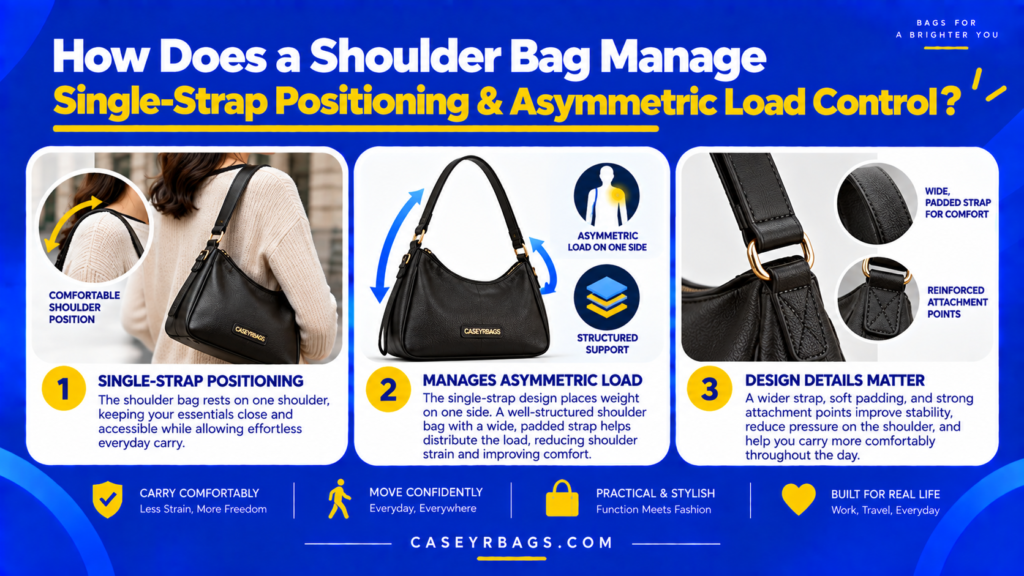
How Does a Shoulder Bag Manage Single-Strap Positioning & Asymmetric Load Control?
A Shoulder Bag manages single-strap positioning by suspending the bag from one shoulder-supported strap path while strap length, width, anchor placement, and bag geometry determine where the bag rests and how much it swings, tilts, or rotates during movement.
Because the support path is asymmetric, internal load placement and bag structure become especially important. Dense or unevenly positioned contents can increase one-sided pull, while controlled organization and predictable bag positioning can help the load remain stable despite being carried from one strap.
What Do Single-Strap Positioning & Asymmetric Load Control Mean in a Shoulder Bag?
A Shoulder Bag normally uses one primary strap that transfers most of the bag’s suspended load through one shoulder-side support path at a time. Unlike a two-strap backpack system, the bag is not designed around equal left-right suspension.
This creates an asymmetric load relationship: the bag hangs to one side of the body and its weight acts through a one-sided strap path. The important question is whether its position, movement, and internal distribution remain predictable.
Effective asymmetric load control depends on strap geometry, anchors, bag body, resting position, and contents. Within Everyday Carry, a Shoulder Bag can remain well controlled without becoming symmetrical.
Which Features Directly Control Single-Strap Positioning?
The strap, strap length, strap width, anchor points, bag body, side panels, base, and internal compartments all influence where the bag hangs and how its load remains organized. Each feature contributes either to suspension geometry, shape control, or content stability.
Feature → positioning role → load-control consequence. Strap adjustment sets height, anchors influence orientation, side panels and base preserve structure, and compartments help keep the internal load from migrating while the bag moves.
Why Is Shoulder Bag Loading Inherently Asymmetric?
A single shoulder-supported path places the suspended bag on one side of the body rather than dividing support across two independent straps. The geometry is one-sided even when the bag itself is centered internally.
Single support path → one-sided suspension. Asymmetric support describes the geometry; it does not automatically describe poor control, instability, or unsafe carrying.
What Makes an Asymmetric Shoulder Bag Load Controlled?
Controlled carry appears when the bag stays in a predictable side position, unwanted tilt remains limited, swing is manageable, contents remain stable, and strap tension does not change erratically during normal movement.
Controlled asymmetric carry means predictable positioning and movement, not perfect symmetry or complete absence of motion. The system can move and still remain functionally controlled.
How Does the Single Strap Create the Shoulder Bag Load Path?
The suspended load travels from the contents into the bag structure, through the anchors, and then into one strap path, so every stage influences final positioning.
How Does Bag Weight Transfer Into the Strap?
Contents first load the bag body and base, which transfer force into the anchor zones. The anchors then pass that load into the strap, and the strap carries it along the one-sided shoulder-supported path.
Contents → bag body/base → anchor zones → strap → shoulder-supported path. Every structural stage affects control because deformation or imbalance at one stage changes the geometry seen by the next.
Why Does Strap Angle Affect Bag Positioning?
Anchor location, strap length, and the bag’s resting location combine to create the effective strap angle. That angle influences whether the bag hangs closer to the body, farther outward, higher, or lower on the side.
Strap angle should never be judged alone. Anchor geometry and strap length determine it, while the packed load decides how strongly that geometry translates into body contact, tilt, or swing.
Why Does One Strap Not Mean One Uncontrolled Suspension Point?
Many Shoulder Bags use one continuous strap connected through two separated anchor points. The strap is single, but the bag body can still receive directional control from two attachment zones.
One strap can still control the bag through two structural attachment points. Separated anchors can reduce some free pivoting without guaranteeing complete stability.
How Does Shoulder Bag Strap Length Control Position?
Strap length changes bag height, body contact, movement freedom, and the size of the swing path, so adjustment should refine the intended resting position rather than act as the only stability fix.
How Does a Shorter Strap Change Bag Position?
A shorter setting usually places the bag higher and closer to the body, reducing some movement range and shortening the potential swing arc. This can improve positional control when the rest of the load system is already compatible.
Shorter ≠ automatically better. Excessive shortening can reduce repositioning freedom or force the bag into an awkward geometry without correcting internal imbalance or excessive depth.
How Does a Longer Strap Change Bag Behavior?
A longer setting lowers the resting position and allows greater movement freedom. The bag may swing through a larger arc and become easier to reposition for access, depending on its size and load.
Longer strap → lower position → greater movement freedom. A longer setting is not automatically unstable; control depends on bag depth, load center, anchors, and body contact.
When Can Strap Length No Longer Correct Poor Control?
Strap adjustment reaches its limit when instability comes from uneven loading, excessive bag depth, poor anchors, flexible collapse, or an unsuitable bag size. Tightening or loosening may change symptoms without removing the cause.
Strap adjustment refines positioning; it cannot repair every structural mismatch. The Classic subtype narrows this fit mechanism through Strap Drop after the general length relationship is understood.
| Strap Setting | Bag Position | Movement Potential | Main Trade-Off |
|---|---|---|---|
| Shorter | Higher / closer | Lower–moderate | Less repositioning freedom |
| Moderate | Mid-side position | Moderate | Balanced positioning |
| Longer | Lower position | Higher potential | Greater movement freedom |
How Does Strap Width Affect Single-Strap Load Control?
Strap width changes the contact surface of the support path but does not change the actual mass of the bag or correct poor load geometry.
How Does a Wider Strap Change Contact With the Support Area?
With the same bag load, a wider strap applies that load across a broader strap-contact surface. Mechanically, this changes the width of the interface through which the suspended load reaches the support area.
The effect is contact geometry, not weight reduction. A wider strap can change how support is applied while leaving bag mass, load center, anchor layout, and movement tendencies unchanged.
Does a Wider Strap Reduce the Actual Bag Weight?
No. Strap width cannot reduce the actual mass of the bag or its contents. The same packed load remains present regardless of whether the strap is narrow or wide.
Wider contact ≠ lighter load. Width can change the support interface, but it does not create symmetrical loading or remove the one-sided suspension path.
When Does Strap Width Provide Little Improvement in Control?
Strap width provides little control benefit when the main problem is unstable anchor geometry, excessive swing, uneven internal loading, poor bag position, or strap twisting. Those problems originate elsewhere in the system.
Strap width affects support contact, not the entire load-control system. A wider or padded strap cannot repair geometry that continues to generate tilt or rotation.
How Does Strap Anchoring Control Shoulder Bag Tilt & Rotation?
Anchor spacing and placement influence how one strap controls bag orientation, especially whether the body pivots freely or stays aligned across a broader attachment relationship.
How Do Two Separated Anchors Help Orient the Shoulder Bag?
Separated anchor points spread strap influence across more of the bag body and can reduce free pivoting compared with a highly concentrated attachment zone. This creates broader orientation-control potential.
Separated anchors → broader bag control. Two anchors do not guarantee stability because their effect still depends on side-panel structure, strap angle, bag depth, and load position.
How Does Uneven Anchor Geometry Affect Asymmetric Loading?
Uneven anchor placement can produce different strap angles, persistent tilt, rotation, or uneven panel deformation because the left-right attachment relationship no longer supports the bag evenly.
Unequal pull geometry can amplify one-sided suspension. The loaded bag should therefore be checked for orientation rather than judging anchors only by whether they are physically strong.
Why Must Anchor Reinforcement and Anchor Geometry Be Evaluated Separately?
Reinforcement helps preserve attachment integrity and surrounding panel strength, while geometry determines where and how strap forces enter the bag body. These are different mechanical roles.
Strong anchor ≠ automatically stable anchor placement. Durable stitching can hold an attachment securely even when the spacing or position still produces poor orientation.
Where Should a Shoulder Bag Rest for Stable Single-Strap Carry?
A functional resting position is the side zone where the loaded bag remains predictable during movement while still allowing workable access and return-to-carry behavior.
How Does a Higher Side Position Affect Control?
A higher side position can increase body contact, shorten the swing arc, and reduce available movement range. This can improve positional control when the bag’s width, depth, and anchors suit that location.
The trade-off is that access or movement clearance can change. Higher does not automatically mean better because bag geometry may interfere with the chosen position.
How Does a Lower Hip-Side Position Affect Movement?
A lower hip-side position can increase forward-back movement freedom and make access easier in some designs. The same freedom can increase swing and reduce body contact if the bag is deep or heavily loaded.
Lower side/hip position → greater movement freedom. Whether that remains functional depends on load placement, strap length, and how easily the bag returns to a stable resting zone.
How Should the Functional Resting Position Be Identified?
Look for a predictable bag location, manageable swing, limited rotation, easy access, and a load that stays stable through normal movement. The bag should not require constant manual correction.
The best position is functional, not a universal body coordinate. For the Classic subtype, Strap Position narrows this general mechanism to close-load carry.
| Position | Body Contact | Movement Freedom | Main Use Consideration |
|---|---|---|---|
| Higher side | Closer | Lower | Control-oriented |
| Mid-side | Moderate | Moderate | Balanced carry/access |
| Lower side/hip | Variable | Higher | More repositioning freedom |
How Does Bag Depth Affect Asymmetric Load Control?
Bag depth changes how far the load projects from the body-facing plane, affecting rotational leverage, swing, and sensitivity to outer-pocket weight.
How Does a Slim Bag Profile Support Body-Facing Positioning?
A slim profile keeps more of the load close to the bag’s body-facing plane and reduces outward projection. This can make the packed geometry potentially easier to control through one-sided suspension.
Smaller depth → load closer to body-facing plane → reduced outward projection. Slim does not automatically mean better because capacity, width, anchors, and access needs still matter.
How Does Greater Bag Depth Change Movement?
Greater depth moves part of the packed load farther outward and can increase rotation, swing, and sensitivity to dense outer contents. The bag behaves as a larger three-dimensional load rather than a flatter hanging body.
Greater bag depth → farther outward projection → increased movement sensitivity. Position and organization become more important as depth increases.
Why Does Depth Matter More When the Bag Is Heavily Filled?
As depth fills out, the load center can move farther from the body-facing plane and create stronger effects on orientation. Dense items near the outer side amplify this relationship further.
More filled depth → larger three-dimensional load → stronger orientation effect. Capacity and movement control must be evaluated together.
| Bag Profile | Body Contact | Movement Potential | Main Control Need |
|---|---|---|---|
| Slim | Higher | Lower–moderate | Position |
| Moderate | Variable | Moderate | Load placement |
| Deep | Lower potential contact | Higher | Stronger organization |
| Deep + outer-heavy | Poorer control | High | Rebalance load |
How Does Internal Load Placement Control Asymmetric Carry?
Internal load placement can either stabilize or amplify one-sided suspension by shifting the packed load center along the bag’s length or away from the body-facing plane.
Where Should Dense Items Be Positioned for Better Control?
Dense items generally behave more predictably when placed closer to the bag’s main structural or body-facing region rather than concentrated at an extreme edge. The exact location still depends on the bag’s internal architecture.
Dense contents closer to the main structure → more predictable load-center behavior. This is a mechanical relationship, not a universal exact-placement rule.
How Does End-Heavy Loading Affect the Shoulder Bag?
A dense item concentrated at one end shifts the longitudinal load center and can pull that side downward. The result may appear as persistent tilt or rotation even when the strap itself is adjusted correctly.
Dense item at one end → uneven longitudinal load → tilt or rotation. Correcting the load source is usually more effective than only tightening the strap.
How Does Outward-Heavy Loading Affect Movement?
A dense outer pocket or load concentrated away from the body-facing plane shifts the load center outward and increases the potential for pull-away behavior or rotation.
Dense outer load → outward load-center shift → outward pull or rotation. When greater load magnitude intensifies that one-sided demand, the narrower condition is Heavy Shoulder Load.
| Load Pattern | Bag Response | Control Quality |
|---|---|---|
| Centered dense load | Predictable orientation | Higher |
| End-heavy load | Side tilt | Lower |
| Outer-heavy load | Outward rotation | Lower |
| Loose shifting load | Changing orientation | Unpredictable |
| Organized mixed load | Stable load center | Improved |
How Does Internal Organization Reduce Single-Strap Load Movement?
Pockets and dividers improve asymmetric control only when they reduce item migration and keep dense or frequently used contents in predictable zones.
How Do Compartments Prevent Dense Items From Migrating?
Defined compartments limit how far a dense item can travel inside the bag as the user walks or repositions it. This helps preserve a more stable internal load center.
Defined compartment → limited item travel → more stable load center. The benefit depends on where the compartment sits, not merely on the fact that a pocket exists.
How Do Small Pockets Help Control Lightweight Contents?
Small pockets can give lightweight items predictable locations, reduce loose movement, and prevent mixing inside the main chamber. This keeps the bag’s internal state more consistent during motion.
The effect is organizational control rather than weight balancing. Lightweight items still contribute to the load, but their movement becomes easier to predict.
Why Do More Compartments Not Automatically Create Better Asymmetric Control?
Poorly located pockets, overloaded outer zones, or excessive fragmentation can still create imbalance even when the bag contains many compartments. Pocket count alone says little about load-center quality.
Pocket placement matters more than pocket count. Organization works when the compartment layout supports balanced, stable item placement.
How Does Shoulder Bag Structure Affect Asymmetric Load Stability?
Soft, semi-structured, and structured bodies respond differently to one-sided suspension because shape retention changes how anchors, compartments, and the load center remain positioned.
How Does a Flexible Shoulder Bag Respond to Uneven Loading?
A flexible body can sag, distort, allow anchor movement, or let the load center shift as contents settle. This adaptability can be useful but places more responsibility on internal load placement.
Flexible body → greater conformity → greater dependence on load placement. Uneven contents can reshape the bag and alter its resting orientation more noticeably.
How Does Greater Structure Change Load Behavior?
A more structured body retains shape, keeps compartment positions more predictable, and resists some collapse under load. This can make the loaded geometry easier to anticipate.
Structured body → greater shape retention → more fixed geometry. The trade-off is lower adaptability, and structure still does not automatically create balanced loading.
When Is Structural Reinforcement Most Useful?
Reinforcement is most useful around the base, strap anchors, compartment boundaries, and load-bearing side panels where shape retention supports predictable attachment and load position.
Structural rigidity ≠ automatic load balance. Reinforcement preserves geometry, while load placement and organization determine whether that geometry is used effectively.
How Does Movement Affect a Single-Strap Shoulder Bag?
Walking and direction changes reveal whether one-sided load control is effective because swing, rotation, and repeated repositioning become visible under motion.
What Causes Forward-and-Back Swing?
Forward-and-back swing can increase with a long strap, lower resting position, dense load, or limited body contact. These conditions create more room or momentum for the bag to move around its suspension path.
Swing should be judged by predictability rather than eliminated completely. Controlled carry can include movement as long as the bag does not require repeated correction.
What Causes Bag Rotation?
Rotation can come from anchor geometry, bag depth, one-sided internal loading, or loose contents that change the load center while the bag moves. Several causes can act together.
Rotation is therefore a multi-factor symptom. A stable strap alone cannot prevent it if the load center or bag geometry continues to shift.
What Causes Repeated Bag Repositioning?
An unstable resting height, poor load balance, strap slipping, or unsuitable bag geometry can force the user to keep moving the bag back into place after walking or access.
Controlled asymmetric carry means movement remains predictable, not absent. Constant manual correction indicates that the system is not holding a functional resting position.
How Does Access Interact With Asymmetric Load Control?
Opening the bag and retrieving contents can temporarily change shape, strap angle, and load distribution, so stable carry should return after the access task ends.
How Does Opening the Bag Change Stability?
Opening can reduce body shape, allow contents to shift, pull the bag forward, or change strap angle. These effects can temporarily move the load center away from its carry-state position.
Access should be treated as a temporary geometry change. The bag should regain predictable orientation after closure and repositioning rather than remain distorted or tilted.
How Can Quick-Access Pockets Create One-Sided Imbalance?
A frequently loaded exterior pocket can create localized weight concentration if dense items repeatedly collect in one zone. Convenience then changes the bag’s longitudinal or outward load center.
Access convenience should not create persistent load imbalance. Frequently used pockets should be assigned contents that do not repeatedly destabilize the packed geometry.
Why Should the Bag Return Easily to Its Normal Carry Position?
A controlled sequence is access → close → reposition → stable carry. The bag should return to a predictable geometry without repeated strap or load correction after routine retrieval.
If access permanently changes tilt or rotation, the issue may be pocket assignment, load migration, bag structure, or strap geometry rather than access itself.
When Does Shoulder Bag Asymmetric Loading Become Poorly Controlled?
Poor control appears when strap, load, position, and structure stop working together and repeated movement symptoms become persistent rather than occasional.
Which Movement Signs Suggest Poor Control?
Repeated large swings, persistent rotation, strong end tilt, outward pulling, or constant manual repositioning indicate that the bag’s one-sided load is no longer staying predictably controlled.
These symptoms identify a system problem, not automatically one failed feature. The load source and geometry should be traced first; Shoulder Asymmetry becomes relevant only after that mechanical diagnosis is established.
Which Structural Signs Suggest a Mismatch?
Distorted anchors, excessive sag, a twisted strap, uneven base deformation, or overloaded outer pockets can show that the bag structure and load are interacting poorly.
Structural signs help distinguish a carry-position problem from a deeper load-control mismatch. They should be checked with the normal packed bag, not only when empty.
Which Factor Should Be Checked First?
- Internal load.
- Loose contents.
- Bag position.
- Strap length.
- Anchor geometry.
- Bag depth.
- Structural support.
Use the diagnosis order exactly so the load source is examined before compensating with strap adjustment. Internal imbalance and loose migration can create symptoms that resemble poor strap or anchor behavior.
Correct the load source before compensating only with strap adjustment. Continue through position, strap length, anchors, depth, and structure only after the preceding checks are understood.
How Can Shoulder Bag Single-Strap Load Control Be Evaluated?
Final evaluation should use the normal load and observe the complete cycle from packing through walking, routine access, and return to carry.
What Should Be Checked Before Wearing the Bag?
Inspect strap condition, strap width, anchor condition, bag structure, normal contents, and dense-item placement before testing movement. These checks establish whether the loaded system begins from a predictable state.
Also note any twisted strap, end-heavy loading, outer-heavy loading, or loose contents. Those conditions can distort later movement results if left unidentified.
What Should Be Observed While Carrying It?
Observe resting position, tilt, rotation, swing, strap twisting, body contact, and load migration while walking normally. The bag should remain reasonably predictable rather than requiring constant correction.
Then access a routine item and return the bag to carry position. The test should show whether the load remains controlled after the geometry is temporarily disturbed.
Which Sequence Should Determine Final Load-Control Fit?
- Load the Shoulder Bag normally.
- Identify the densest items.
- Center or stabilize them within the usable structure.
- Close the bag.
- Adjust strap length.
- Position the bag at its intended side.
- Walk normally.
- Observe tilt, swing, and rotation.
- Access a routine item.
- Return the bag to carry position.
- Reorganize contents if the load no longer remains predictable.
Use the sequence in order so dense-item placement is corrected before strap length and carry position are judged. Walking then reveals whether the packed geometry remains stable under realistic movement.
The access test and return-to-carry step are essential because the system must recover after retrieval. Reorganize contents if predictability is lost instead of forcing a numerical stability score.
How Can Single-Strap & Asymmetric-Load Mismatches Be Avoided?
Mismatches are avoided by treating the Shoulder Bag as one connected load-control system rather than correcting one feature while ignoring the others.
Why Is Simply Widening or Padding the Strap a Weak Solution?
Instability can still come from poor load placement, excessive bag depth, unstable anchors, or an inappropriate resting position. Changing the strap surface does not remove those causes.
Strap treatment cannot correct every load-control problem. Wider or padded support affects contact but not the underlying load center or bag geometry.
Why Is Switching Sides Not a Complete Structural Solution?
Changing shoulders moves the same bag and contents to the opposite side, but it does not correct poor internal balance, excessive depth, loose contents, or bad anchor geometry.
Switching sides changes which side supports the load; it does not change the bag’s structural mechanics. The source of instability still needs direct correction.
What Should Be Verified Before Relying on the Shoulder Bag’s Asymmetric Carry System?
Verify strap condition, width, length, twist, anchors, anchor geometry, bag structure, bag depth, resting position, dense-item placement, loose-content control, pocket roles, and whether swing, tilt, rotation, and outward pull remain manageable.
Also confirm that routine access does not permanently destabilize the load, single-strap carry is not treated as automatically unstable, and strap width or padding is not treated as weight reduction. For a contrasting diagonal-carry architecture, compare Crossbody Bag.
- Strap is intact.
- Strap width suits the intended bag design.
- Strap length supports the intended resting position.
- Strap remains untwisted.
- Both strap anchors are secure.
- Anchor geometry keeps the bag predictably oriented.
- Bag structure remains stable under the normal load.
- Dense contents are identified.
- Dense contents are not strongly concentrated at one end.
- Dense contents are not unnecessarily concentrated in the outermost pocket.
- Loose contents remain controlled.
- Internal pockets have clear load-control roles.
- Pocket count is not treated as automatic organization quality.
- Bag depth does not create excessive outward movement.
- Bag rests in a predictable side position.
- Swing remains manageable.
- Persistent rotation is absent or limited.
- Bag does not require constant manual repositioning.
- Routine access does not permanently destabilize the load.
- Single-strap carry is not treated as automatically unstable.
- Asymmetric loading is not treated as automatic evidence of unsafe carrying.
- Strap width or padding is not treated as weight reduction.
- Overall load control is evaluated as one connected system.
Conclusion
A Shoulder Bag manages single-strap positioning by transferring its load through one shoulder-supported strap path while strap length, width, anchors, and bag position control how the bag hangs and moves. Because suspension is asymmetric, internal load placement, bag depth, organization, and structural support become especially important for keeping orientation predictable.
Effective control does not require perfect symmetry or zero movement. Dense contents should remain stable, anchors should preserve orientation, the resting position should remain functional, and access should not permanently disrupt the load center. A Shoulder Bag controls asymmetric loading most effectively when its single strap, anchor geometry, bag position, internal organization, structure, and load center work together to keep one-sided suspension predictable.
FAQs
No. A Shoulder Bag uses an asymmetric support path, but one-sided suspension does not automatically create uncontrolled movement.
Stability depends on strap geometry, anchor placement, bag position, structure, and internal load control. Strap count alone does not determine whether the bag remains predictable.
A wider strap can spread support across a broader strap-contact surface while carrying the same packed load.
It does not create symmetrical left-right loading or reduce the actual weight of the bag. Wider contact ≠ lighter load, and load geometry still matters.
Possible causes include uneven contents, bag depth, strap length, anchor geometry, flexible structure, or items shifting inside the bag.
These factors can move the load center and create tilt, swing, or rotation. The cause should be diagnosed across the full system rather than assumed from one feature.