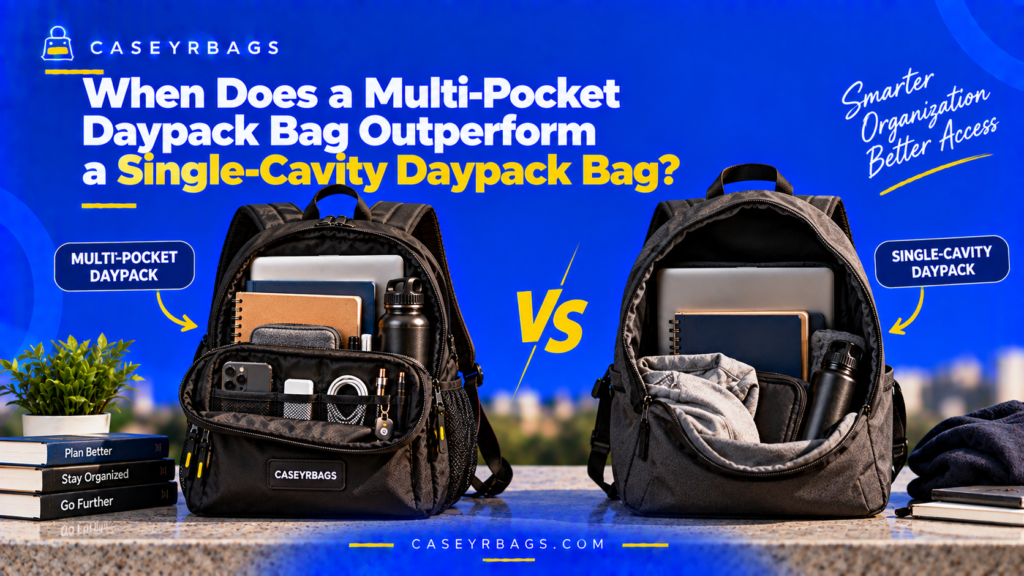
When Does a Multi-Pocket Daypack Bag Outperform a Single-Cavity Daypack Bag?
A Multi-Pocket Daypack Bag outperforms a single-cavity Daypack when the normal load contains several recurring item types that need different access priorities, especially when small loose contents, devices, documents, and frequently retrieved essentials benefit from predictable storage zones. In those conditions, clear pocket roles can reduce repeated searching, limit item migration, and shorten the path from identifying an item to retrieving it.
A single-cavity Daypack can perform better when the load is simple, bulky, irregular, or changes frequently because one flexible chamber preserves more adaptable packing space and fewer compartment decisions. The better architecture therefore depends on whether the user needs location control, stable separation, and repeated access more than maximum flexible volume, simple packing, and freedom to reposition changing contents.
What Does It Mean for a Multi-Pocket Daypack to Outperform a Single-Cavity Daypack?
A Multi-Pocket Daypack divides storage into several purpose-specific zones, while a single-cavity Daypack preserves most of its interior as one flexible chamber. Neither architecture is inherently superior; each solves a different combination of storage, packing, and retrieval problems.
Multi-Pocket architecture becomes advantageous when separation reduces the number of search, repositioning, and retrieval steps required during normal use. Single-cavity architecture becomes advantageous when fixed compartment structure would interfere with variable, bulky, irregular, or frequently changing contents.
The comparison should therefore be based on load complexity, retrieval frequency, item geometry, storage-role clarity, flexible-space requirements, and repeated-use behavior. “Outperform” means creating fewer recurring access and packing compromises for the specific load, not winning an overall Daypack ranking. For the parent definition, return to Daypack Bag.
Which performance criteria should be compared?
The relevant access criteria are location predictability, retrieval steps, small-item control, and quick-access efficiency. Show how they reveal whether separation actually reduces repeated retrieval friction. Relevant observable conditions include item-location predictability, retrieval steps, flexible volume, small-item control, and quick-access efficiency. The mechanism matters because it changes task-specific performance, access friction, flexible volume, and repeated packing compromise for the same carried load.
The relevant packing criteria are flexible volume and load adaptability. Show why a storage system can improve access while still losing efficiency if fixed pockets obstruct the actual carried geometry. A valid comparison should confirm that neither architecture is treated as universally superior through repeated packing and retrieval rather than appearance alone.
When does organization create a measurable advantage?
Organization gains value when recurring item categories repeatedly return to the same functional zones and the user no longer needs to search the complete bag. Relevant observable conditions include stable storage roles, predictable locations, and fewer recurring search steps. The mechanism matters because it changes task-specific performance, access friction, flexible volume, and repeated packing compromise for the same carried load.
The advantage should appear during repeated retrieval—not merely in a tidy empty layout. The pocket system should consistently reduce decisions or physical repositioning. A valid comparison should confirm that neither architecture is treated as universally superior through repeated packing and retrieval rather than appearance alone.
When does organization stop creating an advantage?
Unused or overlapping structure can consume space and create storage choices without solving a recurring retrieval task. Relevant observable conditions include remain unused, duplicate one another, block larger contents, add unnecessary opening decisions, and Quick-Access Pocket. The mechanism matters because it changes task-specific performance, access friction, flexible volume, and repeated packing compromise for the same carried load.
The Multi-Pocket advantage disappears when the cost in complexity and lost flexibility becomes larger than the access benefit. The governing distinction is: Outperformance is task-specific, not universal.. A valid comparison should confirm that neither architecture is treated as universally superior through repeated packing and retrieval rather than appearance alone.
When Does Load Complexity Favor a Multi-Pocket Daypack?
Explain why varied item types create stronger demand for storage separation.
What is a high-complexity daily load?
Define load complexity through meaningful differences in item geometry, role, and retrieval priority rather than raw item count alone. Relevant observable conditions include small loose items, flat items, device-like items, bulky contents, and frequently retrieved essentials. The mechanism matters because it changes item variety, geometry, migration, and separation demand for the same carried load.
Several distinct categories create more potential for mixing, migration, and conflicting access requirements. A valid comparison should confirm that compartment separation is valuable only when recurring categories create real mixing or retrieval problems through repeated packing and retrieval rather than appearance alone.
How do multiple zones reduce load mixing?
Role-specific zones keep dissimilar contents from competing inside one shared search area. Relevant observable conditions include small items remain separated, flat items remain aligned, and frequent items avoid the bottom of the main chamber. The mechanism matters because it changes item variety, geometry, migration, and separation demand for the same carried load.
The benefit depends on stable recurring categories that justify consistent storage roles. A valid comparison should confirm that compartment separation is valuable only when recurring categories create real mixing or retrieval problems through repeated packing and retrieval rather than appearance alone.
When does a simple load not need this architecture?
Simple loads produce fewer location conflicts and lower migration risk. Relevant observable conditions include only a few large items are carried, items are similar, and contents are commonly removed together. The mechanism matters because it changes item variety, geometry, migration, and separation demand for the same carried load.
Additional compartment boundaries can add structure without solving meaningful retrieval friction. The governing distinction is: Higher load variety increases the potential value of compartment separation.. A valid comparison should confirm that compartment separation is valuable only when recurring categories create real mixing or retrieval problems through repeated packing and retrieval rather than appearance alone.
| Load Pattern | Multi-Pocket Benefit | Single-Cavity Benefit |
|---|---|---|
| Many small / varied items | High | Lower without secondary organization |
| Mixed device + small + bulky | High | Moderate |
| Few large items | Lower | High |
| Irregular changing load | Conditional | High |
When Does Retrieval Frequency Favor Multi-Pocket Organization?
Explain how repeated access increases the value of predictable zones.
Why do frequently retrieved items benefit from assigned pockets?
Stable placement removes the need to scan or rearrange the full load each time the same item is required. The mechanism matters because it changes retrieval frequency, location stability, and repeated search cost for the same carried load.
This benefit compounds as the same retrieval occurs repeatedly throughout normal use. The governing distinction is: Repeated item need → predictable storage zone → fewer search steps. A valid comparison should confirm that stable locations reduce recurring search only when individual items are accessed repeatedly through repeated packing and retrieval rather than appearance alone.
What happens in one cavity when high-frequency items move?
Shared-space movement can change the item’s effective location after carrying or retrieving surrounding contents. Relevant observable conditions include item becomes buried, location changes after repacking, and other contents must be moved. The mechanism matters because it changes retrieval frequency, location stability, and repeated search cost for the same carried load.
Recurring location drift increases both cognitive search and physical repositioning. A valid comparison should confirm that stable locations reduce recurring search only when individual items are accessed repeatedly through repeated packing and retrieval rather than appearance alone. The loaded condition is more informative than the empty layout because real contents change both space use and access.
When does retrieval frequency matter less?
Dedicated access hierarchy adds less value when repeated individual retrieval is not part of the task. Relevant observable conditions include bag is opened infrequently, contents are removed together, and item position remains obvious. The mechanism matters because it changes retrieval frequency, location stability, and repeated search cost for the same carried load.
A sparse or visible single-cavity load can keep retrieval direct without dedicated compartments. The governing distinction is: Repeated retrieval increases the value of stable item location.. A valid comparison should confirm that stable locations reduce recurring search only when individual items are accessed repeatedly through repeated packing and retrieval rather than appearance alone.
When Does Small-Item Control Give Multi-Pocket Bags an Advantage?
Explain why small loose contents are one of the strongest use cases for divided storage.
Why are small items difficult in a single large cavity?
Small objects migrate more easily through gaps around larger contents and lose a stable visible location. Relevant observable conditions include settle to the base, move into corners, and hide behind larger objects. The mechanism matters because it changes small-item migration, organizer control, and memory of storage location for the same carried load.
This becomes a recurring retrieval problem when the item must be accessed independently from the rest of the load. A valid comparison should confirm that small-item separation stays simpler than the search problem it solves through repeated packing and retrieval rather than appearance alone.
How do organizer pockets improve control?
Correctly sized organizer zones constrain movement and reduce the physical search area. Relevant observable conditions include define known locations, separate small objects, and reduce blind searching. The mechanism matters because it changes small-item migration, organizer control, and memory of storage location for the same carried load.
Consistent storage roles turn physical separation into predictable repeated retrieval. A valid comparison should confirm that small-item separation stays simpler than the search problem it solves through repeated packing and retrieval rather than appearance alone. The loaded condition is more informative than the empty layout because real contents change both space use and access.
When can too many small-item pockets become counterproductive?
Excessive micro-compartmentation creates several equally plausible storage locations. Relevant observable conditions include item-location confusion, duplicate roles, and forgotten zones. The mechanism matters because it changes small-item migration, organizer control, and memory of storage location for the same carried load.
The search burden can shift from locating an item in one cavity to remembering which small pocket contains it. The governing distinction is: Small-item separation is beneficial only when the organizational map remains simpler than the search problem it solves.. The loaded condition is more informative than the empty layout because real contents change both space use and access.
When Does Device & Flat-Item Separation Favor Multi-Pocket Design?
Explain when dedicated planar storage improves the full Daypack system.
How can a dedicated device zone improve organization?
Planar storage gives a device-like item one stable location rather than allowing it to compete with flexible contents. Relevant observable conditions include predictable flat orientation, separation from loose contents, and reduced main-chamber mixing. The mechanism matters because it changes device and flat-item orientation, fixed structural cost, and main-chamber flexibility for the same carried load.
This becomes useful only when the category is carried regularly enough for dedicated separation to solve a recurring task. A valid comparison should confirm that dedicated planar storage earns its space only when the category is actually carried through repeated packing and retrieval rather than appearance alone.
How can document or flat-item zones improve access?
Flat items can occupy a dedicated plane rather than becoming layered beneath irregular contents. Relevant observable conditions include reduce folding or burial, create predictable retrieval, and preserve main-chamber order. The mechanism matters because it changes device and flat-item orientation, fixed structural cost, and main-chamber flexibility for the same carried load.
Predictable planar storage can reduce disruption to the main chamber during retrieval. A valid comparison should confirm that dedicated planar storage earns its space only when the category is actually carried through repeated packing and retrieval rather than appearance alone.
When can dedicated flat storage become a disadvantage?
The fixed structural cost of a dedicated zone even when its intended category is absent. Relevant observable conditions include padding consumes too much space, sleeve is rarely used, and rigid structure restricts bulky contents. The mechanism matters because it changes device and flat-item orientation, fixed structural cost, and main-chamber flexibility for the same carried load.
The advantage reverses if the lost flexible volume creates more packing friction than the dedicated zone saves in retrieval effort. The governing distinction is: Dedicated separation is useful only when the separated category is actually carried.. A valid comparison should confirm that dedicated planar storage earns its space only when the category is actually carried through repeated packing and retrieval rather than appearance alone.
When Do Quick-Access Pockets Give Multi-Pocket Daypacks an Advantage?
Explain when external or upper pockets reduce unnecessary main-compartment opening.
What type of retrieval benefits most?
High-frequency retrieval benefits from an access path that bypasses the larger main chamber. Relevant observable conditions include are retrieved frequently, are compact, have stable roles, and suit a shallow direct zone. The mechanism matters because it changes quick-access demand, main-chamber disturbance, and selective pocket use for the same carried load.
Compact, consistently carried contents are stronger candidates than bulky or unpredictable items. A valid comparison should confirm that a direct pocket remains advantageous only while its role stays narrow and predictable through repeated packing and retrieval rather than appearance alone.
How does quick access reduce main-compartment disturbance?
Separating a frequent item prevents repeated movement of lower-priority contents. The mechanism matters because it changes quick-access demand, main-chamber disturbance, and selective pocket use for the same carried load.
This benefit becomes stronger as main-chamber density and disruption cost increase. The governing distinction is: Dedicated outer/upper zone → main chamber stays closed → larger load remains undisturbed. A valid comparison should confirm that a direct pocket remains advantageous only while its role stays narrow and predictable through repeated packing and retrieval rather than appearance alone. The loaded condition is more informative than the empty layout because real contents change both space use and access.
When does quick-access architecture lose its advantage?
Crowding reintroduces search inside the supposedly direct-access zone. Relevant observable conditions include pocket becomes overcrowded, too many items compete for the zone, and target item is too bulky. The mechanism matters because it changes quick-access demand, main-chamber disturbance, and selective pocket use for the same carried load.
The pocket loses its advantage when its role becomes too broad or its geometry no longer matches the target item. The governing distinction is: Quick-access advantage depends on selective use.. A valid comparison should confirm that a direct pocket remains advantageous only while its role stays narrow and predictable through repeated packing and retrieval rather than appearance alone.
How Does Search Path Differ Between Multi-Pocket & Single-Cavity Daypacks?
Compare the cognitive and physical search sequence.
What is the typical Multi-Pocket search path?
The cognitive step: reliable role assignment lets the user select a specific compartment before touching the bag. The mechanism matters because it changes cognitive pocket choice, physical search path, and item visibility for the same carried load.
The physical step: the selected pocket must still open and expose the item directly for the path to remain efficient. The governing distinction is: Identify item → identify assigned pocket → open pocket → retrieve. A valid comparison should confirm that the shorter path depends on load complexity and role predictability rather than compartment count alone through repeated packing and retrieval rather than appearance alone.
What is the typical single-cavity search path?
Location must be resolved within the shared volume when no fixed compartment hierarchy exists. The mechanism matters because it changes cognitive pocket choice, physical search path, and item visibility for the same carried load.
The search can remain short when contents are sparse and visible but can lengthen as the load becomes mixed or layered. The governing distinction is: Open main chamber → visually/physically search → move contents → retrieve. A valid comparison should confirm that the shorter path depends on load complexity and role predictability rather than compartment count alone through repeated packing and retrieval rather than appearance alone.
When can the single-cavity path actually be shorter?
Removing the “which pocket?” step can simplify access for an uncomplicated load. Relevant observable conditions include load is sparse, contents are large, everything is visible, and no pocket-location decision is required. The mechanism matters because it changes cognitive pocket choice, physical search path, and item visibility for the same carried load.
Multi-Pocket only gains a search advantage when its storage roles are clear and predictable. The governing distinction is: Either path can be shorter depending on load complexity and role predictability.. A valid comparison should confirm that the shorter path depends on load complexity and role predictability rather than compartment count alone through repeated packing and retrieval rather than appearance alone.
When Does Flexible Volume Favor a Single-Cavity Daypack?
Explain the main situation where fewer compartments outperform organization density.
Why does one large cavity adapt well to bulky items?
One open volume allows an item to occupy space across areas that would otherwise be divided by fixed pockets or sleeves. Relevant observable conditions include fewer fixed dividers, wider usable geometry, and less structural intrusion. The mechanism matters because it changes flexible volume, fixed-divider intrusion, and load adaptability for the same carried load.
This improves packing when item geometry does not align with predetermined compartment boundaries. A valid comparison should confirm that single-cavity storage gains value when shared space solves more packing problems than separation solves retrieval problems through repeated packing and retrieval rather than appearance alone.
Why does flexible volume help changing loads?
Different item combinations can occupy the same chamber without each category needing to match a dedicated pocket. The mechanism matters because it changes flexible volume, fixed-divider intrusion, and load adaptability for the same carried load.
This adaptability becomes valuable when categories, quantities, or shapes change frequently. A valid comparison should confirm that single-cavity storage gains value when shared space solves more packing problems than separation solves retrieval problems through repeated packing and retrieval rather than appearance alone. The loaded condition is more informative than the empty layout because real contents change both space use and access.
When does Multi-Pocket architecture sacrifice too much flexible space?
The direct spatial cost of fixed organizational structure. Relevant observable conditions include fixed organizers remain unused, dividers consume depth, and larger contents cannot fit efficiently. The mechanism matters because it changes flexible volume, fixed-divider intrusion, and load adaptability for the same carried load.
Separation becomes a disadvantage when the real load needs shared geometry more than positional control. The governing distinction is: Packing Flexibility ↔ Positional Control. A valid comparison should confirm that single-cavity storage gains value when shared space solves more packing problems than separation solves retrieval problems through repeated packing and retrieval rather than appearance alone.
When Do Bulky or Irregular Items Favor a Single-Cavity Daypack?
Explain why item geometry can override organizational advantages.
How do bulky contents interact with fixed compartments?
Fixed structures fragment chamber geometry even when the specialized zones are not being used. Relevant observable conditions include pockets intrude into required space, item dimensions exceed designated zones, and closure becomes more difficult. The mechanism matters because it changes bulky or irregular geometry, fixed boundaries, and closure or repacking effort for the same carried load.
Bulky contents can be forced into inefficient positions or interfere with normal closure and repacking. A valid comparison should confirm that item shape can outweigh the organizational value of additional compartments through repeated packing and retrieval rather than appearance alone.
How do irregular contents use an open chamber?
One cavity lets irregular objects choose their own orientation instead of conforming to predefined zones. Relevant observable conditions include occupy space across normal pocket boundaries, rotate or reposition more freely, and use otherwise fragmented volume. The mechanism matters because it changes bulky or irregular geometry, fixed boundaries, and closure or repacking effort for the same carried load.
This can recover usable packing space without implying that flexible storage is universally superior. A valid comparison should confirm that item shape can outweigh the organizational value of additional compartments through repeated packing and retrieval rather than appearance alone.
When can Multi-Pocket still work with bulky items?
A Multi-Pocket design can preserve a sufficiently large main chamber for the dominant bulky item. Relevant observable conditions include main cavity remains sufficiently flexible, secondary pockets do not intrude heavily, and bulky items have predictable dimensions. The mechanism matters because it changes bulky or irregular geometry, fixed boundaries, and closure or repacking effort for the same carried load.
Compartmentation remains viable when organizational benefits do not materially interfere with main-item geometry. The governing distinction is: Item geometry can matter more than item count.. A valid comparison should confirm that item shape can outweigh the organizational value of additional compartments through repeated packing and retrieval rather than appearance alone.
When Does Pocket Hierarchy Matter More Than Flexible Space?
Identify the threshold where retrieval order becomes more valuable than packing freedom.
When is pocket hierarchy especially useful?
Meaningful differences in retrieval priority create a reason to divide the load into access layers. Relevant observable conditions include some items immediately, others routinely, and some only occasionally. The mechanism matters because it changes retrieval priority, pocket hierarchy, and disturbance of lower-priority contents for the same carried load.
Hierarchy becomes more valuable as the cost of disturbing lower-priority contents increases. A valid comparison should confirm that hierarchy matters most when access priorities differ substantially through repeated packing and retrieval rather than appearance alone. The loaded condition is more informative than the empty layout because real contents change both space use and access.
How does hierarchy preserve access under a mixed load?
The hierarchy gives repeated-use contents shorter retrieval paths. The mechanism matters because it changes retrieval priority, pocket hierarchy, and disturbance of lower-priority contents for the same carried load.
Lower-priority contents can remain deeper without competing for immediate-access space. The governing distinction is: High-frequency zone → routine zone → deep storage. A valid comparison should confirm that hierarchy matters most when access priorities differ substantially through repeated packing and retrieval rather than appearance alone. The loaded condition is more informative than the empty layout because real contents change both space use and access.
When is hierarchy unnecessary?
Multiple access layers create little benefit when all items are used in similar ways. Relevant observable conditions include similar access priority, low retrieval frequency, and simple geometry. The mechanism matters because it changes retrieval priority, pocket hierarchy, and disturbance of lower-priority contents for the same carried load.
One flexible shared zone can become more efficient when priority differences are weak. The governing distinction is: Pocket hierarchy matters most when access priorities differ substantially.. A valid comparison should confirm that hierarchy matters most when access priorities differ substantially through repeated packing and retrieval rather than appearance alone.
When Do Duplicate Pockets Reduce Multi-Pocket Performance?
Explain how added organization can reverse its own advantage.
What happens when several pockets perform the same role?
Overlapping roles weaken the mapping between an item category and one predictable storage zone. Relevant observable conditions include multiple plausible item locations, more wrong-pocket openings, and weaker storage memory. The mechanism matters because it changes duplicate pocket roles, location certainty, and unused specialized structure for the same carried load.
Search shifts from locating an item inside one space to deciding which compartment contains it. A valid comparison should confirm that extra organization can reverse its own advantage when roles overlap or remain unused through repeated packing and retrieval rather than appearance alone.
How can unused specialized pockets reduce efficiency?
Specialized structure remains part of the bag even when the intended category is absent. Relevant observable conditions include consume space, create extra visual complexity, and provide no recurring retrieval benefit. The mechanism matters because it changes duplicate pocket roles, location certainty, and unused specialized structure for the same carried load.
This becomes a performance cost when fixed structure reduces flexible space or adds unnecessary access decisions. A valid comparison should confirm that extra organization can reverse its own advantage when roles overlap or remain unused through repeated packing and retrieval rather than appearance alone.
What is the corrective principle?
Every dedicated zone should correspond to a recurring storage-and-retrieval problem. The mechanism matters because it changes duplicate pocket roles, location certainty, and unused specialized structure for the same carried load.
Duplicate roles should be consolidated, ignored, or avoided when they add more search decisions than access value. The governing distinction is: More organizational structure can create more search friction when the structure lacks clear purpose.. A valid comparison should confirm that extra organization can reverse its own advantage when roles overlap or remain unused through repeated packing and retrieval rather than appearance alone.
How Do Changing Daily Loads Affect the Comparison?
Explain which architecture handles load variation more gracefully.
When does Multi-Pocket organization remain effective across changing loads?
Multi-Pocket architecture can remain effective when a stable set of core items continues to occupy predictable pockets even as flexible main-chamber contents change. The mechanism matters because it changes load variability, stable core-item roles, and changing item geometry for the same carried load.
Recurring high-priority categories can justify fixed zones despite variation elsewhere in the load. A valid comparison should confirm that fixed specialization remains useful only where recurring categories stay stable through repeated packing and retrieval rather than appearance alone. The loaded condition is more informative than the empty layout because real contents change both space use and access.
When does single-cavity architecture adapt better?
One cavity allows different daily combinations to reuse the same unrestricted space. Relevant observable conditions include item categories change often, bulky contents vary substantially, and fixed pocket roles frequently go unused. The mechanism matters because it changes load variability, stable core-item roles, and changing item geometry for the same carried load.
Fixed specialization loses value when its intended categories are not stable enough to justify dedicated structure. A valid comparison should confirm that fixed specialization remains useful only where recurring categories stay stable through repeated packing and retrieval rather than appearance alone.
What hybrid behavior is often useful?
The flexible chamber absorbs changing bulk and item geometry. Relevant observable conditions include one flexible main chamber and a limited number of high-value pockets. The mechanism matters because it changes load variability, stable core-item roles, and changing item geometry for the same carried load.
A few stable pockets preserve predictable access for recurring high-priority contents. The governing distinction is: The strongest architecture may preserve flexible volume while separating only predictable high-priority items.. A valid comparison should confirm that fixed specialization remains useful only where recurring categories stay stable through repeated packing and retrieval rather than appearance alone.
How Does Overfilling Change the Comparison?
Explain how dense packing can reduce the advantages of either architecture.
What happens to fixed pockets when the main chamber is overfilled?
Pressure from a full main chamber can reduce the usable geometry of neighboring fixed pockets. Relevant observable conditions include pockets flatten, openings tighten, and items become harder to grasp. The mechanism matters because it changes packing density, pocket compression, search depth, and opening clearance for the same carried load.
A normally direct Multi-Pocket retrieval path can deteriorate under excessive loading pressure. A valid comparison should confirm that overfilling degrades both architectures and cannot be used as a fair architecture comparison through repeated packing and retrieval rather than appearance alone.
What happens to single-cavity access under heavy packing?
One flexible chamber can still contain the load while developing deeper retrieval layers as packing density rises. Relevant observable conditions include layering increases, lower items become buried, and complete search becomes slower. The mechanism matters because it changes packing density, pocket compression, search depth, and opening clearance for the same carried load.
Flexible volume cannot prevent search friction once contents exceed practical searchable geometry. A valid comparison should confirm that overfilling degrades both architectures and cannot be used as a fair architecture comparison through repeated packing and retrieval rather than appearance alone.
What does this comparison show?
Multi-Pocket failure through pocket compression and reduced opening clearance. The mechanism matters because it changes packing density, pocket compression, search depth, and opening clearance for the same carried load.
Single-cavity failure through layering, burial, and deeper search. The governing distinction is: Neither architecture performs well when the load exceeds its usable packing geometry.. A valid comparison should confirm that overfilling degrades both architectures and cannot be used as a fair architecture comparison through repeated packing and retrieval rather than appearance alone. The loaded condition is more informative than the empty layout because real contents change both space use and access.
When Does a Multi-Pocket Daypack Clearly Outperform a Single-Cavity Daypack?
Consolidate the strongest conditions without turning the section into a universal verdict.
Which load characteristics favor Multi-Pocket organization?
Recurring variety creates distinct storage roles that can benefit from stable separation. Relevant observable conditions include several item categories, many small contents, devices or flat items, stable recurring load, and different access priorities. The mechanism matters because it changes complex recurring loads, repeated retrieval, separation value, and flexible-space cost for the same carried load.
Load stability matters: the architecture gains value when the same organizational map remains useful repeatedly. A valid comparison should confirm that Multi-Pocket gains only when separation repeatedly saves more friction than its fixed structure creates through repeated packing and retrieval rather than appearance alone.
Which access characteristics favor it?
Repeated individual-item retrieval magnifies the value of short predictable paths. Relevant observable conditions include repeated retrieval, frequent quick-access needs, high cost of disturbing the main load, and benefit from known storage positions. The mechanism matters because it changes complex recurring loads, repeated retrieval, separation value, and flexible-space cost for the same carried load.
Multi-Pocket becomes more useful when opening or rearranging the entire main chamber would repeatedly disturb unrelated contents. A valid comparison should confirm that Multi-Pocket gains only when separation repeatedly saves more friction than its fixed structure creates through repeated packing and retrieval rather than appearance alone.
What must still remain true?
Role clarity and loaded usability are necessary for compartment separation to produce real gains. Relevant observable conditions include have clear roles, remain accessible when loaded, and avoid excessive volume fragmentation. The mechanism matters because it changes complex recurring loads, repeated retrieval, separation value, and flexible-space cost for the same carried load.
The advantage disappears if fixed structure consumes too much flexible space or introduces its own search complexity. The governing distinction is: Multi-Pocket architecture gains the advantage when separation consistently saves more search and retrieval effort than it costs in flexible space and complexity..
When Does a Single-Cavity Daypack Remain the Better Fit?
Preserve the comparison by identifying conditions where organization density adds little value.
Which loads favor one flexible cavity?
Simple or large-item loads can remain understandable without dense compartment separation. Relevant observable conditions include few large items, irregular objects, changing load combinations, and low small-item count. The mechanism matters because it changes simple or variable loads, visible contents, bulky geometry, and shared flexible space for the same carried load.
Open geometry can fit irregular or changing combinations more efficiently than predetermined compartments. A valid comparison should confirm that single-cavity storage stays stronger when organization density contributes little recurring value through repeated packing and retrieval rather than appearance alone.
Which access pattern favors it?
A complex pocket hierarchy contributes little when items do not require separate repeated retrieval. Relevant observable conditions include infrequent opening, most contents accessed together, and highly visible sparse load. The mechanism matters because it changes simple or variable loads, visible contents, bulky geometry, and shared flexible space for the same carried load.
One main opening can provide the shortest path when the useful load is already visible and easy to identify. A valid comparison should confirm that single-cavity storage stays stronger when organization density contributes little recurring value through repeated packing and retrieval rather than appearance alone.
What should not be inferred?
Organization quality is relative to the complexity of the load. The mechanism matters because it changes simple or variable loads, visible contents, bulky geometry, and shared flexible space for the same carried load.
A simple storage architecture can be highly efficient when its contents are also simple. The governing distinction is: Single-cavity simplicity ≠ poor organization. A valid comparison should confirm that single-cavity storage stays stronger when organization density contributes little recurring value through repeated packing and retrieval rather than appearance alone. The loaded condition is more informative than the empty layout because real contents change both space use and access.
How Can Multi-Pocket vs Single-Cavity Mismatches Be Diagnosed?
Identify whether the current architecture creates unnecessary search, inflexibility, or item migration.
What suggests the user needs more compartment separation?
These symptoms indicate that one shared search space is creating recurring retrieval friction. Relevant observable conditions include repeated small-item searching, frequent contents buried, devices mixing with loose contents, and repeated main-chamber opening for one small item. The mechanism matters because it changes search symptoms, unused structure, bulky-item obstruction, and packing behavior for the same carried load.
Additional separation should target repeated problem categories rather than simply increasing the total pocket count. A valid comparison should confirm that the actual mismatch is identified before replacing the architecture through repeated packing and retrieval rather than appearance alone.
What suggests the user needs more flexible space?
These symptoms indicate that compartment structure is interfering with real item geometry. Relevant observable conditions include specialized pockets unused, bulky items not fitting, dividers consuming room, and constant reshuffling around fixed compartments. The mechanism matters because it changes search symptoms, unused structure, bulky-item obstruction, and packing behavior for the same carried load.
A more open chamber can become more efficient when positional-control benefits remain limited. A valid comparison should confirm that the actual mismatch is identified before replacing the architecture through repeated packing and retrieval rather than appearance alone.
What suggests the problem is item placement rather than architecture?
Poor storage behavior can make either architecture perform worse than its design actually allows. Relevant observable conditions include unclear roles, inconsistent placement, overfilled pockets, and unnecessary contents. The mechanism matters because it changes search symptoms, unused structure, bulky-item obstruction, and packing behavior for the same carried load.
A valid diagnosis requires role clarification, load correction, and consistent placement before blaming the architecture itself. The governing distinction is: Diagnose organization behavior before changing bag architecture.. A valid comparison should confirm that the actual mismatch is identified before replacing the architecture through repeated packing and retrieval rather than appearance alone.
How Should Multi-Pocket & Single-Cavity Daypacks Be Evaluated?
Provide one direct real-load comparison using the same contents and access tasks.
What should be compared before loading?
The empty architectural differences that could affect item placement, separation, and flexible-space use. Relevant observable conditions include main-chamber geometry, pocket count, pocket roles, opening design, and fixed dividers. The mechanism matters because it changes same-load testing, retrieval steps, unused pockets, flexible space, and post-access rearrangement for the same carried load.
Do not decide from empty layouts. Use the inspection only to predict where each architecture may create advantages or constraints under the same real load. A valid comparison should confirm that both architectures are judged under equivalent conditions through repeated packing and retrieval rather than appearance alone.
What should be compared after loading?
The comparison should show how the same contents occupy each architecture and whether storage roles remain practical rather than merely theoretical. Relevant observable conditions include item location, remaining flexible space, retrieval steps, pocket crowding, and main-chamber visibility. The mechanism matters because it changes same-load testing, retrieval steps, unused pockets, flexible space, and post-access rearrangement for the same carried load.
Compare recurring access, remaining adaptability, and how much rearrangement each architecture requires after retrieval. A valid comparison should confirm that both architectures are judged under equivalent conditions through repeated packing and retrieval rather than appearance alone.
Which sequence should determine which architecture fits better?
Steps 1–10 establish the same load and test Multi-Pocket location control, retrieval, search cost, and unused specialization. Relevant observable conditions include reorder, merge, remove, and add steps. The mechanism matters because it changes same-load testing, retrieval steps, unused pockets, flexible space, and post-access rearrangement for the same carried load.
Steps 11–18 apply the same retrieval tasks to the single cavity and compare search, migration, flexible volume, bulky-item fit, and post-access rearrangement. A valid comparison should confirm that both architectures are judged under equivalent conditions through repeated packing and retrieval rather than appearance alone.
- Identify the normal daily load.
- Separate small, flat, bulky, and frequent-use contents.
- Load the same contents into the Multi-Pocket Daypack.
- Assign each pocket a clear role.
- Close the bag normally.
- Retrieve a high-frequency item.
- Retrieve a small item.
- Retrieve a large main-chamber item.
- Count unnecessary pocket-opening or search steps.
- Note unused specialized pockets.
- Repeat the same load in the single-cavity Daypack.
- Arrange contents logically within the main chamber.
- Repeat the same three retrieval tasks.
- Note searching, item migration, and obstruction.
- Compare remaining flexible space.
- Compare whether bulky contents fit naturally.
- Compare how much the load must be rearranged after retrieval.
- Use the architecture that creates fewer recurring access and packing compromises for that load.
How Can Multi-Pocket vs Single-Cavity Mismatches Be Avoided?
Prevent pocket count or structural simplicity from becoming automatic selection rules.
Why is “more pockets means better organization” incomplete?
When additional pockets create actual recurring organizational value by solving stable storage or retrieval problems. Relevant observable conditions include duplicate roles, consume flexible space, increase access decisions, and remain unused. The mechanism matters because it changes load complexity, item geometry, retrieval frequency, quick access, and flexible-space demand for the same carried load.
When they create structural and cognitive cost without meaningfully reducing search or retrieval friction. The governing distinction is: More pockets ≠ better overall Daypack performance. A valid comparison should confirm that selection follows the architecture that removes more recurring friction from the actual load through repeated packing and retrieval rather than appearance alone.
Why is “one big compartment is more flexible, so it is better” also incomplete?
Flexible geometry solves packing problems but does not automatically solve location-control problems. Relevant observable conditions include small-item migration, repeated searching, and weak access hierarchy. The mechanism matters because it changes load complexity, item geometry, retrieval frequency, quick access, and flexible-space demand for the same carried load.
A complex recurring load may still benefit from selective compartment separation while preserving substantial flexible space. A valid comparison should confirm that selection follows the architecture that removes more recurring friction from the actual load through repeated packing and retrieval rather than appearance alone.
What should be verified before choosing either architecture?
Verify the actual load: complexity, geometry, recurrence, access priority, and flexibility demand. Relevant observable conditions include load complexity, item geometry, retrieval frequency, number of small loose items, and device/flat-item requirements. The mechanism matters because it changes load complexity, item geometry, retrieval frequency, quick access, and flexible-space demand for the same carried load.
Verify the architecture: determine whether its fixed or flexible structure repeatedly removes more friction than it creates. A valid comparison should confirm that selection follows the architecture that removes more recurring friction from the actual load through repeated packing and retrieval rather than appearance alone.
- “Outperform” is treated as task-specific.
- Multi-Pocket is not automatically ranked above single-cavity.
- Single-cavity simplicity is not treated as poor organization.
- Load complexity is evaluated first.
- Item variety is considered.
- Retrieval frequency is considered.
- Small-item control is evaluated.
- Device and flat-item separation are evaluated.
- High-frequency contents have appropriate access.
- Quick-access pockets remain selective.
- More pockets are not automatically treated as better.
- Pocket hierarchy has clear roles.
- Duplicate storage roles are minimized.
- Specialized pockets justify their structural space.
- Fixed dividers do not unnecessarily block bulky contents.
- Flexible-volume needs are evaluated.
- Item geometry is considered alongside item count.
- Bulky or irregular contents are not forced into unsuitable compartments.
- Changing daily loads are considered.
- A hybrid architecture remains possible.
- Overfilling is not used to judge either architecture unfairly.
- Main-cavity searching is evaluated under the real load.
- Pocket switching is evaluated under the real load.
- Known item location is distinguished from physical retrieval.
- Better separation is distinguished from greater usable capacity.
- Single-cavity access is evaluated with logical item placement.
- Multi-Pocket access is evaluated with clear pocket roles.
- Architecture mismatch is distinguished from poor packing behavior.
- The same load and retrieval tasks are used for comparison.
- Final suitability reflects the architecture that creates fewer recurring compromises.
Conclusion
A Multi-Pocket Daypack Bag outperforms a single-cavity Daypack when the carried load contains several recurring item categories with different access priorities and when small-item control, device separation, quick access, and predictable retrieval are more important than maximum flexible packing space. Well-defined pocket roles can then reduce search and prevent frequent items from being buried in the main chamber. A single-cavity Daypack remains more effective when the load is simple, bulky, irregular, or frequently changing because one flexible chamber can use space without fixed compartment boundaries. The useful comparison is therefore not pocket count versus simplicity, but whether separation or flexibility removes more recurring friction from the actual packing and retrieval pattern.
FAQs
Neither architecture is universally better. Multi-Pocket designs become more useful when several recurring item categories benefit from predictable separation and repeated individual retrieval.
Single-cavity designs can remain more efficient when the load is simple, bulky, irregular, or frequently changing because flexible shared space avoids unnecessary compartment boundaries.
Extra pockets are useful when each one solves a stable storage or retrieval need, such as controlling small frequent contents or separating a recurring flat item.
Duplicate or rarely used pockets add structure and storage decisions without creating meaningful access benefit, especially when their fixed geometry consumes flexible chamber space.
Yes. A few larger or visually obvious contents can remain highly predictable in one flexible chamber without dense compartmentation or a complex pocket hierarchy.
Selective secondary organization can control small loose contents while preserving the main cavity’s flexible geometry, allowing simple loads to remain organized without heavy fixed separation.