How Does Open-Top Tote Bag Access Work?
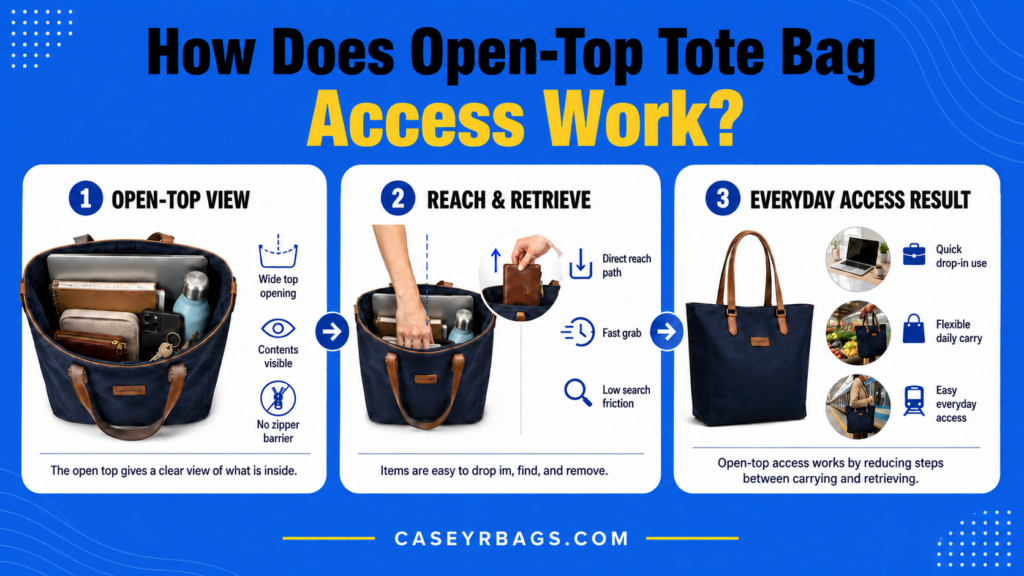
Open-Top Tote Bag Access works through a broad direct entry into the main storage area, while opening geometry, Tote depth, item position, handles, organization, and retention determine how usable that access becomes. The opening can make loading immediate and expose much of the cavity, but the full access path continues after the hand passes the rim.
A Tote may therefore be easy to load yet difficult to search when small items settle below larger objects, handles fall across the opening, or a deep flexible body reduces visibility. Large opening ≠ complete access quality. Strong access depends on whether intended items can be located, reached, and retained with acceptable effort under the way the Tote is actually carried.
What Does Open-Top Access Mean in a Tote Bag?
Open-Top Tote access means the primary storage area is reached through a broad upper entry that creates a relatively direct loading and retrieval path. Fewer opening steps let the hand move into the main cavity quickly, which makes placement and unloading simple when contents change throughout the day.
That direct entry still depends on structural conditions. Opening width determines exposed space, Tote depth determines how far the hand must travel, handle clearance can obstruct or preserve the entry path, body rigidity affects whether the rim stays open, and item position determines what is actually reachable.
Low entry friction can therefore coexist with high search effort. The broader Tote Bag structure explains how this access mechanism works with body form, handles, capacity, and utility carry rather than treating the opening as a complete Tote definition.
Which Structural Features Directly Control Open-Top Tote Access?
Opening width and length control how much of the upper cavity is exposed, while Tote depth controls the vertical reach needed after the hand enters. Side flexibility can let the opening widen around irregular contents or collapse inward when the bag is lightly loaded. Handle spacing and drop affect whether the hand can move through the opening without straps crossing the path.
Base width and internal partitions then influence where objects settle. A wider stable base can spread contents laterally, while narrow or shifting interiors can stack them vertically. The mechanism is structural feature → access effect → retrieval consequence. No single dimension proves strong access because the opening, depth, handles, and interior layout work together.
Why Does a Broad Opening Make Tote Loading Easier?
A broad opening makes Tote loading easier by exposing a larger entry area and reducing the need to align objects with a narrow zipper path or rigid compartment. Irregular item shapes, changing loads, books, clothing, work materials, or shopping contents can be placed directly into the cavity with fewer opening steps. The same geometry also supports fast unloading because the hand can remove larger objects without navigating a small access point.
The useful chain is broad opening → low loading friction → easier Tote loading. The boundary is retrieval efficiency: fast entry does not guarantee fast item location after contents begin to stack, migrate, or hide one another inside the body.
Why Does Open-Top Access Not Guarantee Easy Retrieval?
Open-top access does not guarantee easy retrieval because the opening controls entry into the bag, not the final position of every object. A deep interior can place small items below the natural hand-reach zone, while stacking and crowding can hide frequent objects beneath larger contents. Flexible bodies may also let items migrate toward corners or the base as the Tote moves.
Weak organization adds another layer of search effort. If keys, a phone, or a wallet have no predictable location, the user may still need to scan or move several objects despite the opening being fully exposed. Easy opening ≠ easy item location; retrieval quality depends on position, visibility, and reach after entry.
How Does Opening Geometry Affect Tote Bag Access?
Opening geometry affects Tote access by determining how much interior space is exposed, how freely the hand enters, and how stable the access path remains while the bag is loaded or carried.
How Does Opening Width Change Access?
Opening width changes access by controlling the exposed entry area available for the hand and for wider objects. A wider opening can improve visibility, allow larger items to enter without rotation, and give the hand more lateral freedom during placement or removal. It can also make the upper cavity easier to scan when contents remain below the rim.
Wider opening ≠ automatically better access. If the Tote is very deep, heavily crowded, or flexible enough for the rim to collapse, the extra width may improve loading without reducing search effort. Opening width is strongest when it works with manageable depth, stable geometry, and predictable item position.
How Does Opening Shape Affect Retrieval?
Opening shape changes retrieval because rectangular, narrow elongated, curved, and gathered entries expose different parts of the interior. A rectangular opening can create broad corner-to-corner visibility, while a narrow elongated opening may provide length without much side-to-side hand freedom. Curved or gathered rims can adapt around contents but may reduce the visible area when the material folds inward.
The mechanism is opening geometry → visible interior → hand path → retrieval effort. Shape matters most when the user reaches for frequent items without fully unloading the bag. No shape is universally best because each trades exposed area, structural control, and flexibility differently.
How Does Structural Rigidity Change the Opening?
A structured opening uses a firmer rim, reinforced edge, or shape-retaining body to preserve a predictable entry area as contents change. This can keep the hand path clear and reduce the need to pull the sides apart before reaching inside. A flexible opening can adapt around irregular objects and compress when the bag is lightly loaded, which preserves packing flexibility.
The trade-off is stability versus adaptability. Structured opening → retained shape → predictable entry, while flexible opening → load-responsive geometry → possible repositioning. Rigidity improves access only when preserved shape helps the intended retrieval pattern without making the bag unnecessarily stiff or reducing useful loading flexibility.
| Opening Trait | Access Effect | Main Advantage | Possible Limitation |
|---|---|---|---|
| Wide rectangular opening | Large exposed area | High visibility and hand freedom | Lower passive retention when fully open |
| Narrow elongated opening | Long but constrained entry | Fits flat or long contents | Less lateral hand movement |
| Curved/gathered rim | Adaptive entry shape | Flexible loading | Can reduce exposed area |
| Rigid rim | Retains geometry | Predictable hand entry | Less compressible |
How Does Tote Depth Affect Open-Top Access?
Tote depth changes Open-Top access by increasing or reducing the vertical distance between the opening and stored contents. More depth can create useful capacity, but it can also lengthen the hand-reach and search path.
When Does Tote Depth Improve Storage Usability?
Tote depth improves storage usability when taller items, larger loads, or vertically oriented contents need enough internal height to sit securely below the opening. More depth can keep objects from protruding above the rim and can increase the usable volume available for changing daily contents. It may also allow larger items to stand upright rather than lie across smaller objects.
The correct relationship is depth → capacity opportunity, not depth → automatic access improvement. Extra vertical space becomes useful only when the user can still see, locate, and reach the intended items without repeatedly removing upper contents or searching through an uncontrolled lower layer.
When Does a Deep Tote Make Items Harder to Reach?
A deep Tote makes items harder to reach when small objects settle below larger contents, the user cannot see the base, or stacked items block the natural hand path. Greater vertical distance increases the reach needed to touch lower objects, while flexible sidewalls can let contents shift away from the expected location as the bag moves.
More depth can therefore increase storage while reducing retrieval efficiency. The problem is strongest when frequent items share the lowest area with larger objects and no upper pocket or dedicated zone keeps them predictable. Depth becomes an access cost when the user must repeatedly search, move contents, or insert most of the forearm to retrieve routine items.
How Should Opening Width & Tote Depth Work Together?
Opening width and Tote depth should work together so the exposed entry area provides enough visibility and hand freedom for the vertical distance inside the bag. A wide opening with manageable depth can expose more of the cavity and keep lower items within a shorter reach path. A narrow opening combined with a deep body can make the same contents harder to inspect and access.
The comparison should remain proportional rather than numeric because no universal opening-to-depth measurement fits every use. The useful question is whether the user can see and reach the intended zones without excessive repositioning. Width and depth are complementary access variables, not independent signs of better capacity or retrieval.
How Does Interior Organization Change Open-Top Tote Access?
Interior organization changes Open-Top Tote access by determining whether flexible loading also produces predictable item location. Open space preserves loading freedom, while pockets and partitions can shorten the search path for specific objects.
How Does an Open Interior Support Adaptable Loading?
An open interior supports adaptable loading because the cavity can accept changing item sizes without forcing every object into a predefined compartment. Irregular shapes, larger work materials, clothing, groceries, or mixed personal items can use the available space according to need, and the user can load or unload quickly without navigating multiple dividers.
The trade-off appears after contents begin to move. Flexible loading ≠ predictable retrieval. Small items can settle under larger objects, shift toward corners, or occupy a different position each time the bag is carried. Open interiors are strongest when the load changes frequently and frequent-use items still have a predictable upper or dedicated location.
When Do Pockets Improve Tote Access?
Pockets improve Tote access when they give frequent-use items a dedicated, predictable position near the natural retrieval path. A phone, keys, wallet, or small accessory can be easier to locate when it remains in an upper side pocket instead of migrating through the main cavity. The benefit comes from reducing search rather than simply increasing compartment count.
The mechanism is frequent-use item → dedicated position → lower search effort. Pocket placement matters as much as pocket presence. A deep or hidden pocket can add another search step, while a well-positioned upper pocket can preserve the flexible main cavity and still create reliable access to the items retrieved most often.
When Can Too Much Organization Reduce Open-Top Utility?
Too much organization can reduce Open-Top utility when rigid compartments fragment the main cavity, block irregular objects, or create many small spaces that are difficult to use. Unnecessary pockets can reduce flexible volume and force the user to remember multiple possible item locations instead of making access more predictable. Additional flaps or internal closures can also add retrieval steps inside an otherwise direct opening.
More organization ≠ automatically better access. Organization is useful when it shortens the location path for recurring items without preventing the Tote from handling its normal load. The strongest layout gives high-frequency objects stable positions while leaving enough adaptable volume for the items that vary in size or shape.
| Interior Layout | Loading Flexibility | Item Predictability | Retrieval Effort | Best Access Role |
|---|---|---|---|---|
| Open cavity | High | Low-moderate | Variable | Changing/irregular loads |
| Upper utility pocket | High | High for small items | Low | Frequent-use access |
| Multiple rigid dividers | Low-moderate | High if correctly assigned | Low-moderate | Predictable repeated loads |
| Many small pockets | Lower | Conditional | Can increase if over-fragmented | Narrow item sets |
How Do Handles Affect Open-Top Tote Access?
Handles affect Open-Top Tote access by changing opening clearance, Tote position, hand movement, and repositioning requirements. The same broad opening can behave differently when handles frame it cleanly, fall inward, or press the body against the torso.
How Can Handle Placement Affect the Opening Area?
Handle placement affects the opening area because the straps or handles usually anchor near the same rim the hand must pass through. Widely spaced handles can frame the entry and leave the center open, while long flexible handles may fall inward and partially cover the contents when the Tote is set down. Closely spaced anchors can also concentrate material near the opening and reduce lateral hand freedom.
The useful chain is handle architecture → opening clearance → retrieval effort. Handles improve access when they preserve a clear path without requiring the user to move them repeatedly. The effect depends on spacing, drop, stiffness, and how the bag is positioned, not simply on whether the Tote has long or short handles.
How Does Hand Carry Differ From Shoulder Carry for Tote Access?
Hand carry usually keeps the opening away from the torso and makes the Tote easier to reposition before retrieval. The user can set the bag down, rotate it, or hold the rim open with the free hand, which can improve visibility and clearance. Shoulder carry keeps the bag closer to the body and may allow some on-body retrieval without a full position change.
The trade-off is possible opening compression. When the Tote sits tightly under the arm, the torso and handle tension can narrow the upper entry or push one side inward. Shoulder carry can therefore shorten repositioning for some items while making the opening less exposed. Carry position changes the access path even when the bag itself is unchanged.
When Should the Tote Be Repositioned Before Accessing Contents?
The Tote should be repositioned when the current carry position limits visibility, compresses the opening, blocks hand movement, or makes item location uncertain. Moving the bag from the shoulder to the hand, hip, or a stable surface can expose more of the cavity and allow the user to separate larger contents before reaching for smaller items. Repositioning can also improve retention by giving the user more control over the opening in crowded environments.
Not every item needs to remain accessible while the Tote stays on the shoulder. The better access pattern is the one that keeps frequent retrieval practical without forcing the bag to remain permanently open or unstable. A deliberate reposition can be more efficient than repeated blind searching.
How Do Closures Change Open-Top Tote Access?
Closures modify Open-Top Tote access by increasing retention while adding opening steps or partially restricting the otherwise direct entry path. Their value depends on how much control is needed and how much reopening friction the routine can tolerate.
How Does a Zipper Change Tote Access?
A zipper changes Tote access by adding a deliberate opening step before the hand reaches the main cavity. That extra action can increase retention, reduce exposure, and keep loose items from leaving the bag during movement or tipping. A broad zipper that follows most of the Tote opening can still preserve much of the original loading width once fully opened.
The mechanism is zipper → additional opening step → stronger retention. The trade-off is speed and hand freedom because the user may need to hold or move the zipper before loading and retrieval. A zipper improves access quality when its retention benefit matters more than the small increase in opening friction for the intended context.
How Do Snaps & Magnetic Closures Affect Access?
Snaps and magnetic closures create partial retention with relatively low reopening friction. They can pull the upper edges closer together, reduce casual exposure, and help the Tote stay more controlled without requiring a full zipper path. The user can usually separate the closure quickly and regain broad access to most of the cavity.
The trade-off is limited containment. A single snap or magnet may not stop small objects from leaving the bag if it tips, and it may not protect the entire opening from weather or crowded contact. Light closure → partial retention → relatively low reopening friction is most useful when the user wants some control without giving up the direct character of open-top loading.
When Does a Closure Improve Open-Top Tote Usability?
A closure improves Open-Top Tote usability when crowded environments, repeated movement, loose items, tipping risk, or weather exposure create enough retention pressure to justify another access step. The closure can reduce accidental exposure and keep contents more controlled while the Tote is carried, especially when the opening would otherwise remain wide during movement.
Open access and retention exist on a trade-off rather than as absolute opposites. Strong access does not require zero closure, and retention does not require eliminating the Tote’s broad loading path. When the question shifts from retrieval mechanics to whether extra control is necessary, Tote Access Security addresses that sibling security condition.
| Access System | Opening Effort | Visibility | Retention | Main Trade-Off |
|---|---|---|---|---|
| Fully open top | Very low | High | Low-moderate | Fast access / less passive control |
| Snap or magnet | Low | High after release | Moderate | Quick reopening / partial containment |
| Broad zipper | Moderate | High when fully open | High | More retention / extra opening step |
| Internal security pocket | Higher for selected items | Localized | High for valuables | Targeted control / extra retrieval step |
How Should Open-Top Tote Access Be Evaluated for Everyday Use?
Open-Top Tote access should be evaluated by combining opening geometry, Tote depth, organization, handle clearance, retrieval frequency, and retention requirements. The best access system is the one that works with the normal load under the actual carrying position.
Which Items Should Receive the Easiest Tote Access?
The items used most frequently should receive the easiest Tote access because repeated retrieval creates the largest cumulative access cost. A phone, keys, wallet, badge, or other routine object should remain near a predictable upper or dedicated location when it is needed several times during the day. Rarely used items can tolerate a deeper or less immediate position.
The mechanism is retrieval frequency → item position → access priority. The goal is not to make every object equally exposed. Frequent items should have the shortest reliable path, while larger or less-used contents can occupy deeper areas as long as they do not block essential objects or make the opening difficult to use.
How Should Tote Capacity Be Balanced Against Retrieval Effort?
Tote capacity should be balanced against retrieval effort by giving the normal load enough space without creating uncontrolled excess volume. Too little capacity can force objects to protrude, stack tightly, or block the opening. Too much depth or unused cavity space can let smaller items migrate, increase vertical search distance, and encourage overloading that makes both carrying and retrieval less predictable.
Usable capacity > maximum capacity. The strongest access fit is not the largest cavity available; it is the smallest practical volume that carries the intended items without crowding while preserving predictable locations and a manageable reach path. Capacity supports access only when the space remains controllable.
Which Access Characteristics Should Be Verified Before Use?
- Identify normal carried items.
- Identify frequent-use items.
- Check opening width.
- Check Tote depth.
- Evaluate interior visibility.
- Check handle clearance.
- Review pocket and divider position.
- Evaluate retention needs.
- Test the actual carrying position.
- Confirm retrieval effort is acceptable.
The test should use the normal load rather than an empty bag. If frequent items become hidden, the opening compresses on the shoulder, or the user must repeatedly move large contents before reaching routine objects, the apparent open access is not producing strong everyday retrieval.
How Can Open-Top Tote Access Problems Be Avoided?
Open-Top Tote access problems are avoided by checking how opening geometry, depth, item position, organization, handles, and retention behave together. Most problems appear when one visible access feature is treated as proof of complete retrieval quality.
Why Is Judging Tote Access From Opening Width Alone a Mistake?
Judging Tote access from opening width alone is a mistake because width reveals only the exposed entry area. It does not show body depth, where frequent items settle, whether handles obstruct the opening, how crowded the cavity becomes, or how far the hand must travel after entering. A wide opening can therefore coexist with difficult retrieval.
Opening size ≠ complete access performance. Strong access appears only when the user can move through the opening and continue to a predictable item location without excessive search, stacking, or repositioning. Width is an important signal, but it must be interpreted with the rest of the Tote access path.
How Can Poor Item Placement Make an Open Tote Difficult to Use?
Poor item placement makes an open Tote difficult to use when small objects settle at the base, frequent items sit beneath larger contents, or unstable stacking changes their location during movement. Overloaded pockets can create the same problem by hiding items inside crowded compartments, while loose objects can migrate toward corners that are difficult to see or reach.
The opening remains technically accessible, but the location path becomes inefficient. Frequent items should stay in predictable positions that remain reachable under the normal load. Larger or less-used objects can occupy deeper zones as long as they do not block the access route to items retrieved repeatedly.
What Should Be Verified Before Relying on Open-Top Tote Access?
- Opening fits normal items.
- Opening stays usable while carried.
- Depth allows practical reach.
- Frequent items stay predictable.
- Large items do not block essentials.
- Handles preserve access clearance.
- Interior visibility is acceptable.
- Organization supports retrieval.
- Pockets preserve flexible space.
- Retention fits the context.
- Closure friction is justified.
- Capacity avoids excessive stacking.
- Access-retention trade-off is understood.
- Retrieval works while carried.
If several checks fail, recheck opening, depth, item position, organization, handle clearance, and retention before adding compartments or closures. Follow opening → depth → item position → organization → handle clearance → retention → revalidate. Strong access should become clearer as the complete retrieval path aligns with the intended load.
These are qualitative access-fit outcomes, not a numerical scoring system.
Conclusion
Open-Top Tote Bag Access works through a broad direct entry into the main storage volume, but real access depends on opening geometry, Tote depth, item placement, handles, organization, and retention working together. A wide opening can simplify loading and improve visibility while deeper storage, poor item position, or blocked hand clearance can still increase retrieval effort.
Easy opening ≠ easy item location, large opening ≠ complete access quality, and open-top structure ≠ zero retention control. CaseyrBags evaluates Open-Top Tote access by the complete loading, location, retrieval, and retention path rather than opening size alone. Effective access comes from a broad usable opening combined with manageable depth, predictable item placement, unobstructed reach, and enough retention for the intended carrying context.
FAQs
Tote Bags commonly use broad open tops because the entry lowers loading friction, accommodates changing item shapes, reduces opening steps, and exposes much of the main storage volume. The format is especially useful when contents vary, although broad entry still needs manageable depth and organization for predictable retrieval.
Not necessarily. A zipper modifies the access system by adding an opening step and stronger retention, but a broad zipper can still preserve the Tote’s main loading path when fully opened. Whether the bag remains Tote-like depends on the wider relationship between opening, body, handles, and utility carry.
A broad opening does not create predictable item location by itself. Depth, stacking, loose-item migration, crowding, and weak organization can hide frequent objects or increase hand-reach distance. Open-Top Tote access becomes easier when important items stay in stable positions that remain visible and reachable under the normal load.