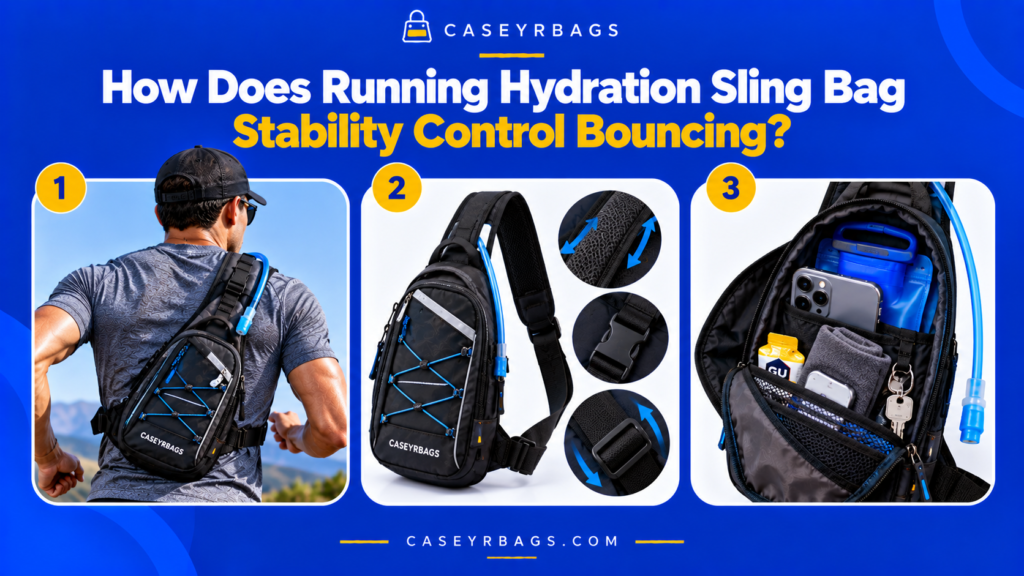
How Does Running Hydration Sling Bag Stability Control Bouncing?
A Running Hydration Sling Bag controls bouncing by keeping its loaded mass close to the torso and limiting how far the bag can move independently during repeated running motion. Strap geometry, appropriate tension, stable anchors, controlled bag depth, and close hydration placement reduce vertical lift, side-to-side swing, and unwanted rotation.
The hydration system also has to remain controlled inside the bag. A stable outer bag can still feel unsettled if the reservoir, bottle, or other dense contents shift internally, so effective bounce control depends on both external bag stability and internal load stability. A useful setup therefore controls the complete loaded system instead of treating outer-bag tightness as the only source of stability.
What Does Bounce Control Mean in a Running Hydration Sling Bag?
Running repeatedly changes the speed and direction of the torso. If the bag has too much freedom relative to the body, its mass can continue moving after the torso changes direction, creating noticeable bounce or swing.
Bounce is not one single movement. A Sling Bag can move vertically, laterally, rotationally, or through a combination of these directions, and different design or loading problems can produce different movement patterns.
Effective stability therefore does not require the bag to become motionless. It requires the bag and its dense contents to remain sufficiently controlled that their movement follows the torso predictably rather than repeatedly separating from it within the broader Sling Bag system.
What Is Vertical Bounce?
Vertical bounce occurs when the bag repeatedly lifts and drops relative to the torso instead of following the body through a smaller controlled movement range. Evaluate the condition with the normal hydration load and normal running essentials, because empty-bag behavior can hide the movement that appears once dense contents are carried.
Observable signs include repeated up/down travel, the lower edge separating and returning, and the strap repeatedly loading and unloading during the running cycle. If the observed movement does not improve, inspect the next related variable instead of continuing to tighten, compress, or restrain the same component beyond its functional range.
What Is Lateral Swing?
Lateral swing occurs when the bag moves side to side across its intended resting position rather than staying within a predictable body-facing path. Observe the same variable during actual running rather than only while standing, since repeated acceleration can expose movement that static fit does not reveal.
Loose suspension, poor torso contact, or an offset load can increase sideways movement, so the cause should be identified before further tightening. A useful correction reduces unnecessary movement while preserving workable access and normal bag geometry; maximum restriction is not the objective.
What Is Rotational Movement?
Rotational movement occurs when the bag changes angle around its strap or torso contact point rather than only moving vertically or laterally. Judge the result from the loaded system as a whole, not from the isolated component, because strap, bag geometry, hydration position, and internal load can interact.
Narrow anchor control, outward loading, or end-heavy packing can increase this movement. Bounce control begins by identifying which movement is actually occurring. This distinction prevents a visible symptom from being blamed on the wrong mechanism and keeps the adjustment focused on the actual source of instability.
Why Does Running Reveal More Bag Movement Than Static Fit?
Standing or walking can make a Sling Bag appear stable even though running introduces repeated acceleration, deceleration, vertical displacement, and torso rotation.
Why Can Standing Fit Hide Bounce Problems?
Standing does not reproduce repeated acceleration, deceleration, torso rotation, or vertical body movement, so free movement may remain hidden. Use the observed movement direction as the diagnostic starting point, since vertical bounce, lateral swing, rotation, container migration, and fluid movement can require different corrections.
A bag can look correctly positioned while stationary yet separate from the torso once repeated running motion begins. Where the movement source remains unclear, change one variable at a time and retest so whole-bag motion can be separated from internal hydration or accessory movement.
Why Can Walking Also Fail to Reveal the Full Problem?
Walking creates a different and often smaller repeated movement pattern, so some strap looseness, load migration, or bounce may remain minor until running. Keep the test conditions consistent before and after adjustment so any change in movement can be attributed to the variable that was actually modified.
Running should therefore be treated as its own stability test rather than an extension of standing fit. The target is predictable loaded behavior, not zero movement, because running will still create some normal motion even when the Sling Bag is functioning well.
What Should Be Evaluated During Actual Running Movement?
Observe bag separation, strap migration, lateral swing, rotation, and internal shifting while the normal hydration and accessory load is carried. Avoid assigning a universal numeric threshold to this condition; the useful result is an observable reduction in uncontrolled movement without breaking normal fit or access.
Running stability must be tested under running motion. For prolonged repeated movement, evaluate whether the same bounce-control features remain effective over longer distances. If the bag remains unstable after a sensible adjustment, recheck load position, depth, anchors, retention, and internal free space before adding more restraint.
How Does the Diagonal Strap Path Control Bounce?
The diagonal Sling strap creates a torso-supported suspension path that can keep the bag closer to a defined carry plane and reduce unrestricted movement.
How Does Diagonal Strap Routing Support the Bag?
The bag transfers load through its anchors into a diagonal strap path that crosses the torso-supported carry line. Check the response with the bag normally loaded and closed, because the same geometry can behave differently once depth, dense contents, and hydration mass are present.
Bag anchors → diagonal strap path → torso-supported suspension. The result depends on anchor placement, adjustment, bag shape, and loading. A stable result should remain observable across ordinary movement without forcing the bag into an unnaturally compressed position or making routine access difficult.
How Does Diagonal Support Reduce Free Swinging?
Body-crossing tension can maintain torso contact, limit pendulum-like movement, and keep the resting angle more predictable during running. Treat the feature as one part of the bounce-control system rather than a stand-alone guarantee, and verify whether it improves the loaded bag’s actual movement pattern.
Diagonal support does not immobilize the bag; it reduces the zone in which the bag can move independently. This keeps the article’s boundary intact: structural strength, close fit, or added restraint can support stability, but none of them proves effective bounce control by itself.
Why Does One Strap Not Automatically Mean Unstable Running Carry?
Single-strap support can remain controlled when the strap path, anchors, adjustment, bag geometry, and load distribution work together. Compare the bag’s position before and after the adjustment using the same load, because a useful change should improve control without introducing a new fit or access problem.
Single-strap support ≠ uncontrolled support. The correction is successful only when it improves the movement pattern that was actually observed rather than merely making the bag feel tighter while standing. Retest with the same normal load so the response remains comparable and the movement source stays identifiable.
| Mechanism | Movement-Control Effect | Bounce Consequence |
|---|---|---|
| Diagonal support | Closer body position | Smaller free movement zone |
| Stable carry plane | More predictable orientation | Less uncontrolled swing |
| Loose diagonal setup | More torso separation | Greater bounce potential |
How Does Strap Tension Affect Running Bounce?
Strap tension should reduce unnecessary separation without distorting the bag, restricting access, or pretending that tightening can solve internal load movement.
What Happens When the Primary Strap Is Too Loose?
The bag can move farther from the torso, increasing vertical separation, lateral swing, and uncontrolled rotation. The practical question is whether this condition helps the loaded bag follow torso movement more predictably rather than moving through a larger independent path.
Primary strap too loose → bag sits farther away → free-movement distance increases → bounce becomes more visible. Use the change in movement as evidence; if the same bounce, swing, or rotation persists, the original diagnosis should be reconsidered rather than intensified. Retest with the same normal load so the response remains comparable and the movement source stays identifiable.
What Happens When the Strap Is Excessively Tight?
Excess tension can distort bag geometry, restrict natural repositioning, make access difficult, and still leave container or fluid movement unresolved. Evaluate the condition with the normal hydration load and normal running essentials, because empty-bag behavior can hide the movement that appears once dense contents are carried.
Tighter strap ≠ automatically less bounce when the true cause lies inside the bag or in load geometry. If the observed movement does not improve, inspect the next related variable instead of continuing to tighten, compress, or restrain the same component beyond its functional range.
What Defines Useful Running Strap Tension?
Useful tension keeps the bag close, limits free movement, preserves stable orientation, and still allows normal access. Observe the same variable during actual running rather than only while standing, since repeated acceleration can expose movement that static fit does not reveal.
Useful tension controls free movement without trying to eliminate all movement. A useful correction reduces unnecessary movement while preserving workable access and normal bag geometry; maximum restriction is not the objective. Retest with the same normal load so the response remains comparable and the movement source stays identifiable.
| Strap Condition | Body Proximity | Free Movement | Main Problem |
|---|---|---|---|
| Too loose | Low | High | Bounce/swing |
| Controlled | High | Low–moderate | Functional stability |
| Excessively tight | Very high | Low | Fit/access restriction |
| Uneven | Variable | Rotational | Unpredictable orientation |
How Does Strap Anchor Geometry Control Bag Orientation?
Anchor placement determines how strap forces enter the bag body and whether the loaded Sling remains flat or pivots around a narrow control zone.
How Does Anchor Separation Affect Rotational Control?
More effective separation between control points can spread orientation control across more of the bag body rather than concentrating it near one pivot. Judge the result from the loaded system as a whole, not from the isolated component, because strap, bag geometry, hydration position, and internal load can interact.
Greater control-point separation can lower pivot potential without creating one universal ideal spacing. This distinction prevents a visible symptom from being blamed on the wrong mechanism and keeps the adjustment focused on the actual source of instability.
How Does Anchor Position Influence the Resting Angle?
Upper and lower anchor locations change strap angle, bag tilt, and how the body-facing panel sits against the torso. Use the observed movement direction as the diagnostic starting point, since vertical bounce, lateral swing, rotation, container migration, and fluid movement can require different corrections.
Anchor geometry therefore affects both static orientation and how the bag responds to repeated running motion. Where the movement source remains unclear, change one variable at a time and retest so whole-bag motion can be separated from internal hydration or accessory movement.
When Can Anchor Geometry Create Excessive Pivoting?
Closely clustered control points, deformation near the attachment zone, or a load that pulls strongly away from the anchor line can increase rotation. Keep the test conditions consistent before and after adjustment so any change in movement can be attributed to the variable that was actually modified.
Strong attachment ≠ effective stability geometry. The target is predictable loaded behavior, not zero movement, because running will still create some normal motion even when the Sling Bag is functioning well. Retest with the same normal load so the response remains comparable and the movement source stays identifiable.
| Anchor Condition | Orientation Result | Movement Risk |
|---|---|---|
| Effective separation | Predictable bag plane | Lower pivot potential |
| Clustered control points | Pivot-prone geometry | More rotation |
| Uneven alignment | Tilted resting angle | Asymmetrical movement |
| Deforming attachment zone | Variable geometry | Unpredictable movement |
How Does Body-Facing Fit Limit Free Movement?
Useful torso contact reduces the free gap in which the bag can travel before strap and body contact begin controlling its motion.
How Does Close Torso Contact Reduce Vertical Separation?
A smaller free gap gives the bag less distance to lift or drop independently before the strap and contact plane limit further travel. Avoid assigning a universal numeric threshold to this condition; the useful result is an observable reduction in uncontrolled movement without breaking normal fit or access.
Smaller free gap → less independent movement distance → lower visible bounce potential. If the bag remains unstable after a sensible adjustment, recheck load position, depth, anchors, retention, and internal free space before adding more restraint. Retest with the same normal load so the response remains comparable and the movement source stays identifiable.
How Does a Stable Contact Plane Reduce Lateral Swing?
When the bag rests against a known body-facing surface, torso contact can limit sideways displacement and help preserve orientation. Check the response with the bag normally loaded and closed, because the same geometry can behave differently once depth, dense contents, and hydration mass are present.
Stable contact supports the strap system rather than replacing it. A stable result should remain observable across ordinary movement without forcing the bag into an unnaturally compressed position or making routine access difficult. Retest with the same normal load so the response remains comparable and the movement source stays identifiable.
Why Is Maximum Compression Against the Body Unnecessary?
Useful close fit does not require the bag to be pressed as tightly as possible, especially when that distorts shape or restricts access. Treat the feature as one part of the bounce-control system rather than a stand-alone guarantee, and verify whether it improves the loaded bag’s actual movement pattern.
Close fit ≠ maximum tightness. This keeps the article’s boundary intact: structural strength, close fit, or added restraint can support stability, but none of them proves effective bounce control by itself. Retest with the same normal load so the response remains comparable and the movement source stays identifiable.
How Does Bag Depth Affect Bounce Potential?
Front-to-back depth moves the effective load center farther from or closer to the torso, changing the leverage and movement envelope of the Sling Bag.
Why Does a Shallow Profile Support Stability?
A shallow body keeps the load center nearer the body-facing plane and reduces the distance through which the bag can project outward. Compare the bag’s position before and after the adjustment using the same load, because a useful change should improve control without introducing a new fit or access problem.
Load center closer to body-facing plane → smaller outward movement envelope. The correction is successful only when it improves the movement pattern that was actually observed rather than merely making the bag feel tighter while standing.
How Does Added Depth Change Running Movement?
Greater depth moves mass outward, increases rotational leverage, and can make exterior movement more noticeable during repeated running motion. The practical question is whether this condition helps the loaded bag follow torso movement more predictably rather than moving through a larger independent path.
Deeper geometry may increase capacity while making one-strap control more demanding. Use the change in movement as evidence; if the same bounce, swing, or rotation persists, the original diagnosis should be reconsidered rather than intensified. Retest with the same normal load so the response remains comparable and the movement source stays identifiable.
Why Can a Shallow Bag Still Bounce?
A loose strap, unstable hydration container, end-heavy loading, or poor anchor geometry can still create movement even with a compact profile. Evaluate the condition with the normal hydration load and normal running essentials, because empty-bag behavior can hide the movement that appears once dense contents are carried.
Shallow depth supports bounce control but does not create it alone. If the observed movement does not improve, inspect the next related variable instead of continuing to tighten, compress, or restrain the same component beyond its functional range.
How Does Hydration Placement Affect Bounce Control?
Hydration is a dense carried load, so its position strongly influences the loaded center of the bag and the leverage acting on the one-strap system.
Why Is Hydration Position Especially Important?
Fluid can represent a substantial share of the loaded Sling Bag mass relative to small running accessories. Observe the same variable during actual running rather than only while standing, since repeated acceleration can expose movement that static fit does not reveal.
Because it is dense, moving hydration outward or toward one end can change bag behavior more than relocating a light accessory. A useful correction reduces unnecessary movement while preserving workable access and normal bag geometry; maximum restriction is not the objective. Retest with the same normal load so the response remains comparable and the movement source stays identifiable.
How Does Body-Facing Hydration Placement Support Stability?
Keeping the dense hydration load nearer the body-facing side helps keep the effective load center closer to the torso. Judge the result from the loaded system as a whole, not from the isolated component, because strap, bag geometry, hydration position, and internal load can interact.
Body-facing hydration → closer effective load center → reduced outward leverage. This distinction prevents a visible symptom from being blamed on the wrong mechanism and keeps the adjustment focused on the actual source of instability. Retest with the same normal load so the response remains comparable and the movement source stays identifiable.
What Happens When Hydration Sits Far Outward?
Outward placement increases pull-away force, rotational leverage, and the influence that any fluid movement can exert on bag orientation. Use the observed movement direction as the diagnostic starting point, since vertical bounce, lateral swing, rotation, container migration, and fluid movement can require different corrections.
The densest load should not be treated like a minor accessory. Where the movement source remains unclear, change one variable at a time and retest so whole-bag motion can be separated from internal hydration or accessory movement. Retest with the same normal load so the response remains comparable and the movement source stays identifiable.
| Hydration Position | Effective Load Center | Likely Stability Effect |
|---|---|---|
| Body-facing | Closer | More stable potential |
| Central | Balanced | Controlled |
| Outer position | Farther outward | More rotation potential |
| End-biased | Offset | Tilt / uneven movement |
How Does Hydration Container Movement Affect Stability?
The whole reservoir or bottle can shift inside the bag independently from the fluid moving within it, so container movement needs its own diagnosis.
What Happens When the Entire Hydration Container Shifts Inside the Bag?
The effective load center changes, bag tilt can change, and repeated internal contact can occur as the container moves within the compartment. Keep the test conditions consistent before and after adjustment so any change in movement can be attributed to the variable that was actually modified.
Container migration → moving load center → less predictable bag orientation. The target is predictable loaded behavior, not zero movement, because running will still create some normal motion even when the Sling Bag is functioning well. Retest with the same normal load so the response remains comparable and the movement source stays identifiable.
How Does a Dedicated Compartment or Retention Feature Help?
A dedicated pocket, sleeve, strap, or other retention feature can keep the hydration container in its intended zone. Avoid assigning a universal numeric threshold to this condition; the useful result is an observable reduction in uncontrolled movement without breaking normal fit or access.
Container held in intended zone → less internal migration → more predictable load placement. If the bag remains unstable after a sensible adjustment, recheck load position, depth, anchors, retention, and internal free space before adding more restraint. Retest with the same normal load so the response remains comparable and the movement source stays identifiable.
Why Does Container Retention Not Stop Fluid Movement?
A fixed reservoir or bottle can still contain liquid that moves internally as running direction changes. Check the response with the bag normally loaded and closed, because the same geometry can behave differently once depth, dense contents, and hydration mass are present.
Container retention ≠ fluid immobilization. A stable result should remain observable across ordinary movement without forcing the bag into an unnaturally compressed position or making routine access difficult. Retest with the same normal load so the response remains comparable and the movement source stays identifiable.
How Does Fluid Movement Interact With Bag Bounce?
Liquid has its own momentum inside the retained hydration container, so fluid behavior can change perceived stability even when the outer bag and container remain well controlled.
Why Can Fluid Continue Moving After the Bag Changes Direction?
Liquid can keep redistributing after the torso and bag change direction because the fluid mass has its own internal momentum. Treat the feature as one part of the bounce-control system rather than a stand-alone guarantee, and verify whether it improves the loaded bag’s actual movement pattern.
This movement occurs within the container and should be separated from whole-container migration. This keeps the article’s boundary intact: structural strength, close fit, or added restraint can support stability, but none of them proves effective bounce control by itself.
How Can Fluid Movement Influence the Perceived Stability of the Bag?
Fluid redistribution can shift the internal mass temporarily and create delayed or changing directional pull inside the otherwise stable compartment. Compare the bag’s position before and after the adjustment using the same load, because a useful change should improve control without introducing a new fit or access problem.
The user may feel movement even when the reservoir itself stays in place. The correction is successful only when it improves the movement pattern that was actually observed rather than merely making the bag feel tighter while standing.
Why Should Fill Level Not Be Reduced to One Universal Rule?
Flexible reservoirs, rigid bottles, baffled containers, different shapes, and different retention systems can behave differently at changing fill states. The practical question is whether this condition helps the loaded bag follow torso movement more predictably rather than moving through a larger independent path.
Fill state changes fluid behavior, but its effect depends on the hydration-container design. Use the change in movement as evidence; if the same bounce, swing, or rotation persists, the original diagnosis should be reconsidered rather than intensified. Retest with the same normal load so the response remains comparable and the movement source stays identifiable.
How Does Internal Compression Reduce Bounce?
Compression reduces unused internal movement space so hydration and accessories behave more like one controlled load rather than several items moving independently.
How Does Compression Reduce Content Migration?
Reducing empty space around contents gives dense items less room to slide, lift, or rotate inside the chamber during repeated motion. Evaluate the condition with the normal hydration load and normal running essentials, because empty-bag behavior can hide the movement that appears once dense contents are carried.
Less unused space around contents → less room for independent item movement. If the observed movement does not improve, inspect the next related variable instead of continuing to tighten, compress, or restrain the same component beyond its functional range.
How Can Compression Support Hydration Positioning?
Compression can help hold the reservoir against its intended panel, keep compartment shape controlled, and reduce migration of nearby contents. Observe the same variable during actual running rather than only while standing, since repeated acceleration can expose movement that static fit does not reveal.
Useful compression preserves the hydration zone without forcing the container into an unnatural shape. A useful correction reduces unnecessary movement while preserving workable access and normal bag geometry; maximum restriction is not the objective. Retest with the same normal load so the response remains comparable and the movement source stays identifiable.
When Does Compression Become Excessive?
Excessive compression can distort bag geometry, press unnecessarily on the hydration container, restrict access, or crush items together. Judge the result from the loaded system as a whole, not from the isolated component, because strap, bag geometry, hydration position, and internal load can interact.
Compression removes unnecessary movement space; it should not force the load unnaturally. This distinction prevents a visible symptom from being blamed on the wrong mechanism and keeps the adjustment focused on the actual source of instability. Retest with the same normal load so the response remains comparable and the movement source stays identifiable.
| Internal Control | Container Movement | Access | Overall Effect |
|---|---|---|---|
| Too loose | High | Easy | Unstable |
| Controlled | Low | Functional | Stable |
| Excessive | Low | Restricted | Over-compressed |
How Does Accessory Load Placement Affect Bouncing?
Smaller accessories can still shift the effective load center when dense items are packed outward, concentrated at one end, or left loose inside the Sling Bag.
Where Should Dense Accessories Generally Sit?
Dense accessories generally work best in controlled central or body-facing zones where suitable and inside defined internal pockets. Use the observed movement direction as the diagnostic starting point, since vertical bounce, lateral swing, rotation, container migration, and fluid movement can require different corrections.
The goal is to keep dense secondary items from pulling the loaded system farther outward than necessary. Where the movement source remains unclear, change one variable at a time and retest so whole-bag motion can be separated from internal hydration or accessory movement.
What Happens When Dense Items Collect at One End?
End-heavy loading can produce bag tilt, unequal anchor demand, and more rotational movement during running. Keep the test conditions consistent before and after adjustment so any change in movement can be attributed to the variable that was actually modified.
Even small objects can matter when their density and position create a persistent offset load. The target is predictable loaded behavior, not zero movement, because running will still create some normal motion even when the Sling Bag is functioning well. Retest with the same normal load so the response remains comparable and the movement source stays identifiable.
Why Can Exterior-Pocket Loading Destabilize the Bag?
Dense items in outer pockets move the effective load center away from the body-facing plane and increase leverage. Avoid assigning a universal numeric threshold to this condition; the useful result is an observable reduction in uncontrolled movement without breaking normal fit or access.
Quick-access placement should not unnecessarily move the densest accessories outward. If the bag remains unstable after a sensible adjustment, recheck load position, depth, anchors, retention, and internal free space before adding more restraint. Retest with the same normal load so the response remains comparable and the movement source stays identifiable.
| Load Pattern | Load Position | Likely Movement |
|---|---|---|
| Central | Controlled | Predictable |
| Body-facing | Close | Stable potential |
| Outer-heavy | Outward | Rotation |
| End-heavy | Offset | Tilt |
| Loose | Changing | Variable bounce |
When Does a Secondary Stabilizer Strap Improve Bounce Control?
A stabilizer strap is useful when an observed movement problem remains after the primary strap, load position, depth, and internal retention have already been set sensibly.
What Does a Stabilizer Strap Change?
A secondary torso connection removes some degrees of bag movement and can reduce unwanted lateral, outward, or rotational travel. Check the response with the bag normally loaded and closed, because the same geometry can behave differently once depth, dense contents, and hydration mass are present.
Secondary torso connection → fewer degrees of bag movement. A stable result should remain observable across ordinary movement without forcing the bag into an unnaturally compressed position or making routine access difficult. Retest with the same normal load so the response remains comparable and the movement source stays identifiable.
Which Problems Can It Help Control?
It can help when lateral swing, outward separation, or unwanted rotation persists despite an otherwise functional primary Sling setup. Treat the feature as one part of the bounce-control system rather than a stand-alone guarantee, and verify whether it improves the loaded bag’s actual movement pattern.
The added strap should address a real movement pattern rather than act as a default feature. This keeps the article’s boundary intact: structural strength, close fit, or added restraint can support stability, but none of them proves effective bounce control by itself.
What Tradeoff Does the Stabilizer Introduce?
Additional stabilization can reduce repositioning freedom, slow rotational access, and add another adjustment step. Compare the bag’s position before and after the adjustment using the same load, because a useful change should improve control without introducing a new fit or access problem.
Secondary stabilization is useful when the primary Sling system cannot adequately control the normal loaded movement on its own. The correction is successful only when it improves the movement pattern that was actually observed rather than merely making the bag feel tighter while standing.
When Is the Primary Sling Strap Enough?
The primary strap is enough when the loaded bag stays predictably close, limits unwanted bounce and swing, and maintains orientation without meaningful improvement from secondary restraint.
What Indicates That Primary Strap Control Is Working?
Consistent torso contact, limited vertical bounce, limited lateral swing, and predictable bag orientation indicate that the primary strap is controlling the normal load. The practical question is whether this condition helps the loaded bag follow torso movement more predictably rather than moving through a larger independent path.
These signals should be judged during running rather than while standing still. Use the change in movement as evidence; if the same bounce, swing, or rotation persists, the original diagnosis should be reconsidered rather than intensified. Retest with the same normal load so the response remains comparable and the movement source stays identifiable.
When Is a Stabilizer Unnecessary?
A stabilizer is unnecessary when adding it produces little observable improvement in normal running stability or only adds adjustment complexity. Evaluate the condition with the normal hydration load and normal running essentials, because empty-bag behavior can hide the movement that appears once dense contents are carried.
Secondary restraint should solve a measured problem rather than be added automatically. If the observed movement does not improve, inspect the next related variable instead of continuing to tighten, compress, or restrain the same component beyond its functional range.
Why Should Stability Features Solve Observed Problems?
Every extra stability feature should address a specific movement source such as swing, rotation, or separation. Observe the same variable during actual running rather than only while standing, since repeated acceleration can expose movement that static fit does not reveal. Record what changes during running rather than assuming the adjustment worked from static feel alone.
More straps ≠ automatically more useful stability. A useful correction reduces unnecessary movement while preserving workable access and normal bag geometry; maximum restriction is not the objective. Retest with the same normal load so the response remains comparable and the movement source stays identifiable.
How Does Changing Hydration Load Affect Stability?
Bag behavior can change as water is consumed because total fluid mass, internal load distribution, and container shape may change throughout use.
How Does Changing Fluid Mass Alter the Loaded Bag?
As hydration is consumed, total carried mass and the contribution of the fluid load to the effective center of mass change. Judge the result from the loaded system as a whole, not from the isolated component, because strap, bag geometry, hydration position, and internal load can interact.
Hydration consumed → total fluid mass and load distribution change. This distinction prevents a visible symptom from being blamed on the wrong mechanism and keeps the adjustment focused on the actual source of instability. Retest with the same normal load so the response remains comparable and the movement source stays identifiable.
How Can Container Shape Change as Volume Decreases?
Flexible reservoirs may collapse inward, rigid bottles usually keep their external shape, and other systems behave according to their construction. Use the observed movement direction as the diagnostic starting point, since vertical bounce, lateral swing, rotation, container migration, and fluid movement can require different corrections.
Container response should therefore be evaluated from the actual hydration system rather than a universal fill rule. Where the movement source remains unclear, change one variable at a time and retest so whole-bag motion can be separated from internal hydration or accessory movement.
Why Should Stability Be Checked Across Realistic Hydration States?
A single full-load test may not represent how the bag behaves after part of the fluid has been consumed and internal geometry changes. Keep the test conditions consistent before and after adjustment so any change in movement can be attributed to the variable that was actually modified.
Realistic changing states help reveal whether retention and compression continue to work as intended. The target is predictable loaded behavior, not zero movement, because running will still create some normal motion even when the Sling Bag is functioning well.
How Can Running Hydration Sling Bounce Be Diagnosed?
Diagnosis should identify whether the instability comes from the whole bag, strap system, bag geometry, hydration container, fluid, or accessory load before more tension or restraint is added.
What Usually Causes Vertical Bounce?
Check a loose primary strap, weak body contact, bag separation from the torso, and excessive movement of the loaded contents. Avoid assigning a universal numeric threshold to this condition; the useful result is an observable reduction in uncontrolled movement without breaking normal fit or access.
Vertical bounce usually reflects excess up/down freedom somewhere in the complete system. If the bag remains unstable after a sensible adjustment, recheck load position, depth, anchors, retention, and internal free space before adding more restraint. Retest with the same normal load so the response remains comparable and the movement source stays identifiable.
What Usually Contributes to Rotational Instability?
Check bag depth, anchor geometry, outward hydration or accessory placement, and end-heavy packing. Check the response with the bag normally loaded and closed, because the same geometry can behave differently once depth, dense contents, and hydration mass are present.
These variables can move the load center away from the intended body-facing plane and increase pivoting. A stable result should remain observable across ordinary movement without forcing the bag into an unnaturally compressed position or making routine access difficult. Retest with the same normal load so the response remains comparable and the movement source stays identifiable.
What Suggests the Problem Is Internal Rather Than External?
If the outer bag remains relatively controlled while a reservoir, bottle, or accessories shift or changing internal mass is clearly felt, the instability may be internal. Treat the feature as one part of the bounce-control system rather than a stand-alone guarantee, and verify whether it improves the loaded bag’s actual movement pattern.
Internal movement should be corrected at the retention, compression, or load-distribution level rather than only by tightening the outer strap. This keeps the article’s boundary intact: structural strength, close fit, or added restraint can support stability, but none of them proves effective bounce control by itself.
| Observed Movement | Inspect First | Likely Direction |
|---|---|---|
| Whole bag lifting vertically | Strap tension, body contact | Vertical bounce |
| Bag swinging side to side | Suspension, offset load | Lateral swing |
| Bag rotating | Depth, anchors, outward load | Rotation |
| Hydration container moving | Retention | Container migration |
| Fluid moving in retained container | Container design / fill state | Internal fluid shift |
| Accessories shifting | Compression / zoning | Changing load center |
When Is the Running Load Too Large for Stable Sling Carry?
Further strap adjustment stops being useful when the packed geometry, load complexity, or outward projection itself exceeds what the one-strap system can control predictably.
What Indicates Excessive Outward Load Depth?
If the bag remains far from the torso, rotates strongly, or moves persistently despite sensible adjustment, the packed depth may be fundamentally too great. Compare the bag’s position before and after the adjustment using the same load, because a useful change should improve control without introducing a new fit or access problem.
Persistent outward leverage is a load-geometry problem rather than a strap-tension problem. The correction is successful only when it improves the movement pattern that was actually observed rather than merely making the bag feel tighter while standing.
What Indicates Excessive Internal Load Complexity?
Multiple dense items competing for stable positions, inadequate retention, and repeated migration suggest the internal load is too complex for the available organization. The practical question is whether this condition helps the loaded bag follow torso movement more predictably rather than moving through a larger independent path.
More capacity does not help when the contents cannot remain controlled. Use the change in movement as evidence; if the same bounce, swing, or rotation persists, the original diagnosis should be reconsidered rather than intensified. Retest with the same normal load so the response remains comparable and the movement source stays identifiable.
Why Is Bag Capacity Not the Same as Stable Running Capacity?
A bag can physically hold more volume than a one-strap running setup can keep predictably stable in motion. Evaluate the condition with the normal hydration load and normal running essentials, because empty-bag behavior can hide the movement that appears once dense contents are carried.
Available volume ≠ appropriate running load, and structural capacity ≠ stable one-strap running capacity. If the observed movement does not improve, inspect the next related variable instead of continuing to tighten, compress, or restrain the same component beyond its functional range. Retest with the same normal load so the response remains comparable and the movement source stays identifiable.
How Should Running Hydration Sling Stability Be Evaluated?
Evaluation should use the normal hydration system, realistic running essentials, actual body-facing fit, and running motion rather than relying on standing appearance.
What Should Be Inspected Before Loading?
Inspect the primary strap, adjuster, anchor points, body-facing panel, bag depth, hydration compartment, retention features, compression system, and optional stabilizer. Observe the same variable during actual running rather than only while standing, since repeated acceleration can expose movement that static fit does not reveal.
These checks establish whether the bag has the basic structures needed to control both external and internal movement. A useful correction reduces unnecessary movement while preserving workable access and normal bag geometry; maximum restriction is not the objective. Retest with the same normal load so the response remains comparable and the movement source stays identifiable.
What Should Be Checked After Loading?
Check hydration position, container retention, accessory distribution, packed depth, strap tension, closure, and torso contact with the real load in place. Judge the result from the loaded system as a whole, not from the isolated component, because strap, bag geometry, hydration position, and internal load can interact.
Loaded inspection reveals whether the intended control features still function once dense contents occupy the bag. This distinction prevents a visible symptom from being blamed on the wrong mechanism and keeps the adjustment focused on the actual source of instability.
Which Sequence Should Determine Bounce-Control Fit?
- Load the hydration system at a realistic fill state.
- Add the normal running essentials.
- Keep the dense hydration load in its intended stable compartment.
- Stabilize dense accessories.
- Use retention features.
- Remove unnecessary internal free movement with appropriate compression.
- Put the Sling Bag on.
- Adjust the primary strap until the bag sits close without excessive tension.
- Walk briefly to verify orientation.
- Run at a normal test pace.
- Observe vertical movement.
- Observe lateral movement.
- Observe rotation.
- Distinguish whole-bag movement from container movement.
- Distinguish container movement from fluid movement.
- Adjust the variable causing the observed problem.
- Add a stabilizer strap only where the design includes one and extra control is actually needed.
- Retest the complete loaded system.
Use the sequence exactly so hydration, essentials, dense items, retention, compression, and primary strap fit are established before running begins. Use the observed movement direction as the diagnostic starting point, since vertical bounce, lateral swing, rotation, container migration, and fluid movement can require different corrections.
Then observe vertical, lateral, and rotational movement, separate whole-bag movement from container and fluid motion, correct the actual variable, add a stabilizer only if needed, and retest. Where the movement source remains unclear, change one variable at a time and retest so whole-bag motion can be separated from internal hydration or accessory movement.
How Can Running Hydration Sling Bounce Mismatches Be Avoided?
Bounce-control mismatches are avoided by solving the actual geometry or load problem instead of defaulting to maximum tightening, maximum compression, or more straps.
Why Is “Tighten the Strap Until the Bag Stops Moving” a Weak Rule?
Zero movement is unnecessary, excessive tension can distort fit, internal movement can remain unresolved, and access can become restricted. Keep the test conditions consistent before and after adjustment so any change in movement can be attributed to the variable that was actually modified.
Tighter strap ≠ automatically less bounce. The target is predictable loaded behavior, not zero movement, because running will still create some normal motion even when the Sling Bag is functioning well. Retest with the same normal load so the response remains comparable and the movement source stays identifiable.
Why Is “Add More Stabilization” Also Incomplete?
Extra restraint cannot correct poor hydration placement, excessive bag depth, or dense contents that continue shifting inside the bag. Avoid assigning a universal numeric threshold to this condition; the useful result is an observable reduction in uncontrolled movement without breaking normal fit or access.
Secondary stabilization should not replace correct load geometry. If the bag remains unstable after a sensible adjustment, recheck load position, depth, anchors, retention, and internal free space before adding more restraint. Retest with the same normal load so the response remains comparable and the movement source stays identifiable.
What Should Be Verified Before Treating the Running Hydration Sling as Stable?
Verify diagonal support, useful strap tension, anchor orientation, body-facing fit, controlled depth, hydration position, container retention, compression, and balanced accessory placement. Check the response with the bag normally loaded and closed, because the same geometry can behave differently once depth, dense contents, and hydration mass are present.
Then confirm through actual running that movement remains predictable, hydration access still works, and no single adjustment is being used to hide a different instability source. A stable result should remain observable across ordinary movement without forcing the bag into an unnaturally compressed position or making routine access difficult.
- Stability is evaluated during running.
- Stability is not confused with zero movement.
- Vertical bounce is identified separately from lateral swing.
- Rotation is identified separately from vertical bounce.
- Primary strap follows the intended diagonal support path.
- Strap is not excessively loose.
- Strap is not excessively tight.
- Anchor points remain structurally sound.
- Anchor geometry supports predictable bag orientation.
- Bag maintains useful body-facing contact.
- Body contact is not treated as complete immobilization.
- Bag depth remains controlled.
- Hydration is positioned in its intended stable zone.
- Dense hydration load is not unnecessarily outer-loaded.
- Hydration container itself is retained.
- Container retention is not confused with fluid immobilization.
- Fluid motion is distinguished from whole-bag bounce.
- No universal full-vs-partial-fill stability claim is assumed.
- Internal compression limits free movement without crushing contents.
- Dense accessories remain controlled.
- One end of the bag is not unnecessarily overloaded.
- Exterior pockets do not carry unnecessary dense mass.
- Optional stabilizer strap solves an observed movement problem.
- More straps are not automatically treated as better stability.
- Hydration access remains functional.
- Bag is tested at realistic changing hydration states where practical.
- Available bag volume is not confused with appropriate running load.
- Persistent bounce is traced to the specific movement source before further adjustment.
- Final setup balances body proximity, load control, hydration stability, and usable access.
Conclusion
A Running Hydration Sling Bag controls bouncing by reducing the amount of independent movement available to the loaded bag during running. A properly adjusted diagonal strap, stable anchor geometry, close body-facing fit, shallow load profile, and controlled internal packing help the bag follow torso movement instead of repeatedly lifting, swinging, or rotating away from it.
Hydration-specific stability also depends on keeping the reservoir or bottle in its intended position and distinguishing container movement from fluid movement. A Running Hydration Sling Bag works best when the complete loaded system stays close, balanced, retained, and internally controlled while preserving functional access rather than chasing zero movement through excessive tightening or compression.
FAQs
Bounce occurs when the bag or its contents retain enough freedom to move independently from the torso during repeated running acceleration and direction changes.
Loose strap adjustment, outward load depth, poor hydration retention, shifting accessories, or fluid movement can all contribute, so the specific movement source should be identified first.
No. The strap should control unnecessary movement while preserving functional fit, access, and the bag’s intended geometry during running.
Excessive tightening cannot correct poor anchor geometry, outward hydration placement, or internal content movement, and it can create new fit or access problems.
The outer bag can remain close while the hydration container, liquid inside it, or dense accessories continue moving independently within the bag.
Outer-bag fit, container retention, fluid movement, and internal load organization therefore need separate evaluation instead of assuming close torso contact has solved every source of instability.