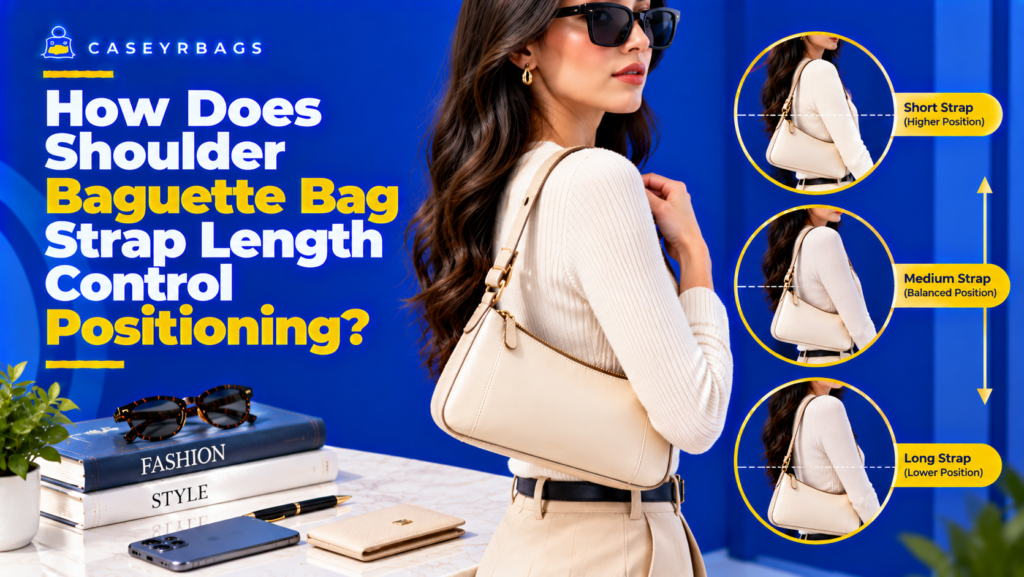
How Does Shoulder Baguette Bag Strap Length Control Positioning?
Shoulder Baguette Bag strap length controls positioning by setting the effective drop between the shoulder and the elongated bag body. A shorter usable path generally raises the bag toward the underarm and upper torso, while a longer path allows it to sit progressively lower along the side of the body.
The final loaded position does not come from strap length alone. Attachment spacing and height, bag-body dimensions, wearer proportions, clothing, loaded depth, and movement determine how the nominal measurement translates into underarm clearance, torso contact, opening access, and everyday carry behavior.
How Does Strap Length Control Shoulder Baguette Bag Position?
A Shoulder Baguette Bag hangs from a usable strap path that travels between two attachment points and over the shoulder. That path establishes the first control over how far the elongated horizontal body sits below the shoulder. This strap-positioning mechanism sits within Baguette Bag .
Shortening the effective path generally raises the bag toward the underarm and upper torso, while lengthening it lowers the body along the side. The vertical change also alters torso contact, arm clearance, access angle, and movement.
The governing sequence is usable strap length → effective shoulder drop → suspended top-edge and lower-edge position → clothing and load modification → clearance, access, and movement outcome.
What Does Strap Length Directly Change?
Usable strap length directly changes the shoulder-to-bag distance and therefore the bag body’s suspended height. Usable strap length primarily changes the shoulder-to-bag distance and therefore the vertical position of the bag’s top edge, body, and lower edge. Describe shorter and longer paths directionally without assigning one ideal number.
Connect the vertical change to underarm clearance, upper-torso or lower-torso placement, torso contact, access angle, and movement. The listed length matters only through the position it creates.
What Modifies the Strap-Length Effect?
Several geometry and use variables modify how a listed length translates into position. Shoulder curvature, attachment spacing, attachment height, hardware direction, bag-body height, horizontal width, wearer proportions, clothing, loaded depth, and settling as separate modifying variables.
Two bags with the same nominal strap length can sit differently because their complete suspension geometry differs. Keep each variable separate for later diagnosis.
What Is the Core Positioning Rule?
The core rule is directional: shorter effective drop raises the bag and longer effective drop lowers it. The rule is shorter effective drop generally raises the bag, and longer effective drop generally lowers it, but the final loaded position emerges from the complete bag-wearer-load system.
The rule remains falsifiable. If a shorter setting still hangs low because of attachment geometry, or a nominally suitable setting becomes crowded when loaded, the measurement alone does not pass.
How Does Total Strap Length Become Effective Shoulder Drop?
Total strap length describes the complete physical path, while effective shoulder drop describes the vertical portion of that path that actually positions the bag. Shoulder curvature, hardware, and attachment spacing consume part of the total length without contributing equally to vertical distance.
What Does Total Strap Length Describe?
Total strap length describes the complete carry path between the bag’s attachment points. Total strap length as the full path between the bag’s attachment points, including the portion that curves over the shoulder and any hardware, tabs, or adjustable segments included in the measurement method.
The measurement method to be stated when exact numbers are used. End-to-end length, drop measured while flat, and worn effective drop are not interchangeable values.
What Does Effective Shoulder Drop Describe?
Effective shoulder drop describes the practical vertical distance that suspends the bag body. Effective drop as the practical vertical distance from the shoulder carry point to the bag’s top edge or another clearly stated reference point while the strap follows its real worn path.
The distinction remains: total strap length ≠ effective shoulder drop. Part of the strap can travel horizontally, diagonally, or around the shoulder instead of contributing to vertical distance.
How Should Effective Drop Be Observed?
Effective drop should be observed from the worn position, not inferred from a flat measurement alone. Where the strap settles, then record the top-edge position, lower-edge position, underarm space, and torso zone with the bag empty and naturally suspended.
Measurement supports rather than replaces worn behavior. The final classification must come from the loaded position under stated wearer and clothing conditions.
How Do Attachments and Bag-Body Geometry Modify Position?
Attachment geometry changes how the same nominal strap is translated into suspension. Spacing redirects part of the path horizontally, attachment height shifts the connection line, and bag-body height determines how far the lower edge extends below the suspended top.
How Does Attachment Spacing Redirect the Strap Path?
Wider attachment spacing can consume more strap length horizontally across the bag. Farther-apart attachment points can consume more of the strap path horizontally across the bag, while closer points can allow more of the path to contribute to vertical drop.
Keep the conclusion conditional because hardware angle, strap flexibility, and top-edge shape also influence the path. Evaluate spacing and worn drop together.
How Does Attachment Height Change Suspension?
Attachment height changes the relationship among the connection line, top edge, center of mass, and lower edge. Attachments above the top edge, at the upper corners, or lower on the side panels create different relationships between the connection line, top edge, center of mass, and lower edge.
Show that side or lower attachments can alter rotation and body height even when the strap itself is unchanged. Preserve strap length and attachment height must be interpreted together.
How Do Bag Height and Horizontal Width Affect the Result?
Bag-body dimensions determine how much torso space the suspended form actually occupies. Effective drop establishes suspension height, while bag-body height determines how far the lower edge extends below that point. A taller body occupies more vertical torso space.
The elongated horizontal body increases the arm-adjacent and torso-contact area. Positioning must therefore account for the whole body, not only the strap connection or top edge.
How Does a Shorter Strap Raise the Baguette Bag?
Shortening the usable strap path usually raises the entire horizontal body. That can strengthen underarm placement and reduce low swing, but loaded depth and clothing can convert a useful high position into crowding or access restriction.
What Changes as Usable Length Decreases?
Reducing usable length generally raises the top edge, chamber, and lower edge toward the shoulder. Reducing usable length generally decreases effective drop and raises the top edge, chamber, and lower edge toward the shoulder and upper torso.
Connect the change to increased underarm relationship, closer torso contact, and potentially reduced low swing. Keep loaded depth and clothing as conditions that can modify the result.
When Does High Positioning Become Too High?
High positioning becomes too high when the selected setting repeatedly interferes with normal movement or access. Continuous underarm pressure, forced arm displacement, blocked closure movement, reduced hand-entry angle, repeated repositioning, or interference during walking and turning.
The threshold is the position is too high when normal movement or routine access repeatedly requires compensation under the fixed test condition.
Why Is the Shortest Setting Not Automatically Best?
The shortest setting can maximize height while reducing clearance, clothing tolerance, and access. Maximum shortening can create the strongest underarm placement while reducing clothing tolerance, opening clearance, loaded-depth allowance, and freedom of movement.
The distinction remains: shorter strap ≠ automatically better underarm positioning. Choose the shortest setting only when it also passes loaded clearance, access, contact, and movement checks.
How Does a Longer Strap Lower the Baguette Bag?
Lengthening the usable path usually lowers the bag and increases underarm clearance. The additional drop can improve access or clothing compatibility, but too much can move the bag out of its intended upper-torso zone and increase swing.
What Changes as Effective Drop Increases?
Increasing effective drop generally lowers the bag and enlarges underarm clearance. Increasing the usable path generally lowers the bag along the torso, expands underarm clearance, changes the contact zone, and can increase the distance through which the bag moves.
The benefit has a trade-off. Additional clearance can support access and clothing compatibility, while lower suspension can increase swing or weaken the intended high Shoulder Baguette profile.
When Does the Bag Sit Too Low?
The bag sits too low when it repeatedly loses the intended upper-torso relationship. Lower-torso placement, loss of the underarm relationship, increased pendulum movement, delayed retrieval reach, or behavior resembling a lower-hanging shoulder bag.
The threshold is the setting is too low when it repeatedly defeats the intended upper-torso position under the stated use condition, not merely because it is longer than another bag’s strap.
Can a Longer Setting Still Be Functional?
A longer setting can remain functional when it improves clearance without losing the intended shoulder zone. A longer setting can remain suitable when it preserves the intended shoulder zone while improving arm clearance, closure visibility, hand-entry angle, or thicker-clothing compatibility.
The distinction remains: longer strap ≠ incorrect positioning by definition. Judge the setting through loaded position, access, contact, movement, and intended use rather than length alone.
How Do Wearer Proportions and Clothing Change Position?
Wearer proportions and clothing modify the path available to the strap. Shoulder contour, torso geometry, and fabric thickness can change where the strap settles and how much clearance remains around the loaded bag.
Which Wearer Variables Affect the Worn Position?
Shoulder contour, torso length, upper-body width, and natural strap settling alter the effective path. Shoulder contour, torso length, upper-body width, and where the strap naturally settles can change the strap path, effective drop, body contact, and lower-edge position.
These remain test conditions rather than body-type prescriptions. The article must evaluate the bag-wearer relationship without declaring one body shape correct or incorrect.
How Do Clothing Layers Change Clearance?
Thicker clothing consumes some of the available underarm space and can redirect the strap path. Thicker clothing can raise or redirect the strap path, occupy space between the arm and torso, reduce underarm clearance, and increase contact with the loaded bag.
Light, moderate, and thick layers under otherwise fixed conditions. Avoid claiming that one adjustment works identically across all clothing.
Why Must the Setting Be Retested Across Conditions?
A setting that works under one clothing condition can become crowded or low under another. A setting functional over a thin layer can become crowded with a coat, while a setting chosen for a coat can hang lower over light clothing.
Adjustable straps may provide a correction range, while fixed straps require the built-in geometry to work across the intended normal conditions. Document any condition that changes the result.
| Condition | Available Strap Path | Underarm Space | Retest Need | Adjustment Meaning |
|---|---|---|---|---|
| Light layer | Baseline | Highest available | Low | Reference setting |
| Moderate layer | Partly redirected | Reduced | Moderate | May need minor change |
| Thick layer | More redirected | Lowest available | High | Retest essential |
| Fixed strap | Unchanged hardware path | Condition-dependent | High across seasons | Geometry must already work |
| Adjustable strap | Variable | Potentially recoverable | Setting-dependent | Range may help but does not guarantee fit |
How Do Loaded Depth, Weight, and Settling Change Position?
Loading can change the observed position even when the nominal strap setting does not move. Added depth projects the bag outward, weight increases tension, and hardware or panels can settle into a different operating position.
How Does Loaded Depth Change the Underarm Relationship?
Added depth projects the horizontal body outward and can reduce the available arm clearance. Thicker contents and expanding panels project the horizontal body farther from the torso, occupy more space beneath the arm, and can alter the strap angle.
The distinction remains: nominal strap measurement ≠ loaded bag position. Local bulges beneath the arm can matter more than the bag’s average empty depth.
How Does Added Weight Affect Settling?
Added weight increases strap tension and can change hardware angle, panel shape, and natural settling. Added mass increases strap tension and attachment loading and can allow the bag, hardware, panels, or strap to settle into a different practical position.
The distinction remains: loaded settling ≠ guaranteed permanent strap stretch. Separate immediate tension, hardware rotation, temporary deformation, and natural settling from documented permanent elongation.
What Can an Empty-Bag Test Miss?
An empty-bag test can miss the projection, rotation, contact, and access changes that appear only after loading. Outward projection, reduced clearance, changed strap angle, rotation, closure obstruction, torso pressure, and movement that appear only after the recurring contents are added.
The empty test is the baseline; the normal loaded test drives the everyday decision. Do not substitute maximum overfill for the representative load.
How Do Clearance, Torso Contact, Access, and Movement Define Fit?
Functional fit requires more than a static height. Underarm clearance, torso contact, opening access, retrieval, walking, turning, and arm movement reveal whether the selected drop still works during normal use.
How Much Underarm Clearance Is Functional?
Functional clearance allows ordinary arm use and access without constant clamping or forced displacement. Functional clearance through normal arm placement, walking, reaching, closure use, and the ability to reposition the bag without continuous clamping or forced arm displacement.
Zero contact is not required. The target is usable space and controlled positioning, not maximum separation or maximum compression. Continue the underarm-positioning question with Underarm Baguette .
How Does Torso Contact Affect Positioning?
Controlled torso contact can stabilize location without requiring continuous compression. Controlled upper-torso contact can reduce large low swing and make the bag’s location more predictable during ordinary carry.
The benefit has a boundary. Excessive contact that blocks access, pushes the arm outward, or requires continuous compression represents a mismatch rather than stronger control.
Why Must the Bag Be Tested During Movement?
Movement reveals rotation, forward shift, backward shift, and swing that a static pose cannot show. Walking, turning, reaching, and arm swing reveal forward shift, backward shift, rotation, repeated contact, and pendulum movement that static standing cannot show.
The distinction remains: shorter drop ≠ complete movement control. Judge whether movement remains compatible with the intended Shoulder Baguette position rather than expecting the bag to remain fixed.
How Do Adjustable, Fixed, and Wide Straps Change the Decision?
Adjustable, fixed, and wide straps change different parts of the decision. Adjustment changes available length, fixed straps lock the geometry, and width mainly changes contact area rather than vertical drop.
What Does an Adjustable Strap Add?
An adjustable strap expands the available range of positions but does not guarantee that one setting will work. Adjustability can provide higher and lower positions, support clothing changes, and compensate for some wearer or load conditions.
The distinction remains: adjustability ≠ guaranteed ideal fit. The range, increments, hardware position, or bag geometry can leave every available setting too high, too low, or otherwise conditional.
Why Do Fixed Straps Require Stronger Geometry Matching?
A fixed strap leaves the attachment geometry, bag body, clothing, and loaded depth to determine the final result. A fixed strap provides one primary path, making attachment geometry, bag-body height, wearer conditions, clothing, and normal loaded depth more decisive.
Use a fixed-strap mismatch only when the built-in geometry repeatedly fails the intended condition. Do not assume that packing adjustments can correct a structural position problem.
Does Strap Width Control Vertical Position?
Strap width mainly changes contact area and lateral behavior rather than effective drop. Strap width mainly changes contact area, visual proportion, and possibly lateral stability, while usable length and attachment geometry primarily control effective drop.
The distinction remains: strap width ≠ strap drop. Do not claim that a wider strap automatically raises the bag, reduces total mass, or proves better positioning.
How Does Positioning Affect Opening Access and Retrieval?
Positioning affects access because a high body can place the opening close to the hand while also crowding the zipper, flap, or hand-entry path. The functional setting balances reach and clearance without implying any security guarantee.
How Can High Positioning Restrict the Opening?
A high body can crowd the closure path or reduce the angle available for the hand to enter. A body pressed tightly beneath the arm can block part of a zipper, flap, snap, or hand-entry path even when the closure works normally away from the wearer.
The distinction remains: higher positioning ≠ automatically easier access. A slightly lower functional setting can improve the access angle while retaining an upper-torso carry zone.
How Does Position Affect Retrieval?
Position changes both reach distance and the angle through which an item must enter or leave the chamber. High placement can keep frequent items near the hand and make the bag’s location predictable, while excessive height can reduce hand-entry room or require repositioning.
Test one representative retrieval and return action while worn. The functional position balances reach, opening clearance, item path, and normal arm movement.
Does Close Positioning Improve Security?
Close positioning can improve physical proximity without proving theft resistance. Close upper-torso placement can keep the bag physically near the wearer and may make the opening easier to monitor under some conditions.
The distinction remains: close-body positioning ≠ theft prevention. Position does not independently prove secure closure, tamper resistance, lock strength, or protection from theft.
How Should Strap-Position Problems Be Diagnosed?
Diagnosis should isolate the first controlling layer before changing the strap. Load depth, attachment spacing, clothing thickness, bag-body height, and adjustment range can all mimic a simple too-short or too-long problem.
What Does “The Bag Sits Too High Only When Loaded” Suggest?
That symptom points toward loaded depth, hardware rotation, or settling before an intrinsic strap-length failure. Loaded depth, rigid-item bulk, outward panel expansion, altered strap angle, hardware rotation, or load settling before concluding that the strap is intrinsically too short.
The same bag empty and normally loaded, remove one optional bulky item, restore the same setting, and recheck clearance. Change one variable at a time.
What Does “The Strap Looks Short but the Bag Hangs Low” Suggest?
That symptom points toward path geometry rather than visual strap length. Wide attachment spacing, shoulder curvature, angled hardware, attachment height, a taller bag body, or confusion between total length and effective drop.
The top edge, lower edge, and complete path instead of relying on appearance. A visually short strap can still create a lower suspended body.
What Does “The Position Changes With a Coat” Suggest?
That symptom points toward clothing-dependent path and clearance changes. Clothing thickness, a changed shoulder path, reduced underarm space, increased bag contact, or insufficient adjustment range.
Test one correction at a time: use a documented alternate setting, reduce optional loaded depth, retest opening access, or classify a fixed-geometry mismatch if the normal clothing condition cannot be supported.
How Should Strap Positioning Be Evaluated and Classified?
Evaluation should compare the same bag, shoulder, clothing, load, item placement, strap setting, movement sequence, and retrieval action. The final classification should come from loaded position and function rather than from the listed measurement alone.
Which Variables Must Remain Separate During Diagnosis?
Positioning variables should remain separate so one symptom is not corrected at the wrong layer. Keep total length, effective drop, adjustment setting, attachment spacing, attachment height, bag-body height, horizontal width, clothing, load, loaded depth, clearance, contact, access, and movement separate.
The first plausible controlling layer. Do not shorten the strap to solve loaded-depth interference or remove contents to hide an attachment-geometry mismatch.
Which 20-Step Sequence Evaluates Positioning?
Use the controlled 20-step sequence below once, in order, to test empty and loaded positioning under fixed conditions. The numbered procedure remains in the dedicated evaluation block rather than being repeated inside this paragraph.
Keep the bag, shoulder, clothing, load, item placement, selected strap setting, movement sequence, access action, and observation method fixed across comparisons. Record every deliberate change before assigning a cause.
How Should the Final Outcome and Correction Be Selected?
The final outcome should integrate effective drop, body position, clearance, contact, access, movement, clothing, and load. Select Strong Strap-Position Functional Match only when effective drop, body position, clearance, torso contact, access, movement, clothing, and normal loading support the same conclusion. Use Acceptable or Conditional Match when a documented limitation does not erase practical function.
Otherwise select the first supported mismatch and test one correction at a time: change one setting, reduce optional bulk, retest clothing, reposition items, compare attachment geometry, or reject the bag-wearer match. State residual uncertainty.
- empty the Shoulder Baguette Bag
- inspect both strap attachment points
- identify whether the strap is fixed or adjustable
- document the usable length or current setting
- inspect attachment spacing, attachment height, hardware path, bag-body height, horizontal width, and empty depth
- select the normal clothing condition
- place the empty bag on the intended shoulder
- observe where the strap settles
- record top-edge, lower-edge, effective-drop, underarm-clearance, and torso-contact observations
- move the arm and test the closure while worn
- add the same normal recurring load
- keep item placement below the normal opening zone and allow the bag to settle
- put the loaded bag on the same shoulder over the same clothing
- observe changes in vertical position, loaded depth, strap angle, rotation, clearance, and contact
- walk normally
- turn, reach, and change direction
- open the bag and retrieve one frequent-use item
- compare one practical alternate setting if adjustment is available
- restore the selected setting and repeat the failed observation
- classify the strap position as functional only when the loaded bag remains in the intended upper-torso zone without chronic underarm crowding, excessive low hang, access restriction, or unsuitable movement
- The H1 is answered directly in two concise production paragraphs.
- No standalone disclaimer is inserted unless specifically requested.
- Technical Blogpost Mode leads; diagnostic support remains secondary.
- The central entity stays the Shoulder Baguette Bag Strap-Length Positioning System.
- The complete strap-to-loaded-position sequence is defined before individual variables.
- Total strap length is separated from effective shoulder drop.
- Effective drop is defined through an observable reference point.
- Attachment spacing is evaluated.
- Attachment height and hardware path are evaluated.
- Bag-body height and horizontal width are evaluated.
- Shorter straps are not treated as automatically better.
- Longer straps are not treated as automatically incorrect.
- Too-high positioning is defined behaviorally.
- Too-low positioning is defined behaviorally.
- Wearer proportions are treated as conditions rather than prescriptions.
- Clothing layers are evaluated.
- Empty and normally loaded positions are tested separately.
- Loaded depth is connected to outward projection and clearance.
- Loaded settling is separated from permanent strap stretch.
- Underarm clearance is evaluated dynamically.
- Torso contact is paired with a compression boundary.
- Arm movement, walking, and turning are tested.
- Opening access is tested while worn.
- Retrieval and return are tested with one representative item.
- Adjustability is not treated as guaranteed fit.
- Fixed straps receive a geometry-specific decision.
- Strap width is separated from vertical drop.
- Close placement is not treated as theft prevention.
- Product-level measurements require documented or measured evidence.
- Inference remains labeled and below stronger evidence.
- The diagnosis changes one variable at a time.
- The 20-step evaluation uses fixed controls.
- One named final outcome is selected.
- Residual uncertainty is stated where evidence is incomplete.
- Exactly nine proof assets are specified, including exactly four SVGs.
- Exactly two reader-facing internal links are inserted in their assigned body locations—one upward and one lateral—while the H1 remains link-free and no unapproved link is added.
Conclusion
Shoulder Baguette Bag strap length controls positioning by setting the effective suspension distance between the shoulder and the elongated bag body. Shorter effective drop generally raises the bag toward the underarm and upper torso, while longer effective drop lowers it along the side of the body.
The correct position cannot be determined from strap length alone. Attachment spacing and height, bag-body dimensions, wearer proportions, clothing, loaded depth, settling, access, and movement all modify the final result; the functional setting is the one that preserves the intended upper-torso zone without chronic crowding, excessive low hang, access restriction, or unsuitable movement.
FAQs
What Strap Length Makes a Shoulder Baguette Bag Sit Under the Arm?
No universal measurement produces the same underarm position for every bag and wearer. Effective drop depends on usable length, attachment spacing and height, shoulder path, bag-body dimensions, wearer proportions, clothing, and loading.
Direct the reader to test the specific bag with normal clothing and the recurring load. The correct length is the one that creates the intended upper-torso position without chronic crowding or restricted access.
Why Does My Baguette Bag Sit Low Even Though the Strap Looks Short?
Visible or total strap length does not equal effective drop. Wide attachment spacing, angled hardware, shoulder curvature, attachment height, and a taller bag body can all produce a lower final position.
Recommend observing the complete strap path, top edge, lower edge, and loaded body rather than judging the strap visually. Verify the suspension geometry before identifying the strap as the cause.
Should Shoulder Baguette Strap Fit Be Tested Empty or Loaded?
The empty test establishes a baseline, but the loaded test is more important for everyday positioning because contents can increase depth, change strap angle, alter settling, reduce clearance, and affect movement.
Recommend using the normal recurring load rather than maximum fill. Repeat the same clearance, access, walking, turning, and retrieval checks after the bag settles naturally.