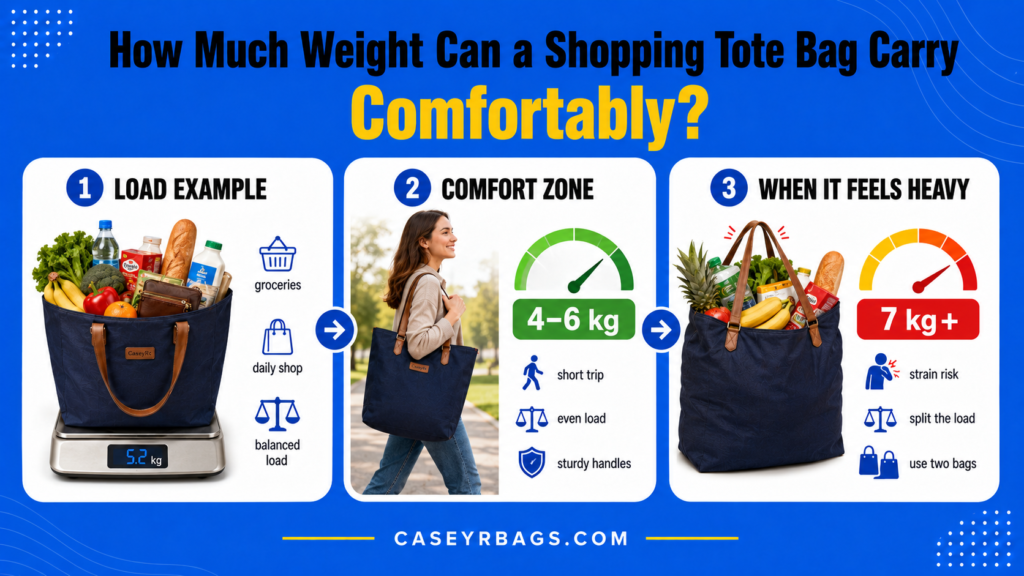
How Much Weight Can a Shopping Tote Bag Carry Comfortably?
A Shopping Tote Bag does not have one universal comfortable weight limit because practical carrying capacity depends on loaded weight, handle design, Tote structure, load distribution, carry position, and carrying duration. Structural capacity describes what the bag can physically support, while comfortable carrying weight describes what remains practical through the handles and normal carry interface.
A large Tote may still become demanding with dense contents, and a structurally strong Tote can remain uncomfortable when handles concentrate pressure or the load shifts to one side. Structural load limit ≠ comfortable carry limit, and available volume ≠ comfortable weight capacity. The useful target is a practical real-use load that stays balanced, supported, manageable through the handles, and appropriate for the actual distance and duration of carry.
What Does Comfortable Carrying Weight Mean for a Shopping Tote Bag?
Comfortable Shopping Tote weight is the load that remains structurally supported and practically manageable through the Tote’s normal carry system under the actual distance and duration of use. Structural capacity describes what the bag construction can support, while comfortable carrying load describes what remains practical for the person using the normal handles.
Handle width, handle attachment, Tote balance, and item distribution all change how the same loaded weight behaves. Broader contact can spread the carry interface, strong attachment can transfer load more predictably into the body, and centered contents can reduce twisting or repeated repositioning. The broader Tote Bag structure provides the parent context for these load questions.
Duration completes the distinction because a load that feels manageable over a short distance may become increasingly demanding when it must be supported for longer periods or through repeated walking. Short-distance tolerance ≠ sustained carrying comfort. The final comfortable load therefore depends on structure, interface, balance, and real-use duration working together.
How Is Structural Load Capacity Different From Comfortable Carry Weight?
Structural load capacity describes the Tote construction: seams, handles, body material, base, and attachment points determine whether the bag can physically support a load without excessive structural failure or deformation. Verified manufacturer guidance, when available, belongs to this structural question because it refers to the bag’s construction rather than the user’s carrying experience.
Comfortable carry weight is different. It depends on total loaded weight, handle interface, carry position, distribution, and duration. A structurally strong Tote can still become impractical if narrow handles concentrate the load, the body twists under uneven contents, or the carry lasts too long. Bag survives load ≠ load is comfortable to carry.
Which Factors Most Directly Change Comfortable Tote Weight?
The most direct factors are loaded weight, handle width, handle drop, carry position, bag balance, base support, item density, load movement, and duration. Total weight establishes the overall carrying demand, while the handle interface determines how that force is transferred into the hand, forearm, or shoulder. Handle drop also changes where the Tote sits and how freely it can move.
Base support and balance affect whether dense contents remain stable or pull the bag off its normal carry line. Duration then extends the same demand over time. Loaded weight + carry interface + load behavior + duration → comfort outcome. No single factor proves comfortable fit by itself.
Why Can One Weight Limit Not Apply to Every Shopping Tote Bag?
One universal weight limit cannot apply because Shopping Totes vary in size, construction, handle design, body structure, and intended carry position. Contents also vary in density: a Tote filled with light bulky items can occupy more space than a partly filled Tote containing dense objects, even when the smaller load is heavier.
Carrying distance, duration, and individual capability add further variation. A load that works for a brief hand carry may not remain practical for a longer walk or repeated shoulder carry. The correct approach is therefore to evaluate the real load and carry system rather than invent a universal kg/lb threshold that ignores Tote design and actual use.
| Limit | What Determines It? | What It Tells the Reader |
|---|---|---|
| Structural limit | Handles, seams, body, base, attachment strength | Whether the Tote can physically support the load |
| Volume limit | Interior dimensions and shape | Whether contents physically fit |
| Comfortable limit | Weight, handles, distribution, position, duration | Whether the load remains practical to carry |
How Does Handle Design Affect Comfortable Tote Weight?
Handle design affects comfortable Tote weight by changing how the loaded bag transfers force into the hand, forearm, or shoulder and how that load enters the Tote structure.
How Does Handle Width Change Load Pressure?
Handle width changes load pressure by changing the contact area through which the Tote’s weight is supported. A narrow handle concentrates the loaded Tote over a smaller interface, while a broader handle spreads that same load across a wider contact area. The total bag weight does not change, but the carrying experience can.
Same load + different handle interface → different carrying experience. Wider handles can improve the interface for some loads, but they do not cancel the effect of total weight, poor balance, or long duration. A heavy Tote can still become demanding even when the handles are broad and well shaped.
How Does Handle Drop Change Carrying Position?
Handle drop changes carrying position by determining whether the Tote is primarily held in the hand, supported over the forearm, or capable of sitting on the shoulder. Short handles keep the bag closer to hand or elbow level, while longer handles may provide shoulder clearance and change the Tote’s position relative to the body.
That position changes movement and load behavior. Shoulder carry can free the hand, but it can also allow the Tote to swing against the body or compress the opening under the arm. Hand carry may make repositioning easier but concentrates support through the hand. Shoulder carry does not automatically solve heavy-load demand.
Why Does Handle Attachment Matter Under Heavier Loads?
Handle attachment matters because loaded weight must transfer from the handle into the Tote body through stitching, reinforcement, anchor area, and attachment position. A broader or better reinforced anchor can distribute structural force more predictably, while a small stressed attachment can show visible distortion as weight increases. The location of the anchor also affects how the body is pulled.
This is a structural durability question, not a comfort guarantee. Structural durability ≠ human carrying comfort. When the discussion shifts specifically to how seams, anchors, and reinforcement support the load, the sibling topic Shopping Tote Load Capacity addresses that structural mechanism without turning it into a universal comfort target.
| Handle Trait | Carry Position | Load Effect | Comfort Consequence | Structural Check |
|---|---|---|---|---|
| Narrow handle | Hand / forearm | Concentrated contact | May become demanding sooner | Check anchor and stitching stability |
| Broader handle | Hand / shoulder | Wider contact area | May improve interface comfort | Total weight still matters |
| Short drop | Hand / forearm | Closer load position | Easy repositioning, hand demand remains | Check handle clearance |
| Longer drop | Shoulder capable | Different support position | May free hand, swing can increase | Check anchor behavior under shoulder pull |
How Does Tote Structure Affect Comfortable Load Carrying?
Tote structure affects comfortable load carrying by controlling how well the bag stabilizes contents, transfers weight, and resists excessive deformation during movement.
How Does Base Support Change Load Stability?
Base support changes load stability by giving dense contents a more predictable platform and reducing local sagging that can pull the body out of shape. A firmer or broader base can help distribute items laterally and keep their position more stable as the Tote is lifted, set down, or carried through repeated movement.
Stable base → more predictable item position → more stable Tote behavior. This can improve practical carrying quality because the load moves less unpredictably, but it does not prove a higher structural capacity rating. Base support should be treated as a stability factor unless verified structural guidance provides a separate load limit.
How Do Flexible & Structured Shopping Totes Carry Weight Differently?
A flexible Shopping Tote uses a load-responsive body that conforms around contents and can accommodate irregular shapes, but that flexibility can also allow denser objects to shift, sag, or migrate as the bag moves. The body may change shape more visibly under an uneven load, which can alter balance and handle tension.
A structured Tote retains its shape more strongly and can keep contents in a more predictable position, reducing some uncontrolled movement. The trade-off is less compressibility and less accommodation for irregular loads. Neither construction automatically supports more comfortable weight because total mass, handle interface, distribution, and duration remain decisive.
How Can Bag Size Create a Misleading Sense of Carrying Capacity?
Bag size can create a misleading sense of capacity because a larger interior makes more space available without determining how much the filled contents will weigh. Bulky clothing or packaging can occupy much of the cavity while remaining relatively light, whereas dense groceries, books, or bottled items can create high mass in a much smaller portion of the Tote.
A Tote can therefore be under-filled by volume and still be heavy. Larger size ≠ greater comfortable weight. The practical limit depends on mass, handles, balance, and duration rather than on how much empty space remains inside the bag.
How Does Load Distribution Change Shopping Tote Comfort?
Load distribution changes Shopping Tote comfort because the same total weight can create different carrying behavior depending on where dense and shifting contents sit relative to the Tote’s carry line.
Where Should Heavier Items Sit Inside a Shopping Tote Bag?
Heavier items are generally easier to control when they remain stable, relatively low, reasonably centered, and close to the Tote’s primary carry line. This positioning can reduce sudden migration and limit the amount of twisting force created when dense contents pull strongly toward one side. The goal is not a packing formula but predictable load behavior.
Stable heavy-item position → lower uncontrolled movement → more predictable carry. Dense objects still add the same total weight, so centered placement does not make the Tote lighter. It simply reduces unnecessary shifting and balance changes that can make the same load more demanding to handle.
Why Can Uneven Loading Make a Tote Harder to Carry?
Uneven loading can make a Tote harder to carry because dense contents placed to one side shift the load center away from the natural carry line. This can create one-sided pulling, twisting, handle imbalance, and greater swing as the bag moves. The user may repeatedly reposition the Tote to restore a more neutral carry position.
Same total weight + poor distribution → worse practical carry. The total mass is unchanged, but the bag behaves less predictably because one side applies more leverage and movement. Better balance therefore improves handling quality without changing the actual weight being carried.
How Do Dense Items Differ From Bulky Lightweight Items?
Dense items place relatively high mass into a limited amount of interior volume, while bulky lightweight items can fill much more of the Tote without producing the same total weight. This difference is why volume cannot be used as a reliable proxy for carrying demand. A half-filled Tote of dense goods may weigh more than a nearly full Tote of light contents.
Full Tote ≠ necessarily heavy Tote, and partly filled Tote ≠ necessarily light Tote. The practical load decision should be based on actual loaded weight, distribution, and carry behavior rather than visual fullness alone.
How Does Carrying Duration Change Comfortable Tote Weight?
Carrying duration changes comfortable Tote weight because the same physical load becomes a greater practical carrying demand when it must be supported for longer periods or through repeated movement.
Why Can a Manageable Short Carry Become Difficult Over Time?
A manageable short carry can become difficult over time because the same load must be supported continuously or repeatedly through the handle interface. The Tote may not change structurally, but the user has to maintain the carry position for longer, which increases practical demand and can lead to more frequent repositioning or hand switching.
Same load + longer duration → greater carrying demand. This is a practical load-fit relationship, not a medical diagnosis. A load that works for a brief trip from car to door may not remain suitable for a longer walk through a market, station, or workplace.
How Does Walking Change Tote-Load Behavior?
Walking changes Tote-load behavior by adding repeated swing, small impacts, item shifting, and handle loading with each step. Dense contents can migrate or pull against one side, while flexible Tote bodies may respond by changing shape around the load. The carry position may also shift between hand, forearm, and shoulder during the route.
These repeated movements can make an otherwise stable stationary load feel less controlled. The relevant question is whether the normal walking pattern keeps balance predictable and repositioning limited, not whether the Tote can simply sit on the floor while carrying the same weight.
When Should the Load Be Divided or Moved to Another Bag Type?
The load should be divided or moved to another carry system when the Tote no longer fits the routine because carrying duration is longer, stable distribution is difficult, hands-free carry is necessary, or stronger load control is required. Repeated hand switching, uncontrolled swing, or increasing repositioning can indicate that the Tote interface is no longer the most practical way to manage the load.
This does not require a specific product recommendation. The principle is functional: when the routine needs better weight distribution or a more stable carry system than the Tote provides, reducing, dividing, or changing the carrying method can restore practical load fit.
| Carry Condition | Load Behavior | Carry Demand | Tote Suitability Question |
|---|---|---|---|
| Brief stable carry | Limited movement | Lower | Does the load remain controlled through the handles? |
| Longer walking | Repeated swing and shifting | Higher | Does balance remain predictable over time? |
| Frequent transitions | Repeated lifting and repositioning | Higher | Does the Tote remain easy to control? |
| Extended heavy carry | Persistent interface demand | Highest | Would reducing or dividing the load improve fit? |
When Does a Shopping Tote Bag Become Too Heavy to Carry Comfortably?
A Shopping Tote becomes too demanding when practical carrying quality deteriorates even though the bag may still remain structurally intact.
Which Carrying Signals Suggest the Tote Load Is Too Demanding?
Practical load-fit signals include frequent hand switching, repeated shoulder repositioning, difficulty maintaining the normal Tote position, handles pressing excessively into the carry area, excessive bag swing, and difficulty lifting or setting the Tote down in the usual controlled way. These signals indicate that the interface, balance, or total carrying demand may no longer fit the routine.
They should be treated as load-fit observations rather than medical diagnoses. The point is not to assign a universal comfort threshold but to notice when the actual carrying task is becoming increasingly difficult or unstable under the normal load.
Why Should the User Stop Below the Tote’s Structural Maximum?
The user should stop below the Tote’s structural maximum because the maximum, where verified, is a construction reference rather than a personal comfort target. It describes what the bag may structurally support under specified conditions, not what remains practical through the handles, distribution, carry position, and duration of everyday use.
Structural maximum → construction reference, while practical everyday load → handling + duration + distribution decision. A Tote should not be loaded to failure or treated as comfortable simply because seams and handles remain intact. Real-use carrying quality can deteriorate well before any visible structural limit is reached.
Why Should Comfortable Weight Be Tested Under Normal Use Conditions?
Comfortable weight should be tested under normal use because the real routine includes actual contents, the usual carry position, normal walking duration, and repeated retrieval or repositioning. A Tote that feels stable while sitting loaded on the floor may behave differently once the handles are supporting the weight and the body is moving.
Real-use fit is more informative than a Tote simply sitting loaded on the floor. The useful test is whether the same normal load remains balanced, controlled, and manageable through the intended carry position for the distance and duration that will actually occur.
How Can Comfortable Shopping Tote Weight Be Evaluated Without a Universal Number?
Comfortable Shopping Tote weight can be evaluated by starting with the normal repeated load and testing how the handles, Tote body, balance, and duration behave under actual carrying conditions.
How Should the Tote Be Loaded for a Comfort Test?
The Tote should be loaded with the normal repeated Shopping Tote load rather than its maximum physical capacity. Use the contents that typically travel together and place dense items in stable, reasonably centered positions so the test reflects the normal carry pattern rather than an artificial extreme. Then inspect whether the body retains a usable shape.
Check handle stability, balance, and controlled item movement before walking. The purpose is to establish a realistic baseline, not to discover how much weight the Tote can survive. A comfortable-load test should reproduce the routine the bag is expected to handle most often.
How Should Load Be Increased When More Capacity Is Needed?
When more capacity is needed, increase the load gradually from the normal baseline rather than jumping directly to unused interior volume. Use the sequence normal load → real carry test → limited increase → retest. This allows changes in balance, handle behavior, structural distortion, and repositioning demand to become visible before the Tote is excessively loaded.
Stop adding load when carry quality worsens materially, balance deteriorates, repositioning increases, or the Tote body begins to distort meaningfully, even if empty space remains. Available volume is not permission for unlimited additional weight because mass and handling demand can rise faster than visible fullness.
Which Criteria Should Determine the Final Comfortable Load?
- Check verified manufacturer structural guidance if available.
- Identify normal contents.
- Assess actual loaded weight.
- Check handle interface.
- Check bag balance.
- Check structural distortion.
- Test normal walking duration.
- Observe repeated repositioning.
- Reduce or redistribute the load when practical carry deteriorates.
The final comfortable load is the highest normal-use load that remains structurally supported and practically manageable without material loss of balance, handle control, or duration fit. It is a real-use decision rather than a universal number and should remain below any verified structural maximum when practical carrying quality has already begun to deteriorate.
How Can Shopping Tote Overload Mismatches Be Avoided?
Shopping Tote overload mismatches are avoided by evaluating actual weight, handle behavior, Tote structure, distribution, and duration rather than assuming that everything fitting inside is appropriate to carry.
Why Is Filling the Tote to Maximum Volume a Weak Load Rule?
Filling the Tote to maximum volume is a weak load rule because available space does not measure mass, handle interface demand, structural loading, balance, or carrying duration. A cavity can appear only partly full while holding dense contents that create a large practical load, or it can look full while carrying lightweight bulky items.
Fits inside ≠ fits the carry system. The correct decision depends on actual loaded weight and how that load behaves through the handles, base, body, and normal carry position. Empty volume should not be treated as permission to keep adding weight after practical carrying quality begins to deteriorate.
Why Is Relying Only on a Bag’s Maximum Load Rating a Mistake?
Relying only on a maximum load rating is a mistake because the rating, when verified, is primarily a structural reference. It can indicate a construction boundary for handles, seams, and body support, but it does not describe how the load feels through the handle interface or how balance and duration affect real use.
Maximum load rating → structural reference, not personal comfort target. The final comfort decision still depends on handle interface, load balance, carry position, duration, and actual movement. A user should not continue adding weight merely because the Tote remains below a structural rating.
What Should Be Verified Before Carrying a Heavily Loaded Shopping Tote Bag?
- Verified manufacturer structural guidance checked where available.
- Normal Shopping Tote contents identified.
- Dense items distinguished from bulky lightweight items.
- Loaded weight remains within verified structural guidance.
- Handles remain stable.
- Handle contact remains manageable.
- Tote body does not distort excessively.
- Base supports contents adequately.
- Dense items remain reasonably centered.
- Load does not shift excessively while walking.
- Carry position can be maintained without repeated adjustment.
- Normal carrying duration has been tested.
- Remaining empty volume is not treated as permission for more weight.
- Load is reduced, divided, or moved when Tote carrying quality deteriorates.
Apply the checklist to the normal repeated load rather than a one-time extreme. If handles remain structurally stable but balance, contact pressure, repositioning, or duration fit deteriorates, the practical limit has already been reached for that use case. Reduce, redistribute, divide, or change the carry method rather than treating unused volume or structural reserve as a comfort target.
These are qualitative load-fit outcomes, not universal kg/lb thresholds or medical limits.
Conclusion
A Shopping Tote Bag does not have one universal comfortable weight limit because practical carrying capacity depends on loaded weight, handle design, Tote structure, load distribution, carrying position, and duration. Structural capacity describes what the bag can support, while comfortable capacity describes what remains balanced, controllable, and manageable through the actual carry interface.
Structural load limit ≠ comfortable carry limit, available volume ≠ comfortable weight capacity, and short-distance tolerance ≠ sustained carrying comfort. CaseyrBags evaluates Shopping Tote carrying weight through structural support and real-use handling rather than one universal load number. The comfortable load is the amount that remains structurally supported, balanced, manageable through the handles, and practical for the actual duration—without using maximum physical capacity as the comfort target.
FAQs
No universal comfortable limit applies to every Shopping Tote. Construction, handle design, manufacturer specifications, item density, carrying duration, and individual capability vary too much. Verified structural limits may describe the bag’s construction, but practical comfort still depends on the actual load and real carry conditions.
Not necessarily. Stronger construction may increase structural capacity, but comfortable carrying still depends on handle width, handle position, balance, item distribution, carry position, and duration. A Tote can remain structurally intact while the same load has already become too demanding for practical everyday carry.
Wider handles can spread the load interface over a broader contact area and may improve the carrying experience, but they do not remove the effect of total weight. Balance, handle position, Tote movement, and carrying duration still determine whether the heavier load remains practical.