When Can a Minimalist Daypack Bag Support Light Travel?
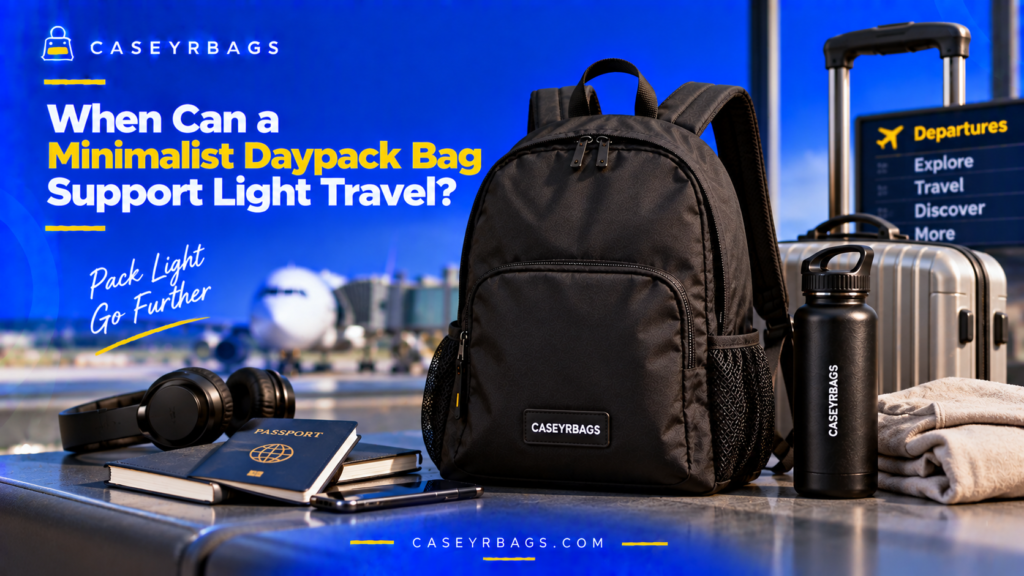
When Can a Minimalist Daypack Bag Support Light Travel? A Minimalist Daypack Bag can support light travel when the intended clothing, personal essentials, documents, devices, and limited situational items fit within its usable space without forcing chronic overfilling. The compact travel load should leave the main opening, organizational zones, quick-access storage, and normal closure behavior functional through packing, carrying, retrieval, and repacking. Suitability depends on more than nominal capacity. Clothing volume, item geometry, device storage, opening access, compression, loaded depth, closure pressure, and retrieval determine whether the Daypack can temporarily expand from daily carry into light travel while preserving its minimalist architecture. The bag remains suitable only while those travel demands stay compatible with controlled dimensions, simple organization, and realistic repacking. Disclaimer Minimalist Daypack designs, capacity measurements, travel needs, clothing requirements, devices, transport restrictions, and user preferences vary. A Daypack that supports one light-travel load may not support another, and practical travel suitability does not guarantee compliance with any transport provider’s baggage rules. Key Takeaway A Minimalist Daypack supports light travel only when the compact travel load fits within usable capacity while opening access, simple organization, loaded depth, closure, retrieval, and repacking remain practical. Light-Travel Evidence Key Usable CapacityComplete intended load fits without chronic overfilling. AccessMain opening and quick-access paths remain usable. OrganizationStorage roles stay simple and predictable. Loaded ProfileDepth and exterior expansion remain controlled. RepackingThe load can be restored without exceptional compression. What Does It Mean for a Minimalist Daypack Bag to Support Light Travel? A Minimalist Daypack normally prioritizes compact daily essentials rather than clothing and travel-specific storage. Supporting light travel therefore means using the same restrained architecture for a broader but still deliberately limited load without pretending the bag is a dedicated Travel Backpack. The bag must do more than physically contain the load. The main compartment should still open normally, important items should remain retrievable, and the loaded profile should stay controlled without extreme compression or permanent exterior overflow. Light-travel suitability is a relationship between usable capacity, packing geometry, organization, access, closure, loaded form, and repeatable repacking. For the complete parent definition behind this question, return to Daypack Bag. The loaded result must still preserve compactness and direct retrieval. Which conditions most directly determine light-travel suitability? The capacity-demand side. Show how clothing, devices, documents, and irregular item shapes compete for the flexible chamber and determine whether the intended travel load remains within usable volume. Observable signals include usable volume, clothing volume, device requirements, and item geometry. The functional-control side. Show how opening access, organization, loaded depth, and closure determine whether that packed capacity remains practical after the bag is closed and carried. The governing distinction is: Travel requirement → bag response → suitability consequence. Confirm that the complete travel-access cycle remains practical after packing, carrying, retrieval, and repacking rather than judging the empty bag alone. How is light travel different from ordinary Daypack use? Ordinary Daypack use primarily serves compact everyday essentials, while light travel adds a second layer of temporary storage demand, especially flexible clothing volume and travel-specific flat/small contents. Observable signals include clothing, personal-care items, travel documents, and additional device accessories. The mechanism matters because it changes usable capacity, clothing, devices, opening access, organization, loaded depth, and closure under the complete intended travel load. The load must remain intentionally compact. The additional contents should increase packing density without requiring the bag to abandon its normal opening, organization, closure, and loaded-profile behavior. Confirm that the complete travel-access cycle remains practical after packing, carrying, retrieval, and repacking rather than judging the empty bag alone. What defines successful light-travel support? Successful initial packing and closure are only the first part of the test. Contents must fit without every zone becoming compressed or dependent on extreme packing precision. Observable signals include Main Compartment, Clothing Zone, Device Sleeve, and Document Zone. The mechanism matters because it changes usable capacity, clothing, devices, opening access, organization, loaded depth, and closure under the complete intended travel load. Actual success requires the bag to remain usable after movement: important items remain retrievable, the chamber can be reopened, and the load can be restored without exceptional effort. The governing distinction is: The complete travel load fits, closes, carries, opens, retrieves, and repacks without repeatedly forcing the Daypack beyond its normal functional geometry.. Minimalist Daypack Light-Travel Anatomy SVG Minimalist Daypack Light-Travel Anatomy SVGAnatomy of the main travel-related storage and access zones in a Minimalist Daypack. Minimalist Daypack Light-Travel Anatomy SVG Travel Load → Packing → Access → Carry → Repacking MAIN / CLOTHING ZONE DEVICE DOCUMENT QUICK-ACCESSPOCKET EXTERIORSTORAGE Opening • Small-item zone • Compression point • Loaded depth CASEYRBAGS.COM Minimalist Daypack light-travel proof asset When Is a Minimalist Daypack’s Capacity Sufficient for Light Travel? Determine sufficiency from the complete load rather than from an isolated liter rating. What should fit before the bag is considered suitable? Clothing, personal essentials, devices, documents, and required small items must fit simultaneously as one real travel system. Do not evaluate each category independently and then assume the combination will also fit. Observable signals include forcing the closure, compressing every internal zone, blocking routine retrieval, and depending on uncontrolled exterior overflow. Sufficient capacity means the packed load still leaves the opening, organization zones, and retrieval paths functional. Physical containment alone is not enough. Confirm that physical fit does not replace practical travel capacity after packing, carrying, retrieval, and repacking rather than judging the empty bag alone. How does the previous minimalist capacity range relate to travel? The upper portion of a Minimalist Daypack capacity range can provide more tolerance for clothing and recurring travel extras because more flexible volume remains after fixed device and organizational structure is accounted for. The mechanism matters because it changes the complete intended load, usable chamber space, normal access, and loaded geometry under the complete intended travel load. Very compact capacities can still support light travel when the actual load is correspondingly restricted. Do not make one liter band mandatory because geometry and contents still govern practical suitability. Confirm that physical fit does not
What Capacity Range Suits a Minimalist Daypack Bag?

What Capacity Range Suits a Minimalist Daypack Bag? A Minimalist Daypack Bag commonly fits within a practical range of roughly 8–22 liters, with about 12–18 liters serving as a useful core range for many everyday minimalist loads. Roughly 8–12 liters better suits highly restricted carry, while 18–22 liters provides more flexibility for recurring larger items or greater daily variation without automatically leaving the minimalist category. The correct range depends on how much of the stated volume remains usable once chamber geometry, padding, sleeves, fixed organization, opening access, and normal contents are considered. The best capacity is therefore the smallest functional band that accommodates the baseline load and realistic variation without repeated overfilling, persistent unnecessary space, or an unnecessarily bulky loaded profile. Disclaimer Daypack capacity ratings, measurement methods, bag dimensions, device sizes, organization layouts, user routines, and daily contents vary. These capacity ranges are practical functional bands rather than universal category limits or fixed sizing rules. Key Takeaway A Minimalist Daypack commonly falls within roughly 8–22 L, but the right band is the smallest one that supports the baseline load and recurring variation while preserving usable geometry, direct access, restrained organization, and a compact loaded profile. Capacity-Band Evidence Key Baseline LoadNormal recurring contents set the primary demand. Usable GeometryShape determines how efficiently liters can be occupied. AccessOpening geometry determines reachable capacity. Loaded DepthReal compactness is judged after loading. VariationReserve serves recurring change, not rare maximum demand. Which Capacity Bands Generally Suit a Minimalist Daypack Bag? A Minimalist Daypack should provide enough room for a deliberately limited daily load while avoiding the storage excess associated with larger general-purpose backpacks. Capacity should therefore be evaluated by function rather than by pursuing the lowest possible liter figure. A useful working spectrum is approximately 8–12 liters for ultra-minimal carry, 12–18 liters for core minimalist daily use, and 18–22 liters for expanded minimalist use. These are practical reference bands rather than strict category boundaries. The correct band depends on the normal load, chamber geometry, structural intrusion, and realistic variation. For the complete parent definition behind this sizing question, return to Daypack Bag. The loaded result must still preserve compactness and direct retrieval. When does ~8–12 L suit minimalist carry? Roughly 8–12 L suits minimalist carry when the daily load is consistently small, bulky contents are limited, device requirements are modest, and little reserve capacity is needed. The smaller shell can minimize unused volume and preserve a very compact loaded profile. Its limitation is adaptability: recurring larger items or normal variation can quickly consume the reserve and push the bag toward crowding or overfilling. Maximum compactness is useful only when the baseline load is genuinely small and predictable. Usable geometry matters more than nominal volume in isolation. Rare exceptional demand should not set the everyday capacity target. Why does ~12–18 L often form the core range? Roughly 12–18 L often forms a useful core range because it can support routine essentials, a flexible main chamber, simple organization, moderate item-size variation, and limited recurring extras without requiring a large shell. The band is a practical reference, not a universal optimum. Usable geometry, opening access, fixed structure, device storage, and the actual daily load can make two bags with the same stated liters perform differently. Usable geometry matters more than nominal volume in isolation. Rare exceptional demand should not set the everyday capacity target. The loaded profile provides the stronger real-use test. When can ~18–22 L still remain minimalist? Roughly 18–22 L can remain minimalist when recurring larger items, device structure, or greater daily variation genuinely require more usable room while organization stays restrained and loaded depth remains controlled. The additional liters should serve recurring needs rather than remain as permanent unused reserve. If large empty zones persist through normal use, the selected band may be larger than the minimalist task requires. Usable geometry matters more than nominal volume in isolation. Rare exceptional demand should not set the everyday capacity target. The loaded profile provides the stronger real-use test. Minimalist Daypack Capacity Anatomy SVG Minimalist Daypack Capacity Anatomy SVGAnatomy showing nominal capacity, main chamber, device zone, flexible space, exterior pocket, compression, and loaded depthMinimalist Daypack Capacity Anatomy SVGFunctional capacity is the space that remains usable after structure and loading.FLEXIBLE MAIN CHAMBERDEVICE ZONEEXTERIOR POCKETCOMPRESSIONLOADED DEPTHAdvertised Volume → Structural Intrusion → Usable Space → Loaded ProfileFigure 1.0:CASEYRBAGS.COM • Minimalist Daypack capacity Capacity Band → Functional Role Matrix Approx. Capacity Functional Role Strength Main Tradeoff ~8–12 L Ultra-minimal Very compact Limited flexibility ~12–18 L Core minimalist Balanced daily use Moderate capacity ceiling ~18–22 L Expanded minimalist Greater adaptability Higher bulk potential Above this range General Daypack overlap increases More storage Minimalist role becomes more design-dependent Why Are Nominal Liters Different From Usable Capacity? Explain why the advertised volume cannot determine capacity suitability by itself. Why can equal liter ratings produce different practical space? This matters because taper, curved panels, internal padding, divider thickness, and fixed sleeves. In a Minimalist Daypack, shape, fixed construction, and measurement scope change how much stated volume becomes practically usable, so the visible condition should be traced to its effect on usable capacity rather than judged from the liter figure alone. Test the condition with the normal baseline load and one realistic recurring variation rather than the empty bag alone. The selected band is appropriate only when the contents fit without chronic overfilling, persistent unnecessary space, or a retrieval path that becomes more complex than the minimalist role requires. How can measurement methods affect comparison? How can measurement methods affect comparison by considering which pockets are included, whether expandable areas are counted, and how irregular spaces are measured. The mechanism matters because shape, fixed construction, and measurement scope change how much stated volume becomes practically usable and the result changes how much of the bag’s stated volume functions as accessible daily capacity. Test the condition with the normal baseline load and one realistic recurring variation rather than the empty bag alone. The selected band is appropriate only when the contents fit without chronic overfilling, persistent unnecessary space,
How Does a Daypack Bag Balance Short-Duration Capacity & Daily Organization?
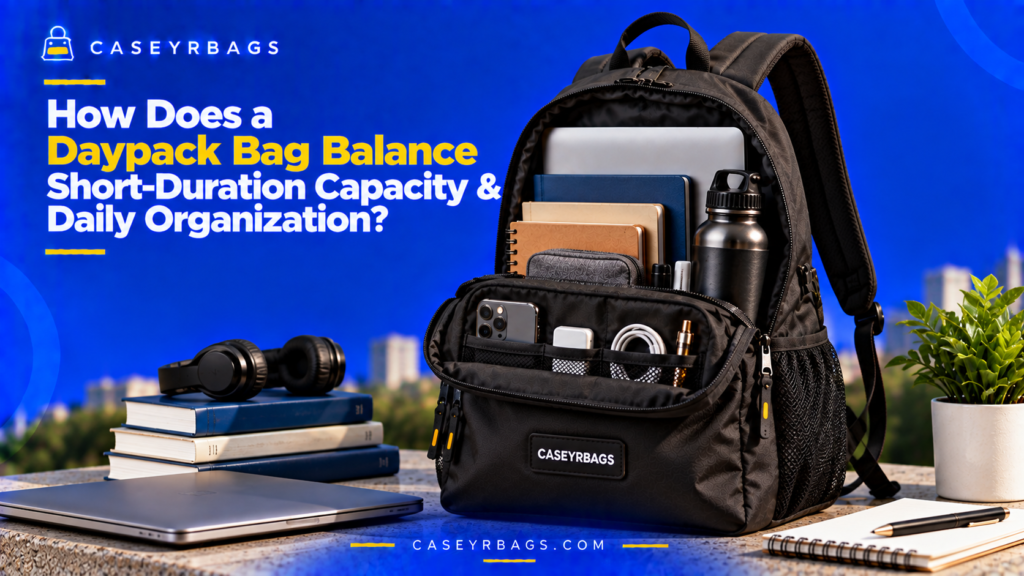
How Does a Daypack Bag Balance Short-Duration Capacity & Daily Organization? A Daypack Bag balances short-duration capacity and daily organization by providing enough usable space for the essentials needed during a limited period while dividing that space into a small number of purposeful storage zones. A functional main compartment handles larger items, while quick-access pockets, sleeves, and small-item sections keep frequently used contents from becoming buried or mixed together. The balance depends on more than nominal capacity. Loaded depth, opening geometry, compartment placement, device storage, exterior pockets, compression, and load distribution determine whether the bag remains compact and easy to use once filled. Effective Daypack design therefore aims for sufficient accessible space without turning every available surface into another compartment or forcing the routine load into unnecessary layers. Disclaimer Daypack Bag designs, user routines, carried items, body fit, and intended activities vary. No single bag volume, pocket count, or compartment layout provides the ideal short-duration capacity and organization for every user. Key Takeaway Useful Daypack capacity is the space the intended short-duration load can actually use while staying accessible and organized. More volume or more pockets only help when they improve predictable daily retrieval without adding unnecessary bulk or fragmentation. Capacity & Organization Evidence Key CapacityNormal daily contents fit without forced overfilling. ZoningStorage roles are limited and purposeful. AccessFrequent-use items have short retrieval paths. DepthLoaded profile remains controlled. AdaptationOrganization remains recognizable across load states. What Does Capacity-and-Organization Balance Mean in a Daypack Bag? A Daypack is generally intended to carry a daily or short-duration load rather than the expanded equipment associated with multi-day use. Its capacity therefore needs to support routine essentials without forcing the bag into the size and complexity of a larger travel or expedition pack. Organization determines how efficiently that usable space functions. A bag with adequate volume can still perform poorly if small items disappear into one chamber, while a highly divided bag can waste useful space when too many fixed pockets compete with larger contents. A balanced Daypack combines sufficient usable volume, controlled loaded shape, purposeful compartment zoning, and predictable access priority during normal loading and retrieval. Within the broader Everyday Carry category, the Daypack is the short-duration branch focused on adaptable daily storage. Which features most directly create the balance? The balance comes from the main compartment, main opening, loaded depth, internal sleeves, quick-access pockets, small-item zones, exterior storage, and compression working as one storage system. Main-chamber geometry provides the physical space, while opening and depth determine how much of that space remains accessible. Test the condition with the normal intended load and confirm that capacity and organization continue to support each other under the normal loaded condition. Do not treat maximum volume, minimum size, or raw pocket count as the goal. The governing distinction is: Feature → capacity role → organization consequence. Judge the complete loaded system rather than the empty bag alone. Why is more storage space not automatically better? More storage space can increase flexibility, but it can also create larger unused zones, deeper loading layers, greater item migration, and more opportunity to add contents that the short-duration task does not require. Extra volume is useful only when the daily load actually benefits from it. Test the condition with the normal intended load and confirm that the intended short-duration contents fit without forcing crowding, inaccessible layers, or unnecessary bulk. Do not treat maximum volume, minimum size, or raw pocket count as the goal. Judge the complete loaded system rather than the empty bag alone. Why is more organization not automatically better? More organization can stabilize item locations, but additional fixed pockets and dividers can fragment the main chamber, duplicate storage roles, create extra search choices, and reduce flexible space for larger contents. Daypack balance comes from enough organization for predictable retrieval, not from maximizing feature count. Test the condition with the normal intended load and confirm that storage zones reduce item mixing without fragmenting the bag into unnecessary fixed compartments. Do not treat maximum volume, minimum size, or raw pocket count as the goal. The governing distinction is: Daypack balance comes from enough capacity and enough organization—not the maximum of either.. Judge the complete loaded system rather than the empty bag alone. Daypack Capacity & Organization Anatomy SVG Daypack Capacity & Organization Anatomy SVGDaypack anatomy showing main compartment, opening, device sleeve, quick-access pocket, small-item zone, side pocket, exterior pocket, base, compression point, and loaded depth. Daypack Capacity & Organization Anatomy Capacity → Zoning → Access → Daily Retrieval MAIN COMPARTMENT DEVICE SLEEVE SMALL-ITEM ZONE QUICK-ACCESSpocket SIDE POCKETexternal zone LOADED DEPTH Base geometry + compression points help control the loaded profile Figure 1.0:Core storage zones and loaded-geometry controls in a Daypack.CASEYRBAGS.COM • Daypack capacity & organization What Makes Daypack Capacity Suitable for Short-Duration Use? Explain capacity according to the intended load rather than a universal volume figure. What does short-duration capacity need to accommodate? Short-duration capacity needs to support the categories required by the intended daily task: primary essentials, one or more larger routine items, small frequent-use contents, optional flat or device-like items, and limited situational extras. The useful requirement comes from the load, not from one universal liter or item-count target. Test the condition with the normal intended load and confirm that the intended short-duration contents fit without forcing crowding, inaccessible layers, or unnecessary bulk. Do not treat maximum volume, minimum size, or raw pocket count as the goal. Judge the complete loaded system rather than the empty bag alone. When is capacity insufficient? Capacity is insufficient when the normal load creates closure strain, forces constant stacking, requires one item to be removed to reach another, or lets rigid contents distort the bag. Physical fit alone is not enough if access and zoning already deteriorate under that load. Test the condition with the normal intended load and confirm that the intended short-duration contents fit without forcing crowding, inaccessible layers, or unnecessary bulk. Do not treat maximum volume, minimum size, or raw pocket count as the goal. Judge the complete loaded
When Can a Pouch-Style Drawstring Bag Function as an Evening Bag?

When Can a Pouch-Style Drawstring Bag Function as an Evening Bag? A Pouch-Style Drawstring Bag can function as an Evening Bag when its compact scale, controlled silhouette, usable drawstring closure, carrying method, and capacity support a limited set of personal essentials without creating excessive bulk or difficult access. Proportionate cords, hardware, finishing, and a coherent loaded shape can strengthen the presentation while preserving the flexible pouch identity. The role depends on the complete use case rather than one decorative or structural cue. A pouch may look refined yet work poorly if required essentials do not fit, retrieval is awkward, or carrying is impractical; a simpler pouch can work effectively when its size, material behavior, access, load control, and presentation suit the intended evening context. Disclaimer Evening Bag expectations vary by event, culture, personal style, carried items, and dress context. No single size, material, closure, carry method, or decorative treatment universally makes a Pouch-Style Drawstring Bag an Evening Bag. Key Takeaway A Pouch-Style Drawstring Bag functions as an Evening Bag only when compact construction, limited but sufficient capacity, usable access, practical carry, controlled loaded form, finishing, and context work together. Evening-Bag Function Evidence Key CapacityRequired limited essentials fit without overfilling. AccessOpening and retrieval remain practical. CarryIntended carry method works predictably. Loaded FormSilhouette stays coherent after loading. ContextFunction and presentation align with intended use. What Allows a Pouch-Style Drawstring Bag to Function as an Evening Bag? A Pouch-Style Drawstring Bag begins as a construction format: a compact or flexible body whose upper opening is controlled by cords. That architecture can support several uses, so the pouch shape and drawstring mechanism alone do not establish an Evening Bag role. To function effectively as an Evening Bag, the pouch needs manageable scale, practical access, limited but sufficient capacity, a usable carrying method, and a loaded silhouette that remains coherent with the intended setting. Evening Bag function should therefore be judged through capacity, retrieval, closure behavior, carry, silhouette, finishing, and context together. Within the broader Drawstring Bag family, the use-case role emerges only when those practical and presentational signals align. Which attributes most directly support Evening Bag function? Which attributes most directly support Evening Bag function should be evaluated through feature → practical effect → evening bag consequence. The construction cue matters only when it changes the pouch’s actual capacity, access, carry behavior, loaded form, or presentation within the intended evening context. Evaluate this with the intended limited load and confirm that the complete pouch supports limited carry, usable access, controlled loading, and context-appropriate presentation. Do not classify the pouch from one size, material, closure, decoration, carry method, or prestige cue alone. The governing distinction is: Feature → practical effect → Evening Bag consequence. Use the complete loaded system to judge practical function and presentation together. Why does Pouch-Style construction not automatically create Evening Bag identity? Pouch-Style construction describes a bag format, not an automatic Evening Bag role. The same compact drawstring architecture can support casual carry, storage, decorative use, or occasion-oriented carry, so the category cannot be assigned from the pouch shape or closure alone. Evaluate this with the intended limited load and confirm that the complete pouch supports limited carry, usable access, controlled loading, and context-appropriate presentation. Do not classify the pouch from one size, material, closure, decoration, carry method, or prestige cue alone. The governing distinction is: Pouch construction ≠ automatic Evening Bag identity. Use the complete loaded system to judge practical function and presentation together. What defines successful Evening Bag function? Successful Evening Bag function means the pouch carries the intended essentials, remains practical to open and retrieve from, preserves a controlled compact form, and uses a carry method that works for the intended setting. Presentation and practical function must align rather than compete. Evaluate this with the intended limited load and confirm that the complete pouch supports limited carry, usable access, controlled loading, and context-appropriate presentation. Do not classify the pouch from one size, material, closure, decoration, carry method, or prestige cue alone. The governing distinction is: The pouch carries the intended essentials, remains easy enough to use, preserves a controlled compact form, and presents a construction appropriate to the intended evening context.. Use the complete loaded. Pouch-Style Evening Bag Anatomy SVG Pouch-Style Evening Bag Anatomy SVGPouch-style Evening Bag anatomy showing drawstring, gathered opening, main chamber, body panel, base, seams, hardware, carry cord or strap, lining, and essential-item zone. Pouch-Style Evening Bag Anatomy Construction must support capacity, access, carry, and presentation together. ESSENTIAL-ITEM ZONElimited intended load OPENING + CORDaccess + compact closure CARRY + HARDWAREhandling + proportion CONSTRUCTION → CAPACITY → ACCESS → CARRY → PRESENTATION Figure 1.0:Core components that support Pouch-Style Evening Bag function.CASEYRBAGS.COM • Pouch-Style Evening use Pouch Construction → Evening Function Matrix Construction / Function State Practical Function Presentation Evening Role Refined + functional Strong Coherent Strong fit Refined + poor access/capacity Weak Strong Mismatch Simple + functional Strong Context-dependent Conditional / strong fit Decorative + dysfunctional Weak Decorative Mismatch How Does Compact Scale Support Evening Bag Function? Explain why Evening Bags commonly emphasize limited carry rather than maximum volume. How can compact dimensions support evening use? How can compact dimensions support evening use because 2 focused paragraphs. In practice, the effect should be traced through usable capacity, closure clearance, and loaded bulk so the consequence for limited carry, usable access, controlled loading, and evening-use presentation stays explicit. Evaluate this with the intended limited load and confirm that the intended limited essentials fit without forced compression or silhouette distortion. Do not classify the pouch from one size, material, closure, decoration, carry method, or prestige cue alone. Use the complete loaded system to judge practical function and presentation together. When does compact become too small? Compact scale becomes too small when normal required contents cannot fit without compression, block the drawstring closure, stack unpredictably, or make routine retrieval difficult. At that point, reduced dimensions stop supporting limited carry and begin creating a capacity-and-access mismatch. Evaluate this with the intended limited load and confirm that the intended limited
How Does Pouch-Style Drawstring Bag Construction Affect Formality?
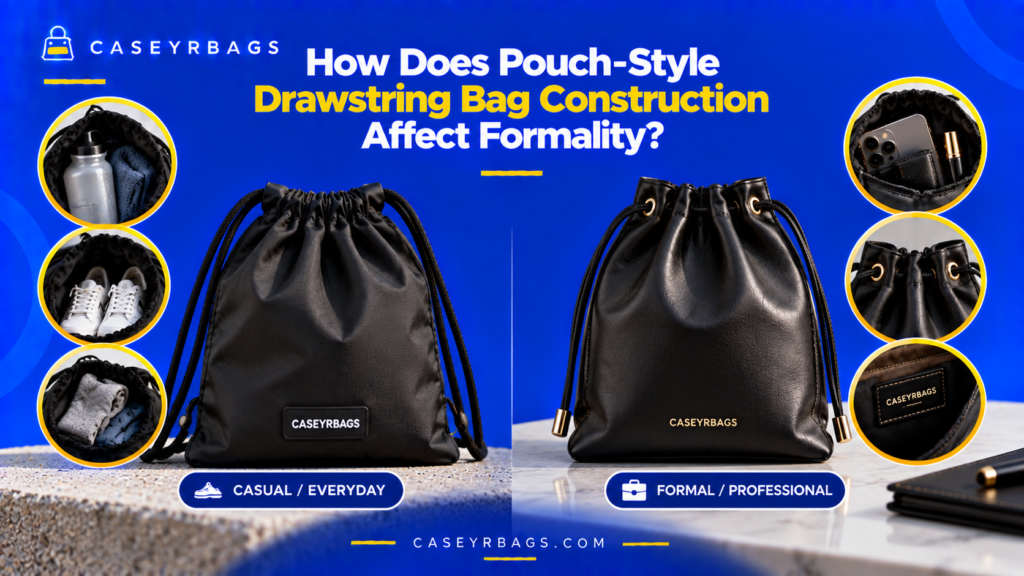
How Does Pouch-Style Drawstring Bag Construction Affect Formality? Pouch-Style Drawstring Bag construction affects perceived formality by shaping how deliberate, balanced, and visually finished the bag appears. Silhouette control, body structure, upper-edge gathering, seam geometry, base support, cord execution, and proportions can work together to create a more refined presentation, while softer drape, bulky gathering, or visibly utilitarian construction can create a more relaxed one. Formality does not come from one material, closure type, level of stiffness, or prestige cue. The same drawstring architecture can range from casual to highly refined depending on finishing, material behavior, hardware integration, and whether the loaded pouch preserves its intended geometry. The result is contextual perception influenced by construction rather than a universal dress-code classification. Disclaimer Pouch-Style Drawstring Bag formality is context-dependent and can vary by culture, event, styling, material interpretation, and personal expectation. Construction features influence perceived refinement but do not create a universal dress-code classification. Key Takeaway Perceived formality comes from coordinated construction. Silhouette, gathering, finishing, proportions, material behavior, hardware, and loaded form matter together; no single material, closure type, size, or stiffness level determines the result. Construction-Formality Evidence Key SilhouetteOverall shape appears deliberate or relaxed. GatheringUpper folds remain controlled or visually bulky. FinishingSeams and edges support visual coherence. ProportionCord, hardware, body, and base remain balanced. Loaded FormNormal contents preserve or weaken intended geometry. What Does Construction-Based Formality Mean in a Pouch-Style Drawstring Bag? A Pouch-Style Drawstring Bag combines a flexible or semi-structured body with an upper opening that contracts through cord tension. The same basic architecture can be executed with different levels of silhouette control, panel support, gathering precision, hardware integration, and finishing. A loosely draped body with visible utility-focused components may create a more relaxed construction language, while controlled proportions, cleaner edge finishing, restrained hardware, deliberate gathering, and coherent panel geometry can create a more polished presentation without requiring maximum stiffness. Construction-based formality therefore depends on how the complete system works together. Within the broader Drawstring Bag family, this pouch-specific question focuses on shape control, visual refinement, material behavior, and the loaded silhouette rather than the drawstring format alone. Which construction features most directly affect perceived formality? Which construction features most directly affect perceived formality should be evaluated through the visible construction, material behavior, proportions, finishing, and loaded geometry. The cue matters only as part of the complete Pouch-Style Drawstring Bag presentation. Compare the cue with the rest of the bag rather than treating it as an independent score. The governing distinction is: Construction cue → visual effect → formality perception. Interpret the result within the intended context and confirm that the empty and loaded forms remain visually coherent before calling the construction more refined, more relaxed, or mixed. Why can the same pouch format appear either formal or casual? The same Pouch-Style Drawstring architecture can appear either more refined or more relaxed because the basic pouch-and-cord format does not fix the visual language by itself. Differences in body structure, material behavior, finishing, proportions, gathering, and detailing change how controlled or informal the final construction appears. Compare the cue with the rest of the bag rather than treating it as an independent score. Interpret the result within the intended context and confirm that the empty and loaded forms remain visually coherent before calling the construction more refined, more relaxed, or mixed. Why should formality be treated as a combined construction effect? Formality should be treated as a combined construction effect because silhouette, closure execution, material behavior, seams, edges, base support, hardware, proportions, and loaded shape influence one another. A single refined-looking feature can be weakened by conflicting geometry or finishing elsewhere in the bag. Compare the cue with the rest of the bag rather than treating it as an independent score. The governing distinction is: No single construction feature independently determines Pouch-Style Drawstring Bag formality.. Interpret the result within the intended context and confirm that the empty and loaded forms remain visually coherent before calling the construction more refined, more relaxed, or mixed. Pouch-Style Drawstring Bag Construction Anatomy SVG Pouch-Style Drawstring Bag Construction Anatomy SVG Pouch anatomy showing drawstring, upper channel, gathered opening, side panel, seam line, body structure, base, hardware, edge finish, and lining. Pouch-Style Drawstring Construction Anatomy Construction cues combine to shape silhouette control and perceived refinement. GATHERED OPENINGcord + upper channel SEAM + EDGEvisible finishing cues DRAWSTRING CONTROL Construction → Shape Control → Visual Refinement → Perceived Formality Figure 1.0: Major construction cues in a Pouch-Style Drawstring Bag. CASEYRBAGS.COM • Pouch-Style formality How Does Overall Silhouette Affect Pouch-Style Drawstring Bag Formality? Explain how the bag’s complete outline creates the first major construction-based formality cue. This construction context also informs whether the pouch can function as an Evening Bag. How does a controlled silhouette affect perceived formality? A controlled silhouette can support perceived refinement by creating a cleaner outline, more predictable proportions, less uncontrolled collapse, and clearer geometric definition. The effect comes from visible deliberateness in the complete shape rather than from stiffness alone. Compare the cue with the rest of the bag rather than treating it as an independent score. Interpret the result within the intended context and confirm that the empty and loaded forms remain visually coherent before calling the construction more refined, more relaxed, or mixed. A softer result can be intentional and does not imply defective construction. How does a highly relaxed silhouette change the impression? A highly relaxed silhouette creates softer geometry because the body shows more drape, movement, and load-driven shape change. That construction language may read as more casual or relaxed, but the softness can still be intentional and should not be treated as evidence of poor construction. Compare the cue with the rest of the bag rather than treating it as an independent score. Interpret the result within the intended context and confirm that the empty and loaded forms remain visually coherent before calling the construction more refined, more relaxed, or mixed. Why is a rigid silhouette not automatically more formal? A rigid silhouette is not automatically more formal because
How Do Cinch Sack Bag Cords Tighten and Secure the Opening?
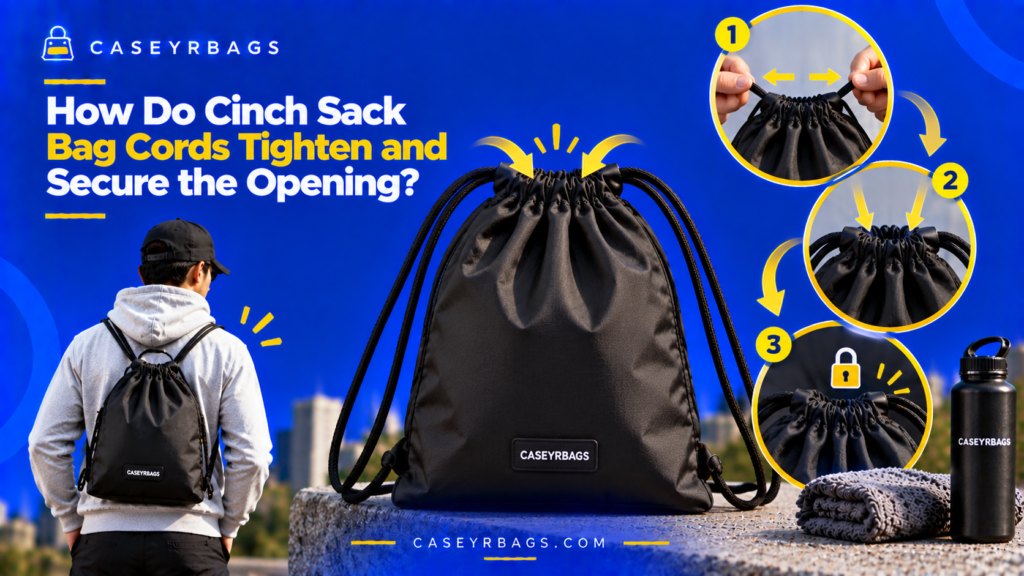
How Do Cinch Sack Bag Cords Tighten and Secure the Opening? Cinch Sack Bag cords tighten the opening by removing slack and transferring the user’s pull into tension around a flexible upper perimeter. As tension reaches the routed upper edge, sections of fabric gather into folds and the effective opening becomes smaller. The tightening stage therefore depends on cord movement, routing geometry, flexible fabric, and enough free space for the perimeter to gather. Keeping that smaller opening controlled is a separate retention stage. Depending on the design, resistance can come from routing friction, cord interaction, a cord lock, a knot, dual-cord behavior, or integrated carry tension. These mechanisms help resist immediate reverse movement during normal use, but they do not automatically create a lock, seal, tamper-resistant closure, or theft-proof system. Disclaimer Cinch Sack Bag cord systems vary in routing, materials, friction, cord-lock design, knot use, and carry configuration. Tightening and retaining the opening do not inherently create a sealed, tamper-resistant, or theft-proof closure. Key Takeaway Tightening and retention are different stages. The cord first removes slack and gathers the opening; a design-specific resistance or retention method then helps keep that reduced geometry controlled until deliberate release. Tightening & Retention Evidence Key SlackAvailable free cord can be removed normally. TensionPull reaches the intended perimeter. GatheringUpper fabric folds predictably. RetentionReduced opening remains controlled. ReleaseSystem reopens without unnecessary force. What Does It Mean for Cinch Sack Cords to Tighten and Secure the Opening? Tightening begins when the user pulls the drawcord and removes available slack from the closure path. As that loose length disappears, the cord starts carrying meaningful tension through the channel, eyelets, loops, or other guide points around the flexible upper perimeter. That transferred tension causes the upper fabric to slide, fold, or bunch along the routed cord. The resulting gathering brings sections of the opening closer together and reduces the effective access gap without turning the flexible perimeter into a rigid seal. Retention follows after the opening has been reduced. The cord position must resist immediate reverse movement if the gathered geometry is to remain controlled. This mechanism sits within the broader Drawstring Bag structure, where cord-controlled access depends on flexible opening geometry and supported load paths. Which components create the tightening action? Which components create the tightening action should be evaluated through the actual cord route, flexible upper edge, load position, and retention behavior. A useful observation connects the visible result to the mechanism that changes slack, tension, gathering, opening size, or reverse movement. Test the condition with the normal intended load and observe tightening, retention, release, and reopening as separate stages. The governing distinction is: Component → tension role → opening effect. Keep the cord setting or retention method only when it preserves a controllable reduced opening without excessive force, blocked gathering, binding, unexplained loosening, or difficult deliberate release. Which components can help retain the tightened state? Which components can help retain the tightened state should be evaluated through the actual cord route, flexible upper edge, load position, and retention behavior. A useful observation connects the visible result to the mechanism that changes slack, tension, gathering, opening size, or reverse movement. Test the condition with the normal intended load and observe tightening, retention, release, and reopening as separate stages. Keep the cord setting or retention method only when it preserves a controllable reduced opening without excessive force, blocked gathering, binding, unexplained loosening, or difficult deliberate release. Why must tightening and retention be evaluated separately? Why must tightening and retention be evaluated separately because the cord can tighten the opening successfully but still fail to retain that tightened state.. The mechanical question is whether that condition changes slack, tension transfer, gathering, opening contraction, retention, release, or reopening in a predictable way without overstating the system as a lock or seal. Test the condition with the normal intended load and observe tightening, retention, release, and reopening as separate stages. The governing distinction is: The cord can tighten the opening successfully but still fail to retain that tightened state.. Keep the cord setting or retention method only when it preserves a controllable reduced opening without excessive force, blocked gathering, binding, unexplained loosening, or difficult deliberate release. Cinch Sack Tightening & Retention Anatomy SVG Cinch Sack Tightening & Retention Anatomy SVGCinch Sack anatomy showing drawcord, channel, guide point, gathered fabric, cord exit, reduced opening, retention point, and lower anchor. Cinch Sack Tightening & Retention Anatomy Tightening reduces the opening; retention resists immediate reverse movement. REDUCED OPENING CORD CHANNELroutes tension RETENTION POINTresists reversal PULL → TENSION → GATHER Reduce opening → retain chosen geometry → deliberate release Figure 1.0:Tightening and retention are separate mechanical stages.CASEYRBAGS.COM • Cinch Sack retention How Does Pulling the Cord Remove Slack? Explain the first stage of tightening before significant gathering occurs. What is cord slack? Cord slack is the portion of cord length not yet carrying meaningful tension through the closure path. At this stage the free cord can move without immediately drawing the upper perimeter inward, because the routing system still contains available length before the cord begins transferring a stronger closing force. Test the condition with the normal intended load and observe tightening, retention, release, and reopening as separate stages. The governing distinction is: Slack is the portion of cord length not currently carrying meaningful tension through the closure path.. Keep the cord setting or retention method only when it preserves a controllable reduced opening without excessive force, blocked gathering, binding, unexplained loosening, or difficult deliberate release. What happens as the free cord end is pulled? Pulling the free cord end first removes available slack. As that loose length is taken up, the routed cord begins carrying increasing tension through the channel, eyelets, loops, or guide points. The useful closing force therefore develops only after enough slack has been removed for the pull to reach the flexible upper perimeter. Test the condition with the normal intended load and observe tightening, retention, release, and reopening as separate stages. The governing distinction is: Free cord moves →