How Does Cinch Sack Bag Cord Closure Work?
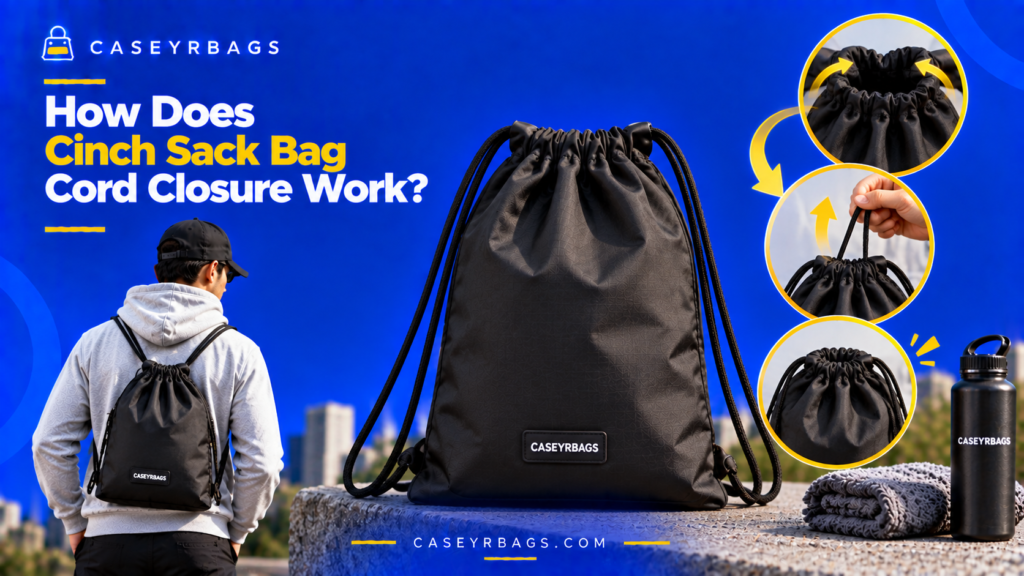
How Does Cinch Sack Bag Cord Closure Work? A Cinch Sack Bag cord closure works by routing one or more drawcords around or through a flexible upper perimeter. When the user pulls the cord, slack decreases and tension travels through the route, drawing sections of the upper edge together. The fabric gathers into folds, which reduces the effective size of the opening without creating a rigid lid. Releasing the cord reverses the mechanism: tension falls, slack returns, and the gathered upper edge can spread so the opening expands again. Reliable closure therefore depends on predictable cord routing, workable channel or guide-point resistance, flexible gathering space, load clearance near the upper edge, and a retention method that does not prevent normal reopening. A cinched opening controls access size; it is not automatically locked or sealed. Disclaimer Cinch Sack Bag designs vary in cord layout, guide points, materials, reinforcement, and carry configuration. A cinched cord closure controls opening size but does not inherently provide locking, waterproof sealing, or guaranteed item retention. Key Takeaway A Cinch Sack closes when pulling reduces cord slack, routed tension gathers the flexible upper edge, and the effective opening becomes smaller. A functional system must also retain the chosen state and reopen predictably. Cord-Closure Evidence Key RoutingCord follows its intended path. TensionUser pull reaches the perimeter. GatheringUpper edge folds predictably. RetentionCinched state remains controllable. ReleaseOpening can expand again. What Is a Cinch Sack Bag Cord Closure? A Cinch Sack Bag uses a flexible upper opening controlled by one or more drawcords rather than a rigid frame or fixed lid. The cord passes through a channel, eyelets, loops, or related guide points that keep the closure mechanism aligned with the movable upper perimeter. Pulling the cord reduces slack and transfers tension around that route. Because the upper material can slide, fold, and bunch, the opening contracts as more of the perimeter becomes gathered instead of remaining fully spread. The complete mechanism therefore depends on cord movement, guided tension, flexible gathering, controllable retention, and reversible release. This subtype mechanism belongs to the broader Drawstring Bag structure, where cord-controlled access and flexible form operate as one system. Which components make up the cord closure? Which components make up the cord closure should be evaluated through the actual drawcord path, upper-edge movement, load position, and reversible opening cycle. A useful observation connects the visible behavior to the specific mechanism that changes tension, gathering, opening size, or retention. Test the condition with the normal intended load and compare both the cinching and reopening phases. The governing distinction is: Component → mechanical role → closure effect. Keep the cord setting or structural feature only when it improves predictable closure without creating excessive resistance, uneven gathering, blocked folds, unexplained loosening, or difficult release. What changes between the open and cinched states? In the open state, cord tension is low, the upper edge is spread, and the effective opening remains relatively large. In the cinched state, cord tension is higher, the upper fabric has gathered into folds, and the effective opening is smaller even though the original fabric perimeter still exists. Test the condition with the normal intended load and compare both the cinching and reopening phases. Keep the cord setting or structural feature only when it improves predictable closure without creating excessive resistance, uneven gathering, blocked folds, unexplained loosening, or difficult release. Why does the mechanism require a flexible opening? Why does the mechanism require a flexible opening because the cinch sack closes because the upper edge can change shape around the cord path.. The important mechanical test is whether that condition changes cord travel, tension transfer, fabric gathering, effective opening size, retention, or release in a predictable way. Test the condition with the normal intended load and compare both the cinching and reopening phases. The governing distinction is: The Cinch Sack closes because the upper edge can change shape around the cord path.. Keep the cord setting or structural feature only when it improves predictable closure without creating excessive resistance, uneven gathering, blocked folds, unexplained loosening, or difficult release. Cinch Sack Cord Closure Anatomy SVG Cinch Sack Cord Closure Anatomy SVGCinch Sack anatomy showing drawcord, upper channel, guide point, flexible edge, opening, gathered section, cord exit, side panel, and lower anchor. Cinch Sack Cord Closure Anatomy A guided cord path converts pulling force into upper-edge gathering. MAIN OPENING UPPER CHANNELroutes the cord GUIDE / EYELETredirects tension PULL / TENSION Cord movement → tension → gathering → opening control Figure 1.0: Core components of a Cinch Sack cord-closure mechanism. CASEYRBAGS.COM • Cinch Sack cord closure What Happens When the Cinch Sack Cord Is Pulled? Explain the first mechanical action that transforms an open bag into a cinched bag. How does pulling create cord tension? Pulling the free cord reduces slack in the routed drawcord. As slack decreases, the user’s pull becomes tension that travels through the channel, loops, or eyelets around the upper perimeter. The cord therefore acts as the force-transfer element that initiates closure rather than directly compressing the entire bag body. Test the condition with the normal intended load and compare both the cinching and reopening phases. The governing distinction is: User pulls free cord length → slack decreases → tension increases through routed cord. Keep the cord setting or structural feature only when it improves predictable closure without creating excessive resistance, uneven gathering, blocked folds, unexplained loosening, or difficult release. How does that tension reach the opening perimeter? Tension reaches the opening perimeter through the specific route created by channel sections, eyelets, loops, and upper-edge guides. Each routing point changes direction or maintains the cord near the flexible edge so the user’s pull can reach multiple parts of the opening instead of remaining concentrated only at the free cord end. Test the condition with the normal intended load and compare both the cinching and reopening phases. Keep the cord setting or structural feature only when it improves predictable closure without creating excessive resistance, uneven gathering, blocked folds, unexplained loosening, or difficult
Why Does a Drawstring Bag Use Cord-Controlled Access & Lightweight Flexible Form?

Why Does a Drawstring Bag Use Cord-Controlled Access & Lightweight Flexible Form? A Drawstring Bag uses cord-controlled access because pulling the drawcord can gather a flexible upper perimeter into a smaller opening without requiring a rigid lid or complex closure frame. Releasing tension allows that same opening to spread again, so loading, closing, reopening, and retrieval depend on cord movement, fabric folds, and predictable tension transfer around the upper edge. Its lightweight flexible form supports the same mechanism. Soft panels, limited framing, minimal rigid hardware, and a flexible base let the bag collapse when empty and reshape around the load when filled. That simplicity does not remove structure: seams, anchors, reinforcement, the base, and the closure zone still determine how well the bag carries contents and how reliably the gathered opening works under load. Disclaimer Drawstring Bag materials, cord systems, reinforcement methods, dimensions, construction details, and intended loads vary. Cord-controlled access does not guarantee secure locking, waterproof sealing, uniform durability, or any specific verified load capacity. Key Takeaway A Drawstring Bag works as one connected system: the drawcord changes the flexible opening, while the soft body, base, seams, and anchors adapt to the intended load. Simplicity does not remove structural limits. Structural Evidence Key Cord PathTension reaches the opening predictably. GatheringUpper edge folds evenly. Body FormSoft panels adapt without excessive distortion. Load PathsAnchors and seams remain supported. Closure ZoneNormal contents still permit gathering. What Defines Cord-Controlled Access & Flexible Form in a Drawstring Bag? A Drawstring Bag combines two linked design ideas: a flexible opening controlled by drawcord tension and a soft body that changes shape around its contents. The access mechanism works because the upper perimeter can move, fold, and gather rather than remaining fixed in one rigid geometry. The flexible body uses relatively soft panels, limited framing, and few rigid closure components. This can reduce structural complexity and empty mass, but it also transfers more shape control to the contents, seams, base, anchors, and the way the load occupies the main chamber. The system works best when cord routing, flexible gathering, load shape, and reinforcement remain compatible. Within the broader Everyday Carry category, the Drawstring Bag is defined by how these access and form mechanisms operate together rather than by rigid structure. Which features define the cord-controlled access system? Which features define the cord-controlled access system should be evaluated through the actual cord path, flexible body response, closure behavior, and loaded geometry. The goal is to connect the visible condition to a specific mechanical cause and then to the effect on access, form, retention, or structural load transfer. Test the condition with the normal carried load and observe both opening behavior and body shape. The governing distinction is: Feature → tension role → opening effect. Keep the adjustment or design feature only when it improves predictable operation without creating excessive cord friction, blocked gathering, panel distortion, anchor strain, seam stress, or difficult reopening. Which features create the lightweight flexible form? Which features create the lightweight flexible form should be evaluated through the actual cord path, flexible body response, closure behavior, and loaded geometry. The goal is to connect the visible condition to a specific mechanical cause and then to the effect on access, form, retention, or structural load transfer. Test the condition with the normal carried load and observe both opening behavior and body shape. Keep the adjustment or design feature only when it improves predictable operation without creating excessive cord friction, blocked gathering, panel distortion, anchor strain, seam stress, or difficult reopening. Why do these two systems work together? Why do these two systems work together because flexible upper perimeter + movable cord tension → opening can expand or gather without rigid closure architecture. The relevant effect should be traced from the component to its mechanical role and then to the access or structural consequence rather than treated as a generic strength, capacity, or convenience claim. Test the condition with the normal carried load and observe both opening behavior and body shape. The governing distinction is: The Drawstring Bag’s access system depends on the body being able to change shape.. Keep the adjustment or design feature only when it improves predictable operation without creating excessive cord friction, blocked gathering, panel distortion, anchor strain, seam stress, or difficult reopening. Drawstring Bag Structural Anatomy SVG Drawstring Bag Structural Anatomy SVG Drawstring Bag anatomy showing drawcord, channel, guide points, gathered upper edge, flexible panels, chamber, base, anchor, and loaded shape. Drawstring Bag Structural Anatomy Cord tension controls the opening while flexible panels adapt to the load. MAIN CHAMBER load-responsive body CORD CHANNEL guides tension GATHERED EDGE opening contracts CORD TENSION Opening control + flexible body response + reinforced load paths Figure 1.0: Drawstring access and flexible-body anatomy. CASEYRBAGS.COM • Drawstring Bag mechanics How Does the Drawcord Control the Main Opening? Explain the basic mechanical relationship between pulling the cord and reducing the effective opening perimeter. For the subtype-specific cord-opening mechanism, see Cinch Sack Bag. What happens when the cord is loosened? Reducing drawcord tension lets the flexible upper perimeter spread outward, increasing the effective size of the main opening. The cord does not create a rigid lid; it simply stops pulling the fabric inward, so the gathered folds relax and the upper edge can open for loading or retrieval. Test the condition with the normal carried load and observe both opening behavior and body shape. The governing distinction is: Reduced cord tension → upper perimeter expands → opening becomes wider. Keep the adjustment or design feature only when it improves predictable operation without creating excessive cord friction, blocked gathering, panel distortion, anchor strain, seam stress, or difficult reopening. What happens when the cord is pulled? Pulling the drawcord increases tension around the flexible upper perimeter, causing the fabric to gather into folds and reducing the effective opening size. The mechanism depends on the fabric moving along the cord path, so closure comes from changing opening geometry rather than from a rigid cover or locking part. Test the condition with
When Does Front Rotation Improve Cross-Body Sling Bag Retrieval?
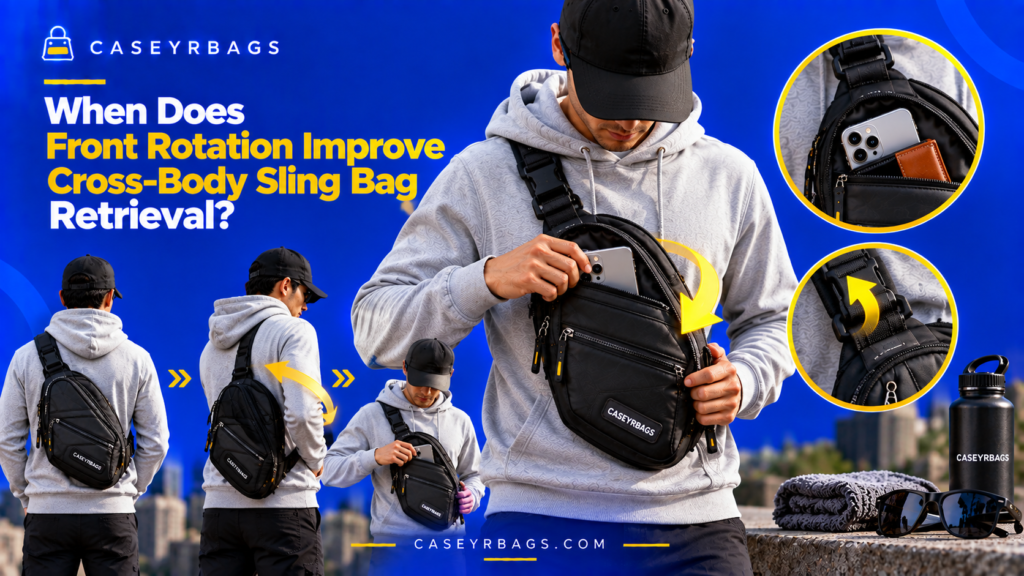
When Does Front Rotation Improve Cross-Body Sling Bag Retrieval? Front rotation improves Cross-Body Sling Bag retrieval when moving the loaded bag forward removes a real access barrier. A rear, rear-side, or side resting position may place the intended compartment outside a practical hand path, while a controlled front or front-side transition can bring the closure and storage zone into easier reach, improve useful visibility, and create a more stable opening position. The benefit is conditional rather than automatic. If direct side access already works, the opening remains poorly oriented, or the forward endpoint adds swing, searching, or return effort, rotation can make retrieval less efficient. The useful amount of rotation is therefore the minimum movement that improves the complete locate, reach, open, retrieve, reclose, and return cycle with the normal carried load. Disclaimer Cross-Body Sling Bag designs, strap layouts, body fit, opening geometry, pocket placement, and carried loads vary. No single front position or rotation distance improves retrieval for every bag or wearer. Key Takeaway Front rotation helps only when it removes more access friction than it adds. The best endpoint is the first stable position that improves reach, opening use, item retrieval, reclosure, and return. Front-Rotation Retrieval Evidence Key BarrierDirect access is genuinely limited. EndpointFront or front-side position remains stable. OpeningClosure and zipper path become more usable. ItemFrequent-use storage becomes easier to locate. ReturnReclosure and reverse rotation stay efficient. What Does “Front Rotation Improves Retrieval” Actually Mean? A Cross-Body Sling Bag may rest behind the torso, at the rear-side, or along the side because those positions can support compact everyday carry. Those same positions can also place a frequent-use compartment outside the most direct hand or visual access path. Front rotation changes that relationship by moving the intended storage zone toward the front or front-side. The movement is useful when it shortens reach, improves opening visibility, or gives the wearer a more stable endpoint for operating the closure and retrieving the intended item. The result should be judged across the full access cycle rather than from forward movement alone. This retrieval-specific behavior sits within the broader Sling Bag system: carry position → controlled rotation → usable endpoint → retrieval → reclosure → return. Which retrieval steps can front rotation improve? The most relevant options are locating the compartment, reaching the closure, stabilizing the bag, and opening the compartment. Their value depends on whether the rotated endpoint places the intended storage zone within a practical hand path while keeping the bag controlled enough for normal opening and retrieval. Test the condition with the normal carried load and compare it with direct access from the resting position. A front-side endpoint may be sufficient; farther rotation is not automatically better. The governing distinction is: Access barrier → rotational change → retrieval improvement. Keep the change only when it reduces total retrieval friction without adding excessive swing, twisting, searching, closure difficulty, or return-path correction. Why is moving the bag forward not enough by itself? Why is moving the bag forward not enough by itself because forward movement only matters when it improves the complete retrieval geometry.. The relevant test is whether the change improves reach, opening control, item location, reclosure, or return without creating another repositioning step. Test the condition with the normal carried load and compare it with direct access from the resting position. A front-side endpoint may be sufficient; farther rotation is not automatically better. The governing distinction is: Forward movement only matters when it improves the complete retrieval geometry.. Keep the change only when it reduces total retrieval friction without adding excessive swing, twisting, searching, closure difficulty, or return-path correction. What defines a real retrieval improvement? A real retrieval improvement exists when front rotation removes more access friction than the movement itself adds. The useful change should simplify locating the compartment, reaching the closure, stabilizing the bag, opening it, retrieving the intended item, and preparing the bag for a controlled return. Test the condition with the normal carried load and compare it with direct access from the resting position. A front-side endpoint may be sufficient; farther rotation is not automatically better. The governing distinction is: Front rotation improves retrieval when it removes more access friction than the rotational movement itself adds.. Keep the change only when it reduces total retrieval friction without adding excessive swing, twisting, searching, closure difficulty, or return-path correction. Cross-Body Sling Front-Rotation Anatomy SVG Cross-Body Sling Front-Rotation Anatomy SVGTorso anatomy showing rear carry, side transition, front-side access, diagonal strap, opening, hand path, and rotation direction. Cross-Body Sling Front-Rotation Anatomy Rotation is useful only when it converts carry position into a better retrieval endpoint. REAR FRONT-SIDE INTENTIONAL ROTATION HAND PATH USABLE ENDPOINT opening + pocket reachable Figure 1.0: Carry → rotate → endpoint → retrieval relationship. CASEYRBAGS.COM • Front-rotation retrieval When Does the Resting Carry Position Make Front Rotation Useful? Identify starting positions where rotation creates meaningful access improvement. When does rear carry benefit most from front rotation? This condition is useful when intended pocket cannot be reached directly, zipper cannot be seen, and bag must otherwise be removed. The practical question is whether front rotation creates a clearer, shorter, or more stable retrieval path than direct access from the bag’s normal resting position. Test the condition with the normal carried load and compare it with direct access from the resting position. A front-side endpoint may be sufficient; farther rotation is not automatically better. Keep the change only when it reduces total retrieval friction without adding excessive swing, twisting, searching, closure difficulty, or return-path correction. When does rear-side or side carry benefit from rotation? This condition is useful when compartment is reachable but awkward, opening faces backward, and arm or torso blocks hand path. The practical question is whether front rotation creates a clearer, shorter, or more stable retrieval path than direct access from the bag’s normal resting position. Test the condition with the normal carried load and compare it with direct access from the resting position. A front-side endpoint may be sufficient; farther rotation is not
How Does Cross-Body Sling Bag Rotation Affect Retrieval?
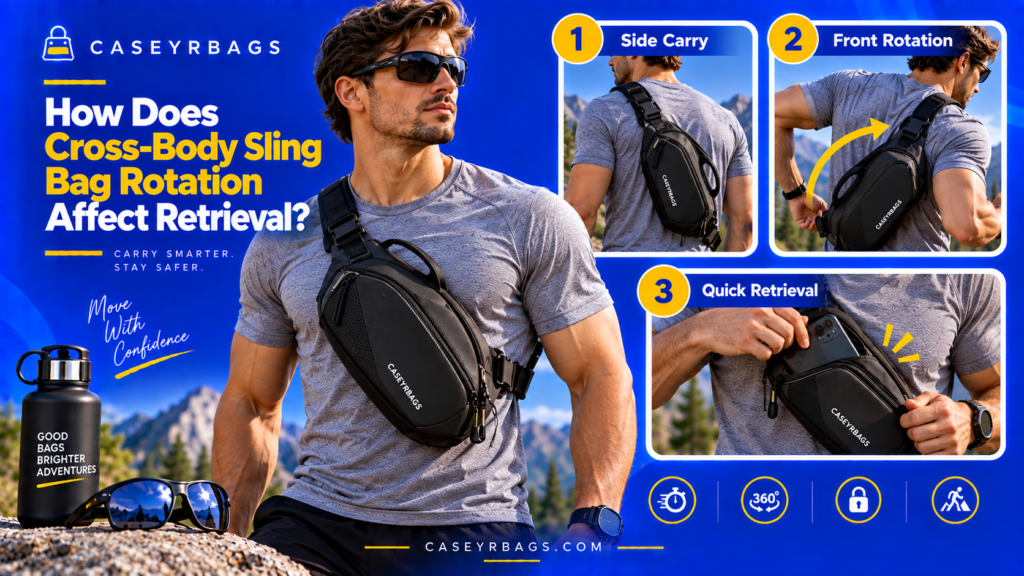
How Does Cross-Body Sling Bag Rotation Affect Retrieval? Cross-Body Sling Bag rotation affects retrieval by determining how easily the worn bag moves from a rear or side resting position into a front or front-side access position. Strap geometry, anchor placement, adjustment, bag depth, and body contact determine whether that movement feels deliberate and predictable or loose, obstructed, and difficult to stop at a useful endpoint. Rotation improves retrieval only when the final position places the intended opening, closure, and storage zone within a practical hand path. A bag can rotate smoothly yet still retrieve poorly if the zipper faces away, the compartment is buried, the load tilts the bag, or the endpoint remains unstable. Effective retrieval also requires the bag to reclose normally and return to its resting position without repeated correction. Disclaimer: Cross-Body Sling Bag designs, strap systems, body fit, opening layouts, carried loads, and intended positions vary. No single rotational path, strap length, or access position provides the same retrieval performance for every Sling Bag or wearer. Key Takeaway Cross-Body Sling retrieval works when rotation is deliberate, the bag stops at a usable endpoint, the intended opening follows a practical hand path, and the bag can reclose and return without repeated correction. Rotational Retrieval Evidence Key MovementIntentional rotation, not free swing. EndpointStable front or front-side stopping point. OpeningClosure and zipper path remain usable. OrganizationFrequent-use zones become predictable. ReturnReclosure and reverse rotation complete retrieval. What Does Rotational Retrieval Mean in a Cross-Body Sling Bag? A Cross-Body Sling Bag usually rests at the rear, rear-side, side, front-side, or front depending on its design and strap adjustment. Rotational retrieval occurs when the wearer deliberately moves the still-worn bag around the torso toward a more accessible front or front-side position while the diagonal strap remains engaged. Successful rotation does not end merely when the bag reaches the front. The intended compartment must also become visible or identifiable, the closure must fall within a practical hand path, and the bag must remain stable enough for the wearer to retrieve or return an item without unnecessary searching, twisting, or repeated stabilization. Rotational retrieval should therefore be evaluated as a complete sequence: carry position → rotation → access position → opening → retrieval → reclosure → return. The movement is useful only when every stage supports the next one predictably. For the broader parent mechanism, see Sling Bag. Which features most directly affect rotational retrieval? Most directly affect rotational retrieval should be judged through the observable movement, endpoint, opening orientation, and return behavior. In this part of Cross-Body Sling rotational retrieval, the important question is how the observed condition changes the bag’s movement path, angle, or final access position. The useful outcome is deliberate, predictable movement rather than unrestricted motion. Evaluate this factor under load, because empty or static behavior may hide the actual rotation-to-retrieval relationship. Judge the result by whether the loaded bag reaches the intended access state without repeated correction. If the same step repeatedly requires extra twisting, stabilization, searching, overshoot correction, or strap readjustment, adjust the variable identified here. Why is intentional rotation different from uncontrolled swing? Intentional rotation different from uncontrolled swing should be judged through leads to wearer initiates movement, leads to bag follows predictable path, leads to bag stops at usable endpoint, leads to movement occurs without deliberate access intent. In this part of Cross-Body Sling rotational retrieval, the important question is how the observed condition changes the bag’s movement path, angle, or final access position. The useful outcome is deliberate, predictable movement rather than unrestricted motion. Evaluate this factor under load, because empty or static behavior may hide the actual rotation-to-retrieval relationship. Rotational access ≠ uncontrolled swing. If the same step repeatedly requires extra twisting, stabilization, searching, overshoot correction, or strap readjustment, adjust the variable identified here. What defines a successful rotational retrieval sequence? A successful rotational retrieval sequence should be judged through The bag rotates predictably, reaches a stable access position, exposes the intended opening, permits retrieval, recloses normally, and returns to its carry position. In this part of Cross-Body Sling rotational retrieval, the important question is how the observed condition changes the bag’s movement path, angle, or final access position. The useful outcome is deliberate, predictable movement rather than unrestricted motion. Evaluate this factor under load, because empty or static behavior may hide the actual rotation-to-retrieval relationship. A useful setup preserves deliberate movement while keeping the endpoint, opening, and return path predictable. If the same step repeatedly requires extra twisting, stabilization, searching, overshoot correction, or strap readjustment, adjust the variable identified here. Cross-Body Sling Rotational Retrieval Anatomy SVG Cross-Body Sling Rotational Retrieval Anatomy SVGTorso anatomy showing diagonal strap, anchors, rear carry, side transition, front-side access, main opening, zipper path, and rotation direction. Cross-Body Sling Rotational Retrieval Anatomy Carry → Rotate → Open → Retrieve → Reclose → Return REAR CARRY FRONT-SIDE CONTROL POINTSUpper AnchorLower AnchorDiagonal Strap Intentional torso path → stable access endpoint → controlled return Figure 1.0:Rotational retrieval anatomy and access endpoint.CASEYRBAGS.COM • Cross-Body Sling rotational retrieval How Does Resting Carry Position Affect Rotation Distance? Explain how the starting position determines how far the bag must travel before retrieval begins. This section evaluates the factor with the normal loaded bag and connects the observed movement directly to endpoint control, opening usability, retrieval, and return. How does rear carry change the rotational path? Rear carry change the rotational path should be judged through longer travel around the torso, movement through side position, progressive opening-orientation change. In this part of Cross-Body Sling rotational retrieval, the important question is how the observed condition changes the bag’s movement path, angle, or final access position. The useful outcome is deliberate, predictable movement rather than unrestricted motion. Evaluate this factor under load, because empty or static behavior may hide the actual rotation-to-retrieval relationship. The mechanism should solve the observed retrieval problem without creating a new movement problem elsewhere. If the same step repeatedly requires extra twisting, stabilization, searching, overshoot correction, or strap readjustment, adjust the variable identified here. How does
Where Should a Chest Sling Bag Sit for Body-Facing Access?
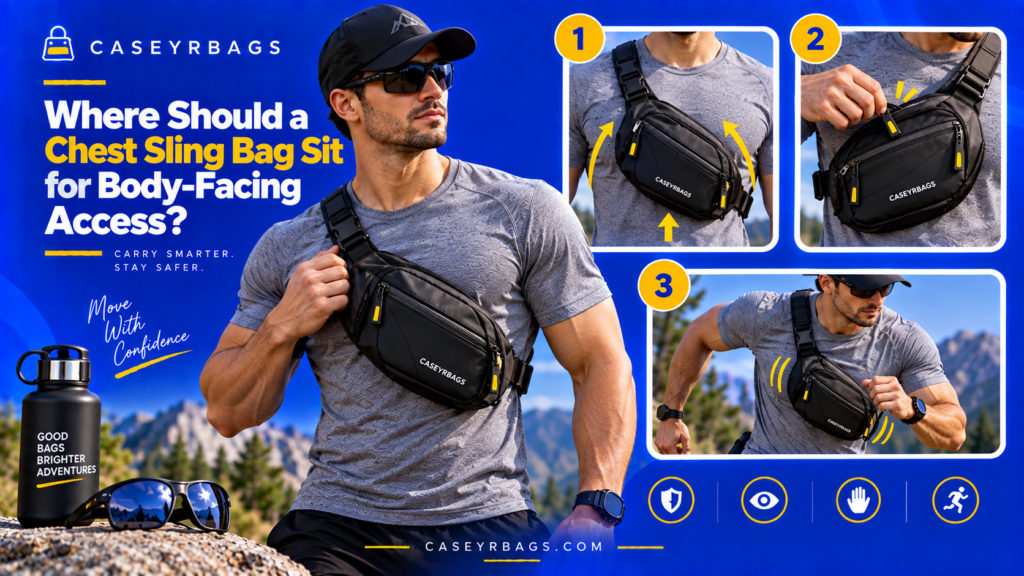
Where Should a Chest Sling Bag Sit for Body-Facing Access? A Chest Sling Bag should sit in a front or front-side torso position where the bag remains close to the body and its main opening falls within a natural reach path. The exact height and lateral position depend on strap geometry, bag dimensions, opening orientation, body shape, and whether access is intended directly from the chest or after a small controlled rotation during routine use. The useful position is not simply the highest, tightest, or most centered position. Body-facing access works best when the loaded bag stays predictably oriented during normal movement, can be opened without excessive twisting or strap adjustment, and can return naturally to its intended resting position after retrieval without repeated manual repositioning. The final test is therefore the loaded bag in real worn use, not its empty appearance. Fit note: Chest Sling Bag designs, strap systems, body dimensions, clothing, load shape, and opening layouts vary. No single chest height or exact anatomical position provides the best body-facing access for every user or bag. Key Takeaway A useful Chest Sling position is defined by loaded function: stable torso contact, a natural hand path, workable opening orientation, and easy return to the resting position. Higher, tighter, or perfectly centered is not automatically better. Body-Facing Access Signals HEIGHTOpening sits within natural vertical reach. LATERAL POSITIONCenter or front-side remains intentional. TORSO CONTACTBag stays predictable without over-compression. OPENING PATHZipper and hand movement align while worn. What Does Body-Facing Access Mean in a Chest Sling Bag? Body-facing access means that the Sling Bag rests against the front or front-side of the torso and remains accessible while it is still being worn. The wearer should not need to remove the bag completely to reach its intended main or routine-access compartment, and the access point should remain identifiable from the normal carry position. The bag does not need to sit motionless or exactly at the center of the chest. A useful body-facing position allows controlled movement while preserving a predictable relationship between the wearer, the bag body, and the opening, so normal access does not depend on repeatedly correcting the bag’s position. Access quality therefore depends on position, body contact, opening orientation, and hand path rather than on one exact chest location. Height and lateral placement are useful only when they support the complete worn-access relationship within the broader Sling Bag system. Which position factors most directly affect body-facing access? Chest height, lateral position, torso contact, bag angle, strap length, opening direction, and loaded depth work together to define body-facing access. A change in one variable can shorten or lengthen the hand path, alter the opening angle, or move the load farther from the torso. This changes the relationship between the bag body, torso contact, and the intended opening, so access should be judged from the worn position rather than from appearance alone. No single factor should be treated as the complete answer; the useful position is the combination that keeps reach, contact, and opening behavior predictable. Why does body-facing not mean chest-center only? Body-facing access is defined by the bag’s relationship to the front torso, not by exact symmetry at the centerline. A front-side position can still maintain strong torso contact, a short reach path, and a usable opening when strap route, dominant hand, and bag geometry support it. This changes the relationship between the bag body, torso contact, and the intended opening, so access should be judged from the worn position rather than from appearance alone. Centered placement is one possible solution, but forcing symmetry can worsen access when the opening or strap architecture works better slightly off center. What defines a functional body-facing position? A functional position keeps the loaded bag close and predictable while the intended opening remains reachable and controllable from the worn position. The wearer should be able to identify the opening, operate it, reclose it, and restore the bag without major twisting or repeated strap correction. This changes the relationship between the bag body, torso contact, and the intended opening, so access should be judged from the worn position rather than from appearance alone. Function rather than symmetry defines the useful position, and normal movement should not repeatedly push the bag out of that workable relationship. Chest Sling Bag Body-Facing Access Anatomy SVG Chest Sling Bag Body-Facing Access Anatomy SVGFront torso anatomy showing strap, anchors, chest and front-side carry zones, body-facing panel, main opening, zipper path, and hand reach.Chest Sling Body-Facing Access AnatomyPosition → Orientation → Reach → AccessMAIN OPENINGNATURAL HAND PATHCHEST CARRY ZONEfront + front-sideCONTROL POINTSUpper anchorLower anchorPrimary strapBody-facing position = close torso contact + usable opening + direct reachFigure 1.0:Body-facing Chest Sling anatomy and reach path.CASEYRBAGS.COM • Chest Sling body-facing access How Does Chest Height Affect Body-Facing Access? Chest height changes vertical reach, opening clearance, and how much movement the bag has before the wearer begins access. What happens when the bag sits relatively high? A relatively high position can shorten vertical reach and increase body contact, keeping the opening close to the upper torso. That can improve visibility and positional control, but excessive height can crowd the opening, narrow the hand angle, and place the bag in the normal arm path. This changes the relationship between the bag body, torso contact, and the intended opening, so access should be judged from the worn position rather than from appearance alone. Higher placement is therefore useful only when the opening remains easy to operate; height that forces downward correction before every retrieval is too restrictive. What happens when the bag sits relatively low? A lower position can make downward reach feel direct and can provide more room for small rotational movement during access. As the strap lengthens, however, the bag may gain more swing, lateral drift, and separation from the chest, making the opening less predictable before the hand reaches it. This changes the relationship between the bag body, torso contact, and the intended opening, so access should be judged from the worn position rather
How Does Chest Sling Bag Positioning Affect Security?
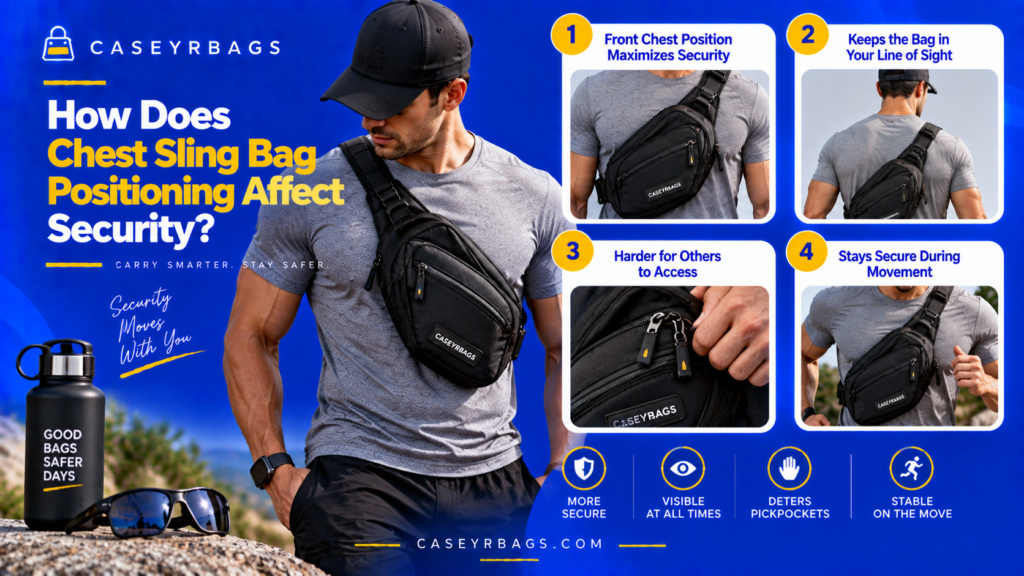
How Does Chest Sling Bag Positioning Affect Security? Chest Sling Bag positioning affects security by changing how visible, reachable, and controllable the bag remains to the wearer. A close front-of-torso position can keep the bag within normal forward awareness while reducing uncontrolled movement that could change opening direction, pocket exposure, or the location of the main closure during ordinary movement. Position alone does not secure the contents. Useful position-based access security also depends on bag height, body-facing contact, opening orientation, closure design, strap adjustment, pocket direction, rotational movement, and whether the loaded shape allows every closure to remain properly engaged. The practical goal is predictable wearer monitoring and a repeatable closed state rather than treating front carry as theft-proofing. Educational disclaimer: Chest Sling Bag designs, strap systems, closures, body fit, clothing, and carrying environments vary. Chest positioning can improve monitoring and access control, but it does not make a Sling Bag theft-proof or guarantee protection from unauthorized access. KEY TAKEAWAY Chest positioning supports security when the loaded bag stays within practical awareness, preserves predictable body-facing orientation, and keeps openings, closures, and pockets controllable. Position improves access control only when strap retention, opening direction, closure state, and loading remain coordinated. Chest Sling Position-Security Signal Key POSITION SIGNALChest height, lateral offset, body proximity, and rotation determine where the bag actually rests. OPENING SIGNALMain-opening direction and zipper-pull location determine how easily closure state can be monitored. RETENTION SIGNALStrap adjustment, closures, pockets, and loaded shape preserve the intended closed state. BOUNDARY SIGNALVisibility and chest carry support awareness; neither creates theft-proof or guaranteed security. What Does Security Mean in Chest Sling Bag Positioning? A Chest Sling Bag places the bag on or across the front of the torso rather than leaving it primarily behind the wearer. This usually places the bag within a more observable and immediately reachable area, so changes in position, rotation, and opening direction are easier for the wearer to notice during normal movement. That visibility can improve awareness of the bag’s position, openings, and closures. However, security depends on whether the bag stays predictably oriented, remains close enough for practical monitoring, and allows the wearer to maintain deliberate control over its access points as the strap, load, and body position change. Position-based security should therefore be evaluated through visibility, body contact, opening exposure, closure control, and item retention rather than through chest position alone. The position supports access control only when those elements continue working together in the loaded bag within the broader Sling Bag system. Which positioning factors most directly affect security? Chest height, body proximity, lateral position, opening orientation, closure exposure, strap stability, and pocket direction are the main positioning variables because each changes what the wearer can see, reach, and verify. A shift in any one of them can alter the geometry of the bag’s access points even when the bag still looks front-carried. Position feature → access effect → security consequence is the useful reading order. The bag should remain predictably oriented, and its important openings should stay within practical wearer control rather than becoming harder to observe because the strap, load, or body position has changed. Why can chest positioning improve wearer awareness? Front-of-torso placement can keep the bag inside the wearer’s normal visual and physical awareness, making changes in bag height, orientation, zipper-pull location, or closure state easier to notice than when the bag sits primarily behind the body. This supports quicker recognition of unintended movement or an incomplete return to the closed state. Awareness is a monitoring advantage, not a guarantee of protection. A visible bag can still have an outward-facing opening, an exposed pocket, or a partially engaged closure, so chest positioning should be judged by whether it makes those states easier for the wearer to verify and correct. Why does front positioning not guarantee security? Front positioning can coexist with exposed openings, loose strap adjustment, outward-facing pockets, incomplete closure, or an overfilled compartment. These conditions can reduce access control even though the bag remains visibly located on the chest, because the actual opening geometry and closure state may still be poorly controlled. Visible carry improves awareness; it does not eliminate access risk. The practical question is whether the loaded bag preserves a predictable closed state and whether the wearer can readily recognize when position, rotation, or loading has changed that state. Chest Sling Bag Security Anatomy SVG Chest Sling Bag Security Anatomy SVGA chest-position anatomy diagram showing strap, anchors, body-facing panel, main opening, zipper pull, quick-access pocket, outer panel and load center. Chest Sling Bag Security AnatomyPosition, orientation, closure control, and retention work together. MAIN OPENING + ZIPPER PULLLOAD BODY-FACING PANELpreserves predictable plane ACCESS POINTSmain opening + pocketclosure state must remain clear Position → Visibility → Opening Control → Item Retention Figure 1.0:Chest-position anatomy for monitoring openings and closures.CASEYRBAGS.COM • Chest Sling position-security How Does Chest Position Improve Bag Visibility? Keeping the Sling Bag within the wearer’s forward field of awareness can make bag position, closure state, and unexpected movement easier to monitor, but visibility only supports access control when the openings themselves remain well managed. How does front carry make bag position easier to monitor? Front-of-torso placement keeps the bag within an area the wearer can more readily see, touch, and compare against its intended resting position. Changes in chest height, lateral offset, rotation, or body contact can therefore become more noticeable during ordinary movement and repeated access. The benefit is practical awareness rather than automatic security. A bag can remain visible while still shifting, opening, or presenting an exposed pocket, so the useful test is whether front carry helps the wearer recognize and restore the intended position and closure state. How does visibility help the wearer monitor openings? When the main opening, zipper pull, or closure hardware remains within easier view, the wearer can check whether the access point has returned to its intended closed position. Bag orientation also becomes easier to notice, so an unexpected rotation or a zipper that has not been fully returned is less likely