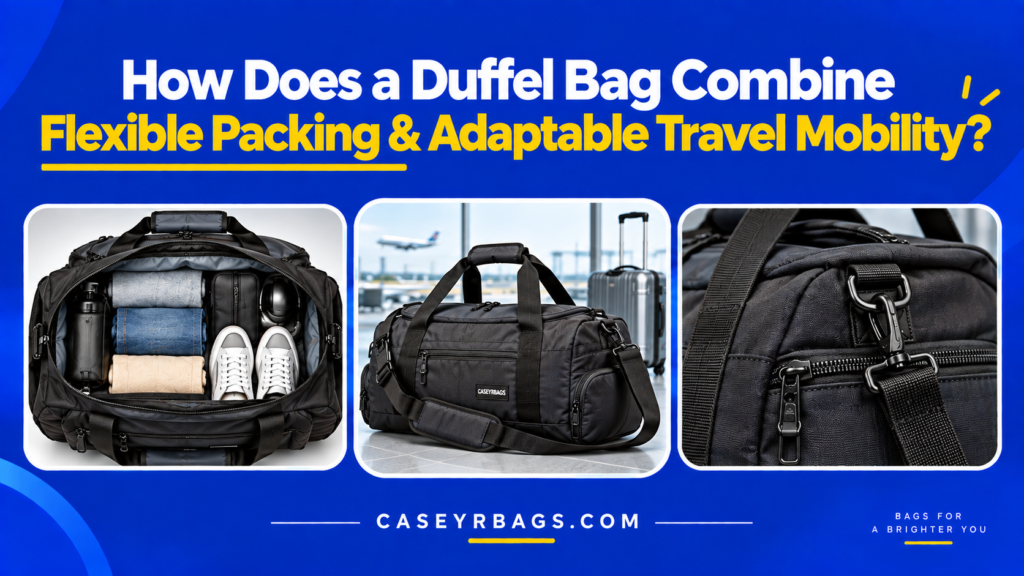
How Does a Duffel Bag Combine Flexible Packing & Adaptable Travel Mobility?
A Duffel Bag combines flexible packing and adaptable travel mobility through a soft or semi-structured main cavity that can conform around different contents while carry handles, a shoulder strap, or an optional rolling system provide more than one way to move the packed load. Its structure adapts both to what is packed and to how the bag travels.
That adaptability depends on control rather than softness alone. The opening must remain usable, the packed shape must stay manageable, and the carry system must match the travel stage. Flexible structure ≠ unlimited capacity, packing adaptability ≠ guaranteed organization, and multiple carry options ≠ equal usefulness in every travel context.
What Do Flexible Packing & Adaptable Mobility Mean in a Duffel Bag?
Flexible packing describes the Duffel Bag’s ability to let its main cavity conform around different item shapes instead of forcing every load into a fixed shell geometry. The degree of conformity depends on panel structure, base stiffness, fill level, and the shape and density of the contents.
Adaptable travel mobility describes the Duffel’s ability to move through different travel stages using handles, shoulder carry, or secondary systems such as wheels where present. These methods do not behave identically, but they can let the same bag transition between lifting, carrying, storing, and rolling.
The defining relationship is therefore not softness or mobility hardware alone. Within Everyday Carry, a useful Duffel must keep flexible packing and travel movement connected so the load remains accessible, sufficiently stable, and practical to move after the external bag shape changes around the contents.
What Makes Duffel Packing Structurally Flexible?
Soft or semi-structured panels, adaptable sidewalls, a large main cavity, and limited fixed internal geometry allow a Duffel to change shape around the packed contents. Instead of forcing irregular items into a rigid shell, the body can conform within the limits of the panel, base, seams, and closure system.
Flexible body → adaptable cavity shape. This flexibility is useful only while the packed load remains controllable. The sidewalls can conform, but they should not be treated as unlimited expansion because excessive fill can distort the opening, change balance, or place unnecessary strain on the closure and carry system.
What Makes Duffel Travel Mobility Adaptable?
Duffel travel mobility becomes adaptable when the bag can be lifted by paired handles, carried by a shoulder strap where present, or moved through a secondary system such as wheels on suitable surfaces. Each method solves a different movement task and changes how the packed load is positioned or controlled.
Multiple mobility methods ≠ identical travel performance. Handles provide direct lifting control, shoulder carry can free the hands, and wheels can reduce continuous lifting on smooth surfaces. The useful method depends on packed shape, travel distance, stairs, storage transitions, and the travel surface.
Why Must Packing Flexibility and Mobility Be Evaluated Together?
Packing changes the Duffel’s external geometry, load center, balance, handle demand, strap behavior, and rolling stability. A bag that looks manageable when empty can move differently after dense items create one-sided bulging or the cavity is filled enough to change the base and sidewall shape.
Packed shape influences how the Duffel moves. Within Everyday Carry, flexible packing is valuable only when the final load can still be lifted, carried, stored, or rolled predictably. Packing and mobility therefore need to be judged as one system rather than as independent features.
How Does Soft-Sided Construction Support Flexible Duffel Packing?
Soft-Sided Duffel construction changes packing by letting the cavity respond to irregular item geometry while reducing the fixed shape control that a rigid shell provides.
How Do Flexible Panels Conform Around Irregular Contents?
Flexible panels can bend and shift around irregular contents instead of forcing every object to match a predetermined internal wall. As a bulky or uneven item presses against the sidewall, the bag can change its external shape and use available cavity space more adaptively.
Irregular item shape → sidewall conformity → adapted external bag shape. The benefit is not unlimited expansion. Panel movement remains constrained by seams, base geometry, zipper path, and surrounding contents, so overfilling can turn useful conformity into uncontrolled bulging.
How Does a Soft Main Cavity Use Available Packing Space?
A soft main cavity uses available space through fewer rigid internal boundaries and a fill pattern that can change with the item mix. Contents can occupy slightly different positions as the sidewalls and top structure conform around the load instead of preserving one fixed internal box.
Usable packing flexibility depends on the actual load shape. Softness can help with mixed or irregular contents, but it does not organize the cavity by itself. Dense items, loose objects, and fill level still determine whether the final shape remains controlled and accessible.
When Does Soft-Sided Flexibility Reduce Packing Control?
Soft-Sided Duffel flexibility reduces control when the cavity develops excessive one-sided bulging, unstable load shift, closure strain, or a packed shape that changes unpredictably during handling. The problem is not softness itself but loss of a manageable relationship between the contents and the bag body.
Useful flexibility becomes a mismatch when load control deteriorates. If the opening distorts, the base sags excessively, or the load moves enough to alter carrying behavior, the contents should be redistributed or reduced before relying on more compression or strap compensation.
| Factor | Softer Duffel Structure | More Structured Duffel |
|---|---|---|
| Shape conformity | Greater | Lower |
| Shape retention | Lower | Greater |
| Irregular-item fit | Potentially easier | More geometry-dependent |
| Load stabilization | Packing-dependent | Structure can assist |
| External shape | Changes more with contents | Changes less |
How Does Duffel Opening Geometry Improve Packing Access?
Duffel opening geometry affects how easily bulky or irregular contents can enter the cavity and how much access remains after the bag is fully packed.
How Does a Wide Opening Change the Loading Path?
A wider or longer opening increases the loading path into the main cavity and reduces the need to angle bulky items through a narrow entry point. This can make placement easier because more of the interior becomes visible and reachable during loading.
Larger opening path → fewer access obstructions → easier placement of bulky or irregular contents. The opening still depends on zipper path, sidewall tension, and fill level, so a wide opening when empty does not guarantee the same access after the Duffel is full.
Why Does Opening Shape Matter After the Duffel Is Packed?
Packed contents can press against the upper sidewalls, alter zipper alignment, and reduce the free space around the opening. A dense item positioned near the top can create an obstruction even when the opening itself is large and well designed.
Large opening ≠ permanently unobstructed access. Packing access should be evaluated after the load is in place, because the final external shape determines whether the closure path remains aligned and whether the user can still retrieve contents without disturbing most of the cavity.
When Can Flexible Packing Interfere With Opening Access?
Overfilling, upward bulging, misplaced dense items, and closure distortion can reduce the effective opening even in a flexible Duffel. The soft body can conform around the contents so strongly that the top panels are pulled inward or the zipper path is placed under unnecessary tension.
The correction is structural rather than cosmetic: reduce or reposition the contents until the opening and closure work without excessive strain. Flexible packing is useful only while the bag can still be opened, loaded, closed, and retrieved from predictably.
How Does a Duffel Bag Control Load Shape After Packing?
The final packed geometry comes from the interaction among item shape, fill level, base stiffness, panel flexibility, compartment use, and where dense items sit inside the main cavity.
What Determines the Duffel’s Packed External Shape?
Fill level, item geometry, base stiffness, panel flexibility, and compartment use determine the final Duffel shape. A lightly filled soft bag can collapse around its contents, while a fuller load can create a more defined outline through outward panel pressure.
The objective is not to preserve one perfect shape but to keep the result controllable. A flexible Duffel can change geometry while remaining functional, provided the opening, base, handles, shoulder strap, and any wheel-supported structure continue to work predictably with that shape.
How Do Dense Items Influence Duffel Shape?
Dense items create localized structural demand where they contact the base, sidewalls, dividers, or nearby contents. If positioned strongly to one side, they can produce asymmetric bulging, lower one side of the bag, or pull the packed load away from the centerline.
Dense item position → localized structural demand → shape and balance change. The item does not need to sit in one universal position, but it should not create enough offset to make the Duffel difficult to lift, carry, or roll predictably.
When Does Packed-Shape Flexibility Become Excessive?
Packed-shape flexibility becomes excessive when one-sided bulging persists, the base sags uncontrollably, the load shifts during movement, the opening becomes distorted, or carry control deteriorates. These signals show that the cavity is adapting beyond the point where shape change remains useful.
At that point, redistribution or load reduction is more appropriate than assuming the soft body should keep accommodating more contents. Flexible structure should preserve travel usefulness, not force the handles, strap, closure, or wheel system to compensate for an unstable load.
| Packing Condition | Shape Response | Mobility Effect |
|---|---|---|
| Balanced moderate fill | More predictable geometry | Easier handling |
| Dense load on one side | Asymmetric shape | Uneven carry behavior |
| Overfilled cavity | Outward bulging | Reduced access/control |
| Loose underfilled contents | Internal movement | Changing balance |
| Controlled flexible load | Adaptive shape | Useful travel flexibility |
How Do Duffel Bag Carry Handles Support Travel Mobility?
Paired carry handles provide direct control for lifting, short-distance carrying, surface-to-surface transfer, and repositioning during travel transitions.
What Role Do Paired Carry Handles Play?
Paired handles give the user direct control over the packed Duffel during lifting, short-distance carrying, repositioning, and transfer between surfaces. Because both handles act near the bag body, they provide a simple way to control the load without relying on secondary mobility hardware.
Carry handles → direct lifting control → short-distance movement. Their usefulness depends on the packed load and distance. A method that works well for lifting the bag into a vehicle may be less suitable for a longer walk through a terminal.
Why Do Handle Placement and Anchors Matter?
Handle placement and anchors define the load path from the packed cavity into the user’s grip. As the Duffel is lifted, the bag load transfers through the surrounding panels and handle anchors before reaching the carry handles.
Packed load → handle anchors → handles → carried load path. Strong-looking handles do not establish a universal load rating because surrounding seams, panels, and anchor reinforcement still determine how the complete connection responds to the actual packed bag.
When Do Handles Become a Limited Mobility Method?
Handles become a limited mobility method when the walking distance increases, the packed load becomes more demanding, both hands are needed, or repeated transitions make constant hand carry inconvenient. Direct grip provides control but also keeps the hands occupied.
Direct hand control does not make hand carry ideal for every distance. A shoulder strap or rolling system can become more useful when the travel task changes, but those alternatives also introduce different bag positions, movement patterns, and structural demands.
How Does a Shoulder Strap Change Duffel Bag Mobility?
A shoulder strap adds an alternate carry mode that can free the hands and change the Duffel’s position during movement compared with paired handle carry.
What Does a Shoulder Strap Add Beyond Carry Handles?
A shoulder strap adds hands-free potential, another bag position, and a carry method that may be more practical for some longer transfers. Instead of holding the Duffel directly below the hands, the strap suspends the packed bag from two attachment points across one shoulder-side carry path.
Shoulder strap → alternate carry mode → hands-free mobility potential. This does not mean the strap is automatically better for heavier loads or long distances. Its value depends on packed shape, strap geometry, attachment position, and how stable the load remains while moving.
How Does Shoulder-Strap Attachment Affect Duffel Control?
Attachment points influence bag tilt, suspension angle, and how the packed shape behaves when the Duffel hangs from the strap. An off-center or shifting load can make one end drop lower, increase swing, or change how the bag responds during direction changes.
The shoulder strap and packed shape therefore interact directly. A stable load gives the strap a more predictable bag to control, while an asymmetric load can make the strap compensate for internal imbalance instead of simply supporting an alternate carry method.
When Does Shoulder Carry Become a Poor Match?
Shoulder carry becomes a poor match when the packed load is unstable, the bag swings excessively, the strap geometry does not control the Duffel well, or the travel task repeatedly requires lifting and repositioning that the strap does not simplify.
No universal safe shoulder-carry weight applies to every Duffel. The relevant test is whether the strap adds useful mobility while the bag remains stable and controllable. If the strap requires extreme compensation or constant repositioning, another mobility method may fit the travel stage better.
How Do Secondary Carry Systems Expand Duffel Travel Mobility?
Rolling Mobility and other secondary systems change how the same packed Duffel moves through travel environments by reducing the need for continuous lifting on suitable surfaces.
How Does Rolling Mobility Change Duffel Travel Use?
Rolling Mobility uses a wheel-supported base to move part of the travel task from continuous lifting to surface-supported movement. On smooth floors, the Duffel can roll between transfer points instead of being carried entirely by the handles or shoulder strap.
Wheel-supported base → less continuous lifting on suitable surfaces → different travel movement. Rolling remains surface-dependent, so stairs, rough ground, tight turns, and storage transitions can still require lifting or direct bag control.
What Structural Changes Accompany a Rolling Duffel Bag?
A Rolling Duffel Bag usually adds wheel housing, a reinforced lower area, a pull handle, and more fixed structure around the base or rear side. These components alter the bag geometry and reduce some of the softness that defines a simpler non-wheeled Duffel.
Added mobility hardware reduces some flexibility while adding another movement method. The bag may gain better rolling stability on suitable surfaces, but wheel structure and handles also consume space, add hardware, and change how the Duffel stores or flexes.
When Is Secondary Mobility Less Useful?
Secondary rolling mobility becomes less useful on stairs, rough surfaces, tight storage areas, or travel patterns that involve frequent lifting. In those situations, the added wheel and pull-handle structure may provide little practical benefit during the parts of the trip that dominate movement.
Wheels ≠ useful on every travel surface. The benefit should be judged by how often surface-supported movement actually replaces carrying, not by the presence of rolling hardware alone. A mobility feature is valuable when it solves a repeated travel transition.
How Does Packing Shape Affect Duffel Bag Travel Mobility?
The internal packing pattern directly influences how the Duffel behaves during hand carry, shoulder carry, and rolling because packed geometry changes balance and external shape.
Why Does Centered Packing Support More Predictable Movement?
A more centered load creates a more controlled external geometry and reduces the chance that one side of the Duffel pulls, bulges, or settles differently from the other. The handles and strap then act on a packed shape that is easier to predict.
More centered load → more controlled external geometry → more predictable handling. Perfect symmetry is not required, but dense or heavy items should not create a strong offset that makes the carry system compensate for the packing pattern.
How Does Uneven Packing Affect Hand or Shoulder Carry?
Uneven packing can create bag tilt, one-sided pull, extra swing, and different demand at the carry handles or shoulder-strap attachments. The softer the sidewalls, the more visibly the external geometry may reflect the internal imbalance.
The correction begins inside the Duffel. Tightening a shoulder strap or gripping the handles differently can change bag position, but it cannot remove a dense item that continues to pull the packed load away from the center.
How Does Packed Shape Affect Rolling Duffel Behavior?
Packed shape affects rolling through base stability, external bulging, load position relative to the wheel-supported zone, and the total geometry of the bag. A load that shifts strongly away from the wheel base can make direction changes or upright control less predictable.
Rolling performance therefore depends on both hardware and packing. A wheel system can support movement, but it cannot fully compensate for an unstable or strongly asymmetric internal load. The packed Duffel still needs enough shape control for the rolling structure to work as intended.
| Packed Shape | Hand Carry | Shoulder Carry | Rolling |
|---|---|---|---|
| Balanced | More predictable | More predictable | More stable |
| One-sided dense load | Uneven | Greater tilt | Possible tracking imbalance |
| Excessive bulging | More awkward | More movement | Added external bulk |
| Controlled flexible shape | Adaptable | Manageable | Depends on rolling structure |
How Does a Duffel Bag Adapt Across Travel Transitions?
Duffel travel adaptability appears most clearly when the bag moves between lifting, carrying, storing, and rolling rather than staying in one mobility mode for the entire trip. Overhead Packing is one narrower example of how controlled flexibility can matter during constrained storage transitions.
Why Are Travel Transitions Important to Duffel Mobility?
Travel transitions include vehicle loading, stairs, terminals, short walks, storage placement, lifting onto surfaces, and moving between carried and rolled movement. Each stage places a different demand on the packed shape and carry system.
A Duffel that rolls well in a terminal may still need strong handle control on stairs or during vehicle transfer. Adaptable mobility therefore means changing methods when the travel stage changes, not expecting one method to solve every movement task.
How Does Flexible Structure Help During Storage Transitions?
Controlled flexibility can help the Duffel conform better to available storage geometry because the sidewalls can adapt slightly around the packed contents instead of preserving a fixed shell outline. This can make the bag easier to position in irregular storage spaces.
Compressibility ≠ guaranteed fit. For Overhead Packing, the actual external dimensions still depend on contents, fill level, base structure, and closure shape, so flexible construction should never be treated as a promise of fit in a specific carrier compartment.
When Can Flexibility Make Transitions Harder?
Flexibility makes transitions harder when the packed shape is unstable, the base sags excessively, lifting becomes difficult because the contents shift, or the bag lacks enough structure to stay controlled while being moved between surfaces.
Flexible packing remains useful only while the packed load stays controllable. If the bag changes shape every time it is lifted, stored, or rolled, the travel transition becomes less predictable even though the cavity is technically adaptable.
| Travel Stage | Main Mobility Demand | Duffel Feature |
|---|---|---|
| Vehicle transfer | Lift & position | Handles |
| Short walk | Carry | Handles / shoulder strap |
| Terminal movement | Carry or roll | Strap / rolling system |
| Stairs | Lift/control | Handles |
| Storage placement | Shape adaptability | Flexible body |
| Retrieval | Opening access | Main opening |
When Is Duffel Bag Flexibility More Useful Than Rigid Structure?
Flexible construction is most useful when cavity conformity and changing item shapes matter more than preserving one fixed external geometry throughout the trip. The Rolling vs Suitcase comparison becomes relevant when wheel-supported Duffel flexibility is weighed against a more rigid luggage format.
Which Loads Benefit From Flexible Cavity Shape?
Irregularly shaped soft goods, changing item mixes, and loads that do not require a fixed shell geometry can benefit from a flexible cavity. The Duffel can adapt around different combinations without demanding that every item fit within a rigid internal outline.
This does not mean soft structure always packs better. The benefit depends on whether the cavity can change shape without losing access, closure alignment, load stability, or manageable external geometry. Flexibility is valuable when adaptation remains controlled.
When Does More Rigid Structure Offer Better Control?
More rigid structure can offer better control when shape retention matters, contents need stronger geometric separation, or a rolling system depends on a stable lower structure. The bag may preserve a clearer outline and resist deformation more strongly as the load changes.
Rigid shape ≠ automatically better load control. Stiff construction can still be poorly organized or unevenly loaded. The relevant trade-off is conformity versus shape retention, not a universal claim that one travel format is superior.
Why Is Format Choice Context-Dependent?
Flexible Duffel usefulness depends on the relationship between contents, opening access, storage geometry, carry distance, travel surface, and mobility method. The same bag can be highly adaptable for one travel pattern and unnecessarily soft or complex for another.
Format choice should therefore follow the repeated travel task. The Rolling vs Suitcase trade-off becomes relevant when flexible rolling travel is compared with more rigid wheeled luggage.
How Can Duffel Packing & Mobility Be Evaluated Together?
A whole-bag evaluation should test the Duffel before and after packing, then observe how the final shape behaves through the primary and secondary mobility methods. A Backpack Bag uses a contrasting carry architecture and should be evaluated separately.
What Should Be Checked Before the Duffel Is Packed?
Before packing, inspect the main cavity, opening, closure path, carry handles, handle anchors, shoulder strap where present, base structure, and rolling system where present. This establishes the starting geometry before the contents begin changing the bag shape.
The empty bag cannot prove final travel fit, but it can reveal damaged hardware, distorted openings, unstable wheels, or compromised carry connections that would make a loaded evaluation unreliable. The normal contents should then be added without treating maximum cavity fill as the objective.
What Should Be Checked After Packing?
After packing, observe external shape, opening clearance, closure alignment, load movement, left-right balance, handle control, shoulder-strap behavior, and rolling behavior where applicable. The load should remain predictable enough that the carry systems do not need to compensate for uncontrolled packing.
Compare the packed result with the intended travel stages. A shape that works for storage but becomes unstable during carrying, or a rolling setup that blocks access, indicates that packing and mobility are no longer compatible enough for the intended use.
Which Sequence Should Determine Duffel Packing & Mobility Fit?
- Identify normal contents.
- Check the unloaded Duffel structure.
- Pack the intended load.
- Check packed external shape.
- Check opening and closure.
- Check load movement.
- Lift using the primary handles.
- Test the shoulder strap where present.
- Test rolling mobility where present.
- Observe normal travel transitions.
- Reduce or redistribute the load if control deteriorates.
Use the sequence in that order so the evaluation begins with the actual travel load rather than one mobility feature. Check the bag empty, pack the intended contents, and verify shape, opening, closure, and internal movement before judging handles, shoulder carry, or wheels.
Then move the loaded Duffel through the normal transitions it is expected to encounter. If control deteriorates during lifting, shoulder carry, rolling, or storage, redistribute or reduce the contents before relying on another carry method to hide the packing mismatch. A Backpack Bag uses a contrasting carry architecture and should be evaluated separately.
How Can Duffel Bag Packing & Mobility Mismatches Be Avoided?
Duffel mismatches are avoided by keeping packing freedom, packed-shape control, opening access, and mobility method aligned instead of treating flexibility as unlimited capacity.
Why Is Maximum Cavity Fill a Weak Packing Goal?
Maximum cavity fill is a weak goal because filling every available space can reduce closure control, block access, increase outward bulging, and change the way the Duffel behaves during lifting or carrying. A flexible cavity can accept more shape variation without making every degree of fill useful.
Maximum fill ≠ optimal Duffel packing. The better objective is a packed load that uses the cavity efficiently while leaving the opening, closure, base, and carry system able to function predictably. Extra capacity has little value if it makes the bag difficult to move.
Why Should Mobility Method Match the Packed Load?
Handles, a shoulder strap, and a rolling system solve different movement tasks. A compact stable load may be easy to carry by hand, while a larger travel pattern may benefit from shoulder or wheel-supported mobility when those systems remain compatible with the packed shape.
Available carry method ≠ appropriate carry method for every load. The correct method is the one that keeps the Duffel controllable through the real distance, surface, lifting requirement, and storage transitions rather than the one with the most hardware.
What Should Be Verified Before Relying on a Duffel Bag for Travel?
Verify that the cavity matches the normal contents, flexible panels are not excessively distorted, the opening remains usable, the closure aligns without excessive strain, dense items do not create major one-sided loading, and the packed shape remains manageable. Handles and anchors should remain functional under the intended load.
Also confirm that any shoulder strap adds useful mobility without extreme compensation, rolling hardware remains stable where present, the expected surfaces actually support wheel use, and compressibility is not being treated as guaranteed overhead-bin compliance. Packing and mobility should still work together after the Duffel is fully loaded.
- Normal contents are identified.
- Duffel cavity matches the item shapes.
- Flexible panels are not excessively distorted.
- Main opening remains usable.
- Closure aligns without excessive strain.
- Dense items do not create major one-sided loading.
- Packed shape remains controllable.
- Base sag remains manageable.
- Carry handles remain functional.
- Handle anchors show no visible structural problem.
- Shoulder strap is useful for the intended movement where present.
- Strap carry does not require extreme compensation.
- Rolling hardware remains stable where present.
- Wheel-supported movement is useful for the intended travel surfaces.
- Flexible packing does not block retrieval.
- External shape matches the intended storage context.
- Flexibility is not being treated as unlimited capacity.
- Compressibility is not being treated as guaranteed overhead-bin compliance.
- Packing and mobility remain compatible after the bag is fully loaded.
Conclusion
A Duffel Bag combines flexible packing and adaptable travel mobility by allowing its main cavity and external shape to respond to the contents while handles, a shoulder strap, or an optional rolling system provide different ways to move that packed load. The format works best when opening access, packed-shape control, and the chosen mobility method remain compatible through real travel transitions.
Soft structure does not create unlimited capacity, multiple carry methods are not equally useful in every context, and rolling hardware does not replace stable packing. A Duffel remains a strong travel fit when its flexibility stays controlled and its carry or rolling system matches the actual load, surface, storage space, and movement pattern.
FAQs
Soft-sided construction can conform around changing or irregular contents more easily than a rigid shell, giving the main cavity greater packing flexibility.
That flexibility can also reduce shape control when the cavity is overfilled or poorly organized. Easier conformity does not automatically mean better packing.
No. A shoulder strap provides an alternate carry mode and can free the hands, but it is not mandatory for every Duffel use.
Handles, packed load, travel distance, and secondary mobility systems determine whether shoulder carry adds practical value for the intended movement.
Not universally. Rolling Duffels and rolling suitcases solve different structural and travel needs through different balances of flexibility, shape retention, and mobility hardware.
Flexible packing, rigid protection, handling, storage geometry, and the expected travel surface determine which format is the stronger fit.